


Baseband Processor Market Size 2024-2028
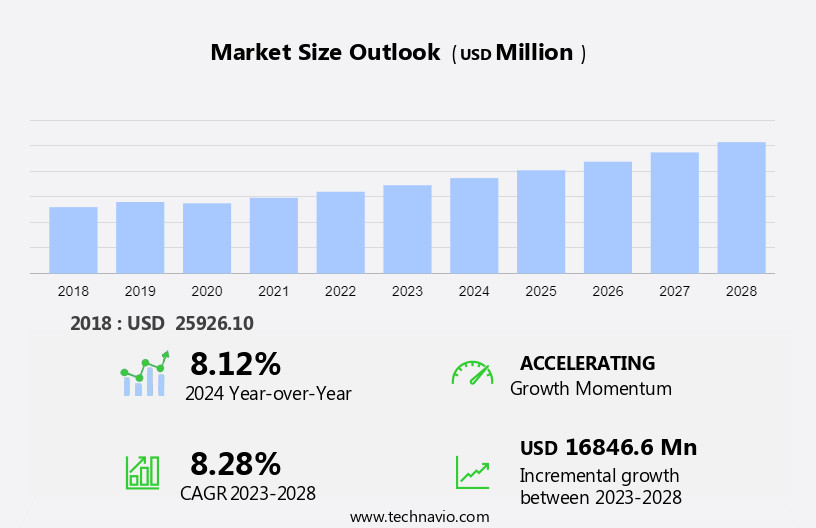
The baseband processor market size is forecast to increase by USD 16.85 billion at a CAGR of 8.28% between 2023 and 2028.
- The market is experiencing significant growth due to the increasing proliferation of smartphones, tablets, wearables, and Internet of Things (IoT) devices. This trend is driven by the continuous advancements in baseband processor technology, enabling faster data processing and more efficient wireless communication. Moreover, the increasing complexity of wireless communication standards necessitates the use of more powerful baseband processors to support multiple frequency bands and advanced features. As a result, the market for baseband processors is expected to grow steadily In the coming years. Additionally, the increasing adoption of 5G technology and the development of autonomous vehicles are expected to provide further opportunities for market growth. Overall, the market is a dynamic and innovative space, driven by technological advancements and the growing demand for connected devices.
What will be the Size of the Baseband Processor Market During the Forecast Period?
- The market encompasses the production and sale of processors that manage digital signal transmission, channel access, error correction, encoding, decoding, modulation, and demodulation for various communication devices. These processors are integral to wireless technologies, including Wi-Fi and cellular networks, in mobile devices, cell towers, and IoT applications. With the proliferation of Wi-Fi, cellular networks, and Bluetooth, the market has experienced significant growth, driven by the increasing demand for high-performance, power-efficient processors. Single-core and multi-core processors cater to diverse requirements, from mobile gaming and payments to AI-powered functionalities in industries such as manufacturing, transportation, healthcare, and smart homes. The advent of 5G networks and the expanding IoT ecosystem further fuel market expansion, with applications ranging from wearable devices and healthcare facilities to IOT sensors and smart home appliances.
How is this Baseband Processor Industry segmented and which is the largest segment?
The baseband processor industry research report provides comprehensive data (region-wise segment analysis), with forecasts and estimates in "USD billion" for the period 2024-2028, as well as historical data from 2018-2022 for the following segments.
- Type
- 4G
- 5G
- Others
- Application
- Smartphone
- Tablets
- Geography
- APAC
- China
- India
- North America
- US
- Europe
- Germany
- UK
- Middle East and Africa
- South America
- APAC
By Type Insights
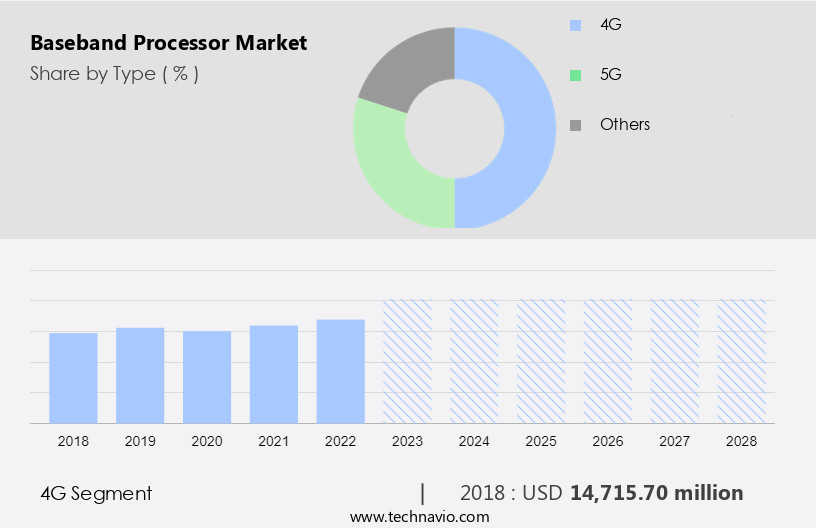
- The 4G segment is estimated to witness significant growth during the forecast period.
In the market, 4G networks remain a key driver for high-speed wireless connectivity in various devices, such as smartphones, tablets, IoT devices, and automotive systems. Baseband processors, which are essential components of 4G networks, optimize signal processing and modulation techniques to enhance spectral efficiency and network performance. These processors facilitate seamless communication and digital data transmission, enabling advanced features like video streaming, online gaming, and real-time collaboration applications. As the backbone of wireless technologies, baseband processors play a crucial role in Wi-Fi, cellular networks, and digital signal transmission. They also contribute to channel access management, error correction, encoding, decoding, and power management.
With the advent of 5G infrastructure, baseband processors will continue to evolve, catering to the growing demands of smartphones, IoT devices, telecommunications companies, and various industries, including manufacturing, transportation, agriculture, healthcare, and smart cities. Baseband processors come in various configurations, including Single-Core Processor, Multi-Core Processor, and Many-Core Processor, to cater to diverse applications and market segments.
Get a glance at the Baseband Processor Industry report of share of various segments Request Free Sample
The 4G segment was valued at USD 14.72 billion in 2018 and showed a gradual increase during the forecast period.
Regional Analysis
- APAC is estimated to contribute 59% to the growth of the global market during the forecast period.
Technavio's analysts have elaborately explained the regional trends and drivers that shape the market during the forecast period.

For more insights on the market share of various regions, Request Free Sample
The market In the APAC region is experiencing substantial growth due to the increasing adoption of communication devices, particularly smartphones, and the proliferation of wireless technologies such as Wi-Fi, cellular networks, and Bluetooth. IoT devices, including smart factories, autonomous vehicles, and healthcare facilities, are also driving demand for advanced baseband processors. Baseband processors play a crucial role in digital data transmission, channel access management, error correction, encoding, decoding, modulation, and demodulation. With the emergence of 5G infrastructure, there is a growing need for baseband processors that support carrier aggregation, beamforming, and AI-powered functionalities. Semiconductor manufacturers are responding to this demand by producing more efficient and powerful baseband processors, such as Single-Core Processors, Multi-Core Processors, and Many-Core Processors.
Market Dynamics
Our researchers analyzed the data with 2023 as the base year, along with the key drivers, trends, and challenges. A holistic analysis of drivers will help companies refine their marketing strategies to gain a competitive advantage.
What are the key market drivers leading to the rise In the adoption of Baseband Processor Industry?
The proliferation of smartphones, tablets, wearables, and IoT devices is the key driver of the market.
- The market is experiencing significant growth due to the increasing adoption of communication devices and wireless technologies, such as Wi-Fi and cellular networks. Baseband processors are essential components in enabling digital signal transmission, channel access management, error correction, encoding, decoding, modulation, and demodulation In these devices. With the rise of mobile devices like smartphones and tablets, as well as IoT devices, the demand for advanced baseband processors is increasing. Consumers' preference for feature-rich and connected devices is driving the need for more sophisticated baseband processor technologies. In the realm of mobile devices, seamless connectivity and high-speed data transmission are crucial.
- For IoT devices, reliable and efficient communication networks are necessary for various applications, including healthcare, manufacturing, transportation, agriculture, and smart cities. Additionally, baseband processors play a vital role in power management and network synchronization, contributing to energy efficiency and improved performance. The evolution of wireless technologies, such as 5G infrastructure, is also fueling the growth of the market. Semiconductor manufacturers are responding to this demand by developing single-core, multi-core, and many-core processors tailored for various IoT applications.
What are the market trends shaping the Baseband Processor Industry?
Continuous advancements in baseband processor technology is the upcoming market trend.
- Baseband processors play a crucial role in communication devices, enabling digital signal transmission through wireless technologies such as Wi-Fi and cellular networks. These processors manage channel access, error correction, encoding, decoding, modulation, and demodulation. With the increasing adoption of mobile devices, cell towers, and IoT devices, the demand for advanced baseband processors continues to grow. Semiconductor manufacturers, telecommunications companies, and OEMs are at the forefront of innovation, developing baseband processors that offer higher performance, improved energy efficiency, and enhanced functionality. For instance, Single-Core, Multi-Core, and Many-Core Processors cater to various applications in manufacturing, transportation, agriculture, and healthcare. Advancements in baseband processors are closely linked to the evolution of wireless standards and technologies, including 5G infrastructure, IoT sensors, Bluetooth, and AI-powered functionalities.
- Carrier aggregation, beamforming, and mobile gaming are just a few applications that benefit from these advancements. Security, network synchronization, and power management are essential considerations In the development of baseband processors, ensuring seamless and efficient communication. The market is driven by the increasing demand for digital data transmission and the integration of advanced features in mobile devices, smart factories, autonomous vehicles, healthcare facilities, smart cities, machine health monitoring, and wearable devices. The market is expected to continue growing as technology advances and new applications emerge.
What challenges does the Baseband Processor Industry face during its growth?
The increasing complexity of wireless communication standards is a key challenge affecting the industry growth.
- The market experiences intricate challenges due to the evolving and diverse nature of wireless communication standards. Baseband processors are essential components in communication devices, including mobile devices, cell towers, and IoT devices, that enable digital signal transmission, channel access management, error correction, encoding, decoding, modulation, and demodulation. Each wireless technology, such as Wi-Fi, cellular networks, and Bluetooth, requires specific technical specifications, interoperability, and regulatory compliance. Manufacturers of baseband processors face the daunting task of developing processors that can support multiple communication standards, frequency bands, and modulation schemes. This complexity extends to implementing advanced features like carrier aggregation, beamforming, and AI-powered functionalities.
- Moreover, energy efficiency, network synchronization, power management, and security are crucial considerations In the design of baseband processors. The market encompasses various applications, including smartphones, tablets, wearable devices, smart home appliances, IoT sensors, and 5G infrastructure. Telecommunications companies, OEMs, and semiconductor manufacturers are key stakeholders in this market. The increasing adoption of wireless communication technologies in sectors like healthcare, manufacturing, transportation, agriculture, and smart cities further expands the market's scope. Baseband processors play a vital role in enabling advanced applications like remote surgery, machine health monitoring, and autonomous vehicles. However, the intricacies of wireless communication standards pose challenges in terms of product development, testing, and certification.
Exclusive Customer Landscape
The market forecasting report includes the adoption lifecycle of the market, covering from the innovator's stage to the laggard's stage. It focuses on adoption rates in different regions based on penetration. Furthermore, the market report also includes key purchase criteria and drivers of price sensitivity to help companies evaluate and develop their market growth analysis strategies.

Customer Landscape
Key Companies & Market Insights
Companies are implementing various strategies, such as strategic alliances, baseband processor market forecast, partnerships, mergers and acquisitions, geographical expansion, and product/service launches, to enhance their presence In the industry.
The industry research and growth report includes detailed analyses of the competitive landscape of the market and information about key companies, including:
- Advanced Micro Devices Inc.
- Broadcom Inc.
- Huawei Technologies Co. Ltd.
- Infineon Technologies AG
- Intel Corp.
- Lattice Semiconductor Corp.
- Marvell Technology Inc.
- MediaTek Inc.
- NVIDIA Corp.
- NXP Semiconductors NV
- Qualcomm Inc.
- Realtek Semiconductor Corp.
- Renesas Electronics Corp.
- Samsung Electronics Co. Ltd.
- Signalchip
- STMicroelectronics International N.V.
- Texas Instruments Inc.
- UNISOC Shanghai Technologies Co. Ltd.
- VIA TECHNOLOGIES Inc.
- ZTE Corp.
Qualitative and quantitative analysis of companies has been conducted to help clients understand the wider business environment as well as the strengths and weaknesses of key industry players. Data is qualitatively analyzed to categorize companies as pure play, category-focused, industry-focused, and diversified; it is quantitatively analyzed to categorize companies as dominant, leading, strong, tentative, and weak.
Research Analyst Overview
The market encompasses a vital segment of the communication devices industry, playing a pivotal role in enabling wireless technologies such as Wi-Fi and cellular networks. These processors are integral to digital signal transmission, channel access management, error correction, encoding, decoding, modulation, and demodulation. They facilitate seamless communication between mobile devices and cell towers, ensuring the reliable transfer of digital data. Baseband processors are essential components in various applications, including smartphones, tablets, and IoT devices. They enable network synchronization, power management, and security features. In the context of 5G infrastructure, these processors are instrumental in enabling advanced functionalities like carrier aggregation, beamforming, and AI-powered capabilities.
Moreover, the proliferation of wireless technologies has led to an increased demand for baseband processors in various industries. In the realm of telecommunications, baseband processors are indispensable for managing and optimizing network performance. In the healthcare sector, they facilitate remote surgery and machine health monitoring. In manufacturing, they are used in smart factories for real-time data processing and optimization. In transportation, baseband processors enable autonomous vehicles and improve connectivity for fleet management. In agriculture, they facilitate precision farming and livestock monitoring. Baseband processors come in various configurations, including single-core, multi-core, and many-core processors. The choice of processor depends on the specific application requirements, such as power efficiency, processing speed, and complexity.
For instance, IoT applications may require low-power, single-core processors, while 5G networks may necessitate high-performance, many-core processors. Semiconductor manufacturers are at the forefront of developing advanced baseband processors to meet the evolving demands of the market. These processors are designed to optimize energy efficiency, enhance processing power, and improve network synchronization. OEMs integrate these processors into their communication devices, enabling superior performance and functionality. The market is driven by the increasing adoption of wireless technologies and the growing demand for advanced functionalities in various industries. The market is expected to grow significantly In the coming years, with applications in smart cities, mobile gaming, mobile payments, and more.
|
Market Scope |
|
|
Report Coverage |
Details |
|
Page number |
194 |
|
Base year |
2023 |
|
Historic period |
2018-2022 |
|
Forecast period |
2024-2028 |
|
Growth momentum & CAGR |
Accelerate at a CAGR of 8.28% |
|
Market Growth 2024-2028 |
USD 16.85 billion |
|
Market structure |
Concentrated |
|
YoY growth 2023-2024(%) |
8.12 |
|
Key countries |
China, US, India, Germany, and UK |
|
Competitive landscape |
Leading Companies, Market Positioning of Companies, Competitive Strategies, and Industry Risks |
What are the Key Data Covered in this Baseband Processor Market Research and Growth Report?
- CAGR of the Baseband Processor industry during the forecast period
- Detailed information on factors that will drive the market growth and forecasting between 2024 and 2028
- Precise estimation of the size of the market and its contribution of the industry in focus to the parent market
- Accurate predictions about upcoming growth and trends and changes in consumer behaviour
- Growth of the market across APAC, North America, Europe, Middle East and Africa, and South America
- Thorough analysis of the market's competitive landscape and detailed information about companies
- Comprehensive analysis of factors that will challenge the baseband processor market growth of industry companies
We can help! Our analysts can customize this baseband processor market research report to meet your requirements.