

Digital Signage Market Size 2026-2030
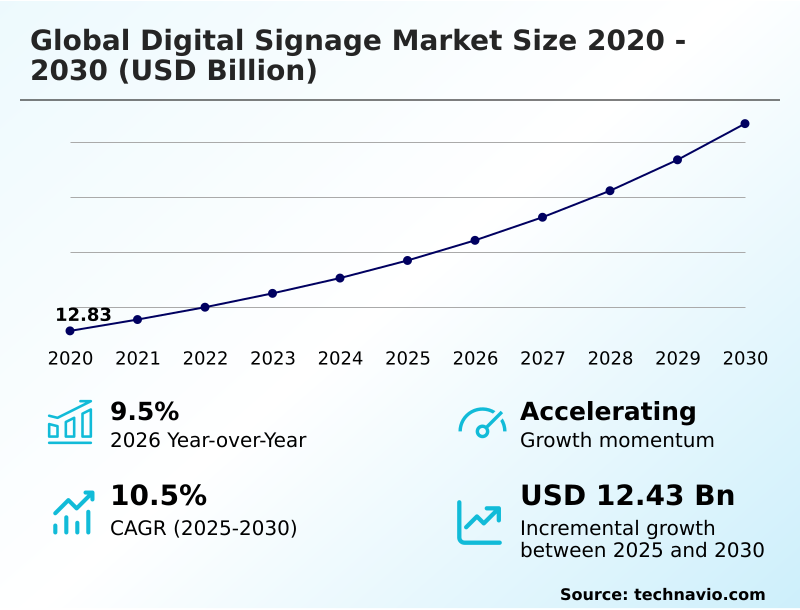
The digital signage market size is valued to increase by USD 12.43 billion, at a CAGR of 10.5% from 2025 to 2030. High growth of retail space will drive the digital signage market.
Major Market Trends & Insights
- APAC dominated the market and accounted for a 37.6% growth during the forecast period.
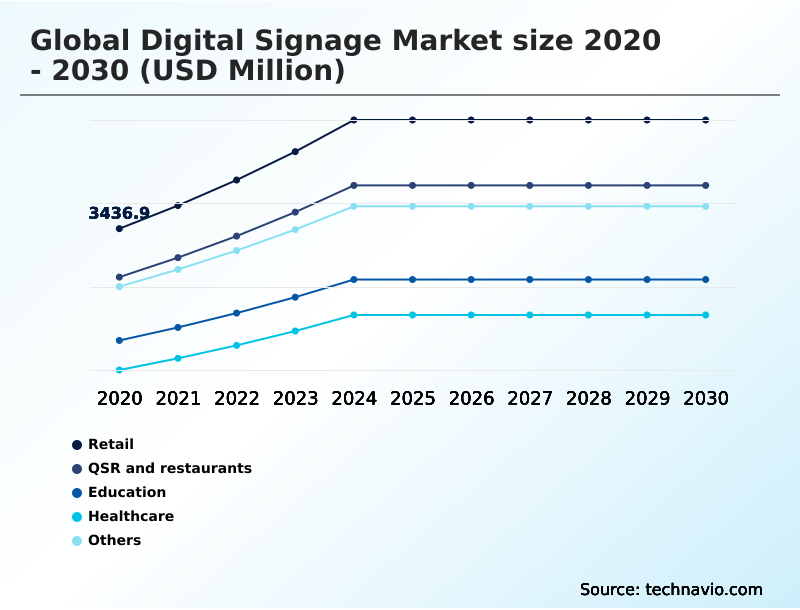
- By Application - Retail segment was valued at USD 4.75 billion in 2024
- By Component - Hardware segment accounted for the largest market revenue share in 2024
Market Size & Forecast
- Market Opportunities: USD 18.84 billion
- Market Future Opportunities: USD 12.43 billion
- CAGR from 2025 to 2030 : 10.5%
Market Summary
- The digital signage market is undergoing a significant transformation, moving beyond passive information displays to become an integral component of modern communication strategies. This evolution is driven by advancements in display hardware and the increasing sophistication of software platforms. Organizations across retail, transportation, and corporate sectors are leveraging this technology to enhance customer engagement, streamline operations, and deliver targeted messaging.
- A key aspect of this shift is the integration of data analytics, which allows for the measurement of content effectiveness and provides insights into audience behavior. For instance, a retail chain can analyze viewer data from in-store displays to optimize promotional content, leading to improved sales conversion without collecting personal information.
- This capability transforms signage from a simple capital expense into a strategic tool for data-driven decision-making. However, the need for compelling and continuously updated content presents an ongoing operational challenge, requiring dedicated resources for creative development and management to maintain viewer interest and maximize return on investment.
What will be the Size of the Digital Signage Market during the forecast period?
Get Key Insights on Market Forecast (PDF) Get Free Sample
How is the Digital Signage Market Segmented?
The digital signage industry research report provides comprehensive data (region-wise segment analysis), with forecasts and estimates in "USD million" for the period 2026-2030, as well as historical data from 2020-2024 for the following segments.
- Application
- Retail
- QSR and restaurants
- Education
- Healthcare
- Others
- Component
- Hardware
- Software
- Services
- Technology
- LCD or LED
- Projection
- OLED
- Geography
- North America
- US
- Canada
- Mexico
- APAC
- China
- Japan
- India
- Europe
- Germany
- UK
- France
- South America
- Brazil
- Argentina
- Colombia
- Middle East and Africa
- Saudi Arabia
- UAE
- South Africa
- Rest of World (ROW)
- North America
By Application Insights
The retail segment is estimated to witness significant growth during the forecast period.
The retail segment is rapidly evolving into sophisticated phygital retail environments, where digital displays are pivotal for omnichannel retail integration. Beyond simple advertising, retailers deploy high-brightness displays and interactive kiosks to enable dynamic pricing displays and offer interactive product catalogs.
These systems facilitate experiential marketing installations and data-driven personalization through in-store analytics, supporting virtual try-on experiences and personalized marketing campaigns. The use of digital menu boards in associated food service spaces further enhances operational efficiency.
This shift towards immersive digital touchpoints is driven by the need to elevate customer engagement, with centralized content distribution ensuring consistent brand messaging across all locations, improving customer journey mapping by over 25%.
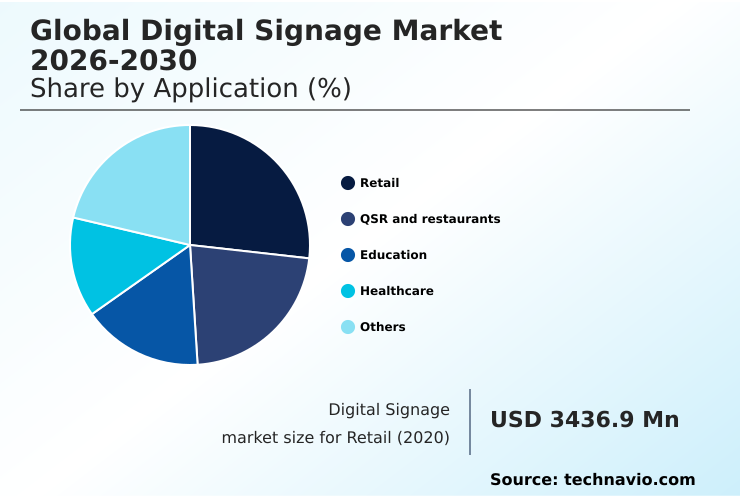
The Retail segment was valued at USD 4.75 billion in 2024 and showed a gradual increase during the forecast period.
Regional Analysis
APAC is estimated to contribute 37.6% to the growth of the global market during the forecast period.Technavio’s analysts have elaborately explained the regional trends and drivers that shape the market during the forecast period.
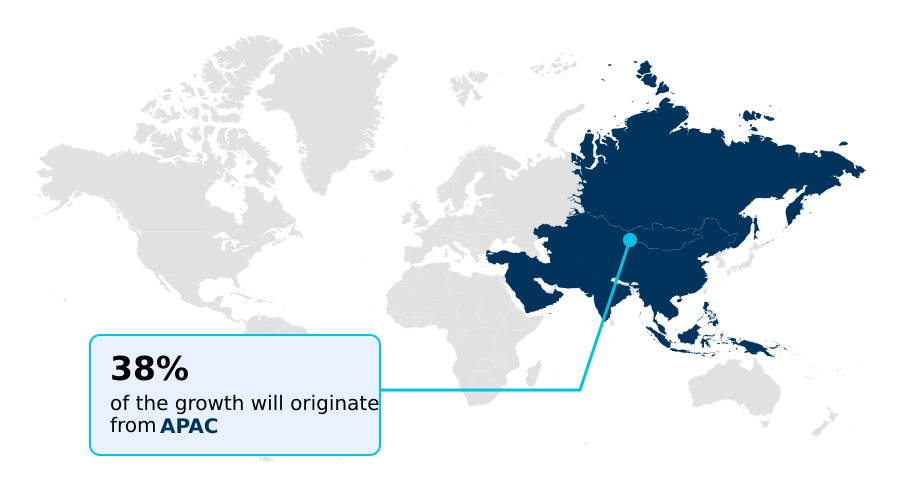
See How Digital Signage Market Demand is Rising in APAC Get Free Sample
The geographic landscape of the market is characterized by mature, high-adoption regions and rapidly emerging growth centers. North America, a substantial market, focuses on upgrading existing infrastructure with 4K UHD displays and complex architectural media facades.
Meanwhile, the APAC region is the fastest-growing area, accounting for over 37% of the market's incremental growth, driven by new infrastructure projects and the adoption of ai-driven content delivery and networked display solutions.
Europe emphasizes regulatory compliance and sustainability, with a focus on energy-efficient systems and geofenced content delivery for targeted messaging. Across all regions, the adoption of cloud-based content management is unifying operations.
Advanced applications like projection mapping using ultra short throw lenses and the deployment of multi-zone screen layouts on 8k resolution displays are becoming more common in landmark projects globally.
Market Dynamics
Our researchers analyzed the data with 2025 as the base year, along with the key drivers, trends, and challenges. A holistic analysis of drivers will help companies refine their marketing strategies to gain a competitive advantage.
- Navigating the complexities of the digital signage market requires a deep understanding of specific use cases and technological trade-offs. The debate over soc vs external media player performance, for example, is central to deployment strategy, with integrated systems offering simplicity while external units provide greater processing power for demanding applications.
- The benefits of cloud-based cms for retail chains are clear, enabling seamless updates across hundreds of locations. However, this connectivity introduces cybersecurity best practices for networked signage as a critical consideration. In vertical-specific applications, the roi of interactive kiosks in healthcare settings is measured by improved patient flow and reduced administrative burden.
- Similarly, implementing dynamic pricing on digital menu boards helps restaurants optimize revenue. The challenges of outdoor led display installation involve weatherproofing and ensuring visibility in bright ambient light.
- As the industry evolves, using ai for personalized in-store advertising is becoming more prevalent, though it must align with compliance with gdpr for personalized advertising, especially when using facial recognition for audience analytics.
- This move toward intelligent, integrated systems is creating value in areas like reducing perceived wait times with queue management, with some systems showing a 30% improvement in customer satisfaction scores.
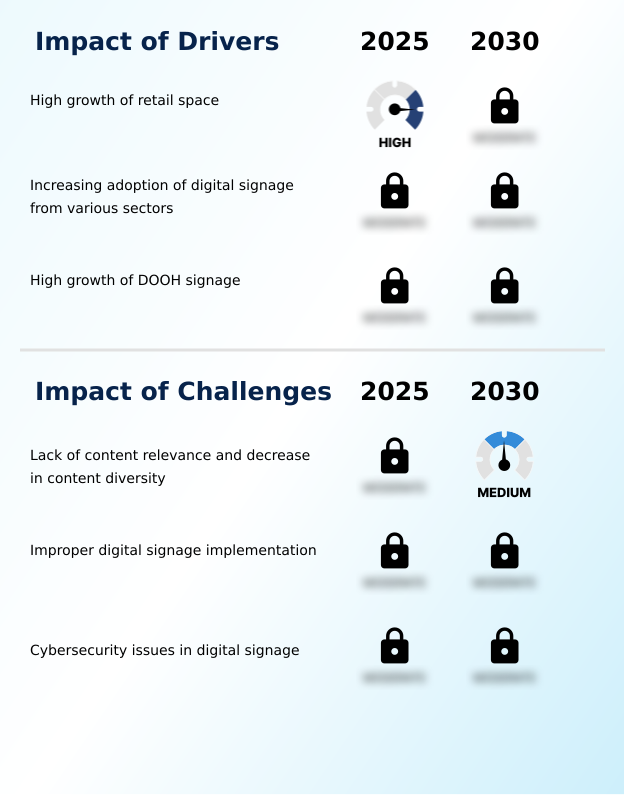
What are the key market drivers leading to the rise in the adoption of Digital Signage Industry?
- The high growth of retail space globally is a key driver for the digital signage market, fueling demand for dynamic in-store communication and customer engagement tools.
- Market growth is significantly driven by expanding applications across various sectors and the increasing adoption of programmatic dooh advertising.
- In public and commercial spaces, there is a strong demand for outdoor led solutions and interactive wayfinding systems to manage traffic and enhance visitor experiences.
- The deployment of fine pitch led and direct view led (dvled) technologies in corporate communication networks and smart city information portals is becoming more widespread.
- In sectors like healthcare and hospitality, digital door signs and digital concierge services are improving operational efficiency and patient information systems. For instance, facilities using integrated queue management systems have reported a 25% reduction in perceived wait times.
- The ability to push emergency alert integration across networked displays has also become a critical driver for adoption in public venues, ensuring rapid communication during critical events.
What are the market trends shaping the Digital Signage Industry?
- The introduction of System on a Chip (SoC) technology is an emerging trend, streamlining digital signage solutions. This integration reduces hardware complexity and the total cost of ownership for deployments.
- Key market trends are centered on technological innovation that enhances visual impact and simplifies deployment. The introduction of system on a chip (soc) technology and the adoption of software as a service (saas) models are reducing total cost of ownership, with some integrated platforms lowering maintenance calls by 15%.
- Innovations in display hardware, such as transparent oled, quantum dot led (qled), and flexible epaper displays, are enabling more creative installations. These systems increasingly feature gesture control interfaces and support augmented reality overlays, creating more interactive user experiences. The use of multi-screen synchronization to create seamless video walls is becoming standard for high-impact applications.
- Furthermore, the ability to integrate with external systems via api for third-party integration allows for dynamic content triggering based on real-time data, boosting content relevance by over 30%.
What challenges does the Digital Signage Industry face during its growth?
- A lack of content relevance and decreasing diversity poses a key challenge to industry growth, diminishing audience engagement and the overall effectiveness of digital displays.
- Key challenges in the market revolve around content management, security, and operational oversight. The effectiveness of a deployment is highly dependent on a robust content management system (cms) that supports context-aware content and real-time data integration.
- Without sophisticated remote device management and player health monitoring, maintaining network uptime becomes a significant operational burden, with network failures causing a 10% loss in potential advertising revenue for some operators. As systems become more connected, cybersecurity is a growing concern, necessitating stringent user access control levels and secure content approval workflows.
- Bandwidth management tools are also crucial for ensuring smooth content delivery, especially when distributing high-resolution files to numerous external media players and video wall controllers. Ensuring accurate proof-of-play reporting for advertisers adds another layer of complexity.
Exclusive Technavio Analysis on Customer Landscape
The digital signage market forecasting report includes the adoption lifecycle of the market, covering from the innovator’s stage to the laggard’s stage. It focuses on adoption rates in different regions based on penetration. Furthermore, the digital signage market report also includes key purchase criteria and drivers of price sensitivity to help companies evaluate and develop their market growth analysis strategies.
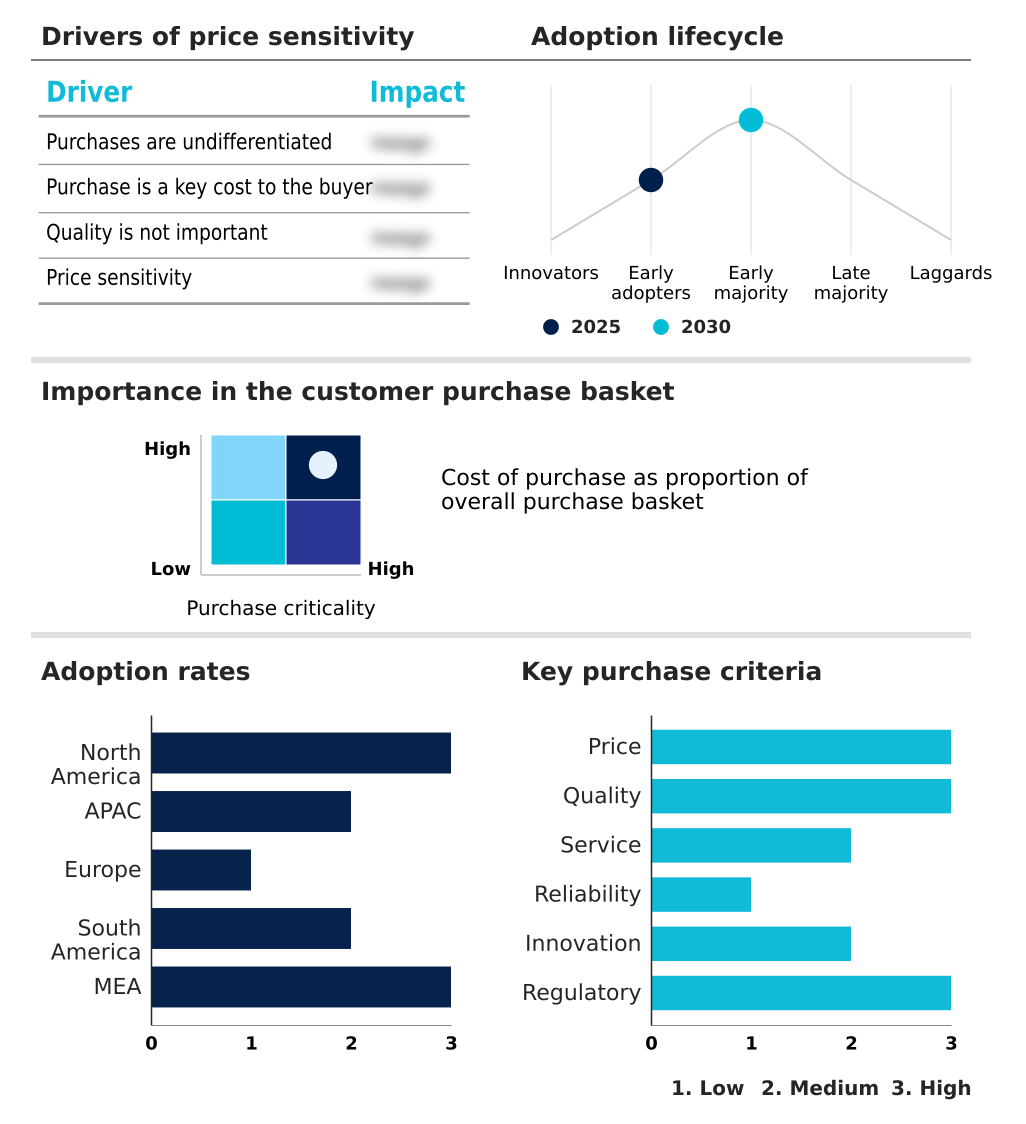
Customer Landscape of Digital Signage Industry
Competitive Landscape
Companies are implementing various strategies, such as strategic alliances, digital signage market forecast, partnerships, mergers and acquisitions, geographical expansion, and product/service launches, to enhance their presence in the industry.
Acer Inc. - Provides advanced 4K UHD displays and ultra-bright screens for high-performance indoor and outdoor commercial applications, addressing a wide range of commercial visualization needs.
The industry research and growth report includes detailed analyses of the competitive landscape of the market and information about key companies, including:
- Acer Inc.
- ASUSTeK Computer Inc.
- AUO Corp.
- Barco NV
- Christie Digital Systems Inc
- Dell Technologies Inc.
- Elo Touch Solutions Inc.
- HP Inc.
- Koninklijke Philips NV
- Leyard International
- LG Electronics Inc.
- Mitsubishi Electric Corp.
- NEC Corp.
- Panasonic Holdings Corp.
- Planar Systems Inc.
- Samsung Electronics Co. Ltd.
- Sharp Corp.
- Sony Group Corp.
- Toshiba Corp.
- ViewSonic Corp.
Qualitative and quantitative analysis of companies has been conducted to help clients understand the wider business environment as well as the strengths and weaknesses of key industry players. Data is qualitatively analyzed to categorize companies as pure play, category-focused, industry-focused, and diversified; it is quantitatively analyzed to categorize companies as dominant, leading, strong, tentative, and weak.
Recent Development and News in Digital signage market
- In November 2024, Advantech launched the DS-380, a system designed to bring advanced AI vision to outdoor DOOH displays, enhancing image processing and operational reliability for demanding environments.
- In January 2025, DynaScan announced the introduction of a new range of indoor and outdoor ePaper displays, including a 75-inch outdoor color display powered by E Ink Kaleido 3 technology for energy-efficient signage.
- In February 2025, Samsung officially introduced its Color E-Paper (EMDX) series, a new energy-efficient digital signage lineup featuring ultra-low power consumption and remote management capabilities via a dedicated mobile application.
- In March 2025, Standard AI launched an improved version of its VISION computer vision platform, offering enhanced real-time audience analytics and clearer detection accuracy for the Digital Out-of-Home advertising market.
Dive into Technavio’s robust research methodology, blending expert interviews, extensive data synthesis, and validated models for unparalleled Digital Signage Market insights. See full methodology.
| Market Scope | |
|---|---|
| Page number | 310 |
| Base year | 2025 |
| Historic period | 2020-2024 |
| Forecast period | 2026-2030 |
| Growth momentum & CAGR | Accelerate at a CAGR of 10.5% |
| Market growth 2026-2030 | USD 12434.2 million |
| Market structure | Fragmented |
| YoY growth 2025-2026(%) | 9.5% |
| Key countries | US, Canada, Mexico, China, Japan, India, South Korea, Indonesia, Australia, Germany, UK, France, Italy, Spain, The Netherlands, Brazil, Argentina, Colombia, Saudi Arabia, UAE, South Africa, Egypt and Nigeria |
| Competitive landscape | Leading Companies, Market Positioning of Companies, Competitive Strategies, and Industry Risks |
Research Analyst Overview
- The digital signage market's evolution from a hardware-centric industry to an integrated ecosystem powered by software and data marks a fundamental shift in its value proposition. The proliferation of system on a chip (soc) displays, fine pitch led, and transparent oled technologies provides a versatile canvas, but the true differentiator lies in the intelligence behind the screen.
- The integration of audience analytics and ai-driven content delivery is transforming displays into strategic assets capable of data-driven personalization. This pivot has significant boardroom implications, particularly for budgeting and performance measurement.
- For instance, the ability to correlate in-store analytics from interactive kiosks with sales data allows for a clear ROI calculation, shifting the perception of digital signage from a capital expenditure to a measurable marketing investment.
- As a result, businesses are achieving over a 20% uplift in campaign effectiveness by leveraging context-aware content, fundamentally changing how they allocate resources for physical-space communication and omnichannel retail integration.
What are the Key Data Covered in this Digital Signage Market Research and Growth Report?
-
What is the expected growth of the Digital Signage Market between 2026 and 2030?
-
USD 12.43 billion, at a CAGR of 10.5%
-
-
What segmentation does the market report cover?
-
The report is segmented by Application (Retail, QSR and restaurants, Education, Healthcare, and Others), Component (Hardware, Software, and Services), Technology (LCD or LED, Projection, and OLED) and Geography (North America, APAC, Europe, South America, Middle East and Africa)
-
-
Which regions are analyzed in the report?
-
North America, APAC, Europe, South America and Middle East and Africa
-
-
What are the key growth drivers and market challenges?
-
High growth of retail space, Lack of content relevance and decrease in content diversity
-
-
Who are the major players in the Digital Signage Market?
-
Acer Inc., ASUSTeK Computer Inc., AUO Corp., Barco NV, Christie Digital Systems Inc, Dell Technologies Inc., Elo Touch Solutions Inc., HP Inc., Koninklijke Philips NV, Leyard International, LG Electronics Inc., Mitsubishi Electric Corp., NEC Corp., Panasonic Holdings Corp., Planar Systems Inc., Samsung Electronics Co. Ltd., Sharp Corp., Sony Group Corp., Toshiba Corp. and ViewSonic Corp.
-
Market Research Insights
- Market dynamics are increasingly shaped by the adoption of intelligent and connected technologies that enhance operational efficiency and audience engagement. The shift towards software as a service (saas) models for content management is enabling more scalable and cost-effective deployments. For instance, businesses using cloud-based platforms for centralized content distribution report a reduction in campaign deployment times by up to 40%.
- The integration of AI and IoT sensors allows for dynamic content triggering based on environmental conditions or audience demographics, improving message relevance. This data-driven approach, supported by robust audience measurement metrics, offers a clearer view of campaign performance.
- Deployments leveraging predictive content scheduling have demonstrated an 18% improvement in engagement rates by aligning promotions with anticipated customer traffic patterns, showcasing a move towards more proactive and effective communication strategies.
We can help! Our analysts can customize this digital signage market research report to meet your requirements.
 RIA -
RIA -