



Distribution Software Market Size 2025-2029
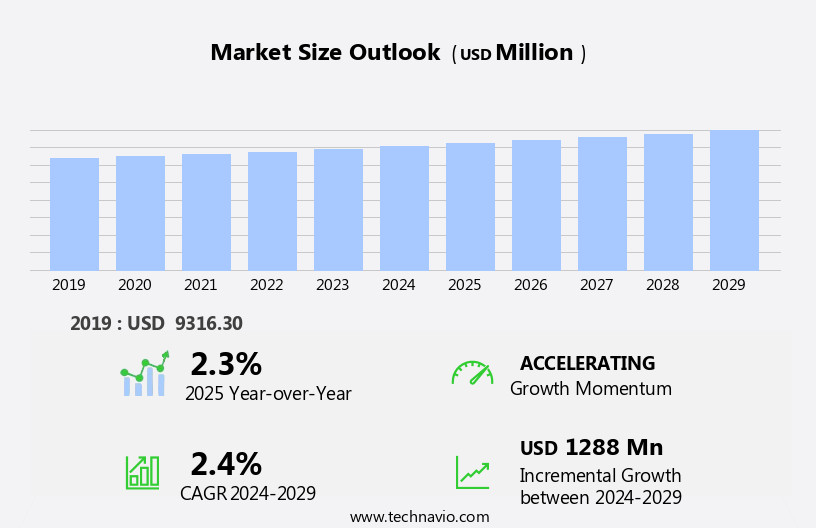
The distribution software market size is forecast to increase by USD 1.29 billion at a CAGR of 2.4% between 2024 and 2029.
- The market is experiencing significant growth, driven by the increasing adoption of value-based pricing strategies by market players and the emergence of omnichannel retailing. Value-based pricing enables businesses to set prices based on the perceived value of their products or services, leading to increased customer satisfaction and loyalty. Omnichannel retailing, which integrates various sales channels such as brick-and-mortar stores, e-commerce platforms, and mobile applications, requires advanced distribution software to manage inventory, orders, and customer interactions effectively. However, the market also faces challenges, including high costs associated with implementing and maintaining distribution software. These costs can include hardware, software, implementation, training, and ongoing support.
- To mitigate these challenges, companies must carefully evaluate the total cost of ownership and consider the long-term benefits of implementing distribution software. By doing so, they can streamline their operations, improve customer service, and gain a competitive edge in their markets. Overall, the market offers significant opportunities for growth, particularly for companies that can provide cost-effective, flexible, and innovative solutions to meet the evolving needs of retailers and distributors. The emergence of omnichannel retailing and the need for real-time visibility and analytics capabilities are key drivers. Distribution software solutions enable demand forecasting, order fulfillment, inventory tracking, warehouse management, and transportation management.
What will be the Size of the Distribution Software Market during the forecast period?
- In today's business landscape, distribution software plays a pivotal role in streamlining operations and enhancing customer experience. Customer service is no longer just about handling queries; it extends to order tracking, cost optimization, and fraud detection. Cross-border distribution poses unique challenges, necessitating compliance with various regulations and international shipping norms. Hybrid deployment models offer flexibility, while supply chain security and sustainability are becoming essential considerations. Warehouse management systems, user interface, and data-driven decisions are key elements of an effective distribution strategy. Cloud computing, e-commerce platform integration, and real-time insights enable businesses to make informed decisions and offer delivery speed and order fulfillment. A centralised platform for software distribution enables efficient distribution operations and logistics, including demand forecasting, order fulfilment, inventory tracking, and warehouse management.
- Inventory management systems, on-premise deployment, and software integration are crucial for maintaining supply chain visibility and resilience. Predictive analytics and delivery optimization contribute to improved user experience and reduced shipping costs. Mobile ordering, delivery timelines, and targeted marketing cater to evolving customer needs. Warehouse automation and compliance regulations ensure data privacy and security. In summary, the market trends revolve around enhancing customer experience, optimizing costs, ensuring compliance, and leveraging technology for improved efficiency and agility.
How is this Distribution Software Industry segmented?
The distribution software industry research report provides comprehensive data (region-wise segment analysis), with forecasts and estimates in "USD million" for the period 2025-2029, as well as historical data from 2019-2023 for the following segments.
- Deployment
- Cloud-based
- On-premises
- End-user
- Distributors
- Manufacturers
- Wholesale and retail
- Food and beverage
- Others
- Sector
- SMEs
- Large enterprises
- Geography
- North America
- US
- Canada
- Europe
- France
- Germany
- Russia
- UK
- Middle East and Africa
- APAC
- Australia
- China
- India
- Japan
- South America
- Rest of World (ROW)
- North America
By Deployment Insights
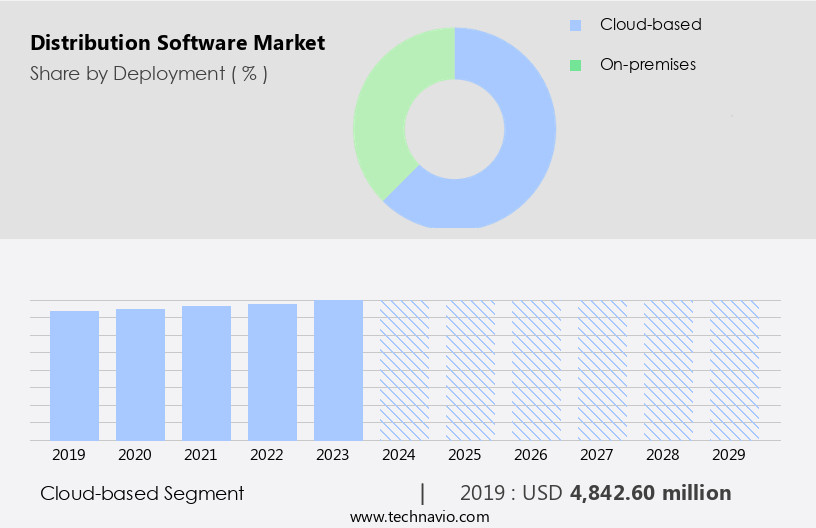
The cloud-based segment is estimated to witness significant growth during the forecast period. Enterprises are shifting their focus towards cloud-based distribution solutions to reduce IT infrastructure costs and enhance business agility and flexibility. The adoption of these software solutions is on the rise as they eliminate the need for clients to set up their servers and purchase additional hardware. Cloud-based distribution software is scalable, enabling the efficient management of IT resources in intricate IT ecosystems. Centralized processing of information streamlines enterprise workflows, leading to significant improvements in operational efficiency. Moreover, businesses are integrating various components such as Business Intelligence, Data Analytics, E-commerce Integration, API Integration, and Machine Learning to gain valuable insights and automate processes.
The implementation of these technologies is revolutionizing the supply chain, from Sales Order Processing and Delivery Management to Inventory Management and Fulfillment Software. Logistics Software, including Shipping Rate Calculation, Automated Order Fulfillment, and Route Optimization, is another critical component of cloud-based distribution. These solutions enable real-time tracking and tracing of orders, ensuring timely and accurate delivery. Furthermore, the integration of the Internet of Things and Blockchain Technology enhances transparency and security in the supply chain. The market is also witnessing the emergence of advanced technologies like Artificial Intelligence and Omni-Channel Commerce, which are transforming the way businesses operate.
Next-Day Delivery and Last Mile Delivery are becoming increasingly popular, especially in the B2C sector. Pharmaceutical Distribution and Manufacturing Distribution are also adopting cloud-based solutions to streamline their operations and ensure the timely delivery of critical products. The market for cloud-based distribution solutions is evolving rapidly, with enterprises leveraging various components to optimize their supply chains and enhance operational efficiency. The integration of advanced technologies is driving innovation and transforming the way businesses manage their distribution networks. Innovations like blockchain are being explored to enhance security and transparency in software distribution.
Get a glance at the market report of share of various segments Request Free Sample
The Cloud-based segment was valued at USD 4.84 billion in 2019 and showed a gradual increase during the forecast period.
Regional Analysis
North America is estimated to contribute 39% to the growth of the global market during the forecast period. Technavio's analysts have elaborately explained the regional trends and drivers that shape the market during the forecast period.

For more insights on the market size of various regions, Request Free Sample
The market in North America is experiencing significant growth due to several factors. The availability of advanced IT infrastructure and technological innovations, such as machine learning, artificial intelligence, and blockchain technology, are driving the market. Additionally, the increasing number of small and medium-sized enterprises (SMEs) and the wide geographic dispersion of employees necessitate efficient distribution management systems. Furthermore, the growing adoption of cloud-based distribution software and the presence of prominent manufacturing and distribution organizations are contributing to market expansion. Moreover, the rising demand for quality products and the need for organizations to minimize costs while maintaining efficient logistical operations are key growth factors.
Market Dynamics
Our researchers analyzed the data with 2024 as the base year, along with the key drivers, trends, and challenges. A holistic analysis of drivers will help companies refine their marketing strategies to gain a competitive advantage.
What are the key market drivers leading to the rise in the adoption of Distribution Software Industry?
- Value-based pricing strategies adopted by market companies is the key driver of the market. In today's competitive business landscape, distribution software companies are implementing customer-focused pricing strategies, driven by technological advancements. Value-based pricing models are increasingly popular, as they cater to customers' unique requirements and perceived value. Software pricing and delivery hinge on a distribution company's ability to provide value and distinguish their software solution's features. Customers consider several economic and market factors when deciding to adopt distribution software. Return on investment (ROI), IT budget constraints, and availability of free models are key factors influencing their decisions. Traditional physical delivery methods are being supplanted by electronic software distribution, Software-as-a-Service (SaaS), and digital delivery. By these dynamics, distribution software companies can tailor their offerings to meet customer needs effectively.
What are the market trends shaping the Distribution Software Industry?
- Emergence of omnichannel retailing is the upcoming market trend. The e-commerce and m-commerce sectors have witnessed significant growth due to the advancement of network infrastructure and the increasing Internet penetration. Retailers are leveraging these platforms to expand their reach and enhance the shopping experience for customers. Omnichannel retailing, which integrates various sales channels such as brick-and-mortar stores, online stores, and mobile applications, is a key trend in this industry. To make omnichannel retailing successful, retailers require real-time inventory visibility. This enables them to provide consistent information to customers across all channels and avoid stock inconsistencies. This deployment model offers numerous benefits, including eliminating the need for on-premises servers and hardware, scalability, and centralized information processing. Accurate inventory tracking is also crucial for retailers to make informed decisions and prevent out-of-stock situations. By streamlining their distribution processes, retailers can offer a seamless shopping experience and maintain a competitive edge in the market.
What challenges does the Distribution Software Industry face during its growth?
- High costs associated with distribution software is a key challenge affecting the industry growth. Distribution software plays a crucial role in optimizing the supply chain and distribution processes for businesses. Small businesses, in particular, benefit from its capabilities to streamline workflows and improve connectivity and automation. However, the high cost of distribution software is a significant concern for these enterprises. The cost varies depending on factors such as the number of users, functionality modules, and required integration and accounting features. Subscription-based distribution software typically costs between USD 45 and USD 50 per month per user. One-time ownership of the software, including installation and training services, can range from USD 2,000 to USD 2,500. These costs may seem prohibitive for small businesses, but the long-term benefits, such as increased efficiency and reduced errors, often outweigh the initial investment.
Exclusive Customer Landscape
The distribution software market forecasting report includes the adoption lifecycle of the market, covering from the innovator's stage to the laggard's stage. It focuses on adoption rates in different regions based on penetration. Furthermore, the distribution software market report also includes key purchase criteria and drivers of price sensitivity to help companies evaluate and develop their market growth analysis strategies.

Customer Landscape
Key Companies & Market Insights
Companies are implementing various strategies, such as strategic alliances, distribution software market forecast, partnerships, mergers and acquisitions, geographical expansion, and product/service launches, to enhance their presence in the industry.
Acumatica Inc. - The company provides cloud-based ERP solutions, including Acumatica Distribution Edition, for efficient inventory, warehouse, and order management in distribution businesses.
The industry research and growth report includes detailed analyses of the competitive landscape of the market and information about key companies, including:
- Acumatica Inc.
- ADS Solutions Corp.
- Agnitech
- Archon Systems Inc.
- Blue Link Associates Ltd.
- Cloud 9 ERP Solutions
- Cloud Pencils Pvt. Ltd.
- DATABASICS Inc.
- Descartes Systems Group Inc.
- ECOUNT Co. Ltd.
- Epicor Software Corp.
- Fishbowl
- IFS World Operations AB
- Infor Inc.
- JCurve Solutions Ltd.
- Manhattan Associates Inc.
- Oracle Corp.
- Sage Group Plc
- SAP SE
- SYSPRO Pty. Ltd.
Qualitative and quantitative analysis of companies has been conducted to help clients understand the wider business environment as well as the strengths and weaknesses of key industry players. Data is qualitatively analyzed to categorize companies as pure play, category-focused, industry-focused, and diversified; it is quantitatively analyzed to categorize companies as dominant, leading, strong, tentative, and weak.
Research Analyst Overview
The market is experiencing significant growth and innovation as businesses strive to streamline their operations and meet the increasing demands of customers. One of the key trends shaping the market is the focus on same-day delivery and real-time inventory tracking to enhance customer experience. This is leading to the adoption of distribution software solutions that offer features such as delivery management, route optimization, and automated order fulfillment. Another trend is the integration of business intelligence and data analytics capabilities into distribution software. This enables businesses to gain insights into their operations and make data-driven decisions, leading to improved process optimization and supply chain management.
The use of machine learning algorithms is also becoming more prevalent, allowing for predictive demand forecasting and automated workflow processes. Subscription services and cloud-based distribution models are gaining popularity due to their flexibility and cost-effectiveness. This is particularly true for small and medium-sized businesses that may not have the resources to invest in expensive on-premises solutions. SaaS distribution and logistics software are also becoming increasingly common, providing businesses with access to advanced features and functionality without the need for extensive IT infrastructure. The use of automation in distribution software is another significant trend. This includes automated shipping label generation, pick and pack processes, and automated order management. The market for software distribution has experienced significant growth, driven by automation and cloud-based solutions.
Automated warehousing and automated workflow processes are also becoming more common, leading to increased efficiency and productivity. The integration of the Internet of Things (IoT) and blockchain technology is also transforming the market. IoT sensors can provide real-time data on inventory levels, shipping status, and delivery locations, while blockchain technology can ensure secure and transparent transactions and supply chain visibility. The market for distribution software is diverse, catering to various industries such as industrial distribution, retail distribution, manufacturing distribution, and pharmaceutical distribution. The software solutions available range from basic order management and shipping rate calculation to complex solutions that offer advanced features such as inventory management, customer relationship management, and transportation management.
The market for distribution software is expected to continue growing as businesses seek to improve their operations and meet the evolving demands of customers. The integration of emerging technologies such as AI, machine learning, and IoT is likely to drive innovation and provide new opportunities for businesses to streamline their operations and gain a competitive edge.
|
Market Scope |
|
|
Report Coverage |
Details |
|
Page number |
221 |
|
Base year |
2024 |
|
Historic period |
2019-2023 |
|
Forecast period |
2025-2029 |
|
Growth momentum & CAGR |
Accelerate at a CAGR of 2.4% |
|
Market growth 2025-2029 |
USD 1.29 billion |
|
Market structure |
Fragmented |
|
YoY growth 2024-2025(%) |
2.3 |
|
Key countries |
US, Germany, China, Canada, UK, Japan, India, France, Russia, and Australia |
|
Competitive landscape |
Leading Companies, Market Positioning of Companies, Competitive Strategies, and Industry Risks |
What are the Key Data Covered in this Distribution Software Market Research and Growth Report?
- CAGR of the Distribution Software industry during the forecast period
- Detailed information on factors that will drive the growth and forecasting between 2025 and 2029
- Precise estimation of the size of the market and its contribution of the industry in focus to the parent market
- Accurate predictions about upcoming growth and trends and changes in consumer behaviour
- Growth of the market across North America, Europe, APAC, South America, and Middle East and Africa
- Thorough analysis of the market's competitive landscape and detailed information about companies
- Comprehensive analysis of factors that will challenge the distribution software market growth of industry companies
We can help! Our analysts can customize this distribution software market research report to meet your requirements.