



K-12 Makerspace Materials Market Size 2026-2030
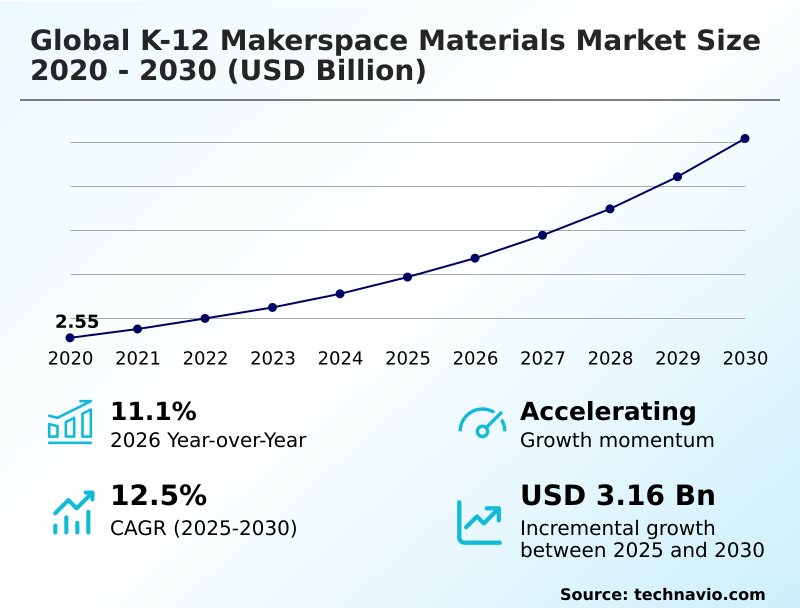
The k-12 makerspace materials market size is valued to increase by USD 3.16 billion, at a CAGR of 12.5% from 2025 to 2030. Advent of advanced makerspace materials will drive the k-12 makerspace materials market.
Major Market Trends & Insights
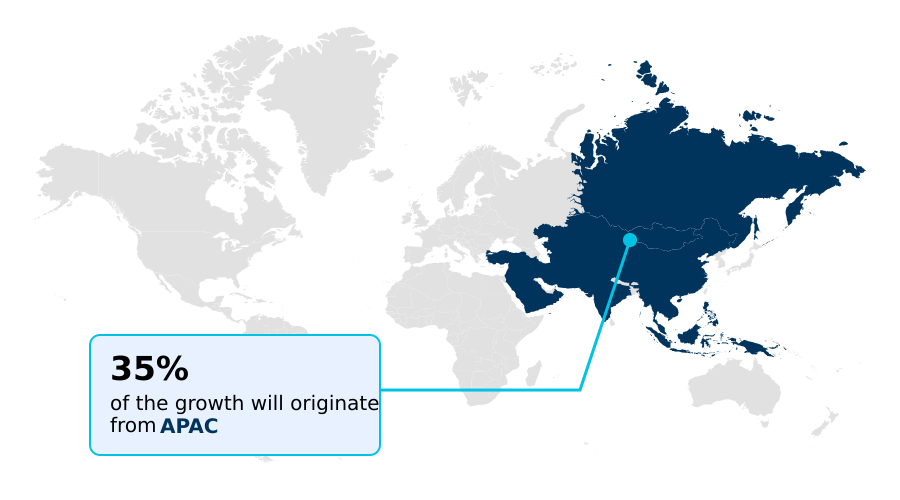
- APAC dominated the market and accounted for a 35% growth during the forecast period.
- By Product - Robotic toolkit segment was valued at USD 1.41 billion in 2024
- By Application - Elementary school segment accounted for the largest market revenue share in 2024
Market Size & Forecast
- Market Opportunities: USD 4.54 billion
- Market Future Opportunities: USD 3.16 billion
- CAGR from 2025 to 2030 : 12.5%
Market Summary
- The K-12 makerspace materials market is experiencing steady expansion, driven by the increasing emphasis on experiential learning models and the need to equip students with practical, future-ready skills. Makerspaces, supported by a wide range of resources from robotics kits to 3D printing filaments, have become integral to modern education.
- The shift from traditional rote learning to interactive, project-based learning is a key factor fueling demand. Technological advancements are also shaping the landscape, with digital tools like AI and cloud-based platforms enhancing the effectiveness of these learning environments.
- For instance, a school district can optimize its resource allocation by using management software to track the usage of consumables like 3D printing materials across its makerspaces, ensuring continuous availability for student projects. However, the market faces challenges, including high initial setup costs and a lack of educators trained to manage these complex spaces, which can slow adoption.
- Despite these hurdles, the long-term outlook is positive as the demand for skill-based education continues to rise, solidifying makerspaces as a key component of modern learning ecosystems.
What will be the Size of the K-12 Makerspace Materials Market during the forecast period?
Get Key Insights on Market Forecast (PDF) Get Free Sample
How is the K-12 Makerspace Materials Market Segmented?
The k-12 makerspace materials industry research report provides comprehensive data (region-wise segment analysis), with forecasts and estimates in "USD million" for the period 2026-2030, as well as historical data from 2020-2024 for the following segments.
- Product
- Robotic toolkit
- Construction materials
- Arts and crafts materials
- Others
- Application
- Elementary school
- Middle school
- High school
- End-user
- Classroom
- Library
- Cafeteria
- Office
- Others
- Geography
- APAC
- China
- Japan
- India
- Europe
- Germany
- UK
- France
- North America
- US
- Canada
- Mexico
- Middle East and Africa
- Saudi Arabia
- UAE
- South Africa
- South America
- Brazil
- Argentina
- Rest of World (ROW)
- APAC
By Product Insights
The robotic toolkit segment is estimated to witness significant growth during the forecast period.
The robotic toolkit segment is central to the K-12 makerspace materials market, driven by the shift toward experiential learning models and project-based learning.
This category, encompassing programmable robotics kits and other hands-on learning tools, is fundamental to modern STEM and STEAM education. Demand is accelerating due to curriculum mandates requiring resources like educational electronics kits, interactive learning tools, and coding robots.
The adoption of advanced kits has resulted in a reported 20% improvement in student participation.
This trend, supported by digital fabrication tools like classroom 3d printers and laser cutting machines, underscores the move toward practical, hands-on stem learning over theoretical instruction, even incorporating materials like cardboard construction kits.
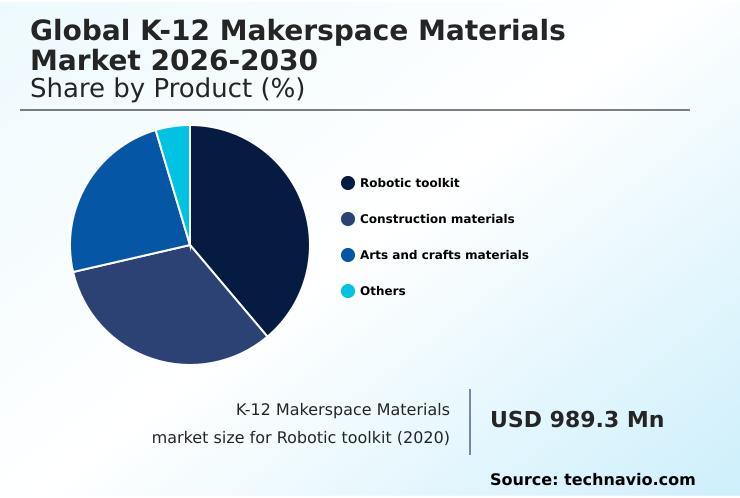
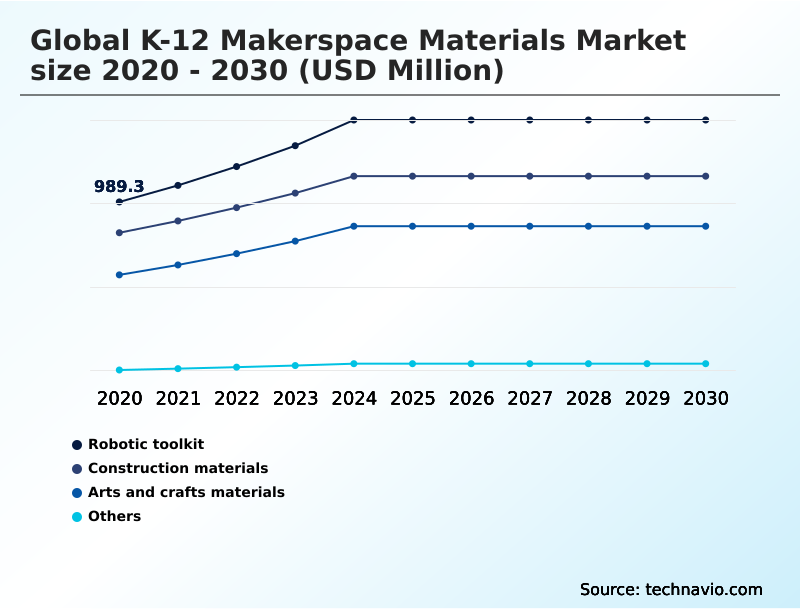
The Robotic toolkit segment was valued at USD 1.41 billion in 2024 and showed a gradual increase during the forecast period.
Regional Analysis
APAC is estimated to contribute 35% to the growth of the global market during the forecast period.Technavio’s analysts have elaborately explained the regional trends and drivers that shape the market during the forecast period.
See How K-12 Makerspace Materials Market Demand is Rising in APAC Get Free Sample
The geographic landscape is defined by regional priorities and varying infrastructure requirements. APAC is set to lead growth, accounting for over 35% of market expansion, focusing on deploying modular building kits and microcontroller platforms.
North America's mature market is upgrading with advanced electronics components and coding modules, while also refining methods for assessing student learning in makerspaces. Europe emphasizes sustainability, incorporating paper-based electronics and reusable connectors.
In emerging regions, the focus is on overcoming limited internet connectivity to provide foundational educational robotics solutions.
Strategic decisions, such as choosing 3d printers for elementary schools, are critical everywhere, as is the adoption of modular robots and cnc machines to support diverse project-based learning.
Market Dynamics
Our researchers analyzed the data with 2025 as the base year, along with the key drivers, trends, and challenges. A holistic analysis of drivers will help companies refine their marketing strategies to gain a competitive advantage.
- Strategic planning in the K-12 makerspace domain requires a multi-faceted approach, addressing both pedagogical goals and operational realities. A key focus is on integrating robotics into K-12 curriculum, which highlights the benefits of project-based learning materials in fostering practical skills.
- Institutions are increasingly exploring curriculum development for STEAM education, which involves integrating art into STEM projects and using the best construction kits for engineering concepts. As schools adopt more advanced tools, understanding how to start a school coding club and planning for robotics competitions for middle schoolers become important engagement strategies.
- The role of makerspaces in skill development is undeniable, but it necessitates careful planning around safety best practices for school makerspaces and identifying stable funding sources for K-12 stem programs. Operational decisions involve choosing 3d printers for elementary schools that are both safe and user-friendly, alongside effectively managing consumables in a classroom makerspace.
- Schools with limited infrastructure are exploring mobile makerspace design and setup and other low-cost makerspace ideas for schools. The rise of hybrid learning models brings virtual reality tools for remote making to the forefront, complemented by ai-powered tools for personalized learning. This also changes methods for assessing student learning in makerspaces.
- Forward-thinking initiatives include using drones to teach high school physics, creating wearable technology projects for students, and prioritizing eco-friendly and sustainable maker materials. Institutions that streamline their supply chain for these materials report inventory-related delays that are 50% lower than those with ad-hoc procurement, underscoring the importance of integrated planning.
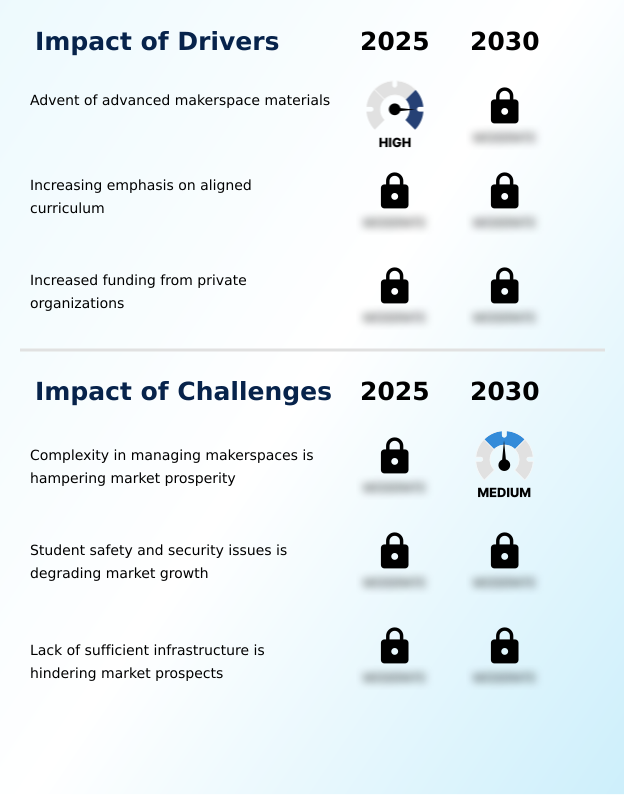
What are the key market drivers leading to the rise in the adoption of K-12 Makerspace Materials Industry?
- The advent of advanced and more accessible makerspace materials is a key driver for the global K-12 makerspace materials market.
- Market growth is strongly driven by curriculum alignment and private funding from philanthropic foundations. These initiatives support school innovation labs and coding labs, expanding access to technology by over 60% in some regions.
- The emphasis on project-based work fuels demand for virtual engineering modules for digital prototyping and hands-on tools like drones in robotics, which are popular in after-school stem programs.
- Widespread deployment of mobile makerspaces and portable learning labs is made possible by these investments.
- Furthermore, integrated solutions that include teacher professional development alongside classroom management software and makerspace inventory tracking are proving critical, with schools using them reporting a 25% increase in operational efficiency.
What are the market trends shaping the K-12 Makerspace Materials Industry?
- A strong shift toward online makerspaces is a significant market trend. This is driven by the increasing adoption of digital and hybrid learning models in schools.
- Key trends are reshaping the market, emphasizing accessibility through mobile stem labs and virtual makerspace platforms. The focus on skill-based learning is driving adoption of ai-enabled learning tools, particularly for ai learning for kids.
- There is a strong push toward sustainability, with a rising demand for eco-friendly materials, biodegradable materials, and other sustainable classroom supplies, reducing school waste by up to 15%. Tinkering labs are increasingly equipped with modular robotics kits featuring simplified coding interfaces.
- This enhances programs like robotics for elementary school and coding for middle school, while the introduction of drones for high school stem has increased project engagement by 30%.
What challenges does the K-12 Makerspace Materials Industry face during its growth?
- The complexity involved in managing school makerspaces is a key challenge that hampers market growth and prosperity.
- Key challenges include the complexity of curriculum integration for advanced topics like aerodynamics education and sensor-based navigation. Inadequate training in equipment handling and student safety protocols presents significant hurdles, with implementation costs increasing operational overhead by 15%. Poor inventory management of project-based learning supplies leads to material shortages, while digital security concerns slow the adoption of connected educational robotics solutions.
- Many schools struggle to implement these experiential learning resources and stem curriculum materials effectively. This operational burden often results in the underutilization of steam educational tools and hinders the expansion of digital fabrication in schools, restraining overall market growth.
Exclusive Technavio Analysis on Customer Landscape
The k-12 makerspace materials market forecasting report includes the adoption lifecycle of the market, covering from the innovator’s stage to the laggard’s stage. It focuses on adoption rates in different regions based on penetration. Furthermore, the k-12 makerspace materials market report also includes key purchase criteria and drivers of price sensitivity to help companies evaluate and develop their market growth analysis strategies.
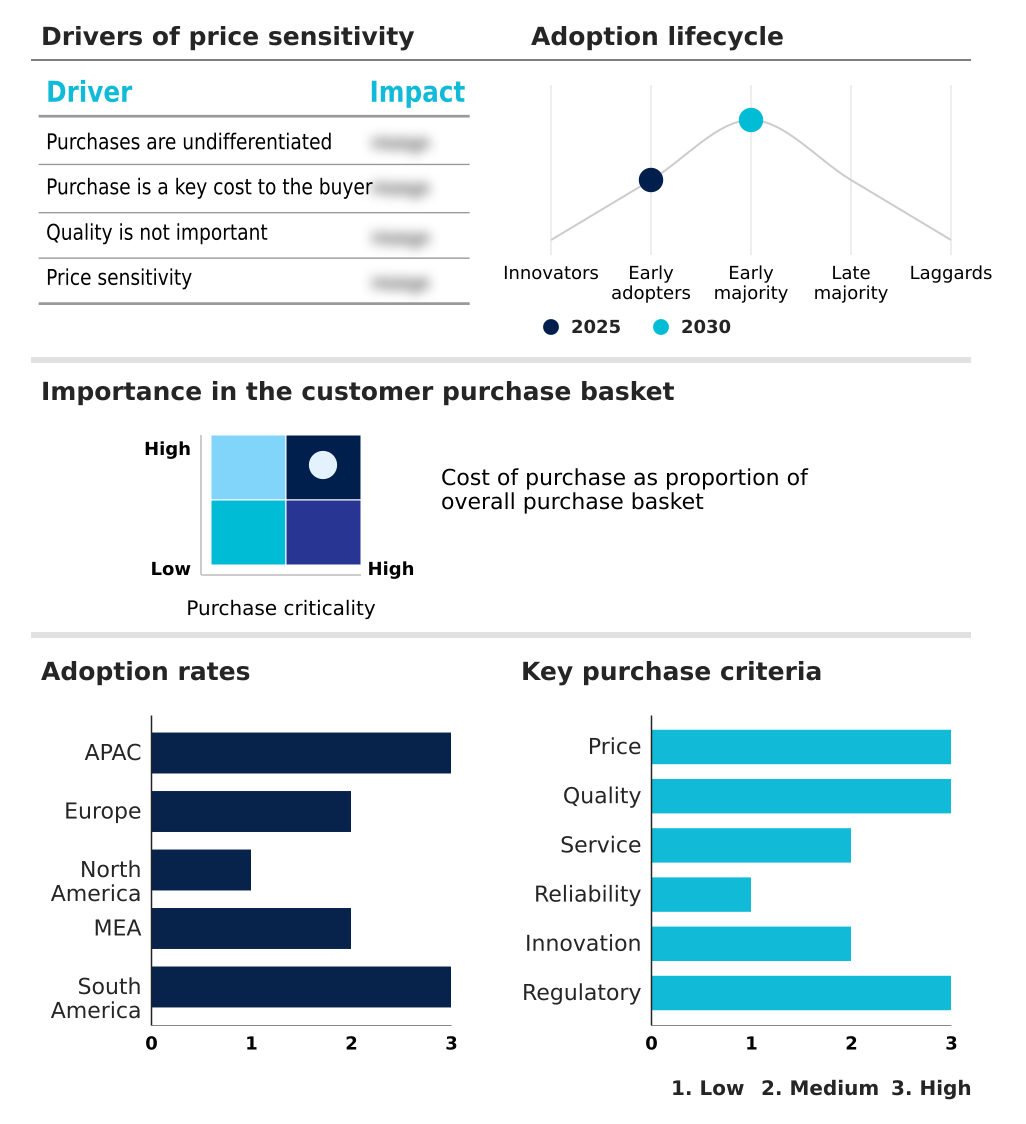
Customer Landscape of K-12 Makerspace Materials Industry
Competitive Landscape
Companies are implementing various strategies, such as strategic alliances, k-12 makerspace materials market forecast, partnerships, mergers and acquisitions, geographical expansion, and product/service launches, to enhance their presence in the industry.
Arduino Srl - Offerings include open-source microcontroller platforms and prototyping tools, central to electronics development and STEM education.
The industry research and growth report includes detailed analyses of the competitive landscape of the market and information about key companies, including:
- Arduino Srl
- Brown Dog Gadgets
- Dremel
- Elenco Electronics Inc.
- Flashforge
- Glowforge Inc.
- hand2mind Inc.
- LEGO System AS
- Makeblock Co. Ltd.
- Makedo
- MakerBot Industries LLC
- Makey Makey LLC.
- Modular Robotics Inc.
- Ozo EDU Inc.
- Prusa Research s.r.o.
- Snapmaker
- Sphero Inc.
- Strawbees AB
- Teknikio Inc.
- VEX Robotics Inc.
Qualitative and quantitative analysis of companies has been conducted to help clients understand the wider business environment as well as the strengths and weaknesses of key industry players. Data is qualitatively analyzed to categorize companies as pure play, category-focused, industry-focused, and diversified; it is quantitatively analyzed to categorize companies as dominant, leading, strong, tentative, and weak.
Recent Development and News in K-12 makerspace materials market
- In March 2025, Discovery Education supported mobile STEM and makerspace lab initiatives across multiple school districts in the United States, providing traveling learning units equipped with hands-on science and engineering kits.
- In April 2025, the Ministry of Education Australia expanded its national curriculum framework to include mandatory STEM-based project learning modules in secondary schools, leading to increased procurement of makerspace kits.
- In April 2025, Parrot expanded its educational drone program across European K-12 schools, introducing coding-enabled drone kits designed for classroom learning and robotics competitions.
- In May 2025, Tinkercad, an Autodesk brand, expanded its cloud-based 3D design and simulation tools for school students, allowing them to build and test digital prototypes remotely and increasing adoption in hybrid classrooms.
Dive into Technavio’s robust research methodology, blending expert interviews, extensive data synthesis, and validated models for unparalleled K-12 Makerspace Materials Market insights. See full methodology.
| Market Scope | |
|---|---|
| Page number | 301 |
| Base year | 2025 |
| Historic period | 2020-2024 |
| Forecast period | 2026-2030 |
| Growth momentum & CAGR | Accelerate at a CAGR of 12.5% |
| Market growth 2026-2030 | USD 3158.1 million |
| Market structure | Fragmented |
| YoY growth 2025-2026(%) | 11.1% |
| Key countries | China, Japan, India, South Korea, Australia, Indonesia, Germany, UK, France, Italy, Spain, The Netherlands, US, Canada, Mexico, Saudi Arabia, UAE, South Africa, Israel, Turkey, Brazil, Argentina and Chile |
| Competitive landscape | Leading Companies, Market Positioning of Companies, Competitive Strategies, and Industry Risks |
Research Analyst Overview
- The K-12 makerspace materials market is evolving beyond simple supply provision to become a cornerstone of modern pedagogy focused on skill-based learning. A key trend is the integration of hands-on learning tools directly into curriculum integration efforts, moving from standalone tinkering labs to essential classroom components.
- This shift toward experiential learning models and project-based learning requires a diverse range of materials, including programmable robotics kits, 3d printing filaments, and modular building kits. The adoption of ai-enabled learning tools and virtual engineering modules for digital prototyping is transforming instruction.
- For boardroom consideration, the growing emphasis on digital security and student safety protocols for equipment handling directly impacts institutional liability and IT budgeting. Schools leveraging integrated inventory management systems for their electronics components and coding modules have achieved a 25% reduction in material waste. The demand for eco-friendly materials and biodegradable materials is also rising.
- Expansion is supported by philanthropic foundations funding coding labs, mobile makerspaces, and portable learning labs to address infrastructure requirements and improve internet connectivity, especially for advanced applications like drones in robotics, which teach aerodynamics education and sensor-based navigation. Success hinges on a supply chain providing everything from microcontroller platforms with simplified coding interfaces to reusable connectors.
What are the Key Data Covered in this K-12 Makerspace Materials Market Research and Growth Report?
-
What is the expected growth of the K-12 Makerspace Materials Market between 2026 and 2030?
-
USD 3.16 billion, at a CAGR of 12.5%
-
-
What segmentation does the market report cover?
-
The report is segmented by Product (Robotic toolkit, Construction materials, Arts and crafts materials, and Others), Application (Elementary school, Middle school, and High school), End-user (Classroom, Library, Cafeteria, Office, and Others) and Geography (APAC, Europe, North America, Middle East and Africa, South America)
-
-
Which regions are analyzed in the report?
-
APAC, Europe, North America, Middle East and Africa and South America
-
-
What are the key growth drivers and market challenges?
-
Advent of advanced makerspace materials, Complexity in managing makerspaces is hampering market prosperity
-
-
Who are the major players in the K-12 Makerspace Materials Market?
-
Arduino Srl, Brown Dog Gadgets, Dremel, Elenco Electronics Inc., Flashforge, Glowforge Inc., hand2mind Inc., LEGO System AS, Makeblock Co. Ltd., Makedo, MakerBot Industries LLC, Makey Makey LLC., Modular Robotics Inc., Ozo EDU Inc., Prusa Research s.r.o., Snapmaker, Sphero Inc., Strawbees AB, Teknikio Inc. and VEX Robotics Inc.
-
Market Research Insights
- The K-12 makerspace materials market's dynamics are heavily influenced by the push for operational efficiency and measurable learning outcomes. The integration of classroom management software has demonstrated an ability to increase equipment utilization by up to 25%, maximizing institutional investment.
- Concurrently, effective makerspace inventory tracking systems are critical for reducing material waste by an average of 15%, directly impacting school budgets. The effectiveness of these tools is amplified by robust teacher professional development, which correlates with a 30% higher rate of successful project completion.
- These factors highlight a market shift toward integrated solutions that not only provide learning materials but also streamline management, improve resource allocation, and ensure that investments in hands-on learning deliver tangible educational returns.
We can help! Our analysts can customize this k-12 makerspace materials market research report to meet your requirements.
 RIA -
RIA -