


Organic Light-Emitting Diode Market Size 2024-2028
The organic light-emitting diode market size is forecast to increase by USD 65.78 billion at a CAGR of 18.52% between 2023 and 2028. The market is experiencing significant growth due to several key drivers. One major factor is the increasing adoption of OLED displays in various applications, such as smartwatches, tablets, and infotainment systems in automobiles. Additionally, the electric vehicle (EV) industry's shift towards OLED displays for dashboards is driving market expansion. However, the availability of less expensive substitutes poses a challenge to market growth. In the consumer electronics sector, innovations like foldable smartphones and curved TVs are fueling the demand for OLED displays. The automotive sector is also exploring OLED technology for rollable displays, enhancing the driving experience.

Organic Light-Emitting Diodes (OLED) have emerged as a promising alternative to traditional display technologies, such as LCDs (Liquid Crystal Displays) and LEDs (Light-Emitting Diodes), in various applications. OLED technology offers several advantages over its counterparts, including high contrast ratio, wide viewing angles, flexibility, transparency, and fast motion. In the consumer electronics sector, OLED displays have gained significant traction in smartphones, televisions, wearables, and automotive displays. The adoption of OLED technology in these applications is driven by its ability to deliver superior image quality, high brightness controls, and enhanced user experience.
Further, compared to LCDs, OLED displays offer several advantages. They provide deeper blacks, higher contrast ratios, and wider viewing angles. In addition, OLED displays are more flexible and can be made transparent, making them suitable for various applications, such as wearables and automotive displays. OLED technology also offers several benefits over LED displays. While LED displays use a backlight to illuminate the screen, OLED displays emit light directly from the pixels, resulting in better energy efficiency, faster response times, and improved image quality. The major factor driving the growth of the OLED market is the increasing demand for high-performance displays in consumer electronics. OLED displays offer several advantages over traditional LCD displays, making them an ideal choice for luxury car manufacturers, television manufacturers, and smartphone OEMs.
Moreover, the rapid advancement of OLED technology has led to the development of new applications, such as OLED lighting solutions. OLED lighting solutions offer several advantages over traditional lighting solutions, including energy efficiency, flexibility, and long lifespan. In the television market, OLED displays offer several advantages over LCD displays. They provide deeper blacks, wider viewing angles, and higher contrast ratios, resulting in a better viewing experience. In the smartphone market, OLED displays offer several advantages over LCD displays, including better energy efficiency, faster response times, and improved image quality. In the automotive display market, OLED displays offer several advantages over traditional LCD displays. They provide better viewing angles, higher contrast ratios, and faster response times, making them an ideal choice for in-car displays.
Market Segmentation
The market research report provides comprehensive data (region-wise segment analysis), with forecasts and estimates in "USD billion" for the period 2024-2028, as well as historical data from 2018-2022 for the following segments.
- Product
- OLED display
- OLED lighting
- Type
- Rigid
- Flexible
- Geography
- APAC
- China
- Japan
- South Korea
- North America
- US
- Europe
- South America
- Middle East and Africa
- APAC
By Product Insights
The OLED display segment is estimated to witness significant growth during the forecast period. In the realm of display technology, Organic Light-Emitting Diodes (OLED) are gaining traction among wearable device manufacturers. The shift from Liquid Crystal Displays (LCD) to OLED lighting is driven by several factors. Firstly, the demand for thinness and lightweight design in wearable devices necessitates the use of OLED displays. OLEDs offer design flexibility, allowing manufacturers to create devices with curved screens and flexible displays. Moreover, OLEDs provide uniform illumination and excellent color rendering, making them an ideal choice for wearable devices. However, the higher cost of OLED displays, due to the expensive raw materials, remains a challenge.
The oversupply of LCD display panels, coupled with the entry of low-cost manufacturers from China, has led to a decline in the average selling price (ASP) of LCD panels. Consequently, LCD companies are seeking alternative technologies to maintain profitability. OLED displays offer higher profitability due to their superior features and unique capabilities. In conclusion, the trend toward OLED displays in wearable devices is driven by the need for thinness, lightweight design, uniform illumination, and color rendering. Despite the higher cost, major players are investing in OLED fabrication units to capitalize on the growing demand for these displays.
Get a glance at the market share of various segments Request Free Sample
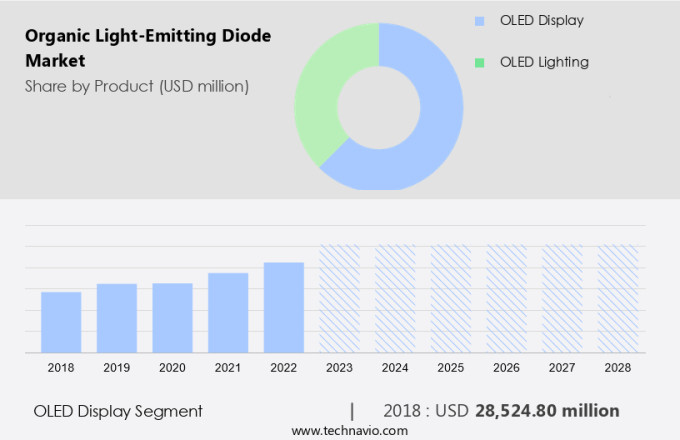
The OLED display segment accounted for USD 28.52 billion in 2018 and showed a gradual increase during the forecast period.
Regional Insights
APAC is estimated to contribute 59% to the growth of the global market during the forecast period. Technavio's analysts have elaborately explained the regional trends and drivers that shape the market during the forecast period.

For more insights on the market share of various regions Request Free Sample
The Organic Light-Emitting Diode (OLED) market is experiencing significant growth due to its adoption in luxury car manufacturers and various automotive applications such as Head-Up Displays (HUDs), instrument clusters, and central stack displays. The trend toward urbanization and energy savings is driving the demand for LED-based lighting in automobiles. APAC's dominance in the global OLED market can be attributed to several factors. Firstly, the region has a high concentration of Original Equipment Manufacturers (OEMs), including automobile and consumer electronic device manufacturers. Notable OEMs are located in countries like South Korea, Taiwan, Japan, and China. Secondly, China is a significant hub for OLED and Active-Matrix Organic Light-Emitting Diode (AMOLED) display manufacturers.
The presence of numerous display device manufacturers in the country is primarily due to the availability of abundant resources and low-cost labor. Lastly, major display panel manufacturers are based in APAC, further contributing to the region's market dominance. These factors collectively position APAC as a key player in the global OLED market. Buyers in this market include OEMs and lighting manufacturers. By focusing on the APAC market, these entities can capitalize on the region's advantages and tap into the growing demand for OLED technology in automotive applications.
Our researchers analyzed the data with 2023 as the base year, along with the key drivers, trends, and challenges. A holistic analysis of drivers will help companies refine their marketing strategies to gain a competitive advantage.
Market Driver
Increasing number of patent-related activities by market companies is the key driver of the market. The Organic Light-Emitting Diode (OLED) market's expansion is significantly influenced by the rising number of patent filings in the industry. Patents serve as exclusive licenses, granting the right to use an invention for a specified duration. This exclusivity deters competitors and newcomers from producing, utilizing, or selling the same technology.
Further, notable companies, such as Samsung Electronics and Universal Display Corp., have secured patents for OLED displays, safeguarding their Intellectual Property Rights (IPR). These patents act as a competitive advantage, enabling these firms to differentiate their offerings and maintain market dominance in the OLED technology landscape. The Organic LED market's growth is further driven by the increasing demand for cooperative display technologies in various applications, including Smartphones.
Market Trends
Increasing adoption of OLED displays in automotive sector is the upcoming trend in the market. The Organic Light-Emitting Diode (OLED) market in the US is experiencing notable growth, particularly in sectors such as smartwatches, tablets, automotive dashboards, infotainment systems, electric vehicles (EVs), foldable smartphones, curved TVs, and rollable displays. OLED technology's ability to deliver vibrant colors, high contrast ratios, and exceptional color reproduction makes it an attractive option for these applications. In the automotive industry, OLED displays offer several advantages, including enhanced brightness, superior visibility in various lighting conditions, increased durability, and the capability to display dynamic and interactive content.
Moreover, this growth can be attributed to the increasing demand for advanced display technologies in various end-use industries. The market is also witnessing collaboration and partnerships between technology companies, automotive manufacturers, and display suppliers to integrate OLED displays into their products. In conclusion, the US OLED market is poised for substantial growth in the coming years, driven by the increasing demand for advanced display technologies in various industries, particularly automotive and consumer electronics.
Market Challenge
Availability of less expensive substitutes is a key challenge affecting the market growth. Organic Light-Emitting Diodes (OLEDs) have gained significant attention in various industries due to their desirable features such as high contrast ratio, wide viewing angles, and fast response time. OLEDs are extensively used in Televisions, Wearables, Automotive displays, and Lighting solutions within the Consumer electronics sector. However, the high production costs and limited production capacity have hindered the widespread adoption of OLEDs compared to other display technologies like Plasma, TFT-LCD, LCD with LED backlight, and LED displays. Manufacturers face several challenges during the production of OLEDs. For instance, during the development phase, they encounter issues such as insufficient surface tension, low performance of blue emitters, and non-uniform deposition.
Additionally, despite these challenges, the demand for OLEDs continues to grow due to their superior display quality. To meet this demand, efforts are being made to improve production efficiency and reduce costs. Despite the high production costs and challenges, OLEDs offer several advantages over other display technologies. Their high contrast ratio, wide viewing angles, and fast response time make them an ideal choice for various applications. As the production technology evolves and economies of scale are realized, the cost of OLEDs is expected to decrease, making them more accessible to a wider audience.
Exclusive Customer Landscape
The market forecasting report includes the adoption lifecycle of the market, covering from the innovator's stage to the laggard's stage. It focuses on adoption rates in different regions based on penetration. Furthermore, the report also includes key purchase criteria and drivers of price sensitivity to help companies evaluate and develop their market growth analysis strategies.

Customer Landscape
Key Companies & Market Insights
Companies are implementing various strategies, such as strategic alliances, partnerships, mergers and acquisitions, geographical expansion, and product/service launches, to enhance their presence in the market.
Visionox Co. - The company offers organic light emitting diode solutions such as 17.3 inch UHD 4K Ink Jet Printing Display.
The market research and growth report includes detailed analyses of the competitive landscape of the market and information about key companies, including:
- AUO Corp.
- BOE Technology Group Co. Ltd.
- Futaba Corp.
- Innolux Corp.
- Japan Display Inc.
- Konica Minolta Inc.
- Kopin Corp.
- Kyocera Corp.
- LG Electronics Inc.
- Lumiotec Inc.
- Nippon Seiki Co. Ltd.
- OLEDWorks LLC
- OSRAM Licht AG
- RiTdisplay Corp.
- Samsung Electronics Co. Ltd.
- Sharp Corp.
- Sumitomo Chemical Co. Ltd.
- Tianma Microelectronics Co. Ltd.
- Truly International Holdings Ltd.
- Universal Display Corp.
Qualitative and quantitative analysis of companies has been conducted to help clients understand the wider business environment as well as the strengths and weaknesses of key market players. Data is qualitatively analyzed to categorize companies as pure play, category-focused, industry-focused, and diversified; it is quantitatively analyzed to categorize companies as dominant, leading, strong, tentative, and weak.
Research Analyst Overview
The market is experiencing significant growth due to the superior features offered by OLED displays compared to traditional display technologies like LCDs and LEDs. OLED technology enables high contrast ratio, wide viewing angles, and fast response time, making it an ideal choice for various applications in consumer electronics. Smartphones, televisions, wearables, automotive displays, and lighting solutions are major sectors driving the demand for OLED displays. OLED technology offers advantages such as thinness, lightweight, design flexibility, uniform illumination, and color rendering. These features make OLED displays an attractive option for manufacturers of smartwatches, tablets, automotive dashboards, infotainment systems, electric vehicles (EVs), foldable smartphones, curved TVs, rollable displays, and wearable devices.
Further, OLED lighting is another area where OLED technology is gaining popularity due to its energy-saving capabilities and sustainability. The use of organic molecules and conductors in OLED technology results in better image quality, fast motion, and bright controls. The rapid advancement of OLED technology is also making it an affordable option, with cost reduction being a major factor in its increasing adoption. Additionally, environmental considerations and sustainability are becoming increasingly important, and OLED technology's eco-friendly nature is another reason for its growing popularity.
|
Market Scope |
|
|
Report Coverage |
Details |
|
Page number |
178 |
|
Base year |
2023 |
|
Historic period |
2018-2022 |
|
Forecast period |
2024-2028 |
|
Growth momentum & CAGR |
Accelerate at a CAGR of 18.52% |
|
Market Growth 2024-2028 |
USD 65.78 billion |
|
Market structure |
Fragmented |
|
YoY growth 2023-2024(%) |
15.18 |
|
Regional analysis |
APAC, North America, Europe, South America, and Middle East and Africa |
|
Performing market contribution |
APAC at 59% |
|
Key countries |
China, US, South Korea, Japan, and Taiwan |
|
Competitive landscape |
Leading Companies, Market Positioning of Companies, Competitive Strategies, and Industry Risks |
|
Key companies profiled |
AUO Corp., BOE Technology Group Co. Ltd., Futaba Corp., Innolux Corp., Japan Display Inc., Konica Minolta Inc., Kopin Corp., Kyocera Corp., LG Electronics Inc., Lumiotec Inc., Nippon Seiki Co. Ltd., OLEDWorks LLC, OSRAM Licht AG, RiTdisplay Corp., Samsung Electronics Co. Ltd., Sharp Corp., Sumitomo Chemical Co. Ltd., Tianma Microelectronics Co. Ltd., Truly International Holdings Ltd., Universal Display Corp., and Visionox Co. |
|
Market dynamics |
Parent market analysis, market growth inducers and obstacles, market forecast, fast-growing and slow-growing segment analysis, COVID-19 impact and recovery analysis and future consumer dynamics, market condition analysis for the forecast period |
|
Customization purview |
If our market report has not included the data that you are looking for, you can reach out to our analysts and get segments customized. |
What are the Key Data Covered in this Market Research and Growth Report?
- CAGR of the market during the forecast period
- Detailed information on factors that will drive the market growth and forecasting between 2024 and 2028
- Precise estimation of the size of the market and its contribution of the market in focus to the parent market
- Accurate predictions about upcoming market growth and trends and changes in consumer behaviour
- Growth of the market across APAC, North America, Europe, South America, and Middle East and Africa
- Thorough analysis of the market's competitive landscape and detailed information about companies
- Comprehensive analysis of factors that will challenge the growth of market companies
We can help! Our analysts can customize this market research report to meet your requirements. Get in touch