


Self-Compacting Concrete Market Size 2024-2028
The self-compacting concrete market size is forecast to increase by USD 4.02 billion at a CAGR of 5.69% between 2023 and 2028. The self-compacting concrete (SCC) market is witnessing significant growth due to the increasing demand for superior surface finishes and mechanical performance in various industries. Notably, the oil and gas sector, including drilled shafts and oil pipelines, is a major consumer of SCC due to its ability to ensure uniform concrete compaction without the need for vibration. The American Concrete Institute defines SCC as concrete that flows and consolidates under its own weight without the need for external vibration. The market is driven by the expansion of the construction industry and the adoption of advanced technologies and materials, such as powder type, viscosity agent type, and combination type SCC. The powder form is made by mixing various fillers such as kaolin, limestone, metakaolin, and fly ash pozzolans. However, the market faces challenges due to the volatility in raw material prices, particularly cement and additives, which can impact the overall cost of production.

Self-consolidating concrete (SCC), also known as self-compacting concrete, is a high-performance concrete type that has gained significant attention in the construction industry. This concrete variant offers numerous advantages over traditional concrete mixtures, particularly in terms of workability and durability. In construction, SCC plays a crucial role in enhancing project efficiency and reducing labor costs. Its high deformability and moderate viscosity enable it to flow easily into tight spaces, eliminating the need for extensive tamping or vibration during placement. This characteristic is especially beneficial for residential projects, where complex architectural designs and limited accessibility can pose challenges.
Further, the self-compacting concrete market is expanding rapidly, driven by its use in high-performance concrete applications for commercial projects. This type of concrete is ideal for the precast industry, offering superior flowability and reduced mold requirements. With the inclusion of materials like Portland slag cement, gold cement, and silver cement, self-consolidating concrete provides enhanced durability and strength. Ready-mixed concrete and building chemicals further support its widespread adoption, making it a preferred choice in modern construction for both structural integrity and ease of use.
Market Segmentation
The market research report provides comprehensive data (region-wise segment analysis), with forecasts and estimates in "USD billion" for the period 2024-2028, as well as historical data from 2018-2022 for the following segments.
- Type
- Powder
- Combination
- Viscosity
- End-user
- Infrastructure
- Building and construction
- Oil and gas construction
- Geography
- Europe
- Germany
- UK
- North America
- US
- APAC
- China
- India
- South America
- Middle East and Africa
- Europe
By Type Insights
The powder segment is estimated to witness significant growth during the forecast period. Self-compacting concrete, also known as self-consolidating concrete, is a high-performance concrete type that ensures optimal finish and placement in construction projects. This concrete variant offers enhanced workability and flowability, which significantly reduces the risk of segregation during placement. The powder form of self-compacting concrete is gaining popularity due to its unique advantages. These additives improve the concrete's strength and workability. The use of powder self-compacting concrete simplifies construction processes, especially in complex structures, as it ensures uniformity and eliminates the need for excessive vibration.
Moreover, powder SCC offers superior durability and strength compared to traditional concrete mixes. Its high performance makes it an ideal choice for various construction applications, including residential, commercial, and infrastructure projects. The demand for powder self-compacting concrete is increasing due to its numerous benefits, such as improved workability, reduced placement time, and enhanced finish quality. In conclusion, the use of powder self-compacting concrete offers numerous advantages in construction projects, making it a preferred choice for builders and contractors. Its unique properties, including enhanced flowability and reduced segregation, simplify construction processes and ensure uniformity in complex structures. Additionally, its superior strength and durability make it an ideal choice for various construction applications, including residential, commercial, and infrastructure projects.
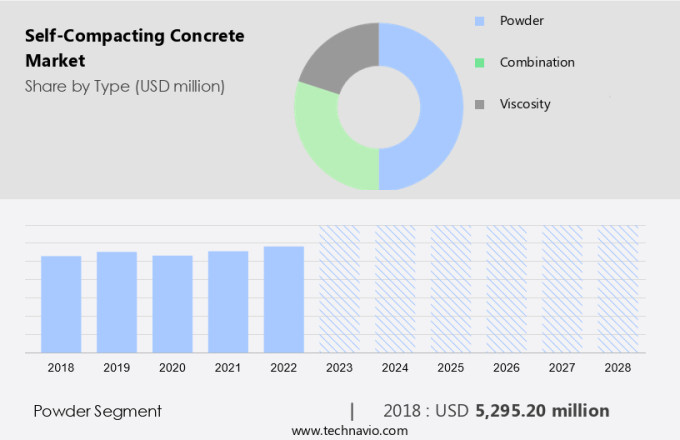
Get a glance at the market share of various segments Request Free Sample
The powder segment accounted for USD 5.30 billion in 2018 and showed a gradual increase during the forecast period.
Regional Insights
Europe is estimated to contribute 34% to the growth of the global market during the forecast period. Technavio's analysts have elaborately explained the regional trends and drivers that shape the market during the forecast period.

For more insights on the market share of various regions Request Free Sample
In the building and construction industry, self-compacting concrete has gained significant traction due to its unique properties, including moderate viscosity, high deformability, and strong segregation resistance. These characteristics make self-compacting concrete an ideal choice for various applications, particularly in oil and gas construction projects where low yield stress is required. The material's ability to fill molds without the need for tamping or other impediments makes it a cost-effective and efficient solution. The European construction market is expected to witness substantial growth in the coming years, with countries such as Germany, the UK, Spain, France, and Italy leading the charge.
Further, social, political, and economic factors are driving this growth, with the UK's evolving international relationships and trade agreements playing a significant role. Moreover, the economic recovery in Germany and Italy is fueling an increase in construction projects, further boosting the demand for self-compacting concrete. Self-compacting concrete is also an eco-friendly construction material, as it consumes less energy during manufacturing and construction compared to traditional concrete. As sustainability becomes a top priority for the construction industry, the adoption of self-compacting concrete is expected to increase. Overall, the market is poised for steady growth in the coming years, driven by the increasing demand for efficient, cost-effective, and eco-friendly construction materials.
Our researchers analyzed the data with 2023 as the base year, along with the key drivers, trends, and challenges. A holistic analysis of drivers will help companies refine their marketing strategies to gain a competitive advantage.
Market Driver
Growth in construction industry is the key driver of the market. Self-compacting concrete, also known as self-consolidating concrete, is gaining popularity in various industries, including the formwork sector and the repair industry, due to its numerous benefits. This concrete type is ideal for leveling concrete and wooden floors in both residential and commercial buildings, enabling the installation of vinyl tiles, ceramic tiles, carpets, and resilient flooring. The ease of application, strength, and durability of self-leveling concrete make it a preferred choice for construction activities. Moreover, the absence of the need for vibrational processes during setting up further fuels the market growth. In the US and North American markets, the infrastructure is well-established, with effective collaboration between public and private entities involved in the development and maintenance of existing and new construction projects.
Self-compacting concrete's ability to reduce labor time and MRO costs, as well as improve air quality, makes it a cost-effective and eco-friendly solution for various applications. The repair industry also benefits from the use of self-compacting concrete due to its ability to fill reinforced sections without the need for additional reinforcement, ensuring a vibration-free process.
Market Trends
Adoption of new technologies and materials is the upcoming trend in the market. Self-compacting concrete is a significant innovation in the US construction industry, offering advantages such as high strength, reduced labor requirements, and accelerated construction timelines. The industry's adoption of advanced technologies and the shift towards self-compacting concrete are boosting productivity, making it an increasingly popular choice. Moreover, ongoing research into the use of nano-materials, specifically nano SiO2, is gaining attention.
Nano self-compacting concrete displays enhanced properties, including superior strength, stability, sustainability, and eco-friendliness, making it an ideal solution for constructing earthquake-resistant buildings. This trend is anticipated to fuel market expansion during the forecast period.
Market Challenge
Volatility in raw material prices is a key challenge affecting the market growth. Self-compacting concrete (SCC) is a specialized concrete mix that boasts superior mechanical performance and surface finish. Its application is extensive in various sectors, including oil pipelines and drilled shafts in the oil and gas industry. The American Concrete Institute (ACI) classifies SCC into three types: powder type, viscosity agent type, and combination type. Manufacturing SCC involves the use of raw materials such as cement, aggregates, plasticizers, additives, or admixtures.
However, the heavy reliance on coal for cement production poses a challenge to market expansion. Factors influencing the operating cost of SCC include the management of manufacturing sites, transportation of concrete, and high labor costs. The escalating cost of cement due to the rising prices of raw materials like limestone, clay, shale, and fly ash further impedes market growth.
Exclusive Customer Landscape
The market forecasting report includes the adoption lifecycle of the market, covering from the innovator's stage to the laggard's stage. It focuses on adoption rates in different regions based on penetration. Furthermore, the report also includes key purchase criteria and drivers of price sensitivity to help companies evaluate and develop their market growth analysis strategies.
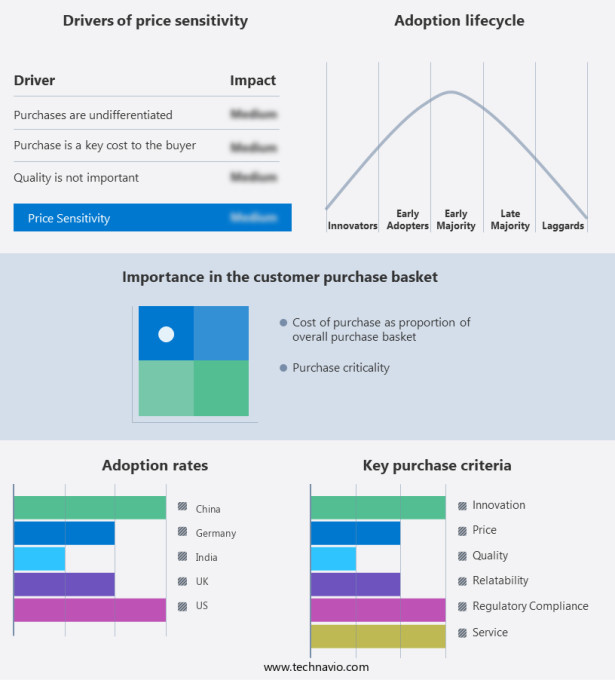
Customer Landscape
Key Companies & Market Insights
Companies are implementing various strategies, such as strategic alliances, partnerships, mergers and acquisitions, geographical expansion, and product/service launches, to enhance their presence in the market.
BASF SE - The company offers self-compacting concrete such as master X seed STE admixture.
The market research and growth report includes detailed analyses of the competitive landscape of the market and information about key companies, including:
- Adani Group
- Aditya Birla Management Corp. Pvt. Ltd.
- Breedon Group plc
- Buzzi SpA
- CEMEX SAB de CV
- CRH Plc
- CTS Cement Manufacturing Corp.
- Firth
- Flowcrete Group Ltd.
- Holcim Ltd.
- JMH International Ltd.
- Kilsaran
- Mapei SpA
- QUIKRETE Holdings Inc.
- RDC Concrete India Pvt. Ltd.
- Sakrete
- Sika AG
- TCC Materials
- Unibeton Ready Mix
Qualitative and quantitative analysis of companies has been conducted to help clients understand the wider business environment as well as the strengths and weaknesses of key market players. Data is qualitatively analyzed to categorize companies as pure play, category-focused, industry-focused, and diversified; it is quantitatively analyzed to categorize companies as dominant, leading, strong, tentative, and weak.
Research Analyst Overview
Self-compacting concrete, also known as self-consolidating concrete (SCC), is a high-performance concrete type that offers superior workability and placement characteristics. In the construction industry, SCC is increasingly being adopted for residential, commercial, and infrastructure projects due to its ability to ensure structural integrity and reduce labor requirements. SCC's high deformability and low yield stress enable it to flow freely into formwork without the need for vibration or tamping, making it an ideal choice for vibration-sensitive structures such as drilled shafts and oil pipelines in the oil and gas sector. Its strong segregation resistance and moderate viscosity allow for easy placement and finishing, resulting in a vibration-free process. The use of SCC in construction activities can lead to significant cost savings through reduced labor requirements and faster construction speed.
However, the cost factor is influenced by the use of specialized materials and admixtures. The concrete industry has seen a wave in education and training initiatives to increase industry knowledge and improve the quality of SCC. Regulations governing the use of SCC vary by region and application. Construction practices, such as noise pollution reduction and environmental impact minimization, are becoming increasingly important considerations in the use of SCC. The American Concrete Institute (ACI) provides guidelines and standards for the design, manufacturing processes, and examination procedures of SCC. SCC offers several advantages over conventional concrete, including improved surface finish, mechanical performance, and resistance to cracks in reinforced sections. Its use in infrastructure development, such as concrete frames and oil and gas sector projects, can lead to significant cost savings and improved structural integrity.
Further, the manufacturing processes for SCC involve the use of blended cement, bulk cement, and specialized admixtures like powder type, viscosity agent type, and combination type. Quality control is crucial in the production and placement of SCC to ensure its dependability and infrastructural development potential. In conclusion, self-compacting concrete is a high-performance concrete type that offers several advantages over conventional concrete, including improved workability, placement characteristics, and structural integrity. Its use in the construction industry is increasing due to its ability to reduce labor requirements, improve construction speed, and minimize environmental impact. The industry continues to evolve with advancements in manufacturing processes, examination procedures, and regulatory guidelines.
|
Market Scope |
|
|
Report Coverage |
Details |
|
Page number |
165 |
|
Base year |
2023 |
|
Historic period |
2018-2022 |
|
Forecast period |
2024-2028 |
|
Growth momentum & CAGR |
Accelerate at a CAGR of 5.69% |
|
Market growth 2024-2028 |
USD 4.02 billion |
|
Market structure |
Fragmented |
|
YoY growth 2023-2024(%) |
5.39 |
|
Regional analysis |
Europe, North America, APAC, South America, and Middle East and Africa |
|
Performing market contribution |
Europe at 34% |
|
Key countries |
US, China, Germany, UK, and India |
|
Competitive landscape |
Leading Companies, Market Positioning of Companies, Competitive Strategies, and Industry Risks |
|
Key companies profiled |
Adani Group, Aditya Birla Management Corp. Pvt. Ltd., BASF SE, Breedon Group plc, Buzzi SpA, CEMEX SAB de CV, CRH Plc, CTS Cement Manufacturing Corp., Firth, Flowcrete Group Ltd., Holcim Ltd., JMH International Ltd., Kilsaran, Mapei SpA, QUIKRETE Holdings Inc., RDC Concrete India Pvt. Ltd., Sakrete, Sika AG, TCC Materials, and Unibeton Ready Mix |
|
Market dynamics |
Parent market analysis, market growth inducers and obstacles, market forecast, fast-growing and slow-growing segment analysis, COVID-19 impact and recovery analysis and future consumer dynamics, market condition analysis for the forecast period |
|
Customization purview |
If our market report has not included the data that you are looking for, you can reach out to our analysts and get segments customized. |
What are the Key Data Covered in this Market Research and Growth Report?
- CAGR of the market during the forecast period
- Detailed information on factors that will drive the market growth and forecasting between 2024 and 2028
- Precise estimation of the size of the market and its contribution of the market in focus to the parent market
- Accurate predictions about upcoming market growth and trends and changes in consumer behaviour
- Growth of the market across Europe, North America, APAC, South America, and Middle East and Africa
- Thorough analysis of the market's competitive landscape and detailed information about companies
- Comprehensive analysis of factors that will challenge the growth of market companies
We can help! Our analysts can customize this market research report to meet your requirements. Get in touch