


SSD Controllers Market Size 2024-2028
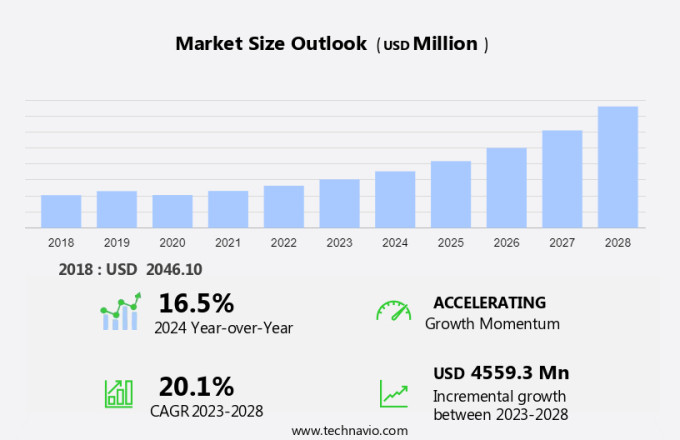
The SSD controllers market size is forecast to increase by USD 4.56 billion at a CAGR of 20.1% between 2023 and 2028.
- The SSD controller market is experiencing significant growth due to several key trends. The increasing demand for cloud-based data centers is driving market growth, as SSD controllers are essential components for these data centers. Additionally, the declining prices of SSD controllers are making them more accessible to a wider range of consumers and businesses. Furthermore, the high dependence on end products such as gaming consoles, smartphones, laptops, and servers that utilize SSDs is fueling market demand. These trends are expected to continue, making the SSD controller market a promising investment opportunity. However, challenges such as the high cost of advanced SSD controllers and the ongoing competition from HDDs and other storage technologies may hinder market growth.
What will be the Size of the SSD Controllers Market During the Forecast Period?
- The SSD controller market is experiencing significant growth due to the increasing demand for high-performance, reliable storage solutions. SSD controllers play a crucial role in managing data read/write operations, impacting read and write speeds, capacity, and overall performance. Specialized processors, such as ARM-based and multi-core controllers, are increasingly popular for their ability to handle large amounts of data transfer and advanced wear-leveling. Memory cells in SSDs require sophisticated management to ensure data integrity, durability, and error correction. SSD controllers employ various techniques like garbage collection, bad block management, thermal throttling, and self-encrypting drives to mitigate wear and maintain data security.
- Advanced features like error correction, encryption, and self-encrypting drives are becoming essential for enterprise-level applications. Manufacturers offer high-performance controllers, custom controllers, and generic controllers, catering to different market segments. Controller architecture continues to evolve, with NAND memory and advanced wear-leveling algorithms driving innovation.
How is this SSD Controllers Industry segmented and which is the largest segment?
The SSD controllers industry research report provides comprehensive data (region-wise segment analysis), with forecasts and estimates in "USD billion" for the period 2024-2028, as well as historical data from 2018-2022 for the following segments.
- End-user
- Data center and enterprise
- Client and retail
- Geography
- APAC
- China
- Japan
- South Korea
- North America
- US
- Europe
- South America
- Middle East and Africa
- APAC
By End-user Insights
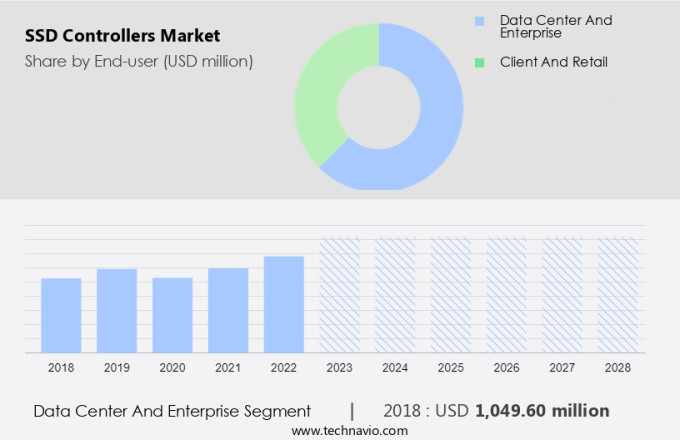
- The data center and enterprise segment is estimated to witness significant growth during the forecast period.
The global shift towards digitalization and cloud computing has led to an increasing demand for advanced storage solutions, particularly Solid State Drives (SSDs). SMEs are anticipated to account for 90% of cloud-based business operations by 2027, driving the need for high-performance, efficient, and scalable storage systems. SSD controllers play a crucial role in ensuring the optimal functioning of these drives, offering features like error correction, encryption, self-encrypting drives, and thermal throttling for enhanced durability and data security. With the global internet user base reaching 60% in 2022, the expansion of data centers is expected to continue, further fueling the growth of the SSD controller market. These advanced storage solutions enable businesses to maintain high computational power while enjoying the benefits of flexible, efficient, and scalable operations.
Get a glance at the SSD Controllers Industry report of share of various segments Request Free Sample
The data center and enterprise segment was valued at USD 1.05 billion in 2018 and showed a gradual increase during the forecast period.
Regional Analysis
- APAC is estimated to contribute 53% to the growth of the global market during the forecast period.
Technavio’s analysts have elaborately explained the regional trends and drivers that shape the market during the forecast period.

For more insights on the market share of various regions, Request Free Sample
The APAC region dominates the global enterprise market due to the presence of a significant number of SSD controller manufacturers. South Korea and Japan are the major contributors to this market, with many companies having production facilities in Southeast Asia. The region's low-cost manufacturing advantage is a significant factor driving market growth. SSD controllers utilize multi-core architectures, multiple channels, advanced wear-leveling, error-correction algorithms, strong encryption capabilities, and NAND memory. companies focus on enhancing data transfer rates and improving flash memory technology to meet the increasing demand for high-performance storage solutions. Key trends include the integration of machine learning and artificial intelligence algorithms to optimize SSD performance and reduce power consumption.
Market Dynamics
Our SSD controllers market researchers analyzed the data with 2023 as the base year, along with the key drivers, trends, and challenges. A holistic analysis of drivers will help companies refine their marketing strategies to gain a competitive advantage.
What are the key market drivers leading to the rise In the adoption of SSD Controllers Industry?
The increase in demand for cloud-based data centers is the key driver of the market.
- The SSD controller market is experiencing significant growth due to the increasing demand for high-performance storage solutions in data centers and cloud computing. SSD controllers play a crucial role in determining the read and write speeds, capacity, and overall performance impact of SSDs. Manufacturers continue to innovate by integrating specialized processors, advanced wear-leveling, error-correction algorithms, strong encryption capabilities, and self-encrypting drives into their SSD controller designs. SSDs utilize NAND memory, and the controller's architecture significantly influences their durability, data integrity, and compatibility. High-performance controllers often feature multi-core processors, multiple channels, and native NVMe support for improved data transfer. Additionally, SSDs require various management functions such as garbage collection, bad block management, thermal throttling, and TRIM support to ensure optimal performance and SSD lifespan.
- SSDs are essential for handling demanding workloads in data centers and cloud computing, where performance, reliability, endurance, and compatibility are critical. Enterprise-grade SSDs prioritize data integrity, error correction, and end-to-end data protection, making them suitable for mission-critical applications. Power efficiency is also a significant concern, as data centers aim to minimize energy consumption and reduce costs.
What are the market trends shaping the SSD Controllers Industry?
Declining prices of SSD controllers is the upcoming market trend.
- The SSD controller market has experienced a significant decline in prices due to increasing density and sales volumes. The density of SSD memory has decreased from 25 nm to below 20 nm, enabling manufacturers to add more memory cells In the same space. This density increase has led to a cost reduction per gigabyte as the storage capacity rises each year. The popularity of SSD controllers has also increased, allowing companies to lower prices and boost production, potentially resulting in further price drops. SSD controllers play a crucial role in determining the read and write speeds, capacity, and overall performance of SSDs.
- Specialized processors, advanced wear-leveling, error correction algorithms, and strong encryption capabilities are essential features of SSD controllers. SSD wear management techniques like garbage collection and bad block management ensure durability and data integrity. Thermal throttling is another important consideration for high-performance controllers to maintain performance during demanding workloads. SSDs come in various models, ranging from high-performance controllers to custom and generic ones. Controller architecture, such as ARM-based multi-core designs with multiple channels, significantly impacts data transfer rates and overall performance. NAND memory types and their advanced wear-leveling techniques also influence the SSD controller market. Enterprise-grade SSDs require native NVMe support, end-to-end data protection, and power efficiency for data centers and cloud computing applications.
What challenges does the SSD Controllers Industry face during its growth?
High dependence on end products is a key challenge affecting the industry's growth.
- The SSD controller market is driven by various factors, including the increasing demand for high-performance storage solutions in data centers and cloud computing, as well as the growing popularity of SSDs in mobile and computing devices. Read and write speeds, capacity, and performance impact are crucial considerations for manufacturers when designing SSD controllers. Specialized processors, SSD wear management, error correction, encryption, and self-encrypting drives are essential features. SSD controller architecture plays a significant role in determining the performance of data read/write operations. Advanced wear-leveling, error-correction algorithms, and strong encryption capabilities are essential for ensuring durability, data integrity, and reliability.
- NAND memory and flash memory are the primary types of memory used in SSDs. Manufacturers offer high-performance controllers, custom controllers, and generic controllers to cater to different market segments. The demand for enterprise-grade SSDs with native NVMe support and end-to-end data protection is increasing due to the growing need for power efficiency and endurance in demanding workloads. Thermal throttling, garbage collection, and bad block management are essential for optimizing SSD lifespan and ensuring TRIM support. The SSD controller market is expected to grow significantly due to the increasing demand for SSDs in various applications, including data centers, cloud computing, and real-time data compression.
Exclusive Customer Landscape
The SSD controllers market forecasting report includes the adoption lifecycle of the market, covering from the innovator’s stage to the laggard’s stage. It focuses on adoption rates in different regions based on penetration. Furthermore, the SSD controllers market report also includes key purchase criteria and drivers of price sensitivity to help companies evaluate and develop their market growth analysis strategies.

Customer Landscape
Key Companies & Market Insights
Companies are implementing various strategies, such as strategic alliances, SSD controllers market forecast, partnerships, mergers and acquisitions, geographical expansion, and product/service launches, to enhance their presence In the industry. The industry research and growth report includes detailed analyses of the competitive landscape of the market and information about key companies, including:
- ADATA Technology Co. Ltd.
- CNEX Labs Inc.
- Greenliant Systems
- Hyperstone GmbH
- Intel Corp.
- IntelliProp Inc.
- Kingston Technology Co. Inc.
- Kioxia Holdings Corp
- Marvell Technology Inc.
- Microchip Technology Inc.
- Micron Technology Inc.
- Phison Electronics Corp.
- Realtek Semiconductor Corp.
- Samsung Electronics Co. Ltd.
- Seagate Technology LLC
- Silicon Motion Technology Corp.
- SK hynix Co. Ltd.
- Toshiba Corp.
- Transcend Information Inc.
- Western Digital Corp.
Qualitative and quantitative analysis of companies has been conducted to help clients understand the wider business environment as well as the strengths and weaknesses of key industry players. Data is qualitatively analyzed to categorize companies as pure play, category-focused, industry-focused, and diversified; it is quantitatively analyzed to categorize companies as dominant, leading, strong, tentative, and weak.
Research Analyst Overview
The storage industry has witnessed a significant shift from traditional hard disk drives (HDDs) to Solid State Drives (SSDs) due to their superior performance and reliability. At the heart of an SSD is the SSD controller, a crucial component that manages data read/write operations and ensures optimal performance. SSD controllers are specialized processors designed to handle the intricacies of NAND memory, which is the primary type of memory used in SSDs. These controllers play a pivotal role in determining the read and write speeds, capacity, and overall performance of an SSD.
Moreover, the performance impact of SSD controllers is substantial. They employ advanced wear-leveling algorithms and error correction capabilities to maintain data integrity and prolong the lifespan of the SSD. Moreover, they support features like garbage collection, bad block management, and thermal throttling to mitigate wear and ensure consistent performance. Modern SSD controllers incorporate ARM-based, multi-core architectures, which offer enhanced data transfer rates and improved power efficiency. These controllers support high-performance SSDs with multiple channels, enabling seamless data transfer and handling demanding workloads. SSDs come in various forms, including enterprise-grade models and self-encrypting drives, each requiring specific controller architectures.
Furthermore, custom controllers cater to the unique requirements of these SSDs, offering strong encryption capabilities, native NVMe support, and end-to-end data protection. Generic controllers, on the other hand, offer a more cost-effective solution for consumers and smaller businesses. They may not offer the same level of performance and features as custom controllers but still provide reliable and efficient storage solutions. The role of SSD controllers extends beyond performance and reliability. They also influence the compatibility and durability of SSDs. Compatibility with different operating systems and hardware is essential, and SSD controllers ensure seamless integration. Furthermore, they contribute to the durability of SSDs by managing data integrity and wear management effectively.
|
SSD Controllers Market Scope |
|
|
Report Coverage |
Details |
|
Page number |
145 |
|
Base year |
2023 |
|
Historic period |
2018-2022 |
|
Forecast period |
2024-2028 |
|
Growth momentum & CAGR |
Accelerate at a CAGR of 20.1% |
|
Market Growth 2024-2028 |
USD 4.56 billion |
|
Market structure |
Fragmented |
|
YoY growth 2023-2024(%) |
16.5 |
|
Key countries |
China, South Korea, US, Taiwan, and Japan |
|
Competitive landscape |
Leading Companies, Market Positioning of Companies, Competitive Strategies, and Industry Risks |
What are the Key Data Covered in this SSD Controllers Market Research and Growth Report?
- CAGR of the SSD Controllers industry during the forecast period
- Detailed information on factors that will drive the SSD Controllers growth and forecasting between 2024 and 2028
- Precise estimation of the size of the market and its contribution of the industry in focus to the parent market
- Accurate predictions about upcoming growth and trends and changes in consumer behaviour
- Growth of the market across APAC, North America, Europe, South America, and Middle East and Africa
- Thorough analysis of the market’s competitive landscape and detailed information about companies
- Comprehensive analysis of factors that will challenge the SSD controllers market growth of industry companies
We can help! Our analysts can customize this SSD controllers market research report to meet your requirements.