



Surgical Drainage Devices Market Size and Trends
The surgical drainage devices market size is forecast to increase by USD 425.3 million, at a CAGR of 3.7% between 2023 and 2028. In the healthcare industry, the demand for surgical drainage devices is on the rise due to an increase in post-operative patients in hospitals, ambulatory surgical centers, and clinics. Neurological diseases, eye diseases, and cardiovascular diseases are among the leading causes for surgeries, resulting in a higher need for these devices. Minimally invasive surgeries have become increasingly popular, leading to a greater reliance on surgical drainage devices to minimize complications and expedite recovery. However, the use of these devices comes with potential risks such as surgical site infections. To mitigate these risks, advancements in local anesthesia delivery via surgical drains are being explored. This report provides a comprehensive analysis of the market trends and growth factors driving the market.

The market plays a significant role in the healthcare industry, particularly in the context of post-operative care. These devices are essential for the removal of excess fluids, such as blood or lymph, that accumulate during surgical procedures. The primary objective of surgical drainage devices is to prevent complications, including infection and air buildup, which can prolong hospital stays and increase out-of-pocket expenses for patients. Surgical drainage devices are utilized extensively across various medical specialties, including neurological diseases, eye diseases, cardiovascular diseases, and cancer-related surgeries. In cancer-related surgeries, for instance, these devices help reduce edema and promote wound healing. In neurological and eye diseases, they help manage cerebrospinal fluid leakage and vitreous humor drainage, respectively. Hospitals, ambulatory surgical centers, and clinics are the primary end-users of surgical drainage devices. The increasing prevalence of chronic diseases and the growing number of surgeries performed annually contribute to the market's growth. According to the Centers for Disease Control and Prevention (CDC), approximately 51 million surgeries were performed in the US in 2019. This number is expected to increase due to the aging population and the rising incidence of chronic diseases. Surgical drainage devices come in various types, including negative pressure wound drainage systems and traditional Penrose drains. Negative pressure wound drainage systems, such as Acelity's VAC Therapy, promote wound healing by maintaining a negative pressure environment, which helps reduce the risk of infection and promote tissue granulation. Penrose drains, on the other hand, are simple, low-cost, and disposable tubes used for draining small amounts of fluid.
Medical technology advancements have led to the development of more sophisticated surgical drainage devices. For example, some devices are designed to minimize infection risks by incorporating antimicrobial agents or using closed systems. Others offer advanced features, such as real-time drainage volume monitoring, which enables healthcare professionals to optimize drainage and improve patient care. Investments in healthcare and medical technology continue to fuel the growth of the market. The increasing adoption of minimally invasive surgeries and the rising trend of medical tourism also contribute to the market's expansion. Plastic surgery and cosmetic surgeries, which often involve the use of surgical drainage devices, are also driving market growth. In conclusion, the market plays a vital role in enhancing patient recovery and reducing hospital readmissions. These devices are essential for the effective management of post-operative care across various medical specialties. The market's growth is driven by the increasing number of surgeries, advancements in medical technology, and investments in healthcare.
Market Segmentation
The market research report provides comprehensive data (region-wise segment analysis), with forecasts and estimates in "USD million" for the period 2024-2028, as well as historical data from 2018 - 2022 for the following segments.
- Application
- Thoracic and cardiovascular surgeries
- Neurosurgical procedures
- Abdominal surgery
- Orthopedics
- Others
- End-user
- Hospitals
- Ambulatory surgical centers
- Clinics
- Geography
- North America
- Canada
- US
- Europe
- Germany
- UK
- France
- Italy
- Asia
- China
- India
- Japan
- South Korea
- Rest of World (ROW)
- North America
By Application Insights
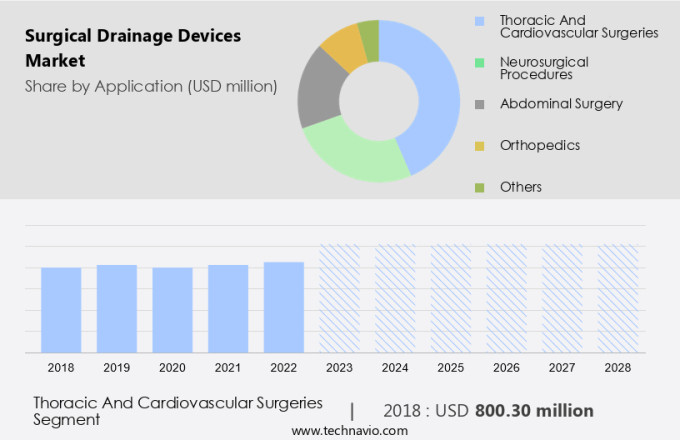
The thoracic and cardiovascular surgeries segment is estimated to witness significant growth during the forecast period. The market experiences significant demand in the context of various surgical procedures, particularly thoracic and cardiovascular surgeries. Obesity-related cardiac surgeries have seen a rise in number due to increasing obesity rates in the population. These surgeries carry an elevated risk of complications such as postoperative bleeding, which can lead to the need for extended mechanical ventilation and increased susceptibility to infections.
Get a glance at the market share of various segments Download the PDF Sample
The thoracic and cardiovascular surgeries segment was valued at USD 800.30 million in 2018. Bacterial infections are a significant concern following surgeries, and they can be exacerbated by factors like alcohol consumption and smoking. Breast reconstruction surgeries and cosmetic surgeries, including laparoscopic and plastic surgeries, also contribute to the market's growth. Infection rates remain a critical concern in these procedures, especially with the increasing number of reconstructive surgeries. The cost of surgeries continues to be a significant factor influencing the market's growth. As the demand for minimally invasive procedures rises, the market for surgical drainage devices is expected to expand further. In summary, the market is driven by the increasing number of surgeries, particularly thoracic and cardiovascular procedures, and the need to mitigate the risks of postoperative complications.
Regional Analysis

For more insights on the market share of various regions Download PDF Sample now!
North America is estimated to contribute 28% to the growth of the global market during the forecast period. Technavio's analysts have elaborately explained the regional trends and drivers that shape the market during the forecast period. In the healthcare landscape, surgical drainage devices play a crucial role in post-surgical care, particularly in the management of fluid accumulation following various procedures. Hospital stays have been a focus of surgical care guidelines to reduce out-of-pocket expenses and re-admissions for patients. Chronic diseases, such as cancer, necessitate multiple surgeries, increasing the demand for these devices. According to the Organization for Economic Co-operation and Development (OECD), there has been a significant increase in the number of cataract-related surgeries in the US and Canada, contributing to the market growth. Tonsillectomies, a common procedure, have transitioned from inpatient to outpatient care in several countries, further boosting the demand. However, the COVID-19 pandemic led to a decline in surgical procedures due to infection risks and restrictions, impacting the market negatively.
Our researchers analyzed the data with 2023 as the base year, along with the key drivers, trends, and challenges. A holistic analysis of drivers will help companies refine their marketing strategies to gain a competitive advantage.
Surgical Drainage Devices Market Driver
The rise in the number of surgeries is notably driving market growth. In the context of the rising prevalence of chronic diseases, particularly cancer, in the United States, the need for surgical drainage devices has become increasingly significant. According to the American Cancer Society, an estimated 2,001,140 new cancer cases are anticipated to be diagnosed in the US by 2024. Surgical procedures, such as mastectomies and reconstructions, which are common for cancer treatment, necessitate the use of surgical drainage units to prevent postoperative complications. These devices facilitate the removal of excess fluid from the surgical site, thereby reducing edema.
Several types of surgical drainage devices are available in the market, including Penrose drains, Negative Pressure Wound Therapy (NPWT) systems, and customized drainage devices. Notable market players include Acelity and Cardinal Health. NPWT systems, which utilize negative pressure to accelerate the healing process, have gained popularity due to their effectiveness in reducing air buildup and promoting faster recovery. Medical tourism has also contributed to the growth of the market, as patients from different regions seek advanced medical treatments. Thus, such factors are driving the growth of the market during the forecast period.
Surgical Drainage Devices Market Trends
Local anesthesia delivery via surgical drains is the key trend in the market. Surgical drainage devices have gained significant importance in post-operative care for patients undergoing surgeries in hospitals, ambulatory surgical centers, and clinics. These devices are particularly useful in managing the accumulation of excess fluids at surgical sites, reducing the risk of complications such as surgical site infections. Neurological and eye diseases, as well as cardiovascular conditions like heart disease, strokes, and type 2 diabetes, have led to an increase in the number of surgeries being performed.
Minimally invasive surgeries have also become increasingly popular, leading to a rise in the demand for surgical drainage devices. Local anesthesia, while effective in minimizing acute pain, is not always sufficient in managing chronic pain post-surgery. Surgical drainage devices offer an effective solution by providing local anesthesia directly to the surgical site, providing pain relief for several hours after the procedure. The market for surgical drainage devices is expected to grow due to the increasing number of surgeries performed and the need for effective post-operative care. Thus, such trends will shape the growth of the market during the forecast period.
Surgical Drainage Devices Market Challenge
Postoperative complications associated with surgical drainage devices is the major challenge that affects the growth of the market. Surgical drains play a crucial role in managing fluid accumulation and preventing complications following various surgical procedures, including thoracic and cardiovascular surgeries. However, their use comes with certain risks. One potential issue is the possibility of drains breaking during removal, which can lead to severe complications necessitating additional surgical interventions. Moreover, drains may get entangled with IV tubes or electrocardiogram leads, resulting in bleeding or discomfort for patients. Healthcare professionals may also face challenges when extracting drains attached to deep-seated wounds, prolonging the postoperative care process.
A significant concern is the risk of bacterial growth due to excessive fluid buildup in the drainage system. Negative pressure therapy, commonly used in chest drainage systems, can help mitigate this risk. In the context of ambulatory surgical centers and specialty clinics, the proper management of surgical drains is essential to ensure optimal patient outcomes and reduce the risk of complications. Hence, the above factors will impede the growth of the market during the forecast period
Exclusive Customer Landscape
The market forecasting report includes the adoption lifecycle of the market, covering from the innovator's stage to the laggard's stage. It focuses on adoption rates in different regions based on penetration. Furthermore, the report also includes key purchase criteria and drivers of price sensitivity to help companies evaluate and develop their market growth analysis strategies.

Customer Landscape
Key Companies & Market Insights
Companies are implementing various strategies, such as strategic alliances, partnerships, mergers and acquisitions, geographical expansion, and product/service launches, to enhance their presence in the market.
3M Co. - The company offers surgical drainage devices such as Prevena.
The market research and growth report also includes detailed analyses of the competitive landscape of the market and information about key companies, including:
- ATMOS MedizinTechnik GmbH and Co. KG
- Axiom Medical Consulting LLC
- Becton Dickinson and Co.
- Bicakcilar Medical Devices
- Cardinal Health Inc.
- Chimed srl
- Cook Group Inc.
- Getinge AB
- Integra LifeSciences Holdings Corp.
- Johnson and Johnson Inc.
- Medela AG
- Medtronic Plc
- QMD
- Redax S.p.A.
- Sinapi Biomedical
- Smiths Group Plc
- Sterimed Medical Devices Pvt. Ltd.
- Stryker Corp.
- Teleflex Inc.
Qualitative and quantitative analysis of companies has been conducted to help clients understand the wider business environment as well as the strengths and weaknesses of key market players. Data is qualitatively analyzed to categorize companies as pure play, category-focused, industry-focused, and diversified; it is quantitatively analyzed to categorize companies as dominant, leading, strong, tentative, and weak.
Surgical drainage devices are essential medical tools used to manage fluid accumulation and air buildup after various surgical interventions. These devices play a crucial role in post-operative care, particularly in surgeries for chronic diseases such as cancer, neurological disorders, and cardiovascular diseases. The use of surgical drainage devices helps reduce the risk of hospital stay, re-admission, and out-of-pocket expenses associated with surgical complications. Two common types of surgical drainage devices include active drainage devices, such as those using negative pressure therapy, and passive drainage devices, such as Penrose drains. Customized drainage devices cater to specific surgical needs, such as chest drainage systems for thoracic surgeries and suction devices for neurological procedures.
Minimally invasive surgeries, like laparoscopy, also benefit from drainage devices to manage fluid buildup and minimize post-operative complications. Sterility and drainage efficiency are essential considerations when selecting surgical drainage devices. Antimicrobial materials and personalized medicine approaches help mitigate infection risks, ensuring optimal patient care in hospitals, ambulatory surgical centers, and clinics. The advancement of medical technology continues to drive investments in surgical drainage devices, offering innovative solutions for various surgical procedures and patient populations.
|
Market Scope |
|
|
Report Coverage |
Details |
|
Page number |
203 |
|
Base year |
2023 |
|
Historic period |
2018 - 2022 |
|
Forecast period |
2024-2028 |
|
Growth momentum & CAGR |
Accelerate at a CAGR of 3.7% |
|
Market Growth 2024-2028 |
USD 425.3 million |
|
Market structure |
Fragmented |
|
YoY growth 2023-2024(%) |
3.6 |
|
Regional analysis |
North America, Europe, Asia, and Rest of World (ROW) |
|
Performing market contribution |
North America at 28% |
|
Key countries |
US, China, Japan, Canada, Germany, India, UK, South Korea, France, and Italy |
|
Competitive landscape |
Leading Companies, Market Positioning of Companies, Competitive Strategies, and Industry Risks |
|
Key companies profiled |
3M Co., ATMOS MedizinTechnik GmbH and Co. KG, Axiom Medical Consulting LLC, Becton Dickinson and Co., Bicakcilar Medical Devices, Cardinal Health Inc., Chimed srl, Cook Group Inc., Getinge AB, Integra LifeSciences Holdings Corp., Johnson and Johnson Inc., Medela AG, Medtronic Plc, QMD, Redax S.p.A., Sinapi Biomedical, Smiths Group Plc, Sterimed Medical Devices Pvt. Ltd., Stryker Corp., and Teleflex Inc. |
|
Market dynamics |
Parent market analysis, Market growth inducers and obstacles, Fast-growing and slow-growing segment analysis, COVID-19 impact and recovery analysis and future consumer dynamics, Market condition analysis for market forecast period. |
|
Customization purview |
If our market report has not included the data that you are looking for, you can reach out to our analysts and get segments customized. |
What are the Key Data Covered in this Market Research Report?
- CAGR of the market during the forecast period
- Detailed information on factors that will drive the market growth and forecasting between 2024 and 2028
- Precise estimation of the size of the market and its contribution of the market in focus to the parent market
- Accurate predictions about upcoming market growth and trends and changes in consumer behaviour
- Growth of the market across North America, Europe, Asia, and Rest of World (ROW)
- Thorough analysis of the market's competitive landscape and detailed information about companies
- Comprehensive analysis of factors that will challenge the growth of market companies
We can help! Our analysts can customize this market research report to meet your requirements.