



Vertical-Specific Software Market Size 2025-2029
The vertical-specific software market size is forecast to increase by USD 111.7 billion, at a CAGR of 11.4% between 2024 and 2029.
- The market is experiencing significant growth due to the increasing adoption of active IoT devices and the need for efficient data collection and resource utilization. Product functionality is a key focus area, with data analytics playing a crucial role in enhancing sales and marketing efforts. Customization and industry-specific tools are essential for businesses seeking user-friendly UI/UX and improved productivity. Cloud-based solutions are gaining popularity due to their flexibility and scalability. Digital transformation and mergers and acquisitions are driving market growth, while the high initial cost remains a challenge. Companies must navigate these trends and address resource constraints to remain competitive in this dynamic market.
What will be the Size of the Market During the Forecast Period?
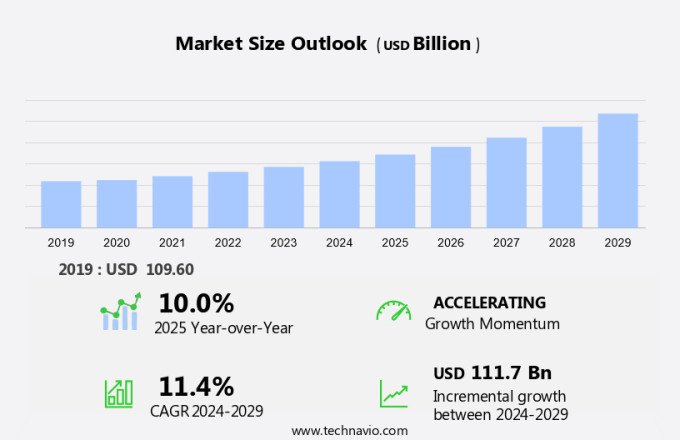
- The software industry that caters to the unique requirements of various industries. This market encompasses a range of applications, including commerce applications, customer relationship management (CRM), supply chain management, enterprise resource planning (ERP), financial applications, HR and payroll, office productivity, product lifecycle management, and more. Vertical-specific software solutions offer industry-tailored functionality and user-friendly UI/UX, enabling organizations to streamline their operations and enhance productivity. The market is characterized by its continuous evolution, driven by advancements in technology and the increasing demand for customized solutions. Resource utilization is a critical factor in the market.
- Cloud-based solutions have gained significant traction due to their flexibility and cost-effectiveness. Subscription-based pricing models have also emerged as a popular choice, allowing businesses to pay for only the services they need and scale up or down as required. Data analytics plays a pivotal role in the market. By providing insights into customer behavior, sales trends, and operational efficiency, data analytics enables organizations to make informed decisions and optimize their operations. AI integration is another key trend, with many software providers incorporating machine learning algorithms to automate processes and improve accuracy. The market offers integrated services, including payment processing, financial services, and compliance software.
How is this market segmented and which is the largest segment?
The market research report provides comprehensive data (region-wise segment analysis), with forecasts and estimates in "USD billion" for the period 2025-2029, as well as historical data from 2019-2023 for the following segments.
- End-user
- Banking and financial services
- Healthcare and pharmaceuticals
- Telecom
- Manufacturing
- Others
- Deployment
- On-premises
- Cloud
- Geography
- North America
- Canada
- US
- Europe
- Germany
- UK
- France
- APAC
- China
- India
- Japan
- South Korea
- South America
- Brazil
- Middle East and Africa
- North America
By End-user Insights
- The banking and financial services segment is estimated to witness significant growth during the forecast period.
Vertical-specific software plays a crucial role in the banking and financial services industry, catering to its distinct operational requirements. These solutions are engineered to adhere to the intricate regulatory frameworks, rigorous risk management practices, and sophisticated CRM demands of the financial sector. By implementing these tailored software applications, financial institutions can optimize their processes, boost productivity, and substantially cut costs, all while safeguarding the security and authenticity of financial transactions. Core banking systems represent the foundation of financial institutions, managing customer accounts, transaction processing, and other fundamental banking functions. Core banking systems enable banks to deliver uninterrupted services to their clientele, ensuring that all transactions are executed with precision and speed.
Subscription-based pricing and AI integration are two emerging trends in the market. Subscription-based pricing models offer financial institutions flexibility and cost savings, while AI integration enhances operational efficiency and customer experience. Mobile applications have become indispensable tools for banking and financial services, providing customers with on-the-go access to their accounts and transactions. CRM software and healthcare solutions are other specialized verticals that cater to unique industry needs, offering advanced features and customized functionalities. On-premise software and internet connectivity are essential components of vertical-specific software solutions, ensuring seamless integration and secure data access. As the financial sector continues to evolve, the demand for innovative and efficient software solutions will persistently grow.
In conclusion, vertical-specific software solutions are indispensable for the banking and financial services sector, addressing its unique operational needs and regulatory requirements. Core banking systems, subscription-based pricing, AI integration, mobile applications, CRM software, healthcare solutions, on-premise software, and internet connectivity are some of the key trends and components shaping the market.
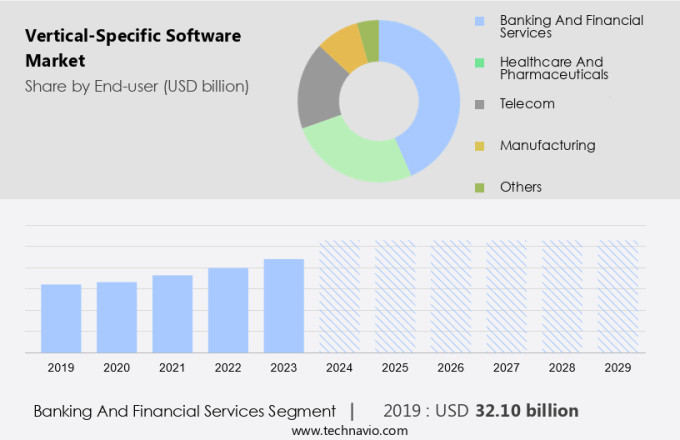
Get a glance at the market report of share of various segments Request Free Sample
The Banking and financial services segment was valued at USD 32.10 billion in 2019 and showed a gradual increase during the forecast period.
Regional Analysis
- North America is estimated to contribute 34% to the growth of the global market during the forecast period.
Technavio's analysts have elaborately explained the regional trends and drivers that shape the market during the forecast period.
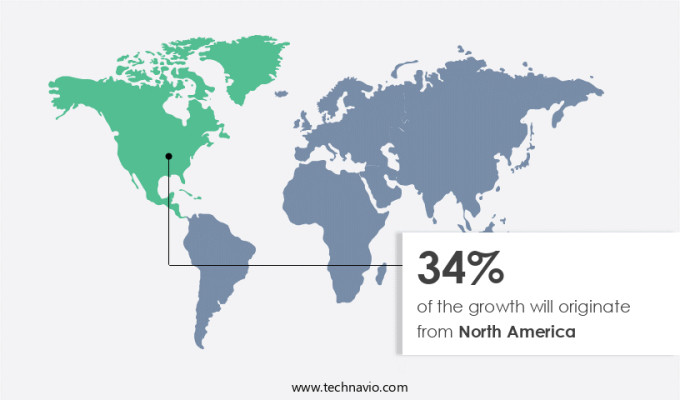
For more insights on the market share of various regions Request Free Sample
The market in North America is witnessing notable expansion, fueled by technological advancements, strategic collaborations, and the increasing demand for customized solutions in various industries. Key verticals, including commerce applications, customer relationship management, supply chain management, enterprise resource planning, financial applications, HR and payroll, office productivity, product lifecycle management, and more, are embracing software solutions to streamline operations and enhance productivity. One significant development in this domain is the establishment of EDC VENTURE LLC's first North American data center in Atlanta, Georgia. This cutting-edge facility boasts a highly efficient design, featuring waterless cooling technology, marking a significant stride in the US data center sector. Part of a larger 168 MW campus, Edged Atlanta, this data center aims to cater to the escalating need for data processing and storage capabilities in the region. This investment underscores the growing importance of advanced infrastructure in supporting the market's continued growth.
Market Dynamics
Our researchers analyzed the data with 2024 as the base year, along with the key drivers, trends, and challenges. A holistic analysis of drivers will help companies refine their marketing strategies to gain a competitive advantage.
What are the key market drivers leading to the rise in adoption of Vertical-Specific Software Market?
Digital transformation across industries is the key driver of the market.
- The digital transformation trend is significantly fueling the expansion of The market. According to estimates, global spending on digital transformation is projected to reach an impressive USD1.8 trillion by 2022, with further growth anticipated to USD2.8 trillion by 2025. This remarkable growth underscores the substantial investments businesses are making to modernize their operations and incorporate digital technologies. The World Economic Forum predicts that digital transformation could potentially generate an astounding USD100 trillion in value for both society and industry by 2025. This transformation is not confined to a single sector but encompasses multiple industries, such as healthcare, finance, manufacturing, and education.
- In the US market, large enterprises in these sectors are increasingly adopting cloud-based solutions for digital transformation, focusing on areas like supply chain optimization, cybersecurity, and risk management. The benefits of these solutions include improved efficiency, enhanced security, and streamlined operations. This trend is expected to continue as businesses prioritize digital transformation to remain competitive in today's market.
What are the market trends shaping the Vertical-Specific Software Market?
Mergers and acquisitions is the upcoming trend in the market.
- The market in the United States is experiencing a notable trend of consolidation as companies aim to broaden their market scope and augment their product capabilities. Notable mergers and acquisitions reflect the strategic actions of major players to fortify their market positions and capitalize on synergies among various industries. For instance, in June 2023, Total Specific Solutions (TSS) acquired Deal Informatique and its subsidiary Planilog. This strategic acquisition bolsters TSS's presence in the US market, notably in the construction, agriculture, industry, and public sectors in the US. Deal Informatique's extensive suite of solutions complements TSS's offerings, empowering them to deliver more all-encompassing and integrated software solutions to their clients.
- Data collection and analysis play a crucial role in the market, driving the need for advanced product functionality and resource utilization. Industry-specific tools and user-friendly UI/UX are essential for effective sales and marketing, while customization remains a key differentiator. Cloud-based solutions are increasingly popular due to their flexibility and scalability. Key players in the market are investing in data analytics to improve product functionality and provide valuable insights to their clients. Customization, user-friendliness, and cloud-based solutions are essential features that businesses look for when selecting vertical-specific software.
What challenges does Vertical-Specific Software Market face during the growth?
The high initial cost is a key challenge affecting the market growth.
- Vertical-specific software, which caters to the unique needs of various industries, continues to gain traction in the business world due to its potential to enhance efficiency and optimize operations. However, the substantial investment required for these custom solutions remains a significant barrier for many organizations, particularly smaller businesses and those with limited budgets. The cost of developing, testing, and implementing vertical-specific software can range from USD50,000 to USD500,000 or more, depending on the complexity of the project. The need for extensive customization drives up costs, making it challenging for businesses to justify the expenditure, especially when immediate returns on investment are not guaranteed.
- Moreover, the integration of emerging technologies such as Internet of Things (IoT), 5G technology, mobile networks, cloud computing, edge computing, and blockchain into vertical-specific software further increases the cost. These technologies offer numerous benefits, including improved user experience, mobility solutions, and remote work capabilities. However, the upfront investment required to integrate these technologies can be substantial. To mitigate the financial burden, businesses can explore various financing options, such as leasing or subscription-based models. Additionally, partnering with software development companies that specialize in vertical-specific solutions can help businesses reduce development costs and time to market. In conclusion, while vertical-specific software offers numerous benefits, the high initial cost remains a significant challenge for many organizations.
Exclusive Customer Landscape
The market forecasting report includes the adoption lifecycle of the market, covering from the innovator's stage to the laggard's stage. It focuses on adoption rates in different regions based on penetration. Furthermore, the market report also includes key purchase criteria and drivers of price sensitivity to help companies evaluate and develop their market growth analysis strategies.
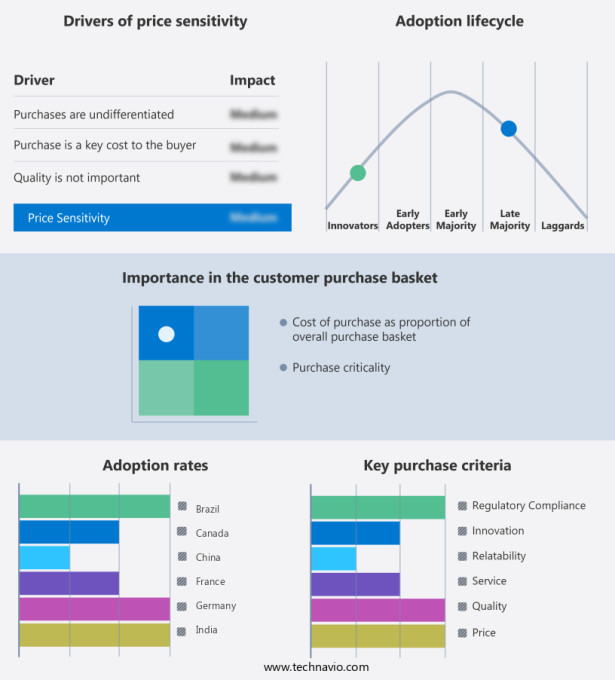
Customer Landscape
Key Companies & Market Insights
Companies are implementing various strategies, such as strategic alliances, market forecast, partnerships, mergers and acquisitions, geographical expansion, and product/service launches, to enhance their presence in the market.
Adobe Inc. - The company offers specialized software solutions tailored to specific industries, including creative, experience, and document management sectors.
The market research and growth report includes detailed analyses of the competitive landscape of the market and information about key companies, including:
- Bain Capital LP
- Blackbaud Inc.
- Constellation Software Inc.
- Epicor Software Corp.
- Fiserv Inc.
- Forbytes
- Infor Inc.
- McKesson Corp.
- Microsoft Corp.
- Oracle Corp.
- PTC Inc.
- Salesforce Inc.
- SAP SE
- ServiceNow Inc.
- Trimble Inc.
- UITOP
- Verisk Analytics Inc.
- Vertical Software
- Workday Inc.
Qualitative and quantitative analysis of companies has been conducted to help clients understand the wider business environment as well as the strengths and weaknesses of key market players. Data is qualitatively analyzed to categorize companies as pure play, category-focused, industry-focused, and diversified; it is quantitatively analyzed to categorize companies as dominant, leading, strong, tentative, and weak.
Research Analyst Overview
The market caters to the unique requirements of various industries, offering personalized solutions for commerce applications, customer relationship management, supply chain management, enterprise resource planning, financial applications, HR and payroll, office productivity, product lifecycle management, and more. These solutions come in both on-premise and cloud formats, catering to large enterprises, manufacturing, banking, healthcare and pharmaceuticals, telecom, and other sectors undergoing digital transformation. Supply chain optimization, cybersecurity, risk management, IoT integration, user experience, remote work, mobility solutions, blockchain suply chain integration, 5G technology, and cloud computing are some of the key trends shaping the market.
In addition, industry-specific tools are being developed with user-friendly UI/UX, AI integration, subscription-based pricing, and mobile applications to enhance product functionality, data analytics, sales and marketing, customization, and cross-sell opportunities. Vertical strategies are essential for software companies to meet the specific needs of industries, ensuring compliance with industry regulations, and providing specialized services like payment processing, financial services, and precision engineering. The focus on data collection, resource utilization, real-time analytics, business intelligence, and AI tasks is driving innovation in the market.
|
Market Scope |
|
|
Report Coverage |
Details |
|
Page number |
211 |
|
Base year |
2024 |
|
Historic period |
2019-2023 |
|
Forecast period |
2025-2029 |
|
Growth momentum & CAGR |
Accelerate at a CAGR of 11.4% |
|
Market Growth 2025-2029 |
USD 111.7 billion |
|
Market structure |
Fragmented |
|
YoY growth 2024-2025(%) |
10.0 |
|
Key countries |
US, China, Germany, UK, India, Japan, Canada, France, South Korea, and Brazil |
|
Competitive landscape |
Leading Companies, Market Positioning of Companies, Competitive Strategies, and Industry Risks |
What are the Key Data Covered in this Market Research and Growth Report?
- CAGR of the market during the forecast period
- Detailed information on factors that will drive the market growth and forecasting between 2025 and 2029
- Precise estimation of the size of the market and its contribution of the market in focus to the parent market
- Accurate predictions about upcoming market growth and trends and changes in consumer behaviour
- Growth of the market across North America, Europe, APAC, South America, and Middle East and Africa
- Thorough analysis of the market's competitive landscape and detailed information about companies
- Comprehensive analysis of factors that will challenge the growth of market companies
We can help! Our analysts can customize this market research report to meet your requirements.