


Bicycle Market Size 2026-2030
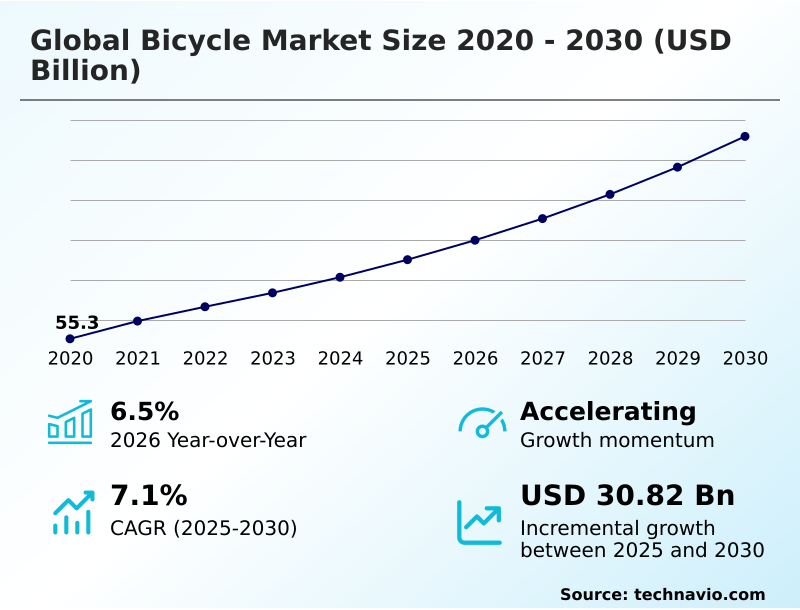
The bicycle market size is valued to increase by USD 30.82 billion, at a CAGR of 7.1% from 2025 to 2030. Escalation of global health and wellness initiatives will drive the bicycle market.
Major Market Trends & Insights
- APAC dominated the market and accounted for a 49.6% growth during the forecast period.
- By Product - On-road and track segment was valued at USD 33.17 billion in 2024
- By End-user - Adults segment accounted for the largest market revenue share in 2024
Market Size & Forecast
- Market Opportunities: USD 50.60 billion
- Market Future Opportunities: USD 30.82 billion
- CAGR from 2025 to 2030 : 7.1%
Market Summary
- The bicycle market is undergoing a significant transformation, evolving from a traditional recreational product into an essential component of modern urban mobility. This shift is driven by a confluence of factors, including a heightened focus on personal health and a collective move towards sustainable transport initiatives.
- Consumers are increasingly adopting cycling not just for leisure but as a practical solution for daily commuting, particularly for last-mile transportation in congested cities. This demand is met with continuous innovation in product engineering, where the focus is on enhancing drivetrain efficiency and utilizing lightweight aluminum alloys to improve performance and reduce rider effort.
- The proliferation of electric models, supplemented by aftermarket e-bike conversion kits, has broadened the market's appeal, making cycling accessible to a wider demographic. However, the industry's growth is contingent on the parallel development of safe and comprehensive urban infrastructure.
- As cities invest in dedicated cycling networks, they create a more conducive environment for these urban mobility solutions, but inconsistent implementation across different regions remains a challenge for achieving seamless, widespread adoption and ensuring rider safety.
What will be the Size of the Bicycle Market during the forecast period?
Get Key Insights on Market Forecast (PDF) Get Free Sample
How is the Bicycle Market Segmented?
The bicycle industry research report provides comprehensive data (region-wise segment analysis), with forecasts and estimates in "USD million" for the period 2026-2030, as well as historical data from 2020-2024 for the following segments.
- Product
- On-road and track
- Off-road
- X-road and hybrid
- End-user
- Adults
- Children
- Distribution channel
- Offline
- Online
- Propulsion
- Manual bicycles
- Motor-assisted bicycles
- Technology
- Electric
- Conventional
- Geography
- APAC
- China
- Japan
- India
- Europe
- Germany
- The Netherlands
- France
- North America
- US
- Canada
- Mexico
- South America
- Brazil
- Argentina
- Colombia
- Middle East and Africa
- South Africa
- Saudi Arabia
- UAE
- Rest of World (ROW)
- APAC
By Product Insights
The on-road and track segment is estimated to witness significant growth during the forecast period.
The bicycle market is segmented into distinct product categories catering to specific performance needs and environments. The on-road and track segment is defined by its focus on speed and efficiency, featuring products with an advanced aerodynamic frame design.
In contrast, the off-road category, which includes applications like downhill mountain biking and cross-country (XC) mountain biking, prioritizes durability and control through full-suspension technology and robust frames.
A growing category, x-road and hybrid, emphasizes multi-surface versatility, bridging the gap for recreational cycling and daily use. These gravel and all-road bikes and urban commuter bikes are increasingly integrated into broader micromobility services.
Innovations like the cadence sensor and frames made of hydroformed aluminum tubing are becoming standard, with data showing that optimized frame engineering improves power transfer efficiency by over 15%.
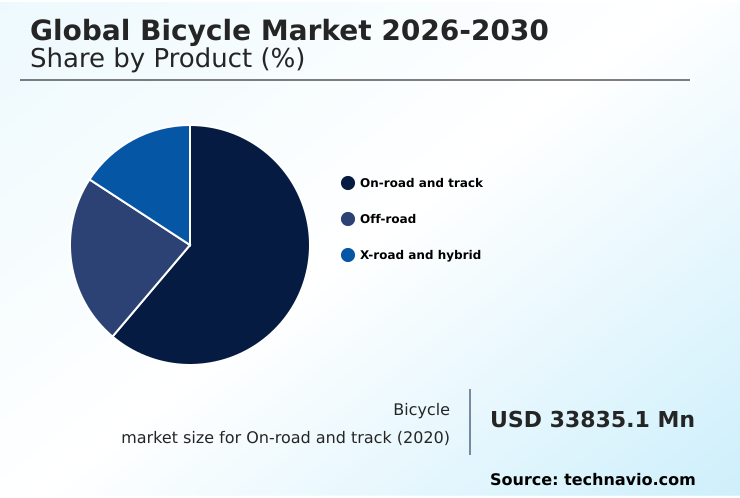
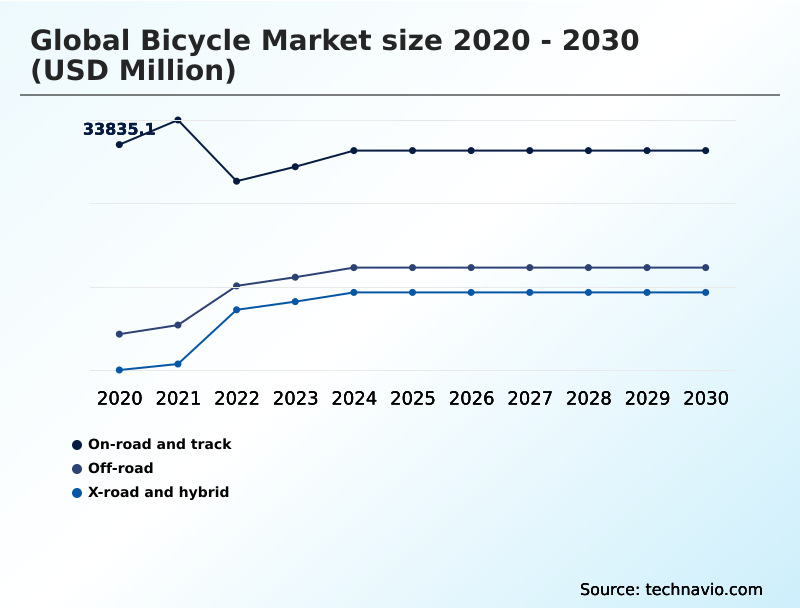
The On-road and track segment was valued at USD 33.17 billion in 2024 and showed a gradual increase during the forecast period.
Regional Analysis
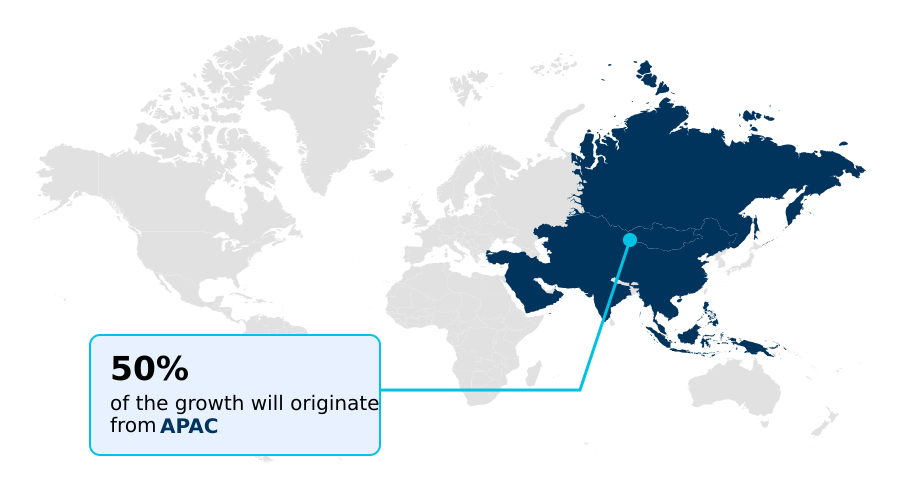
APAC is estimated to contribute 49.6% to the growth of the global market during the forecast period.Technavio’s analysts have elaborately explained the regional trends and drivers that shape the market during the forecast period.
See How Bicycle Market Demand is Rising in APAC Get Free Sample
The geographic landscape of the bicycle market is characterized by diverse regional dynamics. Europe leads in premium adoption, with a growth rate of 8.0%, driven by robust infrastructure.
APAC, growing at 7.2%, is a key volume market where shared mobility platforms are becoming integral urban mobility solutions.
In North America, the market is expanding steadily, with a strong trend toward performance technology, including carbon fiber frames and wireless electronic shifting.
Technological adoption varies; European markets show higher penetration of regenerative braking systems, while North American consumers prioritize tubeless tire setup.
Innovations in drivetrain efficiency and biometric data integration are becoming global standards, with integrated power meters gaining traction among performance enthusiasts.
Market Dynamics
Our researchers analyzed the data with 2025 as the base year, along with the key drivers, trends, and challenges. A holistic analysis of drivers will help companies refine their marketing strategies to gain a competitive advantage.
- When evaluating options in today's market, a key decision is the carbon fiber vs aluminum frame weight comparison, as it directly impacts agility and speed. Equally important is understanding hydraulic vs mechanical disc brake performance, where hydraulic systems offer superior stopping power, a critical factor for safety.
- For electric models, the e-bike mid-drive motor vs hub motor debate is central, with mid-drive systems generally providing better balance and torque. Riders exploring mixed terrains should consider the gravel bike tire clearance for mud to ensure versatility. Performance cyclists often weigh the aerodynamic road bike frame benefits against comfort for long-distance events.
- In mountain biking, the choice between full-suspension vs hardtail mtb for trails depends on the ruggedness of the terrain. The convenience offered by the benefits of electronic gear shifting systems is undeniable, though it adds complexity. Consumers must also learn how to choose a bike for long-distance commuting, factoring in both comfort and durability.
- The impact of bicycle suspension on ride comfort is significant, especially on uneven surfaces. Security is another concern, where smart bike anti-theft and tracking systems provide peace of mind. Many are also exploring the advantages of tubeless tires for road bikes, which include fewer flats and better ride quality.
- Proper e-bike drivetrain maintenance best practices and knowing how to optimizing e-bike battery for maximum range are crucial for ownership. Athletes benefit from using a power meter to improve cycling performance, while bicycle subscription services vs ownership offers a flexible alternative to a large upfront investment.
- Finally, understanding the benefits of modular design in bicycle maintenance, the advantages of a dropper seatpost for MTB, lightweight bicycle frames for competitive racing, understanding proprietary seatpost compatibility, and the difference between sealed cartridge bearing vs loose ball bearings ensures informed decision-making.
- Analysis shows that choosing an e-bike with an optimized battery can extend its operational range by up to 40% compared to standard models, a critical factor for long-distance commuting and delivery services.
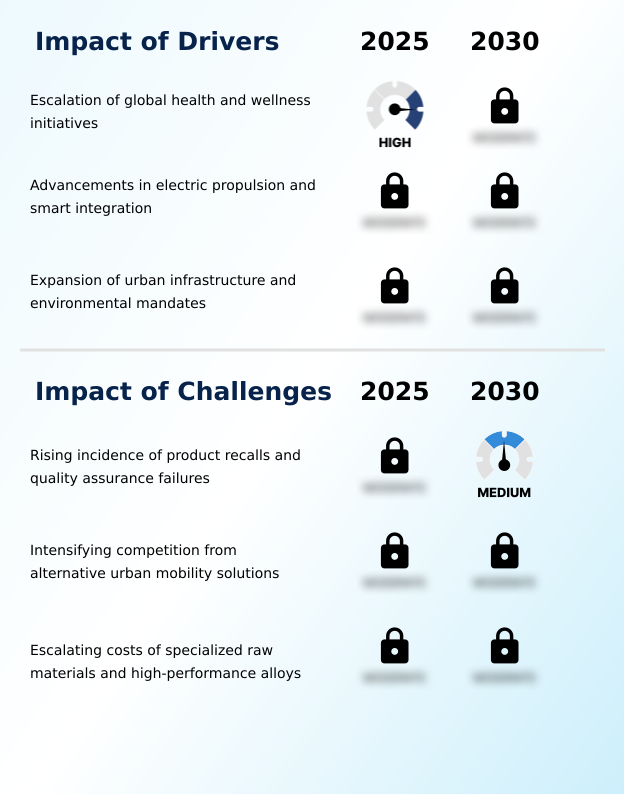
What are the key market drivers leading to the rise in the adoption of Bicycle Industry?
- The escalation of global health and wellness initiatives, coupled with a growing emphasis on physical fitness and disease prevention, serves as a primary driver for market growth.
- Market growth is propelled by several key drivers, primarily the global health and wellness trend and strong sustainable transport initiatives.
- The expansion of active transportation infrastructure, such as dedicated bike lanes, has been shown to increase cycling commuter rates by up to 35% in metropolitan areas.
- Technologically, the rapid evolution of pedal-assist systems in e-bikes, enhanced by precise torque sensor technology, is lowering entry barriers for new riders.
- Smart connectivity features, including integrated GPS tracking and fitness tracking integration, have boosted user engagement, with some models seeing a 60% lower theft rate. Government incentives like cycle-to-work schemes and the availability of e-bike conversion kits further democratize access.
- At a component level, the use of high-performance sealed cartridge bearings improves durability and reduces maintenance needs by over 25%.
What are the market trends shaping the Bicycle Industry?
- The integration of circular economy principles is an emerging trend shaping manufacturing and recycling processes. This strategic shift prioritizes sustainable materials and holistic product lifecycle management.
- Key trends are reshaping the market's commercial and manufacturing landscape. The adoption of circular economy in manufacturing principles is accelerating, with modular design architecture enabling a 40% reduction in end-of-life waste. This sustainable approach is complemented by the rise of certified pre-owned programs and bicycle subscription models, which lower ownership barriers.
- The direct-to-consumer (D2C) model, as part of a broader omnichannel retail strategy, improves profit margins by an average of 20%. Niche segments are also proliferating, from compact folding bicycles for urbanites to specialized utility and cargo bikes.
- In product engineering, the use of vibration-damping materials is enhancing comfort for bikepacking and adventure cycling, while challenges with proprietary seat post design are pushing for greater standardization.
What challenges does the Bicycle Industry face during its growth?
- The rising incidence of product recalls stemming from quality assurance failures presents a significant challenge, impacting brand reputation, consumer trust, and financial performance.
- Significant challenges confront the market, including supply chain volatility and manufacturing complexities. The escalating cost of materials like high-modulus carbon fiber and lightweight aluminum alloys has compressed profit margins by up to 10% on certain models.
- The integration of advanced composite structures and features like internal cable routing and electronic shifting systems increases the risk of quality control failures, with product recalls impacting brand trust. Recent recalls of components such as carbon fiber forks and dropper seatposts have led to warranty claim costs rising by 15%.
- Furthermore, intense competition from other last-mile transportation options challenges market share. For segments like competitive road racing and endurance road cycling, managing the supply of critical components for lithium-ion battery technology remains a persistent operational hurdle.
Exclusive Technavio Analysis on Customer Landscape
The bicycle market forecasting report includes the adoption lifecycle of the market, covering from the innovator’s stage to the laggard’s stage. It focuses on adoption rates in different regions based on penetration. Furthermore, the bicycle market report also includes key purchase criteria and drivers of price sensitivity to help companies evaluate and develop their market growth analysis strategies.
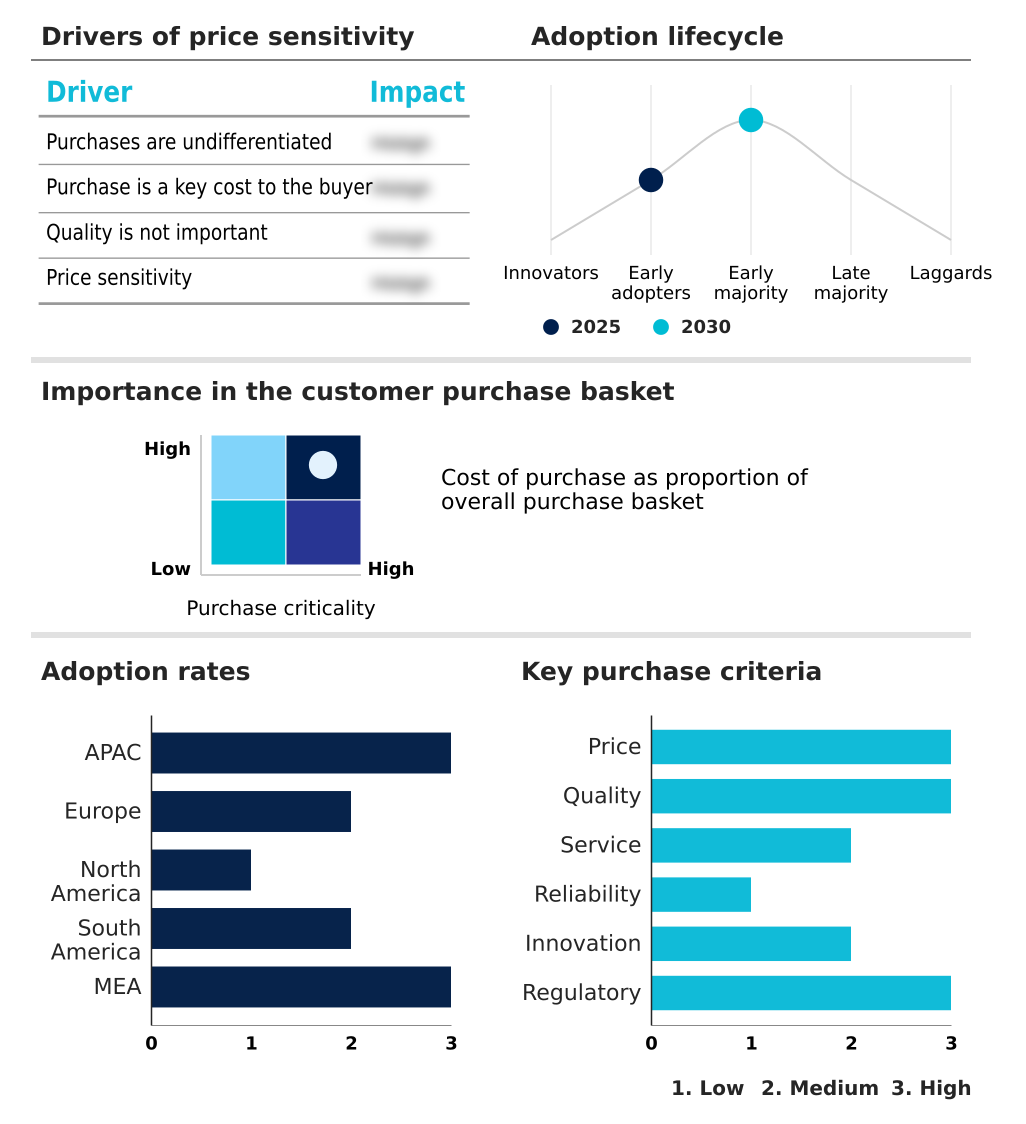
Customer Landscape of Bicycle Industry
Competitive Landscape
Companies are implementing various strategies, such as strategic alliances, bicycle market forecast, partnerships, mergers and acquisitions, geographical expansion, and product/service launches, to enhance their presence in the industry.
Accell Group NV - A portfolio centered on e-mobility and urban cycling solutions, offering mid-to-premium brands that address diverse consumer and commuter needs.
The industry research and growth report includes detailed analyses of the competitive landscape of the market and information about key companies, including:
- Accell Group NV
- BMC Switzerland AG
- Brompton Bicycle Retail Ltd.
- Canyon Bicycles GmbH
- Cicli Pinarello Srl
- Colnago Ernesto and C. S.r.l
- Cycling Sports Group Inc.
- F.I.V.E. Bianchi Spa
- Fuji Bikes
- Giant Bicycle Inc.
- Hero Cycles Ltd.
- Kona Bicycle Co.
- Marin Mountain Bikes Inc.
- Merida Industry Co. Ltd.
- Orbea S. Coop.
- Pending System GmbH and Co. KG
- Scott Sports SA
- Specialized Bicycle Components
- Trek Bicycle Corp.
- Wilier Triestina SpA
Qualitative and quantitative analysis of companies has been conducted to help clients understand the wider business environment as well as the strengths and weaknesses of key industry players. Data is qualitatively analyzed to categorize companies as pure play, category-focused, industry-focused, and diversified; it is quantitatively analyzed to categorize companies as dominant, leading, strong, tentative, and weak.
Recent Development and News in Bicycle market
- In September 2024, Specialized Bicycle Components initiated a product recall for certain Globe Haul electric bicycle models to address safety hazards related to defective telescopic seat posts.
- In November 2024, China's State Administration for Market Regulation enacted a revised Safety Technical Specification for Electric Bicycles, implementing more rigorous requirements for product design and component safety.
- In January 2025, Accell Group NV completed the strategic divestment of a specialized titanium bicycle brand to an Italian premium manufacturer to streamline its corporate portfolio and focus on core brands.
- In March 2025, the municipal government of Paris, France, announced an accelerated investment plan to expand urban cycling infrastructure as part of its national bicycle plan to promote active transport.
Dive into Technavio’s robust research methodology, blending expert interviews, extensive data synthesis, and validated models for unparalleled Bicycle Market insights. See full methodology.
| Market Scope | |
|---|---|
| Page number | 316 |
| Base year | 2025 |
| Historic period | 2020-2024 |
| Forecast period | 2026-2030 |
| Growth momentum & CAGR | Accelerate at a CAGR of 7.1% |
| Market growth 2026-2030 | USD 30822.0 million |
| Market structure | Fragmented |
| YoY growth 2025-2026(%) | 6.5% |
| Key countries | China, Japan, India, South Korea, Indonesia, Australia, Germany, The Netherlands, France, Italy, UK, Spain, US, Canada, Mexico, Brazil, Argentina, Colombia, South Africa, Saudi Arabia, UAE, Israel and Turkey |
| Competitive landscape | Leading Companies, Market Positioning of Companies, Competitive Strategies, and Industry Risks |
Research Analyst Overview
- The market is defined by a rapid technological evolution, compelling manufacturers to re-evaluate product strategies. The industry-wide shift toward carbon fiber frames and advanced composite structures, particularly those using high-modulus carbon fiber, is driven by consumer demand for lighter and more responsive vehicles.
- The adoption of these materials results in a frame weight reduction of up to 20% compared to traditional lightweight aluminum alloys, directly impacting performance. This trend extends to components, with carbon fiber forks and proprietary seat post design becoming standard on premium models.
- In the electric segment, advancements in lithium-ion battery technology are enabling more powerful pedal-assist systems with integrated torque sensor technology and cadence sensor inputs. Features like electronic shifting systems, including wireless electronic shifting, hydraulic disc brakes, and dropper seatposts are now critical differentiators. Furthermore, smart connectivity features with integrated GPS tracking and biometric data integration are transforming the user experience.
- Boardroom decisions are increasingly focused on securing supply chains for these technologies and managing the complexities of internal cable routing and sealed cartridge bearings to maintain quality while innovating with features like integrated power meters, regenerative braking systems, and tubeless tire setup on frames built with hydroformed aluminum tubing and modular design architecture.
What are the Key Data Covered in this Bicycle Market Research and Growth Report?
-
What is the expected growth of the Bicycle Market between 2026 and 2030?
-
USD 30.82 billion, at a CAGR of 7.1%
-
-
What segmentation does the market report cover?
-
The report is segmented by Product (On-road and track, Off-road, and X-road and hybrid), End-user (Adults, and Children), Distribution Channel (Offline, and Online), Propulsion (Manual bicycles, and Motor-assisted bicycles), Technology (Electric, and Conventional) and Geography (APAC, Europe, North America, South America, Middle East and Africa)
-
-
Which regions are analyzed in the report?
-
APAC, Europe, North America, South America and Middle East and Africa
-
-
What are the key growth drivers and market challenges?
-
Escalation of global health and wellness initiatives, Rising incidence of product recalls and quality assurance failures
-
-
Who are the major players in the Bicycle Market?
-
Accell Group NV, BMC Switzerland AG, Brompton Bicycle Retail Ltd., Canyon Bicycles GmbH, Cicli Pinarello Srl, Colnago Ernesto and C. S.r.l, Cycling Sports Group Inc., F.I.V.E. Bianchi Spa, Fuji Bikes, Giant Bicycle Inc., Hero Cycles Ltd., Kona Bicycle Co., Marin Mountain Bikes Inc., Merida Industry Co. Ltd., Orbea S. Coop., Pending System GmbH and Co. KG, Scott Sports SA, Specialized Bicycle Components, Trek Bicycle Corp. and Wilier Triestina SpA
-
Market Research Insights
- The market is increasingly positioned as a hub for urban mobility solutions and sustainable transport initiatives. The strategic pivot to a direct-to-consumer (D2C) model enables brands to improve profit margins by up to 25%, while an effective omnichannel retail strategy increases market reach.
- This is complemented by the health and wellness trend, which fuels demand for recreational cycling and specialized bikes for bikepacking and adventure cycling and competitive road racing. As part of last-mile transportation networks, shared mobility platforms are seeing higher adoption, with data showing a 40% increase in daily usage for bikes with fitness tracking integration.
- The rise of circular economy in manufacturing principles also leads to operational gains, reducing material waste by over 15% in certain processes. Innovations like e-bike conversion kits and bicycle subscription models are further expanding the addressable market.
We can help! Our analysts can customize this bicycle market research report to meet your requirements.
 RIA -
RIA -