


Electronic Waste Recycling Market Analysis, Size, and Forecast 2026-2030: Europe (Germany, France, and UK), APAC (China, Japan, and India), North America (US, Canada, and Mexico), South America (Brazil and Argentina), Middle East and Africa (Saudi Arabia, UAE, and South Africa), and Rest of World (ROW)

Electronic Waste Recycling Market Analysis, Size, and Forecast 2026-2030:
Europe (Germany, France, and UK), APAC (China, Japan, and India), North America (US, Canada, and Mexico), South America (Brazil and Argentina), Middle East and Africa (Saudi Arabia, UAE, and South Africa), and Rest of World (ROW)

Published: Mar 2026 306 Pages SKU: IRTNTR76167

Market Overview at a Glance

$39.02 B
Market Opportunity
22%
CAGR 2025 - 2030
43%
Europe Growth
$9.78 B
Metals and chemicals segment 2024

Electronic Waste Recycling Market Size 2026-2030

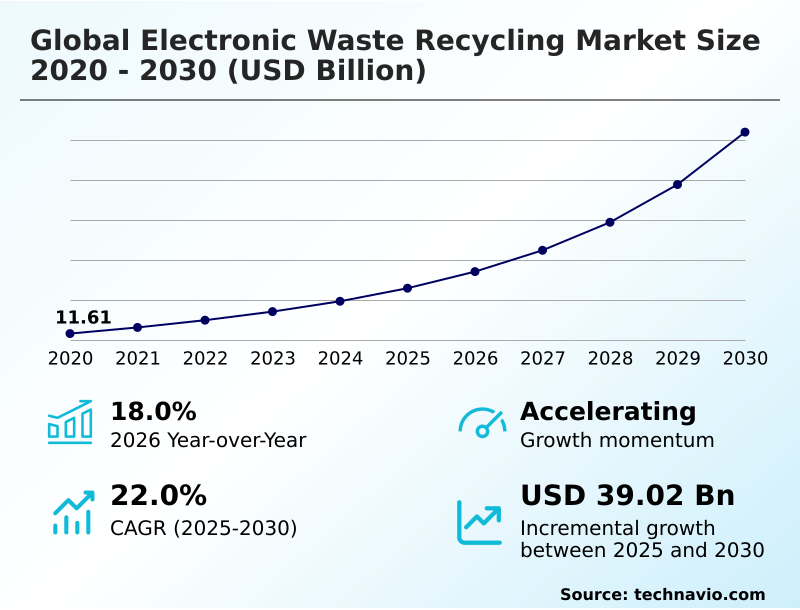
The electronic waste recycling market size is valued to increase by USD 39.02 billion, at a CAGR of 22% from 2025 to 2030. Favorable government regulations for e-waste management will drive the electronic waste recycling market.

Major Market Trends & Insights

  • Europe dominated the market and accounted for a 43% growth during the forecast period.
  • By Material - Metals and chemicals segment was valued at USD 9.78 billion in 2024
  • By Source - Household appliances segment accounted for the largest market revenue share in 2024

Market Size & Forecast

  • Market Opportunities: USD 50.36 billion
  • Market Future Opportunities: USD 39.02 billion
  • CAGR from 2025 to 2030 : 22%

Market Summary

  • The electronic waste recycling market is shaped by a confluence of regulatory pressures, technological advancements, and the growing imperative for a circular economy. Favorable government mandates, such as extended producer responsibility, are compelling manufacturers to design for recyclability and fund end-of-life management, creating a consistent feedstock for recyclers.
  • This is complemented by a market trend toward industry consolidation, where mergers and acquisitions are creating integrated service providers with specialized capabilities in areas like lithium-ion battery recycling and precious metal recovery.
  • For instance, a multinational corporation can implement a comprehensive IT asset disposition program that ensures secure data destruction while maximizing the recovery of valuable materials from decommissioned servers and networking equipment, thereby meeting compliance standards and corporate sustainability goals.
  • However, the high capital cost of advanced sorting and refining technologies remains a significant hurdle, alongside the logistical complexity of managing disparate and often contaminated waste streams.
  • The industry's evolution depends on balancing these economic challenges with the clear environmental and resource benefits of effective e-waste management, pushing innovation in both process efficiency and business models to unlock the full value of urban mining.

What will be the Size of the Electronic Waste Recycling Market during the forecast period?
Get Key Insights on Market Forecast (PDF) Request Free Sample

How is the Electronic Waste Recycling Market Segmented?

The electronic waste recycling industry research report provides comprehensive data (region-wise segment analysis), with forecasts and estimates in "USD million" for the period 2026-2030, as well as historical data from 2020-2024 for the following segments.

  • Material
    • Metals and chemicals
    • Plastic
    • Glass
  • Source
    • Household appliances
    • Entertainment and consumer electronics
    • IT and telecom
    • Medical equipment
    • Others
  • Method
    • Mechanical recycling
    • Pyrolysis
    • Others
  • Geography
    • Europe
      • Germany
      • France
      • UK
    • APAC
      • China
      • Japan
      • India
    • North America
      • US
      • Canada
      • Mexico
    • South America
      • Brazil
      • Argentina
    • Middle East and Africa
      • Saudi Arabia
      • UAE
      • South Africa
    • Rest of World (ROW)

By Material Insights

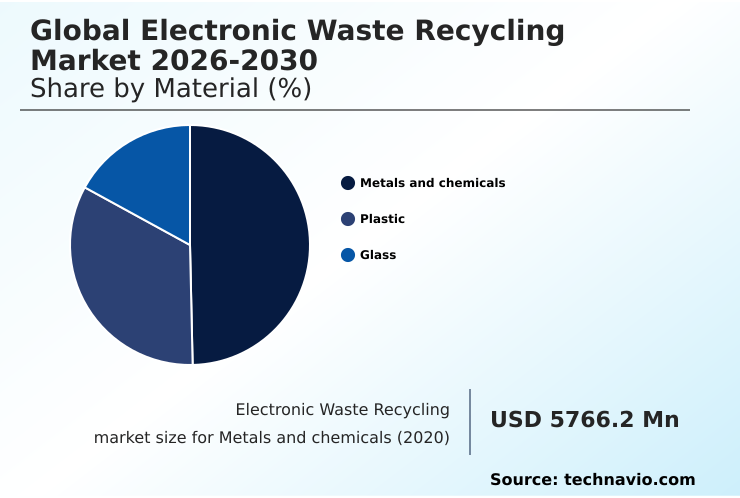
The metals and chemicals segment is estimated to witness significant growth during the forecast period.

The metals and chemicals segment is pivotal, concentrating on the high-value recovery of materials essential for modern hardware. This industrial field leverages advanced metallurgical techniques for the extraction of precious metals from complex electronic scrap.

The process involves sophisticated smelting and refining to separate elements and return them to manufacturing supply chains with high purity, with some facilities achieving over 95% recovery rates.

Innovative chemical leaching and precipitation methods are also enabling the extraction of rare earth elements, previously difficult to recycle.

As demand for sophisticated electronics grows, this segment drives profitability and technological advancement, ensuring valuable resources are kept in a continuous industrial loop.

Effective management of hazardous substances, including brominated flame retardants found on printed circuit boards, remains critical for producing high-quality secondary raw materials and non-ferrous metals.
Request Free Sample

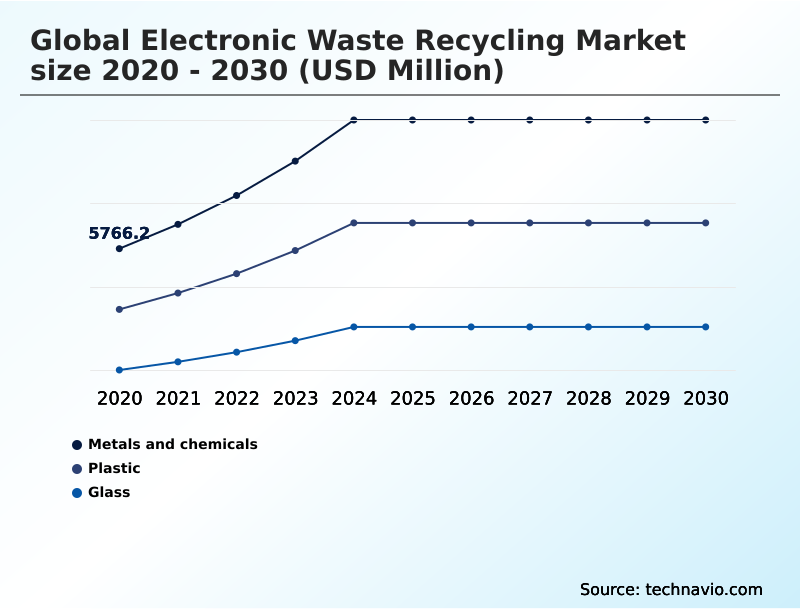
The Metals and chemicals segment was valued at USD 9.78 billion in 2024 and showed a gradual increase during the forecast period.
Request Free Sample

Regional Analysis

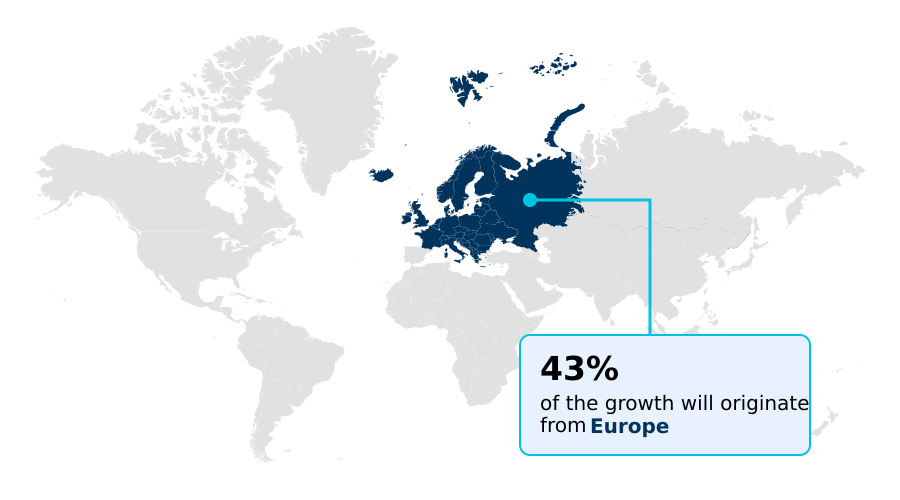
Europe is estimated to contribute 43% to the growth of the global market during the forecast period.Technavio’s analysts have elaborately explained the regional trends and drivers that shape the market during the forecast period.
See How Electronic Waste Recycling Market Demand is Rising in Europe Request Free Sample

The geographic landscape of the market is diverse, with Europe poised to capture over 42% of the incremental growth, driven by stringent regulations and a mature infrastructure.

The region’s market is set to expand at a rate of 22.4%, slightly outpacing North America at 21.2%. In North America, the focus is on secure data destruction and the management of decommissioned equipment from large-scale enterprise operations.

APAC follows as a significant region, projected to contribute nearly 30% of market expansion, fueled by its massive electronics manufacturing and consumption base. Across all regions, advanced techniques like hydrometallurgical processing are being adopted to improve resource recovery.

This enhances the extraction of rare earth elements and ensures high environmental compliance, turning waste streams into valuable resources like glass cullet and supporting new applications like photovoltaic panel recycling, making the urban mine a global reality.

Market Dynamics

Our researchers analyzed the data with 2025 as the base year, along with the key drivers, trends, and challenges. A holistic analysis of drivers will help companies refine their marketing strategies to gain a competitive advantage.

  • Strategic approaches within the market are increasingly nuanced, focusing on specific high-value and high-risk segments. The emphasis on recovering precious metals from circuit boards continues to drive technological investment, as does developing more efficient recycling methods for lithium-ion batteries to support the electric vehicle and consumer electronics sectors.
  • Simultaneously, managing hazardous materials in e-waste, such as lead and mercury, remains a critical compliance and safety concern, shaping operational protocols. Circular economy initiatives for electronics are transitioning from concept to practice, with major brands committing to using recycled content. However, the high cost of advanced e-waste recycling technologies presents a significant barrier, particularly for small and medium-sized enterprises.
  • This financial strain is compounded by the occupational risks in e-waste management, which necessitate costly safety measures and automation. Firms that successfully navigate the complex regulations for transboundary e-waste movement and embrace the principles of extended producer responsibility are better positioned for growth.
  • For example, implementing secure data destruction for IT assets can mitigate data breach risks far more effectively than simple hardware disposal, reducing potential compliance penalties by over 90%.
  • Innovations in sensor-based sorting in e-waste and robotic dismantling technology are crucial for overcoming these hurdles, highlighting the benefits of urban mining from e-waste and addressing challenges in plastic e-waste recycling through methods like pyrolysis for mixed electronic waste. As the market matures, the ability to balance cost, compliance, and technological innovation will define leadership.
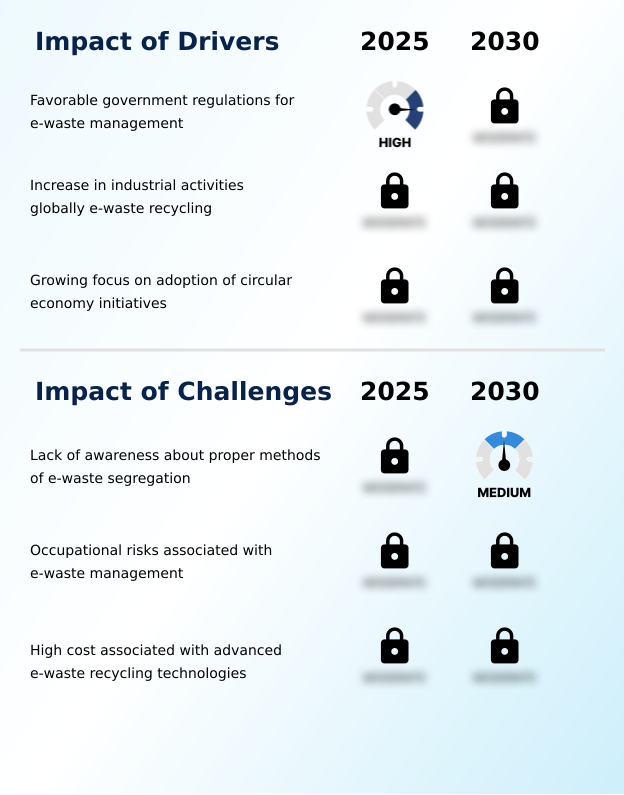
What are the key market drivers leading to the rise in the adoption of Electronic Waste Recycling Industry?

  • Favorable government regulations for e-waste management serve as a key driver for market growth.

  • Market expansion is primarily propelled by a combination of regulatory mandates and a strategic shift toward a circular economy.
  • Favorable government policies, such as extended producer responsibility (EPR) and the WEEE directive, compel manufacturers to engage in product stewardship, which has boosted formal collection of end-of-life electronics by over 25% in some jurisdictions.
  • This creates a reliable feedstock for recycling operations. The growing focus on the circular economy and urban mining is transforming e-waste from a liability into a valuable resource, driving demand for secondary raw materials and improving material recovery.
  • This, in turn, supports corporate sustainability goals, with some companies now sourcing up to 40% of their inputs from recycled content.
  • Furthermore, the emphasis on secure IT asset disposition (ITAD) in the corporate sector provides a high-value, consistent waste stream, reinforcing the need for professional waste stream management.

What are the market trends shaping the Electronic Waste Recycling Industry?

  • A notable upcoming trend is the increasing number of mergers and acquisitions. This consolidation is driven by market companies seeking to expand their capabilities and market presence.

  • Key market trends are reshaping the operational landscape, driven by a push for greater efficiency and scale. Industry consolidation through mergers and acquisitions is creating integrated service providers capable of managing the entire lifecycle of electronic assets, from collection to final refining, improving logistical efficiency by up to 20%.
  • This is complemented by the significant expansion of processing plants, which are incorporating advanced technologies like robotic sorting and sensor-based sorting for more precise material separation. These new facilities are improving recovery rates for materials from shredded electronics by over 15%.
  • A growing emphasis on closed-loop recycling is also evident, with manufacturers and recyclers collaborating on take-back programs and robust e-waste collection networks to ensure a consistent supply of materials for dismantling and reuse. This trend is further supported by the increasing adoption of specialized lines for high-growth segments like lithium-ion battery recycling.

What challenges does the Electronic Waste Recycling Industry face during its growth?

  • A key challenge affecting industry growth is the lack of awareness regarding proper methods for e-waste segregation.

  • Significant challenges constrain market growth, primarily related to cost, awareness, and operational complexity. The high capital investment required for advanced technologies, such as automated pyrolysis or pyrometallurgical processes, creates a substantial barrier to entry, with costs sometimes exceeding initial ROI projections by 50% in the first three years.
  • A persistent lack of public awareness regarding proper e-waste segregation leads to contaminated waste streams, which can increase processing costs for recyclers by up to 35%. Furthermore, managing the diverse range of materials, from legacy cathode ray tubes to modern flat panel displays, requires specialized and often costly hazardous waste management protocols for substances like lead and mercury.
  • Volatile commodity prices for recovered metals add another layer of economic uncertainty. Emerging techniques like bioleaching and electrochemical recycling offer potential long-term solutions but are not yet commercially viable at scale.

Exclusive Technavio Analysis on Customer Landscape

The electronic waste recycling market forecasting report includes the adoption lifecycle of the market, covering from the innovator’s stage to the laggard’s stage. It focuses on adoption rates in different regions based on penetration. Furthermore, the electronic waste recycling market report also includes key purchase criteria and drivers of price sensitivity to help companies evaluate and develop their market growth analysis strategies.
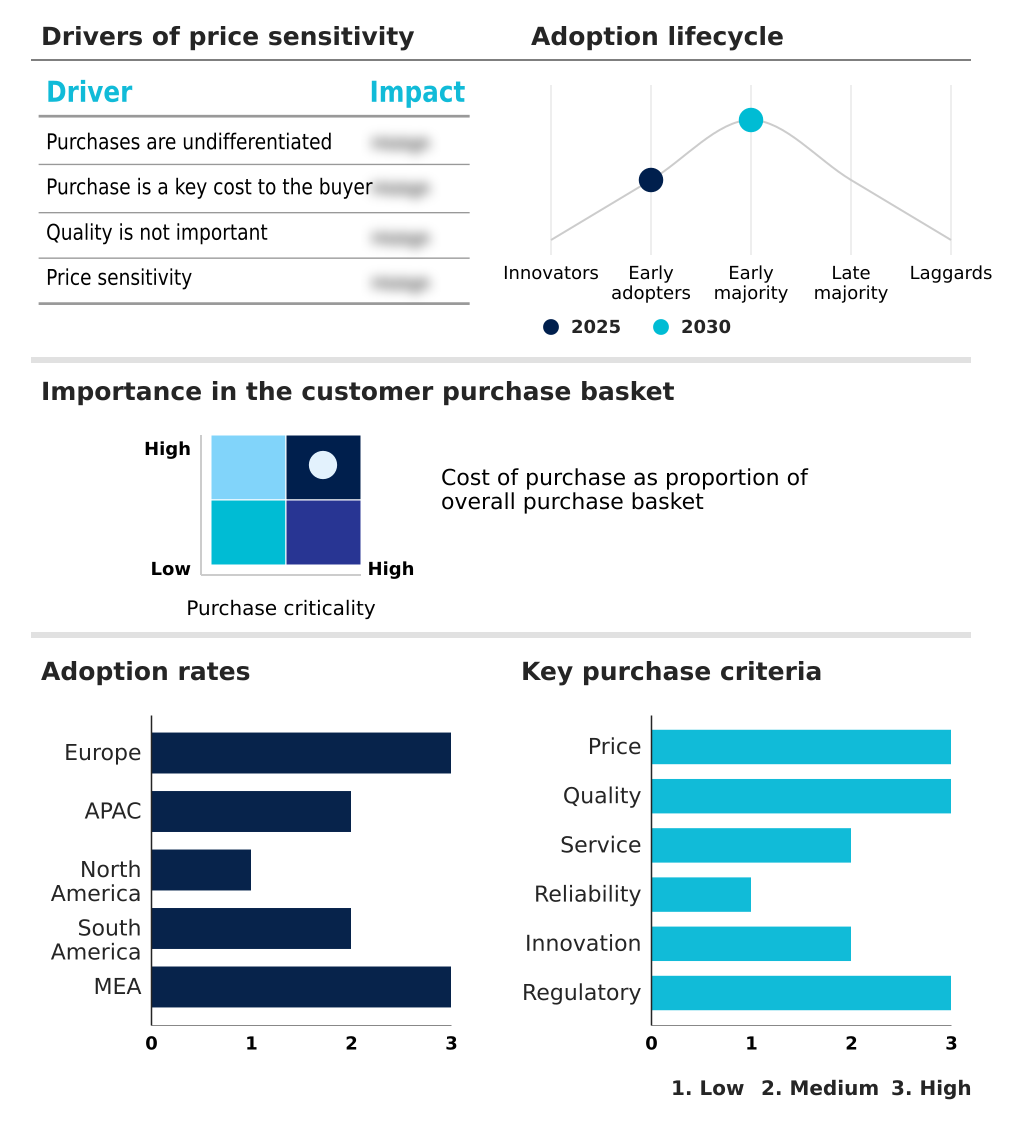
Customer Landscape of Electronic Waste Recycling Industry

Competitive Landscape

Companies are implementing various strategies, such as strategic alliances, electronic waste recycling market forecast, partnerships, mergers and acquisitions, geographical expansion, and product/service launches, to enhance their presence in the industry.

All Green Recycling - Advanced metallurgical recycling processes are utilized to process electronic scrap and industrial residues, enabling the recovery of copper and other precious metals.

The industry research and growth report includes detailed analyses of the competitive landscape of the market and information about key companies, including:

  • All Green Recycling
  • Apto Solutions Inc.
  • Aurubis AG
  • Boliden Group
  • Clean Harbors Inc.
  • Dynamic Lifecycle Innovations
  • ecoATM LLC.
  • Electronic Recyclers Inc.
  • Enviro Hub Holdings Ltd.
  • Glencore Plc
  • Iron Mountain Inc.
  • Kuusakoski Oy
  • Quantum Lifecycle Partners LP
  • Sims Lifecycle Services Inc.
  • Sipi Asset Recovery
  • Stena Recycling AB
  • TES Singapore Pte Ltd.
  • Umicore SA
  • Veolia Environment SA
  • Waste Management Inc.

Qualitative and quantitative analysis of companies has been conducted to help clients understand the wider business environment as well as the strengths and weaknesses of key industry players. Data is qualitatively analyzed to categorize companies as pure play, category-focused, industry-focused, and diversified; it is quantitatively analyzed to categorize companies as dominant, leading, strong, tentative, and weak.

Recent Development and News in Electronic waste recycling market

  • In February, 2025, Umicore announced the successful completion of its expanded precious metals refining facility designed to process complex e-waste streams with higher efficiency, thereby increasing the recovery rates of critical minerals.
  • In January, 2025, Iron Mountain expanded its specialized IT asset disposition services with a new high-tech processing center dedicated to the secure destruction and recycling of enterprise-grade hardware, integrating advanced data wiping and shredding.
  • In March, 2025, Philips launched an updated version of its circular healthcare program, which includes the global take-back and refurbishment or recycling of its high-end medical imaging equipment to promote a circular economy.
  • In May, 2025, Enviro-Hub Holdings finalized a major industrial e-waste management contract to provide specialized recycling services for a large-scale manufacturing hub, involving the processing of decommissioned industrial automation systems.

Dive into Technavio’s robust research methodology, blending expert interviews, extensive data synthesis, and validated models for unparalleled Electronic Waste Recycling Market insights. See full methodology.

Market Scope
Page number 306
Base year 2025
Historic period 2020-2024
Forecast period 2026-2030
Growth momentum & CAGR Accelerate at a CAGR of 22%
Market growth 2026-2030 USD 39018.9 million
Market structure Fragmented
YoY growth 2025-2026(%) 18.0%
Key countries Germany, France, UK, Italy, Spain, The Netherlands, China, Japan, India, South Korea, Australia, Indonesia, US, Canada, Mexico, Brazil, Argentina, Chile, Saudi Arabia, UAE, South Africa, Israel and Turkey
Competitive landscape Leading Companies, Market Positioning of Companies, Competitive Strategies, and Industry Risks

Request Free Sample

Research Analyst Overview

  • The electronic waste recycling market is defined by its critical role in the circular economy and its complex operational landscape. At a strategic level, boardroom decisions are increasingly influenced by the need for robust IT asset disposition (ITAD) protocols and secure data destruction to mitigate corporate risk. The industry's evolution is marked by a clear shift toward sophisticated technological solutions.
  • Advanced processes such as hydrometallurgical processing, pyrometallurgical processes, and emerging methods like bioleaching and electrochemical recycling are becoming essential for maximizing material recovery. Core activities like shredding, dismantling, and smelting are being enhanced by automated technologies, including robotic sorting and sensor-based sorting, which improve efficiency and safety.
  • For instance, firms adopting robotic dismantling have reported a 30% increase in processing throughput. The focus extends to specialized areas like lithium-ion battery recycling and photovoltaic panel recycling, driven by the energy transition. This requires precise refining techniques, including leaching and precipitation, to achieve high-purity outputs.
  • Ultimately, effective hazardous waste management and resource recovery are central to turning end-of-life products into a viable form of urban mining, which is crucial for sustainable supply chains.

What are the Key Data Covered in this Electronic Waste Recycling Market Research and Growth Report?

  • What is the expected growth of the Electronic Waste Recycling Market between 2026 and 2030?

    • USD 39.02 billion, at a CAGR of 22%

  • What segmentation does the market report cover?

    • The report is segmented by Material (Metals and chemicals, Plastic, and Glass), Source (Household appliances, Entertainment and consumer electronics, IT and telecom, Medical equipment, and Others), Method (Mechanical recycling, Pyrolysis, and Others) and Geography (Europe, APAC, North America, South America, Middle East and Africa)

  • Which regions are analyzed in the report?

    • Europe, APAC, North America, South America and Middle East and Africa

  • What are the key growth drivers and market challenges?

    • Favorable government regulations for e-waste management, Lack of awareness about proper methods of e-waste segregation

  • Who are the major players in the Electronic Waste Recycling Market?

    • All Green Recycling, Apto Solutions Inc., Aurubis AG, Boliden Group, Clean Harbors Inc., Dynamic Lifecycle Innovations, ecoATM LLC., Electronic Recyclers Inc., Enviro Hub Holdings Ltd., Glencore Plc, Iron Mountain Inc., Kuusakoski Oy, Quantum Lifecycle Partners LP, Sims Lifecycle Services Inc., Sipi Asset Recovery, Stena Recycling AB, TES Singapore Pte Ltd., Umicore SA, Veolia Environment SA and Waste Management Inc.

Market Research Insights

  • The market is evolving through a focus on comprehensive product stewardship and sophisticated waste stream management for all end-of-life electronics. Efficient e-waste collection networks, often part of manufacturer take-back programs, are crucial for securing a consistent feedstock for recycling.
  • Certified recycling facilities are essential for handling items from decommissioned equipment to obsolete cathode ray tubes and modern flat panel displays, ensuring environmental compliance. These facilities manage complex materials, including those with brominated flame retardants and require specialized refrigerant recovery, with some achieving a 35% improvement in processing efficiency.
  • A shift toward a closed-loop recycling model is supported by policies like the WEEE directive, which has increased formal collection rates by over 20%. This supports stable commodity prices for recovered metals, including rare earth elements, making the urban mine a viable resource.

We can help! Our analysts can customize this electronic waste recycling market research report to meet your requirements.

Get in touch

1. Executive Summary

1.1 Market overview

Executive Summary - Chart on Market Overview
Executive Summary - Data Table on Market Overview
Executive Summary - Chart on Global Market Characteristics
Executive Summary - Chart on Market by Geography
Executive Summary - Chart on Market Segmentation by Material
Executive Summary - Chart on Market Segmentation by Source
Executive Summary - Chart on Market Segmentation by Method
Executive Summary - Chart on Incremental Growth
Executive Summary - Data Table on Incremental Growth
Executive Summary - Chart on Company Market Positioning

2. Technavio Analysis

2.1 Analysis of price sensitivity, lifecycle, customer purchase basket, adoption rates, and purchase criteria

2.2 Criticality of inputs and Factors of differentiation

Chart on Overview on criticality of inputs and factors of differentiation

2.3 Factors of disruption

Chart on Overview on factors of disruption

2.4 Impact of drivers and challenges

Chart on Impact of drivers and challenges in 2025 and 2030

3. Market Landscape

3.1 Market ecosystem

Chart on Parent Market
Data Table on - Parent Market

3.2 Market characteristics

Chart on Market characteristics analysis

3.3 Value chain analysis

Chart on Value chain analysis

4. Market Sizing

4.1 Market definition

Data Table on Offerings of companies included in the market definition

4.2 Market segment analysis

Market segments

4.3 Market size 2025

4.4 Market outlook: Forecast for 2025-2030

Chart on Global - Market size and forecast 2025-2030 ($ million)
Data Table on Global - Market size and forecast 2025-2030 ($ million)
Chart on Global Market: Year-over-year growth 2025-2030 (%)
Data Table on Global Market: Year-over-year growth 2025-2030 (%)

5. Historic Market Size

5.1 Global Electronic Waste Recycling Market 2020 - 2024

Historic Market Size - Data Table on Global Electronic Waste Recycling Market 2020 - 2024 ($ million)

5.2 Material segment analysis 2020 - 2024

Historic Market Size - Material Segment 2020 - 2024 ($ million)

5.3 Source segment analysis 2020 - 2024

Historic Market Size - Source Segment 2020 - 2024 ($ million)

5.4 Method segment analysis 2020 - 2024

Historic Market Size - Method Segment 2020 - 2024 ($ million)

5.5 Geography segment analysis 2020 - 2024

Historic Market Size - Geography Segment 2020 - 2024 ($ million)

5.6 Country segment analysis 2020 - 2024

Historic Market Size - Country Segment 2020 - 2024 ($ million)

6. Qualitative Analysis

6.1 Impact of AI on Global Electronic Waste Recycling Market

6.2 Impact of Geopolitical Conflicts on Global Electronic Waste Recycling Market

7. Five Forces Analysis

7.1 Five forces summary

Five forces analysis - Comparison between 2025 and 2030

7.2 Bargaining power of buyers

Bargaining power of buyers - Impact of key factors 2025 and 2030

7.3 Bargaining power of suppliers

Bargaining power of suppliers - Impact of key factors in 2025 and 2030

7.4 Threat of new entrants

Threat of new entrants - Impact of key factors in 2025 and 2030

7.5 Threat of substitutes

Threat of substitutes - Impact of key factors in 2025 and 2030

7.6 Threat of rivalry

Threat of rivalry - Impact of key factors in 2025 and 2030

7.7 Market condition

Chart on Market condition - Five forces 2025 and 2030

8. Market Segmentation by Material

8.1 Market segments

Chart on Material - Market share 2025-2030 (%)
Data Table on Material - Market share 2025-2030 (%)

8.2 Comparison by Material

Chart on Comparison by Material
Data Table on Comparison by Material

8.3 Metals and chemicals - Market size and forecast 2025-2030

Chart on Metals and chemicals - Market size and forecast 2025-2030 ($ million)
Data Table on Metals and chemicals - Market size and forecast 2025-2030 ($ million)
Chart on Metals and chemicals - Year-over-year growth 2025-2030 (%)
Data Table on Metals and chemicals - Year-over-year growth 2025-2030 (%)

8.4 Plastic - Market size and forecast 2025-2030

Chart on Plastic - Market size and forecast 2025-2030 ($ million)
Data Table on Plastic - Market size and forecast 2025-2030 ($ million)
Chart on Plastic - Year-over-year growth 2025-2030 (%)
Data Table on Plastic - Year-over-year growth 2025-2030 (%)

8.5 Glass - Market size and forecast 2025-2030

Chart on Glass - Market size and forecast 2025-2030 ($ million)
Data Table on Glass - Market size and forecast 2025-2030 ($ million)
Chart on Glass - Year-over-year growth 2025-2030 (%)
Data Table on Glass - Year-over-year growth 2025-2030 (%)

8.6 Market opportunity by Material

Market opportunity by Material ($ million)
Data Table on Market opportunity by Material ($ million)

9. Market Segmentation by Source

9.1 Market segments

Chart on Source - Market share 2025-2030 (%)
Data Table on Source - Market share 2025-2030 (%)

9.2 Comparison by Source

Chart on Comparison by Source
Data Table on Comparison by Source

9.3 Household appliances - Market size and forecast 2025-2030

Chart on Household appliances - Market size and forecast 2025-2030 ($ million)
Data Table on Household appliances - Market size and forecast 2025-2030 ($ million)
Chart on Household appliances - Year-over-year growth 2025-2030 (%)
Data Table on Household appliances - Year-over-year growth 2025-2030 (%)

9.4 Entertainment and consumer electronics - Market size and forecast 2025-2030

Chart on Entertainment and consumer electronics - Market size and forecast 2025-2030 ($ million)
Data Table on Entertainment and consumer electronics - Market size and forecast 2025-2030 ($ million)
Chart on Entertainment and consumer electronics - Year-over-year growth 2025-2030 (%)
Data Table on Entertainment and consumer electronics - Year-over-year growth 2025-2030 (%)

9.5 IT and telecom - Market size and forecast 2025-2030

Chart on IT and telecom - Market size and forecast 2025-2030 ($ million)
Data Table on IT and telecom - Market size and forecast 2025-2030 ($ million)
Chart on IT and telecom - Year-over-year growth 2025-2030 (%)
Data Table on IT and telecom - Year-over-year growth 2025-2030 (%)

9.6 Medical equipment - Market size and forecast 2025-2030

Chart on Medical equipment - Market size and forecast 2025-2030 ($ million)
Data Table on Medical equipment - Market size and forecast 2025-2030 ($ million)
Chart on Medical equipment - Year-over-year growth 2025-2030 (%)
Data Table on Medical equipment - Year-over-year growth 2025-2030 (%)

9.7 Others - Market size and forecast 2025-2030

Chart on Others - Market size and forecast 2025-2030 ($ million)
Data Table on Others - Market size and forecast 2025-2030 ($ million)
Chart on Others - Year-over-year growth 2025-2030 (%)
Data Table on Others - Year-over-year growth 2025-2030 (%)

9.8 Market opportunity by Source

Market opportunity by Source ($ million)
Data Table on Market opportunity by Source ($ million)

10. Market Segmentation by Method

10.1 Market segments

Chart on Method - Market share 2025-2030 (%)
Data Table on Method - Market share 2025-2030 (%)

10.2 Comparison by Method

Chart on Comparison by Method
Data Table on Comparison by Method

10.3 Mechanical recycling - Market size and forecast 2025-2030

Chart on Mechanical recycling - Market size and forecast 2025-2030 ($ million)
Data Table on Mechanical recycling - Market size and forecast 2025-2030 ($ million)
Chart on Mechanical recycling - Year-over-year growth 2025-2030 (%)
Data Table on Mechanical recycling - Year-over-year growth 2025-2030 (%)

10.4 Pyrolysis - Market size and forecast 2025-2030

Chart on Pyrolysis - Market size and forecast 2025-2030 ($ million)
Data Table on Pyrolysis - Market size and forecast 2025-2030 ($ million)
Chart on Pyrolysis - Year-over-year growth 2025-2030 (%)
Data Table on Pyrolysis - Year-over-year growth 2025-2030 (%)

10.5 Others - Market size and forecast 2025-2030

Chart on Others - Market size and forecast 2025-2030 ($ million)
Data Table on Others - Market size and forecast 2025-2030 ($ million)
Chart on Others - Year-over-year growth 2025-2030 (%)
Data Table on Others - Year-over-year growth 2025-2030 (%)

10.6 Market opportunity by Method

Market opportunity by Method ($ million)
Data Table on Market opportunity by Method ($ million)

11. Customer Landscape

11.1 Customer landscape overview

Analysis of price sensitivity, lifecycle, customer purchase basket, adoption rates, and purchase criteria

12. Geographic Landscape

12.1 Geographic segmentation

Chart on Market share by geography 2025-2030 (%)
Data Table on Market share by geography 2025-2030 (%)

12.2 Geographic comparison

Chart on Geographic comparison
Data Table on Geographic comparison

12.3 Europe - Market size and forecast 2025-2030

Chart on Europe - Market size and forecast 2025-2030 ($ million)
Data Table on Europe - Market size and forecast 2025-2030 ($ million)
Chart on Europe - Year-over-year growth 2025-2030 (%)
Data Table on Europe - Year-over-year growth 2025-2030 (%)
Chart on Regional Comparison - Europe
Data Table on Regional Comparison - Europe

12.3.1 Germany - Market size and forecast 2025-2030

Chart on Germany - Market size and forecast 2025-2030 ($ million)
Data Table on Germany - Market size and forecast 2025-2030 ($ million)
Chart on Germany - Year-over-year growth 2025-2030 (%)
Data Table on Germany - Year-over-year growth 2025-2030 (%)

12.3.2 France - Market size and forecast 2025-2030

Chart on France - Market size and forecast 2025-2030 ($ million)
Data Table on France - Market size and forecast 2025-2030 ($ million)
Chart on France - Year-over-year growth 2025-2030 (%)
Data Table on France - Year-over-year growth 2025-2030 (%)

12.3.3 UK - Market size and forecast 2025-2030

Chart on UK - Market size and forecast 2025-2030 ($ million)
Data Table on UK - Market size and forecast 2025-2030 ($ million)
Chart on UK - Year-over-year growth 2025-2030 (%)
Data Table on UK - Year-over-year growth 2025-2030 (%)

12.3.4 Italy - Market size and forecast 2025-2030

Chart on Italy - Market size and forecast 2025-2030 ($ million)
Data Table on Italy - Market size and forecast 2025-2030 ($ million)
Chart on Italy - Year-over-year growth 2025-2030 (%)
Data Table on Italy - Year-over-year growth 2025-2030 (%)

12.3.5 Spain - Market size and forecast 2025-2030

Chart on Spain - Market size and forecast 2025-2030 ($ million)
Data Table on Spain - Market size and forecast 2025-2030 ($ million)
Chart on Spain - Year-over-year growth 2025-2030 (%)
Data Table on Spain - Year-over-year growth 2025-2030 (%)

12.3.6 The Netherlands - Market size and forecast 2025-2030

Chart on The Netherlands - Market size and forecast 2025-2030 ($ million)
Data Table on The Netherlands - Market size and forecast 2025-2030 ($ million)
Chart on The Netherlands - Year-over-year growth 2025-2030 (%)
Data Table on The Netherlands - Year-over-year growth 2025-2030 (%)

12.4 APAC - Market size and forecast 2025-2030

Chart on APAC - Market size and forecast 2025-2030 ($ million)
Data Table on APAC - Market size and forecast 2025-2030 ($ million)
Chart on APAC - Year-over-year growth 2025-2030 (%)
Data Table on APAC - Year-over-year growth 2025-2030 (%)
Chart on Regional Comparison - APAC
Data Table on Regional Comparison - APAC

12.4.1 China - Market size and forecast 2025-2030

Chart on China - Market size and forecast 2025-2030 ($ million)
Data Table on China - Market size and forecast 2025-2030 ($ million)
Chart on China - Year-over-year growth 2025-2030 (%)
Data Table on China - Year-over-year growth 2025-2030 (%)

12.4.2 Japan - Market size and forecast 2025-2030

Chart on Japan - Market size and forecast 2025-2030 ($ million)
Data Table on Japan - Market size and forecast 2025-2030 ($ million)
Chart on Japan - Year-over-year growth 2025-2030 (%)
Data Table on Japan - Year-over-year growth 2025-2030 (%)

12.4.3 India - Market size and forecast 2025-2030

Chart on India - Market size and forecast 2025-2030 ($ million)
Data Table on India - Market size and forecast 2025-2030 ($ million)
Chart on India - Year-over-year growth 2025-2030 (%)
Data Table on India - Year-over-year growth 2025-2030 (%)

12.4.4 South Korea - Market size and forecast 2025-2030

Chart on South Korea - Market size and forecast 2025-2030 ($ million)
Data Table on South Korea - Market size and forecast 2025-2030 ($ million)
Chart on South Korea - Year-over-year growth 2025-2030 (%)
Data Table on South Korea - Year-over-year growth 2025-2030 (%)

12.4.5 Australia - Market size and forecast 2025-2030

Chart on Australia - Market size and forecast 2025-2030 ($ million)
Data Table on Australia - Market size and forecast 2025-2030 ($ million)
Chart on Australia - Year-over-year growth 2025-2030 (%)
Data Table on Australia - Year-over-year growth 2025-2030 (%)

12.4.6 Indonesia - Market size and forecast 2025-2030

Chart on Indonesia - Market size and forecast 2025-2030 ($ million)
Data Table on Indonesia - Market size and forecast 2025-2030 ($ million)
Chart on Indonesia - Year-over-year growth 2025-2030 (%)
Data Table on Indonesia - Year-over-year growth 2025-2030 (%)

12.5 North America - Market size and forecast 2025-2030

Chart on North America - Market size and forecast 2025-2030 ($ million)
Data Table on North America - Market size and forecast 2025-2030 ($ million)
Chart on North America - Year-over-year growth 2025-2030 (%)
Data Table on North America - Year-over-year growth 2025-2030 (%)
Chart on Regional Comparison - North America
Data Table on Regional Comparison - North America

12.5.1 US - Market size and forecast 2025-2030

Chart on US - Market size and forecast 2025-2030 ($ million)
Data Table on US - Market size and forecast 2025-2030 ($ million)
Chart on US - Year-over-year growth 2025-2030 (%)
Data Table on US - Year-over-year growth 2025-2030 (%)

12.5.2 Canada - Market size and forecast 2025-2030

Chart on Canada - Market size and forecast 2025-2030 ($ million)
Data Table on Canada - Market size and forecast 2025-2030 ($ million)
Chart on Canada - Year-over-year growth 2025-2030 (%)
Data Table on Canada - Year-over-year growth 2025-2030 (%)

12.5.3 Mexico - Market size and forecast 2025-2030

Chart on Mexico - Market size and forecast 2025-2030 ($ million)
Data Table on Mexico - Market size and forecast 2025-2030 ($ million)
Chart on Mexico - Year-over-year growth 2025-2030 (%)
Data Table on Mexico - Year-over-year growth 2025-2030 (%)

12.6 South America - Market size and forecast 2025-2030

Chart on South America - Market size and forecast 2025-2030 ($ million)
Data Table on South America - Market size and forecast 2025-2030 ($ million)
Chart on South America - Year-over-year growth 2025-2030 (%)
Data Table on South America - Year-over-year growth 2025-2030 (%)
Chart on Regional Comparison - South America
Data Table on Regional Comparison - South America

12.6.1 Brazil - Market size and forecast 2025-2030

Chart on Brazil - Market size and forecast 2025-2030 ($ million)
Data Table on Brazil - Market size and forecast 2025-2030 ($ million)
Chart on Brazil - Year-over-year growth 2025-2030 (%)
Data Table on Brazil - Year-over-year growth 2025-2030 (%)

12.6.2 Argentina - Market size and forecast 2025-2030

Chart on Argentina - Market size and forecast 2025-2030 ($ million)
Data Table on Argentina - Market size and forecast 2025-2030 ($ million)
Chart on Argentina - Year-over-year growth 2025-2030 (%)
Data Table on Argentina - Year-over-year growth 2025-2030 (%)

12.6.3 Chile - Market size and forecast 2025-2030

Chart on Chile - Market size and forecast 2025-2030 ($ million)
Data Table on Chile - Market size and forecast 2025-2030 ($ million)
Chart on Chile - Year-over-year growth 2025-2030 (%)
Data Table on Chile - Year-over-year growth 2025-2030 (%)

12.7 Middle East and Africa - Market size and forecast 2025-2030

Chart on Middle East and Africa - Market size and forecast 2025-2030 ($ million)
Data Table on Middle East and Africa - Market size and forecast 2025-2030 ($ million)
Chart on Middle East and Africa - Year-over-year growth 2025-2030 (%)
Data Table on Middle East and Africa - Year-over-year growth 2025-2030 (%)
Chart on Regional Comparison - Middle East and Africa
Data Table on Regional Comparison - Middle East and Africa

12.7.1 Saudi Arabia - Market size and forecast 2025-2030

Chart on Saudi Arabia - Market size and forecast 2025-2030 ($ million)
Data Table on Saudi Arabia - Market size and forecast 2025-2030 ($ million)
Chart on Saudi Arabia - Year-over-year growth 2025-2030 (%)
Data Table on Saudi Arabia - Year-over-year growth 2025-2030 (%)

12.7.2 UAE - Market size and forecast 2025-2030

Chart on UAE - Market size and forecast 2025-2030 ($ million)
Data Table on UAE - Market size and forecast 2025-2030 ($ million)
Chart on UAE - Year-over-year growth 2025-2030 (%)
Data Table on UAE - Year-over-year growth 2025-2030 (%)

12.7.3 South Africa - Market size and forecast 2025-2030

Chart on South Africa - Market size and forecast 2025-2030 ($ million)
Data Table on South Africa - Market size and forecast 2025-2030 ($ million)
Chart on South Africa - Year-over-year growth 2025-2030 (%)
Data Table on South Africa - Year-over-year growth 2025-2030 (%)

12.7.4 Israel - Market size and forecast 2025-2030

Chart on Israel - Market size and forecast 2025-2030 ($ million)
Data Table on Israel - Market size and forecast 2025-2030 ($ million)
Chart on Israel - Year-over-year growth 2025-2030 (%)
Data Table on Israel - Year-over-year growth 2025-2030 (%)

12.7.5 Turkey - Market size and forecast 2025-2030

Chart on Turkey - Market size and forecast 2025-2030 ($ million)
Data Table on Turkey - Market size and forecast 2025-2030 ($ million)
Chart on Turkey - Year-over-year growth 2025-2030 (%)
Data Table on Turkey - Year-over-year growth 2025-2030 (%)

12.8 Market opportunity by geography

Market opportunity by geography ($ million)
Data Tables on Market opportunity by geography ($ million)

13. Drivers, Challenges, and Opportunity

13.1 Market drivers

Favorable government regulations for e-waste management
Increase in industrial activities globally e-waste recycling
Growing focus on adoption of circular economy initiatives

13.2 Market challenges

Lack of awareness about proper methods of e-waste segregation
Occupational risks associated with e-waste management
High cost associated with advanced e-waste recycling technologies

13.3 Impact of drivers and challenges

Impact of drivers and challenges in 2025 and 2030

13.4 Market opportunities

Increasing number of mergers and acquisitions by market companies
Expansion of processing plants for e-waste recycling
Programs and conferences leading to collaborations

14. Competitive Landscape

14.1 Overview

14.2

Overview on criticality of inputs and factors of differentiation

14.3 Landscape disruption

Overview on factors of disruption

14.4 Industry risks

Impact of key risks on business

15. Competitive Analysis

15.1 Companies profiled

Companies covered

15.2 Company ranking index

15.3 Market positioning of companies

Matrix on companies position and classification

15.4 Aurubis AG

Aurubis AG - Overview
Aurubis AG - Business segments
Aurubis AG - Key news
Aurubis AG - Key offerings
Aurubis AG - Segment focus
SWOT

15.5 Boliden Group

Boliden Group - Overview
Boliden Group - Product / Service
Boliden Group - Key offerings
SWOT

15.6 Clean Harbors Inc.

Clean Harbors Inc. - Overview
Clean Harbors Inc. - Business segments
Clean Harbors Inc. - Key offerings
Clean Harbors Inc. - Segment focus
SWOT

15.7 Dynamic Lifecycle Innovations

Dynamic Lifecycle Innovations - Overview
Dynamic Lifecycle Innovations - Product / Service
Dynamic Lifecycle Innovations - Key offerings
SWOT

15.8 Electronic Recyclers Inc.

Electronic Recyclers Inc. - Overview
Electronic Recyclers Inc. - Product / Service
Electronic Recyclers Inc. - Key offerings
SWOT

15.9 Enviro Hub Holdings Ltd.

Enviro Hub Holdings Ltd. - Overview
Enviro Hub Holdings Ltd. - Product / Service
Enviro Hub Holdings Ltd. - Key offerings
SWOT

15.10 Glencore Plc

Glencore Plc - Overview
Glencore Plc - Business segments
Glencore Plc - Key offerings
Glencore Plc - Segment focus
SWOT

15.11 Iron Mountain Inc.

Iron Mountain Inc. - Overview
Iron Mountain Inc. - Business segments
Iron Mountain Inc. - Key offerings
Iron Mountain Inc. - Segment focus
SWOT

15.12 Kuusakoski Oy

Kuusakoski Oy - Overview
Kuusakoski Oy - Product / Service
Kuusakoski Oy - Key offerings
SWOT

15.13 Quantum Lifecycle Partners LP

Quantum Lifecycle Partners LP - Overview
Quantum Lifecycle Partners LP - Product / Service
Quantum Lifecycle Partners LP - Key offerings
SWOT

15.14 Sims Lifecycle Services Inc.

Sims Lifecycle Services Inc. - Overview
Sims Lifecycle Services Inc. - Product / Service
Sims Lifecycle Services Inc. - Key offerings
SWOT

15.15 TES Singapore Pte Ltd.

TES Singapore Pte Ltd. - Overview
TES Singapore Pte Ltd. - Product / Service
TES Singapore Pte Ltd. - Key offerings
SWOT

15.16 Umicore SA

Umicore SA - Overview
Umicore SA - Business segments
Umicore SA - Key offerings
Umicore SA - Segment focus
SWOT

15.17 Veolia Environment SA

Veolia Environment SA - Overview
Veolia Environment SA - Business segments
Veolia Environment SA - Key offerings
Veolia Environment SA - Segment focus
SWOT

15.18 Waste Management Inc.

Waste Management Inc. - Overview
Waste Management Inc. - Business segments
Waste Management Inc. - Key offerings
Waste Management Inc. - Segment focus
SWOT

16. Appendix

16.1 Scope of the report

Market definition
Objectives
Notes and caveats

16.2 Inclusions and exclusions checklist

Inclusions checklist
Exclusions checklist

16.3 Currency conversion rates for US$

16.4 Research methodology

16.5 Data procurement

Information sources

16.6 Data validation

16.7 Validation techniques employed for market sizing

16.8 Data synthesis

16.9 360 degree market analysis

16.10 List of abbreviations

Research Methodology

Technavio presents a detailed picture of the market by way of study, synthesis, and summation of data from multiple sources. The analysts have presented the various facets of the market with a particular focus on identifying the key industry influencers. The data thus presented is comprehensive, reliable, and the result of extensive research, both primary and secondary.

INFORMATION SOURCES

Primary sources

  • Manufacturers and suppliers
  • Channel partners
  • Industry experts
  • Strategic decision makers

Secondary sources

  • Industry journals and periodicals
  • Government data
  • Financial reports of key industry players
  • Historical data
  • Press releases

DATA ANALYSIS

Data Synthesis

  • Collation of data
  • Estimation of key figures
  • Analysis of derived insights

Data Validation

  • Triangulation with data models
  • Reference against proprietary databases
  • Corroboration with industry experts

REPORT WRITING

Qualitative

  • Market drivers
  • Market challenges
  • Market trends
  • Five forces analysis

Quantitative

  • Market size and forecast
  • Market segmentation
  • Geographical insights
  • Competitive landscape

Interested in this report?

Get your sample now to see our research methodology and insights!

Download Now

Frequently Asked Questions

Electronic Waste Recycling market growth will increase by USD 39018.9 million during 2026-2030.

The Electronic Waste Recycling market is expected to grow at a CAGR of 22% during 2026-2030.

Electronic Waste Recycling market is segmented by Material (Metals and chemicals, Plastic, Glass) Source (Household appliances, Entertainment and consumer electronics, IT and telecom, Medical equipment, Others) Method (Mechanical recycling, Pyrolysis, Others)

All Green Recycling, Apto Solutions Inc., Aurubis AG, Boliden Group, Clean Harbors Inc., Dynamic Lifecycle Innovations, ecoATM LLC., Electronic Recyclers Inc., Enviro Hub Holdings Ltd., Glencore Plc, Iron Mountain Inc., Kuusakoski Oy, Quantum Lifecycle Partners LP, Sims Lifecycle Services Inc., Sipi Asset Recovery, Stena Recycling AB, TES Singapore Pte Ltd., Umicore SA, Veolia Environment SA, Waste Management Inc. are a few of the key vendors in the Electronic Waste Recycling market.

Europe will register the highest growth rate of 43% among the other regions. Therefore, the Electronic Waste Recycling market in Europe is expected to garner significant business opportunities for the vendors during the forecast period.

Germany, France, UK, Italy, Spain, The Netherlands, China, Japan, India, South Korea, Australia, Indonesia, US, Canada, Mexico, Brazil, Argentina, Chile, Saudi Arabia, UAE, South Africa, Israel, Turkey

  • Favorable government regulations for e-waste management is the driving factor this market.

The Electronic Waste Recycling market vendors should focus on grabbing business opportunities from the Material segment as it accounted for the largest market share in the base year.
RIA - Research AI Assistant
Ask RIA
