


Higher Education Market Size 2026-2030
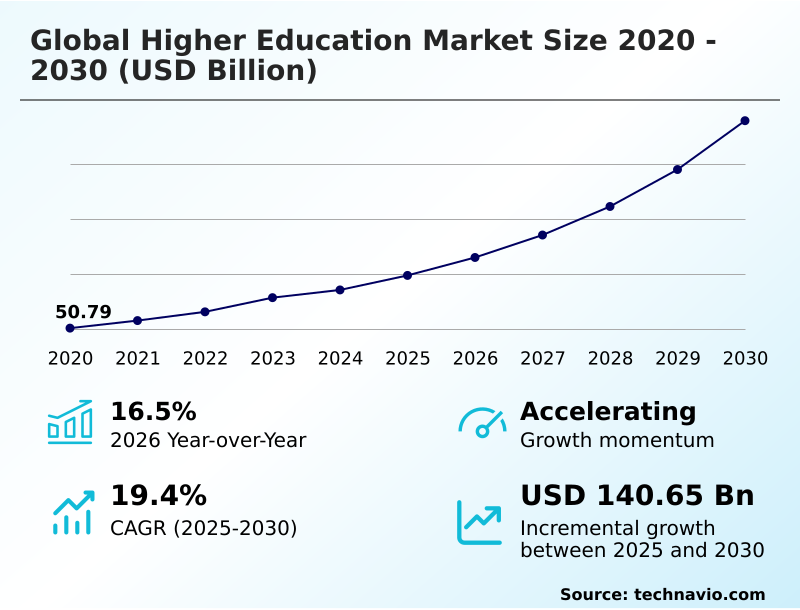
The higher education market size is valued to increase by USD 140.65 billion, at a CAGR of 19.4% from 2025 to 2030. Intensifying global demand for skilled workforce will drive the higher education market.
Major Market Trends & Insights
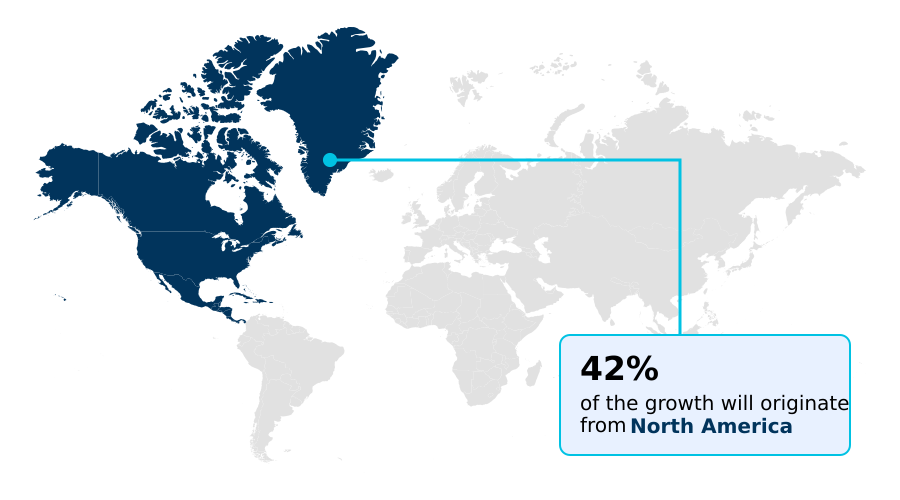
- North America dominated the market and accounted for a 41.9% growth during the forecast period.
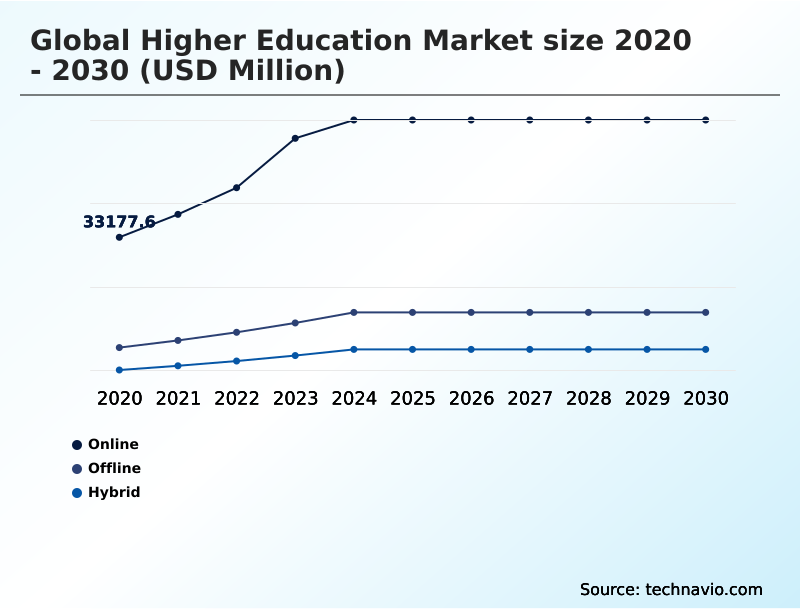
- By Learning Method - Online segment was valued at USD 56.71 billion in 2024
- By End-user - Private colleges segment accounted for the largest market revenue share in 2024
Market Size & Forecast
- Market Opportunities: USD 188.58 billion
- Market Future Opportunities: USD 140.65 billion
- CAGR from 2025 to 2030 : 19.4%
Market Summary
- The higher education market is undergoing a profound transformation, moving beyond traditional enrollment expansion to address the imperatives of a digital-first economy. This evolution is driven by the persistent global demand for advanced skills, compelling institutions to innovate.
- A pivotal trend is the unbundling of monolithic degrees in favor of more flexible, career-aligned educational pathways, including micro-credentials and stackable credentials, which cater to the need for lifelong learning.
- In one business scenario, an institution leverages predictive analytics models for its strategic enrollment management to identify at-risk students, enabling proactive interventions that improve student success and retention rates by double digits. However, the sector grapples with a significant skills gap between academic curricula and employer needs, alongside a student affordability crisis.
- Success is now increasingly defined by an institution's ability to forge strong industry connections, embrace technological innovation like personalized learning paths through learning management systems, and provide learners with tangible returns on their educational investment through improved post-graduation outcomes and socioeconomic mobility.
What will be the Size of the Higher Education Market during the forecast period?
Get Key Insights on Market Forecast (PDF) Get Free Sample
How is the Higher Education Market Segmented?
The higher education industry research report provides comprehensive data (region-wise segment analysis), with forecasts and estimates in "USD million" for the period 2026-2030, as well as historical data from 2020-2024 for the following segments.
- Learning method
- Online
- Offline
- Hybrid
- End-user
- Private colleges
- State universities
- Community colleges
- Courses
- Undergraduate
- Masters
- PhD
- Geography
- North America
- US
- Canada
- Mexico
- Europe
- UK
- Germany
- France
- APAC
- China
- India
- Japan
- South America
- Brazil
- Argentina
- Middle East and Africa
- Saudi Arabia
- UAE
- South Africa
- Rest of World (ROW)
- North America
By Learning Method Insights
The online segment is estimated to witness significant growth during the forecast period.
The online segment of the higher education market has become a significant and expanding modality, propelled by learner demand for flexible and accessible learning.
Characterized by continuous innovation in pedagogical approaches, this segment serves non-traditional students, including working professionals, who require educational models compatible with their schedules.
Institutions are enhancing the quality of this experience by leveraging student engagement analytics and improving their academic program portfolio.
Advanced online program management is becoming standard, with a notable 75% of students now preferring degree programs that grant credit for micro-credentials.
This reflects a major shift where modular, career-focused online learning, supported by robust student support services and effective learning outcome assessment, is an integral component of formal education and lifelong learning.
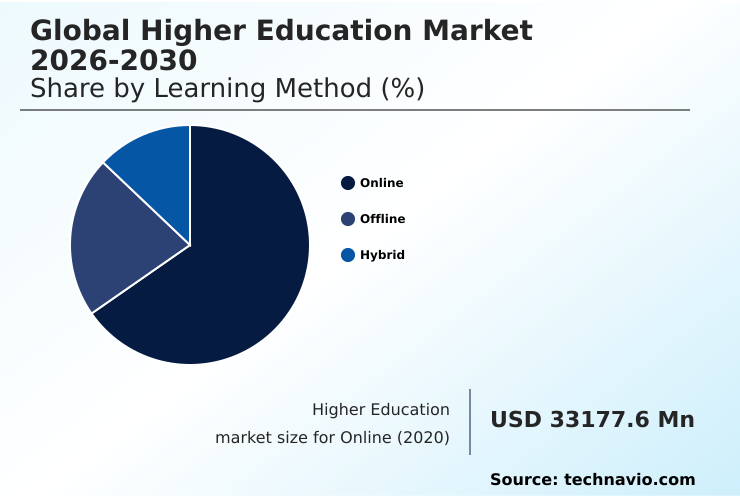
The Online segment was valued at USD 56.71 billion in 2024 and showed a gradual increase during the forecast period.
Regional Analysis
North America is estimated to contribute 41.9% to the growth of the global market during the forecast period.Technavio’s analysts have elaborately explained the regional trends and drivers that shape the market during the forecast period.
See How Higher Education Market Demand is Rising in North America Get Free Sample
The global higher education market exhibits significant regional divergence, shaping its overall competitive landscape. North America remains the most mature region, accounting for over 41% of the market's incremental growth, driven by its prestigious institutions and strong research infrastructure.
In contrast, the APAC region is the most dynamic, with growth rates exceeding 20% annually, fueled by a rising middle class and government investment in creating global education hubs.
This has intensified global student recruitment efforts and the need for strategic enrollment management. Institutions worldwide are adopting transnational education models and forming public-private partnerships to enter these high-growth areas.
The challenge lies in navigating diverse regulatory compliance in education and accreditation standards while delivering quality curriculum development and ensuring positive student mobility experiences, which requires significant campus infrastructure investment.
Market Dynamics
Our researchers analyzed the data with 2025 as the base year, along with the key drivers, trends, and challenges. A holistic analysis of drivers will help companies refine their marketing strategies to gain a competitive advantage.
- The future of the global higher education market is being actively shaped by the strategic integration of advanced technologies and innovative pedagogical models. A key area of exploration is the impact of AI on student assessment, moving beyond traditional testing to competency-based evaluation.
- The role of predictive analytics in student retention is becoming central to institutional strategy, with some universities reporting a reduction in dropout rates nearly double that of those using conventional methods. Concurrently, the use of blockchain for verifying academic credentials offers a secure solution to combat fraud and enhance the portability of qualifications.
- Institutions face the immense task of aligning curricula with industry needs, which involves developing effective transnational education partnerships and fostering deeper industry collaborations. Key strategic questions revolve around the challenges of funding public higher education and measuring the ROI of alternative credentialing programs. Furthermore, the integration of VR and AR in medical education is setting new standards for hands-on training.
- Success hinges on managing international student mobility risks and implementing best practices for online course delivery. The industry must also address the impact of demographic shifts on university enrollment while balancing the research and teaching missions within universities.
- This complex environment requires a sophisticated approach to building effective public-private partnerships in education and navigating the complexities of accreditation in online higher education, all while addressing the student affordability crisis and developing strategies for decolonizing university curricula.
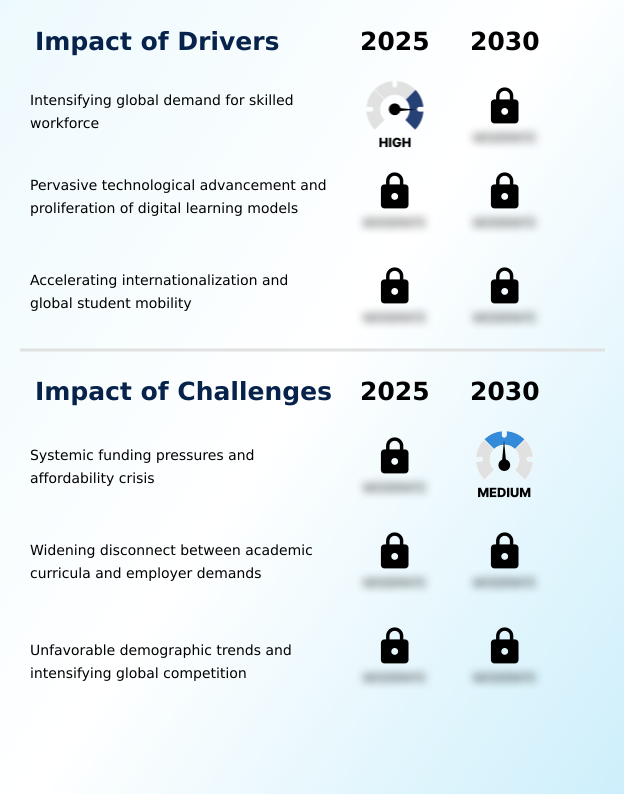
What are the key market drivers leading to the rise in the adoption of Higher Education Industry?
- An intensifying global demand for a skilled workforce is a key driver propelling the higher education market's growth and evolution.
- The market's expansion is fundamentally driven by the global economy's demand for a highly skilled workforce and the pervasive integration of technology. The recognized link between advanced education and socioeconomic mobility fuels persistent demand.
- This is amplified by the proliferation of digital learning models, where the adoption of educational technology integration has been shown to reduce delivery costs by up to 30% for certain programs.
- The rise of transnational education, through international branch campuses and joint degree programs, allows institutions to tap into new markets and talent pools. These partnerships, which are a form of public-private partnerships, are critical for institutional effectiveness.
- The implementation of favorable post-study work rights in key countries has further increased international student mobility, boosting enrollment by an average of 12% in the first two years.
What are the market trends shaping the Higher Education Industry?
- The ascendancy of micro-credentials and alternative credentialing models is a transformative market trend. It signals a shift toward a more flexible, unbundled, and skills-focused ecosystem.
- A transformative trend in the market is the unbundling of traditional degrees into a flexible ecosystem of alternative academic credentialing. This shift is driven by employer demand for specific, verifiable skills, leading to the ascendancy of micro-credentials and digital badges.
- These modular, just-in-time learning pathways are increasingly being integrated into formal education, with adaptive learning platforms enabling personalized learning at scale. Analysis shows that institutions offering stackable credentials see a 20% higher enrollment from working professionals. Furthermore, the strategic embedding of work-integrated learning and co-operative education placements into curricula has demonstrated a 15% improvement in post-graduation employment rates.
- This evolution reflects a systemic move toward a continuous model of lifelong learning, supported by robust alumni engagement strategy and faculty development to meet new pedagogical demands.
What challenges does the Higher Education Industry face during its growth?
- Systemic funding pressures and a widespread student affordability crisis present a key challenge affecting the growth and accessibility of the higher education industry.
- The market faces a dual crisis of institutional funding and a widening skills gap between academic offerings and employer needs. Declining public investment has shifted costs to students, with tuition fee structures in some developed nations rising over 50% in real terms over the past decade.
- This affordability crisis threatens equitable access and has led to a re-evaluation of student financing models. Simultaneously, the rapid pace of technological change creates a disconnect where nearly 40% of employers report that recent graduates lack necessary applied skills.
- This challenge is intensified by unfavorable demographic trends in mature markets and fierce global competition for a shrinking pool of traditional students. Navigating this landscape requires agile enrollment management and a clear focus on demonstrating strong student lifecycle management.
Exclusive Technavio Analysis on Customer Landscape
The higher education market forecasting report includes the adoption lifecycle of the market, covering from the innovator’s stage to the laggard’s stage. It focuses on adoption rates in different regions based on penetration. Furthermore, the higher education market report also includes key purchase criteria and drivers of price sensitivity to help companies evaluate and develop their market growth analysis strategies.
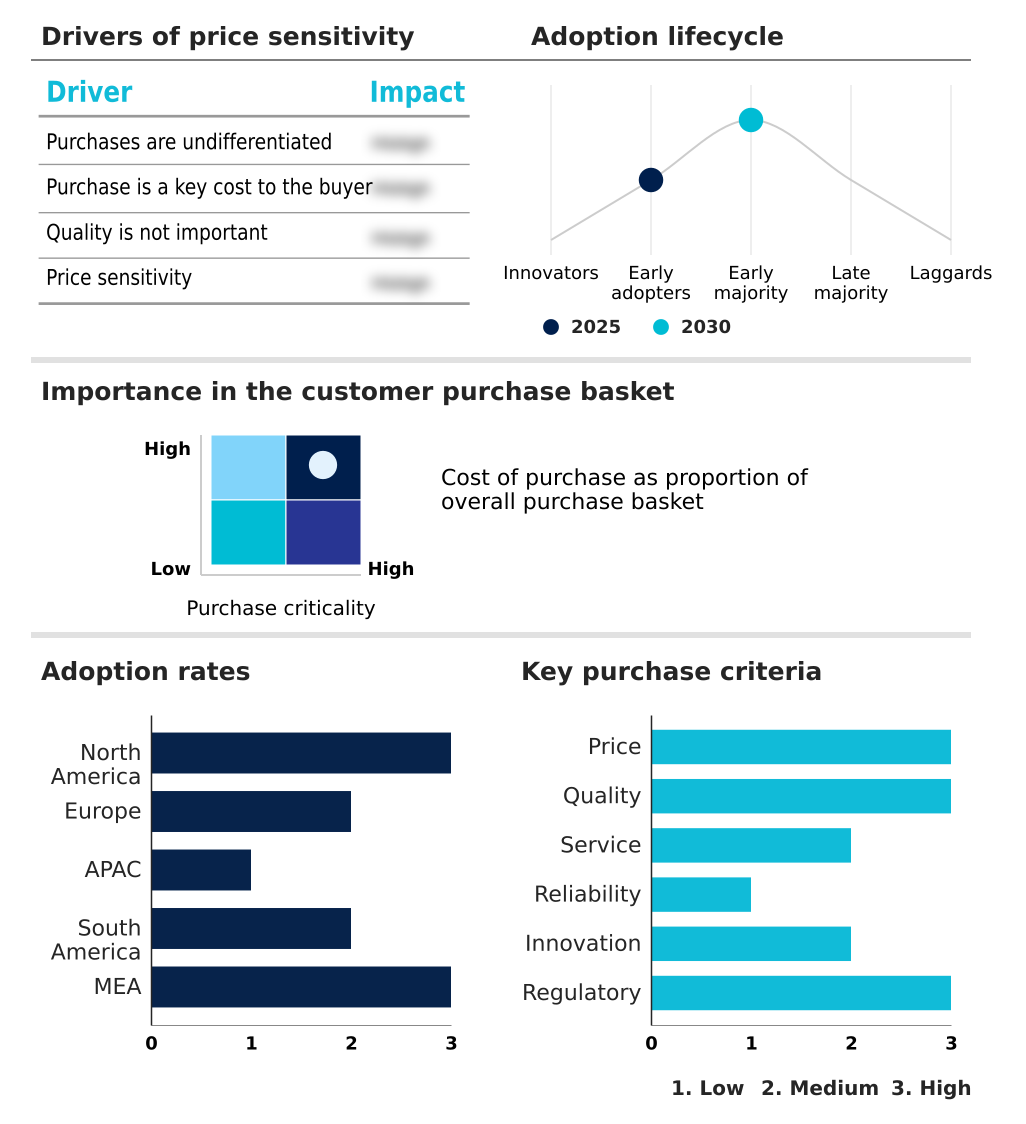
Customer Landscape of Higher Education Industry
Competitive Landscape
Companies are implementing various strategies, such as strategic alliances, higher education market forecast, partnerships, mergers and acquisitions, geographical expansion, and product/service launches, to enhance their presence in the industry.
Cisco Systems Inc. - Delivers secure networking and collaboration tools, creating robust digital campus solutions tailored for modern hybrid learning environments.
The industry research and growth report includes detailed analyses of the competitive landscape of the market and information about key companies, including:
- Cisco Systems Inc.
- Class Technologies Inc.
- D2L Corp.
- Educomp Solutions Ltd.
- Ellucian Co.
- Fujitsu Ltd.
- Harvard University
- Instructure Holdings Inc.
- Jenzabar Inc.
- Massachusetts Institute
- Microsoft Corp.
- Oracle Corp.
- Pearson Plc
- Promethean World Ltd.
- SMART Technologies ULC
- Stanford University
- Unifyed
- University of Cambridge
- University of Oxford
Qualitative and quantitative analysis of companies has been conducted to help clients understand the wider business environment as well as the strengths and weaknesses of key industry players. Data is qualitatively analyzed to categorize companies as pure play, category-focused, industry-focused, and diversified; it is quantitatively analyzed to categorize companies as dominant, leading, strong, tentative, and weak.
Recent Development and News in Higher education market
- In August, 2024, INTO University Partnerships initiated a significant strategic rebranding, which included the launch of the University Study Centre Dubai in partnership with Regent College London, creating an in-market hub for students in the region.
- In November, 2024, Purdue University formalized strategic partnerships with three Malaysian universities to develop the local workforce in the high-demand sectors of semiconductor technology and artificial intelligence, showcasing a sophisticated model of transnational education.
- In March, 2025, The European Commission announced its 'Union of Skills' strategy, a comprehensive initiative designed to address critical skills shortages by fostering more responsive and inclusive education and training systems across its member states.
- In May, 2025, Microsoft Corp. made its Copilot for Microsoft 365 available for purchase by higher education institutions for their students, embedding generative AI capabilities directly into widely used productivity applications to enhance learning processes.
Dive into Technavio’s robust research methodology, blending expert interviews, extensive data synthesis, and validated models for unparalleled Higher Education Market insights. See full methodology.
| Market Scope | |
|---|---|
| Page number | 297 |
| Base year | 2025 |
| Historic period | 2020-2024 |
| Forecast period | 2026-2030 |
| Growth momentum & CAGR | Accelerate at a CAGR of 19.4% |
| Market growth 2026-2030 | USD 140653.2 million |
| Market structure | Fragmented |
| YoY growth 2025-2026(%) | 16.5% |
| Key countries | US, Canada, Mexico, UK, Germany, France, Italy, Spain, The Netherlands, China, India, Japan, Australia, South Korea, Indonesia, Brazil, Argentina, Chile, Saudi Arabia, UAE, South Africa, Egypt and Turkey |
| Competitive landscape | Leading Companies, Market Positioning of Companies, Competitive Strategies, and Industry Risks |
Research Analyst Overview
- The higher education market is undergoing a fundamental recalibration, driven by the shift from time-based credentialing to the verifiable acquisition of career-relevant competencies. This evolution compels institutions to rethink curriculum development and pedagogical approaches. The rise of digital learning models, including online learning platforms and hybrid learning formats, is now standard, facilitated by advanced learning management systems.
- A key boardroom-level decision is how to invest in and market a portfolio of micro-credentials and stackable credentials to capture the lifelong learning segment. Data shows a complex student demand landscape, with a recent 17-point swing in preference back toward in-person instruction, challenging simplistic online-only strategies.
- Success requires a sophisticated blend of delivery modes, integrating virtual and augmented reality for specialized training while using intelligent tutoring systems and personalized learning paths for scalable support.
- This strategic pivot, aimed at closing the skills gap and improving student success and retention, is essential for maintaining relevance and financial stability in a competitive market that demands demonstrable institutional research and experiential learning opportunities.
What are the Key Data Covered in this Higher Education Market Research and Growth Report?
-
What is the expected growth of the Higher Education Market between 2026 and 2030?
-
USD 140.65 billion, at a CAGR of 19.4%
-
-
What segmentation does the market report cover?
-
The report is segmented by Learning Method (Online, Offline, and Hybrid), End-user (Private colleges, State universities, and Community colleges), Courses (Undergraduate, Masters, and PhD) and Geography (North America, Europe, APAC, South America, Middle East and Africa)
-
-
Which regions are analyzed in the report?
-
North America, Europe, APAC, South America and Middle East and Africa
-
-
What are the key growth drivers and market challenges?
-
Intensifying global demand for skilled workforce, Systemic funding pressures and affordability crisis
-
-
Who are the major players in the Higher Education Market?
-
Cisco Systems Inc., Class Technologies Inc., D2L Corp., Educomp Solutions Ltd., Ellucian Co., Fujitsu Ltd., Harvard University, Instructure Holdings Inc., Jenzabar Inc., Massachusetts Institute, Microsoft Corp., Oracle Corp., Pearson Plc, Promethean World Ltd., SMART Technologies ULC, Stanford University, Unifyed, University of Cambridge and University of Oxford
-
Market Research Insights
- The market's dynamics are shaped by a strategic recalibration toward learner-centric models, where institutional effectiveness is paramount. This shift is evident in how institutions are redesigning tuition fee structures and student financing models to address affordability, with some achieving a 10% increase in applications from underserved demographics.
- Post-graduation outcomes are now a core metric, compelling a focus on work-integrated learning and workforce development alignment. Student preferences are also a complex factor; analysis reveals a 17-point swing back toward a preference for in-person lectures, complicating strategic planning for digital campus solutions.
- Concurrently, a significant 75% of students now favor programs that formally recognize alternative academic credentialing, pushing universities to integrate these into their core offerings to remain competitive in global student recruitment.
We can help! Our analysts can customize this higher education market research report to meet your requirements.
 RIA -
RIA -