

North America Bagged Industrial Salt Market Analysis - Size and Forecast 2025-2029

North America Bagged Industrial Salt Market Analysis - Size and Forecast 2025-2029

Published: Dec 2024 164 Pages SKU: IRTNTR80466

Market Overview at a Glance

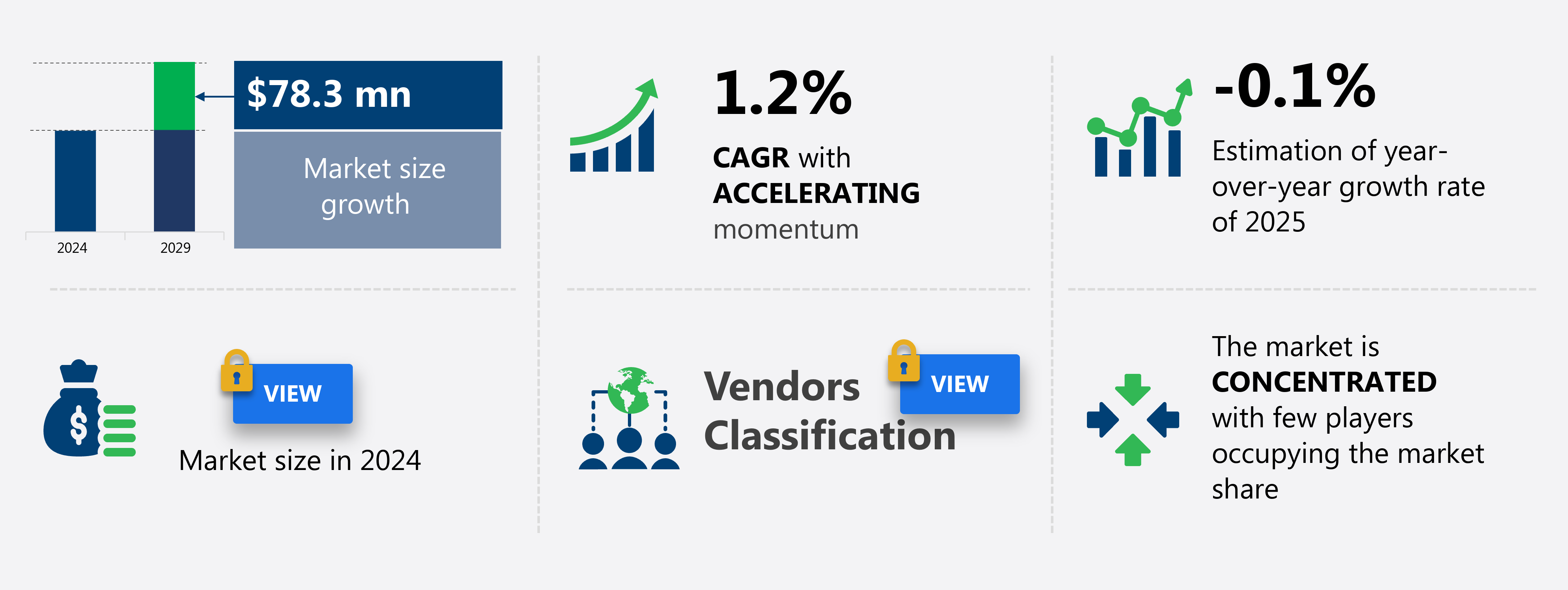
$78.3 Mn
Market Opportunity
1.2%
CAGR
-0.1
YoY growth 2024-2025(%)

North America Bagged Industrial Salt Market Size 2025-2029 

The North America bagged industrial salt market size is forecast to increase by USD 78.3 million at a CAGR of 1.2% between 2024 and 2029.

  • The market is experiencing significant growth due to several key factors. Severe winter weather conditions continue to drive demand for salt as de-icing agent in various industries, particularly transportation and construction. Additionally, the increasing focus on water treatment and wastewater management is leading to increased usage of bagged industrial salt in this application. Furthermore, accidents at salt mines and supply chain disruptions have highlighted the importance of having a reliable and consistent supply of salt, further boosting market growth. These trends are expected to continue shaping the market dynamics in the coming years.

What will be the Size of the Market During the Forecast Period?
Bagged Industrial Salt Market in North America Size

 Request Free Sample

  • The market is a significant sector within the broader industrial salt industry. This market caters to various industries, including pharmaceuticals, food processing, agriculture, and cleaning, among others. The demand for bagged industrial salt is driven by its diverse applications, which range from disinfection and sanitation to food additives and livestock supplements. The industrial automation sector plays a crucial role in the production and distribution of bagged industrial salt. Process engineering and quality control are essential elements of this process, ensuring the consistent delivery of high-quality salt products. The integration of advanced technologies, such as material science and nanotechnology, enhances the efficiency and sustainability of salt production methods. The hygiene industry is another major consumer of bagged industrial salt. The demand for salt in this sector is driven by its role in disinfection and sanitation processes. Salt's ability to absorb moisture and lower the freezing point of water makes it an essential component in various cleaning products. The pharmaceutical industry relies on bagged industrial salt as a critical raw material for producing various medications. Salt is used as a preservative, a bulking agent, and a flavoring agent in pharmaceutical formulations.
  • The production of salt for pharmaceutical applications requires stringent regulatory compliance and adherence to safety regulations. The agricultural sector utilizes bagged industrial salt for various purposes, including animal feed and agricultural chemicals. Salt is used as a livestock supplement to maintain animal health and productivity. In the agricultural sector, salt is also used as a raw material for producing various chemicals, such as fertilizers and pesticides. The food industry uses bagged industrial salt for food additives, food preservation, and de-icing applications. Salt's role in food additives includes its use as a flavor enhancer and a preservative. In food preservation, salt is used to prevent bacterial growth and enhance the shelf life of various food products. The market research reports indicate a growing trend towards sustainable practices in the bagged industrial salt industry. Companies are focusing on reducing their carbon footprint by adopting evaporative salt production methods and solar salt production. These methods reduce the energy consumption and water usage associated with traditional salt mining and brine extraction methods.

How is this market segmented and which is the largest segment?

The market research report provides comprehensive data (region-wise segment analysis), with forecasts and estimates in "USD million" for the period 2025-2029, as well as historical data from 2019-2023 for the following segments.

  • Product Type
    • Fine industrial salt
    • Coarse industrial salt
  • Application
    • Chemical industry
    • De-icing
    • Food processing industry
    • Agriculture
    • Others
  • Geography
    • North America
      • Canada
      • Mexico
      • US

By Product Type Insights

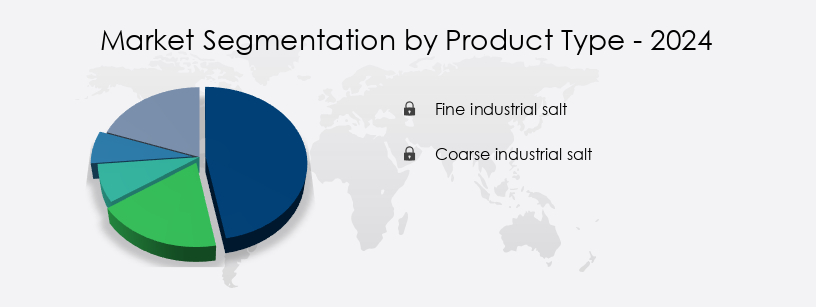
  • The fine industrial salt segment is estimated to witness significant growth during the forecast period.

The market is witnessing significant growth due to its increasing utilization in various industries and advanced manufacturing processes. This segment's expansion is fueled by the demand for finer salt grades, which offer distinct advantages in different industrial applications. In the realm of chemical processing, the necessity for fine industrial salt is particularly prominent. Its precise particle size distribution is essential for ensuring optimal reaction efficiency and superior product quality. The fine granules of this salt create a consistent and controlled environment for chemical reactions, resulting in enhanced yields and superior end products. Moreover, the fine industrial salt market is influenced by the mining techniques used, including vacuum pan technology and solution mining.

Further, logistical services play a crucial role in ensuring the timely delivery of this essential commodity to various end-users, including energy generation, hospitals, and water treatment facilities. The demand for clean drinking water and the growing adoption of solar evaporation for water treatment are also driving the market's growth. The fine industrial salt is a vital component in the production of chlorine, which is used extensively in water treatment processes. Furthermore, its application in energy generation, particularly in the form of brine, is gaining momentum due to the increasing focus on renewable energy sources.
Bagged Industrial Salt Market in North America Share by Product Type

Get a glance at the market report of share of various segments Request Free Sample

Market Dynamics

Our market researchers analyzed the data with 2024 as the base year, along with the key drivers, trends, and challenges. A holistic analysis of drivers will help companies refine their marketing strategies to gain a competitive advantage.

What are the key market drivers leading to the rise in the adoption of the market?

Severe winter weather is the key driver of the market.

  • The market experiences significant growth due to the harsh winter conditions in the United States and Canada. Municipalities and state governments actively utilize high-grade salts, such as magnesium chloride, sodium chloride, and sodium fluorosilicate, for de-icing and snow removal during the winter months. These salts are essential for maintaining traffic safety and preventing accidents caused by icy roads and highways. In the chemical processing industry, industrial salt is used in various applications, including the production of chlorine, sulfates, and sodium hypochlorite for water treatment. Additionally, it is employed in the manufacturing processes of PVC, plastics, and pharmaceuticals. Sodium chlorate, a byproduct of the chlor-alkali process, is another industrial salt application.

    Furthermore, industrial salt is used in various industries such as agriculture, food processing, and mining activities. In agriculture, it is used as a fertilizer and for livestock feed. In food processing, it is used as a preservative and in the production of laundry care products, cosmetics, and meat processing. In mining activities, it is used as a drilling fluid and in solution mining. Environmental compliance plays a crucial role in the industrial salt market. The chemical industry adheres to strict environmental regulations to minimize CO2 emissions and ensure clean drinking water. Vacuum pan technology and solar evaporation are used to produce high-purity salts, reducing the environmental impact of traditional mining practices.

What are the market trends shaping the market?

Growing water treatment needs is the upcoming trend in the market.

  • The market is witnessing notable expansion due to the escalating demand for water treatment solutions. With urbanization and industrialization progressing at an unprecedented pace, there is a growing necessity for water softening processes that are essential for both residential water systems and large-scale municipal treatment plants. These processes eliminate minerals, such as calcium and magnesium, which contribute to water hardness. Strict regulations governing water quality and treatment in North America, particularly in the U.S. And Canada, necessitate continuous investments in enhancing water systems. Consequently, the demand for bagged industrial salt is fueled by these regulatory mandates, as it is an indispensable component in the regeneration of water softening systems.
  • Moreover, the chemical processing industry also relies heavily on high-purity salts, including sodium chloride, magnesium chloride, and sodium fluorosilicate, for various applications. These salts are utilized in the production of chlorine, which is employed in water treatment, disinfection, and bleaching processes. In addition, they are integral to the manufacturing of PVC, a widely used plastic in various industries, including healthcare, food processing, and agriculture. The healthcare sector employs bagged industrial salt in the production of high-purity salts, such as sodium chloride, which is used as an essential electrolyte in intravenous formulas and as a critical component in the production of chlorides for various medical applications.
  • Furthermore, the salt is also used in the pharmaceutical industry for the production of therapeutic drugs and in the manufacturing of soaps and detergents. The food processing industry utilizes industrial salt for various applications, including food preservation, seasoning, and as a raw material in the production of soda ash, which is employed in the manufacturing of glass, paper, and other industrial products. In the agricultural sector, salt is used as a fertilizer and in the production of animal feed. The solar energy industry also employs industrial salt in the production of solar evaporation ponds, which are used for energy generation.

What challenges does the market face during the growth?

Accidents at salt mines is a key challenge affecting the market growth.

  • The market faces challenges due to accidents in salt mines, which impact both supply and financial stability. These incidents can result in temporary mine shutdowns or sections, causing significant disruptions during high-demand periods, such as winter months, for road de-icing salt. The financial consequences of these accidents are substantial, with mining companies incurring losses from recovery efforts and investigations. Furthermore, these interruptions can create market instability, leading to supply shortages and price increases. Magnesium, sodium fluorosilicate, and sulfates are essential chemicals used in the production of industrial salt. In the chemical processing industry, high-grade salts are produced using techniques like vacuum pan technology and solution mining.
  • These salts find applications in various sectors, including laundry care products, water treatment, food processing, agriculture, and energy production. Magnesium chloride, a high-purity salt, is used in PVC production, while sodium chloride is essential for chlorine production in the chemical industry. Sodium chlorate is used in mining activities, while potassium chloride is used in meat processing and cosmetics. Calcium hypochlorite, chlorine dioxide, and sodium hypochlorite are used in water treatment, ensuring clean drinking water and maintaining water quality in waterways. In the healthcare sector, high-purity salts are used in pharmaceuticals and intravenous formulas. In food and beverage applications, salts like sodium chloride, sodium fluorosilicate, and sulfates are used as preservatives and additives.

Exclusive Customer Landscape

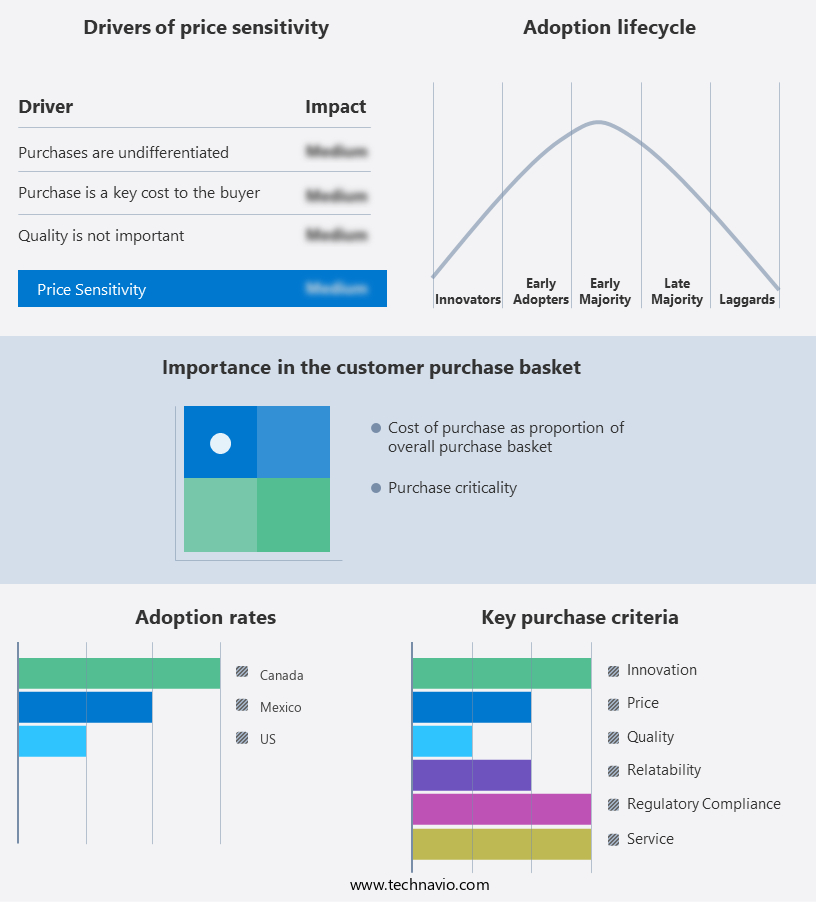
The market forecasting report includes the adoption lifecycle of the market, covering from the innovator's stage to the laggard's stage. It focuses on adoption rates in different regions based on penetration. Furthermore, the market report also includes key purchase criteria and drivers of price sensitivity to help companies evaluate and develop their market growth analysis strategies.
Bagged Industrial Salt Market in North America Share by Geography

 Customer Landscape

Key Companies & Market Insights

Companies are implementing various strategies, such as strategic alliances, market forecast , partnerships, mergers and acquisitions, geographical expansion, and product/service launches, to enhance their presence in the market.

Cargill Inc. -  This company offers bagged industrial salt used in a wide range of industrial applications such as chemical manufacturing, textile processing, and metallurgical smelting.

The market research and growth report includes detailed analyses of the competitive landscape of the market and information about key companies, including:

  • Cargill Inc.
  • Delmon Group
  • Dominion Salt Ltd.
  • Donald Brown Group
  • INEOS Group Holdings S.A.
  • KS Aktiengesellschaft
  • Mitsui and Co. Ltd.
  • Namco Pools
  • Rio Tinto Ltd.
  • Tata Chemicals Ltd.

Qualitative and quantitative analysis of companies has been conducted to help clients understand the wider business environment as well as the strengths and weaknesses of key market players. Data is qualitatively analyzed to categorize companies as pure play, category-focused, industry-focused, and diversified; it is quantitatively analyzed to categorize companies as dominant, leading, strong, tentative, and weak.

Research Analyst Overview

The market is driven by several factors, which are discussed below. Magnesium and other essential minerals are vital components of bagged industrial salt. These minerals find extensive applications in the manufacturing processes of various industries. For instance, magnesium is used in the production of high-purity salts, which are essential in the chemical industry. Magnesium is also used in the production of chlorine, a critical disinfectant in water treatment and various other applications. Polyvinyl chloride (PVC) is another significant application area for bagged industrial salt. The vacuum pan technique is commonly used to produce high-grade chemicals, including PVC, which requires the use of bagged industrial salt. In the production of PVC, sodium fluorosilicate is used as a catalyst, which is derived from bagged industrial salt. Laundry care products and detergents are other major consumers of bagged industrial salt. Sodium chloride, a primary component of bagged industrial salt, is used in the production of laundry care products and detergents. Sodium chloride is also used in the production of chlorine, which is used as a bleaching agent in laundry care products.

Perishable products, such as meat, require preservation to maintain their quality during transportation and storage. Bagged industrial salt is used as a preservative in the transportation and storage of such products. Chlorides, a component of bagged industrial salt, are used as preservatives in the meat industry. The chemical processing industry is a significant consumer of bagged industrial salt. Sodium chlorate, a chlorate salt, is produced from bagged industrial salt and is used as a bleaching agent in the chemical industry. Sodium chlorate also finds applications in mining activities, such as in the production of chlorine dioxide, which is used for water treatment and bleaching. The healthcare industry is another major consumer of bagged industrial salt. Sodium chloride is used in the production of intravenous formulas and contact solutions. Sodium chloride is also used in the production of pharmaceuticals, such as capsules and tablets. The food processing industry uses bagged industrial salt extensively. It is used as a seasoning agent, a preservative, and a raw material in the production of various food items. Rock salt, a type of bagged industrial salt, is used in food processing due to its high purity and unique taste. The solar energy industry uses bagged industrial salt in the production of solar evaporation systems.

Market Scope

Report Coverage

Details

Page number

164

Base year

2024

Historic period

2019-2023

Forecast period

2025-2029

Growth momentum & CAGR

Accelerate at a CAGR of 1.2%

Market Growth 2025-2029

USD 78.3 million

Market structure

Concentrated

YoY growth 2024-2025(%)

-0.1

Key countries

US, Canada, and Mexico

Competitive landscape

Leading Companies, Market Positioning of Companies, Competitive Strategies, and Industry Risks

Request Free Sample

What are the Key Data Covered in this Market Research and Growth Report?

  • CAGR of the market during the forecast period
  • Detailed information on factors that will drive the market growth and forecasting between 2025 and 2029
  • Precise estimation of the size of the market  and its contribution of the market in focus to the parent market
  • Accurate predictions about upcoming market growth and trends and changes in consumer behaviour
  • Growth of the market across North America
  • Thorough analysis of the market's competitive landscape and detailed information about companies
  • Comprehensive analysis of factors that will challenge the growth of market companies

We can help! Our analysts can customize this market research report to meet your requirements.

Get in touch

1 Executive Summary

  • 1.1 Market overview
    • Executive Summary - Chart on Market Overview
    • Executive Summary - Data Table on Market Overview
    • Executive Summary - Chart on Country Market Characteristics
    • Executive Summary - Chart on Market by Geography
    • Executive Summary - Chart on Market Segmentation by Product Type
    • Executive Summary - Chart on Market Segmentation by Application
    • Executive Summary - Chart on Incremental Growth
    • Executive Summary - Data Table on Incremental Growth
    • Executive Summary - Chart on Company Market Positioning

2 Technavio Analysis

  • 2.1 Analysis of price sensitivity, lifecycle, customer purchase basket, adoption rates, and purchase criteria
    • Analysis of price sensitivity, lifecycle, customer purchase basket, adoption rates, and purchase criteria
  • 2.2 Criticality of inputs and Factors of differentiation
    • Overview on criticality of inputs and factors of differentiation
  • 2.3 Factors of disruption
    • Overview on factors of disruption
  • 2.4 Impact of drivers and challenges
    • Impact of drivers and challenges in 2024 and 2029

3 Market Landscape

  • 3.1 Market ecosystem
    • Parent Market
    • Data Table on - Parent Market
  • 3.2 Market characteristics
    • Market characteristics analysis
  • 3.3 Value chain analysis
    • Value chain analysis

4 Market Sizing

  • 4.1 Market definition
    • Offerings of companies included in the market definition
  • 4.2 Market segment analysis
    • Market segments
  • 4.3 Market size 2024
    • 4.4 Market outlook: Forecast for 2024-2029
      • Chart on North America - Market size and forecast 2024-2029 ($ million)
      • Data Table on Regional - Market size and forecast 2024-2029 ($ million)
      • Chart on North America: Year-over-year growth 2024-2029 (%)
      • Data Table on Regional - Market size and forecast 2024-2029 ($ million)

    5 Historic Market Size

    • 5.1 Bagged Industrial Salt Market in North America 2019 - 2023
      • Historic Market Size - Data Table on Bagged Industrial Salt Market in North America 2019 - 2023 ($ million)
    • 5.2 Product Type segment analysis 2019 - 2023
      • Historic Market Size - Product Type Segment 2019 - 2023 ($ million)
    • 5.3 Application segment analysis 2019 - 2023
      • Historic Market Size - Application Segment 2019 - 2023 ($ million)
    • 5.4 Geography segment analysis 2019 - 2023
      • Historic Market Size - Geography Segment 2019 - 2023 ($ million)

    6 Qualitative Analysis

    • 6.1 Impact of Artificial Intelligence (AI) on the bagged industrial salt market in North America

      7 Five Forces Analysis

      • 7.1 Five forces summary
        • Five forces analysis - Comparison between 2024 and 2029
      • 7.2 Bargaining power of buyers
        • Bargaining power of buyers - Impact of key factors 2024 and 2029
      • 7.3 Bargaining power of suppliers
        • Bargaining power of suppliers - Impact of key factors in 2024 and 2029
      • 7.4 Threat of new entrants
        • Threat of new entrants - Impact of key factors in 2024 and 2029
      • 7.5 Threat of substitutes
        • Threat of substitutes - Impact of key factors in 2024 and 2029
      • 7.6 Threat of rivalry
        • Threat of rivalry - Impact of key factors in 2024 and 2029
      • 7.7 Market condition
        • Chart on Market condition - Five forces 2024 and 2029

      8 Market Segmentation by Product Type

      • 8.1 Market segments
        • Chart on Product Type - Market share 2024-2029 (%)
        • Data Table on Product Type - Market share 2024-2029 (%)
      • 8.2 Comparison by Product Type
        • Chart on Comparison by Product Type
        • Data Table on Comparison by Product Type
      • 8.3 Fine industrial salt - Market size and forecast 2024-2029
        • Chart on Fine industrial salt - Market size and forecast 2024-2029 ($ million)
        • Data Table on Fine industrial salt - Market size and forecast 2024-2029 ($ million)
        • Chart on Fine industrial salt - Year-over-year growth 2024-2029 (%)
        • Data Table on Fine industrial salt - Year-over-year growth 2024-2029 (%)
      • 8.4 Coarse industrial salt - Market size and forecast 2024-2029
        • Chart on Coarse industrial salt - Market size and forecast 2024-2029 ($ million)
        • Data Table on Coarse industrial salt - Market size and forecast 2024-2029 ($ million)
        • Chart on Coarse industrial salt - Year-over-year growth 2024-2029 (%)
        • Data Table on Coarse industrial salt - Year-over-year growth 2024-2029 (%)
      • 8.5 Market opportunity by Product Type
        • Market opportunity by Product Type ($ million)
        • Data Table on Market opportunity by Product Type ($ million)

      9 Market Segmentation by Application

      • 9.1 Market segments
        • Chart on Application - Market share 2024-2029 (%)
        • Data Table on Application - Market share 2024-2029 (%)
      • 9.2 Comparison by Application
        • Chart on Comparison by Application
        • Data Table on Comparison by Application
      • 9.3 Chemical industry - Market size and forecast 2024-2029
        • Chart on Chemical industry - Market size and forecast 2024-2029 ($ million)
        • Data Table on Chemical industry - Market size and forecast 2024-2029 ($ million)
        • Chart on Chemical industry - Year-over-year growth 2024-2029 (%)
        • Data Table on Chemical industry - Year-over-year growth 2024-2029 (%)
      • 9.4 De-icing - Market size and forecast 2024-2029
        • Chart on De-icing - Market size and forecast 2024-2029 ($ million)
        • Data Table on De-icing - Market size and forecast 2024-2029 ($ million)
        • Chart on De-icing - Year-over-year growth 2024-2029 (%)
        • Data Table on De-icing - Year-over-year growth 2024-2029 (%)
      • 9.5 Food processing industry - Market size and forecast 2024-2029
        • Chart on Food processing industry - Market size and forecast 2024-2029 ($ million)
        • Data Table on Food processing industry - Market size and forecast 2024-2029 ($ million)
        • Chart on Food processing industry - Year-over-year growth 2024-2029 (%)
        • Data Table on Food processing industry - Year-over-year growth 2024-2029 (%)
      • 9.6 Agriculture - Market size and forecast 2024-2029
        • Chart on Agriculture - Market size and forecast 2024-2029 ($ million)
        • Data Table on Agriculture - Market size and forecast 2024-2029 ($ million)
        • Chart on Agriculture - Year-over-year growth 2024-2029 (%)
        • Data Table on Agriculture - Year-over-year growth 2024-2029 (%)
      • 9.7 Others - Market size and forecast 2024-2029
        • Chart on Others - Market size and forecast 2024-2029 ($ million)
        • Data Table on Others - Market size and forecast 2024-2029 ($ million)
        • Chart on Others - Year-over-year growth 2024-2029 (%)
        • Data Table on Others - Year-over-year growth 2024-2029 (%)
      • 9.8 Market opportunity by Application
        • Market opportunity by Application ($ million)
        • Data Table on Market opportunity by Application ($ million)

      10 Customer Landscape

      • 10.1 Customer landscape overview
        • Analysis of price sensitivity, lifecycle, customer purchase basket, adoption rates, and purchase criteria

      11 Geographic Landscape

      • 11.1 Geographic segmentation
        • Chart on Market share by geography - 2024-2029 (%)
        • Data Table on Market share by geography - 2024-2029 (%)
      • 11.2 Geographic comparison
        • Chart on Geographic comparison
        • Data Table on Geographic comparison
      • 11.3 US - Market size and forecast 2024-2029
        • Chart on US - Market size and forecast 2024-2029 ($ million)
        • Data Table on US - Market size and forecast 2024-2029 ($ million)
        • Chart on US - Year-over-year growth 2024-2029 (%)
        • Data Table on US - Year-over-year growth 2024-2029 (%)
      • 11.4 Canada - Market size and forecast 2024-2029
        • Chart on Canada - Market size and forecast 2024-2029 ($ million)
        • Data Table on Canada - Market size and forecast 2024-2029 ($ million)
        • Chart on Canada - Year-over-year growth 2024-2029 (%)
        • Data Table on Canada - Year-over-year growth 2024-2029 (%)
      • 11.5 Mexico - Market size and forecast 2024-2029
        • Chart on Mexico - Market size and forecast 2024-2029 ($ million)
        • Data Table on Mexico - Market size and forecast 2024-2029 ($ million)
        • Chart on Mexico - Year-over-year growth 2024-2029 (%)
        • Data Table on Mexico - Year-over-year growth 2024-2029 (%)
      • 11.6 Market opportunity by geography
        • Market opportunity by geography ($ million)
        • Data Table on Market opportunity by geography ($ million)

      12 Drivers, Challenges, and Opportunity/Restraints

      • 12.1 Market drivers
        • 12.2 Market challenges
          • 12.3 Impact of drivers and challenges
            • Impact of drivers and challenges in 2024 and 2029
          • 12.4 Market opportunities/restraints

            13 Competitive Landscape

            • 13.1 Overview
              • 13.2 Competitive Landscape
                • Overview on criticality of inputs and factors of differentiation
              • 13.3 Landscape disruption
                • Overview on factors of disruption
              • 13.4 Industry risks
                • Impact of key risks on business

              14 Competitive Analysis

              • 14.1 Companies profiled
                • Companies covered
              • 14.2 Company ranking index
                • Company ranking index
              • 14.3 Market positioning of companies
                • Matrix on companies position and classification
              • 14.4 Cargill Inc.
                • Cargill Inc. - Overview
                • Cargill Inc. - Product / Service
                • Cargill Inc. - Key offerings
                • SWOT
              • 14.5 Delmon Group
                • Delmon Group - Overview
                • Delmon Group - Product / Service
                • Delmon Group - Key offerings
                • SWOT
              • 14.6 Dominion Salt Ltd.
                • Dominion Salt Ltd. - Overview
                • Dominion Salt Ltd. - Product / Service
                • Dominion Salt Ltd. - Key offerings
                • SWOT
              • 14.7 Donald Brown Group
                • Donald Brown Group - Overview
                • Donald Brown Group - Product / Service
                • Donald Brown Group - Key offerings
                • SWOT
              • 14.8 INEOS Group Holdings S.A.
                • INEOS Group Holdings S.A. - Overview
                • INEOS Group Holdings S.A. - Product / Service
                • INEOS Group Holdings S.A. - Key news
                • INEOS Group Holdings S.A. - Key offerings
                • SWOT
              • 14.9 KS Aktiengesellschaft
                • KS Aktiengesellschaft - Overview
                • KS Aktiengesellschaft - Product / Service
                • KS Aktiengesellschaft - Key offerings
                • SWOT
              • 14.10 Mitsui and Co. Ltd.
                • Mitsui and Co. Ltd. - Overview
                • Mitsui and Co. Ltd. - Business segments
                • Mitsui and Co. Ltd. - Key news
                • Mitsui and Co. Ltd. - Key offerings
                • Mitsui and Co. Ltd. - Segment focus
                • SWOT
              • 14.11 Namco Pools
                • Namco Pools - Overview
                • Namco Pools - Product / Service
                • Namco Pools - Key offerings
                • SWOT
              • 14.12 Rio Tinto Ltd.
                • Rio Tinto Ltd. - Overview
                • Rio Tinto Ltd. - Business segments
                • Rio Tinto Ltd. - Key news
                • Rio Tinto Ltd. - Key offerings
                • Rio Tinto Ltd. - Segment focus
                • SWOT
              • 14.13 Tata Chemicals Ltd.
                • Tata Chemicals Ltd. - Overview
                • Tata Chemicals Ltd. - Business segments
                • Tata Chemicals Ltd. - Key offerings
                • Tata Chemicals Ltd. - Segment focus
                • SWOT

              15 Appendix

              • 15.1 Scope of the report
                • 15.2 Inclusions and exclusions checklist
                  • Inclusions checklist
                  • Exclusions checklist
                • 15.3 Currency conversion rates for US$
                  • Currency conversion rates for US$
                • 15.4 Research methodology
                  • Research methodology
                • 15.5 Data procurement
                  • Information sources
                • 15.6 Data validation
                  • Data validation
                • 15.7 Validation techniques employed for market sizing
                  • Validation techniques employed for market sizing
                • 15.8 Data synthesis
                  • Data synthesis
                • 15.9 360 degree market analysis
                  • 360 degree market analysis
                • 15.10 List of abbreviations
                  • List of abbreviations

                Research Methodology

                Technavio presents a detailed picture of the market by way of study, synthesis, and summation of data from multiple sources. The analysts have presented the various facets of the market with a particular focus on identifying the key industry influencers. The data thus presented is comprehensive, reliable, and the result of extensive research, both primary and secondary.

                INFORMATION SOURCES

                Primary sources

                • Manufacturers and suppliers
                • Channel partners
                • Industry experts
                • Strategic decision makers

                Secondary sources

                • Industry journals and periodicals
                • Government data
                • Financial reports of key industry players
                • Historical data
                • Press releases

                DATA ANALYSIS

                Data Synthesis

                • Collation of data
                • Estimation of key figures
                • Analysis of derived insights

                Data Validation

                • Triangulation with data models
                • Reference against proprietary databases
                • Corroboration with industry experts

                REPORT WRITING

                Qualitative

                • Market drivers
                • Market challenges
                • Market trends
                • Five forces analysis

                Quantitative

                • Market size and forecast
                • Market segmentation
                • Geographical insights
                • Competitive landscape

                Interested in this report?

                Get your sample now to see our research methodology and insights!

                Download Now

                Frequently Asked Questions

                Bagged Industrial Salt market growth will increase by $ 78.3 mn during 2025-2029 .

                The Bagged Industrial Salt market is expected to grow at a CAGR of 1.2% during 2025-2029 .

                Bagged Industrial Salt market is segmented by Product Type( Fine industrial salt, Coarse industrial salt) Application( Chemical industry, De-icing, Food processing industry, Agriculture, Others)

                Cargill Inc., Delmon Group, Dominion Salt Ltd., Donald Brown Group, INEOS Group Holdings S.A., KS Aktiengesellschaft, Mitsui and Co. Ltd., Namco Pools, Rio Tinto Ltd., Tata Chemicals Ltd. are a few of the key vendors in the Bagged Industrial Salt market.

                North America will register the highest growth rate of 100% among the other regions. Therefore, the Bagged Industrial Salt market in North America is expected to garner significant business opportunities for the vendors during the forecast period.

                US, Canada, Mexico

                • Severe winter weatherThe severe winter weather conditions in North America is the driving factor this market.
                • particularly in the United States and Canada is the driving factor this market.
                • are a primary driver of the bagged industrial salt market in North America. The heavy snowfall and freezing temperatures prevalent in regions such as the Midwest is the driving factor this market.
                • Northeast is the driving factor this market.
                • and Northern parts of the U.S. and Canada create a substantial demand for industrial salt is the driving factor this market.
                • essential for de-icing and snow removal.During the winter months is the driving factor this market.
                • municipalities and state governments actively utilize industrial salt to ensure the safety of roads is the driving factor this market.
                • highways is the driving factor this market.
                • and parking lots. This practice is critical for maintaining traffic safety and preventing accidents caused by icy conditions. The high seasonal demand for rock salt and other industrial salts for snow and ice control significantly contributes to market growth.A notable instance of the impact of severe winter weather was observed in November 2024. A major winter storm swept across the eastern U.S. and Canada is the driving factor this market.
                • bringing heavy snow and freezing temperatures to the Great Lakes is the driving factor this market.
                • Midwest is the driving factor this market.
                • and Northern Plains. The severity of the storm prompted officials in New York and Pennsylvania to declare states of emergency as poor conditions severely disrupted travel across the region. Such extreme weather events underscore the critical need for effective de-icing solutions is the driving factor this market.
                • driving the demand for bagged industrial salt.The consistent occurrence of harsh winter conditions in these regions ensures a steady demand for industrial salt year after year. The need for quick and efficient snow and ice removal to maintain transportation and prevent hazards keeps municipalities and governments heavily reliant on industrial salt. is the driving factor this market.

                The Bagged Industrial Salt market vendors should focus on grabbing business opportunities from the Fine industrial salt segment as it accounted for the largest market share in the base year.