


Road Freight Transport Market Size 2026-2030
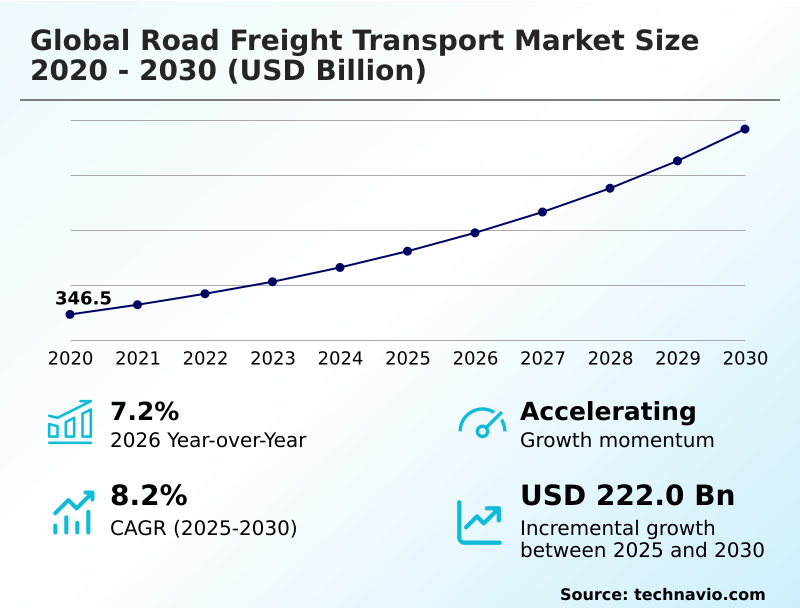
The road freight transport market size is valued to increase by USD 222 billion, at a CAGR of 8.2% from 2025 to 2030. Rising demand from e-commerce and retail sectors will drive the road freight transport market.
Major Market Trends & Insights
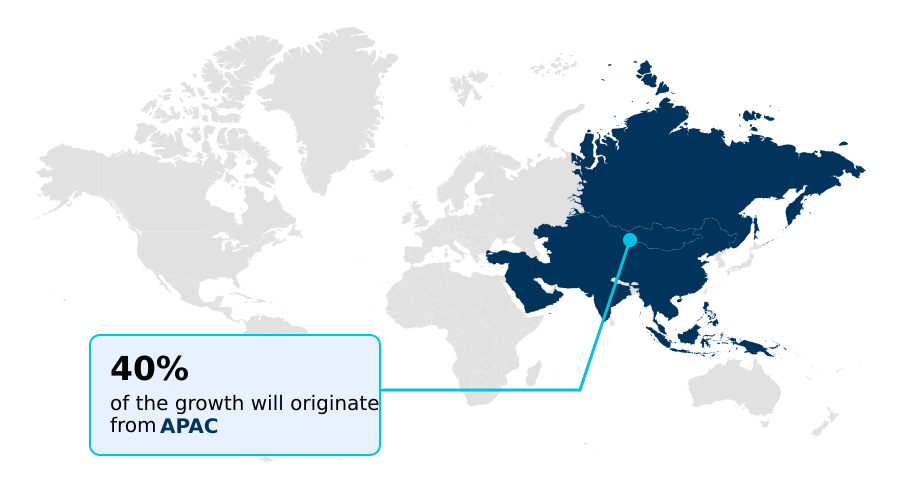
- APAC dominated the market and accounted for a 40.4% growth during the forecast period.
- By Vehicle Type - Medium and heavy commercial vehicle segment was valued at USD 272.4 billion in 2024
- By End-user - Manufacturing segment accounted for the largest market revenue share in 2024
Market Size & Forecast
- Market Opportunities: USD 337 billion
- Market Future Opportunities: USD 222 billion
- CAGR from 2025 to 2030 : 8.2%
Market Summary
- The road freight transport market remains the essential backbone of commerce, facilitating the movement of goods through a complex network of services. Its evolution is driven by the relentless expansion of e-commerce, which has reshaped retail supply chains and intensified the demand for efficient last-mile delivery and middle-mile delivery.
- This has spurred innovation in logistics network optimization and the adoption of advanced technologies. For instance, a logistics provider managing a just-in-time manufacturing supply chain now relies on a transportation management system (tms) with real-time shipment tracking to synchronize the arrival of components, minimizing inventory and preventing production delays.
- At the same time, the industry grapples with challenges such as the persistent driver shortage, volatile fuel costs, and increasing regulatory pressures, particularly environmental mandates promoting green logistics initiatives and the use of alternative fuel vehicles.
- A key trend is the strategic pivot toward building greater supply chain resilience, compelling operators to invest in flexible operational models and enhanced supply chain visibility to navigate disruptions effectively. This dynamic environment fosters continuous transformation, where technology and strategic adaptation are paramount for competitiveness.
What will be the Size of the Road Freight Transport Market during the forecast period?
Get Key Insights on Market Forecast (PDF) Get Free Sample
How is the Road Freight Transport Market Segmented?
The road freight transport industry research report provides comprehensive data (region-wise segment analysis), with forecasts and estimates in "USD billion" for the period 2026-2030, as well as historical data from 2020-2024 for the following segments.
- Vehicle type
- Medium and heavy commercial vehicle
- Light commercial vehicle
- End-user
- Manufacturing
- Automotive
- Consumer goods
- Food and beverage
- Others
- Type
- Domestic
- International
- Geography
- APAC
- China
- India
- Japan
- North America
- US
- Canada
- Mexico
- Europe
- Germany
- France
- UK
- Middle East and Africa
- Saudi Arabia
- South Africa
- UAE
- South America
- Brazil
- Argentina
- Colombia
- Rest of World (ROW)
- APAC
By Vehicle Type Insights
The medium and heavy commercial vehicle segment is estimated to witness significant growth during the forecast period.
The medium and heavy commercial vehicle segment is the cornerstone of the road freight industry, vital for full truckload (ftl) services and the line-haul component of consolidated networks.
These vehicles are essential for long-distance and cross-border haulage, connecting manufacturing centers with distribution points and enabling intermodal trucking through drayage transportation. Operators face pressures from strict vehicle weight limitations and the need for effective operational cost management.
Consequently, many are pursuing fleet modernization programs, adopting telematics and gps tracking to improve asset utilization metrics and carrier capacity management.
A key focus is carbon footprint reduction, with some achieving a 15% decrease in emissions through investment in alternative fuel vehicles and partnerships with specialized third-party logistics (3pl) provider for optimized routing.
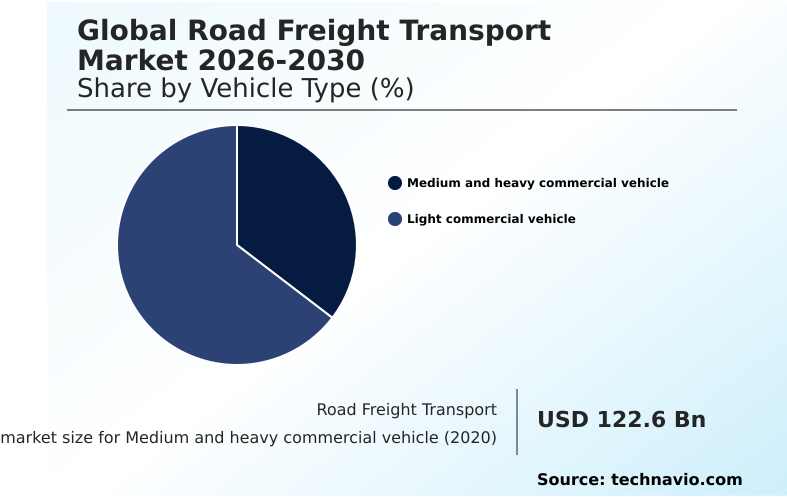
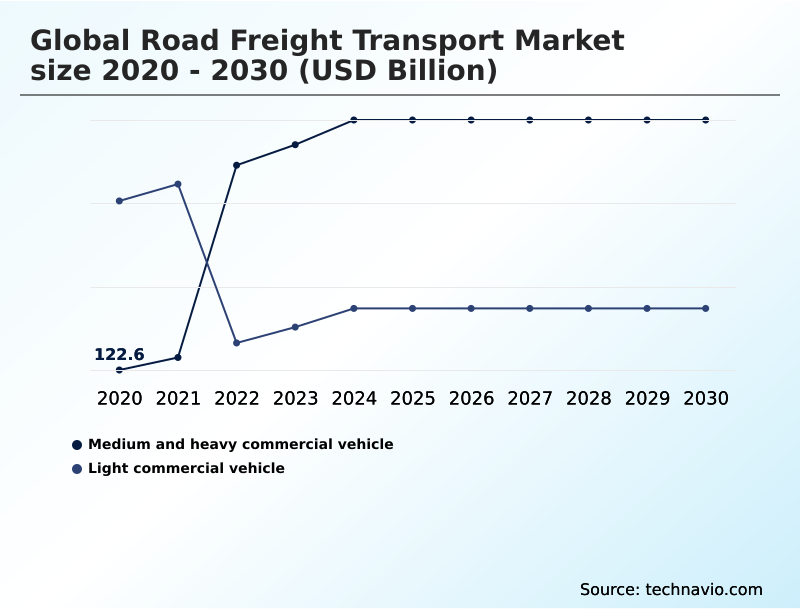
The Medium and heavy commercial vehicle segment was valued at USD 272.4 billion in 2024 and showed a gradual increase during the forecast period.
Regional Analysis
APAC is estimated to contribute 40.4% to the growth of the global market during the forecast period.Technavio’s analysts have elaborately explained the regional trends and drivers that shape the market during the forecast period.
See How Road Freight Transport Market Demand is Rising in APAC Get Free Sample
The market's geographic landscape is characterized by diverse operational models and levels of technological adoption. Mature regions demonstrate high integration of intermodal transport and sophisticated urban logistics planning, while emerging markets focus on foundational infrastructure.
The adoption of a transportation management system (tms) is becoming widespread, with some operators reporting a 15% improvement in logistics network optimization. Predictive analytics for logistics are also being used for supply chain risk mitigation.
Specialized services like temperature-controlled transport and oversized cargo transport are concentrated in industrial hubs. The use of asset-light transportation models through non-asset freight brokerage varies significantly, reflecting regional capital investment trends.
Efficient procurement logistics and strict service-level agreements (slas) are now critical differentiators globally.
Market Dynamics
Our researchers analyzed the data with 2025 as the base year, along with the key drivers, trends, and challenges. A holistic analysis of drivers will help companies refine their marketing strategies to gain a competitive advantage.
- Strategic decision-making in the road freight transport market now hinges on a detailed understanding of nuanced operational trade-offs, such as in ftl vs ltl shipping cost analysis. As companies focus on improving supply chain resilience, they are implementing a transportation management system to gain control over their logistics networks.
- The persistent impact of driver shortages on freight has accelerated the adoption of technology, including the benefits of digital freight matching platforms that optimize carrier selection. Optimizing last-mile delivery routes has become a critical competitive differentiator, especially for firms engaged in optimizing warehousing for e-commerce fulfillment.
- Managing fuel price volatility in trucking remains a core financial challenge, pushing fleets toward more efficient practices. Furthermore, technology for enhancing supply chain visibility is no longer a luxury but a necessity for road freight for just-in-time manufacturing. On the compliance front, navigating low emission zone regulations is a key consideration in fleet modernization.
- Sustainability in road freight transport is a growing priority, with a focus on reducing carbon emissions in logistics. The role of ai in route optimization has demonstrated a capacity to reduce fuel consumption by more than 15% compared to manual methods. Telematics for commercial fleet safety, asset-light vs asset-based trucking models, and addressing cross-border freight compliance challenges are also vital.
- Finally, specialized sectors face unique issues, such as the challenges in cold chain road transport, while many are exploring intermodal transportation for cost savings.
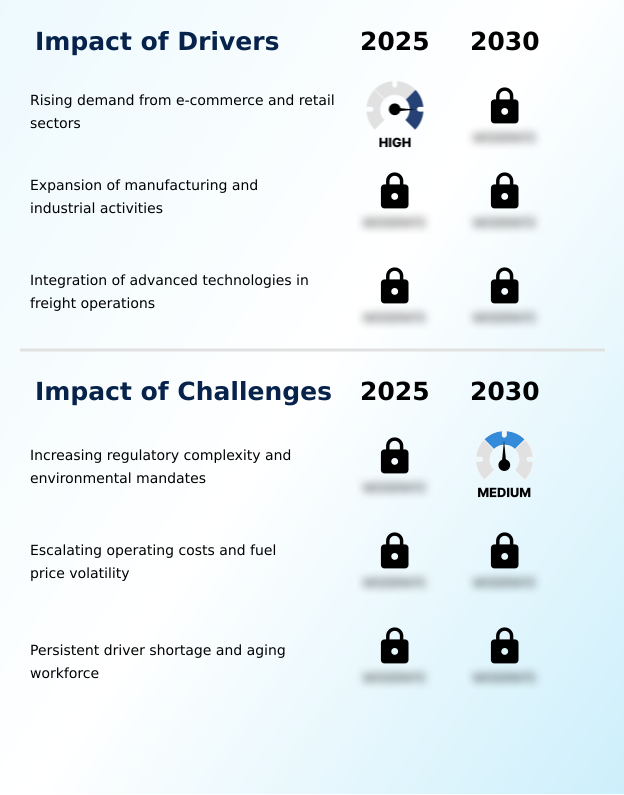
What are the key market drivers leading to the rise in the adoption of Road Freight Transport Industry?
- Rising demand from the e-commerce and retail sectors is a key driver for market growth.
- The rapid expansion of e-commerce fulfillment is a primary market driver, escalating demand for omnichannel retail logistics, especially last-mile delivery and middle-mile delivery.
- This structural shift necessitates sophisticated warehousing and distribution networks and efficient reverse logistics processes, increasing reliance on door-to-door service. Companies leveraging route optimization software are achieving up to a 25% improvement in last mile logistics efficiency.
- The rise of micro-fulfillment center logistics further fuels demand for final mile services.
- These dynamics require integrated logistics solutions with real-time shipment tracking to meet consumer expectations for speed and reliability, boosting overall market activity by an estimated 10% in related segments.
What are the market trends shaping the Road Freight Transport Industry?
- A heightened focus on supply chain resilience and agility is emerging as a defining market trend, prioritizing adaptive logistics networks to mitigate disruptions.
- A strategic shift toward enhancing supply chain resilience and implementing green logistics initiatives defines current market trends. Shippers are adopting multi-sourcing strategy frameworks, including nearshoring supply chains and reshoring initiatives, for effective supply chain risk mitigation. This drives demand for flexible transport solutions like less-than-truckload (ltl) and dedicated contract services.
- Technology is crucial, with digital freight matching platforms improving logistics network optimization by 20% for some users. Enhanced supply chain visibility and value-added logistics services offered through freight brokerage are now standard expectations. Efficient freight consolidation techniques have also been shown to reduce empty miles by over 15%, aligning with sustainability goals.
What challenges does the Road Freight Transport Industry face during its growth?
- Increasing regulatory complexity and environmental mandates present a key challenge affecting industry growth.
- Navigating escalating operational costs and stringent regulations presents a significant challenge. The fuel price volatility impact and the need for driver shortage mitigation strategies strain carrier profitability, with labor costs increasing over 12% in some areas. Compliance with complex rules governing driver hours of service and specialized freight like hazardous materials transport or cold chain logistics requires significant investment.
- The proliferation of low emission zones and emerging road usage pricing models complicates logistics, increasing pressure for backhaul optimization. This has accelerated interest in electric commercial vehicles, though high initial costs remain a barrier. Inefficient customs brokerage services can also cause delays of up to 30%, impacting cross-border trade.
Exclusive Technavio Analysis on Customer Landscape
The road freight transport market forecasting report includes the adoption lifecycle of the market, covering from the innovator’s stage to the laggard’s stage. It focuses on adoption rates in different regions based on penetration. Furthermore, the road freight transport market report also includes key purchase criteria and drivers of price sensitivity to help companies evaluate and develop their market growth analysis strategies.
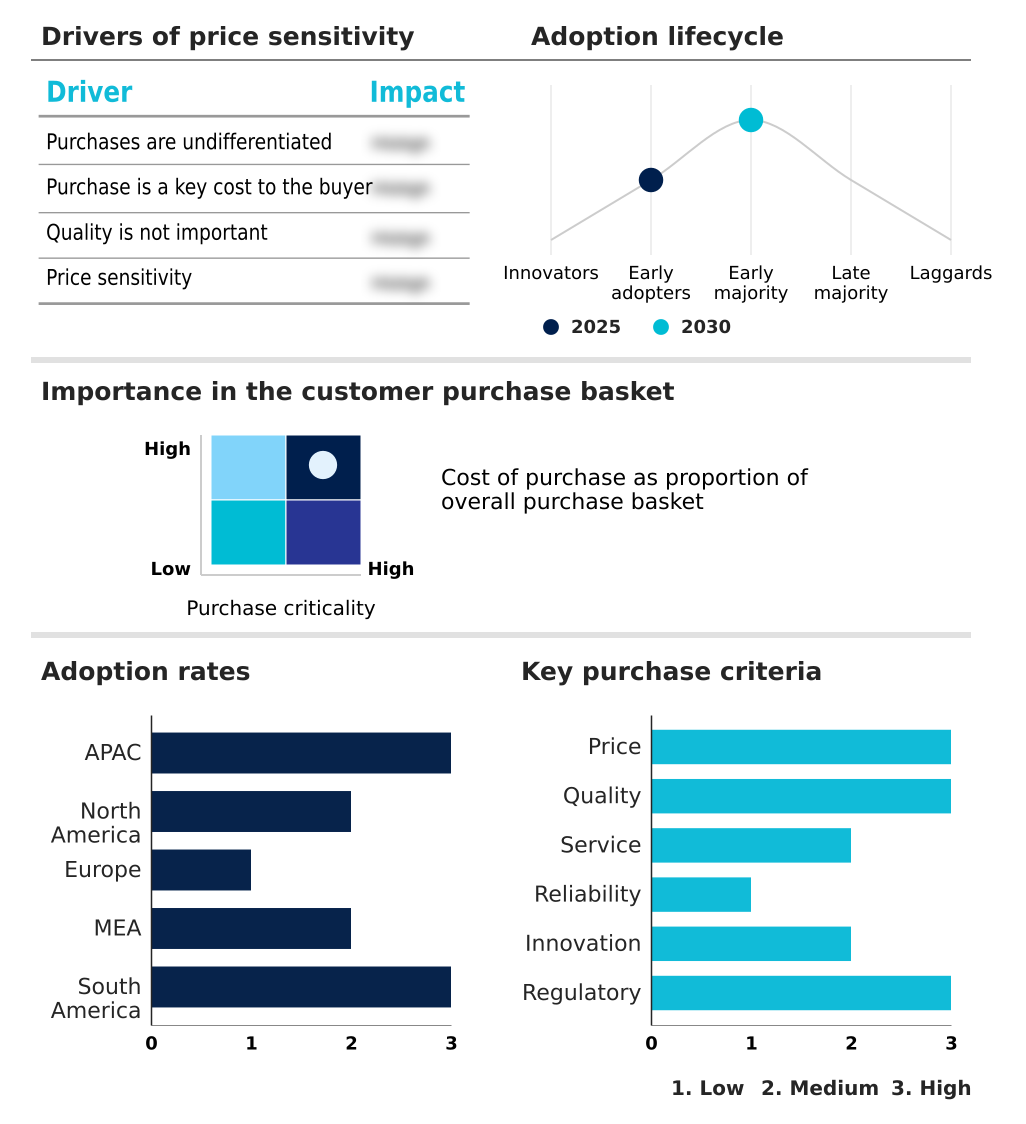
Customer Landscape of Road Freight Transport Industry
Competitive Landscape
Companies are implementing various strategies, such as strategic alliances, road freight transport market forecast, partnerships, mergers and acquisitions, geographical expansion, and product/service launches, to enhance their presence in the industry.
ArcBest Corp. - Delivers integrated road freight transport services, including asset-based less-than-truckload shipping and asset-light logistics solutions, to diverse commercial clients.
The industry research and growth report includes detailed analyses of the competitive landscape of the market and information about key companies, including:
- ArcBest Corp.
- C H Robinson Worldwide Inc.
- CJ Darcl Logistics Ltd.
- CMA CGM Group
- Estes Express Lines
- FedEx Corp.
- Hub Group Inc.
- JB Hunt Transport Services
- Knight Swift Transportation
- Landstar System Inc.
- NFI Industries Inc.
- Old Dominion Freight Line
- Penske Corp.
- R L Carriers Inc.
- Rhenus SE and Co. KG
- Ryder System Inc.
- Schneider National Inc.
- United Parcel Service Inc.
- Werner Enterprises Inc.
- XPO Inc.
Qualitative and quantitative analysis of companies has been conducted to help clients understand the wider business environment as well as the strengths and weaknesses of key industry players. Data is qualitatively analyzed to categorize companies as pure play, category-focused, industry-focused, and diversified; it is quantitatively analyzed to categorize companies as dominant, leading, strong, tentative, and weak.
Recent Development and News in Road freight transport market
- In March, 2025, United Parcel Service Inc. introduced an advanced road freight services platform incorporating centralized fleet management and AI-driven route optimization.
- In January, 2025, Union Pacific announced a 16% increase in intermodal truck-rail shipments, underscoring a strategic shift toward integrated transport models.
- In January, 2025, The Australian Federal Government implemented a new fuel efficiency standard for light commercial vehicles, impacting fleet modernization and procurement decisions.
- In November, 2024, Knight-Swift Transportation completed the acquisition of a regional LTL carrier, expanding its network capacity and service footprint in key industrial corridors.
Dive into Technavio’s robust research methodology, blending expert interviews, extensive data synthesis, and validated models for unparalleled Road Freight Transport Market insights. See full methodology.
| Market Scope | |
|---|---|
| Page number | 292 |
| Base year | 2025 |
| Historic period | 2020-2024 |
| Forecast period | 2026-2030 |
| Growth momentum & CAGR | Accelerate at a CAGR of 8.2% |
| Market growth 2026-2030 | USD 222.0 billion |
| Market structure | Fragmented |
| YoY growth 2025-2026(%) | 7.2% |
| Key countries | China, India, Japan, South Korea, Australia, Indonesia, US, Canada, Mexico, Germany, France, UK, Russia, Poland, The Netherlands, Saudi Arabia, South Africa, UAE, Nigeria, Egypt, Brazil, Argentina and Colombia |
| Competitive landscape | Leading Companies, Market Positioning of Companies, Competitive Strategies, and Industry Risks |
Research Analyst Overview
- The road freight transport market is undergoing a significant operational transformation, driven by technological integration and economic pressures. Core activities like full truckload (ftl) and less-than-truckload (ltl) are being redefined by digital platforms that enable services like digital freight matching and backhaul optimization.
- The industry's response to the rise of online retail is evident in the focus on e-commerce fulfillment, which demands sophisticated warehousing and distribution networks and efficient last-mile delivery. Boardroom decisions are increasingly influenced by the need for enhanced supply chain visibility and supply chain resilience.
- For example, investment in a robust transportation management system (tms) has enabled some firms to achieve a 30% reduction in order processing errors. This focus on data-driven efficiency extends to specialized areas, including temperature-controlled transport and intermodal transport, where telematics and gps tracking are now standard for ensuring integrity and optimizing asset movement through effective fleet management solutions.
What are the Key Data Covered in this Road Freight Transport Market Research and Growth Report?
-
What is the expected growth of the Road Freight Transport Market between 2026 and 2030?
-
USD 222 billion, at a CAGR of 8.2%
-
-
What segmentation does the market report cover?
-
The report is segmented by Vehicle Type (Medium and heavy commercial vehicle, and Light commercial vehicle), End-user (Manufacturing, Automotive, Consumer goods, Food and beverage, and Others), Type (Domestic, and International) and Geography (APAC, North America, Europe, Middle East and Africa, South America)
-
-
Which regions are analyzed in the report?
-
APAC, North America, Europe, Middle East and Africa and South America
-
-
What are the key growth drivers and market challenges?
-
Rising demand from e-commerce and retail sectors, Increasing regulatory complexity and environmental mandates
-
-
Who are the major players in the Road Freight Transport Market?
-
ArcBest Corp., C H Robinson Worldwide Inc., CJ Darcl Logistics Ltd., CMA CGM Group, Estes Express Lines, FedEx Corp., Hub Group Inc., JB Hunt Transport Services, Knight Swift Transportation, Landstar System Inc., NFI Industries Inc., Old Dominion Freight Line, Penske Corp., R L Carriers Inc., Rhenus SE and Co. KG, Ryder System Inc., Schneider National Inc., United Parcel Service Inc., Werner Enterprises Inc. and XPO Inc.
-
Market Research Insights
- The market is characterized by dynamic shifts as operators adapt to new economic realities. The fuel price volatility impact has pushed operational cost management to the forefront, with successful firms improving fuel efficiency by up to 15% through advanced routing. Supply chain risk mitigation strategies are now standard, with a reported 25% of shippers diversifying suppliers to avoid disruptions.
- The focus on last mile logistics efficiency has led to innovations in urban logistics planning, reducing delivery times in dense areas by over 20%. Furthermore, effective carrier capacity management and the use of third-party logistics (3pl) provider partnerships have become critical for maintaining service levels during demand peaks.
- These data-driven approaches are essential for navigating a competitive landscape where service-level agreements (slas) and asset utilization metrics define success.
We can help! Our analysts can customize this road freight transport market research report to meet your requirements.
 RIA -
RIA -