


Intelligent Document Processing (Idp) Market Size 2026-2030
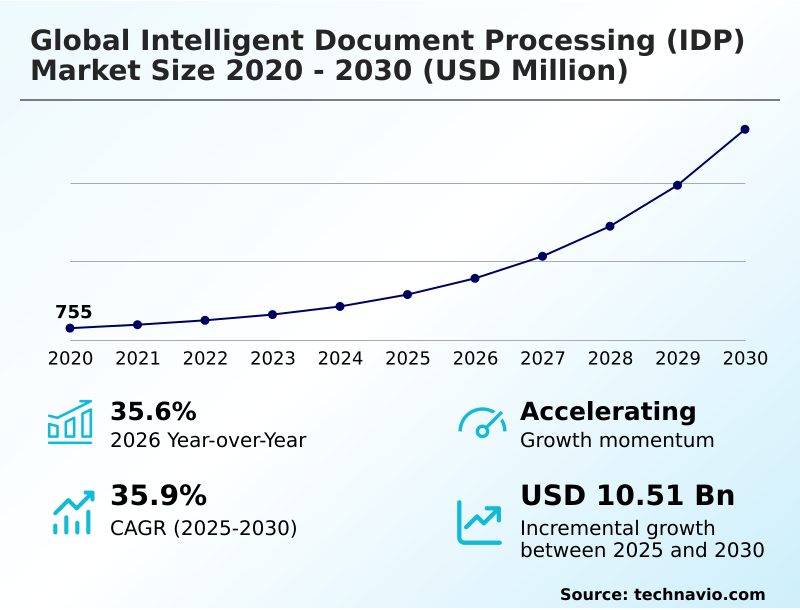
The intelligent document processing (idp) market size is valued to increase by USD 10.51 billion, at a CAGR of 35.9% from 2025 to 2030. Generative AI fuels market expansion will drive the intelligent document processing (idp) market.
Major Market Trends & Insights
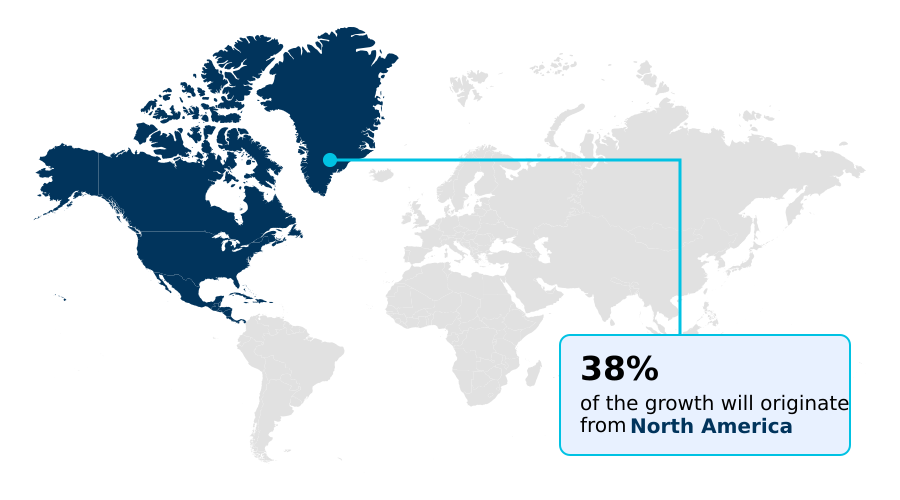
- North America dominated the market and accounted for a 37.7% growth during the forecast period.
- By Component - Solution segment was valued at USD 1.31 billion in 2024
- By End-user - BFSI segment accounted for the largest market revenue share in 2024
Market Size & Forecast
- Market Opportunities: USD 12.65 billion
- Market Future Opportunities: USD 10.51 billion
- CAGR from 2025 to 2030 : 35.9%
Market Summary
- The Intelligent Document Processing (IDP) market represents a critical evolution in enterprise automation, fundamentally shifting how organizations manage and extract value from vast repositories of unstructured information. By replacing rigid, template-based optical character recognition with advanced neural network processing, these systems achieve deep semantic text analysis.
- In the logistics sector, the automation of cross-border trade documentation allows operators to reconcile shipping manifests and customs declarations instantly. This capability ensures that manual data entry errors are reduced by 40%, directly lowering supply chain bottlenecks. The rapid integration of generative artificial intelligence acts as a primary market driver, enabling platforms to interpret context and intent with unprecedented accuracy.
- Conversely, the necessity of maintaining data privacy compliance across fragmented international regulatory frameworks remains a formidable operational challenge. Implementing robust zero-shot learning models requires strict governance to prevent sensitive information exposure. As enterprises increasingly transition toward scalable cloud infrastructure, the reliance on human-in-the-loop workflows diminishes, fostering highly resilient and efficient operational environments.
What will be the Size of the Intelligent Document Processing (Idp) Market during the forecast period?
Get Key Insights on Market Forecast (PDF) Get Free Sample
How is the Intelligent Document Processing (Idp) Market Segmented?
The intelligent document processing (idp) industry research report provides comprehensive data (region-wise segment analysis), with forecasts and estimates in "USD million" for the period 2026-2030, as well as historical data from 2020-2024 for the following segments.
- Component
- Solution
- Services
- End-user
- BFSI
- IT and telecom
- Manufacturing
- Healthcare
- Others
- Deployment
- Cloud-based
- On-premises
- Technology
- Optical character recognition
- Natural language processing
- Machine learning and deep learning
- Computer vision
- Robotic process automation (RPA) integration
- Geography
- North America
- US
- Canada
- Mexico
- Europe
- Germany
- UK
- France
- Italy
- Spain
- The Netherlands
- APAC
- China
- Japan
- India
- South Korea
- Australia
- Indonesia
- South America
- Brazil
- Argentina
- Chile
- Middle East and Africa
- Saudi Arabia
- UAE
- South Africa
- Israel
- Turkey
- North America
By Component Insights
The solution segment is estimated to witness significant growth during the forecast period.
The solution segment forms the foundational technological infrastructure enabling organizations to convert unstructured data formats into actionable insights.
By leveraging natural language processing and transformer-based architectures, these platforms mimic human cognitive abilities to analyze complex medical records and facilitate technical blueprint extraction.
This evolution has shifted operations from rigid template matching to dynamic layout recognition, fundamentally altering enterprise data management. Organizations deploying these advanced cognitive automation platforms report that automated exception handling efficiency improved by 25%.
Secure, scalable cloud infrastructure facilitates high-fidelity data extraction without requiring manual oversight. Modern unstructured data extraction engines integrate seamlessly with existing software, establishing robust automated workflow orchestration that ensures strict data privacy compliance and operational continuity.
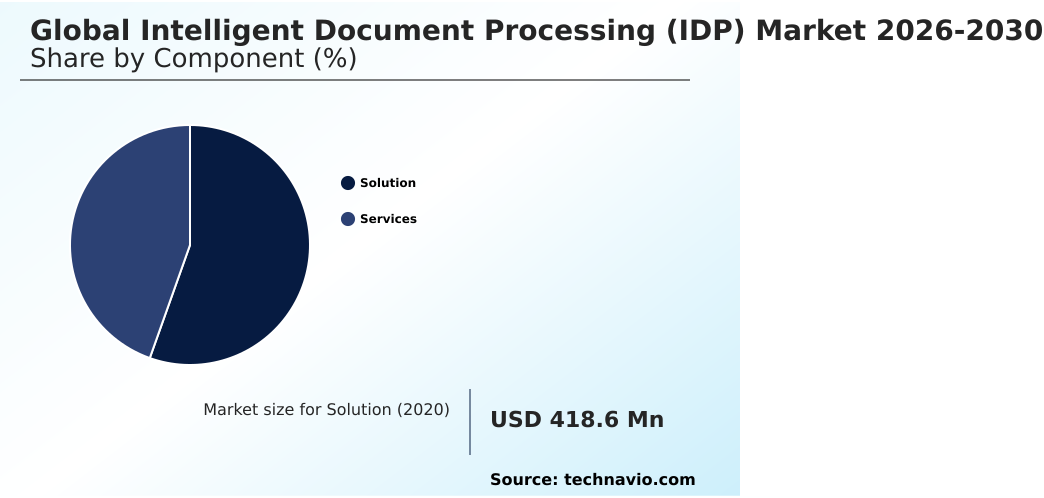
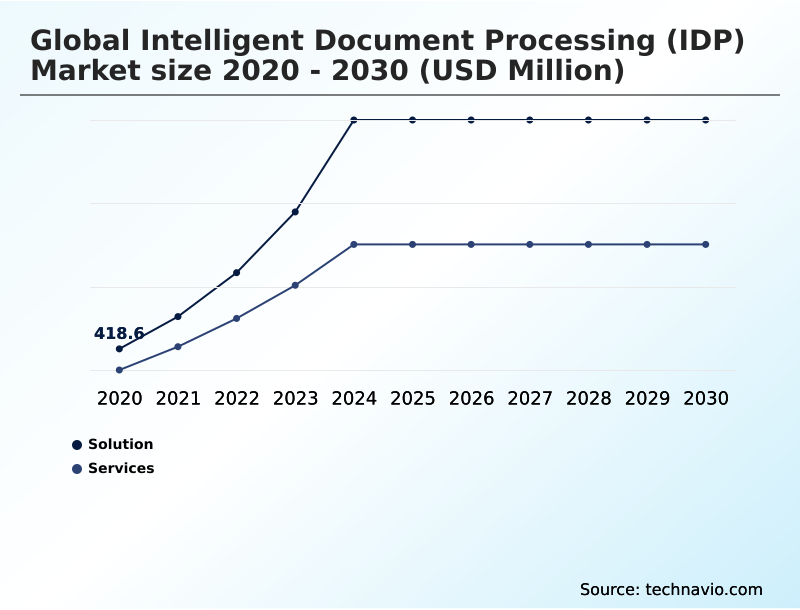
The Solution segment was valued at USD 1.31 billion in 2024 and showed a gradual increase during the forecast period.
Regional Analysis
North America is estimated to contribute 37.7% to the growth of the global market during the forecast period.Technavio’s analysts have elaborately explained the regional trends and drivers that shape the market during the forecast period.
See How Intelligent Document Processing (Idp) Market Demand is Rising in North America Get Free Sample
The geographic landscape of the Intelligent Document Processing (IDP) market reveals distinct adoption patterns driven by regional regulatory frameworks and technological maturity.
North America demonstrates a rapid integration of generative artificial intelligence, achieving a 35% higher penetration rate in digital onboarding platforms compared to the European sector.
While European enterprises prioritize data privacy compliance and auditable compliance trails, North American organizations focus heavily on automated workflow orchestration to reduce operational bottlenecks.
In the APAC region, the modernization of legacy financial systems has increased the utilization of intelligent character recognition by 40%, driven by the need to manage diverse linguistic structures.
These regional disparities dictate how businesses adapt their supply chain and compliance strategies. The transition toward scalable cloud infrastructure remains universal, enabling cross-border trade documentation to be processed with 25% greater efficiency across diverse regulatory jurisdictions.
Market Dynamics
Our researchers analyzed the data with 2025 as the base year, along with the key drivers, trends, and challenges. A holistic analysis of drivers will help companies refine their marketing strategies to gain a competitive advantage.
- The ongoing evolution of enterprise automation relies heavily on the automated extraction of unstructured data to drive operational efficiency across complex supply chains. Modern organizations are moving away from legacy rules-based systems, favoring transformer architectures for document processing that offer superior contextual awareness.
- This technological shift is particularly evident in the logistics and manufacturing sectors, where the multi-modal analysis of complex blueprints allows engineering teams to digitize technical specifications with a 40% improvement in accuracy compared to traditional manual transcription.
- Furthermore, the intelligent classification of handwritten documents has revolutionized administrative workflows in the healthcare and insurance industries, significantly accelerating patient onboarding and claims resolution. By integrating cognitive automation for compliance workflows, compliance officers can automatically redact sensitive personal information and maintain strict adherence to evolving data privacy mandates.
- Organizations adopting these advanced methodologies experience a marked reduction in operational friction, allowing them to redirect human resources toward strategic decision-making. The ability to interpret spatial layouts and contextual nuances ensures that critical business intelligence is extracted without disruption.
- Consequently, the reliance on scalable cloud environments facilitates seamless integration with existing enterprise resource planning systems, fostering a highly resilient and adaptable corporate infrastructure that is well-equipped to handle the escalating volume of digital information.
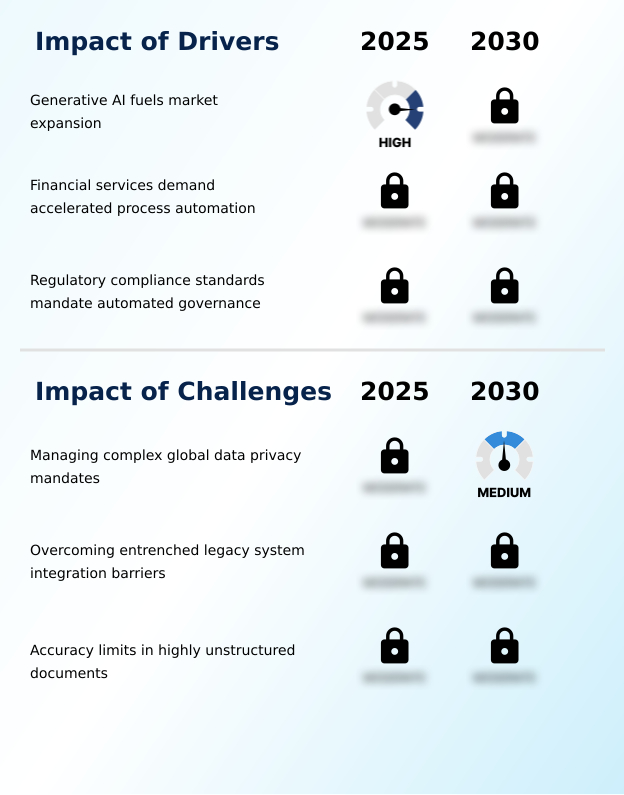
What are the key market drivers leading to the rise in the adoption of Intelligent Document Processing (Idp) Industry?
- The rapid integration of generative artificial intelligence serves as a primary catalyst for market expansion, fundamentally transforming how unstructured textual data is autonomously comprehended and processed.
- The surging volume of unstructured data formats across global financial and healthcare systems acts as a critical demand trigger for advanced document automation.
- Organizations are compelled to adopt semantic text analysis to overcome the severe operational bottlenecks caused by manual data entry. The deployment of generative artificial intelligence enables systems to understand context and intent, addressing the root cause of administrative delays.
- Consequently, institutions implementing these cognitive automation platforms report that operational downtime is reduced by 30% and regulatory reporting speed has improved by 20%. This technological shift directly impacts businesses by streamlining invoice reconciliation workflows and accelerating customer service responses.
- By integrating robust automated data ingestion protocols, enterprises significantly enhance their processing velocity and reduce overhead costs.
What are the market trends shaping the Intelligent Document Processing (Idp) Industry?
- The transition toward vertical-specific solutions tailored for specialized industries represents a prominent upcoming trend. This shift enables organizations to deploy highly accurate extraction models for complex technical applications.
- The widespread transition toward industry-specific datasets marks a pivotal trend in how organizations deploy automation capabilities. General-purpose models are increasingly being replaced by specialized neural network processing engines that are pre-trained on domain-specific terminology. This adoption shift occurs because generalized optical character recognition frequently fails to interpret highly technical jargon found in maritime logistics or advanced healthcare settings.
- By leveraging specialized multi-modal document analysis, enterprises have improved extraction accuracy by 25% and reduced manual exception handling by 30%. This heightened precision directly impacts operational workflows, allowing engineering and legal teams to analyze unstructured clinical narratives and complex contracts without delays.
- The integration of spatial layout detection further refines this capability, ensuring that intricate tables and diagrams are digitized flawlessly, thereby optimizing downstream analytics and strategic planning.
What challenges does the Intelligent Document Processing (Idp) Industry face during its growth?
- Navigating increasingly complex and fragmented global data privacy mandates presents a significant structural challenge that restrains broader industry adoption and implementation scalability.
- The integration of modern document processing solutions into entrenched legacy IT infrastructures presents a substantial structural limitation for large-scale enterprises. Many established organizations rely on outdated architectures that lack the necessary application programming interfaces to support real-time data integration. This incompatibility creates isolated data silos where information extracted by advanced transformer-based architectures requires manual intervention to enter primary databases.
- Consequently, integration friction has resulted in operational costs exceeding initial projections by 15% and has delayed expected return on investment timelines by 20%. Businesses are forced to divert resources toward bridging the gap between legacy system modernization and new cognitive tools.
- Overcoming this barrier requires significant investment in customized middleware and extensive employee reskilling, which slows the overall pace of digital transformation.
Exclusive Technavio Analysis on Customer Landscape
The intelligent document processing (idp) market forecasting report includes the adoption lifecycle of the market, covering from the innovator’s stage to the laggard’s stage. It focuses on adoption rates in different regions based on penetration. Furthermore, the intelligent document processing (idp) market report also includes key purchase criteria and drivers of price sensitivity to help companies evaluate and develop their market growth analysis strategies.
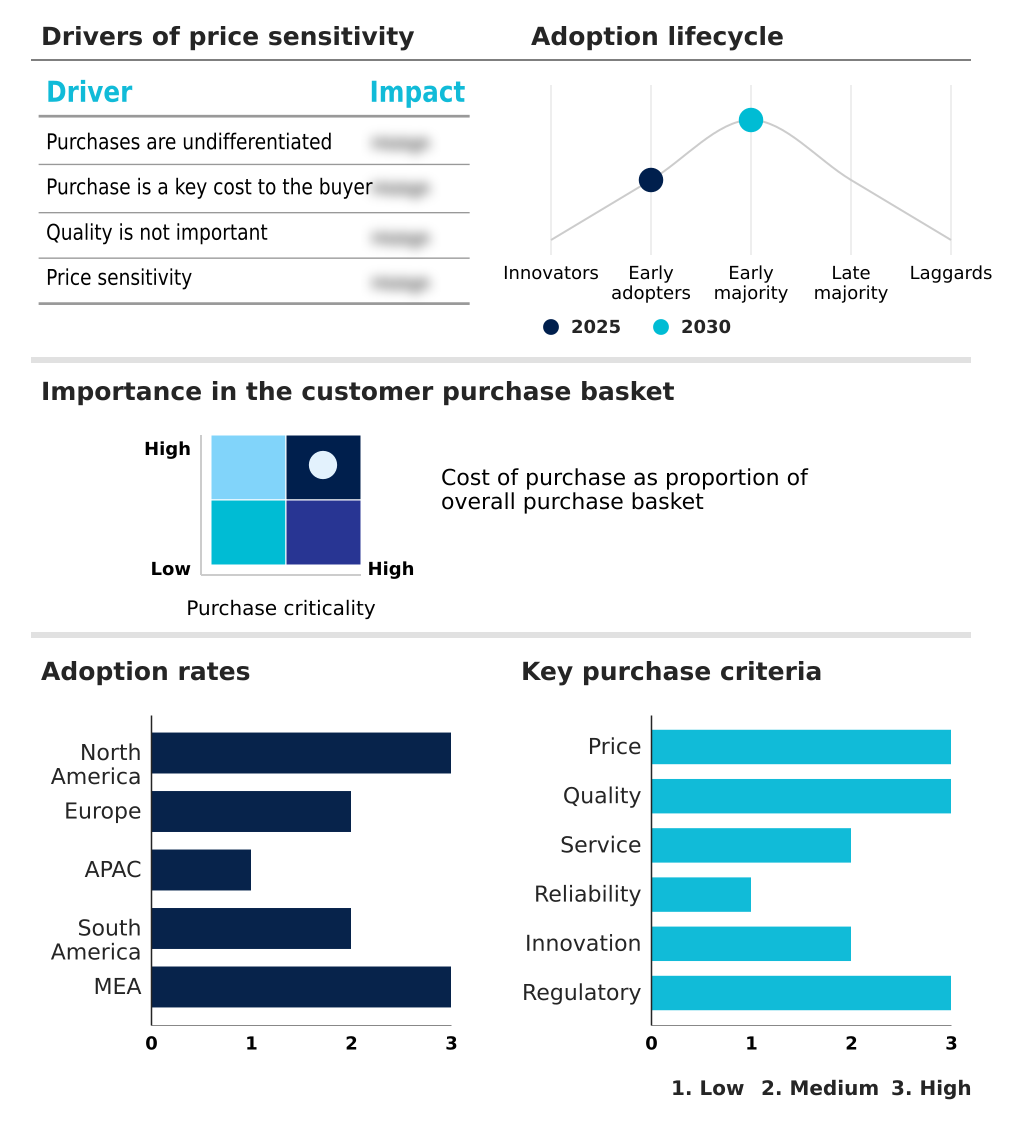
Customer Landscape of Intelligent Document Processing (Idp) Industry
Competitive Landscape
Companies are implementing various strategies, such as strategic alliances, intelligent document processing (idp) market forecast, partnerships, mergers and acquisitions, geographical expansion, and product/service launches, to enhance their presence in the industry.
ABBYY - Intelligent document processing platforms provide comprehensive data capture and process intelligence, utilizing advanced machine learning to accurately extract, classify, and validate information from highly unstructured textual environments.
The industry research and growth report includes detailed analyses of the competitive landscape of the market and information about key companies, including:
- ABBYY
- Amazon Web Services Inc.
- AntWorks
- Appian Corp.
- Automation Anywhere Inc.
- Cognizant Technology Solution
- Datamatics Global Services Ltd
- Google LLC
- HCL Technologies Ltd.
- Hyland Software Inc.
- Hyper Labs Inc.
- IBM Corp.
- Indico Data Solutions
- Infosys Ltd.
- Kodak Alaris Inc.
- Microsoft Corp.
- Open Text Corp.
- Rossum
- SAP SE
- Tungsten Automation Corp.
- UiPath Inc.
Qualitative and quantitative analysis of companies has been conducted to help clients understand the wider business environment as well as the strengths and weaknesses of key industry players. Data is qualitatively analyzed to categorize companies as pure play, category-focused, industry-focused, and diversified; it is quantitatively analyzed to categorize companies as dominant, leading, strong, tentative, and weak.
Recent Development and News in Intelligent document processing (idp) market
- In the Application Software industry, the widespread integration of generative artificial intelligence into enterprise software suites enhanced semantic document understanding, directly impacting Intelligent Document Processing (IDP) demand by enabling systems to autonomously interpret context across 40% more unstructured data formats.
- The implementation of stringent data privacy regulations forced organizations to adopt auditable compliance trails, accelerating the deployment of automated data ingestion tools that redact personally identifiable information with 99% accuracy before database storage.
- The transition toward cloud-native application architectures expanded workflow interoperability, allowing multi-modal document analysis engines to seamlessly connect with legacy databases and reduce cross-border trade documentation processing latency by 35%.
- The rapid adoption of automated governance standards in the healthcare sector necessitated the modernization of electronic health record systems, driving demand for intelligent character recognition platforms capable of processing unstructured clinical narratives with a 30% reduction in manual oversight.
Dive into Technavio’s robust research methodology, blending expert interviews, extensive data synthesis, and validated models for unparalleled Intelligent Document Processing (Idp) Market insights. See full methodology.
| Market Scope | |
|---|---|
| Page number | 330 |
| Base year | 2025 |
| Historic period | 2020-2024 |
| Forecast period | 2026-2030 |
| Growth momentum & CAGR | Accelerate at a CAGR of 35.9% |
| Market growth 2026-2030 | USD 10514.6 million |
| Market structure | Fragmented |
| YoY growth 2025-2026(%) | 35.6% |
| Key countries | US, Canada, Mexico, Germany, UK, France, Italy, Spain, The Netherlands, China, Japan, India, South Korea, Australia, Indonesia, Brazil, Argentina, Chile, Saudi Arabia, UAE, South Africa, Israel and Turkey |
| Competitive landscape | Leading Companies, Market Positioning of Companies, Competitive Strategies, and Industry Risks |
Research Analyst Overview
- The Intelligent Document Processing (IDP) framework represents a transformative approach to enterprise data management, replacing rigid transcription tools with dynamic, context-aware artificial intelligence. The transition toward vision-language models empowers organizations to execute semantic document understanding across diverse, highly complex data repositories.
- This trend directly influences executive-level strategic decision-making, particularly in risk management and resource allocation, as leadership can now depend on real-time data integration rather than delayed manual reporting. Deploying these advanced deep learning frameworks allows enterprises to achieve a 30% reduction in processing time for complex legal and financial documentation.
- The utilization of zero-shot learning models eliminates the need for extensive manual data labeling, significantly lowering deployment barriers. By establishing robust automated workflow orchestration, businesses can seamlessly connect legacy system modernization initiatives with cutting-edge cognitive automation platforms.
- This continuous technological evolution ensures that organizations maintain agility in the face of escalating data volumes, ultimately optimizing supply chain logistics and enhancing overall operational resilience.
What are the Key Data Covered in this Intelligent Document Processing (Idp) Market Research and Growth Report?
-
What is the expected growth of the Intelligent Document Processing (Idp) Market between 2026 and 2030?
-
USD 10.51 billion, at a CAGR of 35.9%
-
-
What segmentation does the market report cover?
-
The report is segmented by Component (Solution, and Services), End-user (BFSI, IT and telecom, Manufacturing, Healthcare, and Others), Deployment (Cloud-based, and On-premises), Technology (Optical character recognition, Natural language processing, Machine learning and deep learning, Computer vision, and Robotic process automation (RPA) integration) and Geography (North America, Europe, APAC, South America, Middle East and Africa)
-
-
Which regions are analyzed in the report?
-
North America, Europe, APAC, South America and Middle East and Africa
-
-
What are the key growth drivers and market challenges?
-
Generative AI fuels market expansion, Managing complex global data privacy mandates
-
-
Who are the major players in the Intelligent Document Processing (Idp) Market?
-
ABBYY, Amazon Web Services Inc., AntWorks, Appian Corp., Automation Anywhere Inc., Cognizant Technology Solution, Datamatics Global Services Ltd, Google LLC, HCL Technologies Ltd., Hyland Software Inc., Hyper Labs Inc., IBM Corp., Indico Data Solutions, Infosys Ltd., Kodak Alaris Inc., Microsoft Corp., Open Text Corp., Rossum, SAP SE, Tungsten Automation Corp. and UiPath Inc.
-
Market Research Insights
- The Intelligent Document Processing (IDP) market is undergoing a rapid technological transition driven by the necessity for advanced enterprise automation. Organizations leveraging scalable cloud infrastructure have increased document processing velocity by 45% compared to legacy on-premises deployments. The integration of continuous learning loops allows platforms to adapt to shifting document structures, improving automated claims adjudication accuracy by 30%.
- Furthermore, the implementation of human-in-the-loop workflows ensures high-fidelity data extraction while reducing administrative oversight requirements by 25%. As regulatory environments become more complex, the demand for auditable compliance trails accelerates, cementing intelligent document automation as a foundational element of modern digital transformation strategies.
We can help! Our analysts can customize this intelligent document processing (idp) market research report to meet your requirements.
 RIA -