Fifth-party Logistics (5PL) Solutions Market Analysis, Size, and Forecast 2026-2030: APAC (China, Japan, and India), North America (US, Canada, and Mexico), Europe (Germany, UK, and France), Middle East and Africa (Saudi Arabia, UAE, and Turkey), South America (Brazil, Argentina, and Chile), and Rest of World (ROW)

Fifth-party Logistics (5PL) Solutions Market Analysis, Size, and Forecast 2026-2030:
APAC (China, Japan, and India), North America (US, Canada, and Mexico), Europe (Germany, UK, and France), Middle East and Africa (Saudi Arabia, UAE, and Turkey), South America (Brazil, Argentina, and Chile), and Rest of World (ROW)

Published: Oct 2026 302 Pages SKU: IRTNTR74566

Market Overview at a Glance

$477.2 Mn
Market Opportunity
7.2%
CAGR 2025 - 2030
41.8%
APAC Growth
$492.4 Mn
Transportation segment 2024

Fifth-Party Logistics (5Pl) Solutions Market Size 2026-2030

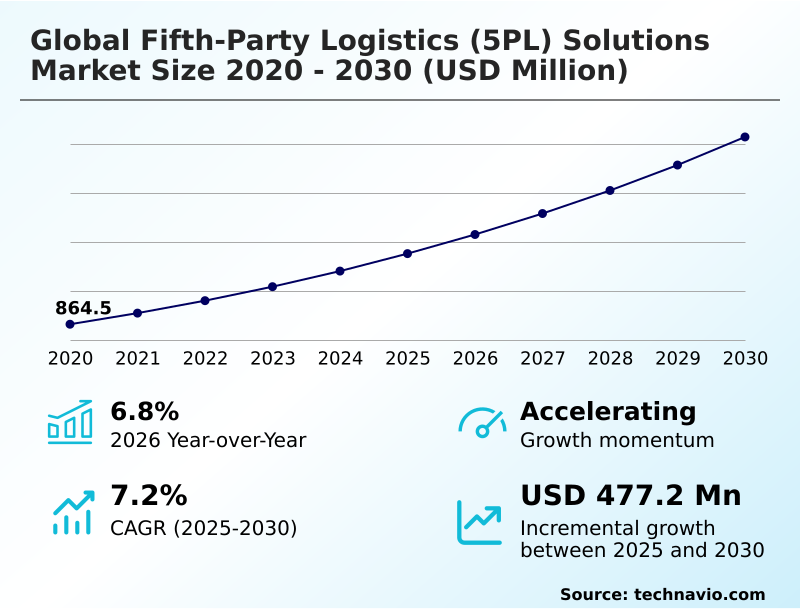
The fifth-party logistics (5pl) solutions market size is valued to increase by USD 477.2 million, at a CAGR of 7.2% from 2025 to 2030. Explosive growth of omnichannel e-commerce networks will drive the fifth-party logistics (5pl) solutions market.

Major Market Trends & Insights

  • APAC dominated the market and accounted for a 41.8% growth during the forecast period.
  • By Service - Transportation segment was valued at USD 492.4 million in 2024
  • By Application - E-commerce segment accounted for the largest market revenue share in 2024

Market Size & Forecast

  • Market Opportunities: USD 766.1 million
  • Market Future Opportunities: USD 477.2 million
  • CAGR from 2025 to 2030 : 7.2%

Market Summary

  • The Fifth-party Logistics (5PL) Solutions exhibits accelerating structural evolution as enterprises increasingly delegate overarching supply chain governance to digital orchestrators. Functioning as master control architects, these solutions synthesize vast operational data streams to automate decision-making across complex multi-modal transport networks.
  • In a practical business scenario, retail conglomerates utilizing centralized cloud-based control towers can dynamically reallocate regional warehouse inventory during sudden demand spikes, successfully preventing stockouts and lowering holding expenses. Consequently, early adopters of these digital twin network models have achieved a 22% improvement in on-time delivery rates compared to businesses reliant on fragmented third-party logistics tracking.
  • The primary driver propelling the Fifth-party Logistics (5PL) Solutions is the rapid expansion of omnichannel e-commerce networks, which necessitates fully automated, elastic carrier capacity management. Conversely, integration complexity across heterogeneous legacy IT environments remains a fundamental challenge, as disparate regional systems obstruct the seamless real-time data interoperability required for autonomous logistics execution.
  • Ultimately, these advanced orchestration platforms are becoming critical operational infrastructure for maintaining competitive resilience.

What will be the Size of the Fifth-Party Logistics (5Pl) Solutions Market during the forecast period?
Get Key Insights on Market Forecast (PDF) Get Free Sample

How is the Fifth-Party Logistics (5Pl) Solutions Market Segmented?

The fifth-party logistics (5pl) solutions industry research report provides comprehensive data (region-wise segment analysis), with forecasts and estimates in "USD million" for the period 2026-2030, as well as historical data from 2020-2024 for the following segments.

  • Service
    • Transportation
    • Warehousing
    • Others
  • Application
    • E-commerce
    • Logistic companies
    • Traders
  • Mode of transportation
    • Road
    • Air
    • Sea
    • Rail
  • Geography
    • APAC
      • China
      • Japan
      • India
      • South Korea
      • Australia
      • Indonesia
    • North America
      • US
      • Canada
      • Mexico
    • Europe
      • Germany
      • UK
      • France
      • Italy
      • Spain
      • The Netherlands
    • Middle East and Africa
      • Saudi Arabia
      • UAE
      • Turkey
      • South Africa
      • Israel
    • South America
      • Brazil
      • Argentina
      • Chile

By Service Insights

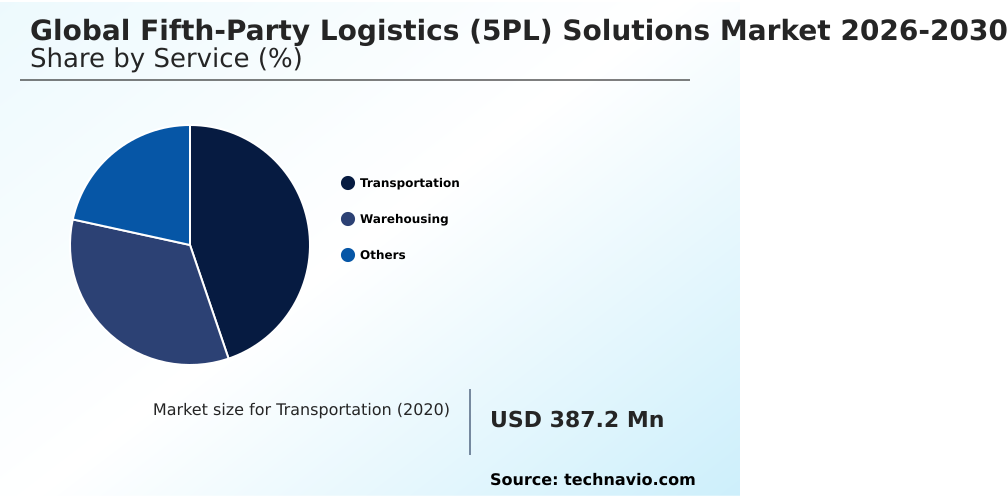
The transportation segment is estimated to witness significant growth during the forecast period.

The transportation segment within the Fifth-party Logistics (5PL) Solutions operates as a digitally integrated orchestrator, streamlining freight movements across global trade corridors.

By leveraging multi-modal transportation orchestration and artificial intelligence analytics, logistics architects optimize dynamic route optimization and cross-border customs clearance without managing physical transport fleets.

Integrating internet of things telemetry into predictive routing systems allows operators to aggregate shipping volumes efficiently, thereby navigating port congestion bottlenecks.

This comprehensive enterprise technology integration drives substantial operational improvements, notably increasing load factor efficiency by 22% compared to traditional decentralized routing methods.

Furthermore, the deployment of cloud-based control towers for continuous supply chain orchestration reduces transit delays by 18%, significantly lowering overall emissions.

Consequently, this centralized oversight provides the agility required to maintain continuous inventory flows amidst fluctuating fuel costs, securing revenue continuity across international distribution networks.
Get Free Sample

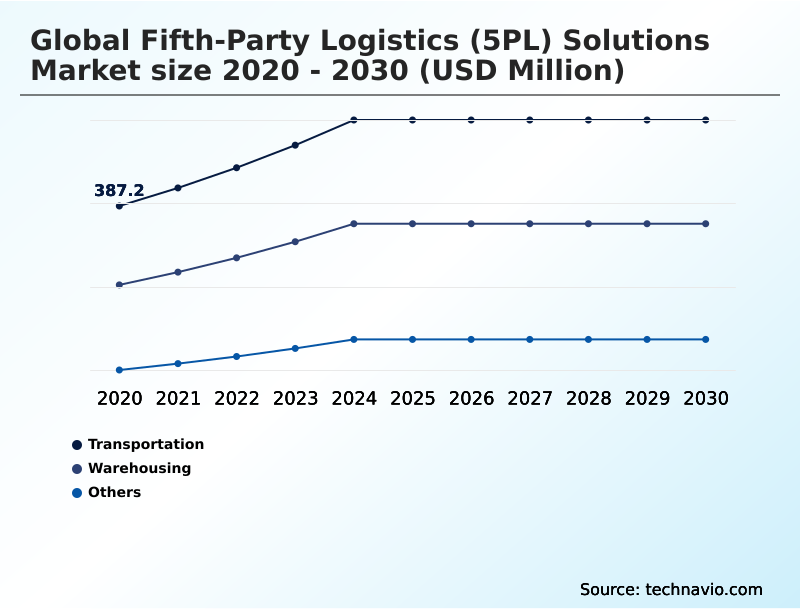
The Transportation segment was valued at USD 492.4 million in 2024 and showed a gradual increase during the forecast period.
Get Free Sample

Regional Analysis

APAC is estimated to contribute 41.8% to the growth of the global market during the forecast period.Technavio’s analysts have elaborately explained the regional trends and drivers that shape the market during the forecast period.
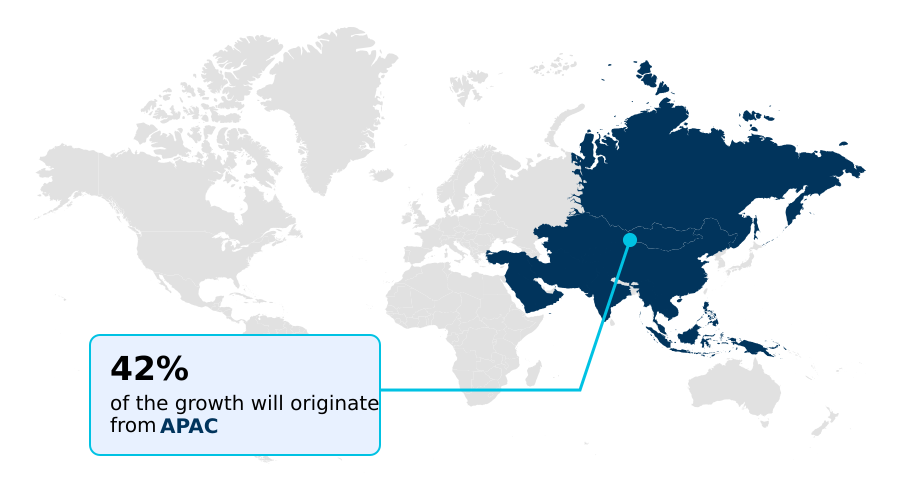
See How Fifth-Party Logistics (5Pl) Solutions Market Demand is Rising in APAC Get Free Sample

The geographic landscape of the Fifth-party Logistics (5PL) Solutions reveals distinct adoption patterns shaped by varying infrastructure maturities and regional manufacturing demands.

APAC demonstrates aggressive technological scaling, driven by immense cross-border commerce volumes and the widespread integration of automated company management platforms.

In contrast, North America prioritizes third-party logistics providers and fourth-party logistics providers to manage complex retail networks, resulting in a 15% higher adoption rate of robotic process automation compared to European markets.

Within APAC, the integration of machine learning demand forecasting across a digital twin network has successfully reduced regional transit delays by 18%.

Conversely, North American operators aggressively expand automated storage and retrieval systems within micro-fulfillment centers to meet stringent same-day delivery expectations, maximizing multi-tenant warehouse capacity.

These distinct regional strategies highlight how businesses optimize contractor management to navigate localized constraints, ensuring highly resilient distribution matrices.

Market Dynamics

Our researchers analyzed the data with 2025 as the base year, along with the key drivers, trends, and challenges. A holistic analysis of drivers will help companies refine their marketing strategies to gain a competitive advantage.

  • The operational architecture of the Fifth-party Logistics (5PL) Solutions fundamentally reshapes how multinational enterprises coordinate vast distribution networks and mitigate supply chain friction. As modern retail and manufacturing sectors encounter unprecedented logistical complexity, organizations are prioritizing comprehensive ai driven supply chain orchestration to synthesize fragmented data streams into actionable intelligence.
  • This transition replaces siloed third-party management with cohesive, algorithmically powered oversight. A critical component of this technological shift is precise cloud based control tower implementation, which provides centralized visibility across all warehousing nodes and carrier networks.
  • Through this centralized infrastructure, enterprises achieve a 30% faster exception resolution rate compared to decentralized legacy software frameworks, directly enhancing compliance alignment and operational planning accuracy. Furthermore, advanced digital twin network logistics management enables supply chain architects to simulate severe maritime disruptions and port delays before they impact physical inventory flows.
  • By executing automated multi modal transport optimization, these platforms instantly re-route critical shipments across air, rail, and road corridors, ensuring uninterrupted fulfillment cycles. Additionally, integrating predictive capacity procurement algorithms allows operators to dynamically secure cost-effective freight space during sudden peak demand surges.
  • By fundamentally transforming static logistics procurement into a highly elastic, self-correcting ecosystem, these advanced orchestration platforms empower businesses to safeguard consumer retention, lower overarching transportation expenditures, and maintain robust resilience against volatile international trade dynamics.
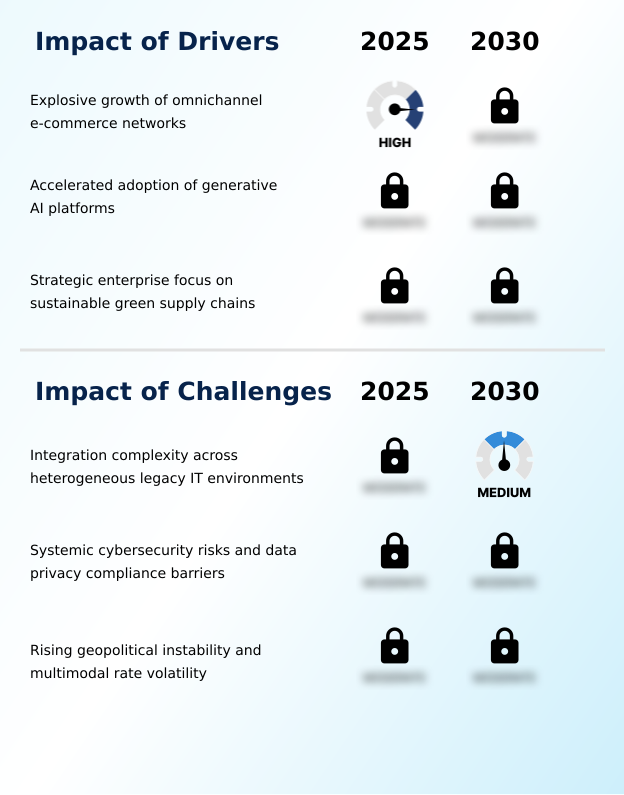
What are the key market drivers leading to the rise in the adoption of Fifth-Party Logistics (5Pl) Solutions Industry?

  • The explosive growth of omnichannel e-commerce networks serves as a primary driver, compelling multinational enterprises to adopt advanced supply chain orchestration for seamless order fulfillment.

  • The explosive expansion of omnichannel retail distribution networks acts as a primary catalyst propelling demand for the Fifth-party Logistics (5PL) Solutions. Modern consumers demand absolute inventory transparency, severely straining conventional decentralized logistics frameworks.
  • To overcome these complex operational bottlenecks, brand owners leverage advanced digital orchestrators capable of executing continuous automated inventory rebalancing across diverse regional micro-fulfillment centers.
  • Integrating real-time vehicle telematics and sophisticated load-pooling algorithms directly optimizes multi-carrier parcel consolidation within expansive digital carrier ecosystems, resulting in a 30% reduction in last-mile delivery delays compared to isolated tracking methods.
  • Furthermore, the application of strategic network planning and spot-market capacity acquisitions empowers businesses to proactively optimize intermodal transfer timing, successfully lowering emergency transport expenditures by 18%.
  • Deploying electronic proof of delivery systems alongside automated trade documentation systems ensures absolute accountability, drastically reducing overarching distribution overhead while securing consumer retention.

What are the market trends shaping the Fifth-Party Logistics (5Pl) Solutions Industry?

  • The transition toward dynamic autonomous supply chain control towers represents a prominent upcoming trend within the market. This structural shift enables organizations to execute self-correcting logistics operations and significantly minimize manual oversight.

  • The rapid transition toward algorithmic elastic logistics models represents a pivotal structural trend within the Fifth-party Logistics (5PL) Solutions. Enterprises aggressively abandon rigid long-term freight contracts in favor of flexible, software-driven capacity management. By utilizing predictive demand sensing algorithms and cognitive supply chain planning tools, orchestrators dynamically pool transportation capacity across independent regional carriers.
  • This structural shift alters how businesses secure freight space, enabling dynamic carrier rate negotiation and automated spot-market tendering that routinely yields a 15% improvement in transportation cost efficiency compared to legacy algorithmic procurement. Furthermore, the strategic application of generative artificial intelligence drastically optimizes multi-echelon inventory strategies and sustainable reverse logistics loops, directly supporting stringent circular economy compliance.
  • By transforming static logistics into a highly responsive ecosystem, organizations successfully safeguard their operating margins while instantly scaling fulfillment operations to match unpredictable global demand surges.

What challenges does the Fifth-Party Logistics (5Pl) Solutions Industry face during its growth?

  • Integration complexity across heterogeneous legacy information technology environments acts as a significant challenge, restricting seamless data interoperability and hindering rapid industry modernization.

  • Severe technological fragmentation across legacy enterprise information technology environments establishes a formidable barrier restricting the widespread implementation of the Fifth-party Logistics (5PL) Solutions. Harmonizing unstructured logistics data into centralized data networks requires extensive capital investment and protracted software integration timelines.
  • Because complex trade orchestration demands absolute real-time interoperability, the persistent absence of standardized data exchange protocols fundamentally disrupts continuous supply chain visibility. Consequently, enterprises struggling with legacy system incompatibilities experience a 25% higher latency in automated document verification and automated risk assessment algorithms compared to fully modernized operations.
  • This technological asymmetry obstructs the accurate deployment of automated container tracking software and predictive capacity procurement, effectively reducing routing efficiency by over 18%. Furthermore, navigating strict electronic freight information mandates becomes exceptionally difficult without unified platforms, hindering precise vessel capacity hedging and comprehensive carbon-accounting algorithms during critical maritime supply chain disruptions.

Exclusive Technavio Analysis on Customer Landscape

The fifth-party logistics (5pl) solutions market forecasting report includes the adoption lifecycle of the market, covering from the innovator’s stage to the laggard’s stage. It focuses on adoption rates in different regions based on penetration. Furthermore, the fifth-party logistics (5pl) solutions market report also includes key purchase criteria and drivers of price sensitivity to help companies evaluate and develop their market growth analysis strategies.
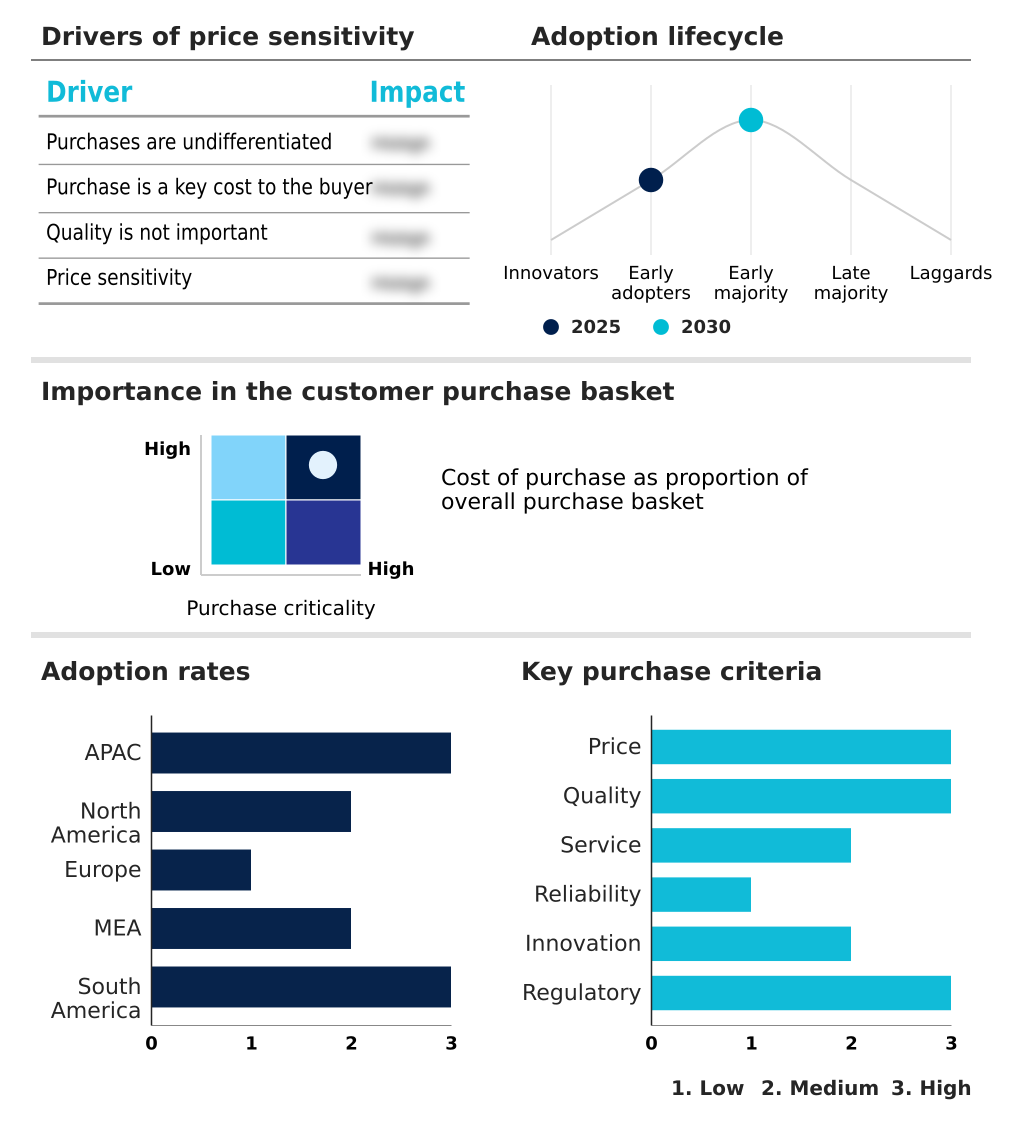
Customer Landscape of Fifth-Party Logistics (5Pl) Solutions Industry

Competitive Landscape

Companies are implementing various strategies, such as strategic alliances, fifth-party logistics (5pl) solutions market forecast, partnerships, mergers and acquisitions, geographical expansion, and product/service launches, to enhance their presence in the industry.

AP Moller Maersk AS - The organization provides comprehensive fifth-party logistics (5PL) solutions emphasizing end-to-end supply chain management, integrated digital visibility platforms, and advanced transportation orchestration to optimize regional warehousing and complex distribution networks.

The industry research and growth report includes detailed analyses of the competitive landscape of the market and information about key companies, including:

  • AP Moller Maersk AS
  • APL Logistics Ltd.
  • C H Robinson Worldwide Inc.
  • CEVA Logistics SA
  • CJ Logistics Corp.
  • Dachser SE
  • DB Schenker
  • DHL International GmbH
  • DSV AS
  • Expeditors International Inc.
  • FedEx Corp.
  • GEODIS
  • GXO Logistics Inc.
  • Hellmann Worldwide Logistics
  • Kuehne Nagel Management AG
  • Nippon Express Holdings Inc.
  • PSA BDP
  • Rhenus SE and Co. KG
  • United Parcel Service Inc.
  • XPO Inc.

Qualitative and quantitative analysis of companies has been conducted to help clients understand the wider business environment as well as the strengths and weaknesses of key industry players. Data is qualitatively analyzed to categorize companies as pure play, category-focused, industry-focused, and diversified; it is quantitatively analyzed to categorize companies as dominant, leading, strong, tentative, and weak.

Recent Development and News in Fifth-party logistics (5pl) solutions market

  • In the Air Freight and Logistics industry, the widespread adoption of automated spot-market tendering and digital carrier ecosystems optimized high-volume cross-border transit, directly impacting Fifth-party Logistics (5PL) Solutions demand by improving load matching efficiency by 24% across fragmented regional corridors.
  • Stringent international aviation security mandates compelled the integration of automated document verification systems and automated risk assessment algorithms at major cargo hubs, accelerating the deployment of Fifth-party Logistics (5PL) Solutions platforms that successfully reduced cross-border customs clearance delays by over 15%.
  • The structural shift toward sustainable aviation fuel usage triggered the implementation of precise carbon-accounting algorithms across global flight networks, driving Fifth-party Logistics (5PL) Solutions adoption as enterprise shippers required centralized platforms capable of tracing scope three emissions with 99% accuracy.
  • Severe air cargo capacity constraints originating from disrupted maritime routes spurred critical investments in predictive capacity procurement models, expanding Fifth-party Logistics (5PL) Solutions integration to enable dynamic air freight rerouting that systematically lowered emergency transportation costs by 18%.

Dive into Technavio’s robust research methodology, blending expert interviews, extensive data synthesis, and validated models for unparalleled Fifth-Party Logistics (5Pl) Solutions Market insights. See full methodology.

Market Scope
Page number 302
Base year 2025
Historic period 2020-2024
Forecast period 2026-2030
Growth momentum & CAGR Accelerate at a CAGR of 7.2%
Market growth 2026-2030 USD 477.2 million
Market structure Fragmented
YoY growth 2025-2026(%) 6.8%
Key countries China, Japan, India, South Korea, Australia, Indonesia, US, Canada, Mexico, Germany, UK, France, Italy, Spain, The Netherlands, Saudi Arabia, UAE, Turkey, South Africa, Israel, Brazil, Argentina and Chile
Competitive landscape Leading Companies, Market Positioning of Companies, Competitive Strategies, and Industry Risks

Request Free Sample

Research Analyst Overview

  • The Fifth-party Logistics (5PL) Solutions undergoes rapid structural transformation as enterprises increasingly demand autonomous, self-correcting supply chain architectures. Organizations are rapidly integrating artificial intelligence analytics and machine learning demand forecasting to transition from reactive monitoring to proactive network optimization. This technological shift directly influences boardroom-level product strategy and operational budgeting by minimizing exposure to volatile freight rates and localized disruptions.
  • By deploying automated company management platforms, supply chain leaders successfully consolidate fragmented carrier networks into unified execution environments. Consequently, enterprises utilizing these advanced frameworks achieve a 25% reduction in overall inventory holding costs compared to legacy decentralized management models. The aggressive implementation of automated storage and retrieval systems fundamentally accelerates warehouse throughput and fulfillment precision.
  • Furthermore, the strategic application of generative artificial intelligence enhances dynamic route planning, optimizing carbon-efficient transport selections necessary for stringent circular economy compliance. Integrating electronic proof of delivery systems ensures absolute transparency across last-mile operations. Ultimately, centralized logistics orchestration platforms provide the critical digital agility required to maintain continuous inventory velocity and safeguard corporate operating margins amidst escalating global trade complexities.

What are the Key Data Covered in this Fifth-Party Logistics (5Pl) Solutions Market Research and Growth Report?

  • What is the expected growth of the Fifth-Party Logistics (5Pl) Solutions Market between 2026 and 2030?

    • USD 477.2 million, at a CAGR of 7.2%

  • What segmentation does the market report cover?

    • The report is segmented by Service (Transportation, Warehousing, and Others), Application (E-commerce, Logistic companies, and Traders), Mode of Transportation (Road, Air, Sea, and Rail) and Geography (APAC, North America, Europe, Middle East and Africa, South America)

  • Which regions are analyzed in the report?

    • APAC, North America, Europe, Middle East and Africa and South America

  • What are the key growth drivers and market challenges?

    • Explosive growth of omnichannel e-commerce networks, Integration complexity across heterogeneous legacy IT environments

  • Who are the major players in the Fifth-Party Logistics (5Pl) Solutions Market?

    • AP Moller Maersk AS, APL Logistics Ltd., C H Robinson Worldwide Inc., CEVA Logistics SA, CJ Logistics Corp., Dachser SE, DB Schenker, DHL International GmbH, DSV AS, Expeditors International Inc., FedEx Corp., GEODIS, GXO Logistics Inc., Hellmann Worldwide Logistics, Kuehne Nagel Management AG, Nippon Express Holdings Inc., PSA BDP, Rhenus SE and Co. KG, United Parcel Service Inc. and XPO Inc.

Market Research Insights

  • The Fifth-party Logistics (5PL) Solutions continuously evolves as multinational corporations transition toward fully automated, centralized supply chain oversight. By aggregating disparate third-party logistics providers into unified digital frameworks, enterprises significantly streamline contractor management across complex global trade corridors.
  • This systemic consolidation directly enhances operational efficiency, enabling organizations to achieve a 28% reduction in administrative processing time compared to traditional manual oversight. Furthermore, integrating automated container tracking software accelerates real-time visibility, allowing logistics architects to improve predictive delivery accuracy by over 20%.
  • As sustainability mandates intensify, the precise orchestration of sustainable reverse logistics loops within these platforms has enabled retailers to recover 15% more residual value from returned merchandise, demonstrating the profound strategic impact of comprehensive logistics orchestration on enterprise profitability.

We can help! Our analysts can customize this fifth-party logistics (5pl) solutions market research report to meet your requirements.

Get in touch

1. Executive Summary

1.1 Market overview

Executive Summary - Chart on Market Overview
Executive Summary - Data Table on Market Overview
Executive Summary - Chart on Global Market Characteristics
Executive Summary - Chart on Market by Geography
Executive Summary - Chart on Market Segmentation by Service
Executive Summary - Chart on Market Segmentation by Application
Executive Summary - Chart on Market Segmentation by Mode of Transportation
Executive Summary - Chart on Incremental Growth
Executive Summary - Data Table on Incremental Growth
Executive Summary - Chart on Company Market Positioning

2. Technavio Analysis

2.1 Analysis of price sensitivity, lifecycle, customer purchase basket, adoption rates, and purchase criteria

2.2 Criticality of inputs and Factors of differentiation

Chart on Overview on criticality of inputs and factors of differentiation

2.3 Factors of disruption

Chart on Overview on factors of disruption

2.4 Impact of drivers and challenges

Chart on Impact of drivers and challenges in 2025 and 2030

3. Market Landscape

3.1 Market ecosystem

Chart on Parent Market
Data Table on - Parent Market

3.2 Market characteristics

Chart on Market characteristics analysis

3.3 Value chain analysis

Chart on Value chain analysis

4. Market Sizing

4.1 Market definition

Data Table on Offerings of companies included in the market definition

4.2 Market segment analysis

Market segments

4.3 Market size 2025

4.4 Market outlook: Forecast for 2025-2030

Chart on Global - Market size and forecast 2025-2030 ($ million)
Data Table on Global - Market size and forecast 2025-2030 ($ million)
Chart on Global Market: Year-over-year growth 2025-2030 (%)
Data Table on Global Market: Year-over-year growth 2025-2030 (%)

5. Historic Market Size

5.1 Global Fifth-Party Logistics (5PL) Solutions Market 2020 - 2024

Historic Market Size - Data Table on Global Fifth-Party Logistics (5PL) Solutions Market 2020 - 2024 ($ million)

5.2 Service segment analysis 2020 - 2024

Historic Market Size - Service Segment 2020 - 2024 ($ million)

5.3 Application segment analysis 2020 - 2024

Historic Market Size - Application Segment 2020 - 2024 ($ million)

5.4 Mode of Transportation segment analysis 2020 - 2024

Historic Market Size - Mode of Transportation Segment 2020 - 2024 ($ million)

5.5 Geography segment analysis 2020 - 2024

Historic Market Size - Geography Segment 2020 - 2024 ($ million)

5.6 Country segment analysis 2020 - 2024

Historic Market Size - Country Segment 2020 - 2024 ($ million)

6. Qualitative Analysis

6.1 Impact of AI on global fifth-party logistics (5PL) solutions market

6.2 Impact of geopolitical conflicts on global fifth-party logistics (5PL) solutions market

7. Five Forces Analysis

7.1 Five forces summary

Five forces analysis - Comparison between 2025 and 2030

7.2 Bargaining power of buyers

Bargaining power of buyers - Impact of key factors 2025 and 2030

7.3 Bargaining power of suppliers

Bargaining power of suppliers - Impact of key factors in 2025 and 2030

7.4 Threat of new entrants

Threat of new entrants - Impact of key factors in 2025 and 2030

7.5 Threat of substitutes

Threat of substitutes - Impact of key factors in 2025 and 2030

7.6 Threat of rivalry

Threat of rivalry - Impact of key factors in 2025 and 2030

7.7 Market condition

Chart on Market condition - Five forces 2025 and 2030

8. Market Segmentation by Service

8.1 Market segments

Chart on Service - Market share 2025-2030 (%)
Data Table on Service - Market share 2025-2030 (%)

8.2 Comparison by Service

Chart on Comparison by Service
Data Table on Comparison by Service

8.3 Transportation - Market size and forecast 2025-2030

Chart on Transportation - Market size and forecast 2025-2030 ($ million)
Data Table on Transportation - Market size and forecast 2025-2030 ($ million)
Chart on Transportation - Year-over-year growth 2025-2030 (%)
Data Table on Transportation - Year-over-year growth 2025-2030 (%)

8.4 Warehousing - Market size and forecast 2025-2030

Chart on Warehousing - Market size and forecast 2025-2030 ($ million)
Data Table on Warehousing - Market size and forecast 2025-2030 ($ million)
Chart on Warehousing - Year-over-year growth 2025-2030 (%)
Data Table on Warehousing - Year-over-year growth 2025-2030 (%)

8.5 Others - Market size and forecast 2025-2030

Chart on Others - Market size and forecast 2025-2030 ($ million)
Data Table on Others - Market size and forecast 2025-2030 ($ million)
Chart on Others - Year-over-year growth 2025-2030 (%)
Data Table on Others - Year-over-year growth 2025-2030 (%)

8.6 Market opportunity by Service

Market opportunity by Service ($ million)
Data Table on Market opportunity by Service ($ million)

9. Market Segmentation by Application

9.1 Market segments

Chart on Application - Market share 2025-2030 (%)
Data Table on Application - Market share 2025-2030 (%)

9.2 Comparison by Application

Chart on Comparison by Application
Data Table on Comparison by Application

9.3 E-commerce - Market size and forecast 2025-2030

Chart on E-commerce - Market size and forecast 2025-2030 ($ million)
Data Table on E-commerce - Market size and forecast 2025-2030 ($ million)
Chart on E-commerce - Year-over-year growth 2025-2030 (%)
Data Table on E-commerce - Year-over-year growth 2025-2030 (%)

9.4 Logistic companies - Market size and forecast 2025-2030

Chart on Logistic companies - Market size and forecast 2025-2030 ($ million)
Data Table on Logistic companies - Market size and forecast 2025-2030 ($ million)
Chart on Logistic companies - Year-over-year growth 2025-2030 (%)
Data Table on Logistic companies - Year-over-year growth 2025-2030 (%)

9.5 Traders - Market size and forecast 2025-2030

Chart on Traders - Market size and forecast 2025-2030 ($ million)
Data Table on Traders - Market size and forecast 2025-2030 ($ million)
Chart on Traders - Year-over-year growth 2025-2030 (%)
Data Table on Traders - Year-over-year growth 2025-2030 (%)

9.6 Market opportunity by Application

Market opportunity by Application ($ million)
Data Table on Market opportunity by Application ($ million)

10. Market Segmentation by Mode of Transportation

10.1 Market segments

Chart on Mode of Transportation - Market share 2025-2030 (%)
Data Table on Mode of Transportation - Market share 2025-2030 (%)

10.2 Comparison by Mode of Transportation

Chart on Comparison by Mode of Transportation
Data Table on Comparison by Mode of Transportation

10.3 Road - Market size and forecast 2025-2030

Chart on Road - Market size and forecast 2025-2030 ($ million)
Data Table on Road - Market size and forecast 2025-2030 ($ million)
Chart on Road - Year-over-year growth 2025-2030 (%)
Data Table on Road - Year-over-year growth 2025-2030 (%)

10.4 Air - Market size and forecast 2025-2030

Chart on Air - Market size and forecast 2025-2030 ($ million)
Data Table on Air - Market size and forecast 2025-2030 ($ million)
Chart on Air - Year-over-year growth 2025-2030 (%)
Data Table on Air - Year-over-year growth 2025-2030 (%)

10.5 Sea - Market size and forecast 2025-2030

Chart on Sea - Market size and forecast 2025-2030 ($ million)
Data Table on Sea - Market size and forecast 2025-2030 ($ million)
Chart on Sea - Year-over-year growth 2025-2030 (%)
Data Table on Sea - Year-over-year growth 2025-2030 (%)

10.6 Rail - Market size and forecast 2025-2030

Chart on Rail - Market size and forecast 2025-2030 ($ million)
Data Table on Rail - Market size and forecast 2025-2030 ($ million)
Chart on Rail - Year-over-year growth 2025-2030 (%)
Data Table on Rail - Year-over-year growth 2025-2030 (%)

10.7 Market opportunity by Mode of Transportation

Market opportunity by Mode of Transportation ($ million)
Data Table on Market opportunity by Mode of Transportation ($ million)

11. Customer Landscape

11.1 Customer landscape overview

Analysis of price sensitivity, lifecycle, customer purchase basket, adoption rates, and purchase criteria

12. Geographic Landscape

12.1 Geographic segmentation

Chart on Market share by geography 2025-2030 (%)
Data Table on Market share by geography 2025-2030 (%)

12.2 Geographic comparison

Chart on Geographic comparison
Data Table on Geographic comparison

12.3 APAC - Market size and forecast 2025-2030

Chart on APAC - Market size and forecast 2025-2030 ($ million)
Data Table on APAC - Market size and forecast 2025-2030 ($ million)
Chart on APAC - Year-over-year growth 2025-2030 (%)
Data Table on APAC - Year-over-year growth 2025-2030 (%)
Chart on Regional Comparison - APAC
Data Table on Regional Comparison - APAC

12.3.1 China - Market size and forecast 2025-2030

Chart on China - Market size and forecast 2025-2030 ($ million)
Data Table on China - Market size and forecast 2025-2030 ($ million)
Chart on China - Year-over-year growth 2025-2030 (%)
Data Table on China - Year-over-year growth 2025-2030 (%)

12.3.2 Japan - Market size and forecast 2025-2030

Chart on Japan - Market size and forecast 2025-2030 ($ million)
Data Table on Japan - Market size and forecast 2025-2030 ($ million)
Chart on Japan - Year-over-year growth 2025-2030 (%)
Data Table on Japan - Year-over-year growth 2025-2030 (%)

12.3.3 India - Market size and forecast 2025-2030

Chart on India - Market size and forecast 2025-2030 ($ million)
Data Table on India - Market size and forecast 2025-2030 ($ million)
Chart on India - Year-over-year growth 2025-2030 (%)
Data Table on India - Year-over-year growth 2025-2030 (%)

12.3.4 South Korea - Market size and forecast 2025-2030

Chart on South Korea - Market size and forecast 2025-2030 ($ million)
Data Table on South Korea - Market size and forecast 2025-2030 ($ million)
Chart on South Korea - Year-over-year growth 2025-2030 (%)
Data Table on South Korea - Year-over-year growth 2025-2030 (%)

12.3.5 Australia - Market size and forecast 2025-2030

Chart on Australia - Market size and forecast 2025-2030 ($ million)
Data Table on Australia - Market size and forecast 2025-2030 ($ million)
Chart on Australia - Year-over-year growth 2025-2030 (%)
Data Table on Australia - Year-over-year growth 2025-2030 (%)

12.3.6 Indonesia - Market size and forecast 2025-2030

Chart on Indonesia - Market size and forecast 2025-2030 ($ million)
Data Table on Indonesia - Market size and forecast 2025-2030 ($ million)
Chart on Indonesia - Year-over-year growth 2025-2030 (%)
Data Table on Indonesia - Year-over-year growth 2025-2030 (%)

12.4 North America - Market size and forecast 2025-2030

Chart on North America - Market size and forecast 2025-2030 ($ million)
Data Table on North America - Market size and forecast 2025-2030 ($ million)
Chart on North America - Year-over-year growth 2025-2030 (%)
Data Table on North America - Year-over-year growth 2025-2030 (%)
Chart on Regional Comparison - North America
Data Table on Regional Comparison - North America

12.4.1 US - Market size and forecast 2025-2030

Chart on US - Market size and forecast 2025-2030 ($ million)
Data Table on US - Market size and forecast 2025-2030 ($ million)
Chart on US - Year-over-year growth 2025-2030 (%)
Data Table on US - Year-over-year growth 2025-2030 (%)

12.4.2 Canada - Market size and forecast 2025-2030

Chart on Canada - Market size and forecast 2025-2030 ($ million)
Data Table on Canada - Market size and forecast 2025-2030 ($ million)
Chart on Canada - Year-over-year growth 2025-2030 (%)
Data Table on Canada - Year-over-year growth 2025-2030 (%)

12.4.3 Mexico - Market size and forecast 2025-2030

Chart on Mexico - Market size and forecast 2025-2030 ($ million)
Data Table on Mexico - Market size and forecast 2025-2030 ($ million)
Chart on Mexico - Year-over-year growth 2025-2030 (%)
Data Table on Mexico - Year-over-year growth 2025-2030 (%)

12.5 Europe - Market size and forecast 2025-2030

Chart on Europe - Market size and forecast 2025-2030 ($ million)
Data Table on Europe - Market size and forecast 2025-2030 ($ million)
Chart on Europe - Year-over-year growth 2025-2030 (%)
Data Table on Europe - Year-over-year growth 2025-2030 (%)
Chart on Regional Comparison - Europe
Data Table on Regional Comparison - Europe

12.5.1 Germany - Market size and forecast 2025-2030

Chart on Germany - Market size and forecast 2025-2030 ($ million)
Data Table on Germany - Market size and forecast 2025-2030 ($ million)
Chart on Germany - Year-over-year growth 2025-2030 (%)
Data Table on Germany - Year-over-year growth 2025-2030 (%)

12.5.2 UK - Market size and forecast 2025-2030

Chart on UK - Market size and forecast 2025-2030 ($ million)
Data Table on UK - Market size and forecast 2025-2030 ($ million)
Chart on UK - Year-over-year growth 2025-2030 (%)
Data Table on UK - Year-over-year growth 2025-2030 (%)

12.5.3 France - Market size and forecast 2025-2030

Chart on France - Market size and forecast 2025-2030 ($ million)
Data Table on France - Market size and forecast 2025-2030 ($ million)
Chart on France - Year-over-year growth 2025-2030 (%)
Data Table on France - Year-over-year growth 2025-2030 (%)

12.5.4 Italy - Market size and forecast 2025-2030

Chart on Italy - Market size and forecast 2025-2030 ($ million)
Data Table on Italy - Market size and forecast 2025-2030 ($ million)
Chart on Italy - Year-over-year growth 2025-2030 (%)
Data Table on Italy - Year-over-year growth 2025-2030 (%)

12.5.5 Spain - Market size and forecast 2025-2030

Chart on Spain - Market size and forecast 2025-2030 ($ million)
Data Table on Spain - Market size and forecast 2025-2030 ($ million)
Chart on Spain - Year-over-year growth 2025-2030 (%)
Data Table on Spain - Year-over-year growth 2025-2030 (%)

12.5.6 The Netherlands - Market size and forecast 2025-2030

Chart on The Netherlands - Market size and forecast 2025-2030 ($ million)
Data Table on The Netherlands - Market size and forecast 2025-2030 ($ million)
Chart on The Netherlands - Year-over-year growth 2025-2030 (%)
Data Table on The Netherlands - Year-over-year growth 2025-2030 (%)

12.6 Middle East and Africa - Market size and forecast 2025-2030

Chart on Middle East and Africa - Market size and forecast 2025-2030 ($ million)
Data Table on Middle East and Africa - Market size and forecast 2025-2030 ($ million)
Chart on Middle East and Africa - Year-over-year growth 2025-2030 (%)
Data Table on Middle East and Africa - Year-over-year growth 2025-2030 (%)
Chart on Regional Comparison - Middle East and Africa
Data Table on Regional Comparison - Middle East and Africa

12.6.1 Saudi Arabia - Market size and forecast 2025-2030

Chart on Saudi Arabia - Market size and forecast 2025-2030 ($ million)
Data Table on Saudi Arabia - Market size and forecast 2025-2030 ($ million)
Chart on Saudi Arabia - Year-over-year growth 2025-2030 (%)
Data Table on Saudi Arabia - Year-over-year growth 2025-2030 (%)

12.6.2 UAE - Market size and forecast 2025-2030

Chart on UAE - Market size and forecast 2025-2030 ($ million)
Data Table on UAE - Market size and forecast 2025-2030 ($ million)
Chart on UAE - Year-over-year growth 2025-2030 (%)
Data Table on UAE - Year-over-year growth 2025-2030 (%)

12.6.3 Turkey - Market size and forecast 2025-2030

Chart on Turkey - Market size and forecast 2025-2030 ($ million)
Data Table on Turkey - Market size and forecast 2025-2030 ($ million)
Chart on Turkey - Year-over-year growth 2025-2030 (%)
Data Table on Turkey - Year-over-year growth 2025-2030 (%)

12.6.4 South Africa - Market size and forecast 2025-2030

Chart on South Africa - Market size and forecast 2025-2030 ($ million)
Data Table on South Africa - Market size and forecast 2025-2030 ($ million)
Chart on South Africa - Year-over-year growth 2025-2030 (%)
Data Table on South Africa - Year-over-year growth 2025-2030 (%)

12.6.5 Israel - Market size and forecast 2025-2030

Chart on Israel - Market size and forecast 2025-2030 ($ million)
Data Table on Israel - Market size and forecast 2025-2030 ($ million)
Chart on Israel - Year-over-year growth 2025-2030 (%)
Data Table on Israel - Year-over-year growth 2025-2030 (%)

12.7 South America - Market size and forecast 2025-2030

Chart on South America - Market size and forecast 2025-2030 ($ million)
Data Table on South America - Market size and forecast 2025-2030 ($ million)
Chart on South America - Year-over-year growth 2025-2030 (%)
Data Table on South America - Year-over-year growth 2025-2030 (%)
Chart on Regional Comparison - South America
Data Table on Regional Comparison - South America

12.7.1 Brazil - Market size and forecast 2025-2030

Chart on Brazil - Market size and forecast 2025-2030 ($ million)
Data Table on Brazil - Market size and forecast 2025-2030 ($ million)
Chart on Brazil - Year-over-year growth 2025-2030 (%)
Data Table on Brazil - Year-over-year growth 2025-2030 (%)

12.7.2 Argentina - Market size and forecast 2025-2030

Chart on Argentina - Market size and forecast 2025-2030 ($ million)
Data Table on Argentina - Market size and forecast 2025-2030 ($ million)
Chart on Argentina - Year-over-year growth 2025-2030 (%)
Data Table on Argentina - Year-over-year growth 2025-2030 (%)

12.7.3 Chile - Market size and forecast 2025-2030

Chart on Chile - Market size and forecast 2025-2030 ($ million)
Data Table on Chile - Market size and forecast 2025-2030 ($ million)
Chart on Chile - Year-over-year growth 2025-2030 (%)
Data Table on Chile - Year-over-year growth 2025-2030 (%)

12.8 Market opportunity by geography

Market opportunity by geography ($ million)
Data Tables on Market opportunity by geography ($ million)

13. Drivers, Challenges, and Opportunity

13.1 Market drivers

Explosive growth of omnichannel e-commerce networks
Accelerated adoption of generative AI platforms
Strategic enterprise focus on sustainable green supply chains

13.2 Market challenges

Integration complexity across heterogeneous legacy IT environments
Systemic cybersecurity risks and data privacy compliance barriers
Rising geopolitical instability and multimodal rate volatility

13.3 Impact of drivers and challenges

Impact of drivers and challenges in 2025 and 2030

13.4 Market opportunities

Transition toward dynamic autonomous supply chain control towers
Shift toward algorithmic elastic multi-carrier capacity management
Expansion of circular economy and sustainable reverse logistics

14. Competitive Landscape

14.1 Overview

14.2

Overview on criticality of inputs and factors of differentiation

14.3 Landscape disruption

Overview on factors of disruption

14.4 Industry risks

Impact of key risks on business

15. Competitive Analysis

15.1 Companies profiled

Companies covered

15.2 Company ranking index

15.3 Market positioning of companies

Matrix on companies position and classification

15.4 AP Moller Maersk AS

AP Moller Maersk AS - Overview
AP Moller Maersk AS - Business segments
AP Moller Maersk AS - Key news
AP Moller Maersk AS - Key offerings
AP Moller Maersk AS - Segment focus
SWOT

15.5 C H Robinson Worldwide Inc.

C H Robinson Worldwide Inc. - Overview
C H Robinson Worldwide Inc. - Business segments
C H Robinson Worldwide Inc. - Key news
C H Robinson Worldwide Inc. - Key offerings
C H Robinson Worldwide Inc. - Segment focus
SWOT

15.6 CEVA Logistics SA

CEVA Logistics SA - Overview
CEVA Logistics SA - Product / Service
CEVA Logistics SA - Key offerings
SWOT

15.7 CJ Logistics Corp.

CJ Logistics Corp. - Overview
CJ Logistics Corp. - Business segments
CJ Logistics Corp. - Key offerings
CJ Logistics Corp. - Segment focus
SWOT

15.8 DB Schenker

DB Schenker - Overview
DB Schenker - Product / Service
DB Schenker - Key offerings
SWOT

15.9 DHL International GmbH

DHL International GmbH - Overview
DHL International GmbH - Business segments
DHL International GmbH - Key news
DHL International GmbH - Key offerings
DHL International GmbH - Segment focus
SWOT

15.10 DSV AS

DSV AS - Overview
DSV AS - Business segments
DSV AS - Key offerings
DSV AS - Segment focus
SWOT

15.11 Expeditors International Inc.

Expeditors International Inc. - Overview
Expeditors International Inc. - Business segments
Expeditors International Inc. - Key offerings
Expeditors International Inc. - Segment focus
SWOT

15.12 FedEx Corp.

FedEx Corp. - Overview
FedEx Corp. - Business segments
FedEx Corp. - Key news
FedEx Corp. - Key offerings
FedEx Corp. - Segment focus
SWOT

15.13 GXO Logistics Inc.

GXO Logistics Inc. - Overview
GXO Logistics Inc. - Product / Service
GXO Logistics Inc. - Key offerings
SWOT

15.14 Kuehne Nagel Management AG

Kuehne Nagel Management AG - Overview
Kuehne Nagel Management AG - Business segments
Kuehne Nagel Management AG - Key news
Kuehne Nagel Management AG - Key offerings
Kuehne Nagel Management AG - Segment focus
SWOT

15.15 Nippon Express Holdings Inc.

Nippon Express Holdings Inc. - Overview
Nippon Express Holdings Inc. - Business segments
Nippon Express Holdings Inc. - Key offerings
Nippon Express Holdings Inc. - Segment focus
SWOT

15.16 Rhenus SE and Co. KG

Rhenus SE and Co. KG - Overview
Rhenus SE and Co. KG - Product / Service
Rhenus SE and Co. KG - Key offerings
SWOT

15.17 United Parcel Service Inc.

United Parcel Service Inc. - Overview
United Parcel Service Inc. - Business segments
United Parcel Service Inc. - Key offerings
United Parcel Service Inc. - Segment focus
SWOT

15.18 XPO Inc.

XPO Inc. - Overview
XPO Inc. - Business segments
XPO Inc. - Key offerings
XPO Inc. - Segment focus
SWOT

16. Appendix

16.1 Scope of the report

Market definition
Objectives
Notes and caveats

16.2 Inclusions and exclusions checklist

Inclusions checklist
Exclusions checklist

16.3 Currency conversion rates for US$

16.4 Research methodology

16.5 Data procurement

Information sources

16.6 Data validation

16.7 Validation techniques employed for market sizing

16.8 Data synthesis

16.9 360 degree market analysis

16.10 List of abbreviations

Research Methodology

Technavio presents a detailed picture of the market by way of study, synthesis, and summation of data from multiple sources. The analysts have presented the various facets of the market with a particular focus on identifying the key industry influencers. The data thus presented is comprehensive, reliable, and the result of extensive research, both primary and secondary.

INFORMATION SOURCES

Primary sources

  • Manufacturers and suppliers
  • Channel partners
  • Industry experts
  • Strategic decision makers

Secondary sources

  • Industry journals and periodicals
  • Government data
  • Financial reports of key industry players
  • Historical data
  • Press releases

DATA ANALYSIS

Data Synthesis

  • Collation of data
  • Estimation of key figures
  • Analysis of derived insights

Data Validation

  • Triangulation with data models
  • Reference against proprietary databases
  • Corroboration with industry experts

REPORT WRITING

Qualitative

  • Market drivers
  • Market challenges
  • Market trends
  • Five forces analysis

Quantitative

  • Market size and forecast
  • Market segmentation
  • Geographical insights
  • Competitive landscape

Interested in this report?

Get your sample now to see our research methodology and insights!

Download Now

Frequently Asked Questions

Fifth-Party Logistics (5Pl) Solutions market growth will increase by USD 477.2 million during 2026-2030.

The Fifth-Party Logistics (5Pl) Solutions market is expected to grow at a CAGR of 7.2% during 2026-2030.

Fifth-Party Logistics (5Pl) Solutions market is segmented by Service (Transportation, Warehousing, Others) Application (E-commerce, Logistic companies, Traders) Mode of transportation (Road, Air, Sea, Rail)

AP Moller Maersk AS, APL Logistics Ltd., C H Robinson Worldwide Inc., CEVA Logistics SA, CJ Logistics Corp., Dachser SE, DB Schenker, DHL International GmbH, DSV AS, Expeditors International Inc., FedEx Corp., GEODIS, GXO Logistics Inc., Hellmann Worldwide Logistics, Kuehne Nagel Management AG, Nippon Express Holdings Inc., PSA BDP, Rhenus SE and Co. KG, United Parcel Service Inc., XPO Inc. are a few of the key vendors in the Fifth-Party Logistics (5Pl) Solutions market.

APAC will register the highest growth rate of 41.8% among the other regions. Therefore, the Fifth-Party Logistics (5Pl) Solutions market in APAC is expected to garner significant business opportunities for the vendors during the forecast period.

China, Japan, India, South Korea, Australia, Indonesia, US, Canada, Mexico, Germany, UK, France, Italy, Spain, The Netherlands, Saudi Arabia, UAE, Turkey, South Africa, Israel, Brazil, Argentina, Chile

  • Explosive growth of omnichannel e-commerce networks is the driving factor this market.

The Fifth-Party Logistics (5Pl) Solutions market vendors should focus on grabbing business opportunities from the Service segment as it accounted for the largest market share in the base year.
RIA - Research AI Assistant
Ask RIA