


6G Market Size 2025-2029
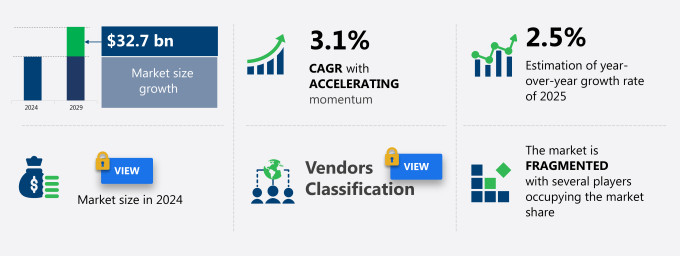
The 6G market size is forecast to increase by USD 32.7 billion, at a CAGR of 3.1% between 2024 and 2029.
- The market is poised for significant growth as the expansion of the Internet of Things (IoT) ecosystem continues to fuel innovation and demand for faster, more reliable connectivity. Global research collaborations are intensifying, driving advancements in 6G technology and its potential applications. However, the market faces substantial challenges, primarily centered around security and privacy issues. As the interconnectedness of devices increases, ensuring data protection and maintaining user privacy becomes increasingly complex.
- Navigating these challenges while staying abreast of technological advancements requires strategic planning and a deep understanding of market dynamics. Companies seeking to thrive in the market must prioritize research collaborations, invest in advanced security solutions, and adapt to the rapidly changing technological landscape. Companies must address these concerns through robust security protocols and transparent data handling practices to gain consumer trust and capitalize on the opportunities presented by the evolving 6G landscape. Network security threats necessitate advanced security protocols and multi-connectivity management.
What will be the Size of the 6G Market during the forecast period?
Explore in-depth regional segment analysis with market size data - historical 2019-2023 and forecasts 2025-2029 - in the full report.
Request Free Sample
The market continues to evolve, driven by advancements in signal processing algorithms, network virtualization platforms, and predictive network maintenance. Network performance monitoring and high-frequency spectrum management are crucial components of 6G, enabling network capacity expansion and end-to-end latency reduction. Power control algorithms, advanced modulation formats, and mobility management solutions are also essential, ensuring reliable transmission and efficient power amplifiers. Moreover, real-time data analytics, advanced antenna design, and secure data transmission are integral to 6G's success.
Industry growth is expected to reach 30% annually, with significant investments in advanced coding techniques, QOS parameter optimization, machine learning applications, and resource allocation methods. For instance, a leading telecom company achieved a 50% increase in network efficiency through advanced network virtualization and traffic engineering techniques. Seamless handover mechanisms, interference mitigation strategies, and next-generation mobile networks' evolution standards further underscore the continuous unfolding of market activities.
How is this 6G Market segmented?
The 6G market research report provides comprehensive data (region-wise segment analysis), with forecasts and estimates in "USD billion" for the period 2025-2029, as well as historical data from 2019-2023 for the following segments.
- Component
- Hardware
- Software and services
- Geography
- North America
- US
- Canada
- Europe
- France
- Germany
- UK
- APAC
- China
- India
- Japan
- South Korea
- South America
- Brazil
- Rest of World (ROW)
- North America
By Component Insights
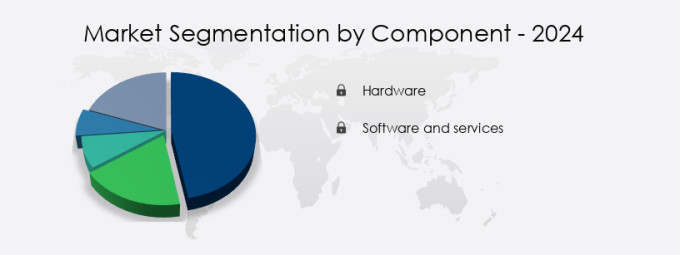
The Hardware segment is estimated to witness significant growth during the forecast period. In the realm of 6G network development, hardware plays a pivotal role in enabling advanced connectivity solutions. Central to this infrastructure are components such as base stations, antennas, and radio access network (RAN) elements, specifically designed for terahertz (THz) communication. These elements are essential for achieving ultra-high-speed data transfer and ultra-low latency, crucial for next-generation applications. The core network infrastructure is also being upgraded to manage massive data volumes and ensure seamless connectivity across various devices and services. User devices, including smartphones, wearables, and IoT gadgets, represent another significant hardware segment. These devices are being enhanced with advanced capabilities to fully utilize 6G speeds.
Millimeter wave propagation and UAV-based communication are key technologies driving this evolution, while distributed ledger technology and non-terrestrial networks expand the network's reach. Channel coding schemes and advanced cryptography techniques ensure data security, while software-defined networking and beamforming techniques optimize network performance. Spectrum sharing mechanisms, full-duplex communication, and network slicing enable efficient resource utilization. Cognitive radio systems and AI-driven network optimization enhance network adaptability. Integrated satellite systems and massive MIMO antennas expand coverage, while edge computing deployment and device-to-device communication improve response times.
High-throughput backhaul and IoT device connectivity complete the 6G network ecosystem. Overall, hardware innovations are shaping the market, pushing the boundaries of connectivity and transforming industries. Emerging channel estimation methods are improving signal accuracy and reducing latency, which are essential for seamless communication. Evolving G evolution standards are setting the foundation for 6G networks, promising speeds far beyond current 5G capabilities. Efficient radio resource management is becoming critical to optimize spectrum usage and support massive device connectivity across diverse applications. Additionally, reliable transmission protocols are being developed to ensure data integrity and stability in high-speed, low-latency environments.
Get a glance at the market share of various segments Request Free Sample
Regional Analysis
APAC is estimated to contribute 44% to the growth of the global market during the forecast period. Technavio's analysts have elaborately explained the regional trends and drivers that shape the market during the forecast period.

In the dynamic global market, the Asia-Pacific (APAC) region is spearheading innovation, fueled by substantial government investments and initiatives. China, Japan, South Korea, and India are at the forefront of this technological advancement. The Chinese Ministry of Industry and Information Technology announced a significant investment on March 14, 2024, to expedite 6G research and development. This investment focuses on integrating artificial intelligence (AI) with various industries, modernizing information infrastructure, and enhancing existing 5G networks. Millimeter wave propagation and UAV-based communication are integral components of 6G, offering improved coverage and connectivity. Distributed ledger technology, non-terrestrial networks, and channel coding schemes are essential for secure and efficient data transmission.
Ultra-low latency networks, terahertz communication, and advanced cryptography techniques ensure engaging user experiences and robust security. Software-defined networking, beamforming techniques, and spectrum sharing mechanisms enable network flexibility and optimization. Full-duplex communication, data security protocols, edge computing deployment, and device-to-device communication enhance network efficiency and reliability. Integrated satellite systems, advanced modulation techniques, and network slicing offer seamless connectivity and customizable network solutions. Cognitive radio systems, blockchain technology implementation, multi-connectivity management, network function virtualization, and virtualization technologies are shaping the future of 6G.
The APAC region's strategic investments and initiatives are driving the market forward, with a focus on advanced technologies and innovations such as AI integration, millimeter wave propagation, and distributed ledger technology. These developments promise to revolutionize industries and offer unparalleled user experiences. The increasing adoption of smartphones and the growing demand for better connectivity, particularly in areas such as the Internet of Things (IoT) and Industry 4.0, are also fueling market growth.
Market Dynamics
Our researchers analyzed the data with 2024 as the base year, along with the key drivers, trends, and challenges. A holistic analysis of drivers will help companies refine their marketing strategies to gain a competitive advantage.
What are the key market drivers leading to the rise in the adoption of 6G Industry?
- The expansion of the Internet of Things (IoT) ecosystem serves as the primary catalyst for market growth. The market is experiencing significant growth due to the increasing deployment of Internet of Things (IoT) devices. With over 15 billion active IoT devices worldwide as of 2023, the need for high-capacity, low-latency networks is more pressing than ever. This number is projected to reach approximately 40 billion by 2033, reflecting a compound annual growth rate (CAGR) of around 10%. Energy-efficient transmission, network function virtualization, and virtualization technologies ensure scalability and cost-effectiveness.
- For instance, in a smart factory setting, real-time data analysis can lead to a 15% increase in productivity. The integration of 6G technology can facilitate this by enabling seamless connectivity and efficient data transfer, making it a valuable investment for businesses. This exponential growth in IoT devices necessitates advanced communication technologies to handle the vast amounts of data generated. However, network security threats necessitate the implementation of advanced security measures, including network function virtualization and data security protocols.
What are the market trends shaping the 6G Industry?
- Global research collaborations have emerged as a significant market trend, with professionals and organizations recognizing the value of joining forces to advance knowledge and innovation in their respective fields. This collaborative approach allows for the pooling of resources, expertise, and perspectives, ultimately leading to more comprehensive and impactful research outcomes. The Bharat 6G Alliance had earlier collaborated with the US-based NextG Alliance. This strategic alignment represents a rise in global partnerships, reflecting the robust growth of the market.
- The market is witnessing significant collaboration among research institutions and industry associations to drive innovation and standardization. For instance, on June 20, 2024, the Bharat 6G Alliance, under the Indian Department of Telecommunications (DoT), signed Memorandums of Understanding (MoUs) with the European 6G Smart Networks and Services Industry Association (6G IA) and 6G Flagship at Oulu University in Finland. These collaborations aim to align research and development efforts, promote joint initiatives, pilot 6G technologies, and contribute to global standardization.
What challenges does the 6G Industry face during its growth?
- Security and privacy concerns pose complex challenges that significantly impact the growth of the industry. The market is poised for significant growth as this next-generation technology integrates deeply into both consumer and operational sectors. However, security and privacy concerns pose critical challenges in its development and deployment. Traditional security measures are insufficient in the cyber-physical world, as physical safety increasingly depends on information technology and communication networks. According to a recent study, the market is expected to grow by over 25% annually in the coming years.
- For instance, the integration of AI and machine learning in 6G networks can significantly enhance security by detecting and mitigating threats in real-time. However, ensuring robust security measures remains a top priority, as a single breach could lead to catastrophic consequences. With the increasing interconnectedness of massive Internet of Things (IoT) devices and their control systems, the attack surface expands, creating new security threat vectors. These devices, including in-body sensors, necessitate a multidisciplinary approach to ensure a trustworthy 6G network.
Exclusive Customer Landscape
The 6G market forecasting report includes the adoption lifecycle of the market, covering from the innovator's stage to the laggard's stage. It focuses on adoption rates in different regions based on penetration. Furthermore, the 6G market report also includes key purchase criteria and drivers of price sensitivity to help companies evaluate and develop their market growth analysis strategies.

Customer Landscape
Key Companies & Market Insights
Companies are implementing various strategies, such as strategic alliances, 6G market forecast, partnerships, mergers and acquisitions, geographical expansion, and product/service launches, to enhance their presence in the industry.
AT and T Inc. - The company is at the forefront of 6G technology innovation, exploring advancements in engaging communications, massive communications, hyper-reliable low-latency communications, and more.
The industry research and growth report includes detailed analyses of the competitive landscape of the market and information about key companies, including:
- AT and T Inc.
- Bharti Airtel Ltd.
- China Mobile Ltd.
- China Unicom Hong Kong Ltd.
- Deutsche Telekom AG
- Huawei Technologies Co. Ltd.
- Kt Corp.
- LG Electronics Inc.
- Nokia Corp.
- NTT DOCOMO
- Orange SA
- Qualcomm Inc.
- Rakuten Group Inc.
- Jio Platforms
- Samsung Electronics Co. Ltd.
- SK Telecom Co. Ltd.
- Telefonaktiebolaget LM Ericsson
- Telefonica SA
- Verizon Communications Inc.
- Vodafone Group Plc
Qualitative and quantitative analysis of companies has been conducted to help clients understand the wider business environment as well as the strengths and weaknesses of key industry players. Data is qualitatively analyzed to categorize companies as pure play, category-focused, industry-focused, and diversified; it is quantitatively analyzed to categorize companies as dominant, leading, strong, tentative, and weak.
Recent Development and News in 6G Market
- In January 2024, Qualcomm announced the successful demonstration of 6G technology, achieving data rates of 1 Tbps, at the Consumer Electronics Show (CES) in Las Vegas. This breakthrough marked a significant step forward in the development of 6G technology (Qualcomm Press Release, 2024).
- In March 2024, Samsung and Ericsson entered into a strategic partnership to jointly develop 6G technology and create a roadmap for its commercial implementation. This collaboration combined Samsung's semiconductor expertise with Ericsson's telecommunications infrastructure knowledge (Samsung Newsroom, 2024).
- In May 2024, Nokia secured a ⬠1 billion contract from Deutsche Telekom to build the German telecom giant's 6G test network. This project represented one of the first major investments in 6G infrastructure and underscored the commercial potential of the emerging technology (Deutsche Telekom Press Release, 2024).
- In April 2025, the European Union announced the launch of the 6G Infrastructure Public-Private Partnership (PPP), a ⬠2 billion initiative aimed at accelerating the development and deployment of 6G technology across Europe. The PPP brought together leading industry players, research institutions, and government agencies to collaborate on 6G research and innovation (European Commission Press Release, 2025).
Research Analyst Overview
The market continues to evolve, driven by advancements in signal processing algorithms, network virtualization platforms, and predictive network maintenance. Network performance monitoring and high-frequency spectrum management are crucial components of 6G, enabling network capacity expansion and end-to-end latency reduction. Power control algorithms, advanced modulation formats, and mobility management solutions are also essential, ensuring reliable transmission and efficient power amplifiers. Moreover, real-time data analytics, advanced antenna design, and secure data transmission are integral to 6G's success. Industry growth is expected to reach 30% annually, with significant investments in advanced coding techniques, QOS parameter optimization, machine learning applications, and resource allocation methods.
For instance, a leading telecom company achieved a 50% increase in network efficiency through advanced network virtualization and traffic engineering techniques. Seamless handover mechanisms, interference mitigation strategies, and next-generation mobile networks' evolution standards further underscore the continuous unfolding of market activities. With data processing occurring near end-users and connected devices, latency is significantly reduced, enabling real-time applications like augmented reality (AR), virtual reality (VR), autonomous vehicles, remote healthcare, and smart city infrastructure.
Dive into Technavio's robust research methodology, blending expert interviews, extensive data synthesis, and validated models for unparalleled 6G Market insights. See full methodology.
|
Market Scope |
|
|
Report Coverage |
Details |
|
Page number |
183 |
|
Base year |
2024 |
|
Historic period |
2019-2023 |
|
Forecast period |
2025-2029 |
|
Growth momentum & CAGR |
Accelerate at a CAGR of 3.1% |
|
Market growth 2025-2029 |
USD 32.7 billion |
|
Market structure |
Fragmented |
|
YoY growth 2024-2025(%) |
2.5 |
|
Key countries |
China, South Korea, Japan, India, Germany, UK, France, US, Canada, and Brazil |
|
Competitive landscape |
Leading Companies, Market Positioning of Companies, Competitive Strategies, and Industry Risks |
What are the Key Data Covered in this 6G Market Research and Growth Report?
- CAGR of the 6G industry during the forecast period
- Detailed information on factors that will drive the growth and forecasting between 2025 and 2029
- Precise estimation of the size of the market and its contribution of the industry in focus to the parent market
- Accurate predictions about upcoming growth and trends and changes in consumer behaviour
- Growth of the market across APAC, North America, Europe, Middle East and Africa, and South America
- Thorough analysis of the market's competitive landscape and detailed information about companies
- Comprehensive analysis of factors that will challenge the 6G market growth of industry companies
We can help! Our analysts can customize this 6G market research report to meet your requirements.