


Adaptive Optics Market Size 2024-2028
The adaptive optics market size is forecast to increase by USD 9.25 billion at a CAGR of 52.65% between 2023 and 2028.
- The market is experiencing significant growth due to the increasing demand for high-speed imaging applications. Adaptive optics systems offer superior image quality by correcting atmospheric distortions, making them ideal for various industries such as defense, healthcare, and telecommunications. Another trend driving market growth is the emergence of night vision devices integrated with thermal imaging technology. However, technical challenges persist in implementing adaptive optics systems, including complex alignment requirements and the need for precise control over wavefront sensors. Addressing these challenges will be crucial for market expansion. Adaptive optics systems provide enhanced imaging capabilities, making them a valuable investment for organizations seeking to improve their operational efficiency and performance.
What will be the Size of the Market During the Forecast Period?
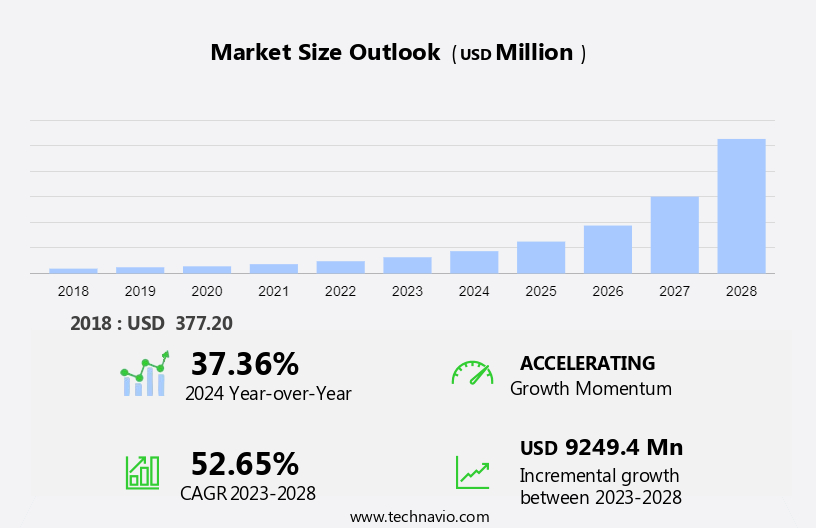
- The market encompasses a diverse range of applications, including optical systems for imaging, microscopy, and laser communication. Adaptive optics technology addresses distortion effects caused by various factors, such as atmospheric turbulence and eye movements, enabling improved image quality and precision. Micromarkets within the adaptive optics industry include retinal imaging, biological research, satellite imaging, laser weapons, and spectroscopy techniques. These segments benefit from the advanced capabilities of adaptive optics systems, which enable high-resolution imaging and accurate data collection. Competitive developments in the market include collaborations and joint ventures between industry players, aimed at enhancing technology and expanding market reach.
- Innovations in wavefront sensors, control systems, and wavefront modulators continue to drive growth in the sector. Adaptive optics technology plays a crucial role in various application ecosystems. In the field of retinal imaging, it enables the detection and diagnosis of eye diseases with unprecedented accuracy. In laser communication, it ensures the secure transmission of data over long distances. In biological research, it facilitates the study of complex cellular structures and processes. Satellite imaging and laser weapons are other significant applications of adaptive optics technology. In satellite imaging, it enhances the resolution and clarity of images, while in laser weapons, it improves the accuracy and effectiveness of the systems.
How is this market segmented and which is the largest segment?
The market research report provides comprehensive data (region-wise segment analysis), with forecasts and estimates in "USD million" for the period 2024-2028, as well as historical data from 2018-2022 for the following segments.
- Application
- Military and defense
- Biomedical
- Industrial and manufacturing
- Others
- Component
- Wavefront sensors
- Wavefront modulators
- Control system
- Geography
- North America
- US
- APAC
- China
- Japan
- Europe
- Germany
- France
- South America
- Middle East and Africa
- North America
By Application Insights
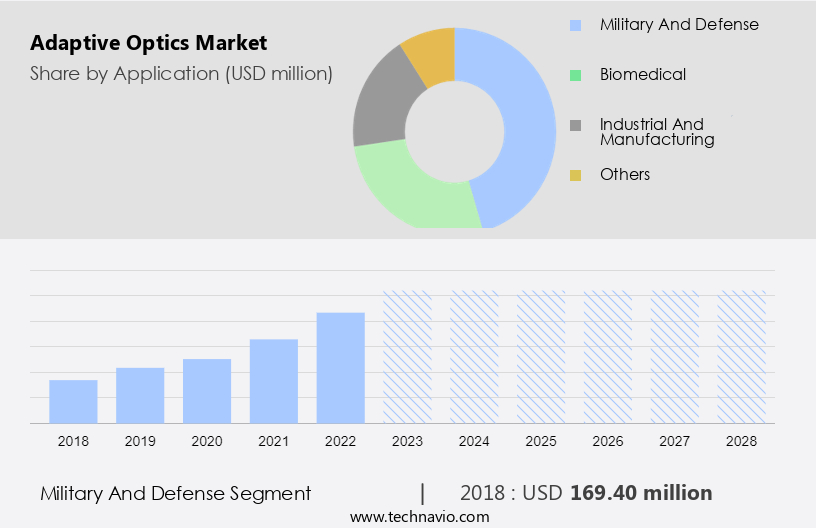
- The military and defense segment is estimated to grow significantly during the forecast period.
Adaptive optics technology plays a crucial role in military applications, enabling soldiers to locate and monitor distant objects with precision. This technology utilizes image stabilization to enhance visibility through fog and dust, making it essential for military forces. The market is poised for growth due to escalating defense spending. Major defense budget holders, including China, Saudi Arabia, Russia, France, and Canada, will fuel market expansion. Factors such as military modernization and the need for advanced weaponry and accessories are driving market growth within the military and defense sector. This trend is expected to persist throughout the forecast period. Adaptive optics also finds applications in laser communication, biological research, satellite imaging, and spectroscopy, further expanding its market potential.
Get a glance at the market report of share of various segments Request Free Sample
The military and defense segment was valued at USD 169.40 million in 2018 and showed a gradual increase during the forecast period.
Regional Analysis
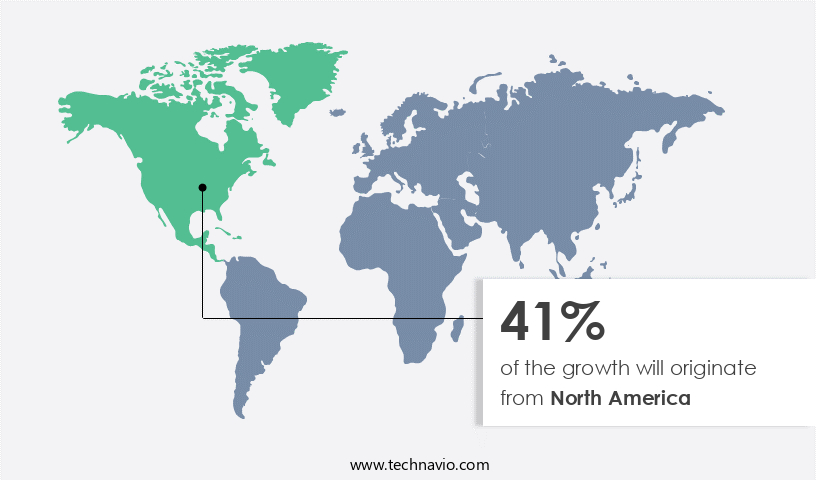
- North America is estimated to contribute 41% to the growth of the global market during the forecast period.
Technavio's analysts have elaborately explained the regional trends and drivers that shape the market during the forecast period.
For more insights on the market share of various regions Request Free Sample
The market in North America is experiencing growth due to the rising production of microscopes and spectroscopy techniques in the region. The generation of large data volumes necessitates the construction of more data centers, creating a demand for adaptive optics systems. Additionally, the introduction of advanced biomedical technologies in countries like the US and Canada is anticipated to fuel market expansion in the healthcare sector. Furthermore, ongoing research in adaptive optics at various universities and research institutions in North America is expected to contribute to market growth during the forecast period.
Market Dynamics
Our researchers analyzed the data with 2023 as the base year, along with the key drivers, trends, and challenges. A holistic analysis of drivers will help companies refine their marketing strategies to gain a competitive advantage.
What are the key market drivers leading to the rise in the adoption of Adaptive Optics Market?
Adaptive optics provide high-speed imaging is the key driver of the market.
- The market encompasses various micromarkets, including imaging, microscopy, satellite imaging, laser communication, spectroscopy techniques, and biomedicine. AO technology, which employs beam steering, optical trapping, wavefront sensors, and control systems, is a key driver for this market. In biomedical applications, high-speed AO enables real-time observation of dynamic cellular processes and retinal conditions, crucial for early diagnosis and treatment in ophthalmology. In microscopy, AO enhances live cell imaging, allowing researchers to study fast-moving biological phenomena with unprecedented detail. In astronomy, AO corrects atmospheric distortions, enhancing telescope imaging and leading to clearer observations of celestial objects and dynamic events, essential for advancing space exploration and observational astronomy.
- However, wavefront distortions and aberrations are key restraining factors in the market. Joint ventures and organic strategies are common competitive developments in this technology-driven market. Deformable mirrors and wavefront sensors are crucial components in telescopic applications, while vivo fluorescence ophthalmoscopy and laser weapons are emerging applications in the adaptive optics ecosystem. Policymakers play a crucial role in regulating the use of AO technology in various industries.
What are the market trends shaping the Adaptive Optics Market?
The emergence of night vision devices with thermal imaging is the upcoming trend in the market.
- The market encompasses various micromarkets, including imaging applications in ophthalmology, microscopy, and astronomy, as well as laser communication, biological research, satellite imaging, laser weapons, and spectroscopy techniques. Competitive developments, such as joint ventures and organic strategies, shape the market's competitive landscape. Adaptive optics (AO) technology relies on beam steering, optical trapping, wavefront sensors, control systems, and wavefront modulators to correct distortion effects caused by atmospheric turbulence and other factors. Aberrations in retinal imaging, for instance, can be mitigated using AO technology, leading to clearer and more accurate images. In the field of biomedicine, AO technology is used in vivo fluorescence ophthalmoscopy to enhance the diagnostic capabilities of medical professionals.
- Policymakers play a crucial role in the market, as regulations and funding decisions can significantly impact its growth. Despite its numerous advantages, key restraining factors, such as high costs and complex implementation, limit the market's expansion. In telescopic applications, adaptive optics is used to correct atmospheric distortions and improve the resolution of images from small observatories. Overall, the market is driven by the increasing demand for high-performance optical systems and the need for precise imaging and measurement in various industries.
What challenges does the Adaptive Optics Market face during its growth?
Technical issues while using AO system is a key challenge affecting the market growth.
- The market encompasses various micromarkets, including imaging, microscopy, laser communication, satellite imaging, laser weapons, spectroscopy techniques, retinal imaging, vivo fluorescence ophthalmoscopy, and telescopic applications. Technological advancements in AO technology have led to competitive developments, such as joint ventures and organic strategies, to enhance the capabilities of optical systems. However, the market faces key restraining factors, including the complexity of wavefront sensing and correction, distortion effects, and the high cost and maintenance requirements of advanced components like deformable mirrors, wavefront sensors, and control systems. The integration of AO systems with existing imaging technologies poses additional challenges, necessitating sophisticated calibration and alignment processes.
- Policymakers play a crucial role in addressing these challenges and promoting the adoption of AO technology in various industries. In the application ecosystem, AO systems are essential for overcoming aberrations and achieving optimal imaging performance in fields like ophthalmology, biomedicine, and astronomy.
Exclusive Customer Landscape
The market forecasting report includes the adoption lifecycle of the market, covering from the innovator's stage to the laggard's stage. It focuses on adoption rates in different regions based on penetration. Furthermore, the market report also includes key purchase criteria and drivers of price sensitivity to help companies evaluate and develop their market growth analysis strategies.
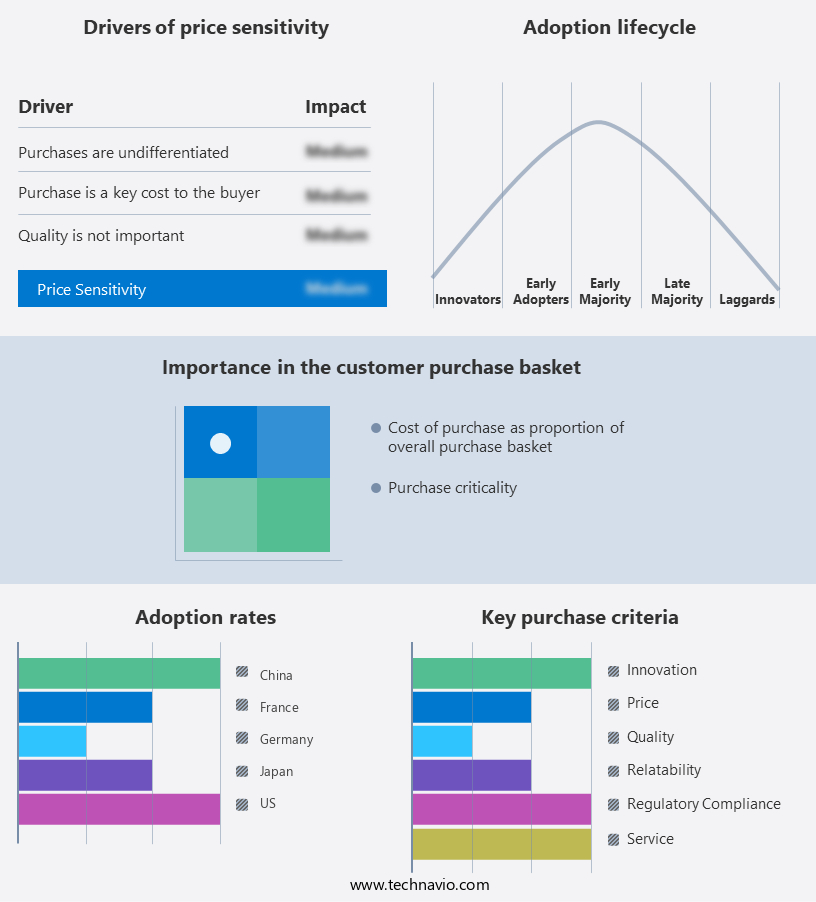
Customer Landscape
Key Companies & Market Insights
Companies are implementing various strategies, such as strategic alliances, market forecast, partnerships, mergers and acquisitions, geographical expansion, and product/service launches, to enhance their presence in the market.
Active Optical Systems LLC - The company offers the 2WIN, VisionFit SC, and Mobile wireless refractive systems.
The market research and growth report includes detailed analyses of the competitive landscape of the market and information about key companies, including:
- Active Optical Systems LLC
- Adaptica Srl
- Alpao SAS
- Baker Adaptive Optics
- Benchmark Electronics Inc.
- Boston Micromachines Corp.
- Edmund Optics Inc.
- Electro Optic Systems Pty Ltd.
- Flexible Optical BV
- Hamamatsu Photonics KK
- HOLOEYE Photonics AG
- Imagine Eyes
- Imagine Optic
- Iris Ao Inc.
- Northrop Grumman Corp.
- PHASICS SA
- Synopsys Inc.
- Teledyne Technologies Inc.
- Thorlabs Inc.
- Turn Ltd.
Qualitative and quantitative analysis of companies has been conducted to help clients understand the wider business environment as well as the strengths and weaknesses of key market players. Data is qualitatively analyzed to categorize companies as pure play, category-focused, industry-focused, and diversified; it is quantitatively analyzed to categorize companies as dominant, leading, strong, tentative, and weak.
Research Analyst Overview
Adaptive Optics (AO) is an advanced technology that enables the correction of distortion effects in optical systems. This technology is crucial in various applications, including imaging, microscopy, laser communication, biomedicine, satellite imaging, and laser weapons. The market is witnessing significant growth due to the increasing demand for high-precision optical systems and the expanding scope of applications. The Adaptive Optics technology relies on the ability to measure and correct wavefront distortions in real-time. This is achieved through the use of wavefront sensors, control systems, and wavefront modulators. Wavefront sensors detect the distortions in the wavefronts, while control systems process the data and generate correction signals.
Moreover, wavefront modulators then apply these corrections to the optical system, resulting in improved image quality. One of the primary applications of Adaptive Optics is in the field of imaging and microscopy. In ophthalmology, Adaptive Optics is used for retinal imaging, enabling high-resolution images of the retina. In astronomy, Adaptive Optics is used in small observatories to correct for atmospheric distortions, improving the quality of telescopic observations. Another significant application of Adaptive Optics is in biomedicine. Optical trapping, a technique that uses Adaptive Optics, is used for biological research, enabling the manipulation and observation of single cells. Adaptive Optics is also used in spectroscopy techniques, allowing for more accurate and precise measurements.
Furthermore, the market is driven by several factors, including the increasing demand for high-precision optical systems, the expanding scope of applications, and the development of new technologies. However, several challenges could hinder the growth of the market. Aberrations, which are distortions in the wavefronts, can limit the performance of Adaptive Optics systems. Policymakers' regulations and funding for research and development are also key restraining factors. Competitive developments, such as joint ventures and organic strategies, are shaping the market. For instance, companies are collaborating to develop new technologies and expand their product offerings. Organic strategies, such as research and development, are also being used to improve the performance of Adaptive Optics systems and expand their applications.
|
Market Scope |
|
|
Report Coverage |
Details |
|
Page number |
160 |
|
Base year |
2023 |
|
Historic period |
2018-2022 |
|
Forecast period |
2024-2028 |
|
Growth momentum & CAGR |
Accelerate at a CAGR of 52.65% |
|
Market Growth 2024-2028 |
USD 9.25 billion |
|
Market structure |
Fragmented |
|
YoY growth 2023-2024(%) |
37.36 |
|
Key countries |
US, China, France, Japan, and Germany |
|
Competitive landscape |
Leading Companies, Market Positioning of Companies, Competitive Strategies, and Industry Risks |
What are the Key Data Covered in this Market Research and Growth Report?
- CAGR of the market during the forecast period
- Detailed information on factors that will drive the market growth and forecasting between 2024 and 2028
- Precise estimation of the size of the market and its contribution of the market in focus to the parent market
- Accurate predictions about upcoming market growth and trends and changes in consumer behaviour
- Growth of the market across North America, APAC, Europe, South America, and Middle East and Africa
- Thorough analysis of the market's competitive landscape and detailed information about companies
- Comprehensive analysis of factors that will challenge the growth of market companies
We can help! Our analysts can customize this market research report to meet your requirements. Get in touch
 RIA -
RIA -