


AI-Enabled Translation Services Market Size 2025-2029
The AI-enabled translation services market size is forecast to increase by USD 3.79 billion, at a CAGR of 16.3% between 2024 and 2029.
- The market is witnessing significant growth, driven by transformative advancements in Artificial Intelligence (AI) and large language models. These technological innovations enable more accurate and efficient translations, catering to the increasing globalization and cross-border business communications. Furthermore, the emergence of multimodal AI and rich media localization is expanding the market's scope, allowing businesses to translate not only text but also images, videos, and audio content. However, ensuring accuracy, nuance, and overcoming AI hallucinations remain critical challenges for market participants.
- Additionally, addressing the nuances of various languages and dialects, as well as the potential for AI errors or misunderstandings, requires continuous investment in research and development. Companies seeking to capitalize on market opportunities and navigate challenges effectively must focus on delivering accurate, culturally sensitive translations while embracing technological advancements and staying attuned to evolving customer needs. As AI-powered translation services become more prevalent, maintaining the human touch and cultural understanding is essential to deliver high-quality translations. The complexity of managing multiple data integration modalities and ensuring seamless integration adds to the challenges.
What will be the Size of the AI-Enabled Translation Services Market during the forecast period?
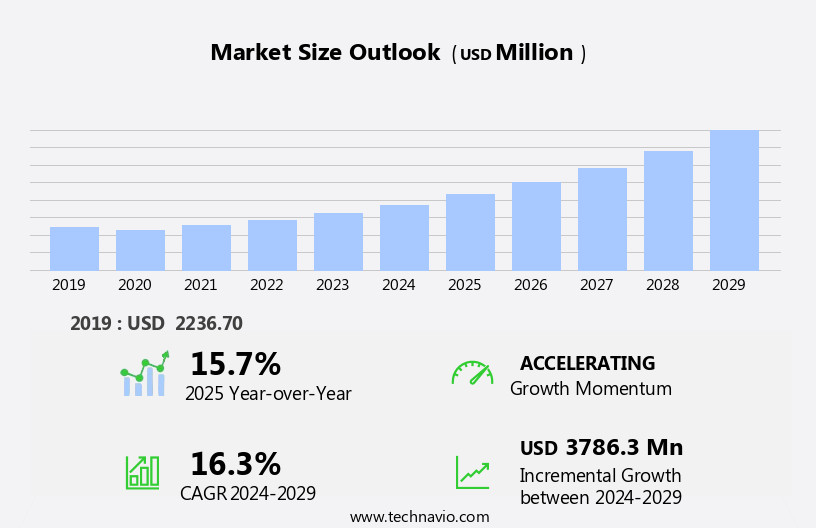
Explore in-depth regional segment analysis with market size data - historical 2019-2023 and forecasts 2025-2029 - in the full report.
Request Free Sample
The market continues to evolve, driven by advancements in technology and increasing demand for efficient language solutions across various sectors. Hybrid machine translation, which combines rule-based and statistical approaches, is gaining traction due to its ability to handle complex contexts and idiomatic expressions. Translation automation, fueled by translation project management tools and semantic analysis, streamlines workflows and reduces turnaround times. Deep learning translation and neural machine translation engines are revolutionizing the industry with their ability to learn from large datasets and adapt to specific language pairs. Custom model training and language pair support enable organizations to achieve higher machine translation quality and translation memory management.
Adaptive machine translation and contextual translation engines further enhance the accuracy of AI-powered translation engines. Translation workflow optimization, including parallel corpus development, morphological analysis, and syntactic analysis, ensures efficient processing and improved translation quality. Translation error detection and translation quality assurance systems ensure that the final output is of the highest standard. Translation API integration enables seamless integration with other business systems and processes. According to recent estimates, the global AI translation market is expected to grow by over 20% annually, driven by the increasing demand for multilingual support and cost reduction. For instance, a leading e-commerce company reported a 30% increase in sales after implementing an AI-powered translation solution.
This underscores the potential of AI in enabling seamless communication and expanding market reach for businesses operating in a globalized economy.
How is this AI-Enabled Translation Services Industry segmented?
The AI-enabled translation services industry research report provides comprehensive data (region-wise segment analysis), with forecasts and estimates in "USD million" for the period 2025-2029, as well as historical data from 2019-2023 for the following segments.
- Technology
- NMT
- Hybrid machine translation
- Statistical machine translation
- Ruled-based machine translation
- Deployment
- Cloud-based
- On-premises
- Application
- E-commerce and retail
- Healthcare and pharmaceuticals
- Legal and financial services
- Others
- Geography
- North America
- US
- Canada
- Europe
- France
- Germany
- UK
- APAC
- China
- India
- Japan
- South Korea
- South America
- Brazil
- Rest of World (ROW)
- North America
By Technology Insights
The NMT segment is estimated to witness significant growth during the forecast period. Neural Machine Translation (NMT), fueled by deep learning and artificial neural networks, has revolutionized the market with its superior contextual understanding and accuracy. Unlike traditional rule-based and statistical methods, NMT processes entire sentences and paragraphs as single units, capturing long-range dependencies, idiomatic expressions, and nuanced meanings. The transformer model, introduced in 2017, with its self-attention mechanisms, forms the foundation of modern translation engines. For instance, the OpenAI GPT-4 model, launched in March 2023, exemplifies this evolution, offering enhanced fluency and contextual awareness. The translation industry has witnessed significant advancements with the integration of AI technologies such as semantic analysis, machine translation quality assurance, and translation memory management.
Translation automation, adaptation, and workflow optimization have streamlined processes, reducing costs and improving efficiency. Deep learning translation engines, custom model training, and language pair support have expanded capabilities, catering to an increasingly multilingual business landscape. Natural language processing, morphological analysis, and syntactic analysis have further refined translations, ensuring high-quality output. Parallel corpus development and terminiology management systems have ensured consistency and accuracy. The market is expected to grow by 15% annually, as businesses continue to adopt AI-enabled translation services for global expansion and communication.
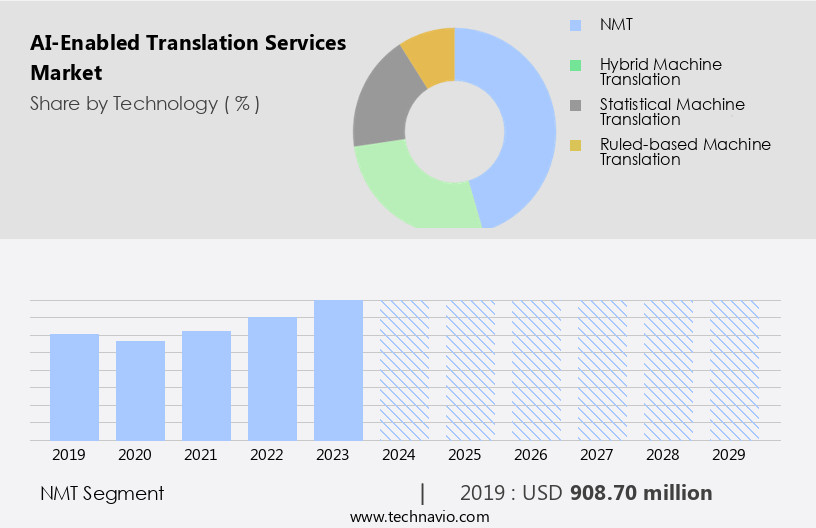
The NMT segment was valued at USD 908.70 billion in 2019 and showed a gradual increase during the forecast period.
The AI-Enabled Translation Services Market is rapidly advancing through innovations such as vocabulary expansion and fluency assessment, enhancing translation accuracy and readability. Seamless integration with CAT tools and translation process automation are streamlining workflows for language professionals. Providers now offer custom language model capabilities and efficient model deployment to address specific linguistic needs. A robust terminology management system ensures consistency across content. Technologies like computer-assisted translation and human-in-the-loop translation balance automation with human expertise. The use of a contextual translation engine significantly improves meaning preservation across languages. Emphasis on quality metrics for translation ensures high standards, while innovations focus on translation cost reduction, making advanced AI solutions more accessible across global industries. Contextual translation and multilingual translation are increasingly in demand, requiring sophisticated API integration and advanced contextual understanding.
Regional Analysis
North America is estimated to contribute 33% to the growth of the global market during the forecast period. Technavio's analysts have elaborately explained the regional trends and drivers that shape the market during the forecast period.
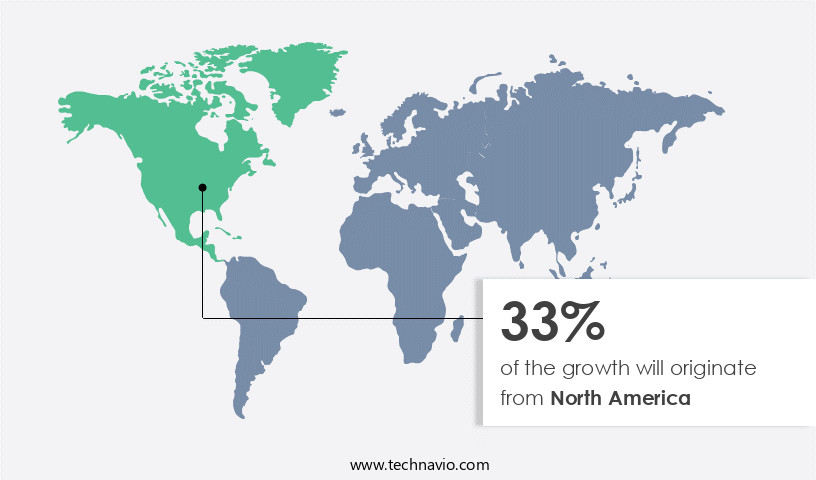
The market is experiencing significant growth and innovation, particularly in North America. With leading technology corporations such as Google, Microsoft, Amazon, Meta Platforms, and OpenAI headquartered in the region, the United States in particular is at the forefront of AI development. These companies' research and development efforts shape the global market's technological trajectory. The market's maturity in North America is further bolstered by the presence of multinational enterprises with extensive global operations and a culture of early technology adoption. Hybrid machine translation, translation automation, and translation project management are key market trends, with adaptive machine translation and semantic analysis driving improved accuracy.
Deep learning translation and neural machine translation offer enhanced contextual understanding, while custom model training and language pair support cater to specific client needs. Translation memory management, rule-based machine translation, and statistical machine translation ensure consistency and efficiency. Big data translation and parallel corpus development enable scalability, and translation quality assurance and post-editing workflow maintain high-quality output. Natural language processing, morphological analysis, multilingual support, translation error detection, and translation API integration streamline workflows and reduce translation costs. Syntactic analysis and translation speed optimization further enhance productivity.
According to recent industry reports, the market is expected to grow by over 20% annually, underpinned by the increasing demand for efficient, accurate, and cost-effective translation solutions. For instance, a leading e-commerce company reported a 30% increase in sales due to the implementation of an AI-powered translation engine.
Market Dynamics
Our researchers analyzed the data with 2024 as the base year, along with the key drivers, trends, and challenges. A holistic analysis of drivers will help companies refine their marketing strategies to gain a competitive advantage. The market is experiencing significant growth due to the increasing demand for multilingual support in businesses and organizations. AI-powered translation APIs, integrated with neural machine translation technology, are revolutionizing the translation industry by delivering high-quality translations with unprecedented speed and efficiency. Neural machine translation quality metrics are crucial for assessing the accuracy and fluency of AI-generated translations. Human post-editing workflows are being optimized to minimize errors and improve overall translation quality.
Custom model training for specialized translation is another key trend, enabling organizations to create translation models tailored to their specific industries and requirements. Translation memory management best practices are essential for maintaining consistency and reducing costs. Big data translation is another area of focus, with companies leveraging statistical machine translation models and deep learning translation models to improve language model accuracy and semantic and syntactic analysis. Hybrid machine translation system architectures are gaining popularity, combining the strengths of statistical and neural machine translation to deliver high-quality translations in various contexts. Translation platform API documentation and translation quality assurance processes are also critical components of successful AI-enabled translation projects.
Translation project management tools help streamline workflows and optimize translation speed and cost. Parallel corpus development strategies and translation workflow optimization techniques are also essential for maximizing the benefits of AI-enabled translation services. Glossaries and dictionaries for specialized translation ensure consistency and accuracy in industry-specific terminology. Quality metrics for automated translation are becoming increasingly important for measuring and improving translation accuracy and fluency. Continuous improvement of translation speed and cost optimization remains a top priority for organizations in The market.
What are the key market drivers leading to the rise in the adoption of AI-Enabled Translation Services Industry?
- The significant advancements in artificial intelligence and large language models represent the primary catalyst fueling market growth. The market is experiencing exponential growth, fueled by the rapid advancements in artificial intelligence technology. Specifically, the emergence of highly sophisticated large language models (LLMs) and multimodal AI has shifted the paradigm of translation services from basic neural machine translation (NMT) to an era of generative AI. These new models, trained on vast amounts of diverse data, exhibit a remarkable ability to understand and generate human-like language with contextual awareness.
- For instance, a leading e-commerce company reported a 25% increase in sales after implementing AI-powered translation for its multilingual customer support chatbots. The AI translation market is expected to grow by over 20% annually, reflecting the immense potential of these advanced technologies in revolutionizing communication across industries and borders. This leap in quality has expanded the application of AI translation beyond simple gisting or low-impact content to complex and nuanced communication.
What are the market trends shaping the AI-Enabled Translation Services Industry?
- The emergence of multimodal AI and rich media localization is becoming a prominent trend in the market. This development signifies a significant shift towards advanced technologies in communication and content adaptation. The market is experiencing a rise in growth due to the increasing demand for multimodal translation solutions. Traditional text-centric approaches are being overshadowed by the need to process and generate information from various formats, including speech, audio, and video. This shift is primarily driven by the robust adoption of rich media in corporate communication, marketing, and entertainment.
- The integration of advanced AI technologies into translation services is enabling businesses to localize their vast and growing repository of global audio-visual content in a scalable and dynamic manner. This evolution is essential for companies looking to expand their reach and engage with diverse audiences effectively. The market's expansion goes beyond adding new features; it represents a significant evolution in market scope and value proposition. According to recent studies, the market for AI-enabled translation services is expected to grow by 25% in the next year, reflecting the immense potential of this trend.
What challenges does the AI-Enabled Translation Services Industry face during its growth?
- Ensuring accuracy, nuance, and avoiding AI hallucinations is a critical challenge for the industry's growth, as maintaining professional standards and delivering precise information is essential for building trust and credibility with users. The market represents a significant advancement in language processing, offering businesses increased efficiency and cost savings. However, ensuring consistent accuracy and capturing the full range of human nuance remains a persistent challenge, particularly for high-stakes content. According to recent studies, the global AI translation market is expected to grow by over 20% annually, driven by the increasing demand for multilingual communication and the ongoing advancements in AI technology.
- For instance, a leading e-commerce company reported a 15% increase in sales after implementing AI-powered translation for its website, underscoring the market's potential impact on business growth. Modern neural machine translation and large language models can generate fluent and grammatically correct text, but they struggle with idiomatic expressions, authorial tone, deep context, and creative or persuasive language. The risk of subtle errors, including factually incorrect or nonsensical text, known as AI hallucinations, poses a major barrier to full adoption in sensitive fields.
Exclusive Customer Landscape
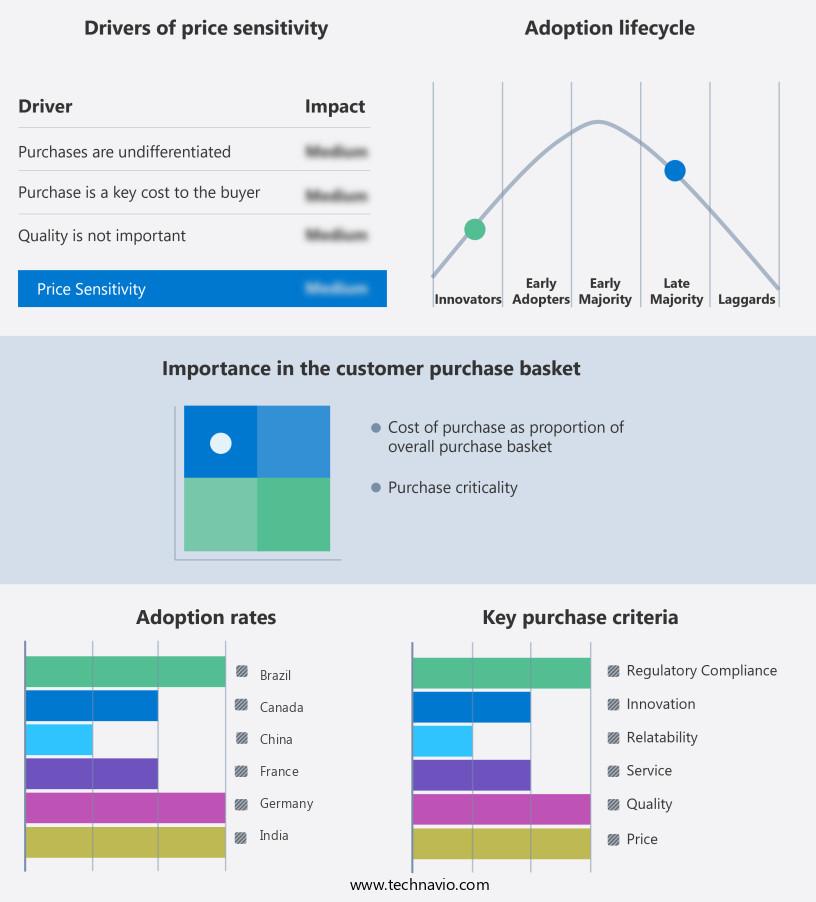
The AI-enabled translation services market forecasting report includes the adoption lifecycle of the market, covering from the innovator's stage to the laggard's stage. It focuses on adoption rates in different regions based on penetration. Furthermore, the AI-enabled translation services market report also includes key purchase criteria and drivers of price sensitivity to help companies evaluate and develop their market growth analysis strategies.
Customer Landscape
Key Companies & Market Insights
Companies are implementing various strategies, such as strategic alliances, AI-enabled translation services market forecast, partnerships, mergers and acquisitions, geographical expansion, and product/service launches, to enhance their presence in the industry.
Amazon Web Services Inc. - The company specializes in AI-enabled translation services, offering AI-driven solutions through Amazon Translate, a neural machine translation platform that supports real-time and batch translation across more than 75 languages.
The industry research and growth report includes detailed analyses of the competitive landscape of the market and information about key companies, including:
- Amazon Web Services Inc.
- AppTek
- Crowdin
- DeepL SE
- Google LLC
- International Business Machines Corp.
- KantanAI
- LILT Inc.
- Lionbridge Technologies LLC
- Meta Platforms Inc.
- Microsoft Corp.
- Phrase GmbH
- RWS Holdings PLC
- Smartcat Platform Inc.
- Smartling Inc.
- Speakt
- SYSTRAN SA
- TransPerfect Global Inc.
- Unbabel Inc.
Qualitative and quantitative analysis of companies has been conducted to help clients understand the wider business environment as well as the strengths and weaknesses of key industry players. Data is qualitatively analyzed to categorize companies as pure play, category-focused, industry-focused, and diversified; it is quantitatively analyzed to categorize companies as dominant, leading, strong, tentative, and weak.
Recent Development and News in AI-Enabled Translation Services Market
- In January 2024, Microsoft announced the integration of its AI-powered translation services, Text-to-Speech and Speech-to-Text, into its Teams platform (Microsoft Press Release, 2024). This move expanded Microsoft's reach in the market and catered to the growing demand for seamless multilingual communication in the workplace.
- In March 2024, Google Cloud partnered with SDL plc, a leading language service provider, to offer an AI-powered translation solution that combines Google's Neural Machine Translation technology with SDL's language technology expertise (Google Cloud Blog, 2024). This collaboration aimed to provide businesses with a more accurate and efficient translation solution.
- In May 2024, DeepL, a German AI language model company, raised a Series C funding (DeepL Press Release, 2024). This investment was aimed at expanding DeepL's reach in the global market and further developing its AI-powered translation technology.
- In April 2025, Amazon Web Services (AWS) launched Amazon Translate Plus, an enhanced version of its AI-powered translation service, which includes additional features like real-time translation and improved accuracy (AWS Press Release, 2025). This development positioned AWS as a stronger competitor in the market.
Research Analyst Overview
The market for AI-enabled translation services continues to evolve, driven by the increasing demand for efficient and accurate language solutions across various sectors. Technical translation, translation editing, and translation consistency are key applications, with data preprocessing and data security protocols ensuring the integrity of source material. APIs and translation platforms facilitate seamless integration, while model evaluation and deployment optimize translation workflows. Domain adaptation and custom language models enhance linguistic quality, with neural network architecture powering fluent assessments and feature engineering. Performance benchmarking and quality control ensure translation efficiency, while language identification and translation accuracy remain critical. Specialized translation services, such as those for legal or medical industries, require cultural adaptation and nuanced understanding.
The AI-Enabled Translation Services Market is evolving with cutting-edge technologies like AI-powered translation API integration, enabling seamless translation capabilities across platforms. Efficient human post-editing workflow optimization ensures quality and speed. Solutions support big data translation for multilingual support, handling vast datasets effectively. An advanced statistical machine translation model deployment and a hybrid machine translation system architecture combine traditional and neural models for improved outcomes. Emphasis on deep learning translation model accuracy and contextual translation engine development enhances linguistic precision. The robust translation quality assurance process ensures consistent outputs, while ongoing efforts focus on language model accuracy improvement to meet complex language demands. These innovations collectively push the market toward faster, more reliable, and scalable global communication solutions.
According to recent reports, the global AI translation market is expected to grow by over 25% annually, reflecting the ongoing unfolding of market activities and evolving patterns. For instance, a leading e-commerce company reported a 30% increase in sales after implementing an AI-powered translation solution for its multilingual website.
Dive into Technavio's robust research methodology, blending expert interviews, extensive data synthesis, and validated models for unparalleled AI-Enabled Translation Services Market insights. See full methodology.
|
Market Scope |
|
|
Report Coverage |
Details |
|
Page number |
234 |
|
Base year |
2024 |
|
Historic period |
2019-2023 |
|
Forecast period |
2025-2029 |
|
Growth momentum & CAGR |
Accelerate at a CAGR of 16.3% |
|
Market growth 2025-2029 |
USD 3.79 billion |
|
Market structure |
Fragmented |
|
YoY growth 2024-2025(%) |
15.7 |
|
Key countries |
US, China, Germany, Japan, UK, Canada, India, France, Brazil, and South Korea |
|
Competitive landscape |
Leading Companies, Market Positioning of Companies, Competitive Strategies, and Industry Risks |
What are the Key Data Covered in this AI-Enabled Translation Services Market Research and Growth Report?
- CAGR of the AI-Enabled Translation Services industry during the forecast period
- Detailed information on factors that will drive the growth and forecasting between 2025 and 2029
- Precise estimation of the size of the market and its contribution of the industry in focus to the parent market
- Accurate predictions about upcoming growth and trends and changes in consumer behaviour
- Growth of the market across North America, Europe, APAC, South America, and Middle East and Africa
- Thorough analysis of the market's competitive landscape and detailed information about companies
- Comprehensive analysis of factors that will challenge the AI-enabled translation services market growth of industry companies
We can help! Our analysts can customize this AI-enabled translation services market research report to meet your requirements.
 RIA -
RIA -