
Airport Ground Support Equipment Market Analysis, Size, and Forecast 2026-2030: North America (US, Canada, and Mexico), Europe (Germany, UK, and France), APAC (China, Japan, and India), South America (Brazil, Argentina, and Chile), Middle East and Africa (Saudi Arabia, UAE, and South Africa), and Rest of World (ROW)

Airport Ground Support Equipment Market Analysis, Size, and Forecast 2026-2030:
North America (US, Canada, and Mexico), Europe (Germany, UK, and France), APAC (China, Japan, and India), South America (Brazil, Argentina, and Chile), Middle East and Africa (Saudi Arabia, UAE, and South Africa), and Rest of World (ROW)

Published: Oct 2026 288 Pages SKU: IRTNTR41210

Market Overview at a Glance

$1.72 B
Market Opportunity
4.1%
CAGR 2025 - 2030
31.6%
North America Growth
$5.74 B
Powered airport GSE segment 2024

Airport Ground Support Equipment Market Size 2026-2030

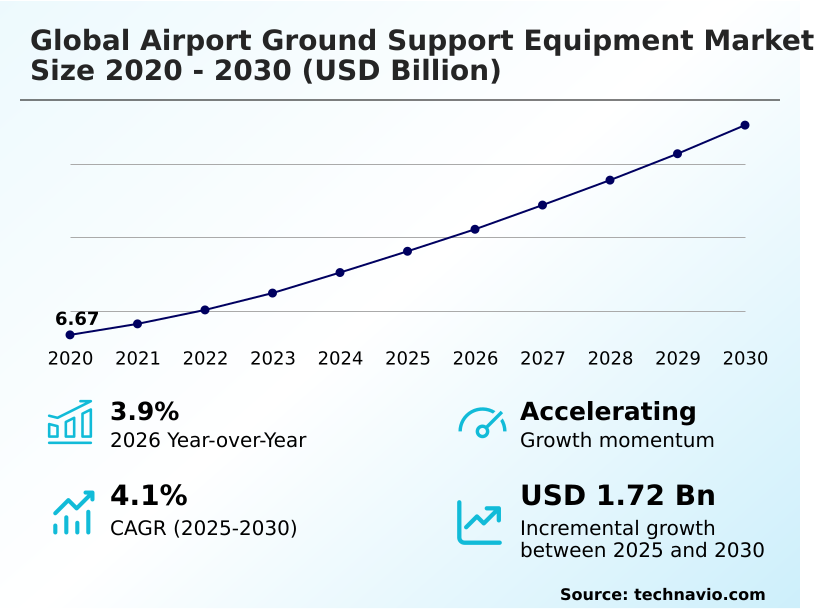
The airport ground support equipment market size is valued to increase by USD 1.72 billion, at a CAGR of 4.1% from 2025 to 2030. Sustained growth in global air traffic and airport modernization programs will drive the airport ground support equipment market.

Major Market Trends & Insights

  • North America dominated the market and accounted for a 31.6% growth during the forecast period.
  • By Type - Powered airport GSE segment was valued at USD 5.74 billion in 2024
  • By Power Rating - Electric segment accounted for the largest market revenue share in 2024

Market Size & Forecast

  • Market Opportunities: USD 2.86 billion
  • Market Future Opportunities: USD 1.72 billion
  • CAGR from 2025 to 2030 : 4.1%

Market Summary

  • The Airport Ground Support Equipment Market is undergoing a rapid technological transformation driven by the critical need to expedite aircraft turnarounds and reduce terminal congestion. Operational dynamics are shifting as ground handling operators transition from conventional internal combustion engines to advanced electric alternatives to comply with stringent sustainability mandates.
  • For instance, the deployment of intelligent telematics in ground handling fleets allows operators to proactively monitor asset health, which has resulted in a 25% reduction in unplanned equipment downtime. A primary driver of this transition is the sustained expansion of aviation infrastructure, which necessitates high-performance machinery to handle surging passenger and cargo volumes safely.
  • Conversely, the market faces structural constraints due to the substantial initial capital outlay required for acquiring technologically advanced fleets and upgrading necessary airside charging infrastructure. Overcoming these financial barriers is essential for facilities aiming to achieve long-term operational efficiency. Ultimately, the integration of automation and data-centric fleet management systems remains pivotal for optimizing logistics across modern airfield environments.

What will be the Size of the Airport Ground Support Equipment Market during the forecast period?
Get Key Insights on Market Forecast (PDF) Get Free Sample

How is the Airport Ground Support Equipment Market Segmented?

The airport ground support equipment industry research report provides comprehensive data (region-wise segment analysis), with forecasts and estimates in "USD million" for the period 2026-2030, as well as historical data from 2020-2024 for the following segments.

  • Type
    • Powered airport GSE
    • Non-powered GSE
  • Power rating
    • Electric
    • Non-electric
    • Hybrid
  • Application
    • Civil airport
    • Military airport
  • Geography
    • North America
      • US
      • Canada
      • Mexico
    • Europe
      • Germany
      • UK
      • France
      • Italy
      • Spain
      • The Netherlands
    • APAC
      • China
      • Japan
      • India
      • Australia
      • South Korea
      • Singapore
    • South America
      • Brazil
      • Argentina
      • Chile
    • Middle East and Africa
      • Saudi Arabia
      • UAE
      • South Africa
      • Turkey
      • Qatar

By Type Insights

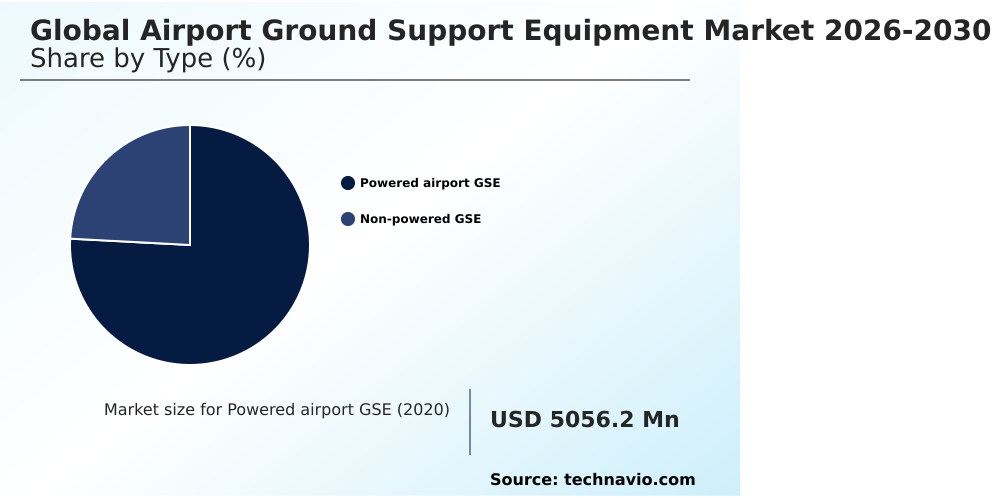
The powered airport gse segment is estimated to witness significant growth during the forecast period.

The powered equipment segment serves as the operational core of modern airfield logistics, directing the mechanical movement required for rapid aircraft servicing protocols. Operations rely heavily on electric tow tractors and aircraft pushback tugs to maneuver massive payloads efficiently.

This segment demands continuous technological upgrades, highlighted by a notable shift where lithium-ion battery integration has improved energy efficiency by 30% across major fleets. This transition significantly alters fleet total cost analysis, driving long-term operational savings.

Advancements in aviation fleet electrification are replacing heavy-duty airfield machinery with streamlined, low-emission alternatives. Furthermore, the deployment of advanced ground power units enhances the reliability of airport ground operations while stationary, thereby optimizing aviation payload efficiency.

These systematic upgrades directly accelerate turnaround schedules, demonstrating how motorized assets dictate the overall velocity of terminal activities.
Get Free Sample

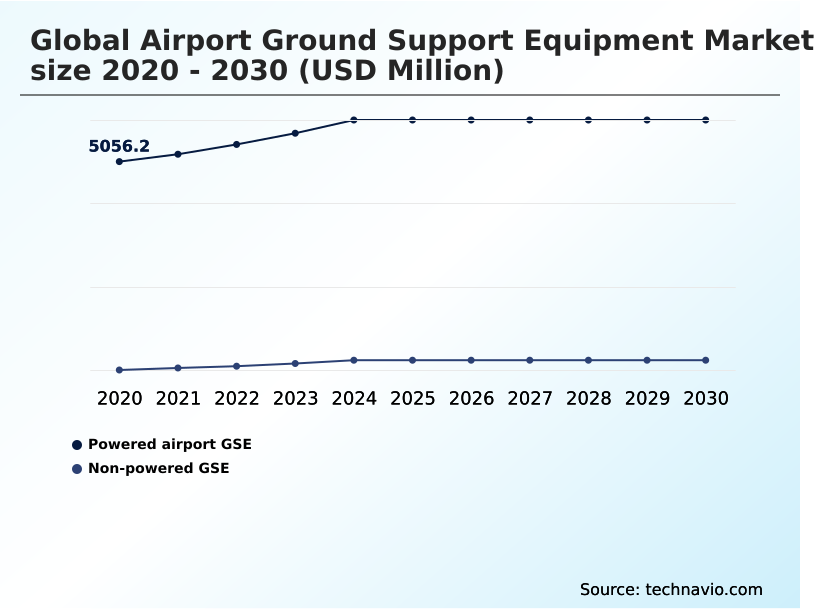
The Powered airport GSE segment was valued at USD 5.74 billion in 2024 and showed a gradual increase during the forecast period.
Get Free Sample

Regional Analysis

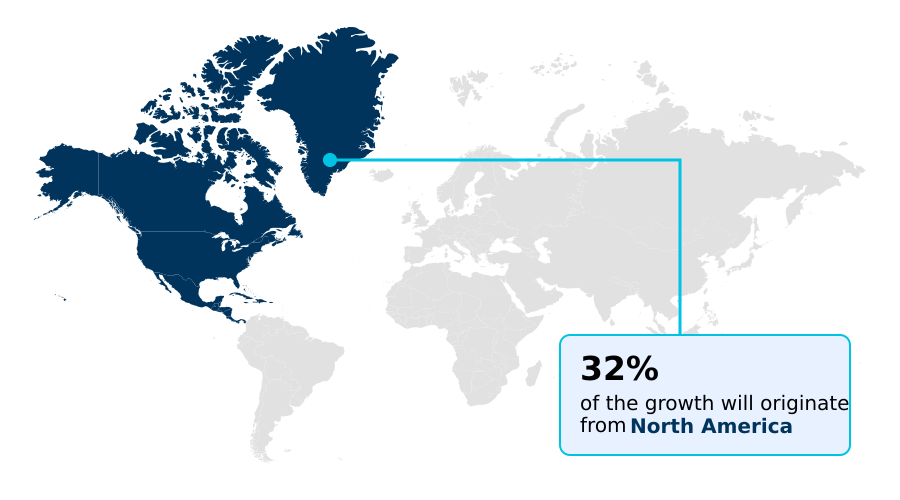
North America is estimated to contribute 31.6% to the growth of the global market during the forecast period.Technavio’s analysts have elaborately explained the regional trends and drivers that shape the market during the forecast period.
See How Airport Ground Support Equipment Market Demand is Rising in North America Get Free Sample

The geographic landscape of the Airport Ground Support Equipment reveals distinct regional trajectories shaped by infrastructure investments. North America prioritizes green operations, driven by strict aviation environmental standards that mandate immediate aviation noise abatement and zero-emission assets.

In contrast, the APAC region exhibits a 31% faster fleet expansion rate, fueled by new terminal construction and surging passenger traffic.

This rapid growth in APAC necessitates highly efficient cargo pallet transporters and streamlined aircraft docking procedures to manage flight volumes.

Across North America, integrating intelligent airport logistics coordination has improved equipment utilization rates by 18%, whereas APAC focuses heavily on basic fleet asset utilization.

Furthermore, deploying advanced aircraft refueling mechanisms and mobile pre-conditioned air units has generated a 12% reduction in energy consumption for North American handlers, demonstrating a clear divide in how regional operations adapt to distinct market pressures.

Market Dynamics

Our researchers analyzed the data with 2025 as the base year, along with the key drivers, trends, and challenges. A holistic analysis of drivers will help companies refine their marketing strategies to gain a competitive advantage.

  • The strategic modernization of terminal infrastructure is forcing operators to reevaluate their approach to mobility and resource allocation. At the core of this transformation is the aggressive procurement of electric powered ground handling vehicles, which significantly reduce the reliance on volatile fossil fuel markets.
  • By transitioning away from conventional diesel machinery, facilities are moving closer to achieving true zero emission airport tarmac operations.
  • This shift is not entirely uniform; for example, heavy-duty applications often face power limitations with pure electric models, making the integration of hybrid aircraft pushback tug systems a 40% more viable alternative for maintaining continuous towing operations without the need for extensive mid-shift recharging. Concurrently, the digitization of these complex assets is streamlining logistics.
  • The deployment of sophisticated aviation fleet telematics management software empowers dispatchers to track real-time battery health and vehicle locations, thereby eliminating idle times and preventing scheduling bottlenecks. Furthermore, labor constraints are propelling the industry to explore robotic alternatives.
  • The implementation of autonomous aviation baggage tractor systems is reshaping cargo workflows, ensuring that luggage transfer speeds remain consistent during peak travel seasons. These technological pivots collectively optimize supply chain reliability and regulatory compliance, allowing businesses to maximize their capital investments while mitigating the operational risks associated with outdated manual processes.
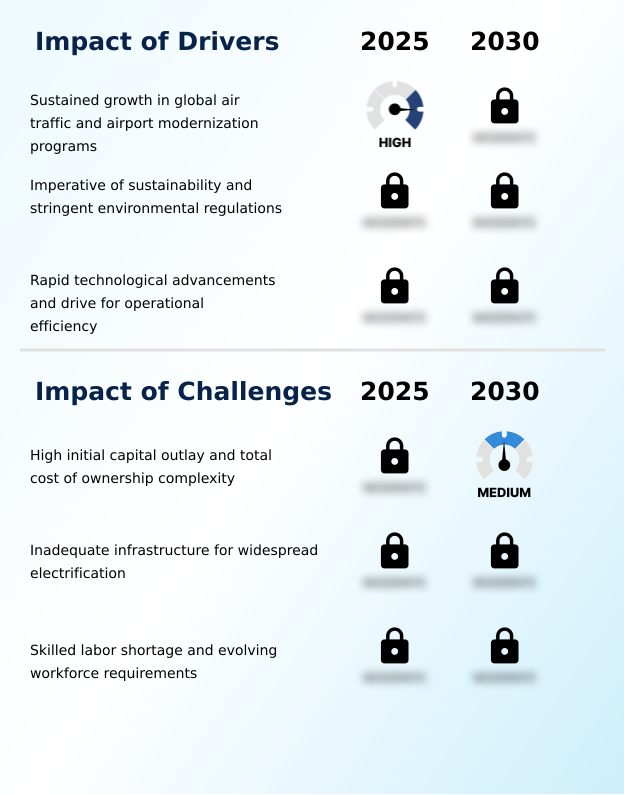
What are the key market drivers leading to the rise in the adoption of Airport Ground Support Equipment Industry?

  • Sustained growth in global air traffic alongside comprehensive airport modernization programs functions as the primary catalyst propelling market expansion.

  • The continuous surge in global travel density directly compels facilities to undertake massive aviation infrastructure expansion and airport terminal modernization projects. This escalation necessitates reliable machinery to ensure rapid aircraft turnaround optimization.
  • To meet stringent aviation sustainability mandates, operators are rapidly replacing outdated assets with electric belt loaders and motorized aircraft passenger stairs.
  • Installing robust airside charging infrastructure is paramount to supporting these fleets, which systematically alleviate bottlenecks and enhance runway congestion management. This strategic upgrade directly impacts profitability, as improving airport turnaround efficiency has increased daily flight handling capacity by 18%.
  • Ultimately, maximizing airport capacity utilization through advanced, eco-friendly assets enables stakeholders to handle escalating traffic volumes safely.

What are the market trends shaping the Airport Ground Support Equipment Industry?

  • The widespread adoption of fleet electrification represents a critical market trend driving sustainability initiatives across the aviation sector. This fundamental transition is rapidly reshaping operational procurement strategies and infrastructure development.

  • The rapid integration of digital intelligence into heavy machinery represents a critical shift in how ground handling logistics are executed. Facilities are aggressively pursuing aviation decarbonization strategies, deploying advanced technologies to establish zero-emission tarmac operations. This transformation is heavily supported by telematics asset tracking and smart ramp management software, which provide real-time visibility into asset health and deployment.
  • Implementing autonomous baggage handling and robotic cargo loaders directly combats systemic labor shortages while simultaneously elevating precision. For instance, the transition toward autonomous vehicle navigation has actively reduced cargo loading errors, improving overall handling accuracy by 25%. Furthermore, optimizing airport resource allocation through these connected networks has lowered daily energy consumption by 14%, alleviating severe pressures on airport grid stability.
  • These connected innovations empower handlers to fundamentally accelerate service delivery and secure long-term operational resilience.

What challenges does the Airport Ground Support Equipment Industry face during its growth?

  • High initial capital requirements coupled with the complexity of calculating total ownership costs present significant barriers to fleet modernization efforts.

  • The fundamental barrier to modernizing airfield operations lies in the exorbitant capital investments required for sustainable architectures. While mandates demand immediate aviation greenhouse gas reduction, the lack of widespread high-voltage charging stations severely restricts fully electric fleet deployment. Operators are forced to rely on complex hybrid propulsion systems and intricate aviation fuel logistics, complicating aviation maintenance scheduling.
  • Integrating predictive maintenance diagnostics into legacy equipment, such as heavy aircraft deicing systems, requires extensive technician retraining. This skills gap directly threatens aviation safety compliance and airfield workforce safety. Overcoming these deficiencies is critical, as facilities failing to modernize suffer a 20% higher incidence of delays. Without adequate investment in technologies for tarmac accident prevention, businesses face escalating operational disruptions.

Exclusive Technavio Analysis on Customer Landscape

The airport ground support equipment market forecasting report includes the adoption lifecycle of the market, covering from the innovator’s stage to the laggard’s stage. It focuses on adoption rates in different regions based on penetration. Furthermore, the airport ground support equipment market report also includes key purchase criteria and drivers of price sensitivity to help companies evaluate and develop their market growth analysis strategies.
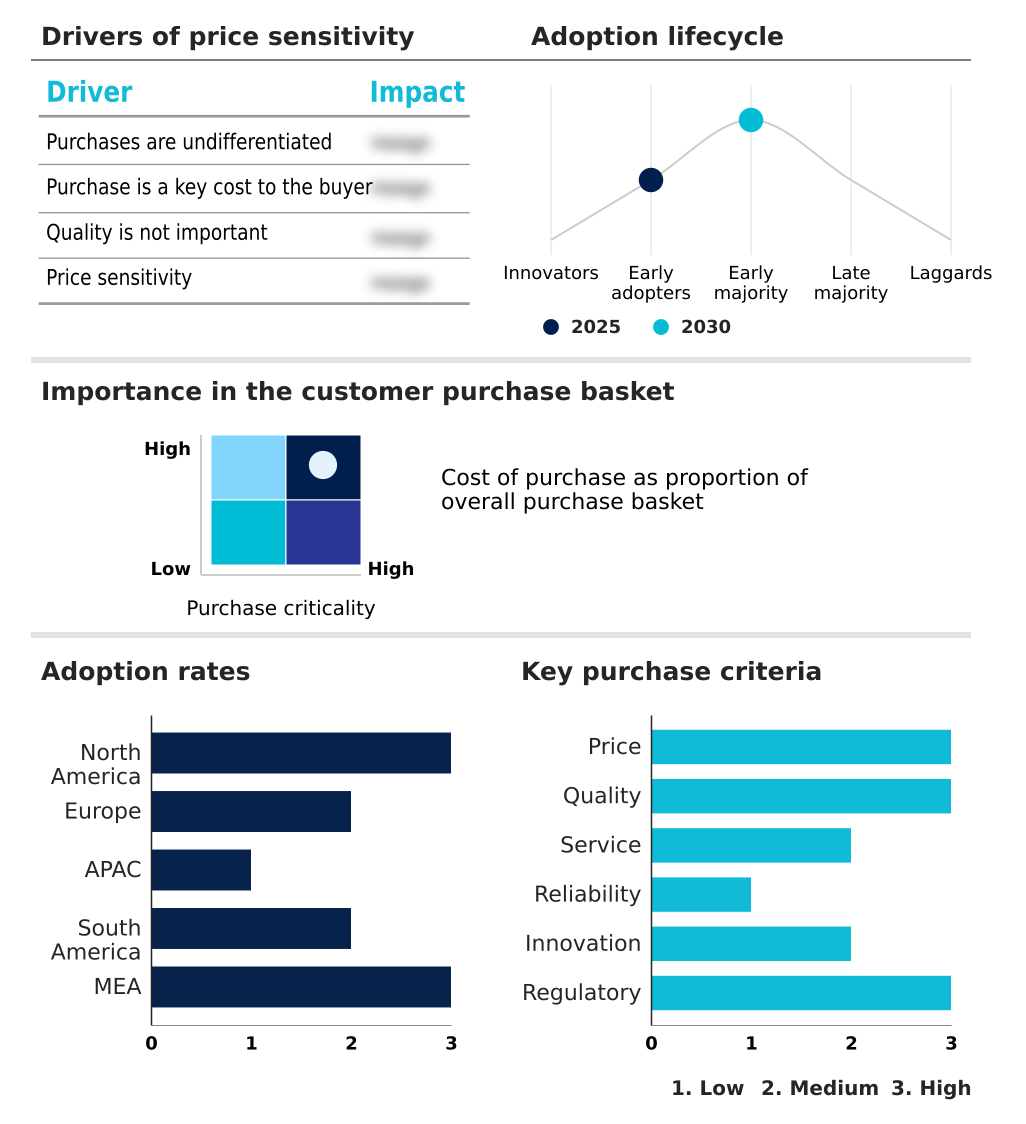
Customer Landscape of Airport Ground Support Equipment Industry

Competitive Landscape

Companies are implementing various strategies, such as strategic alliances, airport ground support equipment market forecast, partnerships, mergers and acquisitions, geographical expansion, and product/service launches, to enhance their presence in the industry.

AERO Specialties Inc. - Key offerings center on delivering specialized aviation support machinery, including automated docking systems and sustainable electrification solutions, designed to optimize airfield logistics and enhance overall operational throughput.

The industry research and growth report includes detailed analyses of the competitive landscape of the market and information about key companies, including:

  • AERO Specialties Inc.
  • Aviramp Ltd.
  • Cavotec SA
  • FAST Global Solutions
  • FAYAT SAS
  • GOLDHOFER
  • Guinault SA
  • ITW GSE ApS
  • Kalmar Motor AB
  • Mallaghan GA Inc.
  • Mototok International GmbH
  • MULAG Fahrzeugwerk
  • Power Stow A S
  • Sinfonia Technology Co
  • Stinar LLC
  • Textron Inc.
  • TLD Group
  • TREPEL Airport Equipment GmbH
  • Tronair Inc.
  • Vestergaard Co.

Qualitative and quantitative analysis of companies has been conducted to help clients understand the wider business environment as well as the strengths and weaknesses of key industry players. Data is qualitatively analyzed to categorize companies as pure play, category-focused, industry-focused, and diversified; it is quantitatively analyzed to categorize companies as dominant, leading, strong, tentative, and weak.

Recent Development and News in Airport ground support equipment market

  • In the Aerospace and Defense industry, the stringent implementation of international carbon offsetting schemes mandated a complete overhaul of aviation environmental standards, directly impacting Airport Ground Support Equipment demand by accelerating the procurement of zero-emission mobility fleets.
  • The widespread deployment of advanced digital twin technologies across terminal infrastructure optimized airport resource allocation, directly impacting Airport Ground Support Equipment demand by requiring integration with centralized fleet asset utilization platforms.
  • The transition toward localized microgrid power generation at major transit hubs stabilized airport grid stability, directly impacting Airport Ground Support Equipment demand by enabling the mass installation of high-voltage charging stations for heavy-duty electric tractors.
  • The integration of autonomous robotic navigation frameworks into military and civil aviation logistics reduced manual handling errors by 18%, directly impacting Airport Ground Support Equipment demand by spurring investments in autonomous vehicle navigation capabilities for cargo transport.

Dive into Technavio’s robust research methodology, blending expert interviews, extensive data synthesis, and validated models for unparalleled Airport Ground Support Equipment Market insights. See full methodology.

Market Scope
Page number 288
Base year 2025
Historic period 2020-2024
Forecast period 2026-2030
Growth momentum & CAGR Accelerate at a CAGR of 4.1%
Market growth 2026-2030 USD 1717.8 million
Market structure Fragmented
YoY growth 2025-2026(%) 3.9%
Key countries US, Canada, Mexico, Germany, UK, France, Italy, Spain, The Netherlands, China, Japan, India, Australia, South Korea, Singapore, Brazil, Argentina, Chile, Saudi Arabia, UAE, South Africa, Turkey and Qatar
Competitive landscape Leading Companies, Market Positioning of Companies, Competitive Strategies, and Industry Risks

Request Free Sample

Research Analyst Overview

  • The Airport Ground Support Equipment sector is undergoing a rigorous operational realignment as terminal authorities prioritize digital transformation to alleviate compounding logistical pressures. Boardroom executives are increasingly linking equipment procurement directly to compliance and capital expenditure strategies, mandating the rapid integration of smart ramp management platforms.
  • This strategic pivot toward data-centric operations allows handlers to utilize predictive maintenance diagnostics, which proactively identify mechanical failures and have successfully reduced un-planned fleet downtime by 28% compared to legacy reactive servicing models. Consequently, the push for zero-emission tarmac operations is accelerating the adoption of technologically advanced machinery, completely restructuring traditional aviation fuel logistics.
  • Furthermore, achieving seamless aircraft turnaround optimization now heavily relies on deploying robotic cargo loaders and autonomous baggage handling frameworks. These advanced systems mitigate human error while ensuring absolute adherence to stringent aviation safety compliance mandates.
  • Ultimately, modernizing these mechanical assets provides operators with the critical agility required to sustain continuous throughput, safeguarding long-term profitability amidst an increasingly complex and regulated travel environment.

What are the Key Data Covered in this Airport Ground Support Equipment Market Research and Growth Report?

  • What is the expected growth of the Airport Ground Support Equipment Market between 2026 and 2030?

    • USD 1.72 billion, at a CAGR of 4.1%

  • What segmentation does the market report cover?

    • The report is segmented by Type (Powered airport GSE, and Non-powered GSE), Power Rating (Electric, Non-electric, and Hybrid), Application (Civil airport, and Military airport) and Geography (North America, Europe, APAC, South America, Middle East and Africa)

  • Which regions are analyzed in the report?

    • North America, Europe, APAC, South America and Middle East and Africa

  • What are the key growth drivers and market challenges?

    • Sustained growth in global air traffic and airport modernization programs, High initial capital outlay and total cost of ownership complexity

  • Who are the major players in the Airport Ground Support Equipment Market?

    • AERO Specialties Inc., Aviramp Ltd., Cavotec SA, FAST Global Solutions, FAYAT SAS, GOLDHOFER, Guinault SA, ITW GSE ApS, Kalmar Motor AB, Mallaghan GA Inc., Mototok International GmbH, MULAG Fahrzeugwerk, Power Stow A S, Sinfonia Technology Co, Stinar LLC, Textron Inc., TLD Group, TREPEL Airport Equipment GmbH, Tronair Inc. and Vestergaard Co.

Market Research Insights

  • The Airport Ground Support Equipment Market demonstrates resilient operational expansion fueled by the imperative to streamline airport turnaround efficiency and modernize aging fleets. The strategic deployment of autonomous vehicle navigation systems has optimized ground handling logistics, resulting in a 22% improvement in cargo transfer speeds.
  • Concurrently, the enforcement of strict aviation decarbonization strategies has prompted a rapid shift toward sustainable solutions, reducing on-tarmac emissions by 15% across early-adopter facilities. Enhancing airport grid stability is critical to supporting these new energy demands. By leveraging advanced analytics to maximize airport capacity utilization, operators are systematically lowering maintenance expenditures and improving overall asset reliability in high-tempo airfield environments.

We can help! Our analysts can customize this airport ground support equipment market research report to meet your requirements.

Get in touch

1. Executive Summary

1.1 Market overview

Executive Summary - Chart on Market Overview
Executive Summary - Data Table on Market Overview
Executive Summary - Chart on Global Market Characteristics
Executive Summary - Chart on Market by Geography
Executive Summary - Chart on Market Segmentation by Type
Executive Summary - Chart on Market Segmentation by Power Rating
Executive Summary - Chart on Market Segmentation by Application
Executive Summary - Chart on Incremental Growth
Executive Summary - Data Table on Incremental Growth
Executive Summary - Chart on Company Market Positioning

2. Technavio Analysis

2.1 Analysis of price sensitivity, lifecycle, customer purchase basket, adoption rates, and purchase criteria

2.2 Criticality of inputs and Factors of differentiation

Chart on Overview on criticality of inputs and factors of differentiation

2.3 Factors of disruption

Chart on Overview on factors of disruption

2.4 Impact of drivers and challenges

Chart on Impact of drivers and challenges in 2025 and 2030

3. Market Landscape

3.1 Market ecosystem

Chart on Parent Market
Data Table on - Parent Market

3.2 Market characteristics

Chart on Market characteristics analysis

3.3 Value chain analysis

Chart on Value chain analysis

4. Market Sizing

4.1 Market definition

Data Table on Offerings of companies included in the market definition

4.2 Market segment analysis

Market segments

4.3 Market size 2025

4.4 Market outlook: Forecast for 2025-2030

Chart on Global - Market size and forecast 2025-2030 ($ million)
Data Table on Global - Market size and forecast 2025-2030 ($ million)
Chart on Global Market: Year-over-year growth 2025-2030 (%)
Data Table on Global Market: Year-over-year growth 2025-2030 (%)

5. Historic Market Size

5.1 Global Airport Ground Support Equipment Market 2020 - 2024

Historic Market Size - Data Table on Global Airport Ground Support Equipment Market 2020 - 2024 ($ million)

5.2 Type segment analysis 2020 - 2024

Historic Market Size - Type Segment 2020 - 2024 ($ million)

5.3 Power Rating segment analysis 2020 - 2024

Historic Market Size - Power Rating Segment 2020 - 2024 ($ million)

5.4 Application segment analysis 2020 - 2024

Historic Market Size - Application Segment 2020 - 2024 ($ million)

5.5 Geography segment analysis 2020 - 2024

Historic Market Size - Geography Segment 2020 - 2024 ($ million)

5.6 Country segment analysis 2020 - 2024

Historic Market Size - Country Segment 2020 - 2024 ($ million)

6. Qualitative Analysis

6.1 Impact of AI on Global Airport Ground Support Equipment Market

6.2 Impact of Geopolitical Conflicts on Global Airport Ground Support Equipment Market

7. Five Forces Analysis

7.1 Five forces summary

Five forces analysis - Comparison between 2025 and 2030

7.2 Bargaining power of buyers

Bargaining power of buyers - Impact of key factors 2025 and 2030

7.3 Bargaining power of suppliers

Bargaining power of suppliers - Impact of key factors in 2025 and 2030

7.4 Threat of new entrants

Threat of new entrants - Impact of key factors in 2025 and 2030

7.5 Threat of substitutes

Threat of substitutes - Impact of key factors in 2025 and 2030

7.6 Threat of rivalry

Threat of rivalry - Impact of key factors in 2025 and 2030

7.7 Market condition

Chart on Market condition - Five forces 2025 and 2030

8. Market Segmentation by Type

8.1 Market segments

Chart on Type - Market share 2025-2030 (%)
Data Table on Type - Market share 2025-2030 (%)

8.2 Comparison by Type

Chart on Comparison by Type
Data Table on Comparison by Type

8.3 Powered airport GSE - Market size and forecast 2025-2030

Chart on Powered airport GSE - Market size and forecast 2025-2030 ($ million)
Data Table on Powered airport GSE - Market size and forecast 2025-2030 ($ million)
Chart on Powered airport GSE - Year-over-year growth 2025-2030 (%)
Data Table on Powered airport GSE - Year-over-year growth 2025-2030 (%)

8.4 Non-powered GSE - Market size and forecast 2025-2030

Chart on Non-powered GSE - Market size and forecast 2025-2030 ($ million)
Data Table on Non-powered GSE - Market size and forecast 2025-2030 ($ million)
Chart on Non-powered GSE - Year-over-year growth 2025-2030 (%)
Data Table on Non-powered GSE - Year-over-year growth 2025-2030 (%)

8.5 Market opportunity by Type

Market opportunity by Type ($ million)
Data Table on Market opportunity by Type ($ million)

9. Market Segmentation by Power Rating

9.1 Market segments

Chart on Power Rating - Market share 2025-2030 (%)
Data Table on Power Rating - Market share 2025-2030 (%)

9.2 Comparison by Power Rating

Chart on Comparison by Power Rating
Data Table on Comparison by Power Rating

9.3 Electric - Market size and forecast 2025-2030

Chart on Electric - Market size and forecast 2025-2030 ($ million)
Data Table on Electric - Market size and forecast 2025-2030 ($ million)
Chart on Electric - Year-over-year growth 2025-2030 (%)
Data Table on Electric - Year-over-year growth 2025-2030 (%)

9.4 Non-electric - Market size and forecast 2025-2030

Chart on Non-electric - Market size and forecast 2025-2030 ($ million)
Data Table on Non-electric - Market size and forecast 2025-2030 ($ million)
Chart on Non-electric - Year-over-year growth 2025-2030 (%)
Data Table on Non-electric - Year-over-year growth 2025-2030 (%)

9.5 Hybrid - Market size and forecast 2025-2030

Chart on Hybrid - Market size and forecast 2025-2030 ($ million)
Data Table on Hybrid - Market size and forecast 2025-2030 ($ million)
Chart on Hybrid - Year-over-year growth 2025-2030 (%)
Data Table on Hybrid - Year-over-year growth 2025-2030 (%)

9.6 Market opportunity by Power Rating

Market opportunity by Power Rating ($ million)
Data Table on Market opportunity by Power Rating ($ million)

10. Market Segmentation by Application

10.1 Market segments

Chart on Application - Market share 2025-2030 (%)
Data Table on Application - Market share 2025-2030 (%)

10.2 Comparison by Application

Chart on Comparison by Application
Data Table on Comparison by Application

10.3 Civil airport - Market size and forecast 2025-2030

Chart on Civil airport - Market size and forecast 2025-2030 ($ million)
Data Table on Civil airport - Market size and forecast 2025-2030 ($ million)
Chart on Civil airport - Year-over-year growth 2025-2030 (%)
Data Table on Civil airport - Year-over-year growth 2025-2030 (%)

10.4 Military airport - Market size and forecast 2025-2030

Chart on Military airport - Market size and forecast 2025-2030 ($ million)
Data Table on Military airport - Market size and forecast 2025-2030 ($ million)
Chart on Military airport - Year-over-year growth 2025-2030 (%)
Data Table on Military airport - Year-over-year growth 2025-2030 (%)

10.5 Market opportunity by Application

Market opportunity by Application ($ million)
Data Table on Market opportunity by Application ($ million)

11. Customer Landscape

11.1 Customer landscape overview

Analysis of price sensitivity, lifecycle, customer purchase basket, adoption rates, and purchase criteria

12. Geographic Landscape

12.1 Geographic segmentation

Chart on Market share by geography 2025-2030 (%)
Data Table on Market share by geography 2025-2030 (%)

12.2 Geographic comparison

Chart on Geographic comparison
Data Table on Geographic comparison

12.3 North America - Market size and forecast 2025-2030

Chart on North America - Market size and forecast 2025-2030 ($ million)
Data Table on North America - Market size and forecast 2025-2030 ($ million)
Chart on North America - Year-over-year growth 2025-2030 (%)
Data Table on North America - Year-over-year growth 2025-2030 (%)
Chart on Regional Comparison - North America
Data Table on Regional Comparison - North America

12.3.1 US - Market size and forecast 2025-2030

Chart on US - Market size and forecast 2025-2030 ($ million)
Data Table on US - Market size and forecast 2025-2030 ($ million)
Chart on US - Year-over-year growth 2025-2030 (%)
Data Table on US - Year-over-year growth 2025-2030 (%)

12.3.2 Canada - Market size and forecast 2025-2030

Chart on Canada - Market size and forecast 2025-2030 ($ million)
Data Table on Canada - Market size and forecast 2025-2030 ($ million)
Chart on Canada - Year-over-year growth 2025-2030 (%)
Data Table on Canada - Year-over-year growth 2025-2030 (%)

12.3.3 Mexico - Market size and forecast 2025-2030

Chart on Mexico - Market size and forecast 2025-2030 ($ million)
Data Table on Mexico - Market size and forecast 2025-2030 ($ million)
Chart on Mexico - Year-over-year growth 2025-2030 (%)
Data Table on Mexico - Year-over-year growth 2025-2030 (%)

12.4 Europe - Market size and forecast 2025-2030

Chart on Europe - Market size and forecast 2025-2030 ($ million)
Data Table on Europe - Market size and forecast 2025-2030 ($ million)
Chart on Europe - Year-over-year growth 2025-2030 (%)
Data Table on Europe - Year-over-year growth 2025-2030 (%)
Chart on Regional Comparison - Europe
Data Table on Regional Comparison - Europe

12.4.1 Germany - Market size and forecast 2025-2030

Chart on Germany - Market size and forecast 2025-2030 ($ million)
Data Table on Germany - Market size and forecast 2025-2030 ($ million)
Chart on Germany - Year-over-year growth 2025-2030 (%)
Data Table on Germany - Year-over-year growth 2025-2030 (%)

12.4.2 UK - Market size and forecast 2025-2030

Chart on UK - Market size and forecast 2025-2030 ($ million)
Data Table on UK - Market size and forecast 2025-2030 ($ million)
Chart on UK - Year-over-year growth 2025-2030 (%)
Data Table on UK - Year-over-year growth 2025-2030 (%)

12.4.3 France - Market size and forecast 2025-2030

Chart on France - Market size and forecast 2025-2030 ($ million)
Data Table on France - Market size and forecast 2025-2030 ($ million)
Chart on France - Year-over-year growth 2025-2030 (%)
Data Table on France - Year-over-year growth 2025-2030 (%)

12.4.4 Italy - Market size and forecast 2025-2030

Chart on Italy - Market size and forecast 2025-2030 ($ million)
Data Table on Italy - Market size and forecast 2025-2030 ($ million)
Chart on Italy - Year-over-year growth 2025-2030 (%)
Data Table on Italy - Year-over-year growth 2025-2030 (%)

12.4.5 Spain - Market size and forecast 2025-2030

Chart on Spain - Market size and forecast 2025-2030 ($ million)
Data Table on Spain - Market size and forecast 2025-2030 ($ million)
Chart on Spain - Year-over-year growth 2025-2030 (%)
Data Table on Spain - Year-over-year growth 2025-2030 (%)

12.4.6 The Netherlands - Market size and forecast 2025-2030

Chart on The Netherlands - Market size and forecast 2025-2030 ($ million)
Data Table on The Netherlands - Market size and forecast 2025-2030 ($ million)
Chart on The Netherlands - Year-over-year growth 2025-2030 (%)
Data Table on The Netherlands - Year-over-year growth 2025-2030 (%)

12.5 APAC - Market size and forecast 2025-2030

Chart on APAC - Market size and forecast 2025-2030 ($ million)
Data Table on APAC - Market size and forecast 2025-2030 ($ million)
Chart on APAC - Year-over-year growth 2025-2030 (%)
Data Table on APAC - Year-over-year growth 2025-2030 (%)
Chart on Regional Comparison - APAC
Data Table on Regional Comparison - APAC

12.5.1 China - Market size and forecast 2025-2030

Chart on China - Market size and forecast 2025-2030 ($ million)
Data Table on China - Market size and forecast 2025-2030 ($ million)
Chart on China - Year-over-year growth 2025-2030 (%)
Data Table on China - Year-over-year growth 2025-2030 (%)

12.5.2 Japan - Market size and forecast 2025-2030

Chart on Japan - Market size and forecast 2025-2030 ($ million)
Data Table on Japan - Market size and forecast 2025-2030 ($ million)
Chart on Japan - Year-over-year growth 2025-2030 (%)
Data Table on Japan - Year-over-year growth 2025-2030 (%)

12.5.3 India - Market size and forecast 2025-2030

Chart on India - Market size and forecast 2025-2030 ($ million)
Data Table on India - Market size and forecast 2025-2030 ($ million)
Chart on India - Year-over-year growth 2025-2030 (%)
Data Table on India - Year-over-year growth 2025-2030 (%)

12.5.4 Australia - Market size and forecast 2025-2030

Chart on Australia - Market size and forecast 2025-2030 ($ million)
Data Table on Australia - Market size and forecast 2025-2030 ($ million)
Chart on Australia - Year-over-year growth 2025-2030 (%)
Data Table on Australia - Year-over-year growth 2025-2030 (%)

12.5.5 South Korea - Market size and forecast 2025-2030

Chart on South Korea - Market size and forecast 2025-2030 ($ million)
Data Table on South Korea - Market size and forecast 2025-2030 ($ million)
Chart on South Korea - Year-over-year growth 2025-2030 (%)
Data Table on South Korea - Year-over-year growth 2025-2030 (%)

12.5.6 Singapore - Market size and forecast 2025-2030

Chart on Singapore - Market size and forecast 2025-2030 ($ million)
Data Table on Singapore - Market size and forecast 2025-2030 ($ million)
Chart on Singapore - Year-over-year growth 2025-2030 (%)
Data Table on Singapore - Year-over-year growth 2025-2030 (%)

12.6 South America - Market size and forecast 2025-2030

Chart on South America - Market size and forecast 2025-2030 ($ million)
Data Table on South America - Market size and forecast 2025-2030 ($ million)
Chart on South America - Year-over-year growth 2025-2030 (%)
Data Table on South America - Year-over-year growth 2025-2030 (%)
Chart on Regional Comparison - South America
Data Table on Regional Comparison - South America

12.6.1 Brazil - Market size and forecast 2025-2030

Chart on Brazil - Market size and forecast 2025-2030 ($ million)
Data Table on Brazil - Market size and forecast 2025-2030 ($ million)
Chart on Brazil - Year-over-year growth 2025-2030 (%)
Data Table on Brazil - Year-over-year growth 2025-2030 (%)

12.6.2 Argentina - Market size and forecast 2025-2030

Chart on Argentina - Market size and forecast 2025-2030 ($ million)
Data Table on Argentina - Market size and forecast 2025-2030 ($ million)
Chart on Argentina - Year-over-year growth 2025-2030 (%)
Data Table on Argentina - Year-over-year growth 2025-2030 (%)

12.6.3 Chile - Market size and forecast 2025-2030

Chart on Chile - Market size and forecast 2025-2030 ($ million)
Data Table on Chile - Market size and forecast 2025-2030 ($ million)
Chart on Chile - Year-over-year growth 2025-2030 (%)
Data Table on Chile - Year-over-year growth 2025-2030 (%)

12.7 Middle East and Africa - Market size and forecast 2025-2030

Chart on Middle East and Africa - Market size and forecast 2025-2030 ($ million)
Data Table on Middle East and Africa - Market size and forecast 2025-2030 ($ million)
Chart on Middle East and Africa - Year-over-year growth 2025-2030 (%)
Data Table on Middle East and Africa - Year-over-year growth 2025-2030 (%)
Chart on Regional Comparison - Middle East and Africa
Data Table on Regional Comparison - Middle East and Africa

12.7.1 Saudi Arabia - Market size and forecast 2025-2030

Chart on Saudi Arabia - Market size and forecast 2025-2030 ($ million)
Data Table on Saudi Arabia - Market size and forecast 2025-2030 ($ million)
Chart on Saudi Arabia - Year-over-year growth 2025-2030 (%)
Data Table on Saudi Arabia - Year-over-year growth 2025-2030 (%)

12.7.2 UAE - Market size and forecast 2025-2030

Chart on UAE - Market size and forecast 2025-2030 ($ million)
Data Table on UAE - Market size and forecast 2025-2030 ($ million)
Chart on UAE - Year-over-year growth 2025-2030 (%)
Data Table on UAE - Year-over-year growth 2025-2030 (%)

12.7.3 South Africa - Market size and forecast 2025-2030

Chart on South Africa - Market size and forecast 2025-2030 ($ million)
Data Table on South Africa - Market size and forecast 2025-2030 ($ million)
Chart on South Africa - Year-over-year growth 2025-2030 (%)
Data Table on South Africa - Year-over-year growth 2025-2030 (%)

12.7.4 Turkey - Market size and forecast 2025-2030

Chart on Turkey - Market size and forecast 2025-2030 ($ million)
Data Table on Turkey - Market size and forecast 2025-2030 ($ million)
Chart on Turkey - Year-over-year growth 2025-2030 (%)
Data Table on Turkey - Year-over-year growth 2025-2030 (%)

12.7.5 Qatar - Market size and forecast 2025-2030

Chart on Qatar - Market size and forecast 2025-2030 ($ million)
Data Table on Qatar - Market size and forecast 2025-2030 ($ million)
Chart on Qatar - Year-over-year growth 2025-2030 (%)
Data Table on Qatar - Year-over-year growth 2025-2030 (%)

12.8 Market opportunity by geography

Market opportunity by geography ($ million)
Data Tables on Market opportunity by geography ($ million)

13. Drivers, Challenges, and Opportunity

13.1 Market drivers

Sustained growth in global air traffic and airport modernization programs
Imperative of sustainability and stringent environmental regulations
Rapid technological advancements and drive for operational efficiency

13.2 Market challenges

High initial capital outlay and total cost of ownership complexity
Inadequate infrastructure for widespread electrification
Skilled labor shortage and evolving workforce requirements

13.3 Impact of drivers and challenges

Impact of drivers and challenges in 2025 and 2030

13.4 Market opportunities

Widespread adoption of fleet electrification
Integration of automation and advanced telematics
Emergence of GSE as service and collaborative pooling models

14. Competitive Landscape

14.1 Overview

14.2

Overview on criticality of inputs and factors of differentiation

14.3 Landscape disruption

Overview on factors of disruption

14.4 Industry risks

Impact of key risks on business

15. Competitive Analysis

15.1 Companies profiled

Companies covered

15.2 Company ranking index

15.3 Market positioning of companies

Matrix on companies position and classification

15.4 Cavotec SA

Cavotec SA - Overview
Cavotec SA - Business segments
Cavotec SA - Key offerings
Cavotec SA - Segment focus
SWOT

15.5 FAST Global Solutions

FAST Global Solutions - Overview
FAST Global Solutions - Product / Service
FAST Global Solutions - Key offerings
SWOT

15.6 FAYAT SAS

FAYAT SAS - Overview
FAYAT SAS - Product / Service
FAYAT SAS - Key offerings
SWOT

15.7 GOLDHOFER

GOLDHOFER - Overview
GOLDHOFER - Product / Service
GOLDHOFER - Key offerings
SWOT

15.8 Guinault SA

Guinault SA - Overview
Guinault SA - Product / Service
Guinault SA - Key offerings
SWOT

15.9 ITW GSE ApS

ITW GSE ApS - Overview
ITW GSE ApS - Product / Service
ITW GSE ApS - Key offerings
SWOT

15.10 Kalmar Motor AB

Kalmar Motor AB - Overview
Kalmar Motor AB - Product / Service
Kalmar Motor AB - Key offerings
SWOT

15.11 Power Stow A S

Power Stow A S - Overview
Power Stow A S - Product / Service
Power Stow A S - Key offerings
SWOT

15.12 Sinfonia Technology Co

Sinfonia Technology Co - Overview
Sinfonia Technology Co - Business segments
Sinfonia Technology Co - Key offerings
Sinfonia Technology Co - Segment focus
SWOT

15.13 Stinar LLC

Stinar LLC - Overview
Stinar LLC - Product / Service
Stinar LLC - Key offerings
SWOT

15.14 Textron Inc.

Textron Inc. - Overview
Textron Inc. - Business segments
Textron Inc. - Key offerings
Textron Inc. - Segment focus
SWOT

15.15 TLD Group

TLD Group - Overview
TLD Group - Product / Service
TLD Group - Key offerings
SWOT

15.16 TREPEL Airport Equipment GmbH

TREPEL Airport Equipment GmbH - Overview
TREPEL Airport Equipment GmbH - Product / Service
TREPEL Airport Equipment GmbH - Key offerings
SWOT

15.17 Tronair Inc.

Tronair Inc. - Overview
Tronair Inc. - Product / Service
Tronair Inc. - Key offerings
SWOT

15.18 Vestergaard Co.

Vestergaard Co. - Overview
Vestergaard Co. - Product / Service
Vestergaard Co. - Key offerings
SWOT

16. Appendix

16.1 Scope of the report

Market definition
Objectives
Notes and caveats

16.2 Inclusions and exclusions checklist

Inclusions checklist
Exclusions checklist

16.3 Currency conversion rates for US$

16.4 Research methodology

16.5 Data procurement

Information sources

16.6 Data validation

16.7 Validation techniques employed for market sizing

16.8 Data synthesis

16.9 360 degree market analysis

16.10 List of abbreviations

Research Methodology

Technavio presents a detailed picture of the market by way of study, synthesis, and summation of data from multiple sources. The analysts have presented the various facets of the market with a particular focus on identifying the key industry influencers. The data thus presented is comprehensive, reliable, and the result of extensive research, both primary and secondary.

INFORMATION SOURCES

Primary sources

  • Manufacturers and suppliers
  • Channel partners
  • Industry experts
  • Strategic decision makers

Secondary sources

  • Industry journals and periodicals
  • Government data
  • Financial reports of key industry players
  • Historical data
  • Press releases

DATA ANALYSIS

Data Synthesis

  • Collation of data
  • Estimation of key figures
  • Analysis of derived insights

Data Validation

  • Triangulation with data models
  • Reference against proprietary databases
  • Corroboration with industry experts

REPORT WRITING

Qualitative

  • Market drivers
  • Market challenges
  • Market trends
  • Five forces analysis

Quantitative

  • Market size and forecast
  • Market segmentation
  • Geographical insights
  • Competitive landscape

Interested in this report?

Get your sample now to see our research methodology and insights!

Download Now

Frequently Asked Questions

Airport Ground Support Equipment market growth will increase by USD 1717.8 million during 2026-2030.

The Airport Ground Support Equipment market is expected to grow at a CAGR of 4.1% during 2026-2030.

Airport Ground Support Equipment market is segmented by Type (Powered airport GSE, Non-powered GSE) Power rating (Electric, Non-electric, Hybrid) Application (Civil airport, Military airport)

AERO Specialties Inc., Aviramp Ltd., Cavotec SA, FAST Global Solutions, FAYAT SAS, GOLDHOFER, Guinault SA, ITW GSE ApS, Kalmar Motor AB, Mallaghan GA Inc., Mototok International GmbH, MULAG Fahrzeugwerk, Power Stow A S, Sinfonia Technology Co, Stinar LLC, Textron Inc., TLD Group, TREPEL Airport Equipment GmbH, Tronair Inc., Vestergaard Co. are a few of the key vendors in the Airport Ground Support Equipment market.

North America will register the highest growth rate of 31.6% among the other regions. Therefore, the Airport Ground Support Equipment market in North America is expected to garner significant business opportunities for the vendors during the forecast period.

US, Canada, Mexico, Germany, UK, France, Italy, Spain, The Netherlands, China, Japan, India, Australia, South Korea, Singapore, Brazil, Argentina, Chile, Saudi Arabia, UAE, South Africa, Turkey, Qatar

  • Sustained growth in global air traffic and airport modernization programs is the driving factor this market.

The Airport Ground Support Equipment market vendors should focus on grabbing business opportunities from the Type segment as it accounted for the largest market share in the base year.
RIA - Research AI Assistant
Ask RIA