
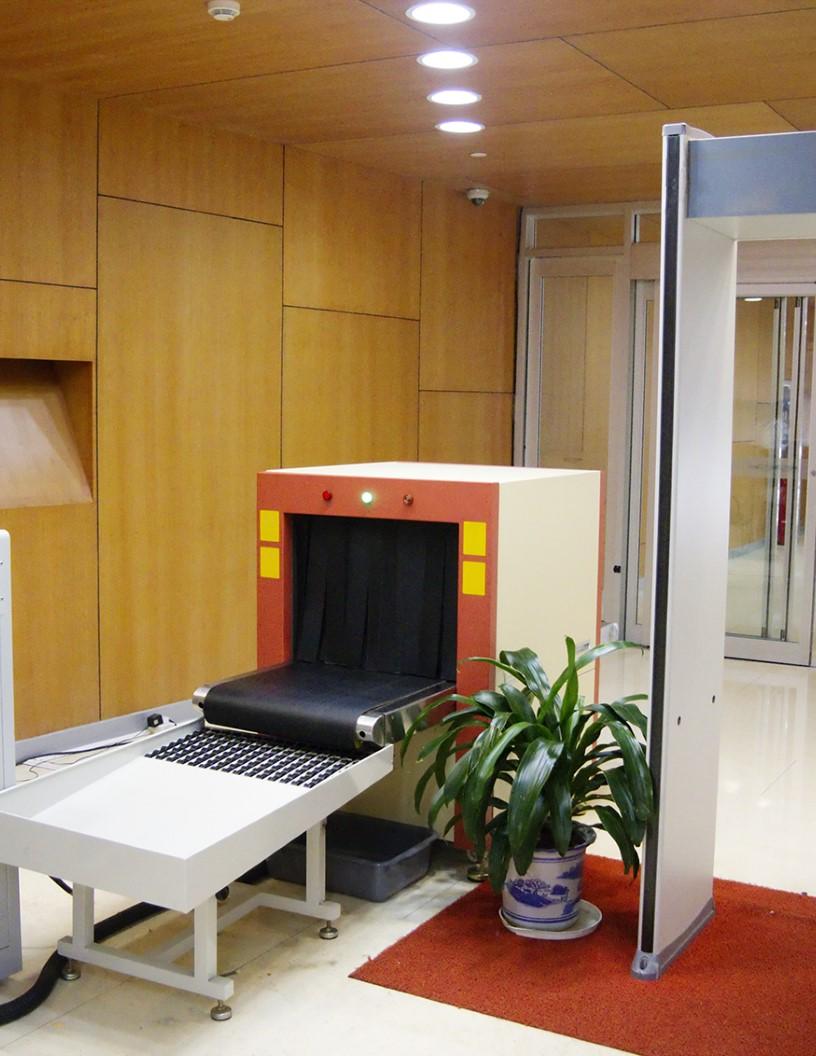


Airport Narcotics Detectors Market Size 2025-2029
The airport narcotics detectors market size is forecast to increase by USD 593 million at a CAGR of 6.6% between 2024 and 2029.
- The market is experiencing significant growth due to the escalating threat of drug trafficking, which continues to pose a major security concern for airports worldwide. The market is driven by the increasing demand for advanced detection systems to enhance security measures and prevent illicit drug smuggling. New product innovations, such as explosive and narcotics detection systems integrated into a single device, are gaining popularity due to their efficiency and cost-effectiveness. However, the high cost of advanced detection systems remains a challenge for many airports, particularly those with limited budgets. The market is characterized by a focus on operational optimization, security analytics, and smart airports.
- Despite this, the market presents ample opportunities for growth, as governments and airport authorities continue to prioritize security and invest in cutting-edge technology to safeguard travelers and infrastructure. Companies seeking to capitalize on these opportunities must stay abreast of the latest trends and technologies, while also navigating the competitive landscape and addressing the affordability concerns of potential customers.
What will be the Size of the Airport Narcotics Detectors Market during the forecast period?

- The market is a critical component of the global security landscape, with ongoing efforts to enhance security measures and mitigate emerging threats. The market is driven by the increasing importance of incident response, security workforce training, and advanced imaging techniques to ensure effective trace explosives detection and identity verification. Remote diagnostics and predictive maintenance enable operational optimization and cost savings, while regulatory compliance and threat intelligence are essential for risk mitigation strategies. Technology adoption, including automated threat identification and integrated security systems, continues to shape the market. Non-invasive screening and data privacy are crucial considerations for passenger flow management, and service level agreements ensure accountability and return on investment.
- Industry collaboration and best practices are key to addressing environmental impact and long-term strategy. Biometric authentication, security investment, and security risk management are essential components of a comprehensive security strategy. The market is expected to grow as airports worldwide prioritize security solutions, security audits, knowledge sharing, and regulatory compliance to address the evolving global security landscape.
How is this Airport Narcotics Detectors Industry segmented?
The airport narcotics detectors industry research report provides comprehensive data (region-wise segment analysis), with forecasts and estimates in "USD million" for the period 2025-2029, as well as historical data from 2019-2023 for the following segments.
- Technology
- Ion mobility spectrometry
- Raman spectroscopy
- Infrared spectroscopy
- Others
- Application
- Civil airports
- Military and federal government airports
- Private airports
- Geography
- North America
- US
- Canada
- Europe
- France
- Germany
- Italy
- UK
- APAC
- China
- India
- Japan
- Middle East and Africa
- UAE
- South America
- North America
By Technology Insights
The ion mobility spectrometry segment is estimated to witness significant growth during the forecast period.
Ion mobility spectrometry (IMS) is a leading technology in airport narcotics detection, recognized for its rapid identification of trace amounts of illicit drugs in luggage, cargo, and on passengers. IMS operates by ionizing air samples and measuring the mobility of ionized particles within an electric field, making it highly effective in detecting powdered and volatile narcotics, such as cocaine, heroin, and methamphetamine. This advanced technology offers significant advantages for airport security applications. Its high sensitivity enables the detection of drugs in parts per billion (ppb) concentrations, ensuring even minute quantities are identified. IMS also integrates seamlessly with X-ray imaging, data analytics, remote monitoring, and other security protocols, enhancing operational efficiency and border security.
Moreover, IMS employs AI algorithms, machine learning, and spectral analysis for real-time analysis and false positive reduction, reducing the workload on security personnel and improving passenger experience. IMS is compliant with ICAO standards and TSA regulations, ensuring adherence to global compliance standards. IMS technology is also utilized in stationary detectors, automated screening, and handheld devices, providing flexibility in deployment strategies. Additionally, it offers advanced features like mass spectrometry, chemical analysis, and neutron activation analysis for thorough threat detection. Cloud-based platforms and operator training further enhance the capabilities of IMS, allowing for centralized monitoring and analysis, and ensuring optimal performance and ease of use.
IMS plays a crucial role in preventing narcotics trafficking, explosive detection, and terrorism prevention at airport security checkpoints and customs inspections.
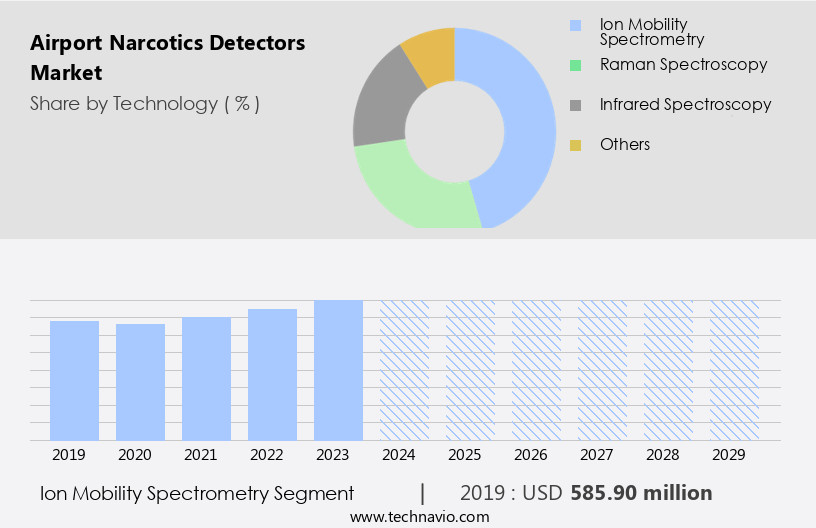
Get a glance at the market report of share of various segments Request Free Sample
The Ion mobility spectrometry segment was valued at USD 585.90 million in 2019 and showed a gradual increase during the forecast period.
Regional Analysis
North America is estimated to contribute 38% to the growth of the global market during the forecast period.Technavio's analysts have elaborately explained the regional trends and drivers that shape the market during the forecast period.
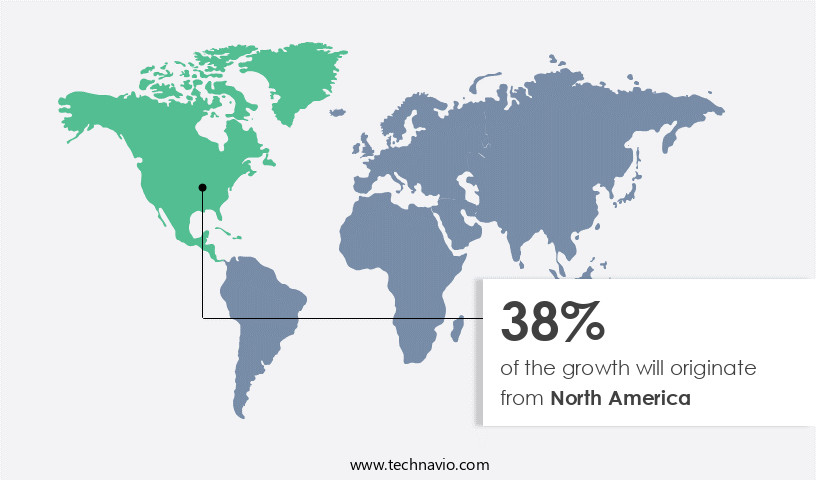
For more insights on the market size of various regions, Request Free Sample
The market is witnessing significant growth in North America, with the US being a key contributor. The region's high airport traffic, stringent security regulations, and advanced technological infrastructure drive market demand. Notable airports, such as Los Angeles International Airport (LAX), John F. Kennedy International Airport (JFK), and Chicago O'Hare, require advanced narcotics detection solutions due to their international significance. In July 2023, US authorities seized six million tramadol pills at JFK International Airport, underscoring the importance of effective narcotics detection systems in combating illicit drug smuggling. The US government, through agencies like the Transportation Security Administration (TSA) and Customs and Border Protection (CBP), mandates the deployment of advanced detection systems to maintain security protocols and adhere to ICAO standards.
These systems employ various technologies, including trace detection, X-ray imaging, data analytics, remote monitoring, handheld detectors, and spectroscopy techniques like mass spectrometry, ion mobility spectrometry, and neutron activation analysis. Technological advancements in machine learning, AI algorithms, and real-time analysis contribute to operational efficiency, false positive reduction, and threat detection. The market also benefits from the integration of automated screening, non-intrusive inspection, and cloud-based platforms for border security and passenger screening. The focus on passenger experience, ease of use, and operator training further enhances the market's growth.
Market Dynamics
Our researchers analyzed the data with 2024 as the base year, along with the key drivers, trends, and challenges. A holistic analysis of drivers will help companies refine their marketing strategies to gain a competitive advantage.
What are the key market drivers leading to the rise in the adoption of Airport Narcotics Detectors Industry?
- Rising drug trafficking threats is the key driver of the market. The market is expected to experience growth from 2025 to 2029 due to escalating drug trafficking threats. With increasing instances of drug smuggling, airport authorities are enhancing security measures to prevent the illegal transportation of narcotics. For instance, in January 2025, at Kempegowda International Airport in Bengaluru, customs officials intercepted a drug smuggling attempt, seizing approximately 23 kilograms of hydroponic marijuana and premium buds worth around USD 2.8 million.
- The contraband, cleverly concealed in separate covers, was discovered during a routine baggage inspection, resulting in the arrest of the suspects and the initiation of a criminal case. This incident underscores the importance of advanced narcotics detection technologies in maintaining airport security and combating the illicit drug trade.
What are the market trends shaping the Airport Narcotics Detectors Industry?
- Introduction of new products is the upcoming market trend. The market is experiencing growth due to technological advancements and heightened security demands. Smiths Detection, a prominent player, recently introduced the SDX 10060 XDi, an innovative X-ray Diffraction (XRD) scanner. This system, which utilizes AI and XRD technology, accurately detects illicit substances by analyzing their molecular structure.
- By minimizing manual inspections, the SDX 10060 XDi significantly improves detection rates and combats sophisticated smuggling tactics, such as those involving fast parcels. This cutting-edge technology is poised to strengthen security measures at international airports, express forwarding facilities, and customs control points.
What challenges does the Airport Narcotics Detectors Industry face during its growth?
- High cost of advanced detection systems is a key challenge affecting the industry growth. The market faces a significant challenge due to the high cost of advanced detection technologies. Innovative drug detection systems, such as mass spectrometry, ion mobility spectrometry (IMS), terahertz imaging, and AI-powered screening solutions, necessitate substantial investment. Consequently, these technologies remain inaccessible to numerous small and mid-sized airports, particularly in developing regions.
- For instance, mass spectrometry-based narcotics detectors, like Thermo Fisher Scientific's TSQ 9000 Triple Quadrupole GC-MS, can cost between USD150,000 and USD300,000 per unit. Ion mobility spectrometry (IMS) devices, such as Smiths Detection's IONSCAN 600, are priced between USD 35,000 and USD 60,000. On the other hand, Raman spectroscopy-based handheld analyzers, such as Thermo Fisher's TruNarc Handheld Narcotics Analyzer, have a more affordable price range of around USD 20,000 to USD 40,000 per unit. Despite these costs, the demand for advanced narcotics detection technologies continues to grow due to the increasing number of air travelers and the need for enhanced security measures.
Exclusive Customer Landscape
The airport narcotics detectors market forecasting report includes the adoption lifecycle of the market, covering from the innovator's stage to the laggard's stage. It focuses on adoption rates in different regions based on penetration. Furthermore, the airport narcotics detectors market report also includes key purchase criteria and drivers of price sensitivity to help companies evaluate and develop their market growth analysis strategies.
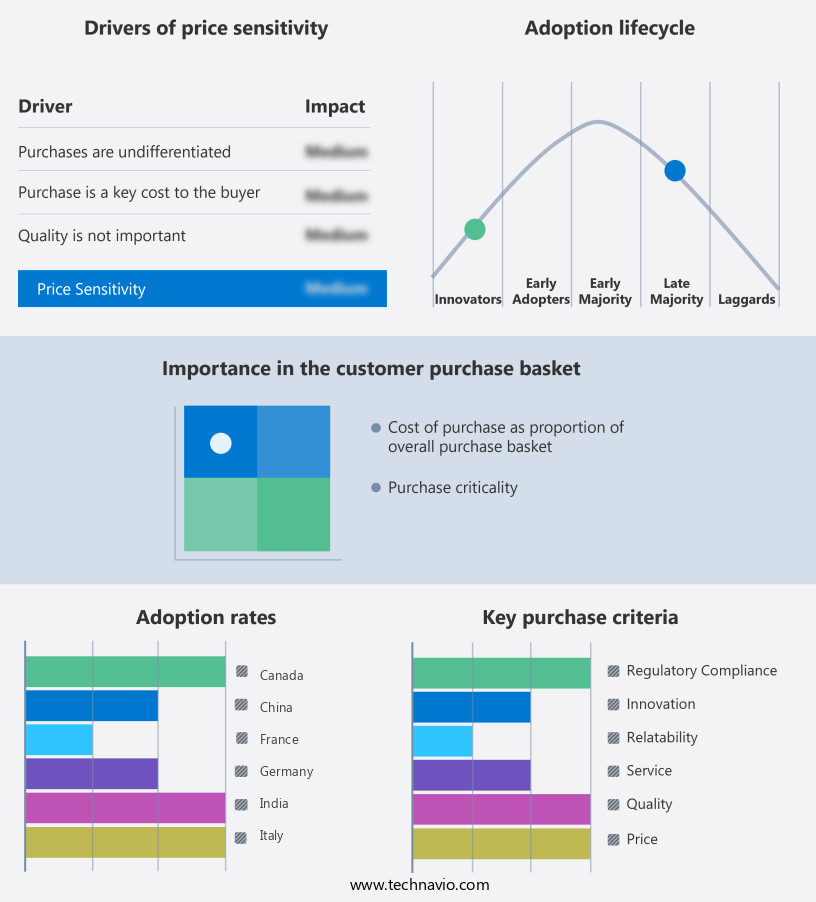
Customer Landscape
Key Companies & Market Insights
Companies are implementing various strategies, such as strategic alliances, airport narcotics detectors market forecast, partnerships, mergers and acquisitions, geographical expansion, and product/service launches, to enhance their presence in the industry.
Agilent Technologies Inc.- The company offers airport narcotics detectors such as Insight range that includes systems like Insight200M and handheld Resolve units, which rapidly screen liquids, gels, and aerosols in opaque containers with minimal false alarms, ensuring seamless security operations.
The industry research and growth report includes detailed analyses of the competitive landscape of the market and information about key companies, including:
- 1st Detect Corp.
- Astrophysics Inc.
- Bruker Corp.
- Chemring Group Plc
- DetectaChem Inc.
- EAS Envimet Analytical Systems GmbH
- Leidos Holdings Inc.
- Nuctech Co. Ltd.
- OSI Systems Inc.
- Scintrex Ltd
- Smiths Detection Group Ltd.
- Teledyne FLIR LLC
- Thermo Fisher Scientific Inc.
- unival group GmbH
- Vidisco Ltd.
- Viken Detection Corp.
Qualitative and quantitative analysis of companies has been conducted to help clients understand the wider business environment as well as the strengths and weaknesses of key industry players. Data is qualitatively analyzed to categorize companies as pure play, category-focused, industry-focused, and diversified; it is quantitatively analyzed to categorize companies as dominant, leading, strong, tentative, and weak.
Research Analyst Overview
The market encompasses a range of technologies and systems designed to identify and prevent the illicit smuggling of drugs through transportation hubs. These detection solutions play a crucial role in maintaining security and adhering to compliance standards in the aviation industry. Detection limits are a significant consideration in the development and implementation of narcotics detectors. X-ray imaging and trace detection technologies are commonly used to identify potential threats, with the ability to detect even trace amounts of illicit substances. Data analytics and remote monitoring capabilities enable real-time analysis and improve operational efficiency. Handheld detectors offer portability and ease of use, making them ideal for on-the-go screening and inspections.
Security personnel rely on these devices to quickly and accurately identify potential threats, integrating seamlessly into airport operations. Baggage screening is a primary application for narcotics detectors, with stationary and automated screening systems deployed at security checkpoints. ICAO and TSA regulations mandate the use of advanced detection technologies to ensure passenger safety and comply with international standards. Narcotics trafficking poses a significant threat to airport security, necessitating the deployment of advanced detection systems. Mass spectrometry, ion mobility spectrometry, and spectral analysis are among the technologies employed to reduce false positives and improve threat identification. Security protocols surrounding narcotics detection are continually evolving, with a focus on increasing operational efficiency and enhancing passenger experience.
Neutron activation analysis and cloud-based platforms offer new possibilities for threat detection and remote monitoring. Explosive detection is another critical application for airport security technologies, with many narcotics detectors offering dual functionality. AI algorithms and machine learning enable advanced threat identification and reduce the workload on security personnel. Non-intrusive inspection technologies, such as X-ray imaging and trace detection, offer a more passenger-friendly experience by minimizing the need for physical searches. Operator training and system integration are essential components of effective airport security strategies. The market is driven by the need to maintain security and adhere to compliance standards.
Continuous innovation and the integration of advanced technologies, such as AI and machine learning, are key trends shaping the market's growth. The market plays a vital role in maintaining security and adhering to compliance standards in the aviation industry. Technologies such as X-ray imaging, trace detection, and data analytics enable real-time threat identification and operational efficiency. The market is continually evolving, with a focus on enhancing passenger experience and reducing false positives.
|
Market Scope |
|
|
Report Coverage |
Details |
|
Page number |
207 |
|
Base year |
2024 |
|
Historic period |
2019-2023 |
|
Forecast period |
2025-2029 |
|
Growth momentum & CAGR |
Accelerate at a CAGR of 6.6% |
|
Market growth 2025-2029 |
USD 593 million |
|
Market structure |
Fragmented |
|
YoY growth 2024-2025(%) |
6.5 |
|
Key countries |
US, Germany, China, Canada, UK, India, France, Japan, UAE, and Italy |
|
Competitive landscape |
Leading Companies, Market Positioning of Companies, Competitive Strategies, and Industry Risks |
What are the Key Data Covered in this Airport Narcotics Detectors Market Research and Growth Report?
- CAGR of the Airport Narcotics Detectors industry during the forecast period
- Detailed information on factors that will drive the growth and forecasting between 2025 and 2029
- Precise estimation of the size of the market and its contribution of the industry in focus to the parent market
- Accurate predictions about upcoming growth and trends and changes in consumer behaviour
- Growth of the market across North America, Europe, APAC, Middle East and Africa, and South America
- Thorough analysis of the market's competitive landscape and detailed information about companies
- Comprehensive analysis of factors that will challenge the airport narcotics detectors market growth and forecasting
We can help! Our analysts can customize this airport narcotics detectors market research report to meet your requirements.