


Artificial Intelligence (AI) Market Size 2026-2030
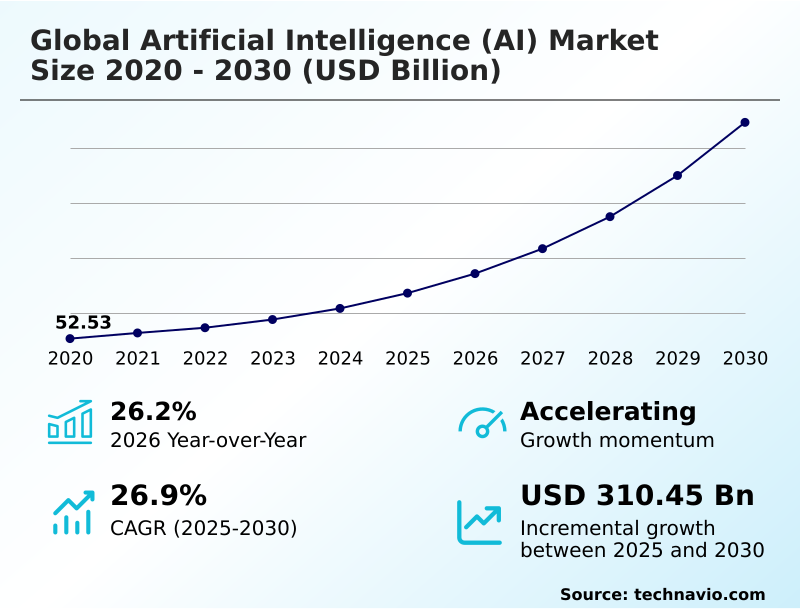
The artificial intelligence (ai) market size is valued to increase by USD 310.45 billion, at a CAGR of 26.9% from 2025 to 2030. Industrial scaling of agentic and autonomous AI will drive the artificial intelligence (ai) market.
Major Market Trends & Insights
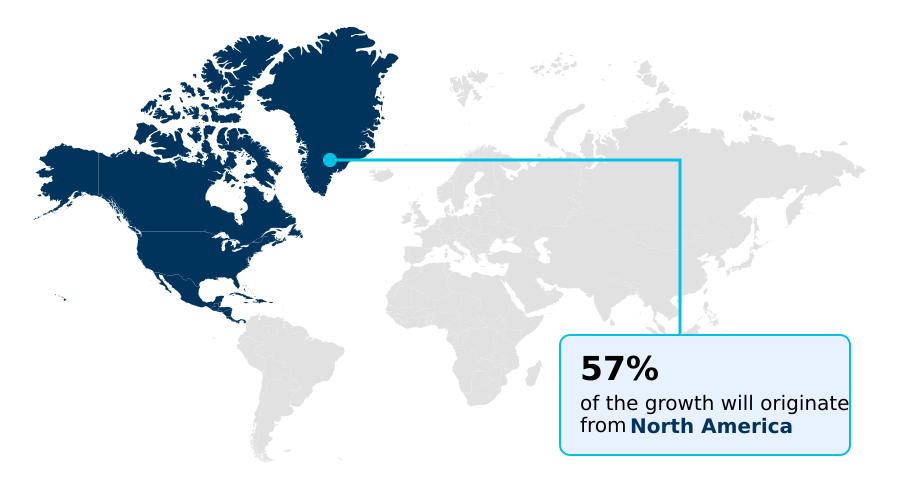
- North America dominated the market and accounted for a 56.6% growth during the forecast period.
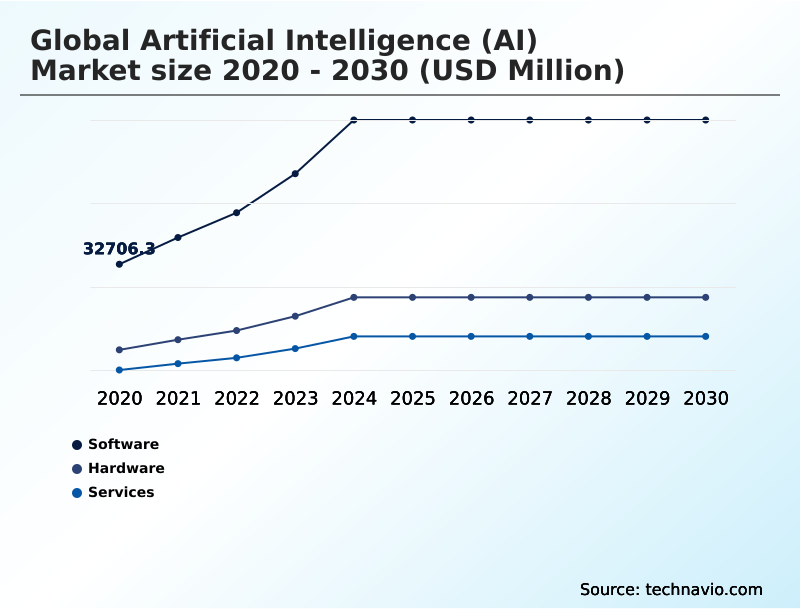
- By Component - Software segment was valued at USD 67.08 billion in 2024
- By End-user - Retail segment accounted for the largest market revenue share in 2024
Market Size & Forecast
- Market Opportunities: USD 393.15 billion
- Market Future Opportunities: USD 310.45 billion
- CAGR from 2025 to 2030 : 26.9%
Market Summary
- The artificial intelligence (AI) market is defined by a comprehensive ecosystem of hardware, software, and services simulating human cognitive functions. This technology enables systems to perform complex tasks by learning from vast datasets. The evolution from a theoretical framework to a foundational technology is driven by advancements in deep learning algorithms, machine learning, and natural language processing.
- The current landscape is shaped by the development of generative AI and reasoning models, allowing systems to act with increasing independence. In supply chain management, for instance, agentic AI systems are deployed to automate intricate workflows. These systems leverage predictive maintenance and computer vision to monitor assets and optimize logistics, using AI-powered advisory services for real-time decision-making.
- This reduces human intervention and enhances operational resilience by utilizing AI-driven analytics and operational intelligence platforms. The integration of AI-powered copilots and explainable AI is becoming standard, ensuring transparency and trust. This shift toward cognitive automation using large language models and on-device intelligence is a critical driver of digital transformation for enterprises worldwide, supported by AI-led enterprise operating models.
What will be the Size of the Artificial Intelligence (AI) Market during the forecast period?
Get Key Insights on Market Forecast (PDF) Get Free Sample
How is the Artificial Intelligence (AI) Market Segmented?
The artificial intelligence (ai) industry research report provides comprehensive data (region-wise segment analysis), with forecasts and estimates in "USD million" for the period 2026-2030, as well as historical data from 2020-2024 for the following segments.
- Component
- Software
- Hardware
- Services
- End-user
- Retail
- Banking
- Manufacturing
- Healthcare
- Others
- Technology
- Deep learning
- Machine learning
- NLP
- Gen AI
- Geography
- North America
- US
- Canada
- Mexico
- Europe
- UK
- Germany
- France
- APAC
- China
- India
- Japan
- South America
- Brazil
- Argentina
- Middle East and Africa
- Saudi Arabia
- UAE
- South Africa
- Rest of World (ROW)
- North America
By Component Insights
The software segment is estimated to witness significant growth during the forecast period.
The global artificial intelligence (AI) market segmentation is increasingly defined by the software layer, which serves as the core for cognitive automation and enterprise applications. This segment includes foundational models, development platforms, and end-user tools driving agentic commerce.
A key trend is the shift toward agentic AI systems capable of orchestrating multi-step workflows without human supervision, leveraging large language models for complex reasoning. Modern architectures prioritize retrieval augmented generation to ensure high-fidelity outputs.
In this dynamic landscape, a focus on explainable AI is crucial, as some implementations have demonstrated a 15% improvement in error detection, underscoring the demand for both on-device intelligence and robust, auditable systems that utilize AI-powered advisory services and AI-driven analytics.
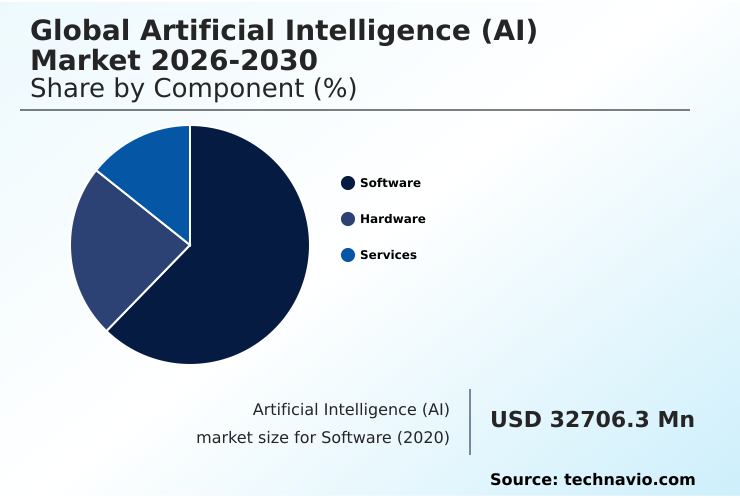
The Software segment was valued at USD 67.08 billion in 2024 and showed a gradual increase during the forecast period.
Regional Analysis
North America is estimated to contribute 56.6% to the growth of the global market during the forecast period.Technavio’s analysts have elaborately explained the regional trends and drivers that shape the market during the forecast period.
See How Artificial Intelligence (AI) Market Demand is Rising in North America Get Free Sample
The geographic landscape of the global artificial intelligence (AI) market is characterized by distinct regional specializations and investment priorities.
North America leads in foundational models and inference optimized semiconductors, with firms in the region securing over 60% of global venture capital for agentic AI systems.
Europe focuses on industrial applications and regulatory leadership, pioneering frameworks for explainable AI and data sovereignty.
Meanwhile, the APAC region is the fastest-growing market, driven by national initiatives in countries like India, which successfully onboarded over 38,000 GPUs to its domestic portal to foster a sovereign AI infrastructure.
This region excels in hardware manufacturing and the mass adoption of on-device AI.
The Middle East is emerging as a capital-intensive hub, investing heavily in AI-optimized data centers to support its economic diversification goals, with crafted AI being a key part of this strategy.
Market Dynamics
Our researchers analyzed the data with 2025 as the base year, along with the key drivers, trends, and challenges. A holistic analysis of drivers will help companies refine their marketing strategies to gain a competitive advantage.
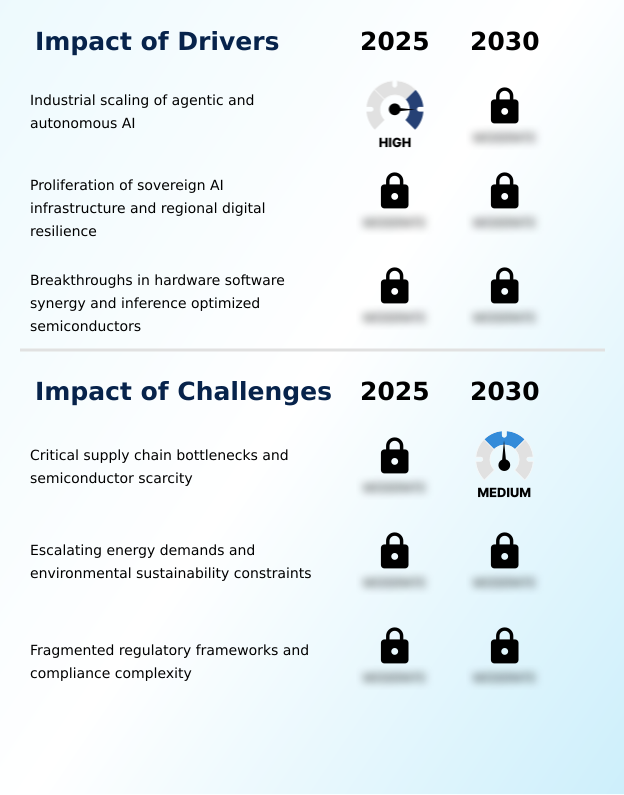
- The global artificial intelligence (AI) market is driven by the industrial scaling of agentic and autonomous AI, a trend moving beyond theoretical applications to tangible enterprise solutions. The proliferation of sovereign AI infrastructure is a parallel force, as nations seek digital resilience and control over their data ecosystems.
- This is complemented by breakthroughs in hardware software synergy, particularly in the development of specialized chips. A key area of innovation is the convergence of multimodal intelligence and edge based inference, which enables more powerful on-device processing. However, the market faces significant headwinds, including critical supply chain bottlenecks and semiconductor scarcity, which can stall production.
- Furthermore, there are escalating energy demands and sustainability constraints associated with large-scale data centers. Navigating fragmented regulatory frameworks and compliance complexity adds another layer of challenge. Strategic focus is now on agentic AI for autonomous task orchestration to improve efficiency. This is closely tied to the goal of sovereign AI for regional digital resilience.
- The technical foundation for these advancements is hardware software co-design for inference optimization and multimodal AI for edge-based processing. Addressing challenges requires tackling semiconductor scarcity impacting AI chip production and mitigating energy consumption constraints on AI data centers. For businesses, successful deployment requires careful regulatory compliance for high-risk AI systems and understanding AI's role in industrial automation.
- The impact of generative AI on creative industries is profound, while AI applications in predictive healthcare diagnostics are saving lives. Many are leveraging AI for supply chain optimization, where some firms have reported efficiency gains more than double that of traditional software.
- Finally, boardrooms are grappling with ethical considerations in autonomous AI deployment and the opportunities presented by AI-driven personalization in retail banking.
What are the key market drivers leading to the rise in the adoption of Artificial Intelligence (AI) Industry?
- The industrial scaling of agentic and autonomous AI represents a key driver for market growth.
- The industrial scaling of agentic AI systems and autonomous task orchestration is a primary market driver, enabling a new level of cognitive automation.
- Enterprises are leveraging these systems to manage end-to-end business processes, achieving up to a 35% increase in organizational throughput.
- A second critical driver is the global emphasis on sovereign AI infrastructure, which ensures data sovereignty and has spurred a 20% year-over-year increase in regional data center investments.
- This is supported by breakthroughs in hardware software synergy, particularly with inference optimized semiconductors.
- These advancements facilitate the inference economy and are essential for making AI economically viable at scale, reducing the computational cost per token by nearly half in some next-generation chips.
- This ecosystem supports AI-integrated operating models and the growth of AI-native enterprise resource planning and AI literacy.
What are the market trends shaping the Artificial Intelligence (AI) Industry?
- The market is undergoing a paradigm shift toward agentic AI, which is increasingly characterized by the adoption of autonomous task orchestration.
- A defining trend in the artificial intelligence (AI) market is the shift toward agentic AI systems capable of autonomous task orchestration. These systems are delivering significant business value, with early adopters reporting a 40% reduction in manual processing for complex financial workflows.
- The convergence of multimodal AI capabilities with edge based inference is another key development, enabling real-time, on-device intelligence without cloud latency. This has improved response times by over 50% in industrial robotics. The rise of sovereign AI and data sovereignty is compelling organizations to localize infrastructure, fostering regional digital resilience.
- This focus on AI-powered search engines and multi agent orchestration is creating a more decentralized and secure global ecosystem, where AI-led enterprise operating models are becoming the norm.
What challenges does the Artificial Intelligence (AI) Industry face during its growth?
- Critical supply chain bottlenecks and semiconductor scarcity present a key challenge affecting industry growth.
- The artificial intelligence (AI) market expansion is constrained by critical supply chain bottlenecks and semiconductor scarcity, with analysts reporting that production plans for AI chips were revised downward by as much as 25% due to packaging constraints. This scarcity of hardware software co-design components and the high cost of high bandwidth memory (HBM) create a stratified market.
- Another challenge is the escalating energy demand from high performance computing clusters, with consumption projected to nearly double by 2030, threatening sustainability goals.
- Furthermore, navigating fragmented regulatory frameworks and compliance complexity is a significant hurdle, increasing compliance-related expenditures for firms by over 15% as they adapt to new mandates for explainable AI and manage the risks of human in the loop oversight. This environment complicates the deployment of AI for good initiatives and AI continent action plan.
Exclusive Technavio Analysis on Customer Landscape
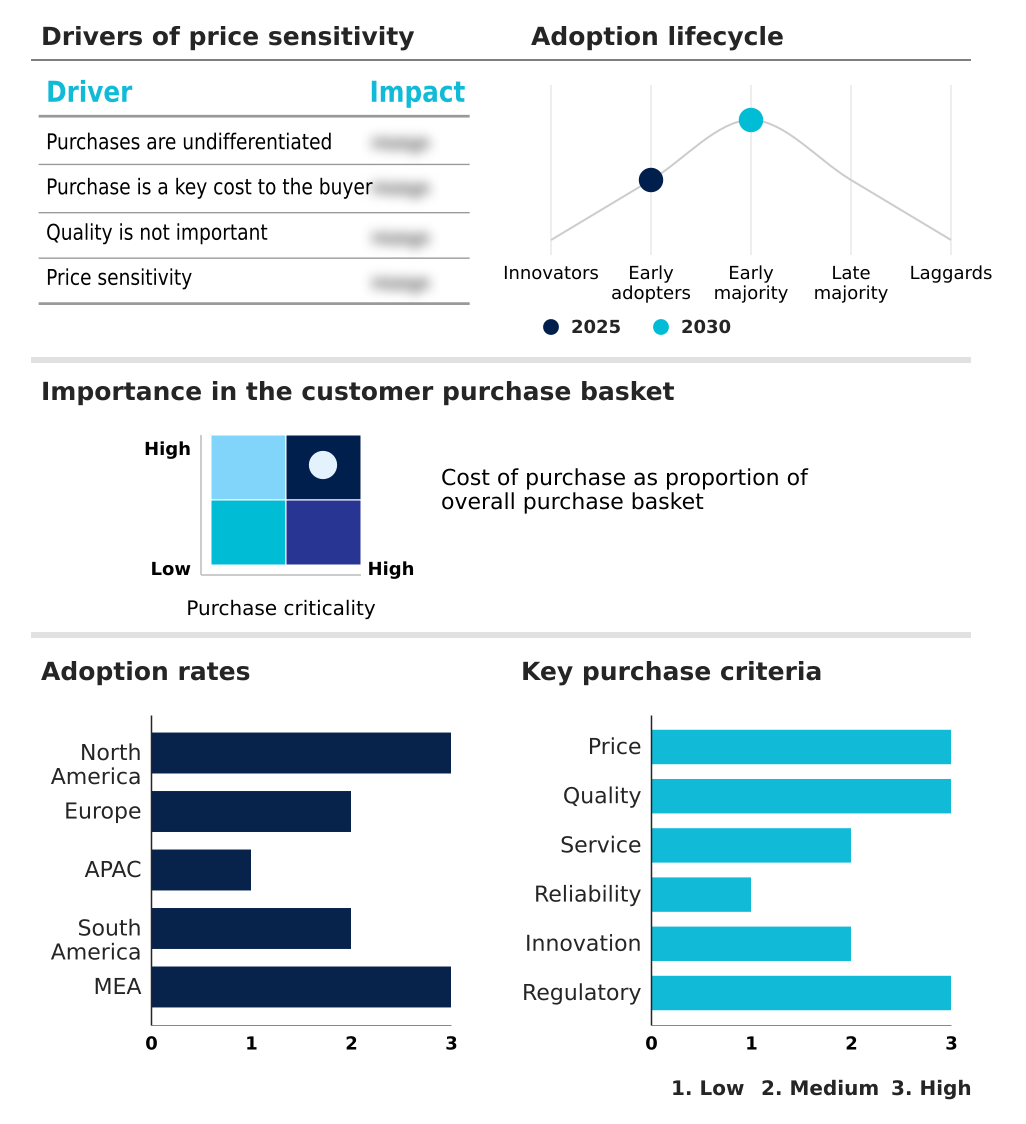
The artificial intelligence (ai) market forecasting report includes the adoption lifecycle of the market, covering from the innovator’s stage to the laggard’s stage. It focuses on adoption rates in different regions based on penetration. Furthermore, the artificial intelligence (ai) market report also includes key purchase criteria and drivers of price sensitivity to help companies evaluate and develop their market growth analysis strategies.
Customer Landscape of Artificial Intelligence (AI) Industry
Competitive Landscape
Companies are implementing various strategies, such as strategic alliances, artificial intelligence (ai) market forecast, partnerships, mergers and acquisitions, geographical expansion, and product/service launches, to enhance their presence in the industry.
Advanced Micro Devices Inc. - Analysis indicates a vendor landscape providing AI accelerators, high-performance computing chips, and enterprise-grade platforms for developing and deploying AI applications.
The industry research and growth report includes detailed analyses of the competitive landscape of the market and information about key companies, including:
- Advanced Micro Devices Inc.
- Amazon Web Services Inc.
- Anthropic PBC
- C3.ai Inc.
- Cerebras Systems Inc.
- Cohere
- Databricks Inc.
- Google LLC
- Groq Inc.
- Hugging Face Inc.
- Intel Corp.
- Meta Platforms Inc.
- Microsoft Corp.
- Midjourney Inc.
- Mistral AI
- NVIDIA Corp.
- OpenAI
- Palantir Technologies Inc.
- Perplexity AI Inc.
- xAI Corp.
Qualitative and quantitative analysis of companies has been conducted to help clients understand the wider business environment as well as the strengths and weaknesses of key industry players. Data is qualitatively analyzed to categorize companies as pure play, category-focused, industry-focused, and diversified; it is quantitatively analyzed to categorize companies as dominant, leading, strong, tentative, and weak.
Recent Development and News in Artificial intelligence (ai) market
- In October 2024, NVIDIA commenced shipping the DGX Spark, the world's first compact desktop AI supercomputer powered by the Blackwell architecture, delivering one petaFLOP of AI computing performance.
- In March 2025, the Nemotron Coalition was launched, uniting leading AI laboratories and hardware manufacturers to develop open frontier models optimized for next-generation cloud architectures.
- In May 2025, OpenAI announced plans to assist in the construction of a large-scale data center in the UAE, intended to become one of the largest global facilities for AI-optimized compute.
- In May 2025, Anthropic announced a partnership with SpaceX to utilize the massive compute capacity of the Colossus 1 data center, incorporating over two hundred thousand hardware accelerators.
Dive into Technavio’s robust research methodology, blending expert interviews, extensive data synthesis, and validated models for unparalleled Artificial Intelligence (AI) Market insights. See full methodology.
| Market Scope | |
|---|---|
| Page number | 307 |
| Base year | 2025 |
| Historic period | 2020-2024 |
| Forecast period | 2026-2030 |
| Growth momentum & CAGR | Accelerate at a CAGR of 26.9% |
| Market growth 2026-2030 | USD 310451.2 million |
| Market structure | Fragmented |
| YoY growth 2025-2026(%) | 26.2% |
| Key countries | US, Canada, Mexico, UK, Germany, France, Italy, Spain, The Netherlands, China, India, Japan, South Korea, Australia, Singapore, Brazil, Chile, Argentina, Saudi Arabia, UAE, Egypt, South Africa and Qatar |
| Competitive landscape | Leading Companies, Market Positioning of Companies, Competitive Strategies, and Industry Risks |
Research Analyst Overview
- The artificial intelligence (AI) market has matured beyond experimental phases, now focusing on enterprise-grade agentic AI systems and cognitive automation. This evolution is underpinned by breakthroughs in hardware software synergy, including inference optimized semiconductors and high bandwidth memory (HBM).
- The push for sovereign AI infrastructure drives investment in localized capabilities, while multimodal AI capabilities are being enabled by specialized neural processing units. The development of foundational models relies on retrieval augmented generation and reinforcement learning from human feedback (RLHF), with large language models at their core.
- In sectors like manufacturing, computer vision and predictive maintenance powered by deep learning algorithms are standard, often visualized through digital twins. In a key boardroom decision area, companies implementing explainable AI frameworks have seen a 30% reduction in compliance-related incidents. The ecosystem also includes world models and neuro symbolic techniques for advanced reasoning.
- The industry is also seeing a rise in AI-powered copilots and agentic commerce through generative business process automation. This is supported by technologies like Chip on Wafer on Substrate (CoWoS) for advanced hardware. The goal of achieving on-device intelligence and on-device AI is driving innovation.
- Applications like algorithmic retail, nature identical molecules for research, smart farming initiatives, AI-powered advisory services, adaptive learning platforms, RegTech, sports tech AI, ecological AI, and agri-AI demonstrate the market's breadth. The development of reasoning models continues to be a central focus.
What are the Key Data Covered in this Artificial Intelligence (AI) Market Research and Growth Report?
-
What is the expected growth of the Artificial Intelligence (AI) Market between 2026 and 2030?
-
USD 310.45 billion, at a CAGR of 26.9%
-
-
What segmentation does the market report cover?
-
The report is segmented by Component (Software, Hardware, and Services), End-user (Retail, Banking, Manufacturing, Healthcare, and Others), Technology (Deep learning, Machine learning, NLP, and Gen AI) and Geography (North America, Europe, APAC, South America, Middle East and Africa)
-
-
Which regions are analyzed in the report?
-
North America, Europe, APAC, South America and Middle East and Africa
-
-
What are the key growth drivers and market challenges?
-
Industrial scaling of agentic and autonomous AI, Critical supply chain bottlenecks and semiconductor scarcity
-
-
Who are the major players in the Artificial Intelligence (AI) Market?
-
Advanced Micro Devices Inc., Amazon Web Services Inc., Anthropic PBC, C3.ai Inc., Cerebras Systems Inc., Cohere, Databricks Inc., Google LLC, Groq Inc., Hugging Face Inc., Intel Corp., Meta Platforms Inc., Microsoft Corp., Midjourney Inc., Mistral AI, NVIDIA Corp., OpenAI, Palantir Technologies Inc., Perplexity AI Inc. and xAI Corp.
-
Market Research Insights
- The artificial intelligence (AI) market's dynamics are influenced by a strategic pivot toward autonomous task orchestration, which has been shown to reduce process cycle times by up to 30% in financial services. The emphasis on regional digital resilience and data sovereignty is reshaping infrastructure investment, with over 60% of new enterprise deployments now requiring localized data processing.
- This trend fuels the inference economy, where edge based inference is critical for real-time applications. The adoption of an AI-led enterprise operating model has led to a 25% improvement in operational efficiency for early adopters. The market is also seeing a rise in AI-powered financial services, moving beyond simple automation to sophisticated risk modeling and AI-driven autonomous systems.
We can help! Our analysts can customize this artificial intelligence (ai) market research report to meet your requirements.
 RIA -
RIA -