



Artificial Intelligence In Security Market Size 2024-2028
The artificial intelligence in security market size is forecast to increase by USD 25.47 billion at a CAGR of 34.73% between 2023 and 2028.
- Artificial Intelligence (AI) is revolutionizing the security industry with its ability to analyze vast amounts of data and identify patterns that humans may miss. The market for AI in security is experiencing significant growth due to several key trends. Machine learning algorithms enable proactive threat detection and response, while natural language processing and context-aware computing enhance threat intelligence. First, there is a rapid increase In the use of mobile and other connected devices, leading to an exponential growth in data. This data requires advanced security measures to protect against cyber threats. Second, there is an increasing demand for cloud-based applications, which require strong security solutions to ensure data privacy and protection. However, the development of AI technologies also presents challenges. Technical difficulties, such as data privacy concerns and the need for large amounts of data to train AI models, can hinder market growth. Despite these challenges, the potential benefits of AI in security are significant, making it a promising area for innovation and investment.
What will be the Size of the Artificial Intelligence In Security Market During the Forecast Period?
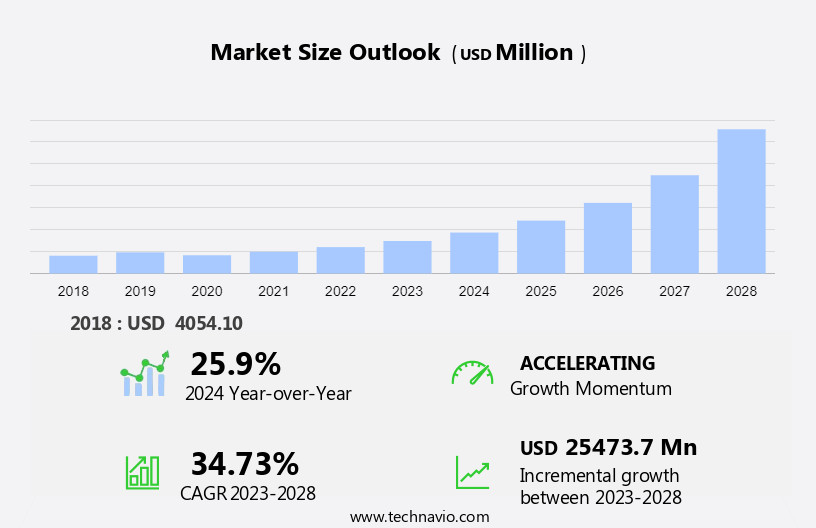
- The artificial intelligence (AI) in security market is experiencing significant growth due to the increasing prevalence of cyber threats and the need for advanced security solutions. This market encompasses various sectors, including network security, application security, and cloud security. AI and machine learning (ML) technologies are increasingly being adopted for professional, managed, on-premises, and cloud-based security solutions. Government and defense sectors, as well as businesses, are investing in AI-driven security solutions to mitigate cyber dangers from cybercriminals, political rivalry, monetary gain, reputational harm, radical religious organizations, and other malicious actors. The market is witnessing a shift towards cloud-based products and services, as organizations seek to leverage AI for smart data utilization and automation trends in security solutions.
- Digital transformation initiatives are also driving the adoption of AI in security, as businesses seek to modernize their security posture and stay ahead of evolving threats. Overall, the AI in security market is expected to continue growing, as organizations prioritize the protection of their networks, applications, and data from a diverse range of cyber threats.
How is this Artificial Intelligence In Security Industry segmented and which is the largest segment?
The artificial intelligence in security industry research report provides comprehensive data (region-wise segment analysis), with forecasts and estimates in "USD billion" for the period 2024-2028, as well as historical data from 2018-2022 for the following segments.
- Deployment
- On-premise
- Cloud
- Geography
- North America
- US
- Europe
- Germany
- UK
- APAC
- China
- Japan
- Middle East and Africa
- South America
- North America
By Deployment Insights
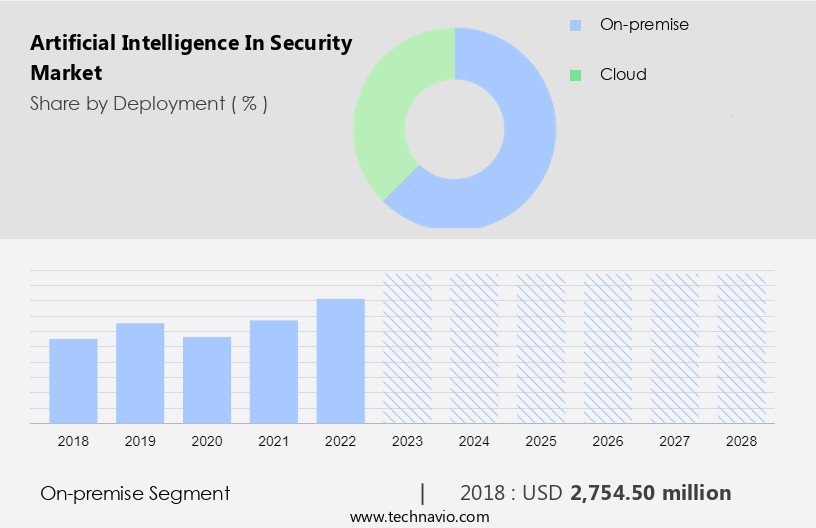
- The on-premise segment is estimated to witness significant growth during the forecast period.
Artificial Intelligence (AI) is revolutionizing the security market, particularly in areas such as Network Security, Application Security, Cloud Security, and Threat Detection. AI-powered systems are increasingly being used to mitigate malicious activities, including cyberattacks, breaches, and vulnerabilities. AI is also transforming industries like Healthcare, Manufacturing, and the Automotive and Transportation sectors, securing electronic health records, medical imaging data, wearable device data, and cloud-based services. AI solutions provide advanced analytics, neural networks, and continuous monitoring to strengthen cybersecurity posture and protect against cyber dangers.
Get a glance at the market report of share of various segments Request Free Sample
The on-premise segment was valued at USD 2.75 billion in 2018 and showed a gradual increase during the forecast period.
Regional Analysis
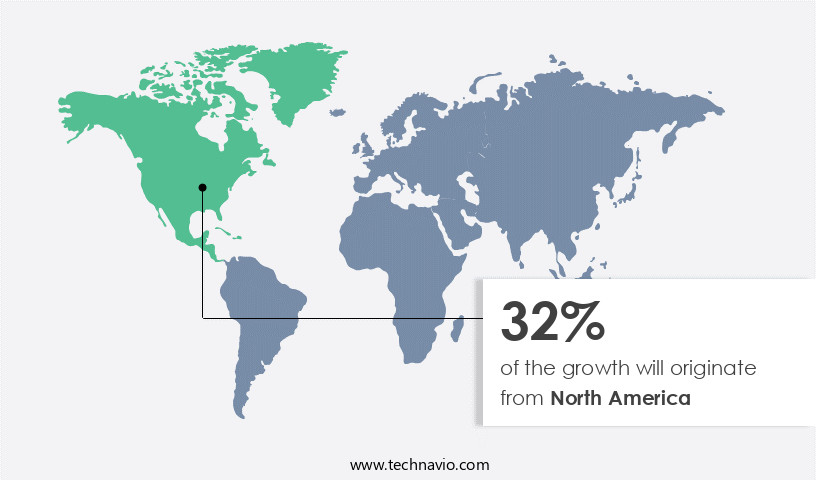
- North America is estimated to contribute 32% to the growth of the global market during the forecast period.
Technavio's analysts have elaborately explained the regional trends and drivers that shape the market during the forecast period.
For more insights on the market size of various regions, Request Free Sample
The AI in security market in North America is experiencing significant growth due to the increasing number of cyberattacks and the subsequent demand for advanced security solutions. Key industries, including retail, BFSI, manufacturing, and healthcare, are major contributors to this market in North America, particularly In the US, Canada, and Mexico. The rise of technological advances and the Internet of Things (IoT) has resulted in an influx of security-related data. AI-powered systems are increasingly being adopted to analyze this data, detect threats, and enhance cybersecurity posture. Threats, such as malicious activities, breaches, and vulnerabilities, pose significant risks to connected enterprises.
Market Dynamics
Our researchers analyzed the data with 2023 as the base year, along with the key drivers, trends, and challenges. A holistic analysis of drivers will help companies refine their marketing strategies to gain a competitive advantage.
What are the key market drivers leading to the rise In the adoption of Artificial Intelligence In Security Industry?
Rapid increase in the use of mobile and other connected devices is the key driver of the market.
- Artificial intelligence (AI) is revolutionizing the security landscape, particularly in areas such as Network Security, Application Security, and Cloud Security. With the proliferation of connected enterprises and the increasing volume of online transactions in sectors like Banking, Healthcare, Manufacturing, Automotive and Transportation, and Government and Defense, the risk of cyberattacks, data breaches, and malicious activities is heightened. AI-powered systems are essential for proactive threat mitigation, as they can analyze vast amounts of data in real-time, enabling quicker response times and more accurate detection of vulnerabilities. AI technologies like machine learning and natural language processing are crucial for threat detection capabilities.
- In the Healthcare sector, AI is used to secure electronic health records, medical imaging data, and wearable device data. Cloud-based services and threat intelligence are also crucial components of AI in Security. AI is vital for detecting and responding to cyber dangers, including phishing websites, malicious browser ads, crypto mining, and ransomware-related activity. Government backing and the development of cloud-based products are driving the adoption of AI in Security. AI solutions offer advanced security capabilities, such as cognitive computing, automation, and intelligent security systems. Collaborative threat intelligence and automated incident response are also essential components of AI in Security.
What are the market trends shaping the Artificial Intelligence In Security Industry?
Increasing demand for cloud-based applications is the upcoming market trend.
- Artificial Intelligence (AI) in Security is a critical area of focus for businesses and organizations seeking to enhance their cybersecurity posture. Cloud-based services are increasingly being adopted for network, application, and cloud security. AI-powered systems are essential for threat detection, mitigating malicious activities, and preventing breaches in connected enterprises. Industries such as Government and Defense, Manufacturing, Healthcare, Automotive and Transportation, and the Banking sector are prime targets for cybercriminals due to the sensitive data they handle. AI-driven threat intelligence and machine learning capabilities enable proactive threat mitigation, identifying vulnerabilities, and responding to cyber dangers in real-time. Healthcare security is particularly important, with AI-enabled systems safeguarding electronic health records, medical imaging data, and wearable device data from breaches.
- Cloud-based services are vital for healthcare organizations, offering scalability and flexibility while maintaining data security. SMEs, with limited security infrastructure, are increasingly turning to cloud-based solutions for threat detection and response. The financial services industry, for instance, relies on AI for online transaction security, NEFT, and mobile commerce protection. Cloud adoption is a significant part of digital transformation initiatives, necessitating advanced security solutions. AI, machine learning, natural language processing, context-aware computing, and IoT are essential technologies in this regard. AI, ML, and cloud solutions are automating security processes, improving response time, and reducing manual errors. Collaborative threat intelligence, automated incident response, and compliance management are essential components of intelligent security systems.
What challenges does the Artificial Intelligence In Security Industry face during its growth?
Technical difficulties in developing AI technologies is a key challenge affecting the industry growth.
- Artificial Intelligence (AI) is revolutionizing the security landscape by enhancing threat detection capabilities against cyberattacks. AI in Security encompasses Network Security, Application Security, and Cloud Security. Machine learning algorithms power AI-driven systems, enabling proactive threat mitigation against malicious activities, breaches, and vulnerabilities. Connected enterprises face various cyber dangers, including phishing websites, malicious browser ads, crypto mining, and ransomware-related activities. AI-powered systems analyze vast amounts of data from various sources, including healthcare security with electronic health records, medical imaging data, wearable device data, and cloud-based services. Threat intelligence and online transactions in sectors like banking and finance are also under constant scrutiny.
- AI and Machine Learning (ML) enable context-aware computing, IoT, and endpoint security. They improve security solutions' response time and minimize manual errors, ensuring advanced analytics and intelligent security systems. Collaborative threat intelligence and automated incident response are essential components of AI-driven cybersecurity. Government backing and the adoption of cloud-based products have led to the integration of AI in security for government organizations and large-scale enterprises. AI in Security addresses insider and outsider attacks, data protection solutions, and IT security risk management. Behavioural biometrics, secure user authentication, and encryption are some of the advanced security solutions that leverage AI.
Exclusive Customer Landscape
The artificial intelligence in security market forecasting report includes the adoption lifecycle of the market, covering from the innovator's stage to the laggard's stage. It focuses on adoption rates in different regions based on penetration. Furthermore, the artificial intelligence in security market report also includes key purchase criteria and drivers of price sensitivity to help companies evaluate and develop their market growth analysis strategies.

Customer Landscape
Key Companies & Market Insights
Companies are implementing various strategies, such as strategic alliances, artificial intelligence in security market forecast, partnerships, mergers and acquisitions, geographical expansion, and product/service launches, to enhance their presence in the industry.
The industry research and growth report includes detailed analyses of the competitive landscape of the market and information about key companies, including:
- Acalvio Technologies Inc.
- Advanced Micro Devices Inc.
- BlackBerry Ltd.
- Broadcom Inc.
- Cisco Systems Inc.
- Darktrace Holdings Ltd.
- Hewlett Packard Enterprise Co.
- Intel Corp.
- International Business Machines Corp.
- Micron Technology Inc.
- NVIDIA Corp.
- Oracle Corp.
- Palo Alto Networks Inc.
- RELX Plc
- Samsung Electronics Co. Ltd.
- SAP SE
- SAS Institute Inc.
- Securonix Inc.
- SparkCognition Inc.
- Thomson Reuters Corp.
Qualitative and quantitative analysis of companies has been conducted to help clients understand the wider business environment as well as the strengths and weaknesses of key industry players. Data is qualitatively analyzed to categorize companies as pure play, category-focused, industry-focused, and diversified; it is quantitatively analyzed to categorize companies as dominant, leading, strong, tentative, and weak.
Research Analyst Overview
Artificial Intelligence (AI) is revolutionizing the security market by enhancing threat detection and response capabilities for various sectors. Network security, application security, and cloud security are among the areas experiencing significant advancements due to AI's ability to analyze vast amounts of data and identify patterns indicative of malicious activities. AI-powered systems are increasingly being adopted by both professional and managed security services to strengthen cybersecurity postures. These systems employ machine learning algorithms to analyze data from networks, applications, and cloud services in real-time. They can detect anomalies and vulnerabilities that might go unnoticed by traditional security tools, enabling proactive threat mitigation.
In addition, the integration of AI in security solutions is crucial for connected enterprises in industries such as government and defense, manufacturing, healthcare, automotive and transportation, and others. AI's threat detection capabilities are essential in mitigating cyber dangers, including data breaches, phishing attempts, ransomware related activities, and insider attacks. The healthcare sector, in particular, benefits significantly from AI's capabilities in securing electronic health records, medical imaging data, and wearable device data. AI can analyze these data types to identify anomalous behavior and potential threats, ensuring the protection of sensitive patient information. Cloud-based services are increasingly becoming the target of cybercriminals, necessitating strong cybersecurity measures.
Furthermore, AI's role in cloud security is vital in threat intelligence, online transactions, and NEFT/mobile commerce In the banking sector. AI-powered systems can analyze patterns in large datasets to identify potential threats, enabling quick response times and minimizing manual errors. Advanced security solutions employing AI and machine learning are becoming the norm as digital transformation initiatives continue to disrupt traditional business models. These solutions offer intelligent security systems that can learn from threats and adapt to new vulnerabilities. They also enable collaborative threat intelligence, automated incident response, and compliance management, ensuring customer data protection and continuous monitoring. The adoption of AI in security is a response to the increasing sophistication of cyber threats.
In addition, cybercriminals employ various tactics, including political rivalry, monetary gain, reputational harm, and radical religious organizations, to exploit vulnerabilities. AI's ability to analyze data and learn from threats makes it an essential component of any organization's cybersecurity strategy. Its ability to analyze vast amounts of data and identify patterns indicative of malicious activities makes it an essential component of any organization's cybersecurity strategy. The integration of AI in security solutions is a response to the increasing sophistication of cyber threats and the need for proactive threat mitigation.
|
Market Scope |
|
|
Report Coverage |
Details |
|
Page number |
144 |
|
Base year |
2023 |
|
Historic period |
2018-2022 |
|
Forecast period |
2024-2028 |
|
Growth momentum & CAGR |
Accelerate at a CAGR of 34.73% |
|
Market growth 2024-2028 |
USD 25.47 billion |
|
Market structure |
Fragmented |
|
YoY growth 2023-2024(%) |
25.9 |
|
Key countries |
US, China, UK, Germany, and Japan |
|
Competitive landscape |
Leading Companies, market growth and forecasting, Market Positioning of Companies, Competitive Strategies, and Industry Risks |
What are the Key Data Covered in this Artificial Intelligence In Security Market Research and Growth Report?
- CAGR of the Artificial Intelligence In Security industry during the forecast period
- Detailed information on factors that will drive the growth and forecasting between 2024 and 2028
- Precise estimation of the size of the market and its contribution of the industry in focus to the parent market
- Accurate predictions about upcoming growth and trends and changes in consumer behaviour
- Growth of the market across North America, Europe, APAC, Middle East and Africa, and South America
- Thorough analysis of the market's competitive landscape and detailed information about companies
- Comprehensive analysis of factors that will challenge the artificial intelligence in security market growth of industry companies
We can help! Our analysts can customize this artificial intelligence in security market research report to meet your requirements.