

US Automated Material Handling Equipment Market Size 2024-2028
The US automated material handling equipment market size is forecast to increase by USD 1.12 billion, at a CAGR of 3% between 2023 and 2028.
- The Automated Material Handling Equipment (AMHE) market in the US is experiencing significant growth, driven by the increasing adoption of advanced automation in processing plants. This trend is a response to the industry's shift towards Industry 4.0, which emphasizes smart manufacturing and interconnected systems. The benefits of AMHE, such as increased efficiency, productivity, and accuracy, are compelling, making it an attractive investment for businesses. However, the market also faces challenges. The complexity of using automated material handling equipment poses a significant obstacle. Integrating these systems into existing infrastructure and ensuring seamless communication between different components can be a daunting task.
- Furthermore, the high initial investment costs and ongoing maintenance requirements can be a barrier to entry for smaller businesses. To navigate these challenges, companies must invest in comprehensive training programs for their workforce and establish robust maintenance schedules. By doing so, they can effectively leverage the potential of AMHE to streamline operations and gain a competitive edge.
What will be the size of the US Automated Material Handling Equipment Market during the forecast period?
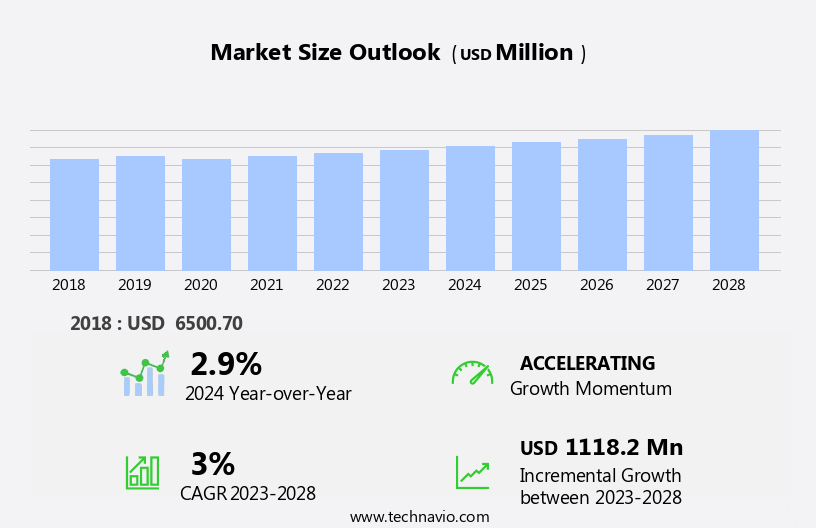
Explore in-depth regional segment analysis with market size data - historical 2018-2022 and forecasts 2024-2028 - in the full report.
Request Free Sample
- The automated material handling equipment (AMHE) market in the US is experiencing significant advancements, driven by the integration of technology to enhance efficiency and productivity. Obstacle avoidance technology in sorting machines ensures seamless material flow, reducing errors and increasing throughput. Wireless control systems enable real-time monitoring and adjustment of case conveyors, pallet conveyors, and shuttle systems. Continuous improvement initiatives, such as six sigma, optimize processes and reduce power consumption. Motion control systems and emergency stops prioritize safety, while charging infrastructure and battery management systems support the integration of lift trucks and collaborative robots (cobots) into JIT operations.
- Precision positioning technology improves the accuracy of picking stations, while energy recovery systems minimize waste. Human-machine interfaces (HMI) streamline operations, enabling operators to effectively manage complex systems. Safety interlocks and lift trucks collaborate to prevent accidents, while pallet stackers optimize storage capacity. The AMHE market is continuously evolving, with a focus on lean manufacturing and reducing overall operational costs.
How is this market segmented?
The market research report provides comprehensive data (region-wise segment analysis), with forecasts and estimates in "USD million" for the period 2024-2028, as well as historical data from 2018-2022 for the following segments.
- Product
- Conveyor system
- AS/RS
- Robotics system
- AGV
- End-user
- Automotive
- E-commerce and 3PL
- Food and beverage
- Others
- Geography
- North America
- US
- North America
By Product Insights
The conveyor system segment is estimated to witness significant growth during the forecast period.
Conveyor systems are integral to the efficient movement of materials within supply chain operations. Harnessing hydraulic, mechanical, and automated technologies, these systems seamlessly connect various stages of the process. In retail environments, conveyor systems facilitate e-commerce fulfillment by transferring products from storage to packing areas and loading docks. Third-party logistics (3PL) providers utilize conveyor systems for sorting and distributing goods, ensuring swift order fulfillment. In manufacturing operations, conveyor systems streamline material flow optimization by transporting raw materials to production lines and finished products to inventory. Warehouse automation integrates conveyor systems with safety regulations, real-time tracking, and machine learning to enhance productivity and energy efficiency.
Lift heights and payload capacities are customizable, accommodating diverse material handling needs. Data analytics and control systems enable continuous improvement by monitoring operating speeds, identifying potential issues, and optimizing performance. Cloud computing and wireless communication technologies facilitate seamless integration with e-commerce platforms and inventory management systems. Safety systems and barcode scanning ensure accurate and secure material handling, while material handling systems and rfid technology streamline sorting and distribution processes. Project management and supply chain management tools facilitate efficient coordination and maintenance and repair services maintain optimal system functionality. Industry standards and computer vision technologies further enhance the capabilities of conveyor systems, enabling advanced applications like picking and packing and case handling.
Overall, conveyor systems continue to evolve, playing a pivotal role in driving operational excellence and enhancing the overall efficiency of supply chain operations.
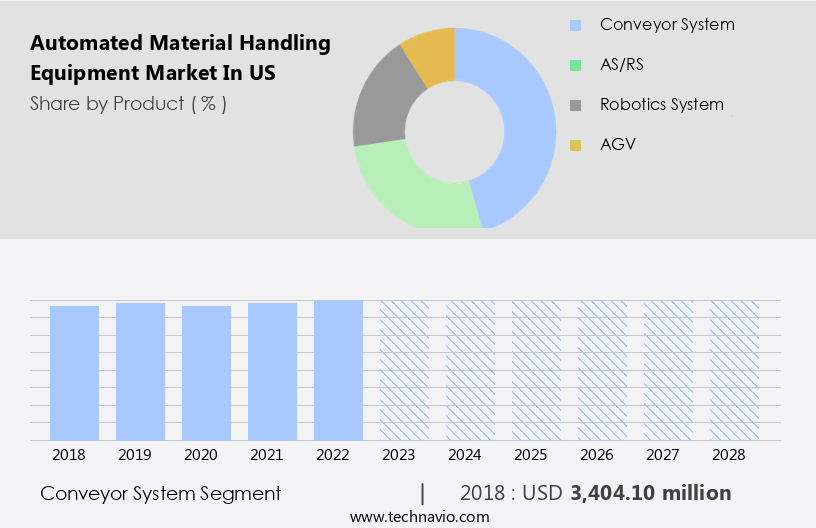
The Conveyor system segment was valued at USD 3404.10 million in 2018 and showed a gradual increase during the forecast period.
Market Dynamics
Our researchers analyzed the data with 2023 as the base year, along with the key drivers, trends, and challenges. A holistic analysis of drivers will help companies refine their marketing strategies to gain a competitive advantage.
What are the US Automated Material Handling Equipment Market drivers leading to the rise in adoption of the Industry?
- Advanced automation plays a crucial role in driving the market by enhancing the efficiency and productivity of processing plants.
- In today's business landscape, distribution centers are increasingly relying on automated material handling equipment to streamline their supply chain management and inventory processes. Advanced technologies such as RFID (Radio Frequency Identification) and artificial intelligence (AI) are revolutionizing the way goods are picked, packed, and transported within distribution centers. These technologies enable real-time data acquisition and analysis, allowing for more efficient project management and maintenance and repair scheduling. Industrial automation solutions, including conveyor systems, robotic arms, and AGVs (Automated Guided Vehicles), are becoming essential for businesses seeking to improve their picking and packing accuracy and reduce labor costs. However, the implementation of these systems requires careful planning and execution to ensure optimal performance and compliance with industry regulations.
- Effective project management and ongoing maintenance and repair are crucial for maximizing the return on investment from these automated solutions. By leveraging the power of AI and data-driven insights, distribution centers can enhance their overall efficiency and competitiveness in the market.
What are the US Automated Material Handling Equipment Market trends shaping the Industry?
- The emergence of Industry 4.0 signifies a significant market trend.
- The current economic landscape is witnessing a significant shift towards automation and data exchange in manufacturing and labor-intensive processes, often referred to as the Fourth Industrial Revolution or Industry 4.0. This trend encompasses cyber-physical systems, the Internet of Things (IoT), and cloud computing, enabling the use of robotics systems controlled by remote computers with machine learning capabilities to process various materials with minimal human intervention. An Industry 4.0 compliant factory integrates various machines, devices, and sensors through the Internet, allowing them to be monitored as a unified system by a system integrator. This integrated approach offers technical support systems, decentralized decision-making, and other advanced solutions, enhancing overall efficiency and productivity.
- Automated material handling equipment, including barcode scanning systems, plays a crucial role in this transformation by streamlining the logistics and supply chain processes. The adoption of these advanced technologies is expected to continue, revolutionizing industries and reshaping the business landscape.
How does US Automated Material Handling Equipment Market faces challenges face during its growth?
- The complexity in utilizing automated material handling equipment poses a significant challenge to the industry's growth trajectory. This intricacy encompasses various aspects, including system integration, workforce training, and technology upgrades, which necessitate substantial investments and resources. Consequently, overcoming these complexities is crucial for enhancing efficiency, reducing costs, and fostering innovation within the industry.
- Automated material handling equipment plays a pivotal role in enhancing the efficiency and productivity of various industries, particularly in retail operations and e-commerce fulfillment. System integration is crucial for seamless communication between different systems, ensuring smooth material handling processes. However, the inflexibility of automated systems can lead to high costs due to the time-consuming process of upgrading or replacing them. Moreover, the complexity of these systems requires extensive integration with various levels of information networks, further increasing costs. In today's dynamic business environment, the need for agility and flexibility is paramount. Omnichannel retailing and e-commerce fulfillment require warehouses to handle items of various shapes and sizes, necessitating the adoption of advanced technologies such as computer vision and data analytics.
- Energy efficiency is another critical factor, with industry standards emphasizing the importance of reducing energy consumption and carbon footprint. Safety regulations are non-negotiable, and third-party logistics (3PL) providers are increasingly focusing on safety measures to ensure the well-being of their workforce and the protection of goods. Pallet handling systems are a key area of focus, with the adoption of automated guided vehicles (AGVs) and robotic arms gaining popularity. Overall, the future of automated material handling equipment lies in its ability to adapt to changing business requirements while ensuring safety, energy efficiency, and cost-effectiveness.
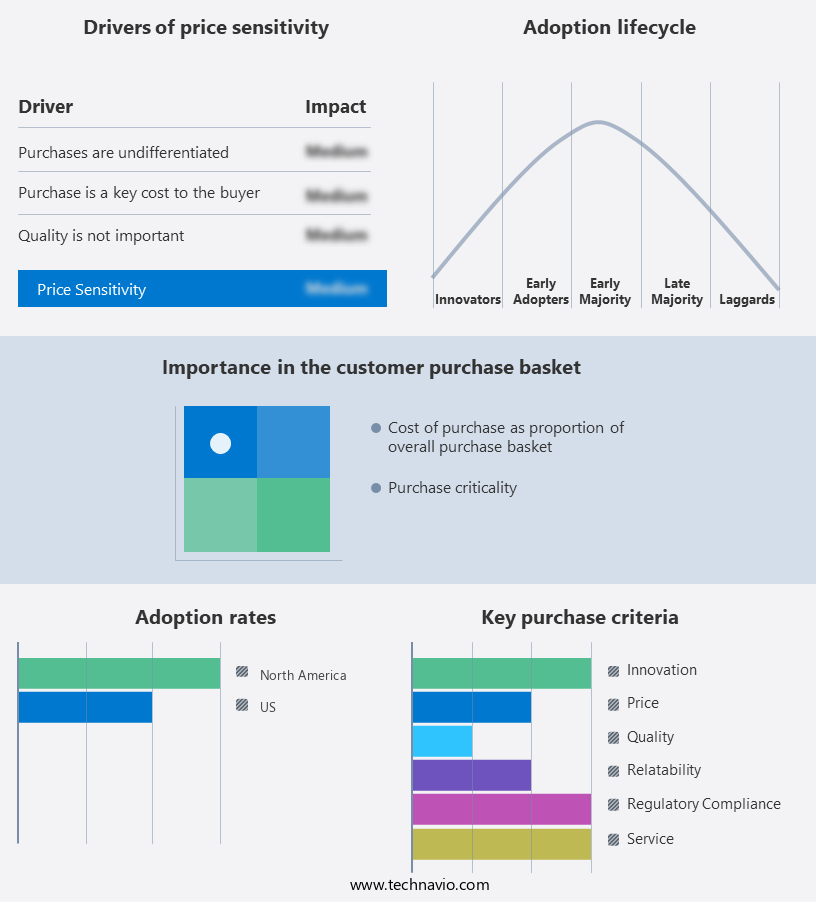
Exclusive US Automated Material Handling Equipment Market Customer Landscape
The market forecasting report includes the adoption lifecycle of the market, covering from the innovator's stage to the laggard's stage. It focuses on adoption rates in different regions based on penetration. Furthermore, the report also includes key purchase criteria and drivers of price sensitivity to help companies evaluate and develop their market growth analysis strategies.
Customer Landscape
Key Companies & Market Insights
Companies are implementing various strategies, such as strategic alliances, market forecast partnerships, mergers and acquisitions, geographical expansion, and product/service launches, to enhance their presence in the market.
The market research and growth report includes detailed analyses of the competitive landscape of the market and information about key companies, including:
- 3PL Central LLC
- AutoCrib Inc.
- Bastian Solutions LLC
- Beumer Group GmbH and Co. KG
- Daifuku Co. Ltd.
- Grabit Inc.
- Honeywell International Inc.
- Hyster Yale Materials Handling Inc.
- Invata Intralogistics Inc.
- inVia Robotics Inc.
- John Bean Technologies Corp.
- KION GROUP AG
- Locus Robotics Corp.
- Material Handling Systems Inc.
- Meidensha Corp.
- MIDEA Group Co. Ltd.
- Murata Machinery Ltd.
- SencorpWhite
- SSI Schafer IT Solutions GmbH
- Westfalia Technologies Inc.
Qualitative and quantitative analysis of companies has been conducted to help clients understand the wider business environment as well as the strengths and weaknesses of key market players. Data is qualitatively analyzed to categorize companies as pure play, category-focused, industry-focused, and diversified; it is quantitatively analyzed to categorize companies as dominant, leading, strong, tentative, and weak.
Recent Development and News in Automated Material Handling Equipment Market In US
- In March 2024, Swisslog, a leading provider of automated material handling solutions, introduced its new QuickMove Robotic Case Picking solution, designed to increase order picking productivity by up to 50% (Swisslog Press Release, 2024). This innovative system combines robotic arms with a conveyor system, enabling efficient order picking and packing in e-commerce and omnichannel distribution centers.
- In June 2024, Daifuku and JDA Software, two major players in the automated material handling and supply chain management industries, announced a strategic partnership to integrate Daifuku's warehouse automation solutions with JDA's supply chain management software (JDA Software Press Release, 2024). This collaboration aims to streamline warehouse operations and improve supply chain efficiency for customers.
- In February 2025, the U.S. Department of Transportation granted an exemption to Amazon and other companies to test autonomous delivery drones for commercial use (Federal Register, 2025). This regulatory approval marks a significant step towards the integration of drones in the material handling and logistics sector, potentially revolutionizing last-mile delivery and reducing transportation costs.
Research Analyst Overview
The automated material handling equipment market in the US continues to evolve, driven by the increasing demand for system integration across various sectors. Retail operations and e-commerce fulfillment are leading the charge, with energy efficiency and industry standards playing crucial roles in shaping market dynamics. Computer vision and data analytics are transforming material flow optimization, while safety regulations ensure the implementation of real-time tracking, machine learning, and fleet management systems. Third-party logistics (3PL) providers are integrating warehouse automation solutions, including conveyor systems, lift height adjustments, and pallet handling systems, to enhance their services. Manufacturing operations are also adopting material handling systems, such as sorting and distribution, to streamline production processes.
Safety systems, wireless communication, and operating speed are essential considerations for the adoption of automated material handling equipment. Cloud computing and e-commerce platforms are revolutionizing order fulfillment, while case handling, payload capacity, and support services are crucial for efficient supply chain management. Industrial automation, inventory management, and project management are also benefiting from the integration of RFID technology and maintenance and repair services. Artificial intelligence (AI) is playing an increasingly significant role in picking and packing processes, while barcode scanning and control systems ensure accurate data acquisition. The ongoing unfolding of market activities underscores the continuous need for innovation and adaptation to meet the evolving demands of various industries.
The market's dynamic nature is reflected in the integration of various technologies, from lift height adjustments to machine learning algorithms, to optimize material handling processes and enhance operational efficiency.
Dive into Technavio's robust research methodology, blending expert interviews, extensive data synthesis, and validated models for unparalleled Automated Material Handling Equipment Market in US insights. See full methodology.
|
Market Scope |
|
|
Report Coverage |
Details |
|
Page number |
142 |
|
Base year |
2023 |
|
Historic period |
2018-2022 |
|
Forecast period |
2024-2028 |
|
Growth momentum & CAGR |
Accelerate at a CAGR of 3% |
|
Market growth 2024-2028 |
USD 1118.2 million |
|
Market structure |
Fragmented |
|
YoY growth 2023-2024(%) |
2.9 |
|
Competitive landscape |
Leading Companies, Market Positioning of Companies, Competitive Strategies, and Industry Risks |
What are the Key Data Covered in this Market Research Report?
- CAGR of the market during the forecast period
- Detailed information on factors that will drive the market growth and forecasting between 2024 and 2028
- Precise estimation of the size of the market and its contribution of the market in focus to the parent market
- Accurate predictions about upcoming market growth and trends and changes in consumer behaviour
- Growth of the market across US
- Thorough analysis of the market's competitive landscape and detailed information about companies
- Comprehensive analysis of factors that will challenge the growth of market companies
We can help! Our analysts can customize this market research report to meet your requirements Get in touch
 RIA -
RIA -