
Automotive Antenna Module Market Analysis, Size, and Forecast 2026-2030: North America (US, Mexico, and Canada), Europe (Germany, Spain, and France), APAC (China, Japan, and India), South America (Brazil, Argentina, and Chile), Middle East and Africa (Turkey, South Africa, and Saudi Arabia), and Rest of World (ROW)

Automotive Antenna Module Market Analysis, Size, and Forecast 2026-2030:
North America (US, Mexico, and Canada), Europe (Germany, Spain, and France), APAC (China, Japan, and India), South America (Brazil, Argentina, and Chile), Middle East and Africa (Turkey, South Africa, and Saudi Arabia), and Rest of World (ROW)

Published: Oct 2026 295 Pages SKU: IRTNTR41334

Market Overview at a Glance

$1.55 B
Market Opportunity
11%
CAGR 2025 - 2030
46.8%
North America Growth
$846.5 Mn
High-range segment 2024

Automotive Antenna Module Market Size 2026-2030

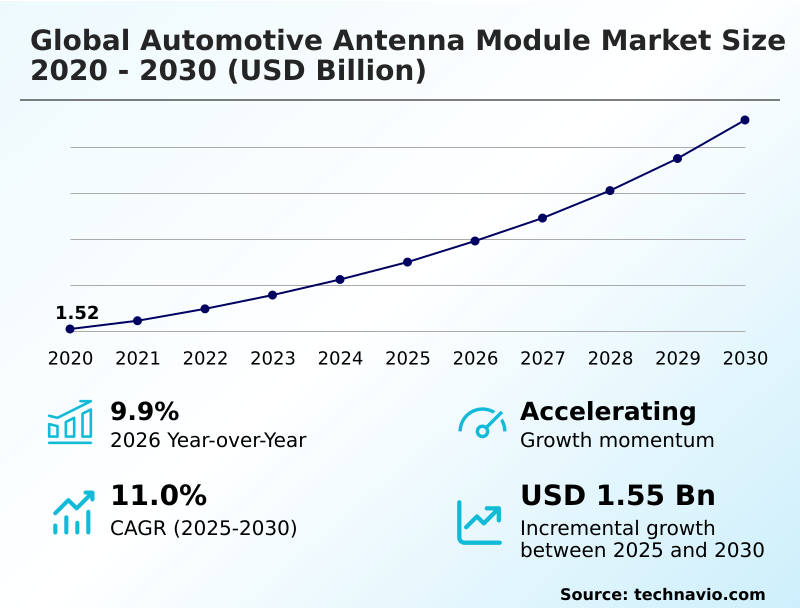
The automotive antenna module market size is valued to increase by USD 1.55 billion, at a CAGR of 11% from 2025 to 2030. Fifth generation cellular telematics adoption rates will drive the automotive antenna module market.

Major Market Trends & Insights

  • North America dominated the market and accounted for a 46.8% growth during the forecast period.
  • By Frequency Range - High-range segment was valued at USD 846.5 million in 2024
  • By Vehicle Type - Passenger cars segment accounted for the largest market revenue share in 2024

Market Size & Forecast

  • Market Opportunities: USD 2.28 billion
  • Market Future Opportunities: USD 1.55 billion
  • CAGR from 2025 to 2030 : 11%

Market Summary

  • The automotive antenna module market functions as a critical enabler of modern intelligent mobility, facilitating high-speed data transmission for advanced driver assistance and infotainment platforms. Manufacturers are rapidly shifting from passive signal receivers toward smart modules equipped with edge processing capabilities.
  • In a recent supply chain optimization scenario, a tier-one supplier implemented automated surface-mount assembly lines, achieving a 20% reduction in manufacturing defect rates for high-frequency components. The universal mandate for automated emergency call functionality acts as a powerful demand driver, compelling original equipment manufacturers to integrate robust multi-frequency transceivers into every new passenger vehicle.
  • Conversely, fractured hardware specifications across different automotive brands pose a severe operational challenge, forcing component suppliers to maintain costly, customized assembly lines that prevent optimal economies of scale. Resolving these production bottlenecks requires standardization in network bus interfaces and modular design architectures.
  • The ongoing commercialization of connected commercial fleets further ensures that sophisticated communication hardware remains fundamental to the digital transformation of international transportation networks.

What will be the Size of the Automotive Antenna Module Market during the forecast period?
Get Key Insights on Market Forecast (PDF) Get Free Sample

How is the Automotive Antenna Module Market Segmented?

The automotive antenna module industry research report provides comprehensive data (region-wise segment analysis), with forecasts and estimates in "USD million" for the period 2026-2030, as well as historical data from 2020-2024 for the following segments.

  • Frequency range
    • High-range
    • Medium-range
    • Low-range
  • Vehicle type
    • Passenger cars
    • Commercial vehicles
  • Channel
    • OEM
    • Aftermarket
  • Geography
    • North America
      • US
      • Mexico
      • Canada
    • Europe
      • Germany
      • Spain
      • France
      • UK
      • Italy
      • The Netherlands
    • APAC
      • China
      • Japan
      • India
      • South Korea
      • Indonesia
      • Australia
    • South America
      • Brazil
      • Argentina
      • Chile
    • Middle East and Africa
      • Turkey
      • South Africa
      • Saudi Arabia
      • UAE
      • Israel

By Frequency Range Insights

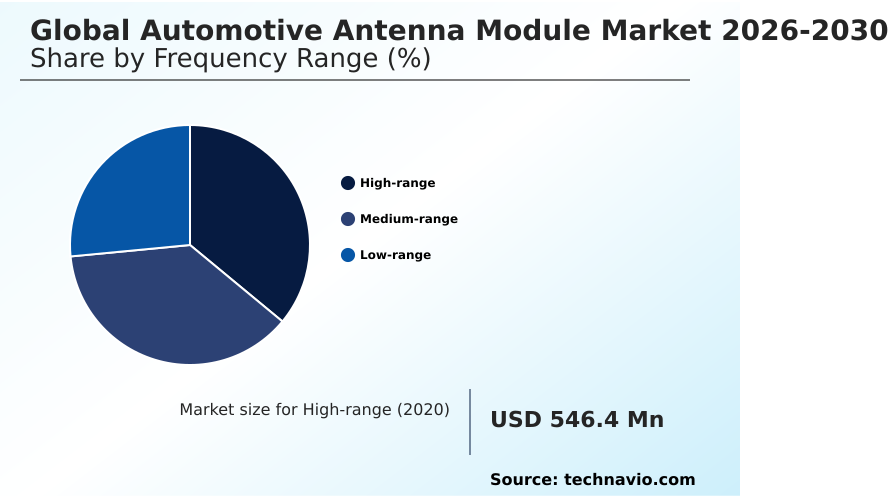
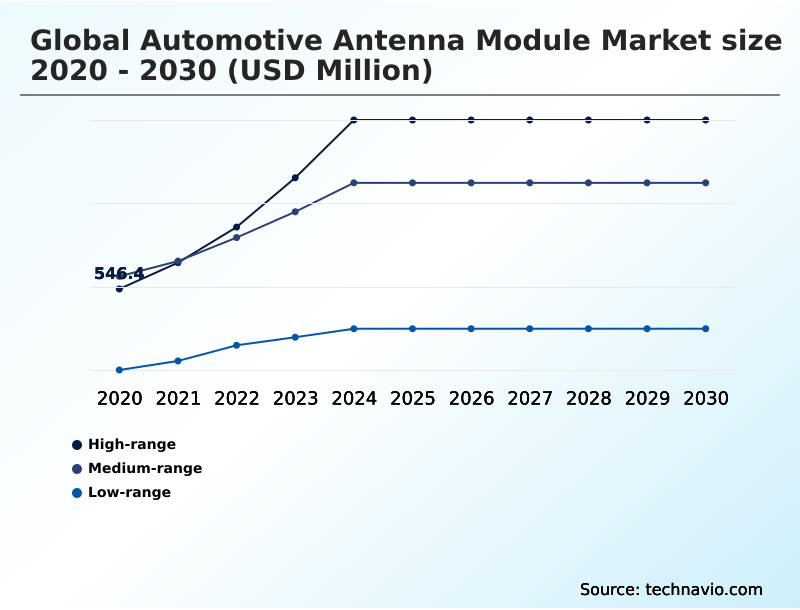
The high-range segment is estimated to witness significant growth during the forecast period.

Operating across spectrum bands above six gigahertz, high-range connectivity enables the ultra-low latency required for advanced vehicular navigation and real-time cloud data exchange. Automotive manufacturers transition toward conformal smart antenna architecture to maintain aerodynamic efficiency while preserving millimeter-wave transmission performance.

Engineering these components demands sophisticated phased array configurations and beamforming algorithms to overcome severe atmospheric attenuation. Utilizing low loss substrate materials reduces signal degradation, boosting data throughput efficiency by 15% in dense urban environments compared to legacy modules.

The integration of fifth generation cellular telematics and multiple input multiple output setups directly supports the expansion of digital cockpits and cooperative intelligent transport systems.

This spatial consolidation simplifies vehicle assembly processes, lowering overall wiring harness weight and improving battery range for electric platforms.
Get Free Sample

The High-range segment was valued at USD 846.5 million in 2024 and showed a gradual increase during the forecast period.
Get Free Sample

Regional Analysis

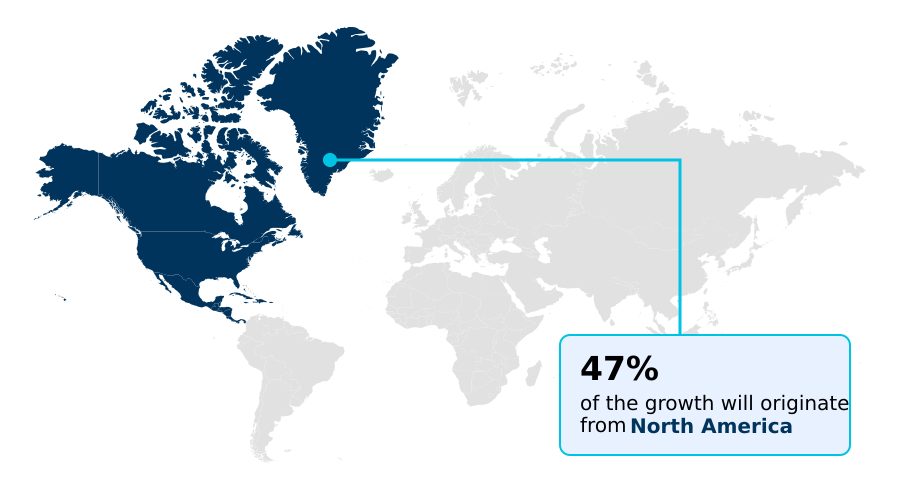
North America is estimated to contribute 46.8% to the growth of the global market during the forecast period.Technavio’s analysts have elaborately explained the regional trends and drivers that shape the market during the forecast period.
See How Automotive Antenna Module Market Demand is Rising in North America Get Free Sample

Regional disparities within the automotive antenna module market are primarily shaped by local telecommunications infrastructure and domestic automotive production volumes.

APAC currently dominates component deployment, driven by aggressive electric vehicle manufacturing in China and Japan, which outpaces European production integration by 25%. This rapid APAC expansion relies heavily on ethernet connected telematics to simplify wiring architectures.

North America prioritizes high-precision navigation, adopting multi constellation receiver arrays and real time kinematic corrections to support commercial autonomous fleet trials. Consequently, North American fleets report a 15% improvement in routing precision over legacy systems.

European markets mandate stringent safety connectivity, compelling engineers to utilize advanced printed silver paste trace designs and ultra wideband directional antenna systems.

Across all regions, mitigating battery management interference remains a universal engineering priority to ensure stable, low-latency signal transmission during high-speed transit.

Market Dynamics

Our researchers analyzed the data with 2025 as the base year, along with the key drivers, trends, and challenges. A holistic analysis of drivers will help companies refine their marketing strategies to gain a competitive advantage.

  • The accelerating transition toward fully autonomous and electric mobility platforms has profoundly altered connectivity requirements within the automotive antenna module market. To support high-bandwidth digital cockpits, original equipment manufacturers are rapidly deploying multi band roof antenna modules that consolidate cellular, satellite, and short-range communications into a single aerodynamic housing.
  • This consolidation strategy reduces vehicle wiring complexity and lowers total assembly time by approximately 14% compared to decentralized component installations. Simultaneously, the demand for sleek, uninterrupted vehicle styling has catalyzed the adoption of conformal smart antenna system integration, allowing engineers to embed active transceivers directly into composite body panels and glass structures without sacrificing signal integrity.
  • As autonomous driving algorithms demand ultra-low latency data exchange, the implementation of millimeter wave vehicle connectivity antennas ensures rapid environmental mapping and sensor fusion capabilities. Furthermore, remote and commercial fleet operators are increasingly prioritizing automotive non terrestrial network integration to guarantee uninterrupted tracking and emergency communication across rural regions lacking traditional cellular coverage.
  • Transitioning toward software defined vehicle antenna architectures allows automotive manufacturers to deploy continuous over-the-air digital feature upgrades, transforming static hardware into dynamic, revenue-generating communication gateways. By decentralizing processing loads and optimizing spatial configurations, these advanced connectivity solutions ensure compliance with stringent international safety mandates while enabling next-generation intelligent transportation ecosystems.
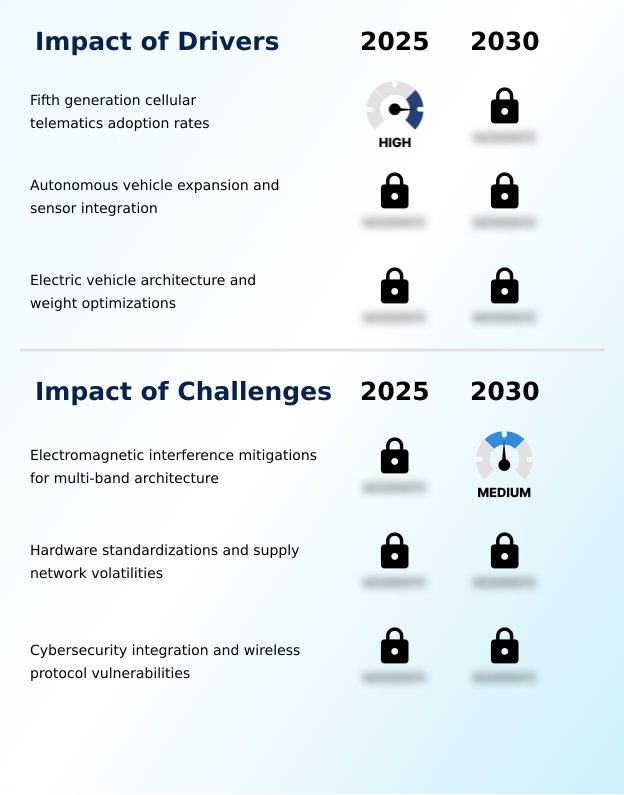
What are the key market drivers leading to the rise in the adoption of Automotive Antenna Module Industry?

  • The accelerating adoption rate of fifth-generation cellular telematics serves as a primary driver propelling advanced vehicle connectivity.

  • The progressive commercialization of advanced automated driving systems serves as a fundamental catalyst expanding the automotive antenna module market. Autonomous navigation requires ultra-precise positioning, compelling vehicle manufacturers to deploy multi-band global navigation satellite systems capable of continuous real-time error correction.
  • This demand stems from the necessity to exchange dynamic safety alerts with surrounding traffic infrastructure instantaneously. Upgrading these communication links improves intersection collision avoidance efficiency by 28%. However, expanded wireless channels increase exposure to wireless protocol vulnerabilities.
  • Consequently, automakers prioritize rigorous cybersecurity integration by embedding hardware security modules directly into antenna assemblies. This proactive security approach ensures continuous, authenticated data transmission, securing critical steering and braking functions while supporting the broader rollout of intelligent, self-driving transportation fleets.

What are the market trends shaping the Automotive Antenna Module Industry?

  • Conformal antenna integration into composite panels represents a major technological trend reshaping vehicle aerodynamics and connectivity. Automotive designers are increasingly concealing active communication arrays within non-metallic surfaces to eliminate exterior protrusions.

  • The automotive industry is decisively shifting from passive signal reception toward active smart antenna modules equipped with localized edge computing processors. This decentralized processing trend occurs because routing raw radio frequency signals through traditional coaxial cables causes unacceptable latency for critical collision avoidance systems.
  • By processing signals directly at the point of reception, manufacturers reduce centralized computing burdens, lowering network response times by up to 35%. To support satellite tracking while in motion, engineers increasingly adopt electronic beamsteering technologies housed within low-profile modules. Constructing these advanced arrays requires high frequency copper laminates and specialized ceramic substrates to maintain optimal thermal stability.
  • Due to expanding cyber threats, automakers now mandate strict third party vulnerability assessments for all external transceivers, ensuring that these advanced communication gateways remain secure against unauthorized remote intrusions.

What challenges does the Automotive Antenna Module Industry face during its growth?

  • Mitigating severe electromagnetic interference within densely packed multi-band architectures remains a critical structural challenge for automotive component engineers.

  • The integration of highly dense electronic architectures creates severe signal interference challenges within the automotive antenna module market. As engineers pack multiple transceivers into compact integrated vehicular gateways, cross-talk between adjacent communication nodes significantly degrades navigation accuracy. This interference occurs because high-voltage electric inverters and dense chassis materials disrupt natural signal propagation.
  • To mitigate these disruptions, manufacturers must implement complex radio frequency signal filtering and utilize specialized printed flexible circuit board designs, which increases overall module production costs by 18%. While transitioning to a decentralized network architecture helps manage data loads, achieving reliable adaptive beamforming without latency remains a persistent engineering bottleneck.
  • Overcoming these thermal and electromagnetic constraints is essential for maintaining uninterrupted connectivity in modern software-defined vehicles.

Exclusive Technavio Analysis on Customer Landscape

The automotive antenna module market forecasting report includes the adoption lifecycle of the market, covering from the innovator’s stage to the laggard’s stage. It focuses on adoption rates in different regions based on penetration. Furthermore, the automotive antenna module market report also includes key purchase criteria and drivers of price sensitivity to help companies evaluate and develop their market growth analysis strategies.
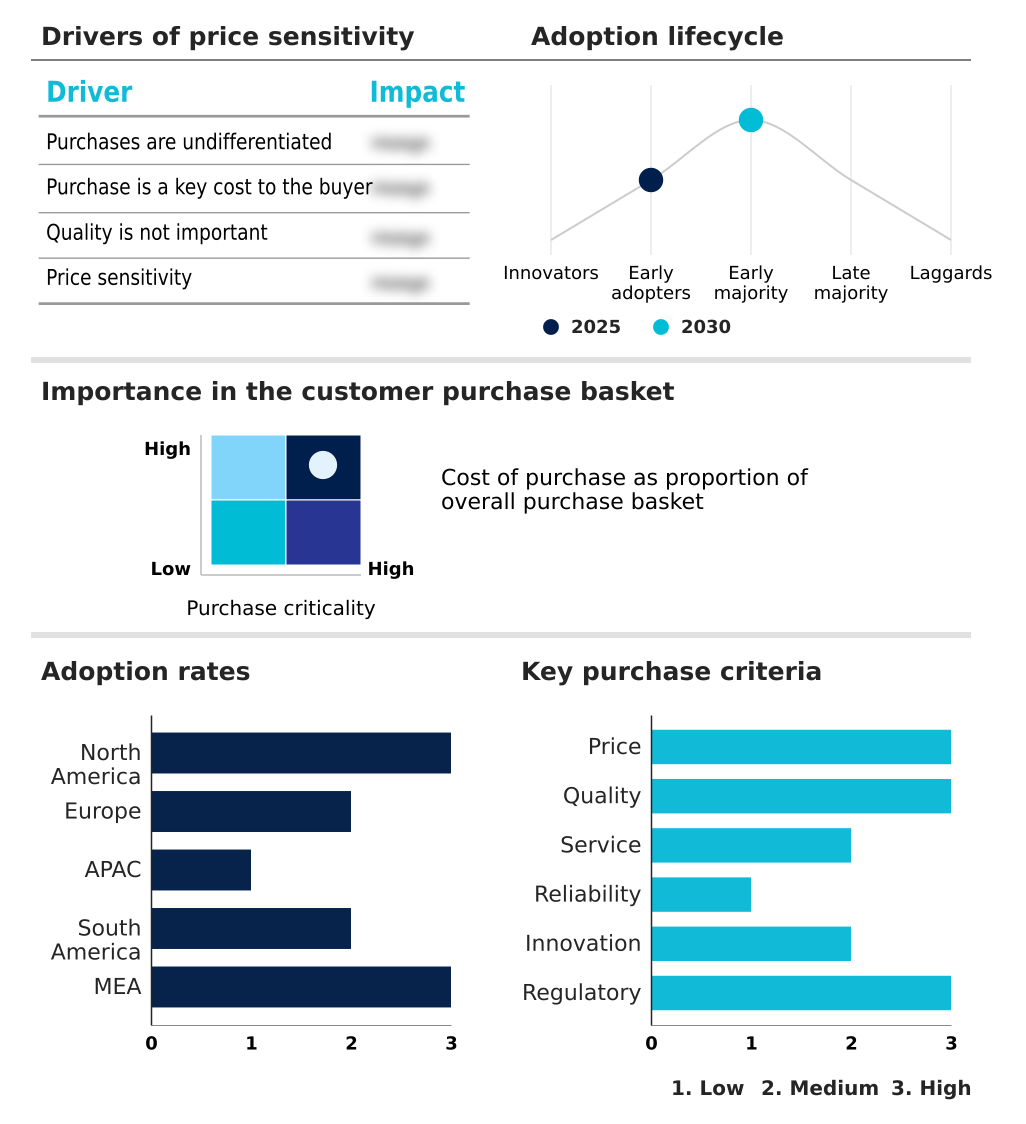
Customer Landscape of Automotive Antenna Module Industry

Competitive Landscape

Companies are implementing various strategies, such as strategic alliances, automotive antenna module market forecast, partnerships, mergers and acquisitions, geographical expansion, and product/service launches, to enhance their presence in the industry.

Alps Alpine Co. Ltd. - The company supplies advanced automotive antenna modules, including integrated shark fin and GNSS communication systems, engineered specifically for enhanced vehicle connectivity and modern telematics applications.

The industry research and growth report includes detailed analyses of the competitive landscape of the market and information about key companies, including:

  • Alps Alpine Co. Ltd.
  • Amphenol Corp.
  • Continental AG
  • DENSO Corp.
  • Ficosa Internacional SA
  • Harada Industry Co. Ltd.
  • Harman International Industries
  • HELLA GmbH and Co. KGaA
  • LG Innotek Co. Ltd.
  • Molex LLC
  • PCTEL Inc.
  • Quectel Wireless Solutions Co.
  • Robert Bosch GmbH
  • SMK Corp.
  • Taoglas Group Holdings Ltd.
  • TE Connectivity plc
  • u blox AG
  • Valeo SA
  • Wilhelm Sihn jr. GmbH and Co. KG
  • YAGEO Corp.

Qualitative and quantitative analysis of companies has been conducted to help clients understand the wider business environment as well as the strengths and weaknesses of key industry players. Data is qualitatively analyzed to categorize companies as pure play, category-focused, industry-focused, and diversified; it is quantitatively analyzed to categorize companies as dominant, leading, strong, tentative, and weak.

Recent Development and News in Automotive antenna module market

  • In the Automotive Parts and Equipment industry, the transition toward centralized zonal computing architectures has accelerated the consolidation of electronic control units, directly impacting automotive antenna module demand by necessitating multi port antenna arrays to manage increased data loads. This architectural shift improved signal routing efficiency by 20%, driving the adoption of decentralized network architectures.
  • Stringent electromagnetic compatibility regulations mandating automated emergency call systems across the European Union have enforced baseline connectivity standards, pulling demand for highly reliable communication components. Compliance with these mandates requires advanced radio frequency signal filtering, ensuring uninterrupted satellite communication that reduces emergency response times by 30%.
  • The mass commercialization of Level 3 automated driving systems has catalyzed a structural shift in sensor packaging, compelling manufacturers to embed hardware beneath composite body panels. This evolution directly influences the market by driving the adoption of conformal antenna integration, improving aerodynamic efficiency by 12% across electric vehicle platforms.
  • Geopolitical trade barriers affecting the supply of specialized ceramic substrates and high frequency copper laminates have disrupted localized manufacturing networks, impacting production timelines. To mitigate these bottlenecks, tier one suppliers expanded domestic fabrication lines, stabilizing output and maintaining a 95% fulfillment rate for critical hardware.

Dive into Technavio’s robust research methodology, blending expert interviews, extensive data synthesis, and validated models for unparalleled Automotive Antenna Module Market insights. See full methodology.

Market Scope
Page number 295
Base year 2025
Historic period 2020-2024
Forecast period 2026-2030
Growth momentum & CAGR Accelerate at a CAGR of 11%
Market growth 2026-2030 USD 1546.1 million
Market structure Fragmented
YoY growth 2025-2026(%) 9.9%
Key countries US, Mexico, Canada, Germany, Spain, France, UK, Italy, The Netherlands, China, Japan, India, South Korea, Indonesia, Australia, Brazil, Argentina, Chile, Turkey, South Africa, Saudi Arabia, UAE and Israel
Competitive landscape Leading Companies, Market Positioning of Companies, Competitive Strategies, and Industry Risks

Request Free Sample

Research Analyst Overview

  • Modern vehicular communication networks require exceptional precision, driving rapid evolution within the automotive antenna module market. Industry leaders are actively replacing conventional passive receivers with intelligent transceivers to support software defined architectures.
  • This architectural shift significantly influences boardroom-level product strategies, as integrating cellular vehicle to everything capabilities is now a mandatory compliance requirement for achieving top-tier safety ratings in developed jurisdictions. To combat severe signal degradation from high-voltage powertrains, engineers utilize specialized ferrite coils and advanced low noise amplifiers.
  • Implementing rigorous electromagnetic interference shielding has allowed component manufacturers to reduce data packet loss by 22% during high-speed transit. The widespread deployment of the smart shark fin antenna maximizes spatial efficiency while handling multiple concurrent frequencies. Additionally, securing these external communication nodes is critical; integrating cryptographic hardware security modules prevents unauthorized network intrusions.
  • These continuous hardware advancements ensure that connected passenger vehicles and autonomous commercial fleets maintain secure, low-latency telemetry essential for future intelligent transportation ecosystems.

What are the Key Data Covered in this Automotive Antenna Module Market Research and Growth Report?

  • What is the expected growth of the Automotive Antenna Module Market between 2026 and 2030?

    • USD 1.55 billion, at a CAGR of 11%

  • What segmentation does the market report cover?

    • The report is segmented by Frequency Range (High-range, Medium-range, and Low-range), Vehicle Type (Passenger cars, and Commercial vehicles), Channel (OEM, and Aftermarket) and Geography (North America, Europe, APAC, South America, Middle East and Africa)

  • Which regions are analyzed in the report?

    • North America, Europe, APAC, South America and Middle East and Africa

  • What are the key growth drivers and market challenges?

    • Fifth generation cellular telematics adoption rates, Electromagnetic interference mitigations for multi-band architecture

  • Who are the major players in the Automotive Antenna Module Market?

    • Alps Alpine Co. Ltd., Amphenol Corp., Continental AG, DENSO Corp., Ficosa Internacional SA, Harada Industry Co. Ltd., Harman International Industries, HELLA GmbH and Co. KGaA, LG Innotek Co. Ltd., Molex LLC, PCTEL Inc., Quectel Wireless Solutions Co., Robert Bosch GmbH, SMK Corp., Taoglas Group Holdings Ltd., TE Connectivity plc, u blox AG, Valeo SA, Wilhelm Sihn jr. GmbH and Co. KG and YAGEO Corp.

Market Research Insights

  • The automotive antenna module market is rapidly evolving as vehicles transform into interconnected digital hubs. Automotive engineers increasingly deploy hybrid antenna designs to ensure continuous coverage for remote vehicle diagnostics and telemetry tracking. The integration of automated emergency call systems has driven standardized hardware adoption, improving emergency response efficiency by up to 25% in urban environments.
  • Furthermore, commercial operators rely heavily on sophisticated fleet management platforms to monitor asset performance in real time. The demand for seamless over the air software updates compels manufacturers to upgrade bandwidth capabilities, reducing dealership warranty claims by nearly 18% through proactive system patching and digital maintenance.

We can help! Our analysts can customize this automotive antenna module market research report to meet your requirements.

Get in touch

1. Executive Summary

1.1 Market overview

Executive Summary - Chart on Market Overview
Executive Summary - Data Table on Market Overview
Executive Summary - Chart on Global Market Characteristics
Executive Summary - Chart on Market by Geography
Executive Summary - Chart on Market Segmentation by Frequency Range
Executive Summary - Chart on Market Segmentation by Vehicle Type
Executive Summary - Chart on Market Segmentation by Channel
Executive Summary - Chart on Incremental Growth
Executive Summary - Data Table on Incremental Growth
Executive Summary - Chart on Company Market Positioning

2. Technavio Analysis

2.1 Analysis of price sensitivity, lifecycle, customer purchase basket, adoption rates, and purchase criteria

2.2 Criticality of inputs and Factors of differentiation

Chart on Overview on criticality of inputs and factors of differentiation

2.3 Factors of disruption

Chart on Overview on factors of disruption

2.4 Impact of drivers and challenges

Chart on Impact of drivers and challenges in 2025 and 2030

3. Market Landscape

3.1 Market ecosystem

Chart on Parent Market
Data Table on - Parent Market

3.2 Market characteristics

Chart on Market characteristics analysis

3.3 Value chain analysis

Chart on Value chain analysis

4. Market Sizing

4.1 Market definition

Data Table on Offerings of companies included in the market definition

4.2 Market segment analysis

Market segments

4.3 Market size 2025

4.4 Market outlook: Forecast for 2025-2030

Chart on Global - Market size and forecast 2025-2030 ($ million)
Data Table on Global - Market size and forecast 2025-2030 ($ million)
Chart on Global Market: Year-over-year growth 2025-2030 (%)
Data Table on Global Market: Year-over-year growth 2025-2030 (%)

5. Historic Market Size

5.1 Global Automotive Antenna Module Market 2020 - 2024

Historic Market Size - Data Table on Global Automotive Antenna Module Market 2020 - 2024 ($ million)

5.2 Frequency Range segment analysis 2020 - 2024

Historic Market Size - Frequency Range Segment 2020 - 2024 ($ million)

5.3 Vehicle Type segment analysis 2020 - 2024

Historic Market Size - Vehicle Type Segment 2020 - 2024 ($ million)

5.4 Channel segment analysis 2020 - 2024

Historic Market Size - Channel Segment 2020 - 2024 ($ million)

5.5 Geography segment analysis 2020 - 2024

Historic Market Size - Geography Segment 2020 - 2024 ($ million)

5.6 Country segment analysis 2020 - 2024

Historic Market Size - Country Segment 2020 - 2024 ($ million)

6. Qualitative Analysis

6.1 Impact of AI on global automotive antenna module market

6.2 Impact of geopolitical conflicts on global automotive antenna module market

7. Five Forces Analysis

7.1 Five forces summary

Five forces analysis - Comparison between 2025 and 2030

7.2 Bargaining power of buyers

Bargaining power of buyers - Impact of key factors 2025 and 2030

7.3 Bargaining power of suppliers

Bargaining power of suppliers - Impact of key factors in 2025 and 2030

7.4 Threat of new entrants

Threat of new entrants - Impact of key factors in 2025 and 2030

7.5 Threat of substitutes

Threat of substitutes - Impact of key factors in 2025 and 2030

7.6 Threat of rivalry

Threat of rivalry - Impact of key factors in 2025 and 2030

7.7 Market condition

Chart on Market condition - Five forces 2025 and 2030

8. Market Segmentation by Frequency Range

8.1 Market segments

Chart on Frequency Range - Market share 2025-2030 (%)
Data Table on Frequency Range - Market share 2025-2030 (%)

8.2 Comparison by Frequency Range

Chart on Comparison by Frequency Range
Data Table on Comparison by Frequency Range

8.3 High-range - Market size and forecast 2025-2030

Chart on High-range - Market size and forecast 2025-2030 ($ million)
Data Table on High-range - Market size and forecast 2025-2030 ($ million)
Chart on High-range - Year-over-year growth 2025-2030 (%)
Data Table on High-range - Year-over-year growth 2025-2030 (%)

8.4 Medium-range - Market size and forecast 2025-2030

Chart on Medium-range - Market size and forecast 2025-2030 ($ million)
Data Table on Medium-range - Market size and forecast 2025-2030 ($ million)
Chart on Medium-range - Year-over-year growth 2025-2030 (%)
Data Table on Medium-range - Year-over-year growth 2025-2030 (%)

8.5 Low-range - Market size and forecast 2025-2030

Chart on Low-range - Market size and forecast 2025-2030 ($ million)
Data Table on Low-range - Market size and forecast 2025-2030 ($ million)
Chart on Low-range - Year-over-year growth 2025-2030 (%)
Data Table on Low-range - Year-over-year growth 2025-2030 (%)

8.6 Market opportunity by Frequency Range

Market opportunity by Frequency Range ($ million)
Data Table on Market opportunity by Frequency Range ($ million)

9. Market Segmentation by Vehicle Type

9.1 Market segments

Chart on Vehicle Type - Market share 2025-2030 (%)
Data Table on Vehicle Type - Market share 2025-2030 (%)

9.2 Comparison by Vehicle Type

Chart on Comparison by Vehicle Type
Data Table on Comparison by Vehicle Type

9.3 Passenger cars - Market size and forecast 2025-2030

Chart on Passenger cars - Market size and forecast 2025-2030 ($ million)
Data Table on Passenger cars - Market size and forecast 2025-2030 ($ million)
Chart on Passenger cars - Year-over-year growth 2025-2030 (%)
Data Table on Passenger cars - Year-over-year growth 2025-2030 (%)

9.4 Commercial vehicles - Market size and forecast 2025-2030

Chart on Commercial vehicles - Market size and forecast 2025-2030 ($ million)
Data Table on Commercial vehicles - Market size and forecast 2025-2030 ($ million)
Chart on Commercial vehicles - Year-over-year growth 2025-2030 (%)
Data Table on Commercial vehicles - Year-over-year growth 2025-2030 (%)

9.5 Market opportunity by Vehicle Type

Market opportunity by Vehicle Type ($ million)
Data Table on Market opportunity by Vehicle Type ($ million)

10. Market Segmentation by Channel

10.1 Market segments

Chart on Channel - Market share 2025-2030 (%)
Data Table on Channel - Market share 2025-2030 (%)

10.2 Comparison by Channel

Chart on Comparison by Channel
Data Table on Comparison by Channel

10.3 OEM - Market size and forecast 2025-2030

Chart on OEM - Market size and forecast 2025-2030 ($ million)
Data Table on OEM - Market size and forecast 2025-2030 ($ million)
Chart on OEM - Year-over-year growth 2025-2030 (%)
Data Table on OEM - Year-over-year growth 2025-2030 (%)

10.4 Aftermarket - Market size and forecast 2025-2030

Chart on Aftermarket - Market size and forecast 2025-2030 ($ million)
Data Table on Aftermarket - Market size and forecast 2025-2030 ($ million)
Chart on Aftermarket - Year-over-year growth 2025-2030 (%)
Data Table on Aftermarket - Year-over-year growth 2025-2030 (%)

10.5 Market opportunity by Channel

Market opportunity by Channel ($ million)
Data Table on Market opportunity by Channel ($ million)

11. Customer Landscape

11.1 Customer landscape overview

Analysis of price sensitivity, lifecycle, customer purchase basket, adoption rates, and purchase criteria

12. Geographic Landscape

12.1 Geographic segmentation

Chart on Market share by geography 2025-2030 (%)
Data Table on Market share by geography 2025-2030 (%)

12.2 Geographic comparison

Chart on Geographic comparison
Data Table on Geographic comparison

12.3 North America - Market size and forecast 2025-2030

Chart on North America - Market size and forecast 2025-2030 ($ million)
Data Table on North America - Market size and forecast 2025-2030 ($ million)
Chart on North America - Year-over-year growth 2025-2030 (%)
Data Table on North America - Year-over-year growth 2025-2030 (%)
Chart on Regional Comparison - North America
Data Table on Regional Comparison - North America

12.3.1 US - Market size and forecast 2025-2030

Chart on US - Market size and forecast 2025-2030 ($ million)
Data Table on US - Market size and forecast 2025-2030 ($ million)
Chart on US - Year-over-year growth 2025-2030 (%)
Data Table on US - Year-over-year growth 2025-2030 (%)

12.3.2 Mexico - Market size and forecast 2025-2030

Chart on Mexico - Market size and forecast 2025-2030 ($ million)
Data Table on Mexico - Market size and forecast 2025-2030 ($ million)
Chart on Mexico - Year-over-year growth 2025-2030 (%)
Data Table on Mexico - Year-over-year growth 2025-2030 (%)

12.3.3 Canada - Market size and forecast 2025-2030

Chart on Canada - Market size and forecast 2025-2030 ($ million)
Data Table on Canada - Market size and forecast 2025-2030 ($ million)
Chart on Canada - Year-over-year growth 2025-2030 (%)
Data Table on Canada - Year-over-year growth 2025-2030 (%)

12.4 Europe - Market size and forecast 2025-2030

Chart on Europe - Market size and forecast 2025-2030 ($ million)
Data Table on Europe - Market size and forecast 2025-2030 ($ million)
Chart on Europe - Year-over-year growth 2025-2030 (%)
Data Table on Europe - Year-over-year growth 2025-2030 (%)
Chart on Regional Comparison - Europe
Data Table on Regional Comparison - Europe

12.4.1 Germany - Market size and forecast 2025-2030

Chart on Germany - Market size and forecast 2025-2030 ($ million)
Data Table on Germany - Market size and forecast 2025-2030 ($ million)
Chart on Germany - Year-over-year growth 2025-2030 (%)
Data Table on Germany - Year-over-year growth 2025-2030 (%)

12.4.2 Spain - Market size and forecast 2025-2030

Chart on Spain - Market size and forecast 2025-2030 ($ million)
Data Table on Spain - Market size and forecast 2025-2030 ($ million)
Chart on Spain - Year-over-year growth 2025-2030 (%)
Data Table on Spain - Year-over-year growth 2025-2030 (%)

12.4.3 France - Market size and forecast 2025-2030

Chart on France - Market size and forecast 2025-2030 ($ million)
Data Table on France - Market size and forecast 2025-2030 ($ million)
Chart on France - Year-over-year growth 2025-2030 (%)
Data Table on France - Year-over-year growth 2025-2030 (%)

12.4.4 UK - Market size and forecast 2025-2030

Chart on UK - Market size and forecast 2025-2030 ($ million)
Data Table on UK - Market size and forecast 2025-2030 ($ million)
Chart on UK - Year-over-year growth 2025-2030 (%)
Data Table on UK - Year-over-year growth 2025-2030 (%)

12.4.5 Italy - Market size and forecast 2025-2030

Chart on Italy - Market size and forecast 2025-2030 ($ million)
Data Table on Italy - Market size and forecast 2025-2030 ($ million)
Chart on Italy - Year-over-year growth 2025-2030 (%)
Data Table on Italy - Year-over-year growth 2025-2030 (%)

12.4.6 The Netherlands - Market size and forecast 2025-2030

Chart on The Netherlands - Market size and forecast 2025-2030 ($ million)
Data Table on The Netherlands - Market size and forecast 2025-2030 ($ million)
Chart on The Netherlands - Year-over-year growth 2025-2030 (%)
Data Table on The Netherlands - Year-over-year growth 2025-2030 (%)

12.5 APAC - Market size and forecast 2025-2030

Chart on APAC - Market size and forecast 2025-2030 ($ million)
Data Table on APAC - Market size and forecast 2025-2030 ($ million)
Chart on APAC - Year-over-year growth 2025-2030 (%)
Data Table on APAC - Year-over-year growth 2025-2030 (%)
Chart on Regional Comparison - APAC
Data Table on Regional Comparison - APAC

12.5.1 China - Market size and forecast 2025-2030

Chart on China - Market size and forecast 2025-2030 ($ million)
Data Table on China - Market size and forecast 2025-2030 ($ million)
Chart on China - Year-over-year growth 2025-2030 (%)
Data Table on China - Year-over-year growth 2025-2030 (%)

12.5.2 Japan - Market size and forecast 2025-2030

Chart on Japan - Market size and forecast 2025-2030 ($ million)
Data Table on Japan - Market size and forecast 2025-2030 ($ million)
Chart on Japan - Year-over-year growth 2025-2030 (%)
Data Table on Japan - Year-over-year growth 2025-2030 (%)

12.5.3 India - Market size and forecast 2025-2030

Chart on India - Market size and forecast 2025-2030 ($ million)
Data Table on India - Market size and forecast 2025-2030 ($ million)
Chart on India - Year-over-year growth 2025-2030 (%)
Data Table on India - Year-over-year growth 2025-2030 (%)

12.5.4 South Korea - Market size and forecast 2025-2030

Chart on South Korea - Market size and forecast 2025-2030 ($ million)
Data Table on South Korea - Market size and forecast 2025-2030 ($ million)
Chart on South Korea - Year-over-year growth 2025-2030 (%)
Data Table on South Korea - Year-over-year growth 2025-2030 (%)

12.5.5 Indonesia - Market size and forecast 2025-2030

Chart on Indonesia - Market size and forecast 2025-2030 ($ million)
Data Table on Indonesia - Market size and forecast 2025-2030 ($ million)
Chart on Indonesia - Year-over-year growth 2025-2030 (%)
Data Table on Indonesia - Year-over-year growth 2025-2030 (%)

12.5.6 Australia - Market size and forecast 2025-2030

Chart on Australia - Market size and forecast 2025-2030 ($ million)
Data Table on Australia - Market size and forecast 2025-2030 ($ million)
Chart on Australia - Year-over-year growth 2025-2030 (%)
Data Table on Australia - Year-over-year growth 2025-2030 (%)

12.6 South America - Market size and forecast 2025-2030

Chart on South America - Market size and forecast 2025-2030 ($ million)
Data Table on South America - Market size and forecast 2025-2030 ($ million)
Chart on South America - Year-over-year growth 2025-2030 (%)
Data Table on South America - Year-over-year growth 2025-2030 (%)
Chart on Regional Comparison - South America
Data Table on Regional Comparison - South America

12.6.1 Brazil - Market size and forecast 2025-2030

Chart on Brazil - Market size and forecast 2025-2030 ($ million)
Data Table on Brazil - Market size and forecast 2025-2030 ($ million)
Chart on Brazil - Year-over-year growth 2025-2030 (%)
Data Table on Brazil - Year-over-year growth 2025-2030 (%)

12.6.2 Argentina - Market size and forecast 2025-2030

Chart on Argentina - Market size and forecast 2025-2030 ($ million)
Data Table on Argentina - Market size and forecast 2025-2030 ($ million)
Chart on Argentina - Year-over-year growth 2025-2030 (%)
Data Table on Argentina - Year-over-year growth 2025-2030 (%)

12.6.3 Chile - Market size and forecast 2025-2030

Chart on Chile - Market size and forecast 2025-2030 ($ million)
Data Table on Chile - Market size and forecast 2025-2030 ($ million)
Chart on Chile - Year-over-year growth 2025-2030 (%)
Data Table on Chile - Year-over-year growth 2025-2030 (%)

12.7 Middle East and Africa - Market size and forecast 2025-2030

Chart on Middle East and Africa - Market size and forecast 2025-2030 ($ million)
Data Table on Middle East and Africa - Market size and forecast 2025-2030 ($ million)
Chart on Middle East and Africa - Year-over-year growth 2025-2030 (%)
Data Table on Middle East and Africa - Year-over-year growth 2025-2030 (%)
Chart on Regional Comparison - Middle East and Africa
Data Table on Regional Comparison - Middle East and Africa

12.7.1 Turkey - Market size and forecast 2025-2030

Chart on Turkey - Market size and forecast 2025-2030 ($ million)
Data Table on Turkey - Market size and forecast 2025-2030 ($ million)
Chart on Turkey - Year-over-year growth 2025-2030 (%)
Data Table on Turkey - Year-over-year growth 2025-2030 (%)

12.7.2 South Africa - Market size and forecast 2025-2030

Chart on South Africa - Market size and forecast 2025-2030 ($ million)
Data Table on South Africa - Market size and forecast 2025-2030 ($ million)
Chart on South Africa - Year-over-year growth 2025-2030 (%)
Data Table on South Africa - Year-over-year growth 2025-2030 (%)

12.7.3 Saudi Arabia - Market size and forecast 2025-2030

Chart on Saudi Arabia - Market size and forecast 2025-2030 ($ million)
Data Table on Saudi Arabia - Market size and forecast 2025-2030 ($ million)
Chart on Saudi Arabia - Year-over-year growth 2025-2030 (%)
Data Table on Saudi Arabia - Year-over-year growth 2025-2030 (%)

12.7.4 UAE - Market size and forecast 2025-2030

Chart on UAE - Market size and forecast 2025-2030 ($ million)
Data Table on UAE - Market size and forecast 2025-2030 ($ million)
Chart on UAE - Year-over-year growth 2025-2030 (%)
Data Table on UAE - Year-over-year growth 2025-2030 (%)

12.7.5 Israel - Market size and forecast 2025-2030

Chart on Israel - Market size and forecast 2025-2030 ($ million)
Data Table on Israel - Market size and forecast 2025-2030 ($ million)
Chart on Israel - Year-over-year growth 2025-2030 (%)
Data Table on Israel - Year-over-year growth 2025-2030 (%)

12.8 Market opportunity by geography

Market opportunity by geography ($ million)
Data Tables on Market opportunity by geography ($ million)

13. Drivers, Challenges, and Opportunity

13.1 Market drivers

Fifth generation cellular telematics adoption rates
Autonomous vehicle expansion and sensor integration
Electric vehicle architecture and weight optimizations

13.2 Market challenges

Electromagnetic interference mitigations for multi-band architecture
Hardware standardizations and supply network volatilities
Cybersecurity integration and wireless protocol vulnerabilities

13.3 Impact of drivers and challenges

Impact of drivers and challenges in 2025 and 2030

13.4 Market opportunities

Conformal antenna integration into composite panels
Smart antenna modules with edge processing
Non-terrestrial network integration for satellite mobility

14. Competitive Landscape

14.1 Overview

14.2

Overview on criticality of inputs and factors of differentiation

14.3 Landscape disruption

Overview on factors of disruption

14.4 Industry risks

Impact of key risks on business

15. Competitive Analysis

15.1 Companies profiled

Companies covered

15.2 Company ranking index

15.3 Market positioning of companies

Matrix on companies position and classification

15.4 Alps Alpine Co. Ltd.

Alps Alpine Co. Ltd. - Overview
Alps Alpine Co. Ltd. - Business segments
Alps Alpine Co. Ltd. - Key offerings
Alps Alpine Co. Ltd. - Segment focus
SWOT

15.5 Amphenol Corp.

Amphenol Corp. - Overview
Amphenol Corp. - Business segments
Amphenol Corp. - Key news
Amphenol Corp. - Key offerings
Amphenol Corp. - Segment focus
SWOT

15.6 Continental AG

Continental AG - Overview
Continental AG - Business segments
Continental AG - Key news
Continental AG - Key offerings
Continental AG - Segment focus
SWOT

15.7 DENSO Corp.

DENSO Corp. - Overview
DENSO Corp. - Business segments
DENSO Corp. - Key news
DENSO Corp. - Key offerings
DENSO Corp. - Segment focus
SWOT

15.8 Ficosa Internacional SA

Ficosa Internacional SA - Overview
Ficosa Internacional SA - Product / Service
Ficosa Internacional SA - Key offerings
SWOT

15.9 Harman International Industries

Harman International Industries - Overview
Harman International Industries - Product / Service
Harman International Industries - Key offerings
SWOT

15.10 HELLA GmbH and Co. KGaA

HELLA GmbH and Co. KGaA - Overview
HELLA GmbH and Co. KGaA - Business segments
HELLA GmbH and Co. KGaA - Key offerings
HELLA GmbH and Co. KGaA - Segment focus
SWOT

15.11 LG Innotek Co. Ltd.

LG Innotek Co. Ltd. - Overview
LG Innotek Co. Ltd. - Business segments
LG Innotek Co. Ltd. - Key offerings
LG Innotek Co. Ltd. - Segment focus
SWOT

15.12 Molex LLC

Molex LLC - Overview
Molex LLC - Product / Service
Molex LLC - Key offerings
SWOT

15.13 Quectel Wireless Solutions Co.

Quectel Wireless Solutions Co. - Overview
Quectel Wireless Solutions Co. - Product / Service
Quectel Wireless Solutions Co. - Key news
Quectel Wireless Solutions Co. - Key offerings
SWOT

15.14 Robert Bosch GmbH

Robert Bosch GmbH - Overview
Robert Bosch GmbH - Product / Service
Robert Bosch GmbH - Key offerings
SWOT

15.15 SMK Corp.

SMK Corp. - Overview
SMK Corp. - Business segments
SMK Corp. - Key offerings
SMK Corp. - Segment focus
SWOT

15.16 TE Connectivity plc

TE Connectivity plc - Overview
TE Connectivity plc - Business segments
TE Connectivity plc - Key offerings
TE Connectivity plc - Segment focus
SWOT

15.17 Valeo SA

Valeo SA - Overview
Valeo SA - Business segments
Valeo SA - Key news
Valeo SA - Key offerings
Valeo SA - Segment focus
SWOT

15.18 YAGEO Corp.

YAGEO Corp. - Overview
YAGEO Corp. - Product / Service
YAGEO Corp. - Key offerings
SWOT

16. Appendix

16.1 Scope of the report

Market definition
Objectives
Notes and caveats

16.2 Inclusions and exclusions checklist

Inclusions checklist
Exclusions checklist

16.3 Currency conversion rates for US$

16.4 Research methodology

16.5 Data procurement

Information sources

16.6 Data validation

16.7 Validation techniques employed for market sizing

16.8 Data synthesis

16.9 360 degree market analysis

16.10 List of abbreviations

Research Methodology

Technavio presents a detailed picture of the market by way of study, synthesis, and summation of data from multiple sources. The analysts have presented the various facets of the market with a particular focus on identifying the key industry influencers. The data thus presented is comprehensive, reliable, and the result of extensive research, both primary and secondary.

INFORMATION SOURCES

Primary sources

  • Manufacturers and suppliers
  • Channel partners
  • Industry experts
  • Strategic decision makers

Secondary sources

  • Industry journals and periodicals
  • Government data
  • Financial reports of key industry players
  • Historical data
  • Press releases

DATA ANALYSIS

Data Synthesis

  • Collation of data
  • Estimation of key figures
  • Analysis of derived insights

Data Validation

  • Triangulation with data models
  • Reference against proprietary databases
  • Corroboration with industry experts

REPORT WRITING

Qualitative

  • Market drivers
  • Market challenges
  • Market trends
  • Five forces analysis

Quantitative

  • Market size and forecast
  • Market segmentation
  • Geographical insights
  • Competitive landscape

Interested in this report?

Get your sample now to see our research methodology and insights!

Download Now

Frequently Asked Questions

Automotive Antenna Module market growth will increase by USD 1546.1 million during 2026-2030.

The Automotive Antenna Module market is expected to grow at a CAGR of 11% during 2026-2030.

Automotive Antenna Module market is segmented by Frequency range (High-range, Medium-range, Low-range) Vehicle type (Passenger cars, Commercial vehicles) Channel (OEM, Aftermarket)

Alps Alpine Co. Ltd., Amphenol Corp., Continental AG, DENSO Corp., Ficosa Internacional SA, Harada Industry Co. Ltd., Harman International Industries, HELLA GmbH and Co. KGaA, LG Innotek Co. Ltd., Molex LLC, PCTEL Inc., Quectel Wireless Solutions Co., Robert Bosch GmbH, SMK Corp., Taoglas Group Holdings Ltd., TE Connectivity plc, u blox AG, Valeo SA, Wilhelm Sihn jr. GmbH and Co. KG, YAGEO Corp. are a few of the key vendors in the Automotive Antenna Module market.

North America will register the highest growth rate of 46.8% among the other regions. Therefore, the Automotive Antenna Module market in North America is expected to garner significant business opportunities for the vendors during the forecast period.

US, Mexico, Canada, Germany, Spain, France, UK, Italy, The Netherlands, China, Japan, India, South Korea, Indonesia, Australia, Brazil, Argentina, Chile, Turkey, South Africa, Saudi Arabia, UAE, Israel

  • Fifth generation cellular telematics adoption rates is the driving factor this market.

The Automotive Antenna Module market vendors should focus on grabbing business opportunities from the Frequency range segment as it accounted for the largest market share in the base year.
RIA - Research AI Assistant
Ask RIA