


Automotive Tire Market Size 2026-2030
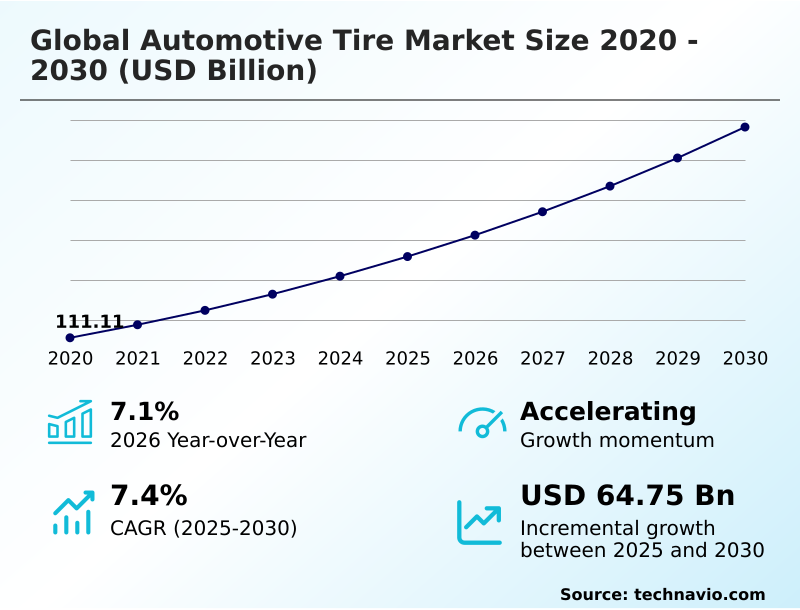
The automotive tire market size is valued to increase by USD 64.75 billion, at a CAGR of 7.4% from 2025 to 2030. Rise in sales of passenger vehicles globally will drive the automotive tire market.
Major Market Trends & Insights
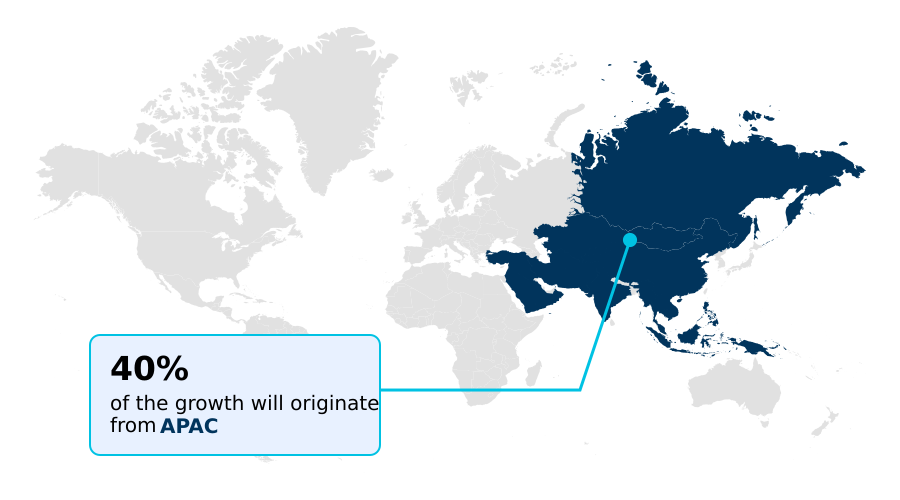
- APAC dominated the market and accounted for a 39.5% growth during the forecast period.
- By Distribution Channel - Aftermarket segment was valued at USD 102.99 billion in 2024
- By Vehicle Type - Passenger vehicle segment accounted for the largest market revenue share in 2024
Market Size & Forecast
- Market Opportunities: USD 105.36 billion
- Market Future Opportunities: USD 64.75 billion
- CAGR from 2025 to 2030 : 7.4%
Market Summary
- The automotive tire market is a cornerstone of the global transportation industry, fundamentally driven by the expansion of vehicle fleets and the continuous need for replacement components. Market dynamics are shaped by the rising sales of passenger vehicles in emerging economies and the robust logistics activities fueling demand for commercial vehicle tires.
- A key trend transforming the sector is the development of eco-friendly tires and sustainable tire materials, driven by stringent environmental regulations and consumer demand for greater fuel efficiency. Innovations such as connected tire technology and smart tire sensors are also becoming pivotal, enhancing vehicle safety and enabling predictive tire maintenance.
- For example, a logistics company integrating a tire-as-a-service (TaaS) model can optimize its supply chain logistics, reducing operational costs and ensuring compliance with safety mandates. However, the industry grapples with challenges like raw material price volatility and the environmental impact of end-of-life tire management, compelling manufacturers to invest in circular economy principles and advanced recycling technologies.
What will be the Size of the Automotive Tire Market during the forecast period?
Get Key Insights on Market Forecast (PDF) Get Free Sample
How is the Automotive Tire Market Segmented?
The automotive tire industry research report provides comprehensive data (region-wise segment analysis), with forecasts and estimates in "USD million" for the period 2026-2030, as well as historical data from 2020-2024 for the following segments.
- Distribution channel
- Aftermarket
- OEM
- Vehicle type
- Passenger vehicle
- Commercial vehicle
- Electric vehicle
- Type
- Radial tires
- Biased tires
- Geography
- APAC
- China
- Japan
- India
- Europe
- Germany
- UK
- France
- North America
- US
- Canada
- Mexico
- South America
- Brazil
- Argentina
- Middle East and Africa
- Saudi Arabia
- UAE
- South Africa
- Rest of World (ROW)
- APAC
By Distribution Channel Insights
The aftermarket segment is estimated to witness significant growth during the forecast period.
The aftermarket segment is a critical pillar of the automotive tire market, driven by recurring replacement cycles independent of new vehicle sales.
This channel serves the vast global vehicle parc, where demand is dictated by wear from road conditions, mileage, and driving habits. Consumers and fleet operators prioritize durability, tire-road friction, and total cost of ownership (TCO).
The aftermarket tire replacement process is evolving, with digitalization improving the tire distribution channel and price transparency. For instance, fleets adopting predictive tire maintenance report up to a 15% reduction in tire-related downtime.
This segment's stability is reinforced by consistent demand for passenger vehicle tires and commercial vehicle tires, alongside a growing focus on regulatory compliance and automotive safety standards.
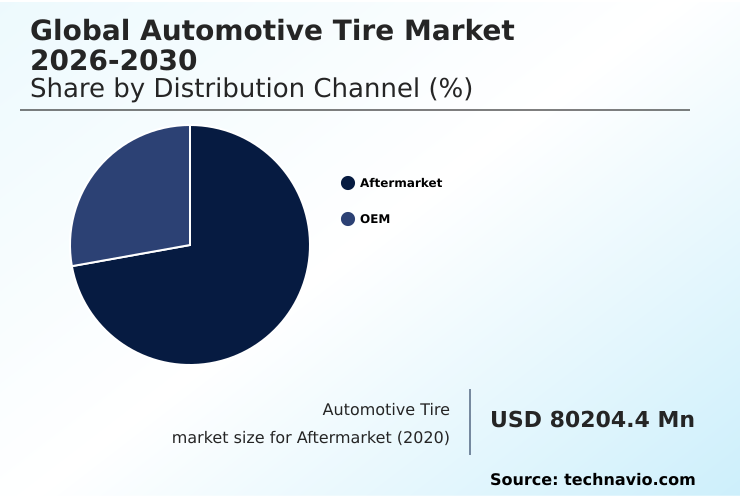
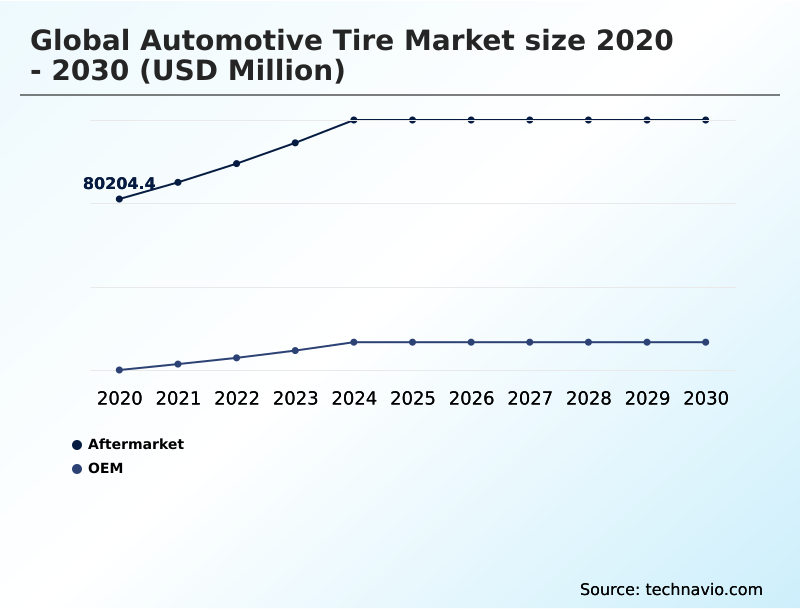
The Aftermarket segment was valued at USD 102.99 billion in 2024 and showed a gradual increase during the forecast period.
Regional Analysis
APAC is estimated to contribute 39.5% to the growth of the global market during the forecast period.Technavio’s analysts have elaborately explained the regional trends and drivers that shape the market during the forecast period.
See How Automotive Tire Market Demand is Rising in APAC Get Free Sample
The geographic landscape is characterized by diverse regional dynamics, with APAC leading market contribution, accounting for 39.5% of the incremental growth. This region's dominance is sustained by high-volume vehicle production and a strong aftermarket.
In contrast, Europe and North America are mature markets focused on high-performance tires and advanced technology, such as run-flat technology and EV-specific tires. In these regions, a 5% improvement in powertrain efficiency is a key target for new tire developments.
The integration of advanced driver-assistance systems (ADAS) is universal, but adoption rates for connected tire technology vary, with Europe showing a 15% higher integration rate in new premium vehicles than North America.
Navigating regional regulatory compliance and raw material sourcing remains a complex task for global players aiming for a balanced portfolio across these distinct markets.
Market Dynamics
Our researchers analyzed the data with 2025 as the base year, along with the key drivers, trends, and challenges. A holistic analysis of drivers will help companies refine their marketing strategies to gain a competitive advantage.
- A comprehensive analysis of the global automotive tire market reveals several critical areas of focus for stakeholders. Understanding the impact of tread pattern on wet traction is fundamental to product development, as it directly influences vehicle safety and aquaplaning resistance.
- Concurrently, the benefits of low rolling resistance tires are increasingly pivotal, especially with the rise of electric vehicles where extending battery range is a primary concern. For commercial operators, adopting best practices for commercial tire maintenance is essential for managing operational costs and maximizing asset lifespan.
- A foundational decision in manufacturing involves comparing radial vs bias-ply tire construction, with radialization now dominant in most segments due to its superior performance and durability. This is a contrast to certain niche off-road applications where bias-ply still holds ground.
- Finally, the role of smart tires in fleet management is transforming the industry from a product-centric model to a service-oriented one, offering data-driven insights that improve efficiency and safety, with some fleets reporting a 10% reduction in tire-related service calls.
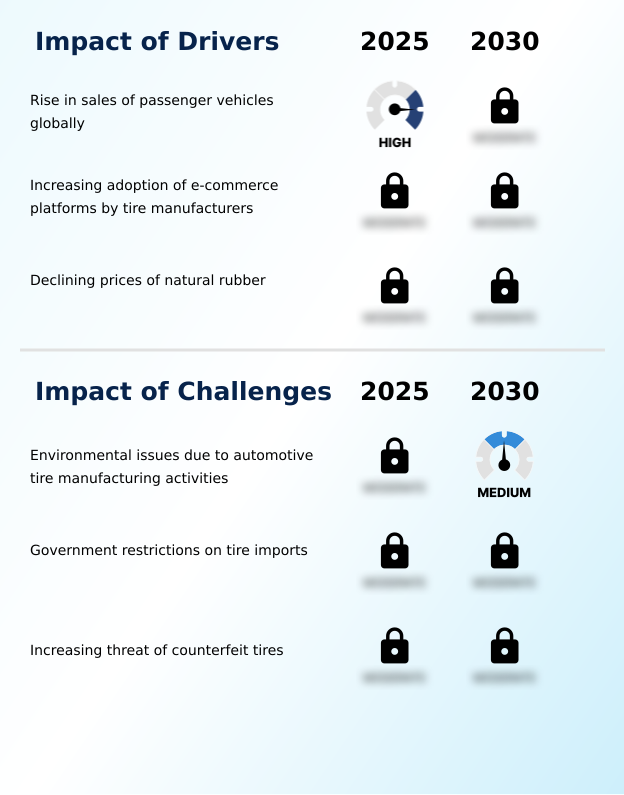
What are the key market drivers leading to the rise in the adoption of Automotive Tire Industry?
- The global rise in passenger vehicle sales is a key driver for the automotive tire market, directly fueling demand for both original equipment and replacement tires.
- The market's growth is propelled by fundamental economic and technological drivers.
- The consistent rise in global passenger vehicle sales directly fuels demand, while the increasing adoption of e-commerce by manufacturers has expanded market reach, with some brands seeing a 20% increase in direct-to-consumer sales.
- A significant operational driver is the fluctuating price of raw materials; for example, a 10% decrease in natural rubber prices can improve manufacturer margins by up to 3%. This allows for more competitive pricing and stimulates demand.
- Furthermore, the focus on powertrain efficiency and operational cost reduction in commercial fleets drives the adoption of tires with lower rolling resistance.
- The ongoing need for aftermarket tire replacement ensures a stable and recurring revenue stream, underpinning the entire industry's financial health.
What are the market trends shaping the Automotive Tire Industry?
- The development of airless tires is an emerging trend augmenting market growth. This innovation addresses longstanding issues such as punctures and pressure maintenance, enhancing vehicle safety and operational reliability.
- Key trends are reshaping the market, driven by innovations that enhance safety and sustainability. The development of airless tire technology is a significant trend, with prototypes showing a 100% elimination of puncture-related downtime in controlled tests. Concurrently, the adoption of connected tire technology enables predictive maintenance, with some fleets reporting a 15% reduction in unexpected tire failures.
- The industry is also seeing a push towards sustainable tire materials, aiming to increase the use of biodegradable polymers by up to 25% in new tire lines. These trends, including advancements in tire-as-a-service (TaaS) models and EV-specific tires, are aligned with the broader industry goals of improving operational efficiency and adhering to stricter environmental mandates.
- The focus remains on delivering tangible performance benefits through technological advancement.
What challenges does the Automotive Tire Industry face during its growth?
- Environmental issues stemming from automotive tire manufacturing activities present a key challenge, restraining industry growth through increased regulatory pressure and sustainability demands.
- The market faces considerable challenges, primarily centered on environmental impact and supply chain integrity. Environmental issues from the tire manufacturing process and end-of-life tire management have led to stricter regulations, increasing compliance management costs by an estimated 10-15% for manufacturers. These pressures drive a focus on circular economy principles and recycled rubber material.
- Simultaneously, government restrictions on imports can disrupt supply chain logistics, adding complexity and cost. A significant operational threat is the proliferation of counterfeit tires, which not only erode brand trust but also pose serious safety risks. The fight against counterfeits requires substantial investment in authentication technologies and robust compliance management, impacting overall profitability and redirecting resources from core R&D activities.
Exclusive Technavio Analysis on Customer Landscape
The automotive tire market forecasting report includes the adoption lifecycle of the market, covering from the innovator’s stage to the laggard’s stage. It focuses on adoption rates in different regions based on penetration. Furthermore, the automotive tire market report also includes key purchase criteria and drivers of price sensitivity to help companies evaluate and develop their market growth analysis strategies.
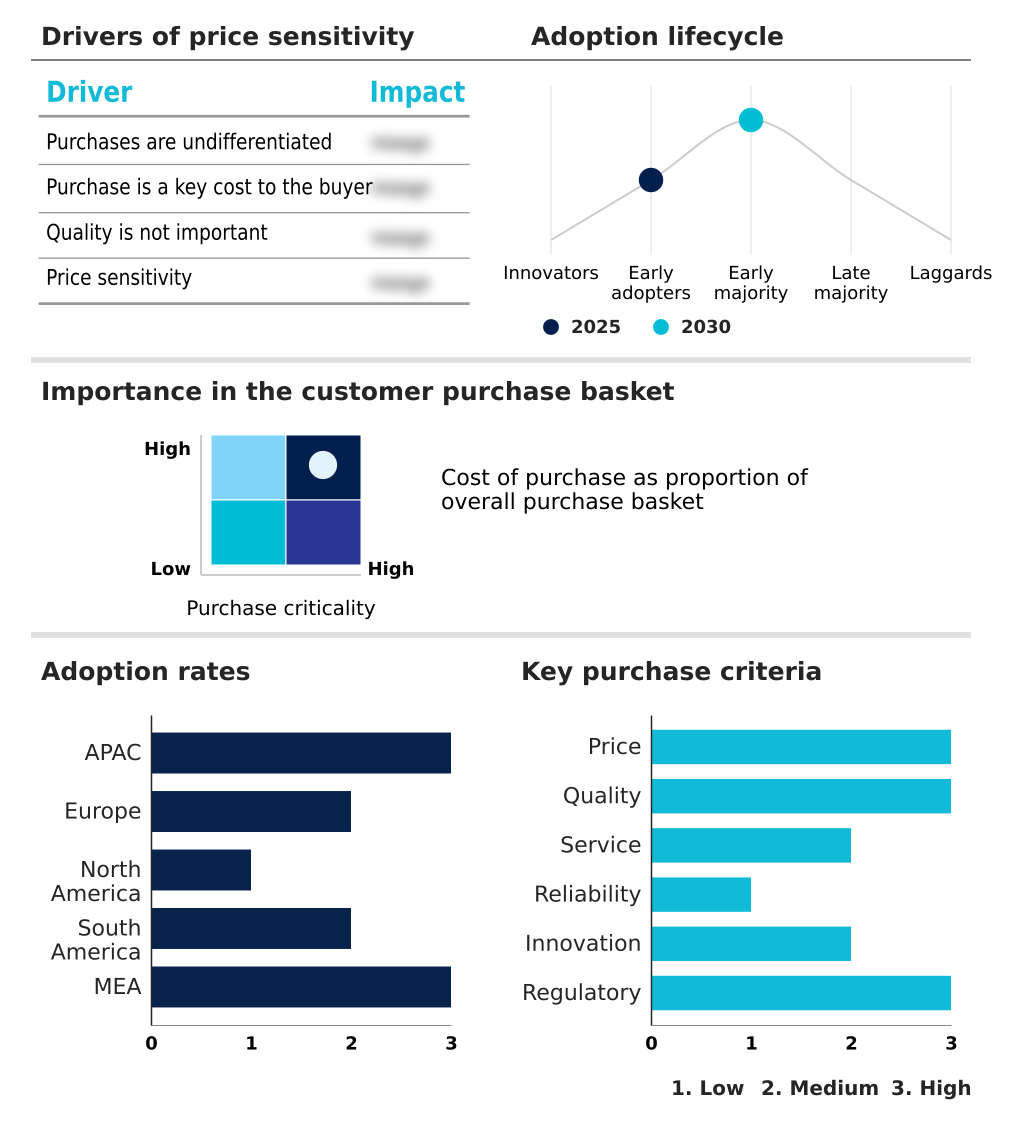
Customer Landscape of Automotive Tire Industry
Competitive Landscape
Companies are implementing various strategies, such as strategic alliances, automotive tire market forecast, partnerships, mergers and acquisitions, geographical expansion, and product/service launches, to enhance their presence in the industry.
Apollo Tyres Ltd. - The company provides a comprehensive portfolio of automotive tire solutions, focusing on performance and reliability across passenger, commercial, and specialty vehicle applications.
The industry research and growth report includes detailed analyses of the competitive landscape of the market and information about key companies, including:
- Apollo Tyres Ltd.
- Bridgestone Corp.
- CEAT Ltd.
- Continental AG
- Giti Tire Pte. Ltd.
- Goodyear Tire and Rubber Co.
- Hankook Tire and Technology Co.
- JK Tyre and Industries Ltd.
- Kumho Tire Co. Inc.
- Michelin
- MRF Ltd.
- Nokian Tyres Plc
- Pirelli and C. S.p.A.
- Sumitomo Rubber Industries Ltd.
- Toyo Tire Corp.
- Triangle Tyre Co. Ltd.
- Yokohama Rubber Co. Ltd.
- Zhongce Rubber Group Co. Ltd.
Qualitative and quantitative analysis of companies has been conducted to help clients understand the wider business environment as well as the strengths and weaknesses of key industry players. Data is qualitatively analyzed to categorize companies as pure play, category-focused, industry-focused, and diversified; it is quantitatively analyzed to categorize companies as dominant, leading, strong, tentative, and weak.
Recent Development and News in Automotive tire market
- In May, 2025, Michelin officially launched its UPTIS airless tire for select passenger vehicle models in the European market, marking a significant step toward commercializing puncture-proof technology.
- In March, 2025, Goodyear Tire and Rubber Co. announced a strategic partnership with a leading electric vehicle manufacturer to co-develop next-generation EV-specific tires designed to enhance range by 5% and reduce cabin noise.
- In January, 2025, Bridgestone Corp. completed the acquisition of a prominent fleet management software company for approximately $500 million, aiming to integrate predictive tire maintenance analytics into its tire-as-a-service (TaaS) offerings.
- In October, 2024, Continental AG received regulatory approval in North America for its new sustainable tire material, which incorporates a high percentage of biodegradable polymers and recycled rubber, reducing the tire’s lifecycle carbon footprint by 20%.
Dive into Technavio’s robust research methodology, blending expert interviews, extensive data synthesis, and validated models for unparalleled Automotive Tire Market insights. See full methodology.
| Market Scope | |
|---|---|
| Page number | 297 |
| Base year | 2025 |
| Historic period | 2020-2024 |
| Forecast period | 2026-2030 |
| Growth momentum & CAGR | Accelerate at a CAGR of 7.4% |
| Market growth 2026-2030 | USD 64749.5 million |
| Market structure | Fragmented |
| YoY growth 2025-2026(%) | 7.1% |
| Key countries | China, Japan, India, South Korea, Australia, Indonesia, Germany, UK, France, Italy, Spain, The Netherlands, US, Canada, Mexico, Brazil, Argentina, Chile, Saudi Arabia, UAE, South Africa, Israel and Turkey |
| Competitive landscape | Leading Companies, Market Positioning of Companies, Competitive Strategies, and Industry Risks |
Research Analyst Overview
- The automotive tire market is undergoing a significant transformation driven by technological innovation and evolving mobility needs. The industry's focus is shifting toward enhancing performance and sustainability through advanced material science and digital integration. Key developments include the widespread adoption of silica-based tread compounds and advanced synthetic rubber compounds to improve grip and reduce low rolling resistance.
- Innovations such as airless tire technology and run-flat technology are moving from niche applications to broader commercial viability. For electric vehicles, EV-specific tires are now a standard requirement.
- The integration of a tire pressure monitoring system (TPMS) is now a baseline, with the next evolution being smart tire sensors and connected tire technology that enable predictive tire maintenance and support advanced driver-assistance systems (ADAS). Tire-as-a-service (TaaS) models are gaining traction in commercial fleets, optimizing tire usage and maintenance schedules.
- The vulcanization process itself is being refined for greater efficiency, while the use of biodegradable polymers and other sustainable tire materials addresses environmental concerns. High-performance tires with asymmetric tread pattern designs continue to cater to the enthusiast segment, offering superior hydroplaning resistance. These advancements collectively signal a shift toward more intelligent, efficient, and sustainable tire solutions.
What are the Key Data Covered in this Automotive Tire Market Research and Growth Report?
-
What is the expected growth of the Automotive Tire Market between 2026 and 2030?
-
USD 64.75 billion, at a CAGR of 7.4%
-
-
What segmentation does the market report cover?
-
The report is segmented by Distribution Channel (Aftermarket, and OEM), Vehicle Type (Passenger vehicle, Commercial vehicle, and Electric vehicle), Type (Radial tires, and Biased tires) and Geography (APAC, Europe, North America, South America, Middle East and Africa)
-
-
Which regions are analyzed in the report?
-
APAC, Europe, North America, South America and Middle East and Africa
-
-
What are the key growth drivers and market challenges?
-
Rise in sales of passenger vehicles globally, Environmental issues due to automotive tire manufacturing activities
-
-
Who are the major players in the Automotive Tire Market?
-
Apollo Tyres Ltd., Bridgestone Corp., CEAT Ltd., Continental AG, Giti Tire Pte. Ltd., Goodyear Tire and Rubber Co., Hankook Tire and Technology Co., JK Tyre and Industries Ltd., Kumho Tire Co. Inc., Michelin, MRF Ltd., Nokian Tyres Plc, Pirelli and C. S.p.A., Sumitomo Rubber Industries Ltd., Toyo Tire Corp., Triangle Tyre Co. Ltd., Yokohama Rubber Co. Ltd. and Zhongce Rubber Group Co. Ltd.
-
Market Research Insights
- Market dynamics are increasingly influenced by the pursuit of operational efficiency and adherence to stringent automotive safety standards. The adoption of advanced solutions directly impacts total cost of ownership (TCO), with fleets leveraging predictive maintenance reporting a 15% improvement in tire lifecycle management.
- Furthermore, the integration of specialized commercial vehicle tires designed for lower rolling resistance can contribute to a 3-5% enhancement in fuel efficiency rating. A key shift is occurring in the tire distribution channel, where digital platforms now account for over 20% of aftermarket tire replacement sales in several key regions.
- This move toward e-commerce improves pricing transparency and consumer access, reshaping traditional supply chain logistics. Navigating complex tire labeling regulations and OEM tire specifications remains a critical focus for manufacturers aiming to maintain a competitive edge.
We can help! Our analysts can customize this automotive tire market research report to meet your requirements.
 RIA -
RIA -