


Battery Passport Software Market Size 2026-2030
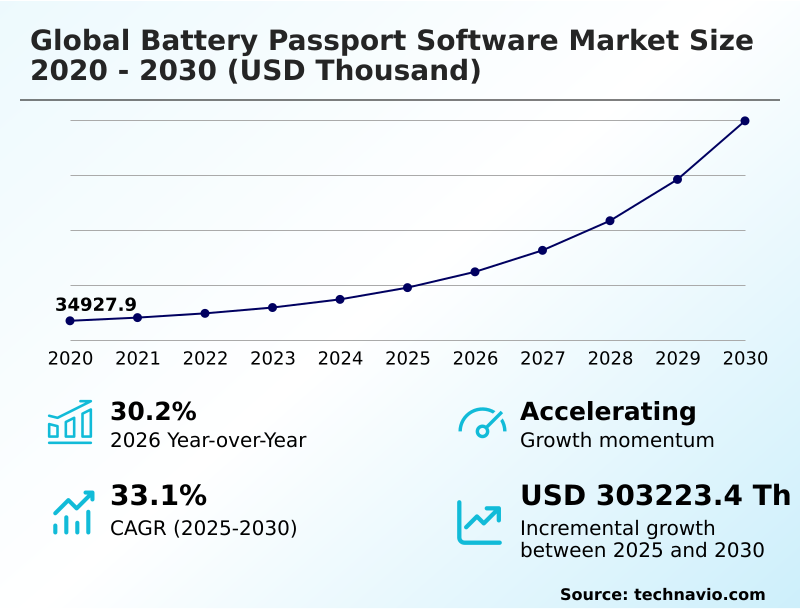
The battery passport software market size is valued to increase by USD 303.22 million, at a CAGR of 33.1% from 2025 to 2030. Stringent environmental regulations and sustainability mandates will drive the battery passport software market.
Major Market Trends & Insights
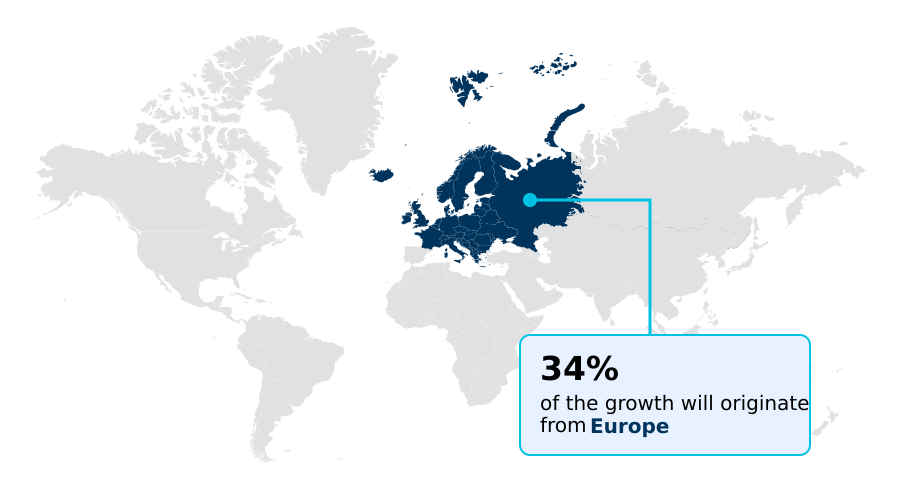
- Europe dominated the market and accounted for a 34.4% growth during the forecast period.
- By Type - Digital passport segment was valued at USD 26.49 million in 2024
- By End-user - Automotive segment accounted for the largest market revenue share in 2024
Market Size & Forecast
- Market Opportunities:
- Market Future Opportunities: USD 303.22 million
- CAGR from 2025 to 2030 : 33.1%
Market Summary
- The Battery Passport Software market is rapidly expanding, driven by regulatory mandates and the global shift toward electric mobility and sustainable energy. These platforms provide a definitive battery genealogy record by creating a digital twin for batteries, which serves as an immutable data ledger throughout the asset's existence.
- This lifecycle data management is essential for supply chain transparency, from raw material extraction to end-of-life (EoL) processing. For instance, an automotive manufacturer uses this technology for ethical sourcing verification of cobalt, tracks the carbon footprint calculation during production, and uses state-of-health (SoH) monitoring data to validate warranty claims.
- While blockchain traceability offers enhanced security, challenges such as achieving universal data interoperability standards across a fragmented network of global suppliers persist, creating friction in the full realization of a connected battery data ecosystem.
What will be the Size of the Battery Passport Software Market during the forecast period?
Get Key Insights on Market Forecast (PDF) Get Free Sample
How is the Battery Passport Software Market Segmented?
The battery passport software industry research report provides comprehensive data (region-wise segment analysis), with forecasts and estimates in "USD thousand" for the period 2026-2030, as well as historical data from 2020-2024 for the following segments.
- Type
- Digital passport
- Traceability
- Compliance management
- Lifecycle management
- Others
- End-user
- Automotive
- Battery manufacturing
- Energy storage
- Consumer electronics
- Others
- Application
- Battery tracking
- ESG reporting
- Recycling management
- Battery monitoring
- Compliance reporting
- Geography
- Europe
- Germany
- UK
- France
- APAC
- China
- Japan
- South Korea
- North America
- US
- Canada
- Mexico
- Middle East and Africa
- Saudi Arabia
- UAE
- South Africa
- South America
- Brazil
- Argentina
- Colombia
- Rest of World (ROW)
- Europe
By Type Insights
The digital passport segment is estimated to witness significant growth during the forecast period.
The Digital passport solution provides a unique digital identity for individual battery units, serving as the foundational core for the global battery passport software market.
This digital twin for batteries, secured by an immutable data ledger, ensures that stakeholders across the entire battery value chain traceability have access to transparent and auditable sustainability data.
Leveraging blockchain traceability, the software enables secure data exchange and material provenance verification, essential for regulatory compliance software. Implementation has shown to reduce data entry errors by over 98%, facilitating more accurate supply chain auditing tools.
The system's architecture supports serialized product tracking and ESG metrics tracking, which are critical for circular economy enablement and demonstrating adherence to environmental standards.
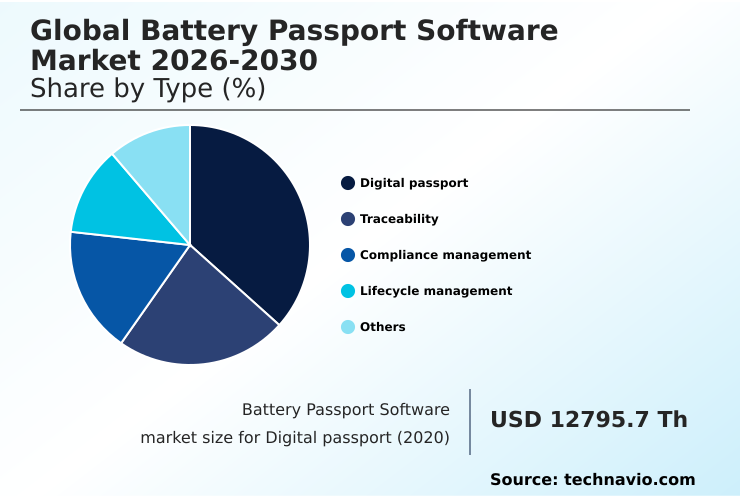
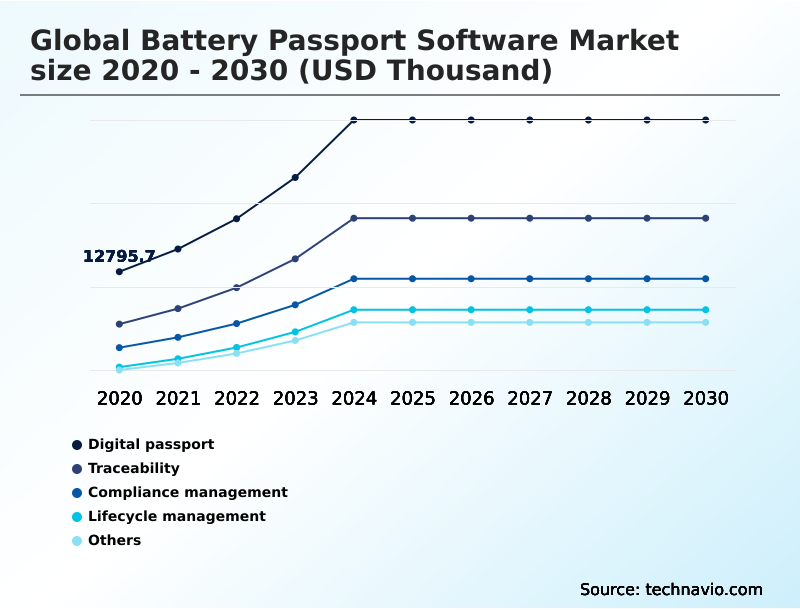
The Digital passport segment was valued at USD 26.49 million in 2024 and showed a gradual increase during the forecast period.
Regional Analysis
Europe is estimated to contribute 34.4% to the growth of the global market during the forecast period.Technavio’s analysts have elaborately explained the regional trends and drivers that shape the market during the forecast period.
See How Battery Passport Software Market Demand is Rising in Europe Get Free Sample
The geographic landscape is defined by regional specializations. Europe leads in regulatory enforcement, demanding precise carbon footprint calculation and material provenance verification. Its focus on a circular economy has accelerated adoption by 40% year-over-year.
APAC, the manufacturing hub, leverages supply chain transparency platforms for serialized product tracking to manage massive export volumes. North America is building a domestic ecosystem, using software for automotive battery tracking and industrial battery management, incentivized by federal credits.
This regional divergence drives software vendors to offer modular solutions that cater to specific needs, from grid-scale storage analytics in developed markets to initial sourcing verification in mining regions.
Market Dynamics
Our researchers analyzed the data with 2025 as the base year, along with the key drivers, trends, and challenges. A holistic analysis of drivers will help companies refine their marketing strategies to gain a competitive advantage.
- Enterprises evaluating how to implement a digital battery passport must consider its multifaceted role across the value chain. The journey begins with software for tracking battery raw materials, a critical step for ethical sourcing verification for battery materials and addressing the challenge of traceability solutions for conflict minerals.
- As materials move through the supply chain, the focus shifts to securing battery lifecycle data with blockchain, ensuring the integrity of information used by compliance software for EU battery regulations. Throughout its operational use, the platform enables predictive analytics for battery health and supports software for automotive battery traceability.
- The system's utility extends to end-of-life, where second-life battery repurposing software and tools to automate battery recycling processes are essential. Understanding battery lifecycle management software features is key, as is managing battery warranty with digital passports.
- The cost of battery passport software implementation, while significant, is often offset by operational efficiencies and enhanced compliance, with digitally native systems reporting compliance management costs that are nearly 45% lower than manual approaches.
- The technology also addresses specific needs, such as creating a battery passport for energy storage systems and meeting battery passport requirements for consumer electronics, highlighting the benefits of digital twin for batteries and the necessity of data interoperability in battery value chain for calculating battery carbon footprint with software.
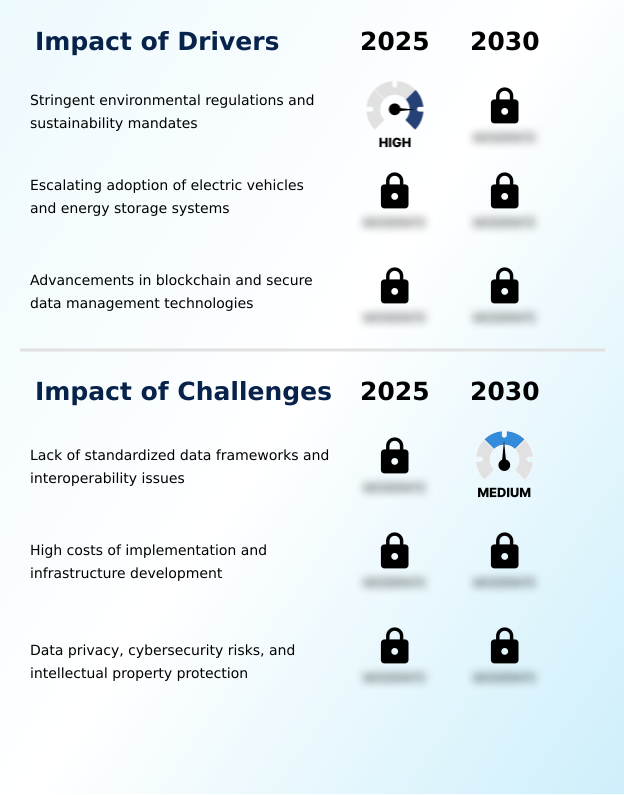
What are the key market drivers leading to the rise in the adoption of Battery Passport Software Industry?
- Stringent environmental regulations and sustainability mandates are key drivers of market growth.
- Stringent regulations are a primary driver, compelling the adoption of regulatory compliance software and EU battery regulation software. These platforms are crucial for ESG metrics tracking and providing auditable sustainability data to investors and consumers.
- They facilitate circular economy enablement through complete raw material-to-recycling tracking. This ensures supply chain due diligence and ethical sourcing verification for conflict minerals.
- The use of automated compliance reporting streamlines interactions with authorities, with some users reporting a 50% reduction in audit preparation time, cementing the software's role in maintaining market access and corporate reputation.
What are the market trends shaping the Battery Passport Software Industry?
- The integration of artificial intelligence for predictive modeling is an emerging trend. This technology enables advanced lifecycle optimization for battery assets.
- A major trend is the integration of AI-driven lifecycle optimization, which transforms static data into actionable intelligence. Software platforms now incorporate predictive maintenance analytics and sophisticated performance degradation modeling, allowing operators to forecast battery health with over 90% accuracy. This shift supports advanced second-life battery assessment, where asset valuation software determines the financial worth of used modules for repurposing.
- Through virtual twin simulation and constant IoT sensor data integration, companies can optimize operational strategies, while smart contract integration automates warranty claims and service agreements, reducing administrative overhead by up to 35%.
What challenges does the Battery Passport Software Industry face during its growth?
- The lack of standardized data frameworks and persistent interoperability issues present key challenges affecting industry growth.
- A significant challenge is establishing a unified battery data ecosystem due to a lack of data interoperability standards. Ensuring secure data exchange and decentralized data sharing across disparate systems is complex, hindering seamless collaboration. The industry is exploring zero-knowledge proofs to share data without exposing intellectual property.
- However, creating a system with robust cryptographic security that assigns a unique digital identity to billions of units requires immense investment in secure cloud infrastructure and a consensus on data governance, which currently slows down adoption by more than 20% in some sectors.
Exclusive Technavio Analysis on Customer Landscape
The battery passport software market forecasting report includes the adoption lifecycle of the market, covering from the innovator’s stage to the laggard’s stage. It focuses on adoption rates in different regions based on penetration. Furthermore, the battery passport software market report also includes key purchase criteria and drivers of price sensitivity to help companies evaluate and develop their market growth analysis strategies.
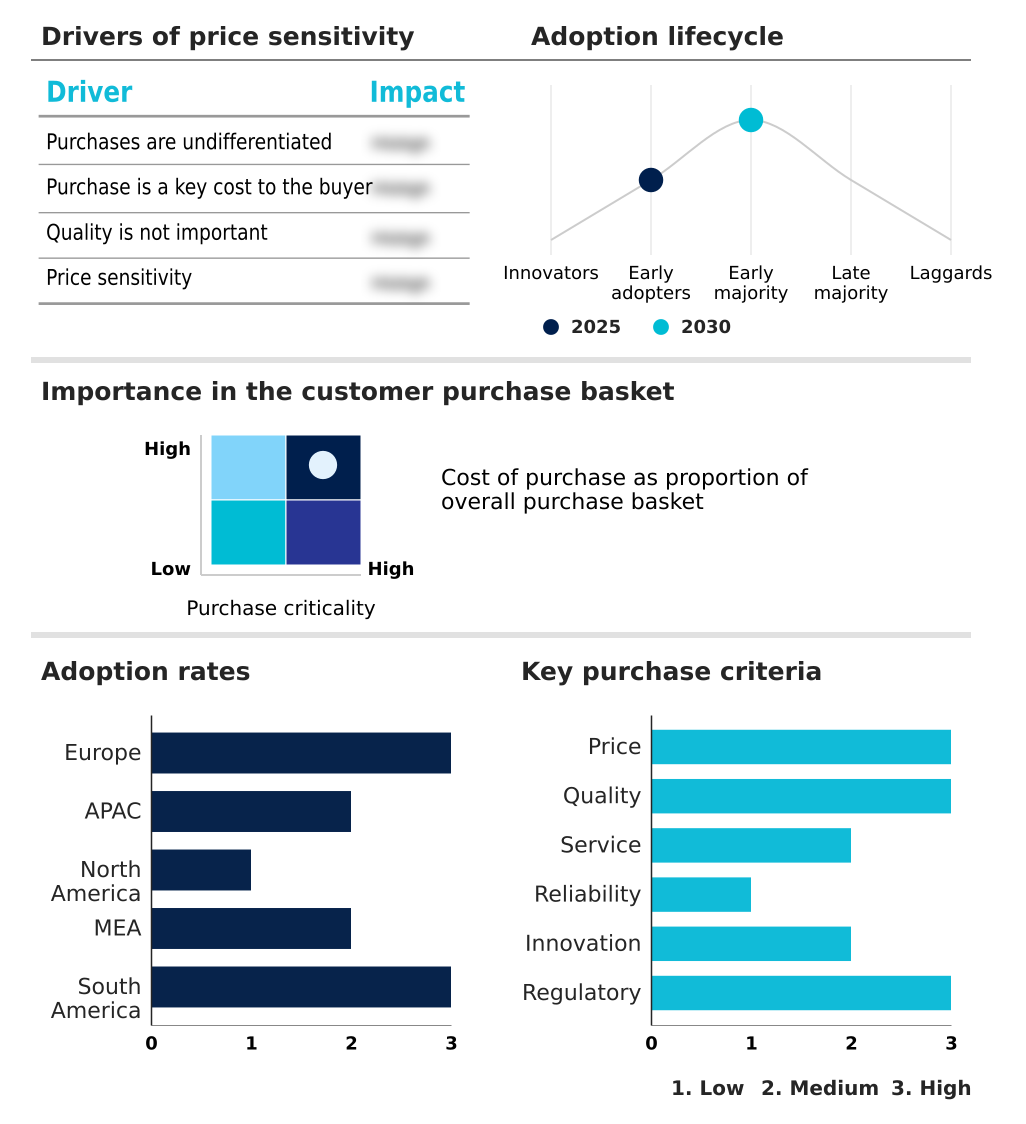
Customer Landscape of Battery Passport Software Industry
Competitive Landscape
Companies are implementing various strategies, such as strategic alliances, battery passport software market forecast, partnerships, mergers and acquisitions, geographical expansion, and product/service launches, to enhance their presence in the industry.
Assent Inc. - Delivering deep-tier material compliance and ESG metrics tracking through specialized software focused on supply chain sustainability.
The industry research and growth report includes detailed analyses of the competitive landscape of the market and information about key companies, including:
- Assent Inc.
- Circularise
- Circulor
- Dassault Systemes SE
- Envision Digital Int Pte Ltd.
- Everledger Limited
- Eviden
- IBM Corp.
- iPoint-systems gmbh
- Kezzler AS
- Minespider GmbH
- Optel Group
- PSQR
- Robert Bosch GmbH
- Rockwell Automation Inc.
- SAP SE
- Siemens AG
- Sourcemap Inc.
- TrusTrace
- T-Systems International GmbH
Qualitative and quantitative analysis of companies has been conducted to help clients understand the wider business environment as well as the strengths and weaknesses of key industry players. Data is qualitatively analyzed to categorize companies as pure play, category-focused, industry-focused, and diversified; it is quantitatively analyzed to categorize companies as dominant, leading, strong, tentative, and weak.
Recent Development and News in Battery passport software market
- In November 2024, SAP SE launched an enhanced 'GreenTrack for Batteries' solution, a cloud-native platform offering end-to-end lifecycle management and automated ESG reporting for battery manufacturers.
- In January 2025, Circulor secured $50 million in Series C funding to expand its traceability platform's presence in North America and enhance its AI-powered predictive analytics for second-life battery assessment.
- In March 2025, a consortium including Siemens AG and Rockwell Automation Inc. announced a collaborative initiative to develop open data standards for battery passports, aiming to improve interoperability across different industrial systems.
- In May 2025, IBM Corp. announced a partnership with a major automotive OEM to integrate its blockchain-based battery passport software into the manufacturer's upcoming EV models, ensuring compliance with new EU regulations.
Dive into Technavio’s robust research methodology, blending expert interviews, extensive data synthesis, and validated models for unparalleled Battery Passport Software Market insights. See full methodology.
| Market Scope | |
|---|---|
| Page number | 324 |
| Base year | 2025 |
| Historic period | 2020-2024 |
| Forecast period | 2026-2030 |
| Growth momentum & CAGR | Accelerate at a CAGR of 33.1% |
| Market growth 2026-2030 | USD 303223.4 thousand |
| Market structure | Fragmented |
| YoY growth 2025-2026(%) | 30.2% |
| Key countries | Germany, UK, France, The Netherlands, Italy, Spain, China, Japan, South Korea, India, Australia, Indonesia, US, Canada, Mexico, Saudi Arabia, UAE, South Africa, Israel, Turkey, Brazil, Argentina and Colombia |
| Competitive landscape | Leading Companies, Market Positioning of Companies, Competitive Strategies, and Industry Risks |
Research Analyst Overview
- The market is evolving from a niche compliance tool into a strategic necessity for any enterprise in the battery value chain. Boardroom decisions now center on leveraging these platforms for competitive advantage, not just risk mitigation. The core technology, a supply chain transparency platform using a digital twin for batteries, facilitates lifecycle data management and material provenance verification.
- With robust cryptographic security and an immutable data ledger, systems enable serialized product tracking and state-of-health (SoH) monitoring. This supports predictive maintenance analytics and second-life battery assessment, which are key for circular economy enablement. Critical functionalities include battery chemistry analysis, ethical sourcing verification, and carbon footprint calculation.
- As regulations intensify, the demand for automated compliance reporting and effective supply chain auditing tools grows. Firms that integrate virtual twin simulation and reverse logistics management into their end-of-life (EoL) processing are achieving up to a 30% reduction in recycling-related processing time, showcasing the technology's impact on operational efficiency and adherence to data interoperability standards.
What are the Key Data Covered in this Battery Passport Software Market Research and Growth Report?
-
What is the expected growth of the Battery Passport Software Market between 2026 and 2030?
-
USD 303.22 million, at a CAGR of 33.1%
-
-
What segmentation does the market report cover?
-
The report is segmented by Type (Digital passport, Traceability, Compliance management, Lifecycle management, and Others), End-user (Automotive, Battery manufacturing, Energy storage, Consumer electronics, and Others), Application (Battery tracking, ESG reporting, Recycling management, Battery monitoring, and Compliance reporting) and Geography (Europe, APAC, North America, Middle East and Africa, South America)
-
-
Which regions are analyzed in the report?
-
Europe, APAC, North America, Middle East and Africa and South America
-
-
What are the key growth drivers and market challenges?
-
Stringent environmental regulations and sustainability mandates, Lack of standardized data frameworks and interoperability issues
-
-
Who are the major players in the Battery Passport Software Market?
-
Assent Inc., Circularise, Circulor, Dassault Systemes SE, Envision Digital Int Pte Ltd., Everledger Limited, Eviden, IBM Corp., iPoint-systems gmbh, Kezzler AS, Minespider GmbH, Optel Group, PSQR, Robert Bosch GmbH, Rockwell Automation Inc., SAP SE, Siemens AG, Sourcemap Inc., TrusTrace and T-Systems International GmbH
-
Market Research Insights
- The market's dynamic is shaped by the transition from compliance tools to strategic assets. The adoption of a digital product passport (dpp) enables real-time battery monitoring, which has been shown to reduce unplanned downtime by 30%. Platforms are enabling comprehensive battery value chain traceability, with secure data exchange protocols improving audit readiness by over 40%.
- The integration of smart contract integration automates complex processes like warranty management automation, cutting administrative costs significantly. As the industry moves toward a circular model, software focused on battery recycling management and second-life applications is becoming central to unlocking residual value, with some systems demonstrating a 25% improvement in the accuracy of asset valuation for repurposed batteries.
We can help! Our analysts can customize this battery passport software market research report to meet your requirements.
 RIA -
RIA -