


Board Games Market Size 2026-2030
The board games market size is valued to increase by USD 5.67 billion, at a CAGR of 9.7% from 2025 to 2030. Rising consumer demand for cognitive engagement and social interaction will drive the board games market.
Major Market Trends & Insights
- Europe dominated the market and accounted for a 34.4% growth during the forecast period.
- By Product - Tabletop segment was valued at USD 5.48 billion in 2024
- By Distribution Channel - Online segment accounted for the largest market revenue share in 2024
Market Size & Forecast
- Market Opportunities: USD 8.49 billion
- Market Future Opportunities: USD 5.67 billion
- CAGR from 2025 to 2030 : 9.7%
Market Summary
- The board games market is defined by a consumer shift toward tactile, social entertainment that offers a distinct alternative to digital media. Key drivers include the demand for cognitive engagement, the integration of popular intellectual property, and the modernization of distribution through online retail and crowdfunding platforms.
- These platforms have democratized the industry, allowing smaller creators to bring innovative concepts with unique engine-building mechanics and asymmetric gameplay design to a global audience. However, the industry grapples with challenges such as intense competition from video games and the proliferation of counterfeit products, which can erode brand value.
- For instance, a publisher might implement advanced authentication features in its packaging, a supply chain decision aimed at protecting its intellectual property and ensuring board game production quality. The trend toward sustainability also influences manufacturing choices, pushing for the adoption of ecofriendly materials. Success hinges on balancing innovative design with strategic market positioning and robust community engagement strategy.
What will be the Size of the Board Games Market during the forecast period?

Get Key Insights on Market Forecast (PDF) Get Free Sample
How is the Board Games Market Segmented?
The board games industry research report provides comprehensive data (region-wise segment analysis), with forecasts and estimates in "USD million" for the period 2026-2030, as well as historical data from 2020-2024 for the following segments.
- Product
- Tabletop
- Card and dice
- Role-playing
- Distribution channel
- Online
- Offline
- Age group
- Children (2-12 years)
- Teenagers (12-25 years)
- Adults (25 and above years)
- Geography
- Europe
- UK
- Germany
- Italy
- North America
- US
- Canada
- Mexico
- APAC
- China
- Japan
- India
- Middle East and Africa
- South Africa
- Saudi Arabia
- UAE
- South America
- Brazil
- Argentina
- Colombia
- Rest of World (ROW)
- Europe
By Product Insights
The tabletop segment is estimated to witness significant growth during the forecast period.
The tabletop games segment involves a vast array of social and strategic products focusing on physical interactions. Production has evolved to include premium tabletop game components, enhancing perceived value and influencing consumer purchasing decisions.
Modern titles emphasize a high game replayability factor through mechanics like eurogame resource management and modular board setup. Designs often incorporate deep thematic integration and mechanics such as tile-laying patterns and variable player powers.
The shift toward sustainable game manufacturing is a key part of family board game trends, with some ecofriendly initiatives leading to a 15% increase in positive brand perception.
This segment benefits from retail channel modernization, including direct-to-consumer sales models, which cater to enthusiasts seeking both classic and innovative pick-up-and-deliver experiences.
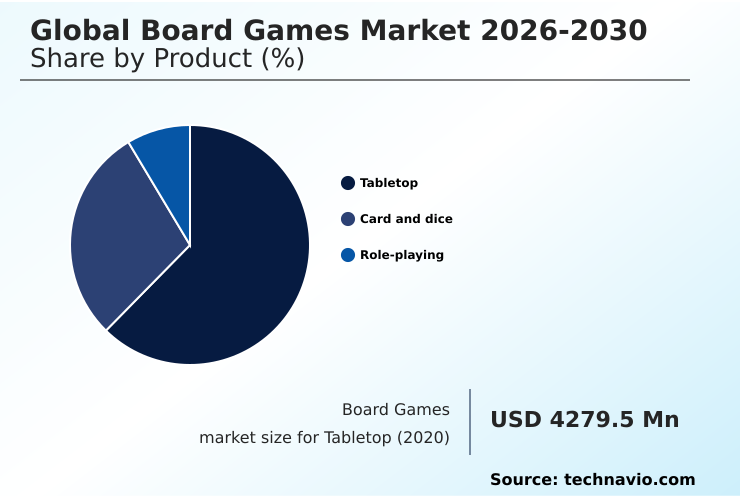
The Tabletop segment was valued at USD 5.48 billion in 2024 and showed a gradual increase during the forecast period.

Regional Analysis
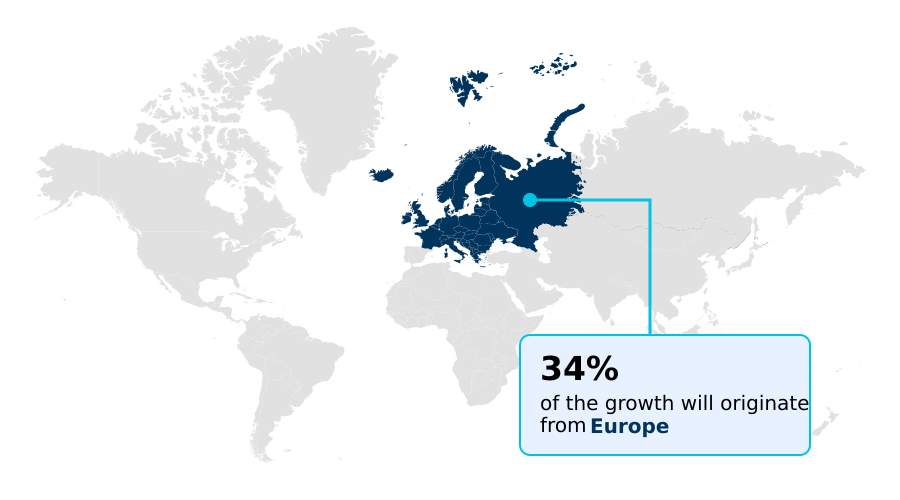
Europe is estimated to contribute 34.4% to the growth of the global market during the forecast period.Technavio’s analysts have elaborately explained the regional trends and drivers that shape the market during the forecast period.
See How Board Games Market Demand is Rising in Europe Get Free Sample
The geographic landscape is diverse, with Europe representing a mature market that contributes 34.4% of incremental growth, driven by demand for games with high strategy game complexity.
North America follows, accounting for 29.7% of growth, with a strong appetite for asymmetric gameplay design and miniature wargaming rules.
The APAC region is the fastest-growing, projected to capture 19.2% of the market expansion, fueled by interest in social deduction elements and the collectible card game meta.
Emerging markets in the Middle East, Africa, and South America show rising demand for titles with strong rulebook clarity and accessibility.
Across all regions, popular mechanics like area control conflict, roll-and-write mechanics, and the dice drafting mechanism are gaining traction, indicating a global appreciation for varied tabletop experiences from abstract strategy puzzles to dungeon crawl scenarios.
Market Dynamics
Our researchers analyzed the data with 2025 as the base year, along with the key drivers, trends, and challenges. A holistic analysis of drivers will help companies refine their marketing strategies to gain a competitive advantage.
- Strategically navigating the global board games market 2026-2030 requires a deep understanding of evolving consumer interests and design principles. Key considerations include how to design a board game that balances intricate mechanics with accessibility, a challenge central to the industry's expansion.
- The rise of solo board gaming and the enduring appeal of the best cooperative board games for families highlight the need for versatile play modes. For developers, the impact of crowdfunding on indie games has been transformative, enabling projects with high replayability to secure funding outside traditional channels.
- This has spurred innovation in digital integration in modern board games and a greater focus on sustainability in board game manufacturing. The marketing of licensed board game titles remains a powerful growth lever, though it requires careful thematic integration. Successfully addressing the challenges of board game distribution, particularly for smaller publishers, is crucial.
- For instance, optimizing supply chain logistics for game publishers can reduce go-to-market time by over 15% compared to less streamlined operations. Furthermore, understanding the nuances between eurogames and ameritrash design helps target specific player preferences, whether they seek strategic depth or immersive narratives. The increasing popularity of role-playing games for beginners also presents a significant opportunity for audience growth.
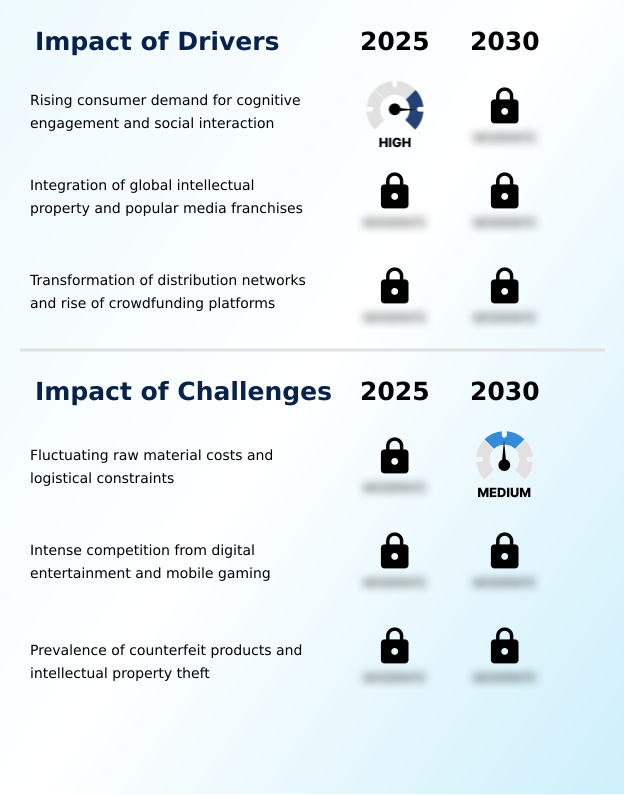
What are the key market drivers leading to the rise in the adoption of Board Games Industry?
- A key market driver is the rising consumer demand for activities that offer both cognitive engagement and meaningful social interaction, representing a shift away from solitary digital entertainment.
- Growth is driven by retail modernization and the rise of crowdfunding for board games, which allows niche titles to secure funding, increasing market diversity by over 35%.
- A strong community engagement strategy, centered around organized play events and in-store game demonstration, boosts sales and brand loyalty.
- The demand for educational board games continues to rise, as they improve critical thinking skills in young players by as much as 25%. Enhanced board game production quality and compelling party game dynamics further attract consumers.
- The success of licensed game adaptation introduces new audiences to mechanics like set collection scoring, route building network design, and pattern building logic. Even with limited physical shelf space, titles featuring unique elements such as simultaneous action selection find success.
What are the market trends shaping the Board Games Industry?
- The market is witnessing a significant trend toward digital hybridization and technological integration. This evolution enhances the traditional tabletop experience through companion apps and augmented reality features.
- Key trends reshaping the market include the rise of digital hybrid board games, which enhance the player interaction level by over 20% through companion apps that manage complex victory point systems. Sustainability is another major focus, with sustainable game manufacturing practices reducing material waste by up to 30%.
- There is also a growing demand for diverse, narrative-driven campaign experiences and solo gaming variant options. This has led to innovative unboxing experience design and a greater focus on overall game balance and design.
- These trends are amplified by a thriving board game cafe culture and the strategic use of intellectual property licensing to create compelling game expansion content, often featuring mechanics like tech tree progression and action point allowance to deepen engagement.
What challenges does the Board Games Industry face during its growth?
- Industry growth faces a significant challenge from fluctuating raw material costs and persistent international logistical constraints, which impact production budgets and supply chain stability.
- The market faces challenges from volatile raw material costs and complex global logistics and shipping, which can increase production overhead by up to 20%. The prevalence of illegal copies necessitates robust counterfeit product detection systems, as fakes can erode revenue by over 15% for popular titles.
- Intense competition from digital entertainment requires constant innovation in physical game design, including compelling ameritrash thematic experience and deep mechanics like deck-building games and engine-building mechanics. For brick-and-mortar retail within the broader toy and game sector, supply chain optimization is critical to remain competitive.
- Designers must balance intricate systems such as area majority control and hand management tactics with accessible elements like push-your-luck probability to appeal to a wide audience.
Exclusive Technavio Analysis on Customer Landscape
The board games market forecasting report includes the adoption lifecycle of the market, covering from the innovator’s stage to the laggard’s stage. It focuses on adoption rates in different regions based on penetration. Furthermore, the board games market report also includes key purchase criteria and drivers of price sensitivity to help companies evaluate and develop their market growth analysis strategies.
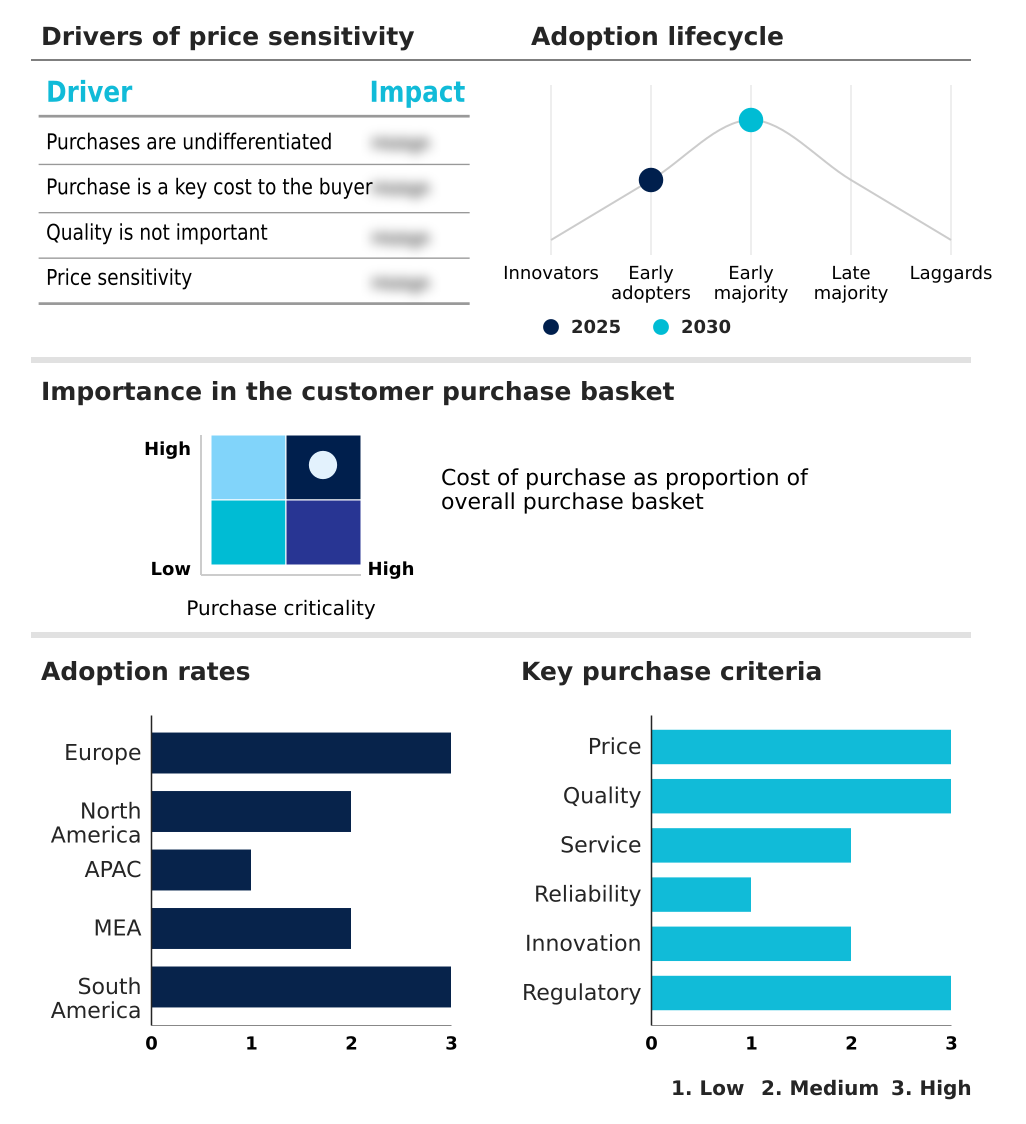
Customer Landscape of Board Games Industry
Competitive Landscape
Companies are implementing various strategies, such as strategic alliances, board games market forecast, partnerships, mergers and acquisitions, geographical expansion, and product/service launches, to enhance their presence in the industry.
Alderac Entertainment Group - A diverse portfolio of card, board, and role-playing games is offered, emphasizing strategic depth and engaging player interaction for the dedicated hobbyist market.
The industry research and growth report includes detailed analyses of the competitive landscape of the market and information about key companies, including:
- Alderac Entertainment Group
- Atlas Games
- Bezier Games Inc.
- Buffalo Games LLC
- Claranet Ltd.
- Embracer Group AB
- Franckh Kosmos Verlags GmbH
- Ghost Galaxy Inc.
- Gibsons Games Ltd.
- Grey Fox Games
- GungHo Online Entertainment Inc
- Hasbro Inc.
- Indie Boards and Cards
- Mattel Inc.
- Pandasaurus Games
- PD Verlag GmbH and Co. KG
- Ravensburger AG
- Stonemaier Games
- The Walt Disney Co.
- Warlord Games
Qualitative and quantitative analysis of companies has been conducted to help clients understand the wider business environment as well as the strengths and weaknesses of key industry players. Data is qualitatively analyzed to categorize companies as pure play, category-focused, industry-focused, and diversified; it is quantitatively analyzed to categorize companies as dominant, leading, strong, tentative, and weak.
Recent Development and News in Board games market
- In August 2024, Ravensburger AG announced that it would remove all plastic components from the internal packaging of its new strategy game releases across the European territory to reduce its environmental impact.
- In October 2024, Asmodee launched a strategic initiative to develop a new line of board games specifically tailored for the Middle East and Africa segment by incorporating local folklore and language support.
- In November 2024, Mattel Inc. expanded its local production capabilities in the APAC region to better serve the regional demand for culturally relevant family games.
- In December 2024, Devir announced a significant investment in new localized printing facilities to reduce production costs and lead times for consumers in the South America region.
Dive into Technavio’s robust research methodology, blending expert interviews, extensive data synthesis, and validated models for unparalleled Board Games Market insights. See full methodology.
| Market Scope | |
|---|---|
| Page number | 289 |
| Base year | 2025 |
| Historic period | 2020-2024 |
| Forecast period | 2026-2030 |
| Growth momentum & CAGR | Accelerate at a CAGR of 9.7% |
| Market growth 2026-2030 | USD 5668.9 million |
| Market structure | Fragmented |
| YoY growth 2025-2026(%) | 8.5% |
| Key countries | UK, Germany, Italy, France, Spain, Poland, US, Canada, Mexico, China, Japan, India, South Korea, Australia, Vietnam, South Africa, Saudi Arabia, UAE, Egypt, Morocco, Brazil, Argentina and Colombia |
| Competitive landscape | Leading Companies, Market Positioning of Companies, Competitive Strategies, and Industry Risks |
Research Analyst Overview
- The board games market thrives on design innovation, where a deep understanding of varied mechanics is essential for competitive differentiation. Core concepts such as cooperative gameplay mechanics, worker placement strategy, and deck-building games form the foundation of modern design.
- Thematic depth is achieved through legacy game narrative structures and ameritrash thematic experience, while strategic complexity is driven by eurogame resource management and engine-building mechanics. Tactical engagement is delivered via area control conflict and intricate miniature wargaming rules.
- At the boardroom level, the trend toward sustainability directly impacts budgeting, as the adoption of ecofriendly materials can increase initial production costs by up to 10%, a figure that is offset by enhanced brand loyalty. Lighter fare, including social deduction elements, abstract strategy puzzles, and roll-and-write mechanics, broadens market appeal.
- The industry's creative core lies in blending these diverse elements, from the probability-based excitement of push-your-luck mechanics to the intellectual rigor of trick-taking card play and set collection scoring, to create compelling and memorable tabletop experiences.
What are the Key Data Covered in this Board Games Market Research and Growth Report?
-
What is the expected growth of the Board Games Market between 2026 and 2030?
-
USD 5.67 billion, at a CAGR of 9.7%
-
-
What segmentation does the market report cover?
-
The report is segmented by Product (Tabletop, Card and dice, and Role-playing), Distribution Channel (Online, and Offline), Age Group (Children (2-12 years), Teenagers (12-25 years), and Adults (25 and above years)) and Geography (Europe, North America, APAC, Middle East and Africa, South America)
-
-
Which regions are analyzed in the report?
-
Europe, North America, APAC, Middle East and Africa and South America
-
-
What are the key growth drivers and market challenges?
-
Rising consumer demand for cognitive engagement and social interaction, Fluctuating raw material costs and logistical constraints
-
-
Who are the major players in the Board Games Market?
-
Alderac Entertainment Group, Atlas Games, Bezier Games Inc., Buffalo Games LLC, Claranet Ltd., Embracer Group AB, Franckh Kosmos Verlags GmbH, Ghost Galaxy Inc., Gibsons Games Ltd., Grey Fox Games, GungHo Online Entertainment Inc, Hasbro Inc., Indie Boards and Cards, Mattel Inc., Pandasaurus Games, PD Verlag GmbH and Co. KG, Ravensburger AG, Stonemaier Games, The Walt Disney Co. and Warlord Games
-
Market Research Insights
- The market's dynamics are shaped by evolving consumer preferences and innovative business models. The rise of crowdfunding for board games has dramatically lowered entry barriers, contributing to a 35% increase in niche title releases annually. This direct-to-consumer sales model fosters a strong community engagement strategy and provides valuable data for consumer purchasing decisions.
- Simultaneously, the focus on sustainable game manufacturing is resonating with buyers, with ecofriendly packaging capable of boosting brand perception by over 25% in key demographics.
- These shifts are compelling legacy publishers to adapt their retail channel modernization efforts, moving beyond traditional physical shelf space to embrace a hybrid approach that leverages both brick-and-mortar retail and digital storefronts to optimize reach and engagement within the competitive toy and game sector.
We can help! Our analysts can customize this board games market research report to meet your requirements.
 RIA -
RIA -