


Boiler Condenser Market Size 2026-2030
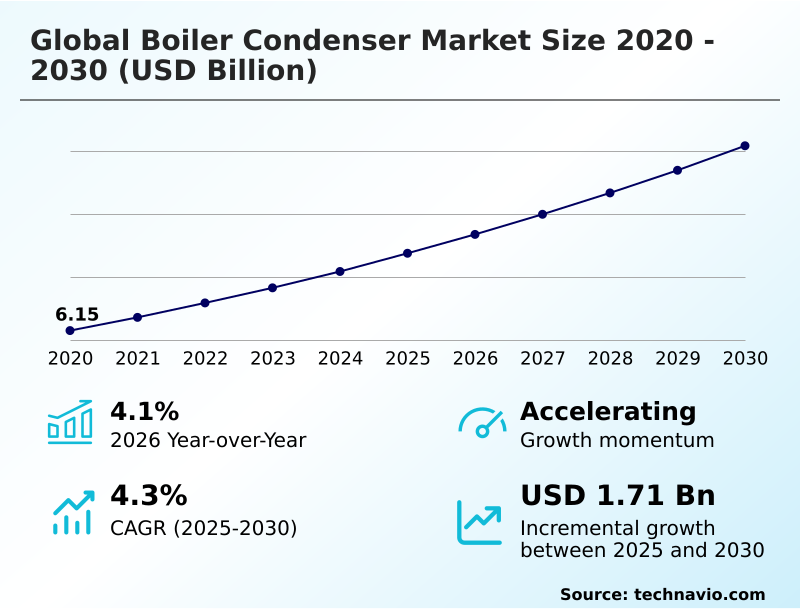
The boiler condenser market size is valued to increase by USD 1.71 billion, at a CAGR of 4.3% from 2025 to 2030. Increasing focus on energy efficiency systems will drive the boiler condenser market.
Major Market Trends & Insights
- APAC dominated the market and accounted for a 40.4% growth during the forecast period.
- By Application - Electricity generation segment was valued at USD 2.97 billion in 2024
- By Type - Spray condenser segment accounted for the largest market revenue share in 2024
Market Size & Forecast
- Market Opportunities: USD 2.93 billion
- Market Future Opportunities: USD 1.71 billion
- CAGR from 2025 to 2030 : 4.3%
Market Summary
- The boiler condenser market is defined by a consistent push toward greater operational efficiency and regulatory compliance. Stringent environmental mandates and the high cost of energy compel industries to adopt advanced condensing technology to maximize heat recovery and minimize fuel consumption.
- This evolution is not limited to new installations; retrofitting aging infrastructure with modern systems that feature superior heat exchanger designs and corrosion-resistant materials is also a significant market activity. For instance, a large-scale chemical processing facility can implement a closed-loop condensate management system, integrating smart diagnostics to monitor water chemistry and prevent scaling.
- This proactive approach to maintenance not only extends equipment lifespan but also ensures compliance with emissions standards, directly impacting the bottom line by reducing downtime and avoiding potential fines. The market's trajectory is toward integrated solutions that combine high performance with intelligent data analysis, enabling industries to meet both economic and sustainability objectives without compromise.
What will be the Size of the Boiler Condenser Market during the forecast period?
Get Key Insights on Market Forecast (PDF) Request Free Sample
How is the Boiler Condenser Market Segmented?
The boiler condenser industry research report provides comprehensive data (region-wise segment analysis), with forecasts and estimates in "USD million" for the period 2026-2030, as well as historical data from 2020-2024 for the following segments.
- Application
- Electricity generation
- Industrial production
- Others
- Type
- Spray condenser
- Filling condenser
- Water plate condenser
- Plate condenser
- Distribution channel
- Indirect sales
- Direct sales
- Geography
- APAC
- China
- Japan
- India
- North America
- US
- Canada
- Mexico
- Europe
- Germany
- UK
- France
- Middle East and Africa
- Saudi Arabia
- UAE
- South Africa
- South America
- Brazil
- Argentina
- Rest of World (ROW)
- APAC
By Application Insights
The electricity generation segment is estimated to witness significant growth during the forecast period.
The electricity generation segment is critical, where boiler condensers are indispensable for rankine cycle optimization in thermal power plants. In these emission-intensive industries, effective steam condensation is crucial for maintaining low turbine back pressure, directly boosting thermal efficiency.
The push for carbon footprint reduction and adherence to high energy efficiency ratings drives investment in advanced systems, including ultra-supercritical boilers.
Efficient waste heat recovery and diligent condensate management are central to asset lifecycle management strategies, ensuring both regulatory compliance and improved operational outputs.
This focus on sustainable infrastructure is not just about retrofitting but integrating superior technology for on-site power generation, which has been shown to improve overall plant efficiency by up to 8%.
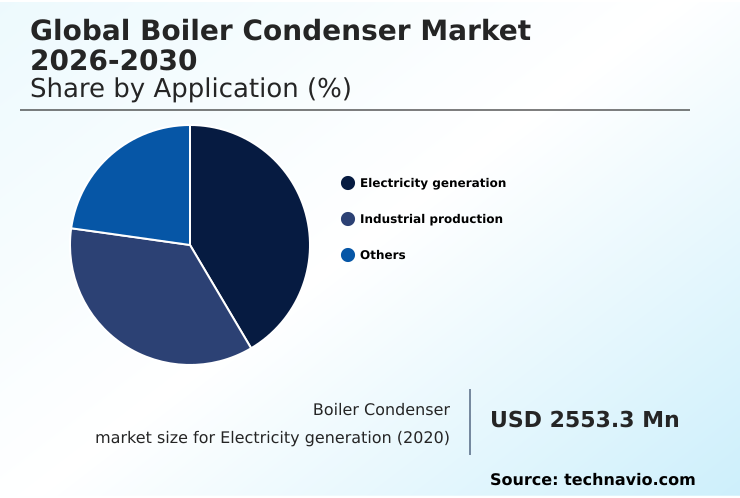
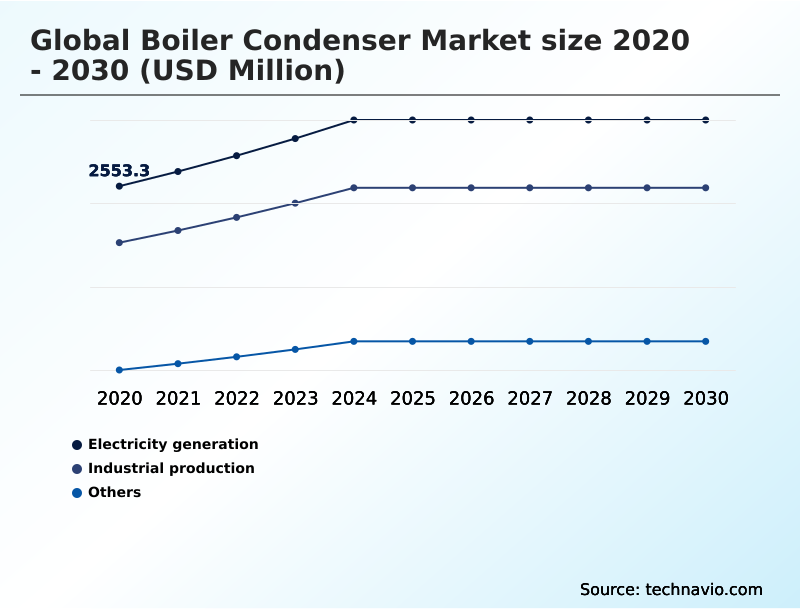
The Electricity generation segment was valued at USD 2.97 billion in 2024 and showed a gradual increase during the forecast period.
Regional Analysis
APAC is estimated to contribute 40.4% to the growth of the global market during the forecast period.Technavio’s analysts have elaborately explained the regional trends and drivers that shape the market during the forecast period.
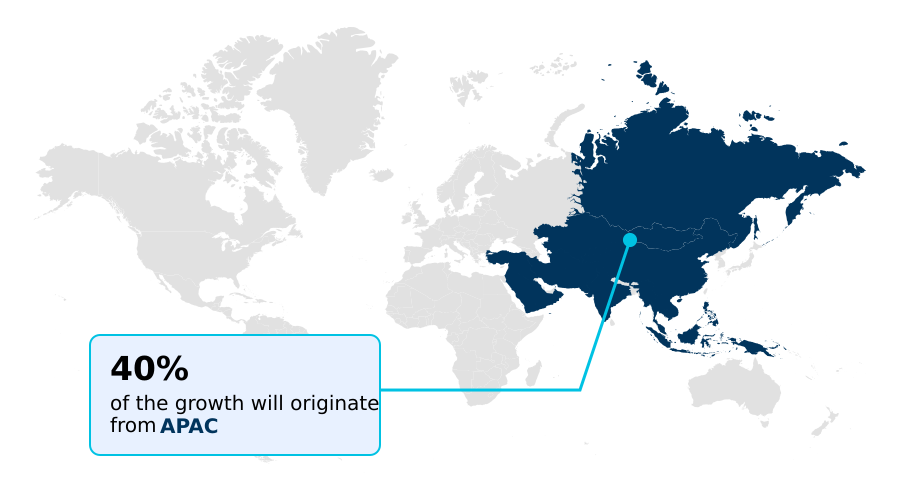
See How Boiler Condenser Market Demand is Rising in APAC Request Free Sample
The geographic landscape is shaped by diverse regional priorities, from industrial decarbonization in Europe to energy security in North America.
In regions with advanced grid stability, the focus is on renewable energy integration, with technologies like combined heat and power (CHP) and ammonia co-firing gaining traction.
For instance, the adoption of advanced hydronic technology in new commercial constructions has led to a 20% reduction in heating-related energy consumption.
Meanwhile, in markets with less developed infrastructure, the emphasis is on fuel flexibility and reliability, with the compact d-type package boiler serving critical needs.
Across all regions, flue gas heat recovery systems are becoming standard, with gasketed plate heat exchanger designs being favored for their serviceability.
The growth of nearshoring trends is also influencing demand, with manufacturing facilities in resource-constrained environments prioritizing on-site energy solutions.
Market Dynamics
Our researchers analyzed the data with 2025 as the base year, along with the key drivers, trends, and challenges. A holistic analysis of drivers will help companies refine their marketing strategies to gain a competitive advantage.
- Achieving optimal performance in the global boiler condenser market 2026-2030 requires a multi-faceted approach. Improving boiler condenser heat transfer is a primary goal, often addressed through advancements in compact boiler condenser design and specialized materials for high-pressure boiler condensers.
- For industrial applications, the choice of a boiler condenser for industrial production versus one for electricity generation involves distinct design considerations, often necessitating a comparison of spray vs plate condensers. A key challenge is reducing boiler condenser maintenance costs, which involves managing corrosion in boiler condenser systems and optimizing condensate drainage systems.
- Integrating smart controls in boiler condensers and adopting boiler condenser performance monitoring techniques are critical for efficiency. Firms now use boiler condenser efficiency calculation methods that are 25% more accurate than legacy systems, improving regulatory compliance for boiler condenser emissions. A thorough cost-benefit analysis of condensing boilers, considering the impact of fuel type on condenser design, is essential.
- This is particularly relevant for boiler condenser retrofitting best practices and in specific sectors like the boiler condenser in food processing industry. Understanding the boiler condenser role in district heating is also vital for urban applications, where waste heat recovery from boiler flue gas offers significant environmental benefits.
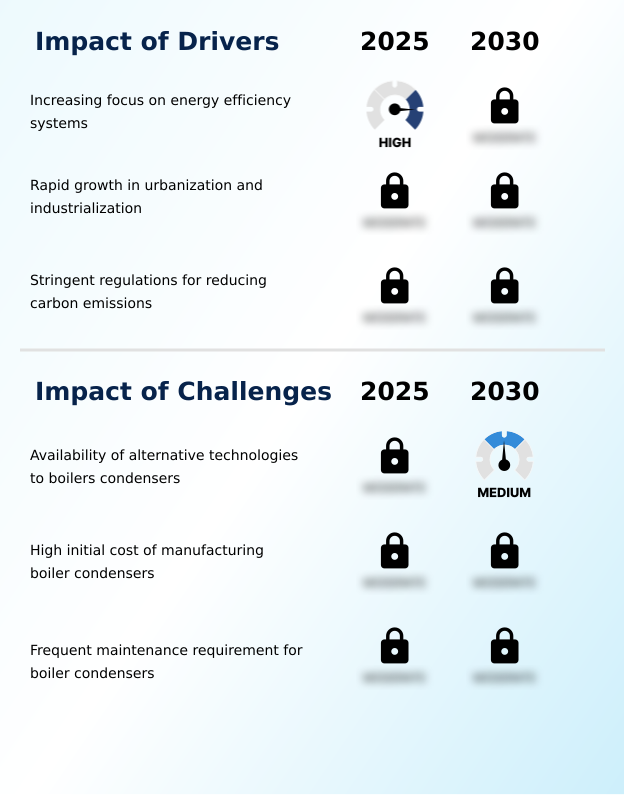
What are the key market drivers leading to the rise in the adoption of Boiler Condenser Industry?
- An increasing focus on energy-efficient systems, driven by rising energy costs and stringent environmental regulations, is a key driver for the market.
- Market growth is significantly driven by the global emphasis on low-emission heating and stringent energy performance standards.
- The adoption of advanced condensing technology is mandated by clean air mandates and ambitious green building certifications, compelling industries to reduce their carbon footprint. This regulatory pressure, combined with the goal of operational expenditures reduction, makes high-efficiency systems essential.
- In the industrial sector, reliable process steam generation is critical, while in urban areas, district heating systems are being expanded to meet climate targets, with some cities reporting a 15% improvement in urban air quality after implementation.
- The deployment of biomass boiler systems aligns with circular economy principles, and smart city initiatives are accelerating the uptake of connected, efficient energy infrastructure.
- Widespread adoption of these technologies can lead to an average energy savings of 20-30% for commercial buildings.
What are the market trends shaping the Boiler Condenser Industry?
- The market is increasingly shaped by technological advancements in boiler condensers. These innovations are focused on enhancing system efficiency, improving reliability, and integrating smarter operational controls.
- Key trends are centered on technological advancements in boiler condenser systems. The integration of smart diagnostics and predictive maintenance, powered by advanced control algorithms, is transitioning the industry toward proactive maintenance. This shift has been shown to reduce equipment failure rates by up to 25%.
- Modular boiler systems are gaining popularity for their scalability, while the development of hydrogen-ready boilers and hybrid heating systems addresses the demand for fuel flexibility. Digital twin modeling is increasingly used in the design phase to optimize performance and lower the total cost of ownership.
- These innovations, combined with enhanced remote monitoring capabilities and strategies for process intensification, are crucial for improving asset lifecycle management and overall system efficiency. The result is a move toward more intelligent, adaptable, and cost-effective heating solutions.
What challenges does the Boiler Condenser Industry face during its growth?
- The growing availability and adoption of alternative technologies, such as heat pumps and solar thermal systems, present a key challenge to the boiler condenser industry's growth.
- Key challenges stem from the availability of alternatives like geothermal heat pumps and solar thermal systems, alongside technical and economic hurdles. The high initial cost of systems using specialized corrosion resistance alloys for condensate management is a significant barrier, exacerbated by recent supply chain disruptions that have increased material lead times by over 20%.
- Proper fuel-to-air ratio adjustment and combustion efficiency are critical for performance, but achieving this requires specialized expertise. Furthermore, managing emissions like particulate matter, nitrogen oxides (NOx), and sulfur dioxide (SO2) to comply with the boiler and pressure vessel code adds complexity. The need for acidic condensate neutralization systems adds to maintenance requirements.
- Innovations in brazed plate heat exchanger technology help mitigate some of these issues, but the overall complexity can deter adoption in certain market segments.
Exclusive Technavio Analysis on Customer Landscape
The boiler condenser market forecasting report includes the adoption lifecycle of the market, covering from the innovator’s stage to the laggard’s stage. It focuses on adoption rates in different regions based on penetration. Furthermore, the boiler condenser market report also includes key purchase criteria and drivers of price sensitivity to help companies evaluate and develop their market growth analysis strategies.
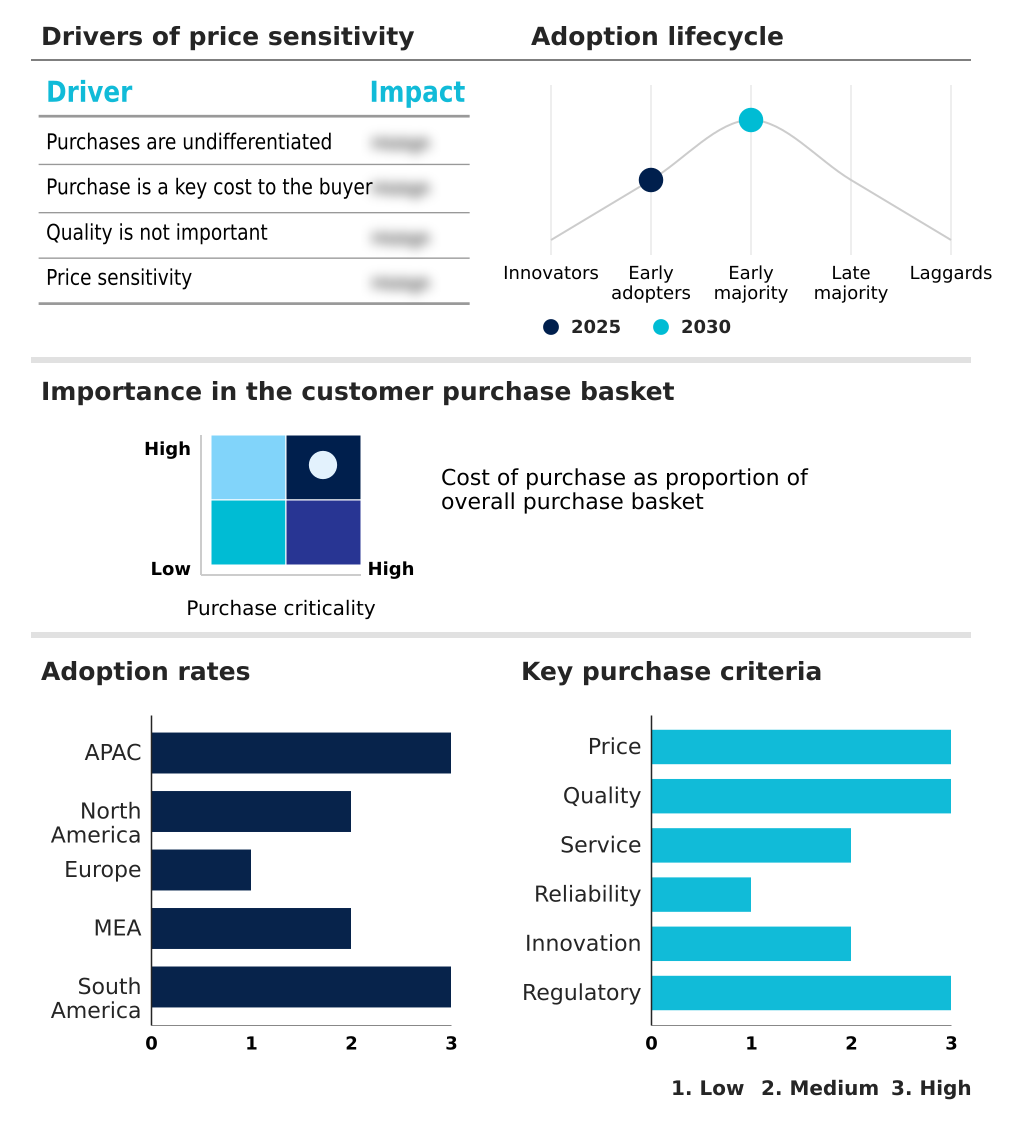
Customer Landscape of Boiler Condenser Industry
Competitive Landscape
Companies are implementing various strategies, such as strategic alliances, boiler condenser market forecast, partnerships, mergers and acquisitions, geographical expansion, and product/service launches, to enhance their presence in the industry.
A. O. Smith Corp. - The company offers a range of high-efficiency boiler condensers, including specialized series designed for medium to large-scale commercial applications with a focus on performance and reliability.
The industry research and growth report includes detailed analyses of the competitive landscape of the market and information about key companies, including:
- A. O. Smith Corp.
- ABHAY BOILERS PVT LTD.
- AERCO
- Alfa Laval AB
- Benvig Heat Transfer spol.
- Bronswerk
- E.ON UK Plc
- Fbm Hudson Italiana
- GEA Group AG
- General Electric Co.
- Grundfos Holding AS
- Parker Boiler Co.
- Patterson Kelley
- Robert Bosch GmbH
- Siemens AG
- SPG Dry Cooling
- The Cleaver Brooks Co. Inc.
- Thermax Ltd.
- Vaillant Group
- Viessmann Climate Solutions SE
Qualitative and quantitative analysis of companies has been conducted to help clients understand the wider business environment as well as the strengths and weaknesses of key industry players. Data is qualitatively analyzed to categorize companies as pure play, category-focused, industry-focused, and diversified; it is quantitatively analyzed to categorize companies as dominant, leading, strong, tentative, and weak.
Recent Development and News in Boiler condenser market
- In January 2024, Carrier finalized its acquisition of Viessmann Climate Solutions, a move aimed at enhancing its portfolio of intelligent and sustainable energy technologies.
- In February 2024, AtmosZero, a startup focused on electric industrial boiler technology, successfully secured $21 million in a funding round to advance its decarbonization solutions.
- In March 2025, Kawasaki Thermal Engineering introduced a new compact D-type package boiler in Japan, designed with improved energy efficiency and fuel flexibility for small to medium industrial applications.
- In April 2025, SWEP International AB introduced a new line of brazed plate heat exchangers constructed from CO2-reduced steel, addressing the industry's need for more sustainable manufacturing practices.
Dive into Technavio’s robust research methodology, blending expert interviews, extensive data synthesis, and validated models for unparalleled Boiler Condenser Market insights. See full methodology.
| Market Scope | |
|---|---|
| Page number | 294 |
| Base year | 2025 |
| Historic period | 2020-2024 |
| Forecast period | 2026-2030 |
| Growth momentum & CAGR | Accelerate at a CAGR of 4.3% |
| Market growth 2026-2030 | USD 1712.3 million |
| Market structure | Fragmented |
| YoY growth 2025-2026(%) | 4.1% |
| Key countries | China, Japan, India, South Korea, Australia, Indonesia, US, Canada, Mexico, Germany, UK, France, Italy, Spain, The Netherlands, Saudi Arabia, UAE, South Africa, Israel, Turkey, Brazil, Argentina and Chile |
| Competitive landscape | Leading Companies, Market Positioning of Companies, Competitive Strategies, and Industry Risks |
Research Analyst Overview
- The boiler condenser market is advancing through a focus on sophisticated condensing technology and advanced heat exchanger designs. Innovations in steam condensation and flue gas heat recovery are enhancing combustion efficiency, while the use of corrosion resistance alloys is crucial for effective condensate management.
- Low-emission heating is a primary objective, addressed by modular boiler systems and ultra-supercritical boilers that optimize turbine back pressure. The integration of smart diagnostics and advanced control algorithms enables predictive maintenance, a critical factor for boardroom decisions on asset management, as it can reduce unplanned downtime by over 30%.
- The market is also seeing a diversification in energy sources, with hydrogen-ready boilers, hybrid heating systems, and biomass boiler systems gaining traction. Technologies such as combined heat and power (CHP), rankine cycle optimization, and industrial decarbonization are pivotal.
- In industrial settings, process steam generation is optimized using specialized equipment like the compact d-type package boiler, with developments in thermal spray technology and nanomaterials for heat transfer pushing performance boundaries. Systems are also adapting to new fuels, demonstrated by successful ammonia co-firing trials.
What are the Key Data Covered in this Boiler Condenser Market Research and Growth Report?
-
What is the expected growth of the Boiler Condenser Market between 2026 and 2030?
-
USD 1.71 billion, at a CAGR of 4.3%
-
-
What segmentation does the market report cover?
-
The report is segmented by Application (Electricity generation, Industrial production, and Others), Type (Spray condenser, Filling condenser, Water plate condenser, and Plate condenser), Distribution Channel (Indirect sales, and Direct sales) and Geography (APAC, North America, Europe, Middle East and Africa, South America)
-
-
Which regions are analyzed in the report?
-
APAC, North America, Europe, Middle East and Africa and South America
-
-
What are the key growth drivers and market challenges?
-
Increasing focus on energy efficiency systems, Availability of alternative technologies to boilers condensers
-
-
Who are the major players in the Boiler Condenser Market?
-
A. O. Smith Corp., ABHAY BOILERS PVT LTD., AERCO, Alfa Laval AB, Benvig Heat Transfer spol., Bronswerk, E.ON UK Plc, Fbm Hudson Italiana, GEA Group AG, General Electric Co., Grundfos Holding AS, Parker Boiler Co., Patterson Kelley, Robert Bosch GmbH, Siemens AG, SPG Dry Cooling, The Cleaver Brooks Co. Inc., Thermax Ltd., Vaillant Group and Viessmann Climate Solutions SE
-
Market Research Insights
- Market dynamics are shaped by a drive to meet stringent energy performance standards and achieve green building certifications, which influences technology adoption. Businesses are reducing operational expenditures reduction by selecting systems that offer a lower total cost of ownership. The focus on proactive maintenance and effective asset lifecycle management minimizes downtime, while sophisticated remote monitoring capabilities provide real-time performance data.
- Process intensification and adherence to the boiler and pressure vessel code ensure safety and efficiency. Digital twin modeling is used for optimizing designs, and nearshoring trends are altering supply chain strategies. In resource-constrained environments, fuel flexibility and energy security have become paramount.
- Adherence to clean air mandates has led to a 15% improvement in emission controls, while new sustainable infrastructure projects are growing at a rate 1.5 times faster than conventional ones.
We can help! Our analysts can customize this boiler condenser market research report to meet your requirements.