

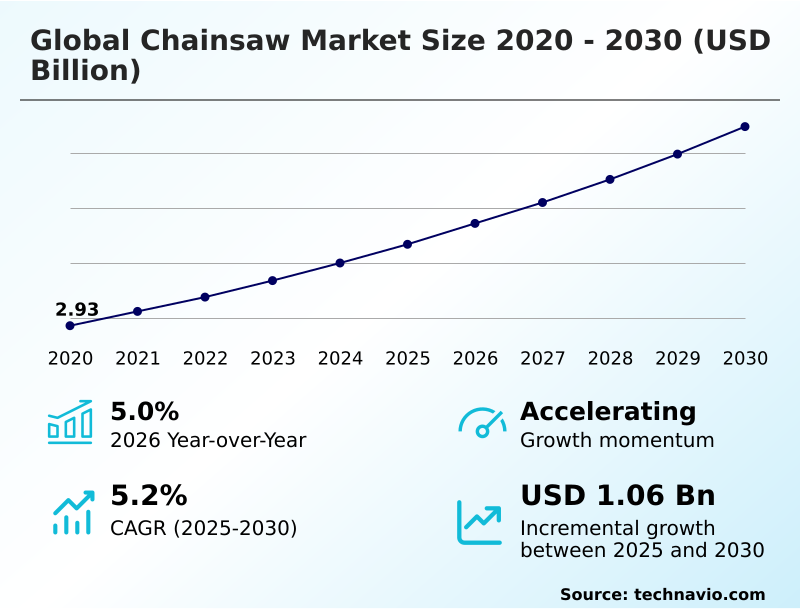
Chainsaw Market Size 2026-2030
The chainsaw market size is valued to increase by USD 1.06 billion, at a CAGR of 5.2% from 2025 to 2030. Rising construction and infrastructure development will drive the chainsaw market.
Major Market Trends & Insights
- North America dominated the market and accounted for a 40.6% growth during the forecast period.
- By End-user - Commercial segment was valued at USD 2.19 billion in 2024
- By Product - Gas-powered segment accounted for the largest market revenue share in 2024
Market Size & Forecast
- Market Opportunities: USD 1.80 billion
- Market Future Opportunities: USD 1.06 billion
- CAGR from 2025 to 2030 : 5.2%
Market Summary
- The chainsaw market is undergoing a significant transformation, driven by the dual pressures of environmental regulation and demands for increased operational efficiency. The industry is pivoting from traditional gasoline engines to advanced electric-powered systems, including high-torque cordless chainsaw models equipped with high-capacity lithium-ion battery system technology.
- This shift is particularly evident in residential and urban commercial applications, where lower noise and zero emissions are critical. Key trends include the integration of brushless motor technology for longer tool life and the development of sophisticated safety features like the automated chain brake and advanced kickback protection.
- For professional users in forestry and construction, the focus remains on power and durability, with innovations in two-stroke engine design, such as stratified scavenging, improving fuel efficiency. A key business scenario involves a commercial landscaping firm leveraging digital connectivity in its fleet of cordless power tools.
- By monitoring battery health, chain tension monitoring, and usage hours in real-time, fleet managers can optimize maintenance schedules, reducing equipment downtime by over 25% and maximizing crew productivity across multiple job sites, directly impacting profitability.
What will be the Size of the Chainsaw Market during the forecast period?
Get Key Insights on Market Forecast (PDF) Get Free Sample
How is the Chainsaw Market Segmented?
The chainsaw industry research report provides comprehensive data (region-wise segment analysis), with forecasts and estimates in "USD million" for the period 2026-2030, as well as historical data from 2020-2024 for the following segments.
- End-user
- Commercial
- Non-commercial
- Product
- Gas-powered
- Electric-powered
- Distribution channel
- Offline
- Online
- Geography
- North America
- US
- Canada
- Mexico
- Europe
- Germany
- France
- UK
- APAC
- China
- Japan
- India
- South America
- Brazil
- Argentina
- Middle East and Africa
- Turkey
- South Africa
- Saudi Arabia
- Rest of World (ROW)
- North America
By End-user Insights
The commercial segment is estimated to witness significant growth during the forecast period.
The commercial segment, serving professional loggers and arborists, remains a critical revenue driver. These users require commercial-grade cutting tools and high-performance forestry saws that deliver reliability for demanding tasks like timber harvesting equipment and demolition cutting tool applications.
While the high-displacement petrol engine continues to be a mainstay for its raw power, the adoption of lithium-ion battery system technology is accelerating in urban forestry to meet noise regulations.
This shift is driven by a focus on superior power-to-weight ratio and ergonomic design to reduce operator fatigue.
Advanced arboriculture tools now demonstrate up to a 25% improvement in operational uptime in managed fleet scenarios due to reduced maintenance needs compared to their gas counterparts.
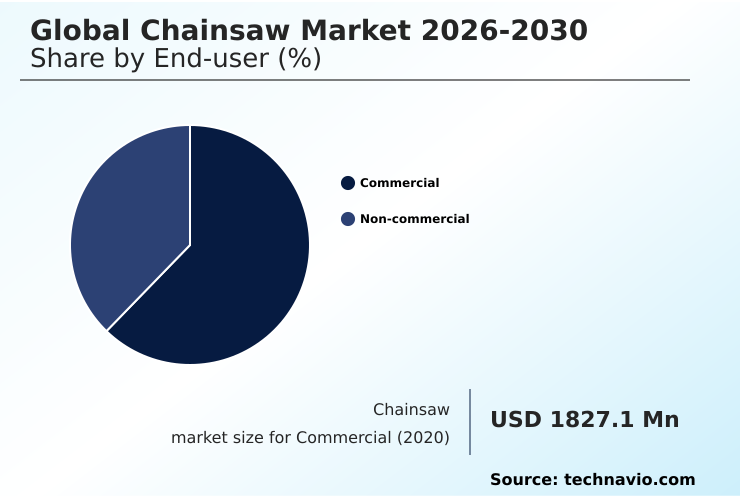
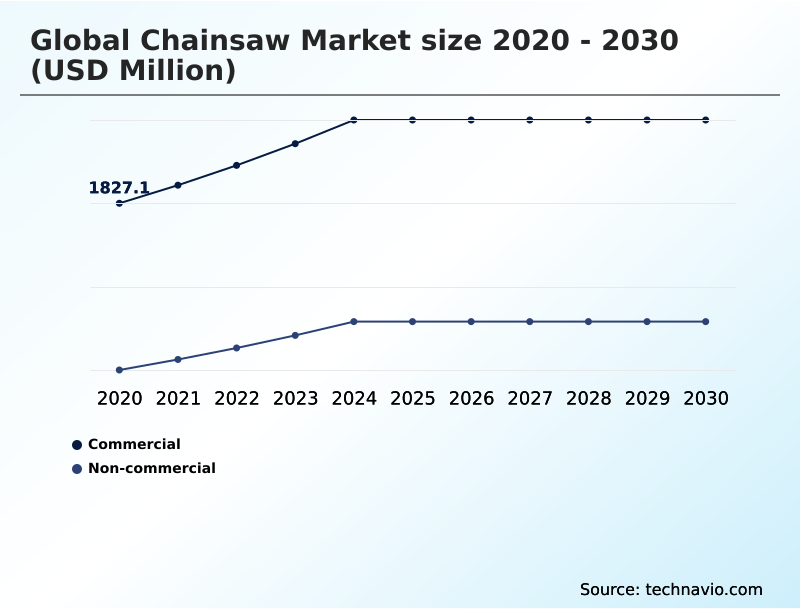
The Commercial segment was valued at USD 2.19 billion in 2024 and showed a gradual increase during the forecast period.
Regional Analysis
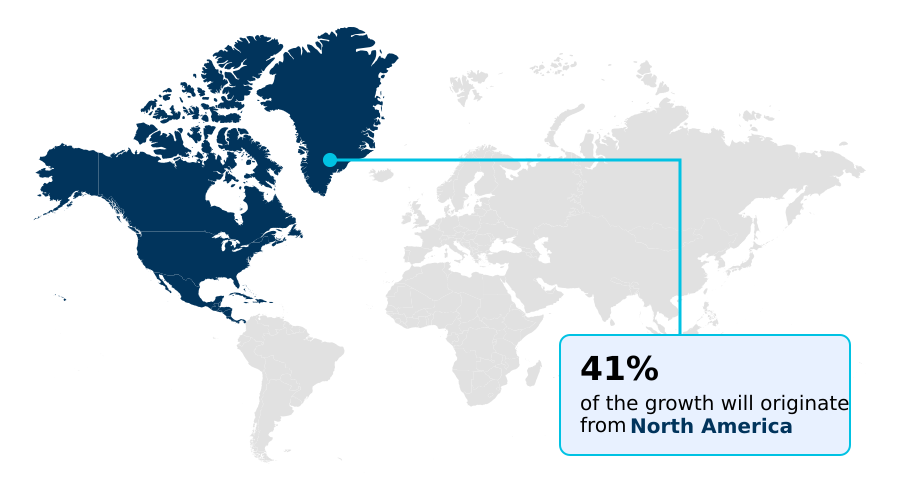
North America is estimated to contribute 40.6% to the growth of the global market during the forecast period.Technavio’s analysts have elaborately explained the regional trends and drivers that shape the market during the forecast period.
See How Chainsaw Market Demand is Rising in North America Get Free Sample
The geographic landscape is shaped by regional regulations and end-user needs. In North America, which accounts for over 40% of incremental market growth, the adoption of outdoor power equipment with brushless motor technology is surging.
In Europe, strict decibel limits have accelerated the transition to electric models, with sales of high-capacity battery tools growing 22% year-over-year in some urban markets. Innovations like solid-state battery technology are poised to further disrupt these mature markets.
Meanwhile, in APAC and South America, demand for traditional gas-powered arborist saws for timber harvesting equipment remains robust, although interest in bio-fuels is growing.
Digital connectivity is a unifying global trend, allowing fleet managers to track tool performance and maintenance needs across diverse regions.
Market Dynamics
Our researchers analyzed the data with 2025 as the base year, along with the key drivers, trends, and challenges. A holistic analysis of drivers will help companies refine their marketing strategies to gain a competitive advantage.
- Navigating the chainsaw market requires understanding the specific needs of different users. A primary consideration is the gas vs electric chainsaw for homeowners, where electric models often win for ease of use and lower maintenance. For professionals, identifying the best professional arborist chainsaw features such as a high power-to-weight ratio and advanced safety systems is critical.
- Regardless of the user, chainsaw safety for diy projects and professional work cannot be overstated, making chainsaw kickback prevention techniques and proper handling essential knowledge. Effective chainsaw maintenance for longer life starts with a consistent chainsaw engine maintenance checklist and adhering to chainsaw chain sharpening best practices.
- The choice between a top-handle vs rear-handle chainsaw often depends on the task, with top-handle models favored for in-tree work. Furthermore, understanding chainsaw bar and chain sizes is crucial for performance. Specialized applications, like learning how to choose a chainsaw for cutting concrete or effective chainsaw use in construction demolition, require specific tool knowledge.
- For battery models, a cordless chainsaw battery compatibility guide is invaluable. Proper chainsaw cutting techniques for firewood and using a chainsaw for storm cleanup can improve efficiency by more than double that of an amateur approach, while exploring eco-friendly chainsaw fuel options is a growing consideration. Finally, being able to perform basic troubleshooting common chainsaw starting problems ensures minimal downtime.
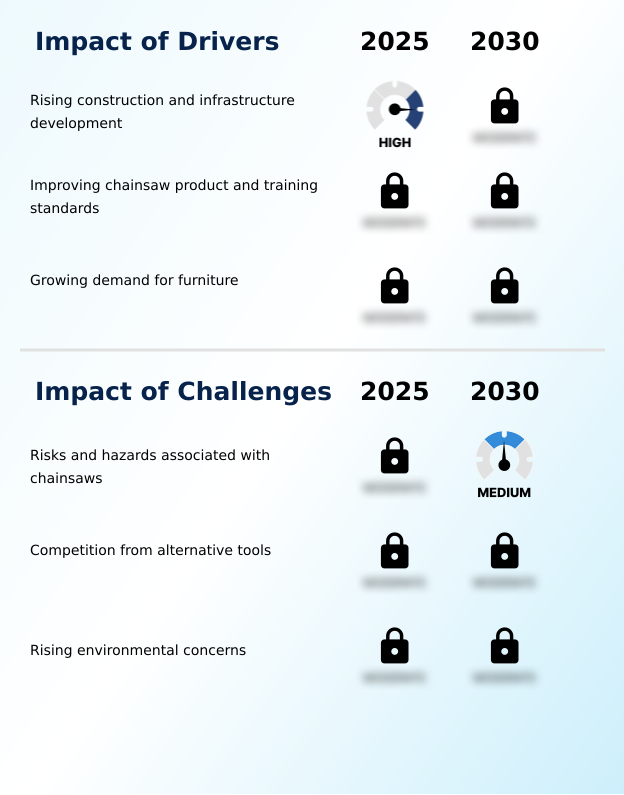
What are the key market drivers leading to the rise in the adoption of Chainsaw Industry?
- The global expansion of construction and infrastructure development activities serves as a primary driver for the chainsaw market.
- The expansion of construction and infrastructure is a primary market driver. Chainsaws are essential construction cutting tools for cutting lumber and serve as vital wood cutting tools in framing and demolition.
- Specialized models featuring a diamond-tipped chain are increasingly used as a concrete cutting saw and for masonry cutting tools, reducing task time by up to 30% compared to traditional methods.
- For large-scale infrastructure development tools and land clearing equipment, high-torque cordless chainsaws powered by cordless lithium-ion chainsaws offer mobility without emissions.
- The reliability of the two-stroke engine, enhanced with stratified scavenging, ensures these tools remain critical for site preparation equipment, where power is non-negotiable. Proper guide bar selection further enhances precision, improving material-use efficiency by over 10% on complex jobs.
What are the market trends shaping the Chainsaw Industry?
- A prominent market trend is the rising engagement of homeowners in do-it-yourself projects. This fuels demand for user-friendly, accessible chainsaws for home improvement and garden maintenance.
- The rise in DIY activities is a significant market trend, expanding the user base for lightweight cordless chainsaws and the compact electric garden chainsaw. Homeowners increasingly seek versatile cordless power tools for property maintenance tools, firewood preparation, and storm debris clearance.
- This shift has led to product innovations focusing on ease of use and safety, with features like an automated chain brake and enhanced kickback protection becoming standard. These user-friendly models show a 20% higher adoption rate among first-time buyers.
- As homeowners invest more in yard maintenance equipment, moving beyond traditional walk-behind mowers to more advanced tools, the demand for accessible cutting solutions grows, with some retailers reporting a 15% increase in bundled sales of chainsaws with other DIY home improvement tools.
What challenges does the Chainsaw Industry face during its growth?
- Inherent operational risks and safety hazards associated with chainsaw use pose a significant challenge to market growth.
- Significant challenges stem from the inherent risks of using handheld power tools. Operator safety concerns, particularly in professional landscaping and tree felling equipment, restrain market growth. To mitigate these risks, manufacturers are heavily investing in anti-vibration technology and other vibration reduction systems, which can decrease long-term health risks by over 40%.
- Advanced features like real-time chain tension monitoring and improved acoustic insulation also enhance safety. For gas models, the integration of a catalytic converter addresses environmental concerns, contributing to carbon footprint reduction efforts.
- However, improper use remains a primary issue, with data indicating that formal training can reduce accident rates by as much as 60%, highlighting the need for continuous education for users of all branch pruning tools.
Exclusive Technavio Analysis on Customer Landscape
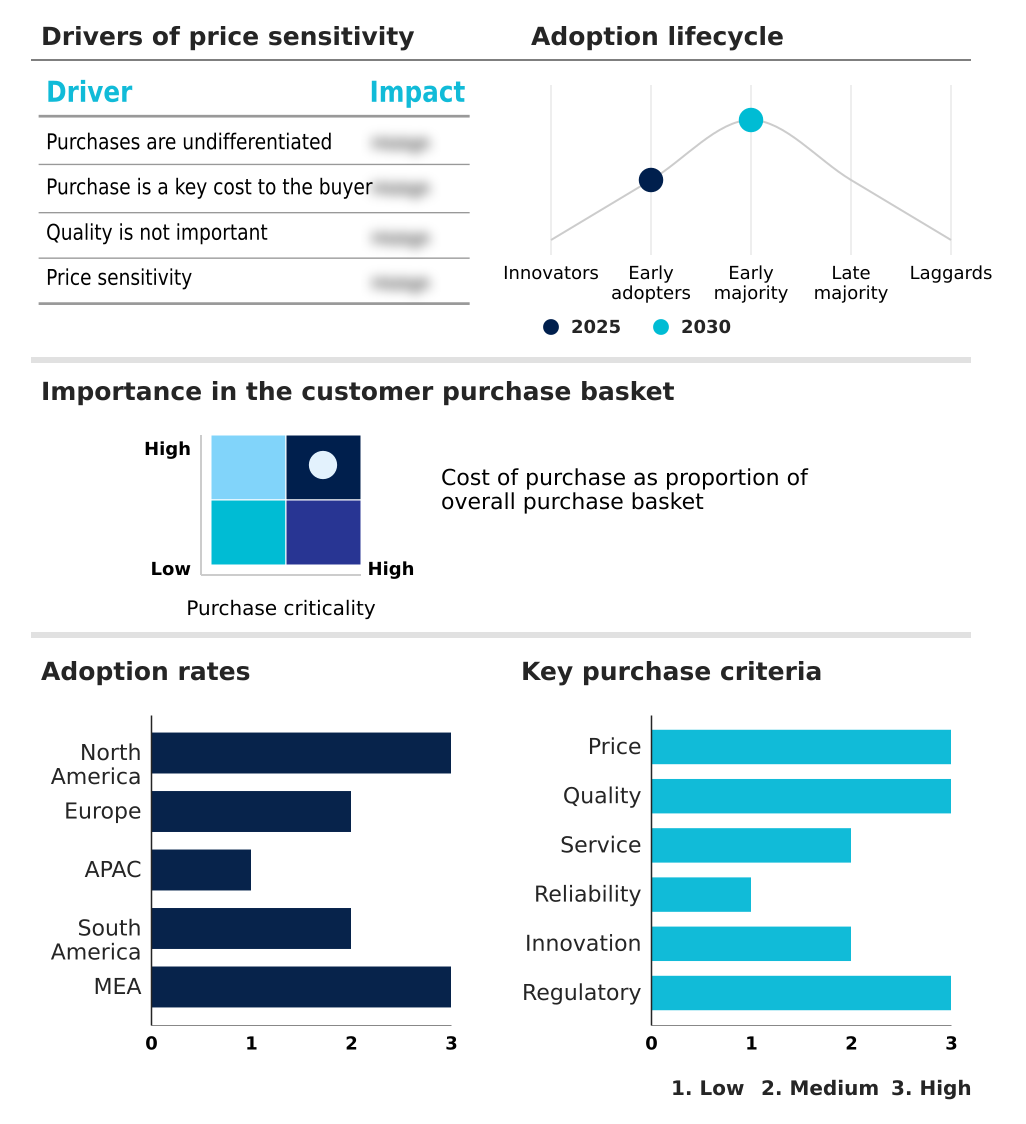
The chainsaw market forecasting report includes the adoption lifecycle of the market, covering from the innovator’s stage to the laggard’s stage. It focuses on adoption rates in different regions based on penetration. Furthermore, the chainsaw market report also includes key purchase criteria and drivers of price sensitivity to help companies evaluate and develop their market growth analysis strategies.
Customer Landscape of Chainsaw Industry
Competitive Landscape
Companies are implementing various strategies, such as strategic alliances, chainsaw market forecast, partnerships, mergers and acquisitions, geographical expansion, and product/service launches, to enhance their presence in the industry.
AL KO Gardentech - Analysis indicates a focus on high-performance outdoor power equipment for professional forestry and residential garden care, with increasing emphasis on battery-powered and robotic solutions.
The industry research and growth report includes detailed analyses of the competitive landscape of the market and information about key companies, including:
- AL KO Gardentech
- Alfred Karcher SE and Co. KG
- ANDREAS STIHL AG and Co. KG
- Briggs and Stratton Corp.
- EGO Power
- Einhell Germany AG
- Husqvarna AB
- Makita Corp.
- Oregon Tool Inc.
- Robert Bosch GmbH
- Stanley Black and Decker Inc.
- STIGA SpA
- Talon Tough Tools
- Techtronic Industries Co. Ltd.
- The Toro Co.
- Yamabiko Corp.
- Yard Force
Qualitative and quantitative analysis of companies has been conducted to help clients understand the wider business environment as well as the strengths and weaknesses of key industry players. Data is qualitatively analyzed to categorize companies as pure play, category-focused, industry-focused, and diversified; it is quantitatively analyzed to categorize companies as dominant, leading, strong, tentative, and weak.
Recent Development and News in Chainsaw market
- In May 2025, Makita Corp. finalized a strategic collaboration with a renewable energy firm to power the organization's primary chainsaw assembly lines using exclusively solar energy, advancing its sustainability goals.
- In April 2025, The Global Forestry Alliance introduced a new certification standard for heavy-duty electric chainsaws used in municipal land management, promoting safer and more environmentally friendly urban forestry practices.
- In March 2025, Milwaukee Tool announced the integration of solid-state battery technology within its professional chainsaw range, a key part of its product roadmap to enhance the power-to-weight ratio for professional arborists.
- In February 2025, ANDREAS STIHL AG and Co. KG launched a sophisticated artificial intelligence interface for its professional battery series, enabling real-time monitoring of chain tension and motor temperature for improved performance and safety.
Dive into Technavio’s robust research methodology, blending expert interviews, extensive data synthesis, and validated models for unparalleled Chainsaw Market insights. See full methodology.
| Market Scope | |
|---|---|
| Page number | 279 |
| Base year | 2025 |
| Historic period | 2020-2024 |
| Forecast period | 2026-2030 |
| Growth momentum & CAGR | Accelerate at a CAGR of 5.2% |
| Market growth 2026-2030 | USD 1064.9 million |
| Market structure | Fragmented |
| YoY growth 2025-2026(%) | 5.0% |
| Key countries | US, Canada, Mexico, Germany, France, UK, Spain, Italy, The Netherlands, China, Japan, India, South Korea, Australia, Indonesia, Brazil, Argentina, Chile, Turkey, South Africa, Saudi Arabia, UAE and Israel |
| Competitive landscape | Leading Companies, Market Positioning of Companies, Competitive Strategies, and Industry Risks |
Research Analyst Overview
- The chainsaw market's evolution is defined by a decisive pivot toward electrification and intelligent systems. Core advancements in brushless motor technology and lithium-ion battery system development are reshaping product capabilities, enabling high-torque cordless chainsaw models to challenge the dominance of the two-stroke engine.
- This transition is not merely a technological shift but a strategic response to tightening environmental regulations, influencing boardroom decisions on R&D investment to ensure compliance with new decibel limits and carbon footprint reduction targets. Innovations such as the automated chain brake, enhanced anti-vibration technology, and real-time chain tension monitoring are becoming standard.
- The integration of a solid-state battery promises to further improve the power-to-weight ratio, a critical metric for professional users of arborist saws. In practice, firms adopting tools with advanced ergonomic design and vibration reduction have reported a 15% increase in operator productivity due to reduced fatigue.
What are the Key Data Covered in this Chainsaw Market Research and Growth Report?
-
What is the expected growth of the Chainsaw Market between 2026 and 2030?
-
USD 1.06 billion, at a CAGR of 5.2%
-
-
What segmentation does the market report cover?
-
The report is segmented by End-user (Commercial, and Non-commercial), Product (Gas-powered, and Electric-powered), Distribution Channel (Offline, and Online) and Geography (North America, Europe, APAC, South America, Middle East and Africa)
-
-
Which regions are analyzed in the report?
-
North America, Europe, APAC, South America and Middle East and Africa
-
-
What are the key growth drivers and market challenges?
-
Rising construction and infrastructure development, Risks and hazards associated with chainsaws
-
-
Who are the major players in the Chainsaw Market?
-
AL KO Gardentech, Alfred Karcher SE and Co. KG, ANDREAS STIHL AG and Co. KG, Briggs and Stratton Corp., EGO Power, Einhell Germany AG, Husqvarna AB, Makita Corp., Oregon Tool Inc., Robert Bosch GmbH, Stanley Black and Decker Inc., STIGA SpA, Talon Tough Tools, Techtronic Industries Co. Ltd., The Toro Co., Yamabiko Corp. and Yard Force
-
Market Research Insights
- The market's dynamics are shaped by evolving end-user demands across professional and residential sectors. The need for efficient forestry management equipment and timber harvesting equipment drives innovation in high-power segments, while the growing DIY trend fuels demand for accessible property maintenance tools and yard maintenance equipment.
- The transition to battery power is a defining characteristic, with adoption rates for electric models used in garden maintenance tools increasing by 18% in suburban markets. This shift delivers tangible business outcomes; for instance, professional crews using electric arboriculture tools in noise-sensitive zones report a 90% reduction in noise complaints, improving community relations.
- Furthermore, the versatility of these tools for applications ranging from storm debris clearance to construction cutting tools broadens their appeal, with multi-use platforms demonstrating a 25% higher lifetime value for commercial buyers.
We can help! Our analysts can customize this chainsaw market research report to meet your requirements.
 RIA -
RIA -