

Digital Biology Market Size 2026-2030
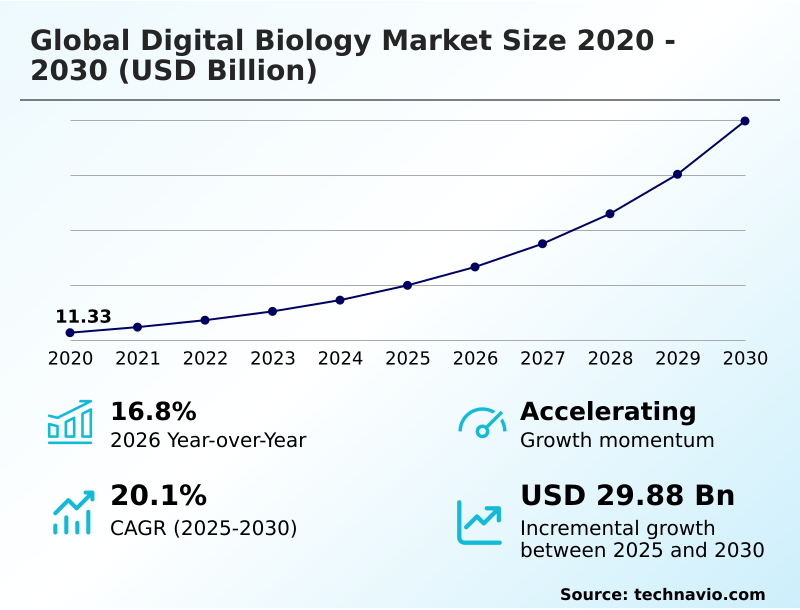
The digital biology market size is valued to increase by USD 29.88 billion, at a CAGR of 20.1% from 2025 to 2030. Integration of AI and ML in genomic sequencing will drive the digital biology market.
Major Market Trends & Insights
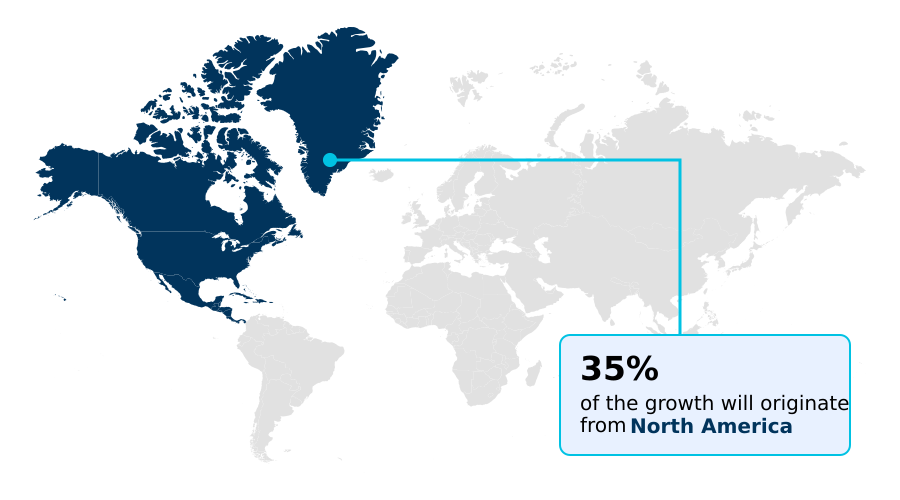
- North America dominated the market and accounted for a 35.2% growth during the forecast period.
- By Application - Drug discovery segment was valued at USD 6.23 billion in 2024
- By End-user - Pharmaceutical companies segment accounted for the largest market revenue share in 2024
Market Size & Forecast
- Market Opportunities: USD 38.49 billion
- Market Future Opportunities: USD 29.88 billion
- CAGR from 2025 to 2030 : 20.1%
Market Summary
- The digital biology market represents the convergence of computational science and biological research, leveraging AI and machine learning to analyze complex systems. This discipline is driven by the integration of AI in genomic sequencing, which accelerates data processing and enhances predictive accuracy for therapeutic outcomes.
- Key trends include the expansion of digital twin technology, allowing for in silico trials that de-risk development, and the use of decentralized platforms for enhanced data security.
- For instance, a pharmaceutical firm can leverage an AI-enabled operating system to model a new compound's interaction with a specific protein structure, predicting its efficacy and potential side effects before committing to expensive lab experiments. This computational approach optimizes the R&D pipeline, reducing development timelines.
- However, the market faces challenges such as data interoperability limitations between proprietary systems and a significant shortage of multidisciplinary talent. Addressing these issues is crucial for harnessing the full potential of digital biology to innovate in precision medicine and synthetic biology, ultimately transforming healthcare and other life science-dependent industries.
What will be the Size of the Digital Biology Market during the forecast period?
Get Key Insights on Market Forecast (PDF) Get Free Sample
How is the Digital Biology Market Segmented?
The digital biology industry research report provides comprehensive data (region-wise segment analysis), with forecasts and estimates in "USD million" for the period 2026-2030, as well as historical data from 2020-2024 for the following segments.
- Application
- Drug discovery
- Synthetic biology
- Precision medicine
- Clinical diagnostics
- Agricultural biotechnology
- End-user
- Pharmaceutical companies
- Biotechnology companies
- Research institutes
- Healthcare providers
- Agricultural companies
- Component
- Solutions
- Services
- Geography
- North America
- US
- Canada
- Mexico
- Europe
- Germany
- UK
- France
- Asia
- Rest of World (ROW)
- North America
By Application Insights
The drug discovery segment is estimated to witness significant growth during the forecast period.
The global digital biology market 2026-2030 is revolutionizing drug discovery by integrating advanced computational tools and AI. This shift from traditional lab work to in silico screening of vast chemical libraries against biological targets optimizes resource allocation.
Utilizing high-performance computing and sophisticated bioinformatics pipelines, researchers can now simulate molecular interactions, predicting binding affinity and potential toxicity before physical testing.
This computational approach, incorporating AI-driven drug discovery, significantly narrows the pool of compounds for physical trials, reducing late-stage failures by over 20%.
Digital models also facilitate a deeper understanding of complex biological pathways, empowering scientists to identify novel targets for diseases lacking effective treatments.
These advancements in computational chemistry and molecular dynamics simulations accelerate the entire therapeutic development lifecycle, making it a critical growth segment.
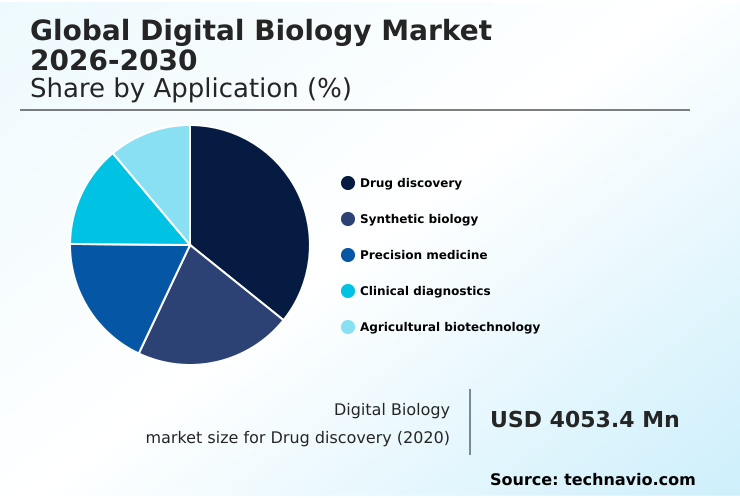
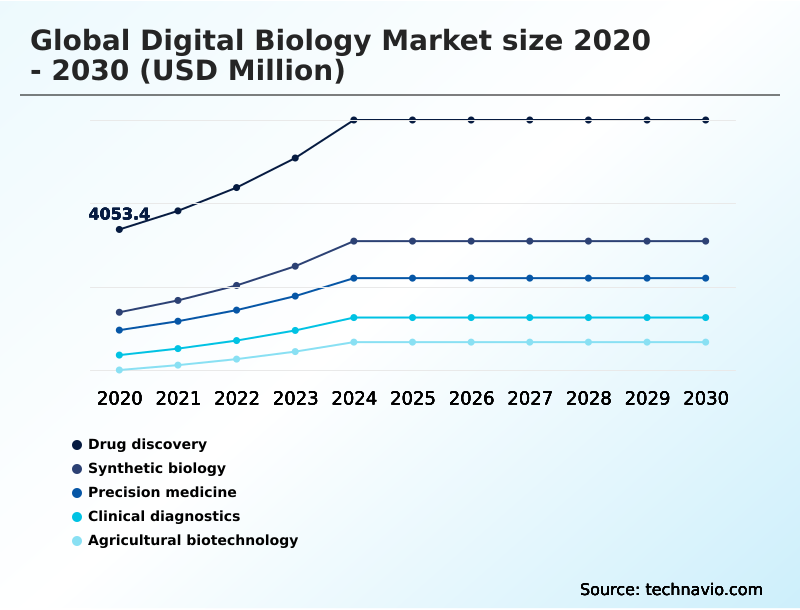
The Drug discovery segment was valued at USD 6.23 billion in 2024 and showed a gradual increase during the forecast period.
Regional Analysis
North America is estimated to contribute 35.2% to the growth of the global market during the forecast period.Technavio’s analysts have elaborately explained the regional trends and drivers that shape the market during the forecast period.
See How Digital Biology Market Demand is Rising in North America Get Free Sample
The global digital biology market 2026-2030's geographic landscape is led by North America, which accounts for over 35% of incremental growth, driven by robust funding and advanced research infrastructure. The region excels in applying pharmacogenomics and molecular dynamics simulations.
Meanwhile, Asia is the fastest-growing region, with expansion outpacing others by nearly 3 percentage points, fueled by large-scale genomic initiatives and government investment in high-performance computing.
European markets are characterized by strong regulatory frameworks that foster trust in decentralized science and federated learning models, with applications in in silico screening showing potential to reduce preclinical costs by up to 25%.
This regional diversification, supported by advancements in synthetic gene circuits and AI-driven drug discovery, creates a competitive global ecosystem.
Market Dynamics
Our researchers analyzed the data with 2025 as the base year, along with the key drivers, trends, and challenges. A holistic analysis of drivers will help companies refine their marketing strategies to gain a competitive advantage.
- The strategic implementation of digital biology is reshaping life sciences, with AI for drug discovery platforms becoming central to R&D. Companies are increasingly using quantum computing for biology to tackle complex molecular simulations that were previously unsolvable, accelerating the design of novel therapeutics.
- The emphasis on data integrity is driving the adoption of methods for securing genomic data with blockchain, which provides an immutable and transparent ledger for patient consent and data access. In parallel, the use of digital twins in clinical trials allows for predictive modeling of patient responses, significantly de-risking development and reducing costs.
- Automating lab workflows with AI is no longer a futuristic concept; it is a practical approach to increasing throughput and reducing human error. This automation allows researchers to focus on higher-value tasks, supported by machine learning in genomic analysis for identifying subtle biomarkers.
- Furthermore, AI models for drug repurposing are gaining traction, enabling firms to find new applications for existing compounds at a fraction of the cost of de novo discovery. Firms leveraging generative AI for protein design report a two-fold increase in identifying viable candidates compared to traditional methods.
- These advanced predictive toxicology screening methods and cloud platforms for life sciences are creating a more efficient, precise, and cost-effective paradigm for therapeutic innovation.
What are the key market drivers leading to the rise in the adoption of Digital Biology Industry?
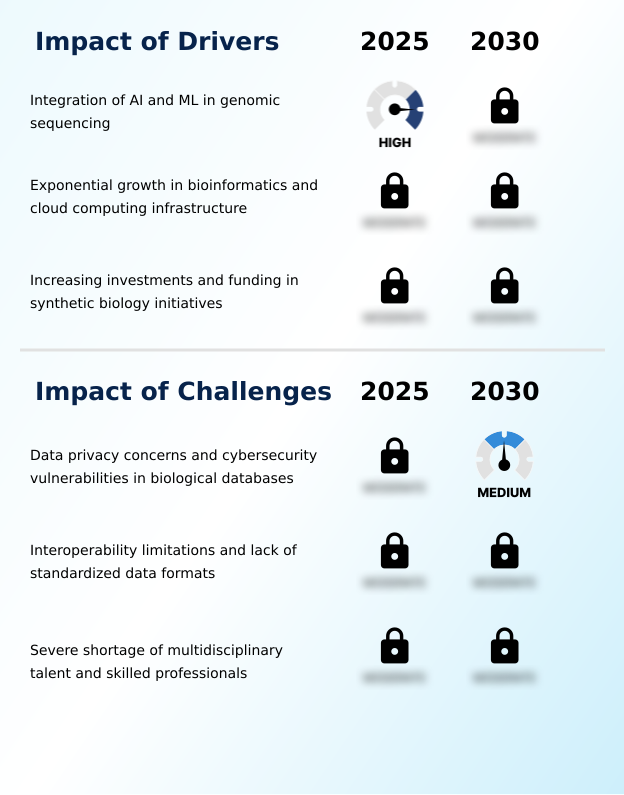
- The integration of artificial intelligence and machine learning into genomic sequencing workflows is a key driver for market growth.
- Market growth is primarily driven by the integration of AI and machine learning with next-generation sequencing, a synergy that has accelerated genomic data analysis speeds by over 50%.
- The exponential growth in bioinformatics and the scalability of cloud-based bioinformatics platforms are also critical drivers, making high-performance computing accessible to startups at a 90% lower upfront cost compared to on-premise infrastructure.
- This democratization of technology, combined with increasing investments in synthetic biology, fuels innovation in areas like pharmacokinetics and pharmacodynamics modeling.
- The ability to perform rapid in silico screening and analyze population-level genomic data propels the entire digital biology ecosystem forward, enabling faster and more accurate scientific discoveries.
What are the market trends shaping the Digital Biology Industry?
- The expansion of digital twin technology within pharmaceutical drug discovery pipelines is emerging as a significant market trend, enabling the virtual simulation of complex biological systems.
- Key trends in the global digital biology market 2026-2030 are redefining research paradigms. The expansion of digital twin technology is a primary factor, allowing for sophisticated in silico trials that improve predictive accuracy in pharmaceutical R&D by over 25%. This innovation is coupled with the rise of decentralized science, which leverages blockchain to enhance security and patient data sovereignty.
- Another significant trend is the application of quantum computing to simulate complex biological systems, which reduces molecular simulation times by a factor of 10 compared to classical methods. These advancements, supported by federated learning models and the use of multi-modal clinical data, are transforming how therapeutics are designed and validated, fostering a more efficient and precise development ecosystem.
What challenges does the Digital Biology Industry face during its growth?
- Data privacy concerns and cybersecurity vulnerabilities associated with biological databases represent a key challenge affecting industry growth.
- The global digital biology market 2026-2030 faces significant hurdles, primarily data privacy concerns and cybersecurity vulnerabilities in biological databases. The lack of standardized data formats creates interoperability limitations, with internal studies showing these issues can increase project timelines by 15% due to manual data conversion.
- This fragmentation restricts the seamless analysis of information from automated wet labs and liquid biopsy analysis. Furthermore, a severe shortage of multidisciplinary talent skilled in both biology and computational science creates a critical bottleneck. This talent deficit can inflate data integration costs by up to 40% and hinders the effective use of advanced platforms, constraining overall market expansion and innovation.
Exclusive Technavio Analysis on Customer Landscape
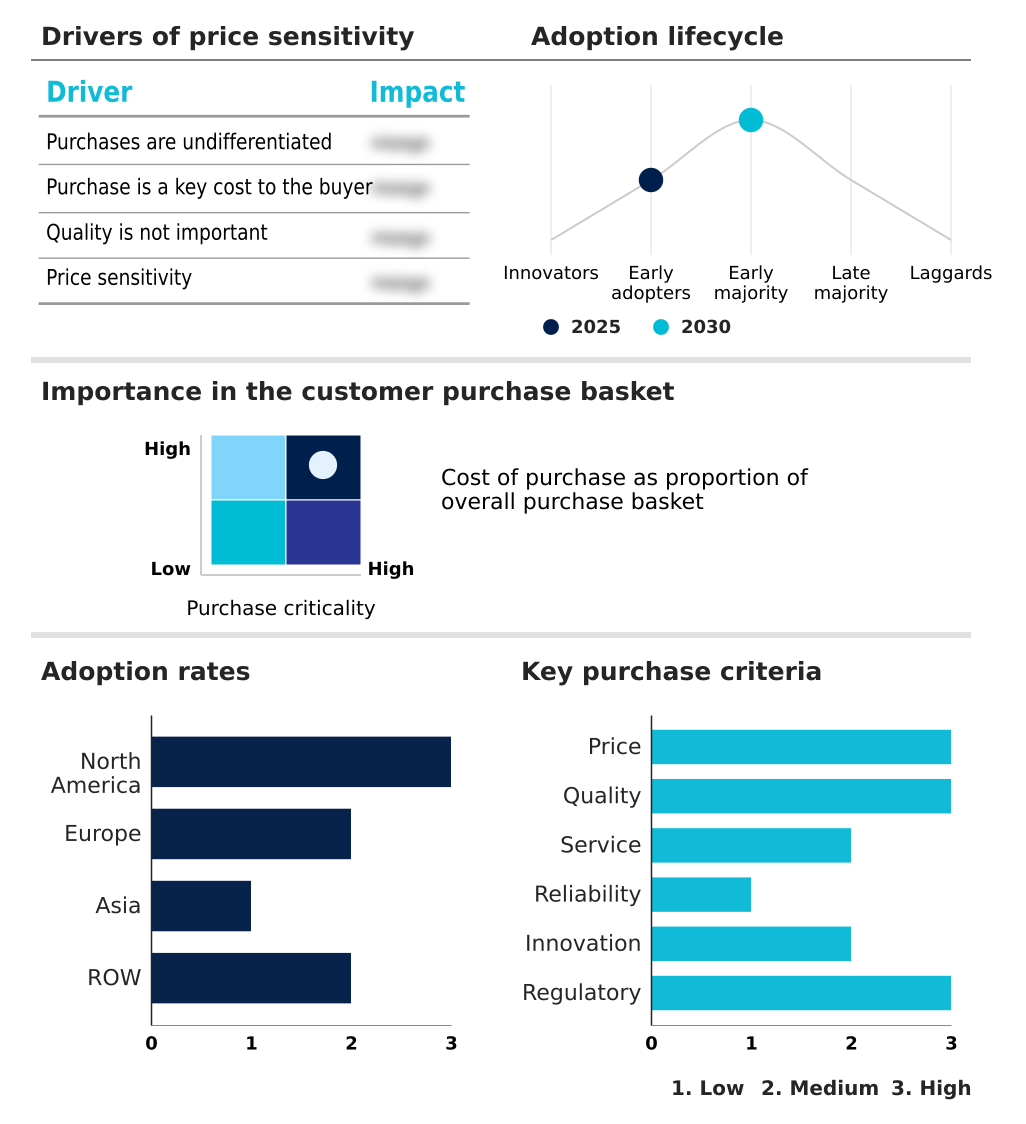
The digital biology market forecasting report includes the adoption lifecycle of the market, covering from the innovator’s stage to the laggard’s stage. It focuses on adoption rates in different regions based on penetration. Furthermore, the digital biology market report also includes key purchase criteria and drivers of price sensitivity to help companies evaluate and develop their market growth analysis strategies.
Customer Landscape of Digital Biology Industry
Competitive Landscape
Companies are implementing various strategies, such as strategic alliances, digital biology market forecast, partnerships, mergers and acquisitions, geographical expansion, and product/service launches, to enhance their presence in the industry.
10X Genomics Inc. - Offers integrated digital biology solutions combining instruments with bioinformatics software to enable high-resolution mapping and analysis of complex biological systems.
The industry research and growth report includes detailed analyses of the competitive landscape of the market and information about key companies, including:
- 10X Genomics Inc.
- AbCellera Biologics Inc.
- Asimov Inc
- Benchling Inc.
- BenevolentAI
- Cradle
- DNAnexus Inc.
- Generate Biomedicines
- Ginkgo Bioworks Holdings Inc.
- Illumina Inc.
- Insilico Medicine
- Isomorphic Labs
- Microsoft Corp.
- NVIDIA Corp.
- Recursion Pharmaceuticals Inc.
- Relay Therapeutics Inc.
- Schrodinger Inc.
- Tempus AI Inc.
- Twist Bioscience Corp.
- Valo Health
Qualitative and quantitative analysis of companies has been conducted to help clients understand the wider business environment as well as the strengths and weaknesses of key industry players. Data is qualitatively analyzed to categorize companies as pure play, category-focused, industry-focused, and diversified; it is quantitatively analyzed to categorize companies as dominant, leading, strong, tentative, and weak.
Recent Development and News in Digital biology market
- In January 2025, Johnson and Johnson announced the acquisition of Intra-Cellular Therapies in a deal valued at approximately $14.6 billion, strengthening its neuroscience portfolio and highlighting interest in digitally enabled therapeutic development.
- In February 2025, GeneDx completed its acquisition of Fabric Genomics for up to $51 million, enhancing its AI-driven genomic interpretation and clinical sequencing capabilities for rare disease diagnostics.
- In April 2025, investment firms including Breyer Capital increased their investments in computational biology and AI-driven life sciences companies, signaling renewed market confidence in AI-native biotech infrastructure.
- In April 2025, Recursion Pharmaceuticals and Exscientia announced a merger to build an integrated, AI-driven drug discovery platform, unifying phenomics and biological imaging with AI-powered chemistry and precision medicine technologies.
Dive into Technavio’s robust research methodology, blending expert interviews, extensive data synthesis, and validated models for unparalleled Digital Biology Market insights. See full methodology.
| Market Scope | |
|---|---|
| Page number | 307 |
| Base year | 2025 |
| Historic period | 2020-2024 |
| Forecast period | 2026-2030 |
| Growth momentum & CAGR | Accelerate at a CAGR of 20.1% |
| Market growth 2026-2030 | USD 29883.8 million |
| Market structure | Fragmented |
| YoY growth 2025-2026(%) | 16.8% |
| Key countries | US, Canada, Mexico, Germany, UK, France, Italy, Spain, The Netherlands, Russia, China, Japan, India, South Korea, Singapore, Indonesia, Thailand, Australia, Brazil, Saudi Arabia, Turkey, UAE and South Africa |
| Competitive landscape | Leading Companies, Market Positioning of Companies, Competitive Strategies, and Industry Risks |
Research Analyst Overview
- The digital biology market is defined by the deep integration of computational power into life sciences, transforming research from a manual, experimental process into a data-driven, predictive discipline. The adoption of digital twin technology is now a critical boardroom decision, directly influencing R&D budgets and strategic portfolio management by enabling in silico trials.
- This shift is powered by technologies like AI-driven drug discovery, generative biology, and high-performance computing. An AI-enabled operating system allows for the seamless orchestration of automated wet labs and bioinformatics pipelines, while computational chemistry and molecular dynamics simulations provide deep insights into molecular behavior.
- Firms implementing such integrated systems, which leverage pharmacogenomics and protein structure prediction based on multi-omics research, report a 30% reduction in experimental validation cycles. This efficiency gain underscores the tangible business impact of embracing synthetic gene circuits and advanced computational models in modern therapeutic development.
What are the Key Data Covered in this Digital Biology Market Research and Growth Report?
-
What is the expected growth of the Digital Biology Market between 2026 and 2030?
-
USD 29.88 billion, at a CAGR of 20.1%
-
-
What segmentation does the market report cover?
-
The report is segmented by Application (Drug discovery, Synthetic biology, Precision medicine, Clinical diagnostics, and Agricultural biotechnology), End-user (Pharmaceutical companies, Biotechnology companies, Research institutes, Healthcare providers, and Agricultural companies), Component (Solutions, and Services) and Geography (North America, Europe, Asia, Rest of World (ROW))
-
-
Which regions are analyzed in the report?
-
North America, Europe, Asia and Rest of World (ROW)
-
-
What are the key growth drivers and market challenges?
-
Integration of AI and ML in genomic sequencing , Data privacy concerns and cybersecurity vulnerabilities in biological databases
-
-
Who are the major players in the Digital Biology Market?
-
10X Genomics Inc., AbCellera Biologics Inc., Asimov Inc, Benchling Inc., BenevolentAI, Cradle, DNAnexus Inc., Generate Biomedicines, Ginkgo Bioworks Holdings Inc., Illumina Inc., Insilico Medicine, Isomorphic Labs, Microsoft Corp., NVIDIA Corp., Recursion Pharmaceuticals Inc., Relay Therapeutics Inc., Schrodinger Inc., Tempus AI Inc., Twist Bioscience Corp. and Valo Health
-
Market Research Insights
- The digital biology market is defined by a rapid shift from traditional lab work to computationally intensive methodologies, fueled by innovations in multi-modal clinical data analysis and cloud-based bioinformatics. This transition is delivering measurable business outcomes, with organizations adopting automated wet labs reporting up to a 40% reduction in manual errors and a 30% increase in experimental throughput.
- The application of sophisticated algorithms to population-level genomic data allows for more targeted therapeutic development, improving clinical trial success rates by over 15%. This dynamic landscape, where next-generation sequencing meets advanced predictive modeling, fosters an ecosystem where data-driven insights directly inform strategic R&D and commercialization decisions across the life sciences sector.
We can help! Our analysts can customize this digital biology market research report to meet your requirements.
 RIA -
RIA -