



Digital Transformation In Oil And Gas Industry Market Size 2026-2030
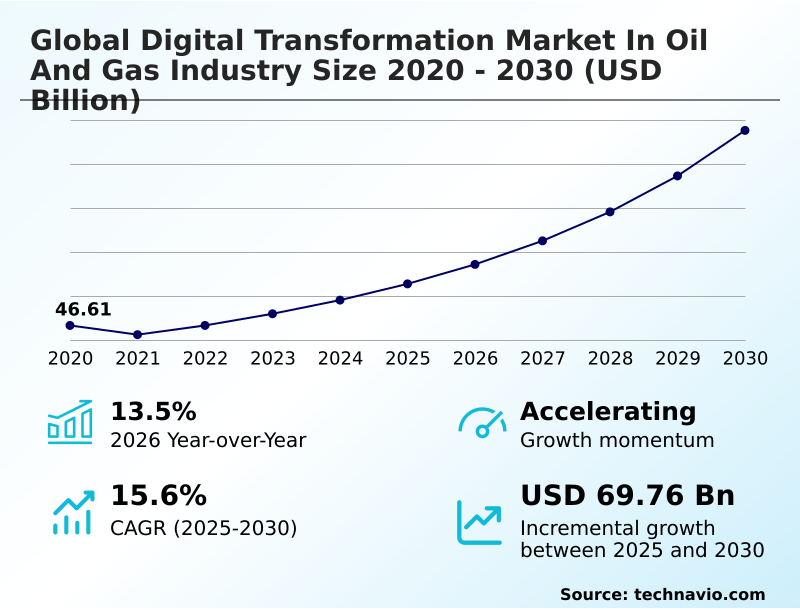
The digital transformation in oil and gas industry market size is valued to increase by USD 69.76 billion, at a CAGR of 15.6% from 2025 to 2030. Institutionalization of agentic AI and autonomous decision intelligence will drive the digital transformation in oil and gas industry market.
Major Market Trends & Insights
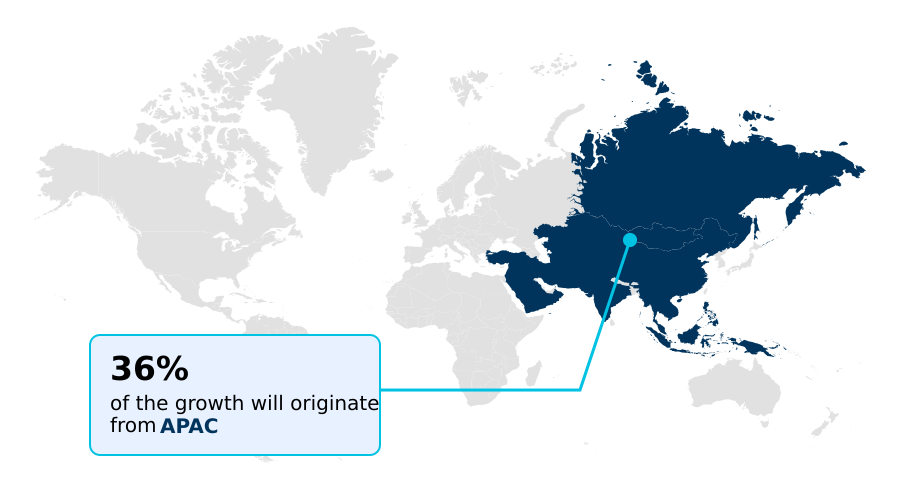
- APAC dominated the market and accounted for a 36.3% growth during the forecast period.
- By Technology - IoT segment was valued at USD 20.85 billion in 2024
- By Sector - Downstream segment accounted for the largest market revenue share in 2024
Market Size & Forecast
- Market Opportunities: USD 88.66 billion
- Market Future Opportunities: USD 69.76 billion
- CAGR from 2025 to 2030 : 15.6%
Market Summary
- The digital transformation market in oil and gas industry is undergoing a structural shift, moving from legacy processes to data-centric operational models. This evolution is driven by the need for greater efficiency and safety, leveraging a data-driven operational framework built on the industrial internet of things (IIoT), high-performance computing, and machine learning algorithms.
- The deployment of agentic AI and digital twins enables predictive maintenance and predictive simulation, significantly reducing operational risks. In one business scenario, an operator utilizes an integrated asset management system to monitor a network of remote subsea pipelines.
- By applying predictive analytics to sensor data, the system identifies a potential integrity issue, automatically rerouting flow and scheduling a robotic subsea inspection, thereby preventing a costly and environmentally damaging failure. The integration of such technologies is no longer optional but a core component of strategy, addressing challenges from technical debt in legacy infrastructure to the complexities of IT/OT cybersecurity.
- This transition towards a digital oilfield, supported by cloud-native architectures and zero-trust security, underpins the industry's future resilience and sustainability.
What will be the Size of the Digital Transformation In Oil And Gas Industry Market during the forecast period?
Get Key Insights on Market Forecast (PDF) Get Free Sample
How is the Digital Transformation In Oil And Gas Industry Market Segmented?
The digital transformation in oil and gas industry industry research report provides comprehensive data (region-wise segment analysis), with forecasts and estimates in "USD million" for the period 2026-2030, as well as historical data from 2020-2024 for the following segments.
- Technology
- IoT
- Big data and analytics
- Cloud computing
- Artificial intelligence
- Others
- Sector
- Downstream
- Upstream
- Midstream
- Component
- Software
- Hardware
- Services
- Geography
- APAC
- China
- Japan
- India
- North America
- US
- Canada
- Mexico
- Middle East and Africa
- Saudi Arabia
- UAE
- South Africa
- Europe
- Germany
- UK
- France
- South America
- Brazil
- Argentina
- Rest of World (ROW)
- APAC
By Technology Insights
The iot segment is estimated to witness significant growth during the forecast period.
The industrial internet of things (IIoT) segment is foundational, enabling a data-driven operational framework through extensive real-time data acquisition from remote and hazardous environments.
This involves deploying smart sensors across the value chain for pipeline integrity monitoring and midstream logistics optimization.
This shift from reactive maintenance to proactive, condition-based monitoring leverages edge computing to process information locally, which reduces the need for manual inspections in high-risk zones.
Integrating these IIoT systems with legacy supervisory control and data acquisition (SCADA) and operational technology (OT) hardware is critical.
This digital foundation, which powers everything from real-time reservoir modeling to downstream process optimization, allows for unprecedented visibility, helping to prevent up to 80% of catastrophic equipment failures.
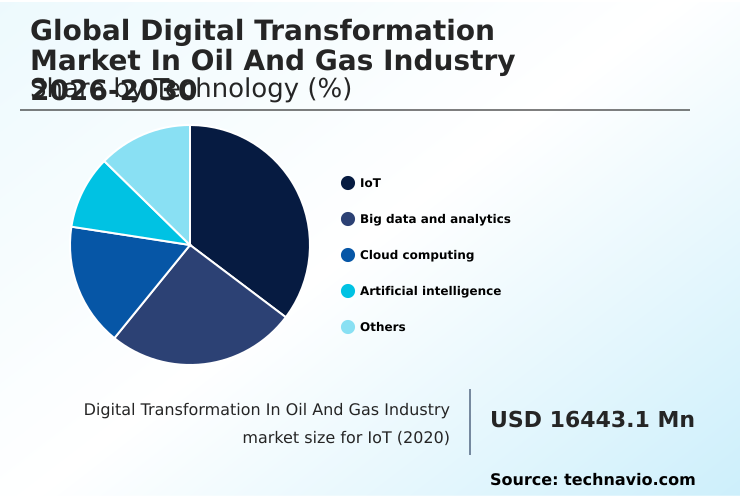
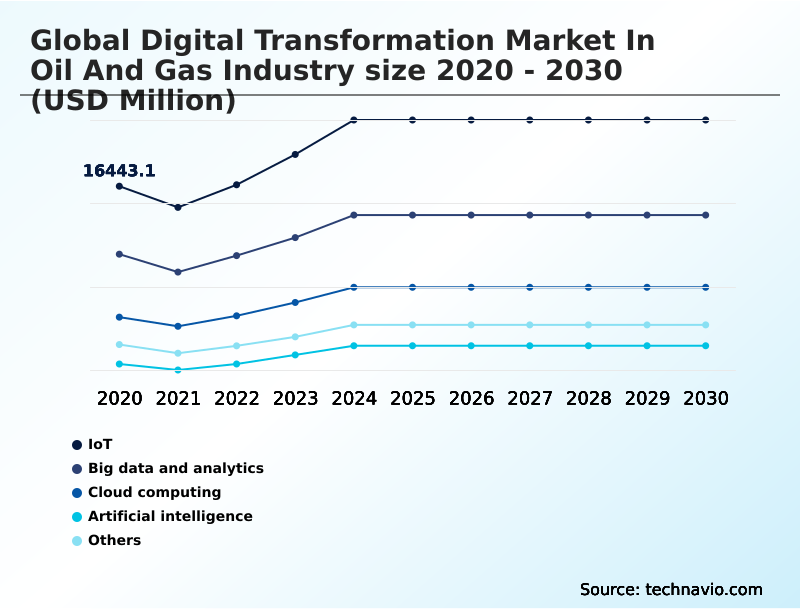
The IoT segment was valued at USD 20.85 billion in 2024 and showed a gradual increase during the forecast period.
Regional Analysis
APAC is estimated to contribute 36.3% to the growth of the global market during the forecast period.Technavio’s analysts have elaborately explained the regional trends and drivers that shape the market during the forecast period.
See How Digital Transformation In Oil And Gas Industry Market Demand is Rising in APAC Get Free Sample
The geographic landscape is increasingly defined by regional priorities in digitalization, with APAC emerging as a significant growth engine, contributing over 36% of the market's incremental growth.
In this region, the focus is on deploying cloud-native architectures and smart refineries, using machine learning algorithms to optimize production. North America continues to lead in the adoption of remote operations centers, while the Middle East pioneers large-scale predictive simulation.
The use of blockchain for supply chain verification is gaining traction globally to improve transparency through decentralized ledgers.
This technology, combined with computer vision for automated inspections and natural language processing for analyzing technical documents, is creating a more interconnected and efficient global energy ecosystem. These regional adaptations underscore a universal push toward digital modernization.
Market Dynamics
Our researchers analyzed the data with 2025 as the base year, along with the key drivers, trends, and challenges. A holistic analysis of drivers will help companies refine their marketing strategies to gain a competitive advantage.
- Achieving operational excellence in the modern energy sector increasingly depends on mastering specific digital applications. The use of agentic AI in operational workflows is transitioning from pilot projects to core strategy, enabling autonomous decision-making that optimizes complex processes.
- This is complemented by the deployment of digital twins for asset management, which provide virtual replicas of physical infrastructure for risk-free simulation and planning. The growing pressure for sustainability is driving the adoption of automated ESG reporting frameworks, which leverage AI for predictive maintenance scheduling and ensure transparent compliance.
- In the upstream sector, generative AI in reservoir engineering and high-performance computing for seismic data are shortening exploration cycles. For instance, firms using AI-driven seismic analysis have reported identifying viable hydrocarbon deposits over 30% faster than those using traditional methods.
- Concurrently, the use of robotic systems for subsea inspection and autonomous drones for pipeline surveillance is enhancing safety and reducing operational costs. Securing these interconnected assets is paramount, leading to a focus on unified cybersecurity for IT and OT and the implementation of a zero-trust architecture in OT environments.
- The integration of industrial IoT for remote monitoring, edge computing for low-latency control, and cloud-native industrial data platforms creates a resilient foundation.
- Furthermore, technologies like blockchain for energy supply chains, machine learning for production optimization, and NLP for technical document analysis are essential for creating the smart refinery and digital oilfield of the future, all while navigating the complexities of integrating legacy SCADA systems.
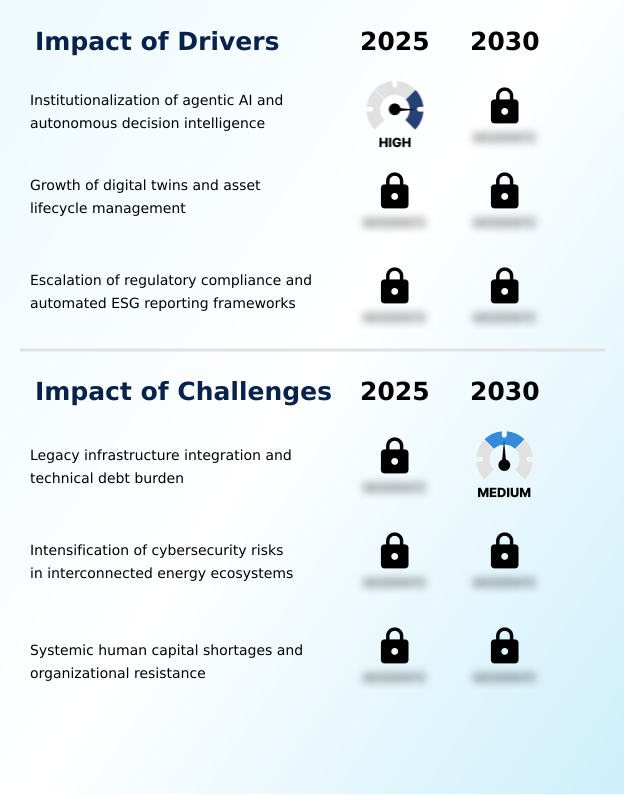
What are the key market drivers leading to the rise in the adoption of Digital Transformation In Oil And Gas Industry Industry?
- A key market driver is the institutionalization of agentic AI and autonomous decision intelligence layers across complex operational workflows.
- Market growth is primarily driven by the institutionalization of autonomous decision intelligence and agentic AI, which facilitate self-correcting systems and software-led orchestration across operations.
- This shift enables the deployment of high-fidelity digital twins for comprehensive asset lifecycle management, allowing for predictive simulations that optimize capital expenditure and extend infrastructure longevity.
- The use of AI-powered monitoring systems and spatial data analytics provides granular operational insights, leading to a more data-driven corporate culture. Furthermore, escalating regulatory mandates for environmental, social, and governance (ESG) compliance are compelling operators to adopt automated ESG reporting.
- This involves using digital tools to provide real-time emissions data, ensuring firms can meet decarbonization targets and secure green financing, with automated systems reducing compliance reporting errors by up to 60%.
What are the market trends shaping the Digital Transformation In Oil And Gas Industry Industry?
- A key market trend is the industrialization of generative AI to address complex subsurface and reservoir engineering challenges. This involves using advanced algorithms to synthesize geological data for high-fidelity drilling models.
- Key market trends are centered on the industrialization of AI and automation for complex engineering tasks. The use of generative AI and generative design tools for reservoir engineering is enabling a new level of computational exploration, significantly shortening the time to identify viable hydrocarbon deposits. This is complemented by advancements in seismic imaging, allowing for more precise subsurface modeling.
- In parallel, the digital oilfield concept is expanding into hazardous environments through the deployment of robotic subsea inspection systems. These resident robotic systems and autonomous underwater vehicles are transforming subsea engineering and wellbore management.
- The adoption of agentic AI frameworks allows these systems to perform tasks with minimal human oversight, improving safety and reducing operational expenditures by over 25% in deepwater maintenance campaigns.
What challenges does the Digital Transformation In Oil And Gas Industry Industry face during its growth?
- A significant challenge affecting industry growth is the difficulty of integrating advanced digital layers with legacy infrastructure, compounded by a substantial technical debt burden.
- Significant challenges are restraining market adoption, led by legacy infrastructure integration and the associated technical debt. Many operators struggle with outdated industrial control systems (ICS) that are incompatible with modern analytics, creating a barrier to deploying a digital-first organizational culture. Firms often face a choice between costly system integration or creating security risks within their cyber-physical security framework.
- The convergence of IT and OT in interconnected energy ecosystems intensifies these risks, with approximately 94% of top energy firms experiencing at least one major breach. Addressing this requires a move toward open-architecture platforms and a zero-trust security model, supported by continuous threat-hunting services.
- However, the high cost of implementation and a systemic shortage of talent with expertise in hybrid cloud environments remain significant hurdles.
Exclusive Technavio Analysis on Customer Landscape
The digital transformation in oil and gas industry market forecasting report includes the adoption lifecycle of the market, covering from the innovator’s stage to the laggard’s stage. It focuses on adoption rates in different regions based on penetration. Furthermore, the digital transformation in oil and gas industry market report also includes key purchase criteria and drivers of price sensitivity to help companies evaluate and develop their market growth analysis strategies.
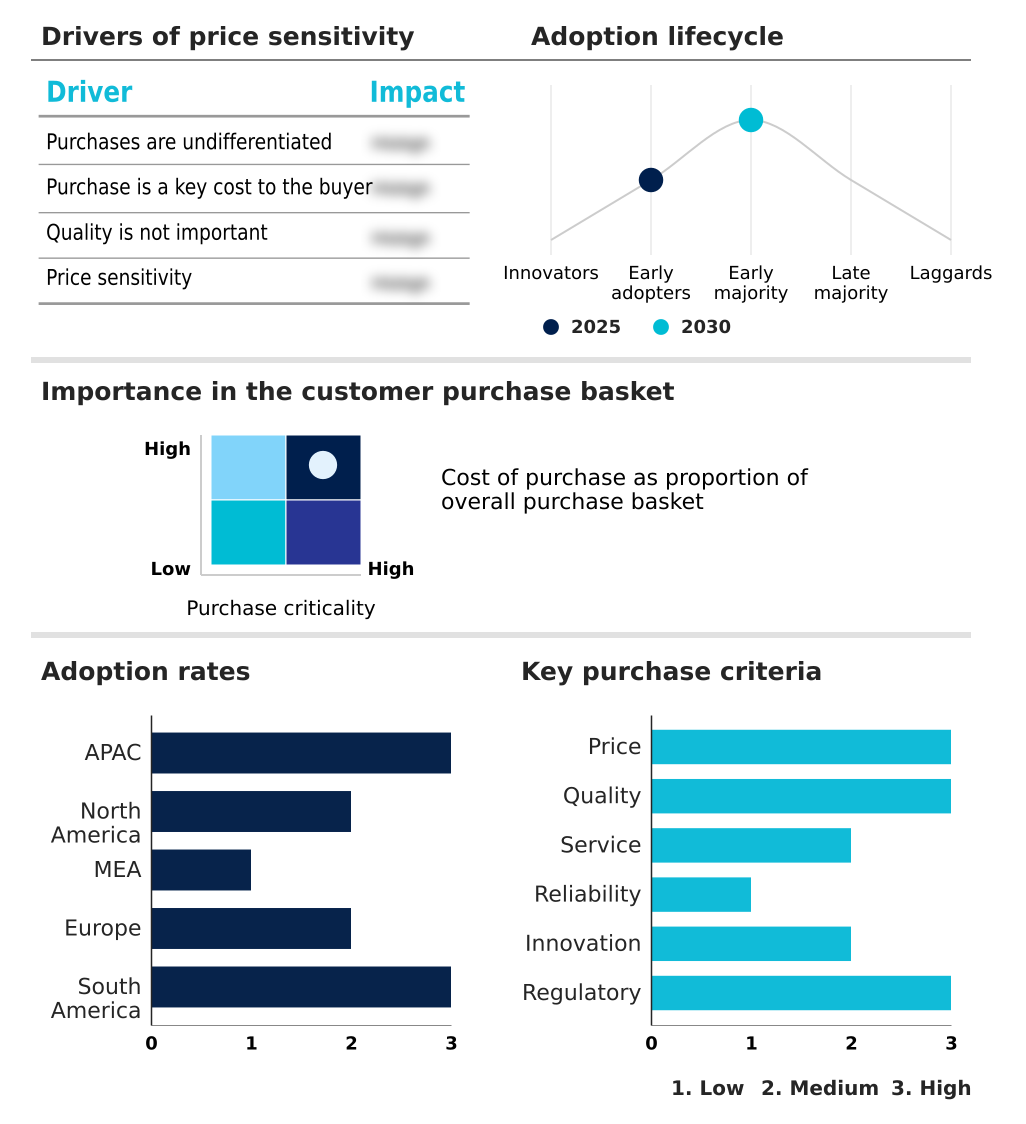
Customer Landscape of Digital Transformation In Oil And Gas Industry Industry
Competitive Landscape
Companies are implementing various strategies, such as strategic alliances, digital transformation in oil and gas industry market forecast, partnerships, mergers and acquisitions, geographical expansion, and product/service launches, to enhance their presence in the industry.
Accenture Plc - Key offerings center on AI-driven operational solutions and industrial analytics platforms, enabling enhanced asset performance management and autonomous decision intelligence across the energy value chain.
The industry research and growth report includes detailed analyses of the competitive landscape of the market and information about key companies, including:
- Accenture Plc
- Amazon.com Inc.
- AVEVA Group Ltd.
- Baker Hughes Co.
- Emerson Electric Co.
- General Electric Co.
- Halliburton Co.
- IBM Corp.
- Informatica Inc.
- Intel Corp.
- Microsoft Corp.
- NVIDIA Corp.
- Oracle Corp.
- Rockwell Automation Inc.
- SAP SE
- Schlumberger Ltd.
- Siemens AG
- Tata Consultancy Services
- Teradata Corp.
- TIBCO Software Inc.
Qualitative and quantitative analysis of companies has been conducted to help clients understand the wider business environment as well as the strengths and weaknesses of key industry players. Data is qualitatively analyzed to categorize companies as pure play, category-focused, industry-focused, and diversified; it is quantitatively analyzed to categorize companies as dominant, leading, strong, tentative, and weak.
Recent Development and News in Digital transformation in oil and gas industry market
- In September 2024, NVIDIA Corp. announced the launch of a new generative AI platform specifically designed for reservoir engineering, enabling energy companies to create high-fidelity drilling models from unstructured geological data.
- In November 2024, Siemens AG and Baker Hughes Co. entered a strategic partnership to deploy integrated digital twin solutions for comprehensive asset lifecycle management across major downstream refinery operations.
- In January 2025, Microsoft Corp. completed its acquisition of a leading cybersecurity firm specializing in unified IT/OT security, aiming to strengthen its Azure platform's capabilities for protecting interconnected energy ecosystems.
- In April 2025, SAP SE released an enhanced version of its sustainability software suite, featuring an automated ESG reporting framework that integrates real-time IoT sensor data for improved emissions tracking and compliance.
Dive into Technavio’s robust research methodology, blending expert interviews, extensive data synthesis, and validated models for unparalleled Digital Transformation In Oil And Gas Industry Market insights. See full methodology.
| Market Scope | |
|---|---|
| Page number | 312 |
| Base year | 2025 |
| Historic period | 2020-2024 |
| Forecast period | 2026-2030 |
| Growth momentum & CAGR | Accelerate at a CAGR of 15.6% |
| Market growth 2026-2030 | USD 69755.3 million |
| Market structure | Fragmented |
| YoY growth 2025-2026(%) | 13.5% |
| Key countries | China, Japan, India, South Korea, Australia, Indonesia, US, Canada, Mexico, Saudi Arabia, UAE, South Africa, Israel, Turkey, Germany, UK, France, Italy, Spain, The Netherlands, Brazil, Argentina and Chile |
| Competitive landscape | Leading Companies, Market Positioning of Companies, Competitive Strategies, and Industry Risks |
Research Analyst Overview
- The market is defined by the convergence of a data-driven operational framework with advanced digital technologies. Key components include agentic AI and autonomous decision intelligence, which enable predictive maintenance and asset lifecycle management through the use of digital twins and predictive simulation.
- The industrial internet of things (IIoT) facilitates real-time data acquisition, which is crucial for automated ESG reporting and the functioning of smart refineries. This data is processed using high-performance computing and machine learning algorithms, often within cloud-native architectures that support data democratization.
- Trends show a move toward generative AI for complex tasks like reservoir engineering and the use of computer vision and natural language processing for operational insights. The deployment of subsea robotics and autonomous underwater vehicles for robotic subsea inspection is becoming standard. However, challenges persist, including legacy infrastructure integration, technical debt, and human capital shortages.
- Addressing these requires a unified IT/OT cybersecurity approach, implementing a zero-trust architecture to protect industrial control systems (ICS) and operational technology (OT) across interconnected energy ecosystems. Technologies like edge computing for local processing and blockchain for supply chain security are critical for building a resilient digital oilfield.
What are the Key Data Covered in this Digital Transformation In Oil And Gas Industry Market Research and Growth Report?
-
What is the expected growth of the Digital Transformation In Oil And Gas Industry Market between 2026 and 2030?
-
USD 69.76 billion, at a CAGR of 15.6%
-
-
What segmentation does the market report cover?
-
The report is segmented by Technology (IoT, Big data and analytics, Cloud computing, Artificial intelligence, and Others), Sector (Downstream, Upstream, and Midstream), Component (Software, Hardware, and Services) and Geography (APAC, North America, Middle East and Africa, Europe, South America)
-
-
Which regions are analyzed in the report?
-
APAC, North America, Middle East and Africa, Europe and South America
-
-
What are the key growth drivers and market challenges?
-
Institutionalization of agentic AI and autonomous decision intelligence, Legacy infrastructure integration and technical debt burden
-
-
Who are the major players in the Digital Transformation In Oil And Gas Industry Market?
-
Accenture Plc, Amazon.com Inc., AVEVA Group Ltd., Baker Hughes Co., Emerson Electric Co., General Electric Co., Halliburton Co., IBM Corp., Informatica Inc., Intel Corp., Microsoft Corp., NVIDIA Corp., Oracle Corp., Rockwell Automation Inc., SAP SE, Schlumberger Ltd., Siemens AG, Tata Consultancy Services, Teradata Corp. and TIBCO Software Inc.
-
Market Research Insights
- The market's dynamics are shaped by a strategic shift towards autonomous and data-centric operations, where organizations are leveraging hybrid cloud environments and managed cybersecurity services. This transition is critical, as evidenced by the fact that approximately 94% of top energy firms have reported at least one significant data breach, highlighting the need for robust cyber-physical security.
- The adoption of self-correcting systems and software-led orchestration has been shown to reduce unplanned downtime by as much as 40%. The focus is on implementing a digital-first organizational culture supported by system integration and advanced process control to create a resilient and efficient operational framework.
- This evolution is essential for navigating the complexities of modern energy production while maximizing return on digital investments.
We can help! Our analysts can customize this digital transformation in oil and gas industry market research report to meet your requirements.
 RIA -
RIA - 
