


Diisocyanates And Polyisocyanates Market Analysis, Size, and Forecast 2026-2030: APAC (China, Japan, and India), North America (US, Canada, and Mexico), Europe (Germany, UK, and France), Middle East and Africa (Saudi Arabia, UAE, and South Africa), South America (Brazil and Argentina), and Rest of World (ROW)

Diisocyanates And Polyisocyanates Market Analysis, Size, and Forecast 2026-2030:
APAC (China, Japan, and India), North America (US, Canada, and Mexico), Europe (Germany, UK, and France), Middle East and Africa (Saudi Arabia, UAE, and South Africa), South America (Brazil and Argentina), and Rest of World (ROW)

Published: Dec 2025 298 Pages SKU: IRTNTR80060

Market Overview at a Glance

$14.19 B
Market Opportunity
6.5%
CAGR 2025 - 2030
55%
APAC Growth
$31.82 B
Diisocyanates segment 2024

Diisocyanates And Polyisocyanates Market Size 2026-2030

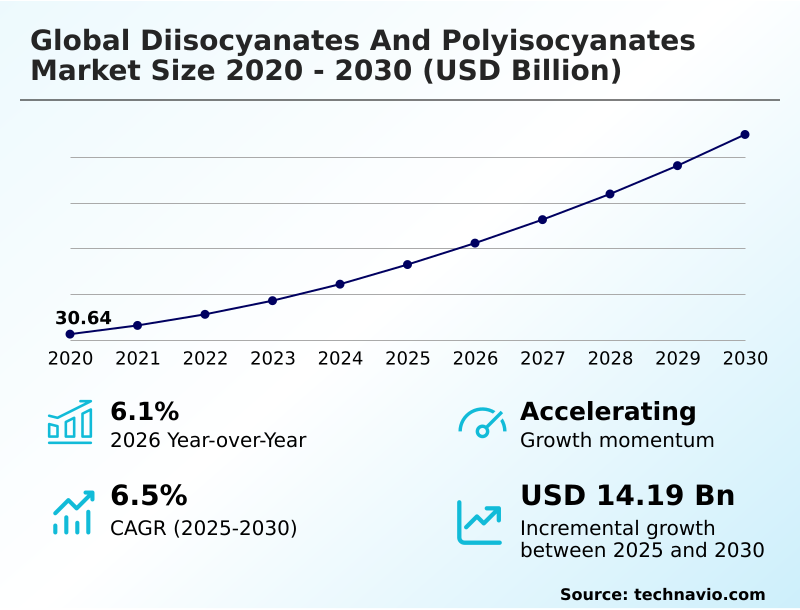
The diisocyanates and polyisocyanates market size is valued to increase by USD 14.19 billion, at a CAGR of 6.5% from 2025 to 2030. Exponential growth in construction sector will drive the diisocyanates and polyisocyanates market.

Major Market Trends & Insights

  • APAC dominated the market and accounted for a 55% growth during the forecast period.
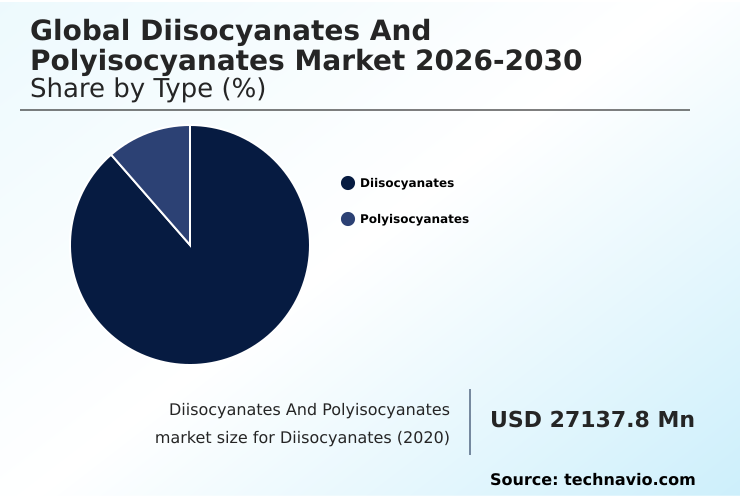
  • By Type - Diisocyanates segment was valued at USD 31.82 billion in 2024
  • By Application - Coating segment accounted for the largest market revenue share in 2024

Market Size & Forecast

  • Market Opportunities: USD 21.78 billion
  • Market Future Opportunities: USD 14.19 billion
  • CAGR from 2025 to 2030 : 6.5%

Market Summary

  • The diisocyanates and polyisocyanates market is foundational to modern manufacturing, providing the essential building blocks for polyurethane-based materials used across automotive, construction, and consumer goods. Growth is propelled by the increasing demand for lightweight, durable, and energy-efficient products. For instance, the automotive industry relies on polyurethane foams and composites to reduce vehicle weight and meet stringent emission standards.
  • A primary trend involves the shift toward sustainability, with significant R&D focused on bio-based feedstocks and phosgene-free synthesis to mitigate environmental impact and health concerns associated with traditional isocyanate-terminated prepolymers. As a business scenario, an automotive OEM must balance the performance benefits of polycarbodiimide chemistry in high-strength adhesives with the supply chain risks tied to volatile petrochemical feedstock prices.
  • This dynamic is complicated by stringent regulations governing workplace exposure to monomeric diisocyanates. Consequently, optimizing the isocyanate index to achieve desired properties while ensuring cost-effectiveness and compliance remains a critical challenge for producers and end-users, influencing innovation around the core urethane linkage and overall polymer backbone structure.

What will be the Size of the Diisocyanates And Polyisocyanates Market during the forecast period?
Get Key Insights on Market Forecast (PDF) Request Free Sample

How is the Diisocyanates And Polyisocyanates Market Segmented?

The diisocyanates and polyisocyanates industry research report provides comprehensive data (region-wise segment analysis), with forecasts and estimates in "USD million" for the period 2026-2030, as well as historical data from 2020-2024 for the following segments.

  • Type
    • Diisocyanates
    • Polyisocyanates
  • Application
    • Coating
    • Foam
    • Adhesive
    • Others
  • Grade type
    • Industrial grade
    • Specialty grade
  • Geography
    • APAC
      • China
      • Japan
      • India
    • North America
      • US
      • Canada
      • Mexico
    • Europe
      • Germany
      • UK
      • France
    • Middle East and Africa
      • Saudi Arabia
      • UAE
      • South Africa
    • South America
      • Brazil
      • Argentina
    • Rest of World (ROW)

By Type Insights

The diisocyanates segment is estimated to witness significant growth during the forecast period.

The diisocyanates and polyisocyanates market is segmented based on chemical structure, end-use application, and performance grade. Key distinctions are made between diisocyanates such as methylene diphenyl diisocyanate and polyisocyanates, which define the final properties of polyurethane polymers.

Applications including high-performance coatings and flexible and rigid foams represent major consumption channels, driven by industries seeking durable adhesive solutions and superior thermal insulation materials.

The market is further delineated by grade, with industrial grades for large-scale uses and specialty grades for niche requirements like non-yellowing aliphatic coatings.

APAC accounts for 55% of the incremental growth, underscoring its dominance in manufacturing lightweight automotive components and energy-efficient building materials that rely on advanced isocyanate chemistry and polyurethane synthesis reaction. These segments collectively influence supply chain strategies.
Request Free Sample

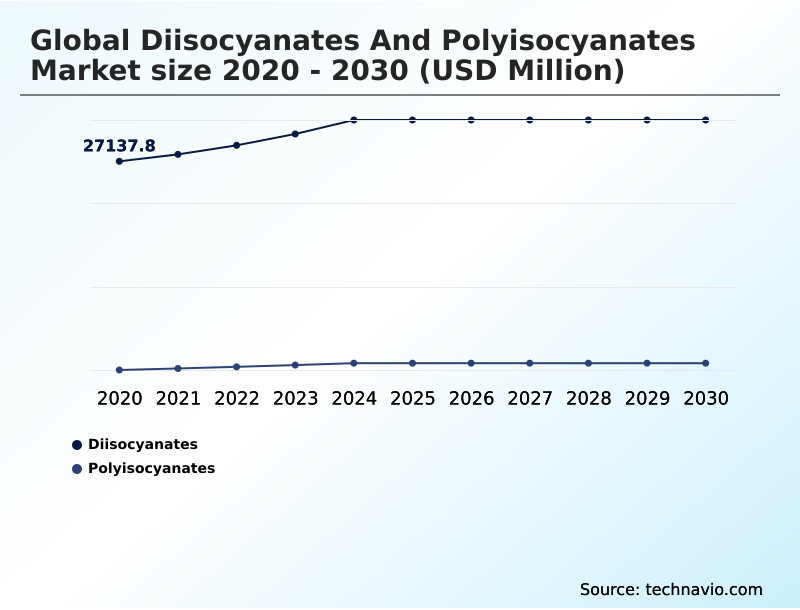
The Diisocyanates segment was valued at USD 31.82 billion in 2024 and showed a gradual increase during the forecast period.
Request Free Sample

Regional Analysis

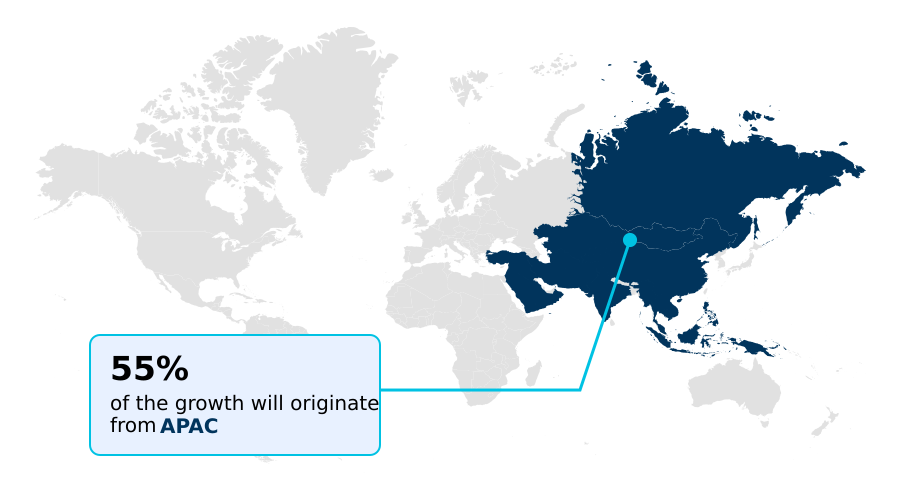
APAC is estimated to contribute 55% to the growth of the global market during the forecast period.Technavio’s analysts have elaborately explained the regional trends and drivers that shape the market during the forecast period.
See How Diisocyanates And Polyisocyanates Market Demand is Rising in APAC Request Free Sample

The market's geographic landscape is led by APAC, which accounts for 55% of the growth and is expanding at a regional rate of 6.8%.

This dominance is fueled by robust manufacturing in construction and automotive sectors, demanding vast quantities of polyurethane dispersion and one-component foam. North America focuses on high-performance applications, including casting polyurethanes for industrial parts and reaction injection molding for complex components.

The region prioritizes polyurethane potting compounds and advanced adhesive bonding technology. Europe, with its stringent regulations, drives innovation in waterborne polyurethane adhesives and cycloaliphatic diisocyanates for eco-friendly surface coating formulation.

Established supply chains for two-component systems and blocked isocyanates in these developed regions contrast with emerging markets where infrastructure for specialty chemicals is still developing.

Market Dynamics

Our researchers analyzed the data with 2025 as the base year, along with the key drivers, trends, and challenges. A holistic analysis of drivers will help companies refine their marketing strategies to gain a competitive advantage.

  • The strategic application of diisocyanates and polyisocyanates is becoming highly specialized, driving innovation across multiple sectors. The use of MDI applications in rigid foam insulation is a cornerstone of energy-efficient construction, with advancements in spray foam insulation for building envelopes allowing for superior air sealing.
  • For consumer products, TDI use in flexible foam cushioning continues to evolve for enhanced comfort and durability. In high-performance sectors, the focus is on specialized formulations, such as aliphatic polyisocyanate for automotive coatings, which provides exceptional UV resistance. Concurrently, the industry is proactively developing bio-based alternatives to isocyanates and reducing VOCs in polyurethane coatings to meet regulations.
  • This includes formulating high-solids polyurethane systems and developing blocked isocyanates for one-component coatings. The versatility is evident in diverse uses, from polyurethane elastomers for industrial applications to thermoplastic polyurethane in medical devices. Adhesion science is also advancing with polyurethane adhesives for composite bonding. Formulators are using polyols to modify polyurethane properties and deploying isocyanate prepolymers for cast elastomers.
  • Furthermore, waterborne polyurethane dispersions for wood finishes are gaining share, while polyisocyanates as crosslinkers for sealants enhance durability. Manufacturers are also improving fire retardancy of polyurethane foams and using polyurethane potting compounds for electronics. Ensuring safety measures for handling diisocyanates remains paramount across all applications, including polyurethane binders for reconstituted wood.
  • Companies adopting these solutions report product failure rates up to 50% lower than those using generic formulations.
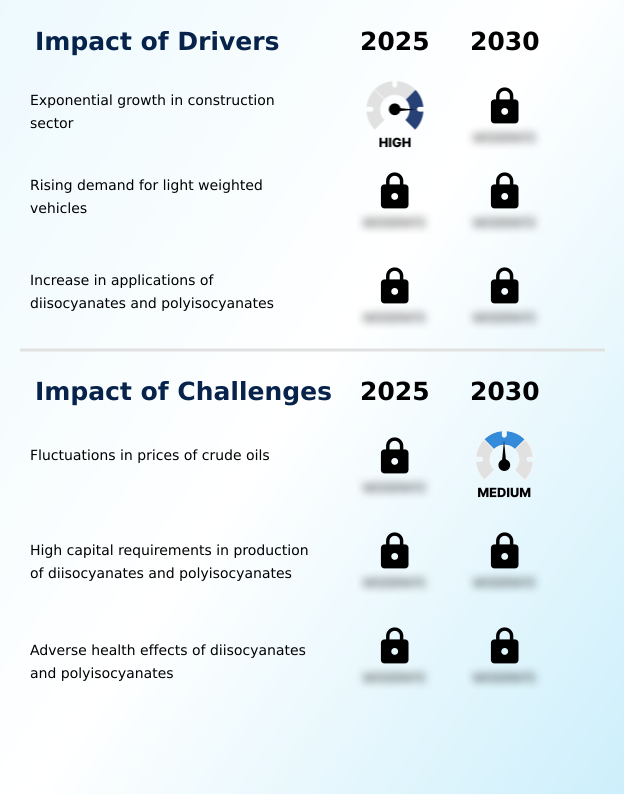
What are the key market drivers leading to the rise in the adoption of Diisocyanates And Polyisocyanates Industry?

  • The exponential growth of the global construction sector is a key driver for the diisocyanates and polyisocyanates market.

  • Market growth is fundamentally driven by expanding applications in core industrial sectors. The construction industry's demand for spray polyurethane foam for insulation contributes significantly, with proper application reducing building energy consumption by up to 30%.
  • In the automotive sector, the push for lightweighting has increased the use of polyurethane composites and foams, where a 10% weight reduction can improve fuel efficiency by nearly 7%.
  • The versatility of aromatic isocyanates and polyol components enables the creation of materials for everything from flexible foam cushioning in furniture to robust structural adhesives.
  • This broad utility, combined with the superior performance of chemical resistant polymers in automotive refinish coatings and footwear sole manufacturing, ensures sustained demand and drives ongoing material development.

What are the market trends shaping the Diisocyanates And Polyisocyanates Industry?

  • Technological advancements in the production of diisocyanates and polyisocyanates are emerging as a significant market trend, shaping both manufacturing efficiency and product innovation.

  • Key market trends are driven by innovation in production and formulation, with a strong focus on sustainability. The development of bio-based isocyanates is gaining momentum, with new processes improving yields by up to 15% compared to conventional methods. This shift addresses both regulatory pressures and demand for sustainable polyurethane solutions.
  • Companies are also adopting phosgene-free synthesis and other advanced prepolymer technology to enhance safety and efficiency. Collaborations are accelerating the adoption of low-VOC formulations and high-solids coatings, with joint ventures reporting a 20% faster path to commercialization for new industrial coating systems.
  • These advancements in polyurethane recycling processes and the creation of epoxy-polyurethane hybrids are reshaping the competitive landscape, pushing the industry toward a circular economy model.

What challenges does the Diisocyanates And Polyisocyanates Industry face during its growth?

  • Fluctuations in crude oil prices present a key challenge affecting the growth of the diisocyanates and polyisocyanates industry.

  • Significant challenges confront the market, led by raw material cost volatility. As petrochemical feedstocks are the primary source, crude oil price swings can alter production costs by over 20% in a single quarter, compressing margins on products like toluene diisocyanate and hexamethylene diisocyanate.
  • High capital expenditure for new facilities and stringent safety regulations surrounding monomeric diisocyanates act as barriers to entry. Developing safer handling protocols and isocyanate hardeners adds complexity. Moreover, the industry faces scrutiny over the lifecycle of elastomeric materials, pushing for better elastomer processing and end-of-life solutions.
  • Firms that successfully navigate these issues, perhaps by optimizing foam density control or adopting solventborne polyurethane coatings with better environmental profiles, can gain a competitive edge.

Exclusive Technavio Analysis on Customer Landscape

The diisocyanates and polyisocyanates market forecasting report includes the adoption lifecycle of the market, covering from the innovator’s stage to the laggard’s stage. It focuses on adoption rates in different regions based on penetration. Furthermore, the diisocyanates and polyisocyanates market report also includes key purchase criteria and drivers of price sensitivity to help companies evaluate and develop their market growth analysis strategies.
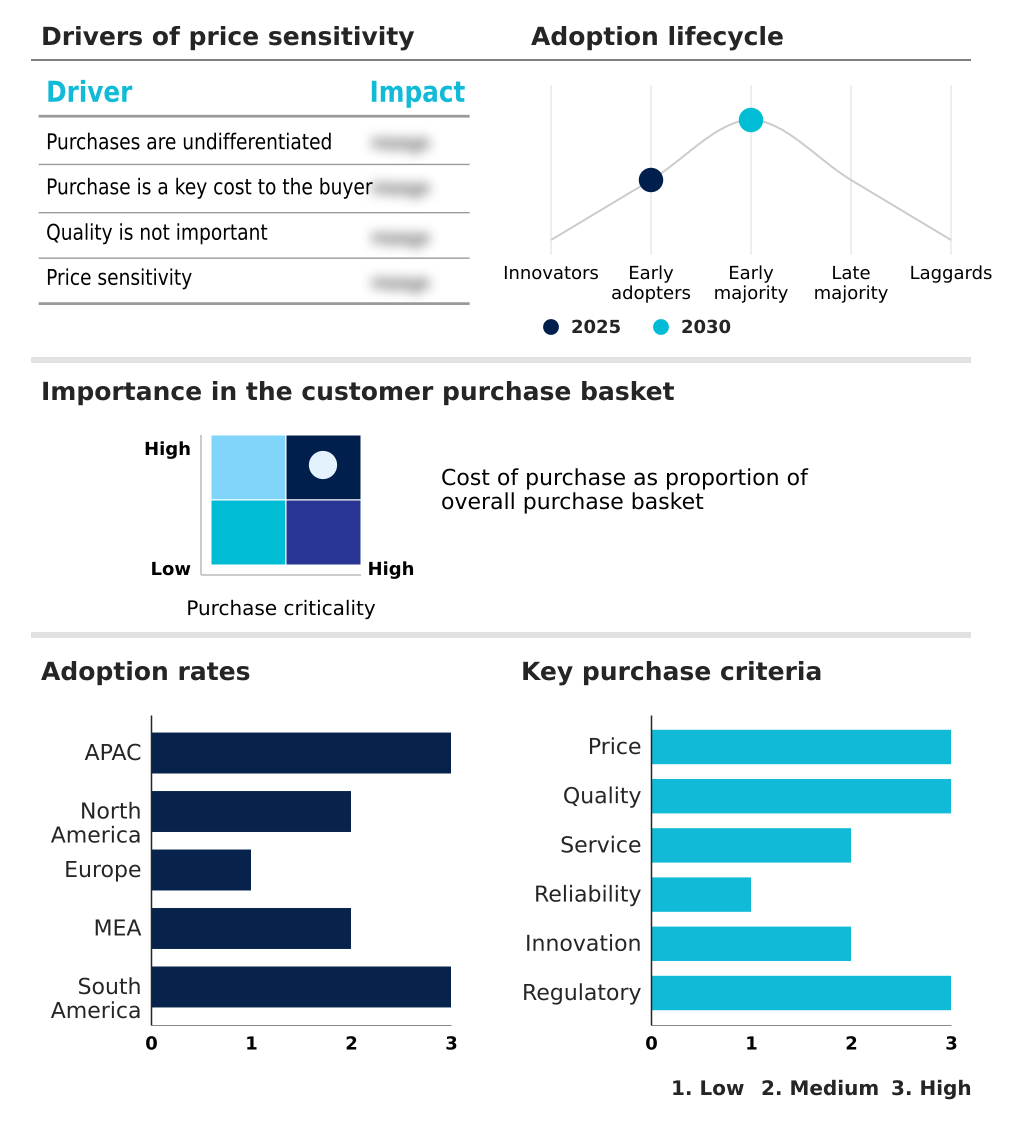
Customer Landscape of Diisocyanates And Polyisocyanates Industry

Competitive Landscape

Companies are implementing various strategies, such as strategic alliances, diisocyanates and polyisocyanates market forecast, partnerships, mergers and acquisitions, geographical expansion, and product/service launches, to enhance their presence in the industry.

Anhui Sinograce Chemical - The market provides essential diisocyanates and polyisocyanates, foundational for high-performance coatings, durable adhesives, and versatile polyurethane foams across key industrial sectors.

The industry research and growth report includes detailed analyses of the competitive landscape of the market and information about key companies, including:

  • Anhui Sinograce Chemical
  • Asahi Kasei Corp.
  • BASF SE
  • BorsodChem
  • Cosmos Plastics and Chemicals
  • Covestro AG
  • DIC Corp.
  • Dow Chemical Co.
  • Evonik Industries AG
  • Huntsman International LLC
  • Jiahua Chemical Co. Ltd.
  • Merck KGaA
  • Mitsui Chemicals Inc.
  • N Shashikant and Co.
  • Prakash Chemicals Intl. Ltd.
  • Prasol Chemicals Ltd.
  • Shandong INOV Polyurethane Co.
  • Super Urecoat Industries
  • Tosoh Corp.

Qualitative and quantitative analysis of companies has been conducted to help clients understand the wider business environment as well as the strengths and weaknesses of key industry players. Data is qualitatively analyzed to categorize companies as pure play, category-focused, industry-focused, and diversified; it is quantitatively analyzed to categorize companies as dominant, leading, strong, tentative, and weak.

Recent Development and News in Diisocyanates and polyisocyanates market

  • In September 2024, InnovaChem Solutions launched a new line of bio-based polyisocyanates derived from renewable feedstocks, aiming to reduce the carbon footprint of polyurethane coatings by up to 30%.
  • In December 2024, PolyVantage Group and EcoResin Technologies announced a strategic partnership to build a pilot plant for the chemical recycling of post-consumer polyurethane foam, with an initial capacity of 5,000 metric tons per year.
  • In February 2025, Global Materials Inc. completed its acquisition of specialty chemicals firm Adhesives & Polymers Co. for USD 150 million, expanding its portfolio of high-performance structural adhesives for the automotive and aerospace industries.
  • In May 2025, DuraCoat Technologies received regulatory approval for its new phosgene-free synthesis process for aliphatic diisocyanates, enabling cleaner production and reducing workplace hazards at its European manufacturing sites.

Dive into Technavio’s robust research methodology, blending expert interviews, extensive data synthesis, and validated models for unparalleled Diisocyanates And Polyisocyanates Market insights. See full methodology.

Market Scope
Page number 298
Base year 2025
Historic period 2020-2024
Forecast period 2026-2030
Growth momentum & CAGR Accelerate at a CAGR of 6.5%
Market growth 2026-2030 USD 14185.3 million
Market structure Fragmented
YoY growth 2025-2026(%) 6.1%
Key countries China, Japan, India, South Korea, Australia, Indonesia, US, Canada, Mexico, Germany, UK, France, Italy, Spain, The Netherlands, Saudi Arabia, UAE, South Africa, Israel, Turkey, Brazil, Argentina and Chile
Competitive landscape Leading Companies, Market Positioning of Companies, Competitive Strategies, and Industry Risks

Request Free Sample

Research Analyst Overview

  • The diisocyanates and polyisocyanates market is defined by its critical role in producing versatile polyurethane polymers. Core to this are isocyanate functional groups that form a strong urethane linkage upon reaction. Key chemicals include methylene diphenyl diisocyanate and toluene diisocyanate for flexible and rigid foams, and aliphatic polyisocyanate and aromatic isocyanates for high-performance coatings.
  • Boardroom decisions are increasingly influenced by the shift away from traditional petrochemical feedstocks toward sustainable alternatives. This strategic pivot involves significant investment in phosgene-free synthesis and prepolymer technology for creating isocyanate-terminated prepolymers. Advanced low-VOC formulations, such as waterborne polyurethane adhesives and moisture-curing adhesives, are becoming standard.
  • Formulators utilize isocyanate hardeners and crosslinking agents for coatings to develop robust two-component systems and structural adhesives. Innovation is also seen in thermoplastic polyurethane, casting polyurethanes, and elastomeric materials using specialized polyol components. Products like one-component foam and spray polyurethane foam are optimized through reaction injection molding.
  • The development of blocked isocyanates and polycarbodiimide chemistry has improved chemical resistant polymers and polyurethane dispersion. This focus on R&D, exploring materials from hexamethylene diisocyanate to novel polyurethane binders with a controlled isocyanate index, has led to operational gains, with some advanced processes reducing waste by 15%.

What are the Key Data Covered in this Diisocyanates And Polyisocyanates Market Research and Growth Report?

  • What is the expected growth of the Diisocyanates And Polyisocyanates Market between 2026 and 2030?

    • USD 14.19 billion, at a CAGR of 6.5%

  • What segmentation does the market report cover?

    • The report is segmented by Type (Diisocyanates, and Polyisocyanates), Application (Coating, Foam, Adhesive, and Others), Grade Type (Industrial grade, and Specialty grade) and Geography (APAC, North America, Europe, Middle East and Africa, South America)

  • Which regions are analyzed in the report?

    • APAC, North America, Europe, Middle East and Africa and South America

  • What are the key growth drivers and market challenges?

    • Exponential growth in construction sector, Fluctuations in prices of crude oils

  • Who are the major players in the Diisocyanates And Polyisocyanates Market?

    • Anhui Sinograce Chemical, Asahi Kasei Corp., BASF SE, BorsodChem, Cosmos Plastics and Chemicals, Covestro AG, DIC Corp., Dow Chemical Co., Evonik Industries AG, Huntsman International LLC, Jiahua Chemical Co. Ltd., Merck KGaA, Mitsui Chemicals Inc., N Shashikant and Co., Prakash Chemicals Intl. Ltd., Prasol Chemicals Ltd., Shandong INOV Polyurethane Co., Super Urecoat Industries and Tosoh Corp.

Market Research Insights

  • Market dynamics are shaped by a convergence of demand for high-performance materials and a push for sustainability. Industries are leveraging durable adhesive solutions and weather-resistant coatings to extend product lifecycles, with some advanced formulations improving weatherability by up to 40% over conventional products.
  • The adoption of thermal insulation materials in construction has demonstrated a reduction in building energy costs by as much as 25%. Concurrently, isocyanate chemistry is evolving, with bio-based isocyanates emerging as viable alternatives that support corporate sustainability mandates.
  • This transition is supported by advancements in polyurethane synthesis reaction processes, enabling the creation of lightweight automotive components and energy-efficient building materials that meet both performance and environmental criteria, driving innovation across the value chain.

We can help! Our analysts can customize this diisocyanates and polyisocyanates market research report to meet your requirements.

Get in touch

1. Executive Summary

1.1 Market overview

Executive Summary - Chart on Market Overview
Executive Summary - Data Table on Market Overview
Executive Summary - Chart on Global Market Characteristics
Executive Summary - Chart on Market by Geography
Executive Summary - Chart on Market Segmentation by Type
Executive Summary - Chart on Market Segmentation by Application
Executive Summary - Chart on Market Segmentation by Grade Type
Executive Summary - Chart on Incremental Growth
Executive Summary - Data Table on Incremental Growth
Executive Summary - Chart on Company Market Positioning

2. Technavio Analysis

2.1 Analysis of price sensitivity, lifecycle, customer purchase basket, adoption rates, and purchase criteria

2.2 Criticality of inputs and Factors of differentiation

Chart on Overview on criticality of inputs and factors of differentiation

2.3 Factors of disruption

Chart on Overview on factors of disruption

2.4 Impact of drivers and challenges

Chart on Impact of drivers and challenges in 2025 and 2030

3. Market Landscape

3.1 Market ecosystem

Chart on Parent Market
Data Table on - Parent Market

3.2 Market characteristics

Chart on Market characteristics analysis

3.3 Value chain analysis

Chart on Value chain analysis

4. Market Sizing

4.1 Market definition

Data Table on Offerings of companies included in the market definition

4.2 Market segment analysis

Market segments

4.3 Market size 2025

4.4 Market outlook: Forecast for 2025-2030

Chart on Global - Market size and forecast 2025-2030 ($ million)
Data Table on Global - Market size and forecast 2025-2030 ($ million)
Chart on Global Market: Year-over-year growth 2025-2030 (%)
Data Table on Global Market: Year-over-year growth 2025-2030 (%)

5. Historic Market Size

5.1 Global Diisocyanates And Polyisocyanates Market 2020 - 2024

Historic Market Size - Data Table on Global Diisocyanates And Polyisocyanates Market 2020 - 2024 ($ million)

5.2 Type segment analysis 2020 - 2024

Historic Market Size - Type Segment 2020 - 2024 ($ million)

5.3 Application segment analysis 2020 - 2024

Historic Market Size - Application Segment 2020 - 2024 ($ million)

5.4 Grade Type segment analysis 2020 - 2024

Historic Market Size - Grade Type Segment 2020 - 2024 ($ million)

5.5 Geography segment analysis 2020 - 2024

Historic Market Size - Geography Segment 2020 - 2024 ($ million)

5.6 Country segment analysis 2020 - 2024

Historic Market Size - Country Segment 2020 - 2024 ($ million)

6. Qualitative Analysis

6.1 Impact of AI in the Global Diisocyanates and Polyisocyanates Market

7. Five Forces Analysis

7.1 Five forces summary

Five forces analysis - Comparison between 2025 and 2030

7.2 Bargaining power of buyers

Bargaining power of buyers - Impact of key factors 2025 and 2030

7.3 Bargaining power of suppliers

Bargaining power of suppliers - Impact of key factors in 2025 and 2030

7.4 Threat of new entrants

Threat of new entrants - Impact of key factors in 2025 and 2030

7.5 Threat of substitutes

Threat of substitutes - Impact of key factors in 2025 and 2030

7.6 Threat of rivalry

Threat of rivalry - Impact of key factors in 2025 and 2030

7.7 Market condition

Chart on Market condition - Five forces 2025 and 2030

8. Market Segmentation by Type

8.1 Market segments

Chart on Type - Market share 2025-2030 (%)
Data Table on Type - Market share 2025-2030 (%)

8.2 Comparison by Type

Chart on Comparison by Type
Data Table on Comparison by Type

8.3 Diisocyanates - Market size and forecast 2025-2030

Chart on Diisocyanates - Market size and forecast 2025-2030 ($ million)
Data Table on Diisocyanates - Market size and forecast 2025-2030 ($ million)
Chart on Diisocyanates - Year-over-year growth 2025-2030 (%)
Data Table on Diisocyanates - Year-over-year growth 2025-2030 (%)

8.4 Polyisocyanates - Market size and forecast 2025-2030

Chart on Polyisocyanates - Market size and forecast 2025-2030 ($ million)
Data Table on Polyisocyanates - Market size and forecast 2025-2030 ($ million)
Chart on Polyisocyanates - Year-over-year growth 2025-2030 (%)
Data Table on Polyisocyanates - Year-over-year growth 2025-2030 (%)

8.5 Market opportunity by Type

Market opportunity by Type ($ million)
Data Table on Market opportunity by Type ($ million)

9. Market Segmentation by Application

9.1 Market segments

Chart on Application - Market share 2025-2030 (%)
Data Table on Application - Market share 2025-2030 (%)

9.2 Comparison by Application

Chart on Comparison by Application
Data Table on Comparison by Application

9.3 Coating - Market size and forecast 2025-2030

Chart on Coating - Market size and forecast 2025-2030 ($ million)
Data Table on Coating - Market size and forecast 2025-2030 ($ million)
Chart on Coating - Year-over-year growth 2025-2030 (%)
Data Table on Coating - Year-over-year growth 2025-2030 (%)

9.4 Foam - Market size and forecast 2025-2030

Chart on Foam - Market size and forecast 2025-2030 ($ million)
Data Table on Foam - Market size and forecast 2025-2030 ($ million)
Chart on Foam - Year-over-year growth 2025-2030 (%)
Data Table on Foam - Year-over-year growth 2025-2030 (%)

9.5 Adhesive - Market size and forecast 2025-2030

Chart on Adhesive - Market size and forecast 2025-2030 ($ million)
Data Table on Adhesive - Market size and forecast 2025-2030 ($ million)
Chart on Adhesive - Year-over-year growth 2025-2030 (%)
Data Table on Adhesive - Year-over-year growth 2025-2030 (%)

9.6 Others - Market size and forecast 2025-2030

Chart on Others - Market size and forecast 2025-2030 ($ million)
Data Table on Others - Market size and forecast 2025-2030 ($ million)
Chart on Others - Year-over-year growth 2025-2030 (%)
Data Table on Others - Year-over-year growth 2025-2030 (%)

9.7 Market opportunity by Application

Market opportunity by Application ($ million)
Data Table on Market opportunity by Application ($ million)

10. Market Segmentation by Grade Type

10.1 Market segments

Chart on Grade Type - Market share 2025-2030 (%)
Data Table on Grade Type - Market share 2025-2030 (%)

10.2 Comparison by Grade Type

Chart on Comparison by Grade Type
Data Table on Comparison by Grade Type

10.3 Industrial grade - Market size and forecast 2025-2030

Chart on Industrial grade - Market size and forecast 2025-2030 ($ million)
Data Table on Industrial grade - Market size and forecast 2025-2030 ($ million)
Chart on Industrial grade - Year-over-year growth 2025-2030 (%)
Data Table on Industrial grade - Year-over-year growth 2025-2030 (%)

10.4 Specialty grade - Market size and forecast 2025-2030

Chart on Specialty grade - Market size and forecast 2025-2030 ($ million)
Data Table on Specialty grade - Market size and forecast 2025-2030 ($ million)
Chart on Specialty grade - Year-over-year growth 2025-2030 (%)
Data Table on Specialty grade - Year-over-year growth 2025-2030 (%)

10.5 Market opportunity by Grade Type

Market opportunity by Grade Type ($ million)
Data Table on Market opportunity by Grade Type ($ million)

11. Customer Landscape

11.1 Customer landscape overview

Analysis of price sensitivity, lifecycle, customer purchase basket, adoption rates, and purchase criteria

12. Geographic Landscape

12.1 Geographic segmentation

Chart on Market share by geography 2025-2030 (%)
Data Table on Market share by geography 2025-2030 (%)

12.2 Geographic comparison

Chart on Geographic comparison
Data Table on Geographic comparison

12.3 APAC - Market size and forecast 2025-2030

Chart on APAC - Market size and forecast 2025-2030 ($ million)
Data Table on APAC - Market size and forecast 2025-2030 ($ million)
Chart on APAC - Year-over-year growth 2025-2030 (%)
Data Table on APAC - Year-over-year growth 2025-2030 (%)
Chart on Regional Comparison - APAC
Data Table on Regional Comparison - APAC

12.3.1 China - Market size and forecast 2025-2030

Chart on China - Market size and forecast 2025-2030 ($ million)
Data Table on China - Market size and forecast 2025-2030 ($ million)
Chart on China - Year-over-year growth 2025-2030 (%)
Data Table on China - Year-over-year growth 2025-2030 (%)

12.3.2 Japan - Market size and forecast 2025-2030

Chart on Japan - Market size and forecast 2025-2030 ($ million)
Data Table on Japan - Market size and forecast 2025-2030 ($ million)
Chart on Japan - Year-over-year growth 2025-2030 (%)
Data Table on Japan - Year-over-year growth 2025-2030 (%)

12.3.3 India - Market size and forecast 2025-2030

Chart on India - Market size and forecast 2025-2030 ($ million)
Data Table on India - Market size and forecast 2025-2030 ($ million)
Chart on India - Year-over-year growth 2025-2030 (%)
Data Table on India - Year-over-year growth 2025-2030 (%)

12.3.4 South Korea - Market size and forecast 2025-2030

Chart on South Korea - Market size and forecast 2025-2030 ($ million)
Data Table on South Korea - Market size and forecast 2025-2030 ($ million)
Chart on South Korea - Year-over-year growth 2025-2030 (%)
Data Table on South Korea - Year-over-year growth 2025-2030 (%)

12.3.5 Australia - Market size and forecast 2025-2030

Chart on Australia - Market size and forecast 2025-2030 ($ million)
Data Table on Australia - Market size and forecast 2025-2030 ($ million)
Chart on Australia - Year-over-year growth 2025-2030 (%)
Data Table on Australia - Year-over-year growth 2025-2030 (%)

12.3.6 Indonesia - Market size and forecast 2025-2030

Chart on Indonesia - Market size and forecast 2025-2030 ($ million)
Data Table on Indonesia - Market size and forecast 2025-2030 ($ million)
Chart on Indonesia - Year-over-year growth 2025-2030 (%)
Data Table on Indonesia - Year-over-year growth 2025-2030 (%)

12.4 North America - Market size and forecast 2025-2030

Chart on North America - Market size and forecast 2025-2030 ($ million)
Data Table on North America - Market size and forecast 2025-2030 ($ million)
Chart on North America - Year-over-year growth 2025-2030 (%)
Data Table on North America - Year-over-year growth 2025-2030 (%)
Chart on Regional Comparison - North America
Data Table on Regional Comparison - North America

12.4.1 US - Market size and forecast 2025-2030

Chart on US - Market size and forecast 2025-2030 ($ million)
Data Table on US - Market size and forecast 2025-2030 ($ million)
Chart on US - Year-over-year growth 2025-2030 (%)
Data Table on US - Year-over-year growth 2025-2030 (%)

12.4.2 Canada - Market size and forecast 2025-2030

Chart on Canada - Market size and forecast 2025-2030 ($ million)
Data Table on Canada - Market size and forecast 2025-2030 ($ million)
Chart on Canada - Year-over-year growth 2025-2030 (%)
Data Table on Canada - Year-over-year growth 2025-2030 (%)

12.4.3 Mexico - Market size and forecast 2025-2030

Chart on Mexico - Market size and forecast 2025-2030 ($ million)
Data Table on Mexico - Market size and forecast 2025-2030 ($ million)
Chart on Mexico - Year-over-year growth 2025-2030 (%)
Data Table on Mexico - Year-over-year growth 2025-2030 (%)

12.5 Europe - Market size and forecast 2025-2030

Chart on Europe - Market size and forecast 2025-2030 ($ million)
Data Table on Europe - Market size and forecast 2025-2030 ($ million)
Chart on Europe - Year-over-year growth 2025-2030 (%)
Data Table on Europe - Year-over-year growth 2025-2030 (%)
Chart on Regional Comparison - Europe
Data Table on Regional Comparison - Europe

12.5.1 Germany - Market size and forecast 2025-2030

Chart on Germany - Market size and forecast 2025-2030 ($ million)
Data Table on Germany - Market size and forecast 2025-2030 ($ million)
Chart on Germany - Year-over-year growth 2025-2030 (%)
Data Table on Germany - Year-over-year growth 2025-2030 (%)

12.5.2 UK - Market size and forecast 2025-2030

Chart on UK - Market size and forecast 2025-2030 ($ million)
Data Table on UK - Market size and forecast 2025-2030 ($ million)
Chart on UK - Year-over-year growth 2025-2030 (%)
Data Table on UK - Year-over-year growth 2025-2030 (%)

12.5.3 France - Market size and forecast 2025-2030

Chart on France - Market size and forecast 2025-2030 ($ million)
Data Table on France - Market size and forecast 2025-2030 ($ million)
Chart on France - Year-over-year growth 2025-2030 (%)
Data Table on France - Year-over-year growth 2025-2030 (%)

12.5.4 Italy - Market size and forecast 2025-2030

Chart on Italy - Market size and forecast 2025-2030 ($ million)
Data Table on Italy - Market size and forecast 2025-2030 ($ million)
Chart on Italy - Year-over-year growth 2025-2030 (%)
Data Table on Italy - Year-over-year growth 2025-2030 (%)

12.5.5 Spain - Market size and forecast 2025-2030

Chart on Spain - Market size and forecast 2025-2030 ($ million)
Data Table on Spain - Market size and forecast 2025-2030 ($ million)
Chart on Spain - Year-over-year growth 2025-2030 (%)
Data Table on Spain - Year-over-year growth 2025-2030 (%)

12.5.6 The Netherlands - Market size and forecast 2025-2030

Chart on The Netherlands - Market size and forecast 2025-2030 ($ million)
Data Table on The Netherlands - Market size and forecast 2025-2030 ($ million)
Chart on The Netherlands - Year-over-year growth 2025-2030 (%)
Data Table on The Netherlands - Year-over-year growth 2025-2030 (%)

12.6 Middle East and Africa - Market size and forecast 2025-2030

Chart on Middle East and Africa - Market size and forecast 2025-2030 ($ million)
Data Table on Middle East and Africa - Market size and forecast 2025-2030 ($ million)
Chart on Middle East and Africa - Year-over-year growth 2025-2030 (%)
Data Table on Middle East and Africa - Year-over-year growth 2025-2030 (%)
Chart on Regional Comparison - Middle East and Africa
Data Table on Regional Comparison - Middle East and Africa

12.6.1 Saudi Arabia - Market size and forecast 2025-2030

Chart on Saudi Arabia - Market size and forecast 2025-2030 ($ million)
Data Table on Saudi Arabia - Market size and forecast 2025-2030 ($ million)
Chart on Saudi Arabia - Year-over-year growth 2025-2030 (%)
Data Table on Saudi Arabia - Year-over-year growth 2025-2030 (%)

12.6.2 UAE - Market size and forecast 2025-2030

Chart on UAE - Market size and forecast 2025-2030 ($ million)
Data Table on UAE - Market size and forecast 2025-2030 ($ million)
Chart on UAE - Year-over-year growth 2025-2030 (%)
Data Table on UAE - Year-over-year growth 2025-2030 (%)

12.6.3 South Africa - Market size and forecast 2025-2030

Chart on South Africa - Market size and forecast 2025-2030 ($ million)
Data Table on South Africa - Market size and forecast 2025-2030 ($ million)
Chart on South Africa - Year-over-year growth 2025-2030 (%)
Data Table on South Africa - Year-over-year growth 2025-2030 (%)

12.6.4 Israel - Market size and forecast 2025-2030

Chart on Israel - Market size and forecast 2025-2030 ($ million)
Data Table on Israel - Market size and forecast 2025-2030 ($ million)
Chart on Israel - Year-over-year growth 2025-2030 (%)
Data Table on Israel - Year-over-year growth 2025-2030 (%)

12.6.5 Turkey - Market size and forecast 2025-2030

Chart on Turkey - Market size and forecast 2025-2030 ($ million)
Data Table on Turkey - Market size and forecast 2025-2030 ($ million)
Chart on Turkey - Year-over-year growth 2025-2030 (%)
Data Table on Turkey - Year-over-year growth 2025-2030 (%)

12.7 South America - Market size and forecast 2025-2030

Chart on South America - Market size and forecast 2025-2030 ($ million)
Data Table on South America - Market size and forecast 2025-2030 ($ million)
Chart on South America - Year-over-year growth 2025-2030 (%)
Data Table on South America - Year-over-year growth 2025-2030 (%)
Chart on Regional Comparison - South America
Data Table on Regional Comparison - South America

12.7.1 Brazil - Market size and forecast 2025-2030

Chart on Brazil - Market size and forecast 2025-2030 ($ million)
Data Table on Brazil - Market size and forecast 2025-2030 ($ million)
Chart on Brazil - Year-over-year growth 2025-2030 (%)
Data Table on Brazil - Year-over-year growth 2025-2030 (%)

12.7.2 Argentina - Market size and forecast 2025-2030

Chart on Argentina - Market size and forecast 2025-2030 ($ million)
Data Table on Argentina - Market size and forecast 2025-2030 ($ million)
Chart on Argentina - Year-over-year growth 2025-2030 (%)
Data Table on Argentina - Year-over-year growth 2025-2030 (%)

12.7.3 Chile - Market size and forecast 2025-2030

Chart on Chile - Market size and forecast 2025-2030 ($ million)
Data Table on Chile - Market size and forecast 2025-2030 ($ million)
Chart on Chile - Year-over-year growth 2025-2030 (%)
Data Table on Chile - Year-over-year growth 2025-2030 (%)

12.8 Market opportunity by geography

Market opportunity by geography ($ million)
Data Tables on Market opportunity by geography ($ million)

13. Drivers, Challenges, and Opportunity

13.1 Market drivers

Exponential growth in construction sector
Rising demand for light weighted vehicles
Increase in applications of diisocyanates and polyisocyanates

13.2 Market challenges

Fluctuations in prices of crude oils
High capital requirements in production of diisocyanates and polyisocyanates
Adverse health effects of diisocyanates and polyisocyanates

13.3 Impact of drivers and challenges

Impact of drivers and challenges in 2025 and 2030

13.4 Market opportunities

Technological advancements in production of diisocyanates and polyisocyanates
Increase in collaborations among companies
Rising focus on production of high-efficiency bio-based isocyanate

14. Competitive Landscape

14.1 Overview

14.2

Overview on criticality of inputs and factors of differentiation

14.3 Landscape disruption

Overview on factors of disruption

14.4 Industry risks

Impact of key risks on business

15. Competitive Analysis

15.1 Companies profiled

Companies covered

15.2 Company ranking index

15.3 Market positioning of companies

Matrix on companies position and classification

15.4 Anhui Sinograce Chemical

Anhui Sinograce Chemical - Overview
Anhui Sinograce Chemical - Product / Service
Anhui Sinograce Chemical - Key offerings
SWOT

15.5 Asahi Kasei Corp.

Asahi Kasei Corp. - Overview
Asahi Kasei Corp. - Business segments
Asahi Kasei Corp. - Key news
Asahi Kasei Corp. - Key offerings
Asahi Kasei Corp. - Segment focus
SWOT

15.6 BASF SE

BASF SE - Overview
BASF SE - Business segments
BASF SE - Key news
BASF SE - Key offerings
BASF SE - Segment focus
SWOT

15.7 BorsodChem

BorsodChem - Overview
BorsodChem - Product / Service
BorsodChem - Key offerings
SWOT

15.8 Cosmos Plastics and Chemicals

Cosmos Plastics and Chemicals - Overview
Cosmos Plastics and Chemicals - Product / Service
Cosmos Plastics and Chemicals - Key offerings
SWOT

15.9 DIC Corp.

DIC Corp. - Overview
DIC Corp. - Business segments
DIC Corp. - Key news
DIC Corp. - Key offerings
DIC Corp. - Segment focus
SWOT

15.10 Dow Chemical Co.

Dow Chemical Co. - Overview
Dow Chemical Co. - Business segments
Dow Chemical Co. - Key news
Dow Chemical Co. - Key offerings
Dow Chemical Co. - Segment focus
SWOT

15.11 Evonik Industries AG

Evonik Industries AG - Overview
Evonik Industries AG - Business segments
Evonik Industries AG - Key news
Evonik Industries AG - Key offerings
Evonik Industries AG - Segment focus
SWOT

15.12 Huntsman International LLC

Huntsman International LLC - Overview
Huntsman International LLC - Business segments
Huntsman International LLC - Key news
Huntsman International LLC - Key offerings
Huntsman International LLC - Segment focus
SWOT

15.13 Jiahua Chemical Co. Ltd.

Jiahua Chemical Co. Ltd. - Overview
Jiahua Chemical Co. Ltd. - Product / Service
Jiahua Chemical Co. Ltd. - Key offerings
SWOT

15.14 Merck KGaA

Merck KGaA - Overview
Merck KGaA - Business segments
Merck KGaA - Key news
Merck KGaA - Key offerings
Merck KGaA - Segment focus
SWOT

15.15 Mitsui Chemicals Inc.

Mitsui Chemicals Inc. - Overview
Mitsui Chemicals Inc. - Business segments
Mitsui Chemicals Inc. - Key offerings
Mitsui Chemicals Inc. - Segment focus
SWOT

15.16 Prasol Chemicals Ltd.

Prasol Chemicals Ltd. - Overview
Prasol Chemicals Ltd. - Product / Service
Prasol Chemicals Ltd. - Key offerings
SWOT

15.17 Shandong INOV Polyurethane Co.

Shandong INOV Polyurethane Co. - Overview
Shandong INOV Polyurethane Co. - Product / Service
Shandong INOV Polyurethane Co. - Key offerings
SWOT

15.18 Tosoh Corp.

Tosoh Corp. - Overview
Tosoh Corp. - Business segments
Tosoh Corp. - Key offerings
Tosoh Corp. - Segment focus
SWOT

16. Appendix

16.1 Scope of the report

Market definition
Objectives
Notes and caveats

16.2 Inclusions and exclusions checklist

Inclusions checklist
Exclusions checklist

16.3 Currency conversion rates for US$

16.4 Research methodology

16.5 Data procurement

Information sources

16.6 Data validation

16.7 Validation techniques employed for market sizing

16.8 Data synthesis

16.9 360 degree market analysis

16.10 List of abbreviations

Research Methodology

Technavio presents a detailed picture of the market by way of study, synthesis, and summation of data from multiple sources. The analysts have presented the various facets of the market with a particular focus on identifying the key industry influencers. The data thus presented is comprehensive, reliable, and the result of extensive research, both primary and secondary.

INFORMATION SOURCES

Primary sources

  • Manufacturers and suppliers
  • Channel partners
  • Industry experts
  • Strategic decision makers

Secondary sources

  • Industry journals and periodicals
  • Government data
  • Financial reports of key industry players
  • Historical data
  • Press releases

DATA ANALYSIS

Data Synthesis

  • Collation of data
  • Estimation of key figures
  • Analysis of derived insights

Data Validation

  • Triangulation with data models
  • Reference against proprietary databases
  • Corroboration with industry experts

REPORT WRITING

Qualitative

  • Market drivers
  • Market challenges
  • Market trends
  • Five forces analysis

Quantitative

  • Market size and forecast
  • Market segmentation
  • Geographical insights
  • Competitive landscape

Interested in this report?

Get your sample now to see our research methodology and insights!

Download Now

Frequently Asked Questions

Diisocyanates And Polyisocyanates market growth will increase by USD 14185.3 million during 2026-2030.

The Diisocyanates And Polyisocyanates market is expected to grow at a CAGR of 6.5% during 2026-2030.

Diisocyanates And Polyisocyanates market is segmented by Type (Diisocyanates, Polyisocyanates) Application (Coating, Foam, Adhesive, Others) Grade type (Industrial grade, Specialty grade)

Anhui Sinograce Chemical, Asahi Kasei Corp., BASF SE, BorsodChem, Cosmos Plastics and Chemicals, Covestro AG, DIC Corp., Dow Chemical Co., Evonik Industries AG, Huntsman International LLC, Jiahua Chemical Co. Ltd., Merck KGaA, Mitsui Chemicals Inc., N Shashikant and Co., Prakash Chemicals Intl. Ltd., Prasol Chemicals Ltd., Shandong INOV Polyurethane Co., Super Urecoat Industries, Tosoh Corp. are a few of the key vendors in the Diisocyanates And Polyisocyanates market.

APAC will register the highest growth rate of 55% among the other regions. Therefore, the Diisocyanates And Polyisocyanates market in APAC is expected to garner significant business opportunities for the vendors during the forecast period.

China, Japan, India, South Korea, Australia, Indonesia, US, Canada, Mexico, Germany, UK, France, Italy, Spain, The Netherlands, Saudi Arabia, UAE, South Africa, Israel, Turkey, Brazil, Argentina, Chile

  • Exponential growth in construction sector is the driving factor this market.

The Diisocyanates And Polyisocyanates market vendors should focus on grabbing business opportunities from the Type segment as it accounted for the largest market share in the base year.