

Emergency Ambulance Vehicles Market Analysis North America, APAC, Europe, Middle East and Africa, South America - US, China, Germany, India, UK, Japan, Canada, France, Australia, Brazil - Size and Forecast 2025-2029

Emergency Ambulance Vehicles Market Analysis North America, APAC, Europe, Middle East and Africa, South America - US, China, Germany, India, UK, Japan, Canada, France, Australia, Brazil - Size and Forecast 2025-2029

Published: Dec 2024 196 Pages SKU: IRTNTR80487

Market Overview at a Glance

$3.73 B
Market Opportunity
4.3%
CAGR
2.9
YoY growth 2024-2025(%)

Emergency Ambulance Vehicles Market Size 2025-2029

The emergency ambulance vehicles market size is forecast to increase by USD 3.73 billion at a CAGR of 4.3% between 2024 and 2029.

  • The market is experiencing significant growth due to increasing healthcare demands and the subsequent need for efficient and timely emergency medical services. companies in this market are responding to these demands by launching new products and innovations. Compliance with regulatory and safety standards is also a major trend In the market, as governments and regulatory bodies enforce stricter regulations to ensure patient safety. These factors are driving the growth of the market. Additionally, advancements in technology, such as telemedicine and mobile health solutions, are providing new opportunities for market expansion. However, challenges such as high costs and complex regulatory environments pose significant hurdles for market growth.
  • Despite these challenges, the market is expected to continue its growth trajectory due to the pressing need for reliable and efficient emergency medical services.
  • What will be the Size of the Emergency Ambulance Vehicles Market During the Forecast Period?

    Emergency Ambulance Vehicles Market Size

     Request Free Sample

  • The market encompasses a range of medical transportation services, including ambulances, air ambulances, and mobile medical units. This market is driven by the growing need for pre-hospital care and emergency response in various healthcare settings, such as community health outreach, disaster relief, and rural healthcare access. The integration of healthcare technology trends, such as remote patient monitoring, medical equipment maintenance, and healthcare data analytics, is transforming the market, enabling faster response times and improved patient outcomes. Emergency medical dispatch, hospital transfer, and trauma center services are key applications for emergency ambulance vehicles. Paramedic training and first responder initiatives are essential to ensuring quality assurance and effective patient stabilization.
  • Healthcare regulations and emergency response protocols are critical factors shaping the market, with a focus on critical care transport, cardiovascular health, and stroke prevention. The market is also influenced by healthcare technology innovations, such as telemedicine adoption, emergency preparedness, and healthcare financing models. Addressing healthcare disparities and the healthcare workforce shortage through community health centers and healthcare innovation is a significant challenge for the market. The integration of fall prevention, medical equipment innovation, and home healthcare services is expected to expand the market's reach and impact.
  • How is this Emergency Ambulance Vehicles Industry segmented and which is the largest segment?

    The emergency ambulance vehicles industry research report provides comprehensive data (region-wise segment analysis), with forecasts and estimates in "USD billion" for the period 2025-2029, as well as historical data from 2019-2023 for the following segments.

    • Vehicle Type
      • Basic life support (BLS)
      • Advanced life support (ALS)
    • Type
      • Modular design
      • Monocoque design
    • Geography
      • North America
        • Canada
        • US
      • APAC
        • China
        • India
        • Japan
      • Europe
        • Germany
        • UK
        • France
      • Middle East and Africa
        • South America
          • Brazil

      By Vehicle Type Insights

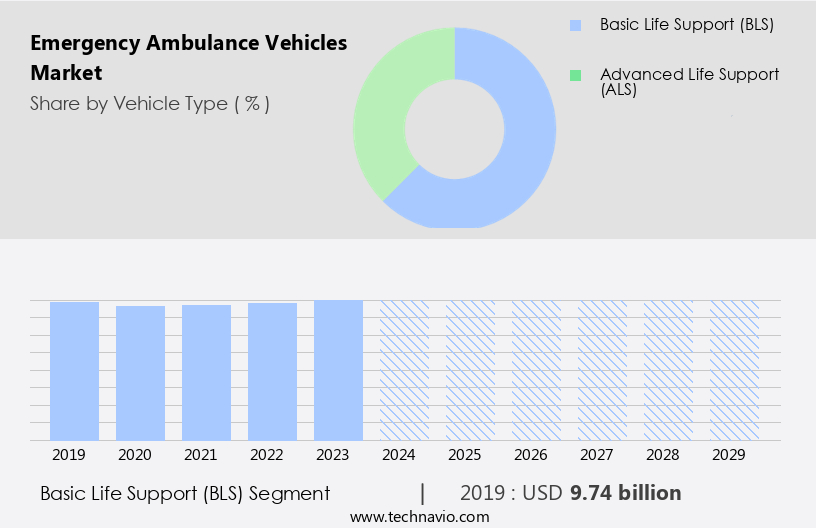
      • The basic life support (bls) segment is estimated to witness significant growth during the forecast period.

      The market encompasses a range of ambulance types, with basic life support (BLS) ambulances representing a substantial segment. BLS ambulances are engineered to offer essential medical care and transport for patients with stable conditions, requiring medical attention during transit. Staffed by emergency medical technicians (EMTs) and paramedics, these vehicles ensure urgent medical intervention for patients. Equipped with fundamental medical supplies, BLS ambulances incorporate oxygen supplies for breathing assistance, stretchers for safe patient transport, and trauma kits for addressing minor injuries. Moreover, these vehicles play a pivotal role in disaster response and cardiac care units. The aging population's increasing mortality rate and the prevalence of cardiovascular emergencies, such as heart attacks and cardiovascular diseases, necessitate advancements in emergency medical services.

      The market value is driven by the need for cost-effective items, healthcare access, and timely transportation. Expert analysis reveals a growing demand for critical medical interventions on-site, including ventilators, defibrillators, and diagnostic equipment. The market is influenced by healthcare policies, investments, and regulatory reforms, addressing operational costs and healthcare infrastructure development. Emergency ambulance vehicles cater to modern hospitals, general hospitals, and hard-to-reach locations, ensuring effective medical care for clients.
      Emergency Ambulance Vehicles Market Size

      Get a glance at the  Emergency Ambulance Vehicles Industry report of share of various segments Request Free Sample

      The Basic life support (BLS) segment was valued at USD 9.74 billion in 2019 and showed a gradual increase during the forecast period.

      Regional Analysis

      • APAC is estimated to contribute 34% to the growth of the global market during the forecast period.

      Technavio’s analysts have elaborately explained the regional trends and drivers that shape the market during the forecast period.

      Emergency Ambulance Vehicles Market Share by Geography

      For more insights on the market share of various regions, Request Free Sample

      The North American the market is witnessing significant growth due to escalating road accidents and an expanding elderly population. According to the National Highway Traffic Safety Administration (NHTSA), approximately 40,990 people lost their lives in motor vehicle crashes In the US in 2023. In Canada, fatalities, serious injuries, and total injuries increased in 2022, with 1,931 fatalities marking the second-highest count In the past decade. This trend highlights the importance of efficient emergency ambulance services to deliver prompt medical care and transportation. Additionally, the aging population is another major driver, as per the Administration on Aging, the 65+ population In the US is projected to reach 83.7

      million by 2050. This demographic shift increases the demand for emergency medical services, including ambulances, to address the rising number of falls, heart attacks, and cardiovascular emergencies. The market value is further propelled by investments in healthcare infrastructure, advancements in critical medical interventions such as ventilators, defibrillators, trauma kits, and cost-effective items like oxygen supplies. Disaster response and healthcare policies also play a crucial role in market growth. Despite regulatory reforms and operational costs, the market is expected to continue expanding due to the need for on-site medical care and reimbursement for emergency services.

      Market Dynamics

      Our  researchers analyzed the data with 2024 as the base year, along with the key drivers, trends, and challenges. A holistic analysis of drivers will help companies refine their marketing strategies to gain a competitive advantage.

      What are the key market drivers leading to the rise In the adoption of Emergency Ambulance Vehicles Industry?

      Rising healthcare demands is the key driver of the market.

    • The market is experiencing significant growth due to the increasing number of casualties requiring urgent medical attention. Paramedics and emergency medical technicians (EMTs) In these vehicles play a crucial role in providing critical medical interventions on-site, including cardiac care units, oxygen supplies, ventilators, defibrillators, trauma kits, and stretchers. With an aging population, the prevalence of cardiovascular diseases, heart attacks, and cardiovascular emergencies has increased, leading to a higher demand for emergency medical services. Moreover, disaster response situations, such as falls among the elderly, also necessitate the use of emergency ambulance vehicles. The healthcare infrastructure, including hospitals and healthcare facilities, relies on these vehicles for timely transportation and treatment of patients.
    • The market value is expected to advance due to expert analysis, research and development, cost-effective items, and investments in healthcare services. The need for medical personnel and medical care in hard-to-reach locations is also driving the market growth. Healthcare policies and regulatory reforms aim to improve healthcare access, especially in areas with limited resources. Operational costs, including the cost of ambulance vehicles and staff salaries, are a significant consideration for stakeholders. In conclusion, the market is essential in providing essential medical care to those in need, particularly In the context of an aging population and the increasing prevalence of noncommunicable diseases.
    • The market dynamics, including healthcare demands, technological advancements, and regulatory reforms, are shaping the future of emergency medical services.
    • What are the market trends shaping the Emergency Ambulance Vehicles Industry?

      New product launches by vendors is the upcoming market trend.

    • The market In the US is experiencing substantial growth due to the increasing number of casualties requiring urgent medical attention. Paramedics and emergency medical technicians rely on these vehicles to provide critical medical interventions during transport to hospitals. The market value is driven by the aging population, which is more susceptible to cardiac care units' needs, such as heart attacks and cardiovascular emergencies. These vehicles are essential for disaster response situations and come equipped with oxygen supplies, ventilators, defibrillators, trauma kits, and stretchers. Healthcare facilities invest in cost-effective items like emergency ambulance vehicles to ensure timely transportation and on-site medical care for emergency cases.
    • Medical personnel utilize these vehicles for diagnosing and treating conditions like strokes, falls, and road accidents victims. The market is influenced by healthcare access, infrastructure, and policies, leading to increased investments in research and development. Emergency ambulance vehicles are crucial for providing medical care in hard-to-reach locations, making them indispensable for modern hospitals and general hospitals. Operational costs, regulatory reforms, and reimbursement are key factors impacting the market's growth. The market dynamics are shaped by the need for life-saving equipment like ventilators, defibrillators, and stretchers, ensuring the highest level of medical care for clients. The market is expected to continue growing, driven by the increasing mortality rate due to cardiovascular diseases.
    • What challenges does the Emergency Ambulance Vehicles Industry face during its growth?

      Compliance with regulatory and safety standards is a key challenge affecting the industry growth.

    • The market In the US is driven by the increasing number of casualties requiring urgent medical attention. Paramedics and emergency medical technicians (EMTs) play a crucial role in providing on-site medical care and timely transportation to critical care units in hospitals. These vehicles are essential for cardiac care units, as they carry oxygen supplies, ventilators, defibrillators, trauma kits, and other life-saving equipment for cardiovascular emergencies, such as heart attacks and strokes. The aging population, with its higher mortality rate and increased susceptibility to falls, is a significant factor fueling the demand for emergency ambulance vehicles. The healthcare infrastructure In the US, including modern hospitals and general healthcare facilities, relies on these vehicles for cost-effective items and efficient healthcare services.
    • Regulatory reforms and healthcare policies aim to improve healthcare access and ensure the safety of medical personnel and clients during transportation. Compliance with these regulations, such as the CAAS Ground Vehicle Standard (GVS v.1.0) and NFPA 1917, 2016 edition, focuses on crash safety, secure equipment mounting, and improved workspace ergonomics. Investments in research and development are essential for the advancement of emergency medical services, including the integration of telemedicine technology and the development of more cost-effective and efficient ambulance vehicles. The market value of emergency ambulance vehicles is expected to grow significantly due to the increasing number of emergency cases and the need for timely and effective medical interventions.
    • Disaster response situations, such as road accidents, require specialized emergency ambulance vehicles equipped with advanced medical equipment and trained medical personnel. The operational costs of maintaining these vehicles and ensuring their availability at all times can be substantial, but the potential impact on mortality rates and overall healthcare access makes the investment worthwhile. In conclusion, the market In the US is a critical component of the healthcare infrastructure, ensuring the timely delivery of medical care to those in need. Compliance with evolving regulatory standards, investments in research and development, and the integration of advanced medical technology are essential for the continued growth and success of this market.
    • Exclusive Customer Landscape

      The emergency ambulance vehicles market forecasting report includes the adoption lifecycle of the market, covering from the innovator’s stage to the laggard’s stage. It focuses on adoption rates in different regions based on penetration. Furthermore, the emergency ambulance vehicles market report also includes key purchase criteria and drivers of price sensitivity to help companies evaluate and develop their market growth analysis strategies.

      Emergency Ambulance Vehicles Market Share by Geography

       Customer Landscape

      Key Companies & Market Insights

      Companies are implementing various strategies, such as strategic alliances, emergency ambulance vehicles market forecast, partnerships, mergers and acquisitions, geographical expansion, and product/service launches, to enhance their presence In the industry.

      AmbulanceMed - The market encompasses a range of specialized vehicles designed for medical transport, including intensive care ambulances and gynecological mobile health units. These vehicles are outfitted with advanced medical equipment to provide critical care to patients en route to hospitals. The market for these vehicles caters to various medical needs and applications, ensuring efficient and effective emergency response services.

      The industry research and growth report includes detailed analyses of the competitive landscape of the market and information about key companies, including:

      • AmbulanceMed
      • Ashok Leyland Ltd.
      • Demers Ambulances
      • Excellance Inc
      • Frazer Ltd
      • Infinity Chassis Units
      • Lenco Industries Inc.
      • Mahindra and Mahindra Ltd.
      • Medix Specialty Vehicles LLC
      • Mobile Hospital Designers and Developers India Pvt Ltd
      • Osage Industries Inc
      • REV Group Inc.
      • Tata Motors Ltd.
      • Wietmarscher Ambulanz und Sonderfahrzeug GmbH

      Qualitative and quantitative analysis of companies has been conducted to help clients understand the wider business environment as well as the strengths and weaknesses of key industry players. Data is qualitatively analyzed to categorize companies as pure play, category-focused, industry-focused, and diversified; it is quantitatively analyzed to categorize companies as dominant, leading, strong, tentative, and weak.

      Research Analyst Overview

      The emergency ambulance vehicle market encompasses a vital segment of the healthcare industry, providing urgent medical transportation and on-site care for individuals in need of critical interventions. This market caters to various medical emergencies, including cardiovascular diseases, falls among the elderly, and road accidents. The aging population is a significant factor driving the growth of the emergency ambulance vehicle market. With increasing life expectancy and the rising prevalence of chronic conditions, the demand for timely medical attention and transportation is on the rise. Elderly individuals, in particular, are more susceptible to falls and cardiovascular emergencies, making the need for emergency medical services increasingly essential.

      The healthcare infrastructure plays a crucial role In the market's dynamics. Modern hospitals and general healthcare facilities require efficient and cost-effective items, such as stretchers, ventilators, defibrillators, and trauma kits, to be readily available In their ambulance fleets. These vehicles serve as an extension of the healthcare facilities, ensuring that medical personnel can provide critical care during transportation to the hospital. The healthcare access and Medicaid policies also influence the market. As healthcare policies evolve, there is a growing emphasis on providing affordable and accessible emergency medical services to a broader population. This trend is expected to continue, leading to increased investments In the development and deployment of emergency ambulance vehicles.

      Regulatory reforms and operational costs are essential factors shaping the market. Regulations governing the design, manufacturing, and maintenance of emergency ambulance vehicles ensure the safety and effectiveness of these critical assets. Operational costs, including fuel, maintenance, and personnel expenses, are ongoing considerations for ambulance service providers. The market value of emergency ambulance vehicles is influenced by various factors, including the number of emergency cases, healthcare policies, and investments in research and development. The market is expected to grow as the demand for efficient and cost-effective emergency medical services continues to rise. The emergency ambulance vehicle market is a dynamic and essential component of the healthcare industry.

      Its role in providing timely transportation and on-site medical care for individuals in need of critical interventions is invaluable. As the population ages and healthcare policies evolve, the market is poised for continued growth and innovation.

      Market Scope

      Report Coverage

      Details

      Page number

      196

      Base year

      2024

      Historic period

      2019-2023

      Forecast period

      2025-2029

      Growth momentum & CAGR

      Accelerate at a CAGR of 4.3%

      Market growth 2025-2029

      USD 3.73 billion

      Market structure

      Fragmented

      YoY growth 2024-2025(%)

      2.9

      Key countries

      US, China, Germany, India, UK, Japan, Canada, France, Australia, and Brazil

      Competitive landscape

      Leading Companies, Market Positioning of Companies, Competitive Strategies, and Industry Risks

      Request Free Sample

      What are the Key Data Covered in this Emergency Ambulance Vehicles Market Research and Growth Report?

      • CAGR of the Emergency Ambulance Vehicles industry during the forecast period
      • Detailed information on factors that will drive the growth and forecasting between 2025 and 2029
      • Precise estimation of the size of the market and its contribution of the industry in focus to the parent market
      • Accurate predictions about upcoming growth and trends and changes in consumer behaviour
      • Growth of the market across North America, APAC, Europe, Middle East and Africa, and South America
      • Thorough analysis of the market’s competitive landscape and detailed information about companies
      • Comprehensive analysis of factors that will challenge the emergency ambulance vehicles market growth of industry companies

      We can help! Our analysts can customize this emergency ambulance vehicles market research report to meet your requirements.

      Get in touch


      Table of Contents not available.

      Research Methodology

      Technavio presents a detailed picture of the market by way of study, synthesis, and summation of data from multiple sources. The analysts have presented the various facets of the market with a particular focus on identifying the key industry influencers. The data thus presented is comprehensive, reliable, and the result of extensive research, both primary and secondary.

      INFORMATION SOURCES

      Primary sources

      • Manufacturers and suppliers
      • Channel partners
      • Industry experts
      • Strategic decision makers

      Secondary sources

      • Industry journals and periodicals
      • Government data
      • Financial reports of key industry players
      • Historical data
      • Press releases

      DATA ANALYSIS

      Data Synthesis

      • Collation of data
      • Estimation of key figures
      • Analysis of derived insights

      Data Validation

      • Triangulation with data models
      • Reference against proprietary databases
      • Corroboration with industry experts

      REPORT WRITING

      Qualitative

      • Market drivers
      • Market challenges
      • Market trends
      • Five forces analysis

      Quantitative

      • Market size and forecast
      • Market segmentation
      • Geographical insights
      • Competitive landscape

      Interested in this report?

      Get your sample now to see our research methodology and insights!

      Download Now

      Frequently Asked Questions

      Emergency Ambulance Vehicles market growth will increase by $ 3.73 bn during 2025-2029.

      The Emergency Ambulance Vehicles market is expected to grow at a CAGR of 4.3% during 2025-2029.

      Emergency Ambulance Vehicles market is segmented by Vehicle Type( Basic life support (BLS), Advanced life support (ALS)) Type( Modular design, Monocoque design)

      AmbulanceMed, Ashok Leyland Ltd., Demers Ambulances, Excellance Inc, Frazer Ltd, Infinity Chassis Units, Lenco Industries Inc., Mahindra and Mahindra Ltd., Medix Specialty Vehicles LLC, Mobile Hospital Designers and Developers India Pvt Ltd, Osage Industries Inc, REV Group Inc., Tata Motors Ltd., Wietmarscher Ambulanz und Sonderfahrzeug GmbH are a few of the key vendors in the Emergency Ambulance Vehicles market.

      APAC will register the highest growth rate of 34% among the other regions. Therefore, the Emergency Ambulance Vehicles market in APAC is expected to garner significant business opportunities for the vendors during the forecast period.

      US, China, Germany, India, UK, Japan, Canada, France, Australia, Brazil

      • Rising healthcare demandsThe global emergency ambulance vehicles market is significantly driven by rising healthcare demands is the driving factor this market.
      • particularly due to the increasing prevalence of noncommunicable diseases (NCDs). NCDs is the driving factor this market.
      • which include cardiovascular diseases is the driving factor this market.
      • cancers is the driving factor this market.
      • chronic respiratory diseases is the driving factor this market.
      • and diabetes is the driving factor this market.
      • are responsible for 41 million deaths annually is the driving factor this market.
      • accounting for 74% of global deaths. As of 2023 is the driving factor this market.
      • 17 million people died from NCDs before reaching the age of 70 is the driving factor this market.
      • with 86% of these premature deaths occurring in low- and middle-income countries. This alarming statistic underscores the urgent need for robust EMS to manage and mitigate the impact of these diseases.The growing global population further exacerbates the demand for healthcare services. As the number of people worldwide continues to rise is the driving factor this market.
      • so does the incidence of chronic diseases. This trend places immense pressure on healthcare systems to provide timely and effective medical care is the driving factor this market.
      • particularly in emergency situations. Consequently is the driving factor this market.
      • there is a heightened need for well-equipped ambulances capable of delivering rapid medical transport and care.Emergency ambulance vehicles play a crucial role in addressing the healthcare demands associated with NCDs and the increasing global population. These vehicles are essential for providing immediate medical attention and transport to healthcare facilities is the driving factor this market.
      • ensuring that patients receive the necessary care without delay. The ability to offer advanced life support and specialized medical interventions during transport is vital for improving patient outcomes is the driving factor this market.
      • particularly in critical situations.The rising healthcare demands are driving innovations in ambulance design and technology. Manufacturers are focusing on developing ambulances equipped with state-of-the-art medical equipment and advanced communication systems to enhance the efficiency and effectiveness of EMS. This includes the integration of telemedicine capabilities is the driving factor this market.
      • which allow paramedics to consult with medical professionals remotely is the driving factor this market.
      • providing better care during transport.In summary is the driving factor this market.
      • the rising healthcare demands is the driving factor this market.
      • driven by the increasing prevalence of NCDs and the growing global population is the driving factor this market.
      • are significant drivers for the global emergency ambulance vehicles market. The need for timely and effective emergency medical services is paramount is the driving factor this market.
      • and well-equipped ambulances are essential in meeting this demand. is the driving factor this market.

      The Emergency Ambulance Vehicles market vendors should focus on grabbing business opportunities from the Basic life support (BLS) segment as it accounted for the largest market share in the base year.