


Family Entertainment Center Market Size 2026-2030
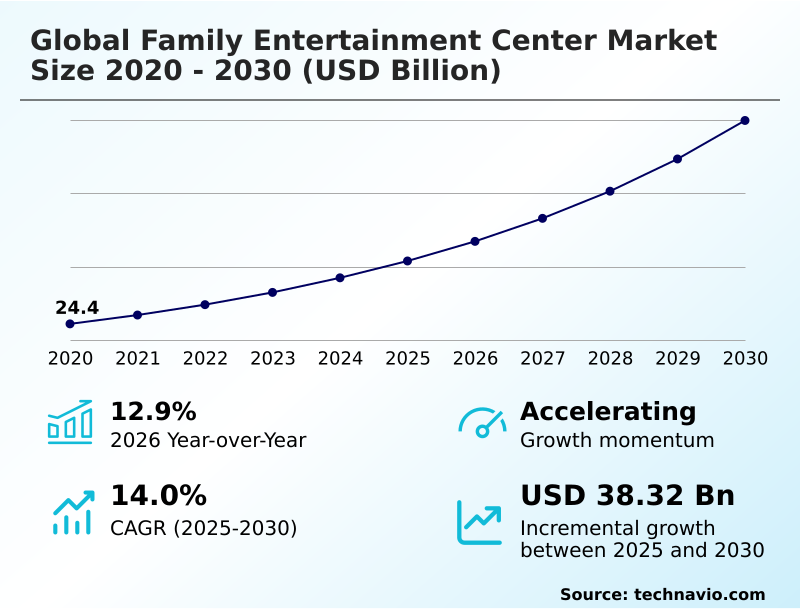
The family entertainment center market size is valued to increase by USD 38.32 billion, at a CAGR of 14% from 2025 to 2030. Expansion of AEI is augmenting market growth will drive the family entertainment center market.
Major Market Trends & Insights
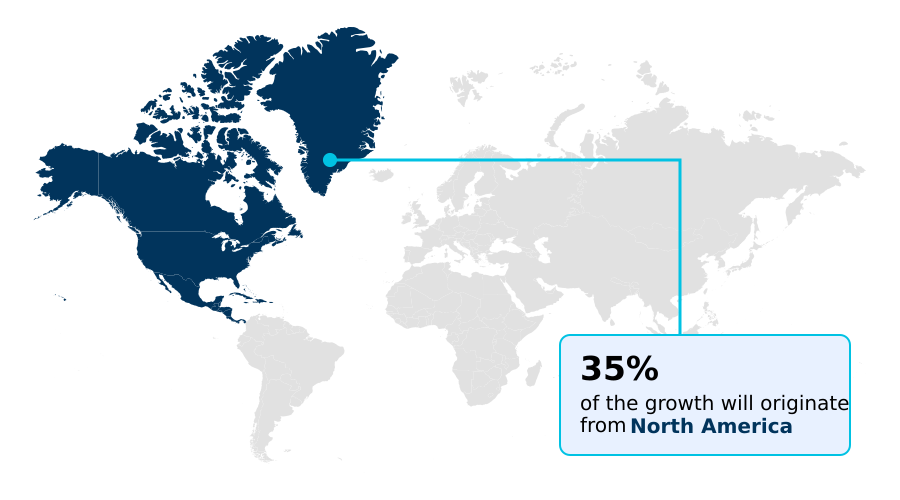
- North America dominated the market and accounted for a 34.9% growth during the forecast period.
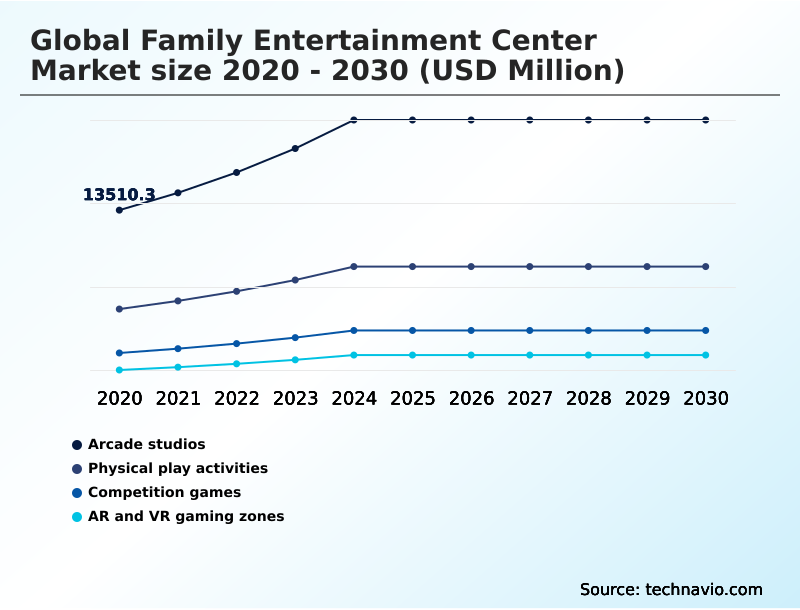
- By Application - Arcade studios segment was valued at USD 20.16 billion in 2024
- By Capacity - 10001 to 20000 square feet segment accounted for the largest market revenue share in 2024
Market Size & Forecast
- Market Opportunities: USD 55.47 billion
- Market Future Opportunities: USD 38.32 billion
- CAGR from 2025 to 2030 : 14%
Market Summary
- The Family Entertainment Center market is rapidly evolving beyond traditional leisure, becoming a hub for technology-driven social entertainment. Key market drivers include the rising demand for experiential entertainment and the expansion of amusement, entertainment, and indoor (AEI) recreation formats that blend physical and digital engagement.
- Advanced attractions such as immersive VR arenas, multiplayer VR experiences, and interactive sports simulators are becoming standard. Operators are focusing on hybrid entertainment models that combine trampoline parks, bowling alleys, and soft play zones with high-tech competition games. However, high operational expenditure and the need for continuous innovation in themed entertainment zones present significant challenges.
- For instance, a facility might leverage data-driven customer analytics to strategically place new redemption-based games, resulting in higher user engagement and a measurable lift in revenue per visitor without increasing its physical footprint, showcasing a move toward operational optimization and enhanced profitability.
What will be the Size of the Family Entertainment Center Market during the forecast period?
Get Key Insights on Market Forecast (PDF) Get Free Sample
How is the Family Entertainment Center Market Segmented?
The family entertainment center industry research report provides comprehensive data (region-wise segment analysis), with forecasts and estimates in "USD million" for the period 2026-2030, as well as historical data from 2020-2024 for the following segments.
- Application
- Arcade studios
- Physical play activities
- Competition games
- AR and VR gaming zones
- Capacity
- 10001 to 20000 square feet
- More than 40000 square feet
- 5001 to 10000 square feet
- 20001 to 40000 square feet
- Up to 5000 square feet
- Age group
- Teenagers (12-18)
- Families with children (0-9)
- Families with children (9-12)
- Adults (24 and above)
- Young adults (18-24)
- Revenue stream
- Entry fees and ticket sales
- Food and beverages
- Merchandising
- Advertisement
- Geography
- North America
- US
- Canada
- Mexico
- Europe
- Germany
- UK
- France
- APAC
- China
- Japan
- India
- South America
- Brazil
- Argentina
- Middle East and Africa
- Saudi Arabia
- UAE
- South Africa
- Rest of World (ROW)
- North America
By Application Insights
The arcade studios segment is estimated to witness significant growth during the forecast period.
The arcade studios segment is undergoing a significant transformation, evolving from simple game rooms to sophisticated entertainment hubs.
Modern facilities are pivotal for delivering shared social experiences, integrating a diverse mix of arcade gaming, virtual reality attractions, and redemption-based games to increase customer dwell time.
These venues are increasingly designed as family-oriented attractions, offering everything from classic bowling alleys to elaborate themed entertainment zones. This shift towards skill-based entertainment and group-based gaming is crucial for revenue diversification.
The use of competitive gaming formats in laser tag arenas and other attractions has proven to extend visitor engagement by over 20%, reinforcing the segment's role as a core component of the modern Family Entertainment Center.
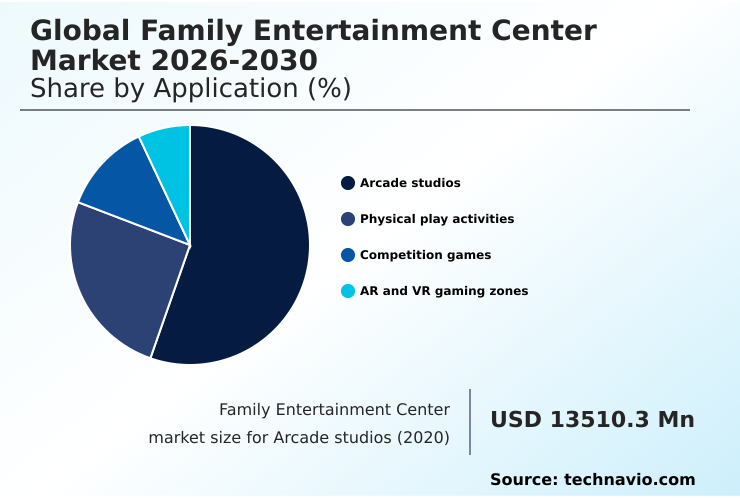
The Arcade studios segment was valued at USD 20.16 billion in 2024 and showed a gradual increase during the forecast period.
Regional Analysis
North America is estimated to contribute 34.9% to the growth of the global market during the forecast period.Technavio’s analysts have elaborately explained the regional trends and drivers that shape the market during the forecast period.
See How Family Entertainment Center Market Demand is Rising in North America Get Free Sample
The geographic landscape of the Family Entertainment Center market reflects varied adoption rates and consumer preferences. In North America, there is a strong emphasis on large-scale venues offering competitive virtual sports and high-speed electric indoor kart racing.
In contrast, the market in APAC is seeing faster growth, outpacing other regions by nearly 2 percentage points, driven by new themed infrastructure and a focus on story-driven simulations.
Venues are implementing stronger customer engagement strategies and a customer-centric service model to build brand recognition. This includes offering unique adventure rides and fantasy gaming zones that promote social interaction.
Enhanced safety and supervision protocols are paramount, with operators investing in technology-driven entertainment that also ensures a secure environment, thereby improving customer trust and retention.
Market Dynamics
Our researchers analyzed the data with 2025 as the base year, along with the key drivers, trends, and challenges. A holistic analysis of drivers will help companies refine their marketing strategies to gain a competitive advantage.
- Strategic planning within the Family Entertainment Center market is now heavily focused on a variety of interconnected factors. Effective family entertainment center business models are crucial for navigating the competitive landscape. A key area of focus is the impact of technology on leisure facilities, which directly influences investment trends in leisure facilities.
- Operators are closely examining VR integration in amusement parks and the associated arcade game maintenance and costs. To capture specific demographics, many are implementing teen-focused entertainment center design concepts. The core challenge remains balancing costs and revenue, requiring robust FEC operational efficiency strategies and techniques for optimizing FEC revenue per visitor.
- Managing high maintenance costs in FECs is a constant battle, compelling a closer look at the profitability of bowling entertainment centers and other high-capital attractions. Simultaneously, aei recreation infrastructure development is creating new opportunities, demanding innovative marketing strategies for entertainment centers.
- The role of edutainment in FECs is growing, influencing the design of themed indoor play areas and the structure of multi-activity entertainment hub design. This complex environment, with its seasonal visitor fluctuation management needs, has shown that facilities with integrated food and beverage services perform up to 25% better in terms of revenue per square foot compared to those without.
- Adherence to safety standards for trampoline parks and other high-activity zones remains a non-negotiable aspect of customer engagement in entertainment venues, especially given the competition from home entertainment systems.
What are the key market drivers leading to the rise in the adoption of Family Entertainment Center Industry?
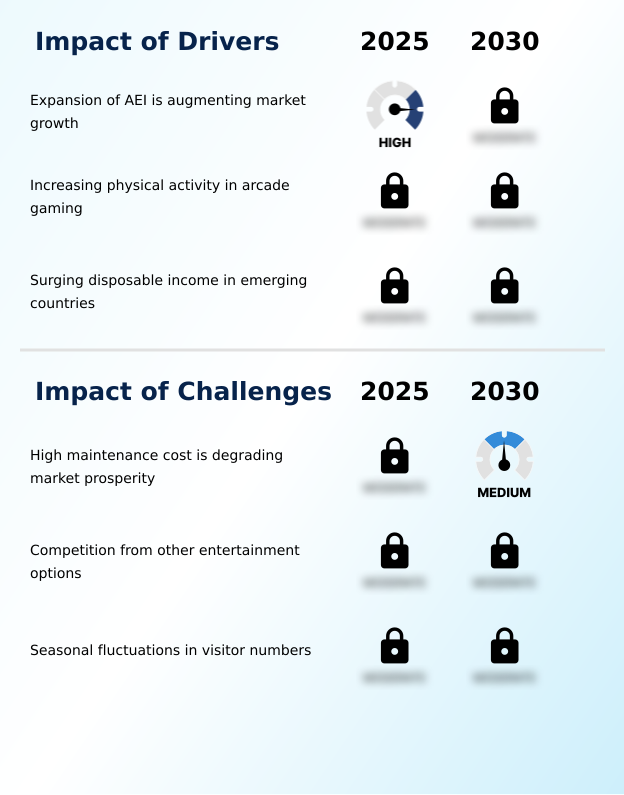
- The expansion of amusement, entertainment, and indoor (AEI) recreation is a key driver augmenting market growth.
- Market expansion is fundamentally driven by the consumer shift towards experiential entertainment and the development of comprehensive amusement facilities.
- These indoor recreational spaces are evolving into multi-activity entertainment hubs that combine themed play areas, augmented reality attractions, and diverse food and beverage services to maximize revenue per visitor.
- Enhanced user engagement is a critical factor, with operators focusing on creating attractions that encourage repeat visits and high levels of customer retention.
- The success of corporate event hosting, for example, has been shown to increase overall facility utilization by over 25% annually.
- This focus on social entertainment experiences is compelling operators to manage operational expenditure carefully while investing in facility modernization to maintain a competitive edge through superior customer service and safety and supervision.
What are the market trends shaping the Family Entertainment Center Industry?
- The increasing integration of virtual reality within gaming applications is a significant trend. This development is accelerating overall market expansion.
- A primary trend shaping the market is the deep integration of technology to enhance both operations and the customer journey. The adoption of cashless payment solutions and digital ticketing platforms is streamlining transactions, with facilities reporting up to a 40% reduction in queue times during peak hours.
- Concurrently, operators are leveraging data-driven customer analytics to deploy dynamic pricing strategies, which have proven to boost off-peak attendance by 15-20%. The rise of hybrid entertainment models, combining physical attractions with digital elements like motion simulation systems and interactive sports simulators, is central to this evolution.
- This is supported by facility modernization and the growth of franchise expansion models that rely on scalable, tech-forward blueprints for multiplayer VR experiences, creating a framework for sustained revenue diversification through sophisticated loyalty programs.
What challenges does the Family Entertainment Center Industry face during its growth?
- High maintenance costs represent a key challenge, negatively impacting market prosperity and hindering industry growth.
- Key challenges in the market revolve around balancing high operational expenditure with the need for continuous innovation to drive user engagement. Thinning profit margins are pressuring operators to refine their customer engagement strategies without compromising the quality of technology-driven entertainment.
- The high cost of maintaining themed infrastructure for immersive gaming zones, AR and VR gaming zones, and indoor rides limits innovation budgets for many smaller players. This creates a competitive disadvantage, as strong brand recognition is often tied to the novelty and quality of physical play activities and interactive digital gaming.
- To mitigate this, some operators are achieving a 10% reduction in maintenance overhead through predictive analytics. Success hinges on creating compelling social interaction and repeat visits, which is difficult when capital is constrained.
Exclusive Technavio Analysis on Customer Landscape
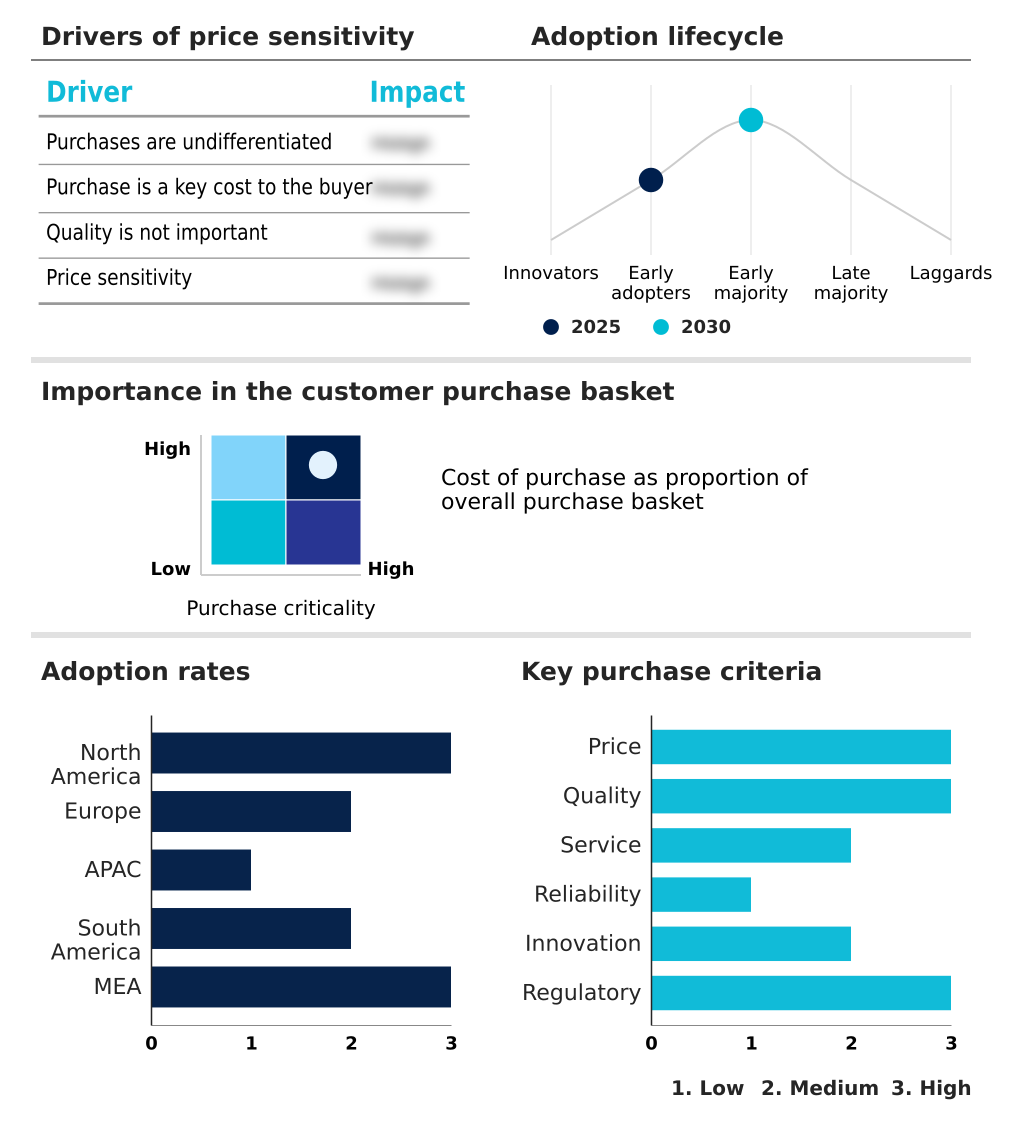
The family entertainment center market forecasting report includes the adoption lifecycle of the market, covering from the innovator’s stage to the laggard’s stage. It focuses on adoption rates in different regions based on penetration. Furthermore, the family entertainment center market report also includes key purchase criteria and drivers of price sensitivity to help companies evaluate and develop their market growth analysis strategies.
Customer Landscape of Family Entertainment Center Industry
Competitive Landscape
Companies are implementing various strategies, such as strategic alliances, family entertainment center market forecast, partnerships, mergers and acquisitions, geographical expansion, and product/service launches, to enhance their presence in the industry.
Andretti Indoor Karting and Games - Integrated amusement facilities and arcade gaming zones are leveraged with branded entertainment experiences to deliver comprehensive family entertainment solutions.
The industry research and growth report includes detailed analyses of the competitive landscape of the market and information about key companies, including:
- Andretti Indoor Karting and Games
- BANDAI NAMCO Europe S.A.S
- Bowlero Corp.
- CEC Entertainment Concepts L.P.
- Cinergy Entertainment Group
- Citymax Hotels Pvt. Ltd.
- Dave and Busters Entertainment
- Hollywood Bowl Group plc
- KidZania S.A.P.I. de C.V.
- Merlin Entertainments Ltd.
- Nickels and Dimes Inc.
- Round1 Entertainment Inc.
- Scene 75 Entertainment Centers
- Six Flags Entertainment Corp.
- TEEG Australia Pty Ltd.
- Tenpin Entertainment Ltd.
- The Walt Disney Co.
- Topgolf International Inc
- Urban Air Trampoline
- Veltmeijer Group
Qualitative and quantitative analysis of companies has been conducted to help clients understand the wider business environment as well as the strengths and weaknesses of key industry players. Data is qualitatively analyzed to categorize companies as pure play, category-focused, industry-focused, and diversified; it is quantitatively analyzed to categorize companies as dominant, leading, strong, tentative, and weak.
Recent Development and News in Family entertainment center market
- In November 2024, Scene 75 Entertainment Centers expanded its AEI-driven facility by adding new immersive VR arenas and interactive sports simulators to enhance customer engagement.
- In March 2025, CEC Entertainment Concepts L.P. disclosed increased maintenance and refurbishment expenses tied to arcade equipment and facility modernization across its Chuck E. Cheese venues.
- In March 2025, Main Event Entertainment launched a new 15,000-square-foot center, expanding its mid-sized format with upgraded arcade gaming and compact bowling lanes.
- In April 2025, The VOID partnered with major venue operators to expand its immersive VR experience zones across multiple locations in North America, signaling strong commercial adoption of VR technologies.
Dive into Technavio’s robust research methodology, blending expert interviews, extensive data synthesis, and validated models for unparalleled Family Entertainment Center Market insights. See full methodology.
| Market Scope | |
|---|---|
| Page number | 328 |
| Base year | 2025 |
| Historic period | 2020-2024 |
| Forecast period | 2026-2030 |
| Growth momentum & CAGR | Accelerate at a CAGR of 14% |
| Market growth 2026-2030 | USD 38323.6 million |
| Market structure | Fragmented |
| YoY growth 2025-2026(%) | 12.9% |
| Key countries | US, Canada, Mexico, Germany, UK, France, Italy, Spain, The Netherlands, China, Japan, India, South Korea, Australia, Indonesia, Brazil, Argentina, Chile, Saudi Arabia, UAE, South Africa, Israel and Turkey |
| Competitive landscape | Leading Companies, Market Positioning of Companies, Competitive Strategies, and Industry Risks |
Research Analyst Overview
- The Family Entertainment Center market is defined by a push toward technologically advanced, immersive experiences. Boardroom decisions increasingly center on the capital investment required for attractions like immersive VR arenas and high-speed electric indoor kart racing versus their projected return on engagement. The integration of amusement, entertainment and indoor (AEI) recreation with social entertainment is paramount.
- Venues now combine traditional bowling alleys, trampoline parks, and laser tag arenas with high-tech motion simulation systems and virtual reality attractions. The goal is to create hybrid entertainment models offering a mix of physical play activities, competition games, and story-driven simulations. This requires a focus on edutainment, experiential entertainment, and collaborative gaming missions.
- Operators are using themed entertainment zones, including fantasy gaming zones and AR and VR gaming zones with augmented reality attractions, to create unique indoor recreational spaces. The adoption of cashless payment solutions has been shown to reduce transaction times by up to 30%, improving throughput.
- Key offerings like multiplayer VR experiences, indoor rides, and themed play areas, featuring sports challenges and redemption-based games, are essential for success in this dynamic environment.
What are the Key Data Covered in this Family Entertainment Center Market Research and Growth Report?
-
What is the expected growth of the Family Entertainment Center Market between 2026 and 2030?
-
USD 38.32 billion, at a CAGR of 14%
-
-
What segmentation does the market report cover?
-
The report is segmented by Application (Arcade studios, Physical play activities, Competition games, and AR and VR gaming zones), Capacity (10001 to 20000 square feet, More than 40000 square feet, 5001 to 10000 square feet, 20001 to 40000 square feet, and Up to 5000 square feet), Age Group (Teenagers (12-18), Families with children (0-9), Families with children (9-12), Adults (24 and above), and Young adults (18-24)), Revenue Stream (Entry fees and ticket sales, Food and beverages, Merchandising, and Advertisement) and Geography (North America, Europe, APAC, South America, Middle East and Africa)
-
-
Which regions are analyzed in the report?
-
North America, Europe, APAC, South America and Middle East and Africa
-
-
What are the key growth drivers and market challenges?
-
Expansion of AEI is augmenting market growth, High maintenance cost is degrading market prosperity
-
-
Who are the major players in the Family Entertainment Center Market?
-
Andretti Indoor Karting and Games, BANDAI NAMCO Europe S.A.S, Bowlero Corp., CEC Entertainment Concepts L.P., Cinergy Entertainment Group, Citymax Hotels Pvt. Ltd., Dave and Busters Entertainment, Hollywood Bowl Group plc, KidZania S.A.P.I. de C.V., Merlin Entertainments Ltd., Nickels and Dimes Inc., Round1 Entertainment Inc., Scene 75 Entertainment Centers, Six Flags Entertainment Corp., TEEG Australia Pty Ltd., Tenpin Entertainment Ltd., The Walt Disney Co., Topgolf International Inc, Urban Air Trampoline and Veltmeijer Group
-
Market Research Insights
- The market's momentum is increasingly defined by strategic operational adjustments that enhance the visitor experience and bolster financial performance. Operators are adopting dynamic pricing strategies and sophisticated loyalty programs to smooth out demand fluctuations and encourage repeat business, with some achieving a 10-15% uplift in off-peak revenue.
- The implementation of digital ticketing platforms and fully integrated cashless payment solutions has streamlined entry and in-venue purchases, reducing wait times by over 30% in high-traffic locations. Furthermore, data-driven customer analytics are empowering franchise expansion models, enabling targeted marketing and optimized attraction mixes that align with local demographic preferences, strengthening both customer retention and overall profitability.
We can help! Our analysts can customize this family entertainment center market research report to meet your requirements.
 RIA -
RIA - 
