


Fertigation And Chemigation Market Size 2026-2030
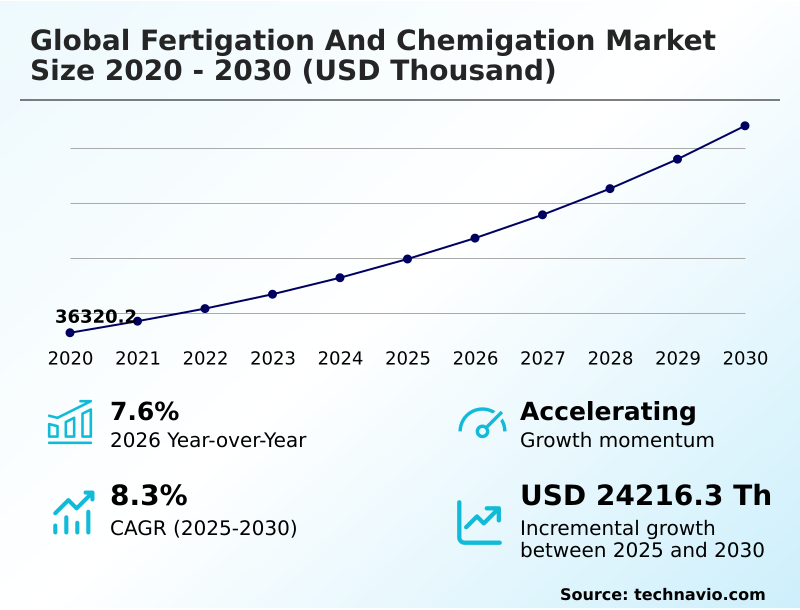
The fertigation and chemigation market size is valued to increase by USD 24.22 million, at a CAGR of 8.3% from 2025 to 2030. Water scarcity and efficient resource management will drive the fertigation and chemigation market.
Major Market Trends & Insights
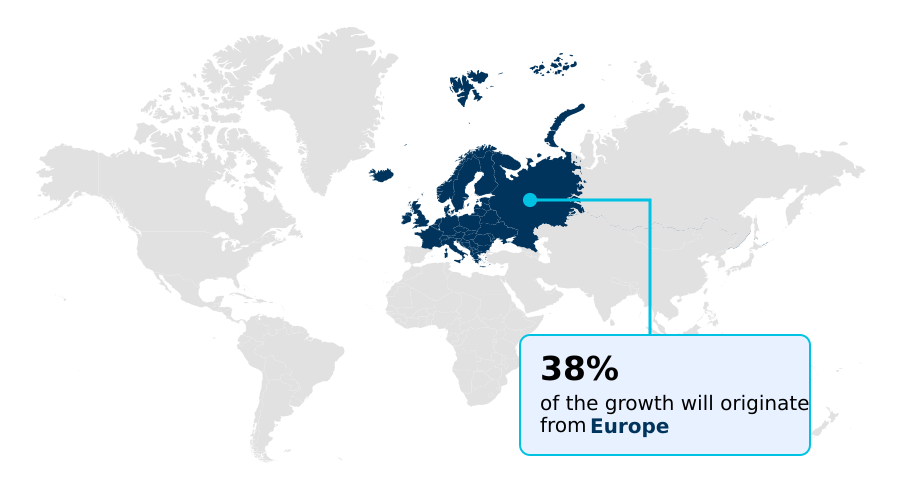
- Europe dominated the market and accounted for a 38% growth during the forecast period.
- By Type - Drip segment was valued at USD 28.01 million in 2024
- By Product Type - Fertilizers segment accounted for the largest market revenue share in 2024
Market Size & Forecast
- Market Opportunities:
- Market Future Opportunities: USD 24.22 million
- CAGR from 2025 to 2030 : 8.3%
Market Summary
- The fertigation and chemigation market is undergoing a significant transformation, driven by the agricultural sector's urgent need for enhanced productivity and sustainability. Key market dynamics are shaped by the dual pressures of global water scarcity and the necessity for higher crop yields to ensure food security.
- In response, there is a strong trend toward adopting precision technologies, including IoT sensors and automated control systems, which enable real-time monitoring and data-driven adjustments to nutrient and water delivery. These systems support sustainable intensification by maximizing resource efficiency and minimizing environmental impact.
- For instance, a large-scale commercial farm can implement an integrated drip fertigation system to achieve precise, variable-rate application of water-soluble fertilizers directly to the crop root zone. This approach not only conserves water but also improves nutrient use efficiency, leading to higher-quality yields and reduced operational costs.
- However, technical challenges such as emitter clogging from mineral precipitates and biofilms require advanced filtration and maintenance protocols to ensure long-term system reliability and performance. The market's evolution is geared toward providing holistic solutions that combine innovative hardware with intelligent software for optimized, climate-resilient agriculture.
What will be the Size of the Fertigation And Chemigation Market during the forecast period?
Get Key Insights on Market Forecast (PDF) Request Free Sample
How is the Fertigation And Chemigation Market Segmented?
The fertigation and chemigation industry research report provides comprehensive data (region-wise segment analysis), with forecasts and estimates in "USD thousand" for the period 2026-2030, as well as historical data from 2020-2024 for the following segments.
- Type
- Drip
- Sprinkler
- Product type
- Fertilizers
- Insecticides
- Fungicides
- Herbicides
- Others
- Application
- Agriculture irrigation
- Landscape irrigation
- Greenhouse irrigation
- Others
- Geography
- Europe
- Germany
- UK
- France
- APAC
- China
- India
- Japan
- North America
- US
- Canada
- Mexico
- South America
- Brazil
- Argentina
- Middle East and Africa
- Saudi Arabia
- South Africa
- UAE
- Rest of World (ROW)
- Europe
By Type Insights
The drip segment is estimated to witness significant growth during the forecast period.
The drip segment is pivotal in the fertigation and chemigation market, defined by its high water use efficiency and precision nutrient management.
This method involves the direct root zone delivery of inputs through drip irrigation systems, minimizing waste from runoff and evaporation.
The integration of digital farming technologies with sprinkler irrigation systems enables automated fertigation scheduling and real-time adjustments, addressing the need for resource-efficient farming. Adoption is driven by the clear operational cost reduction and enhanced crop quality enhancement.
However, system longevity is impacted by factors like chemical precipitate management.
Advanced maintenance protocols, such as managed acid washing, have demonstrated a 24% improvement in mitigating clogs under optimal conditions, underscoring the importance of proactive system care and the use of intelligent irrigation controllers to sustain performance and protect investments in climate adaptation strategies and smart agriculture platforms.
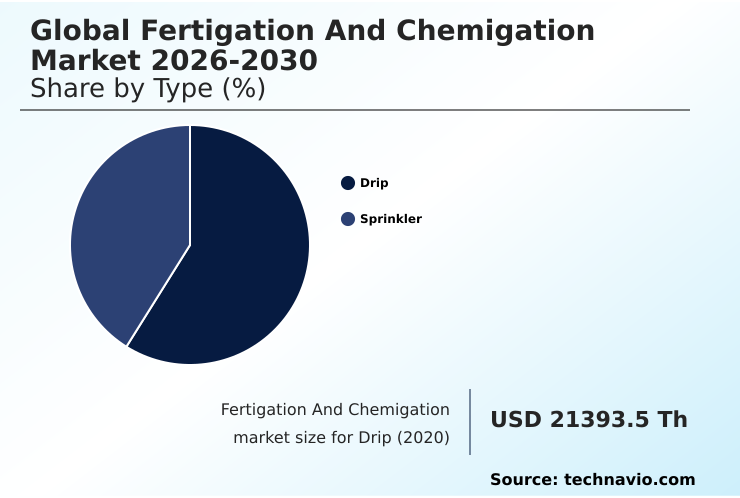
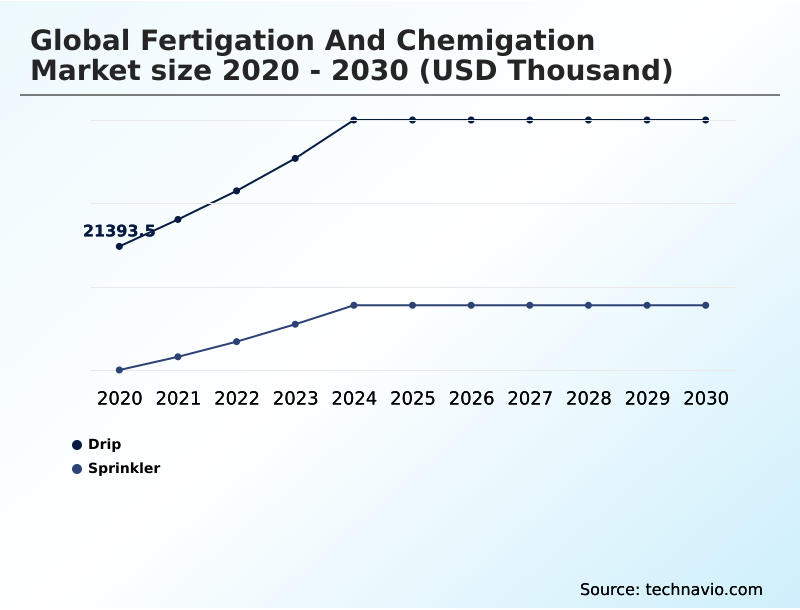
The Drip segment was valued at USD 28.01 million in 2024 and showed a gradual increase during the forecast period.
Regional Analysis
Europe is estimated to contribute 38% to the growth of the global market during the forecast period.Technavio’s analysts have elaborately explained the regional trends and drivers that shape the market during the forecast period.
See How Fertigation And Chemigation Market Demand is Rising in Europe Request Free Sample
The geographic landscape of the fertigation and chemigation market is characterized by varied adoption rates and regional priorities, with Europe leading in market share, capturing approximately 38% of the global growth opportunity.
This dominance is propelled by stringent environmental regulations and a strong focus on sustainable intensification.
APAC follows, contributing nearly 30% to market growth, driven by government initiatives in countries like India and China to promote water conservation technologies and smart agriculture platforms.
In North America, adoption is concentrated in high-value crop sectors where precision nutrient management is critical for quality and yield.
The deployment of advanced filtration units and automated controllers is essential across all regions to combat issues like emitter clogging, ensuring the long-term viability of investments in both sprinkler irrigation systems and micro-irrigation solutions.
These regional dynamics highlight a global shift toward more technologically advanced and sustainable agricultural practices.
Market Dynamics
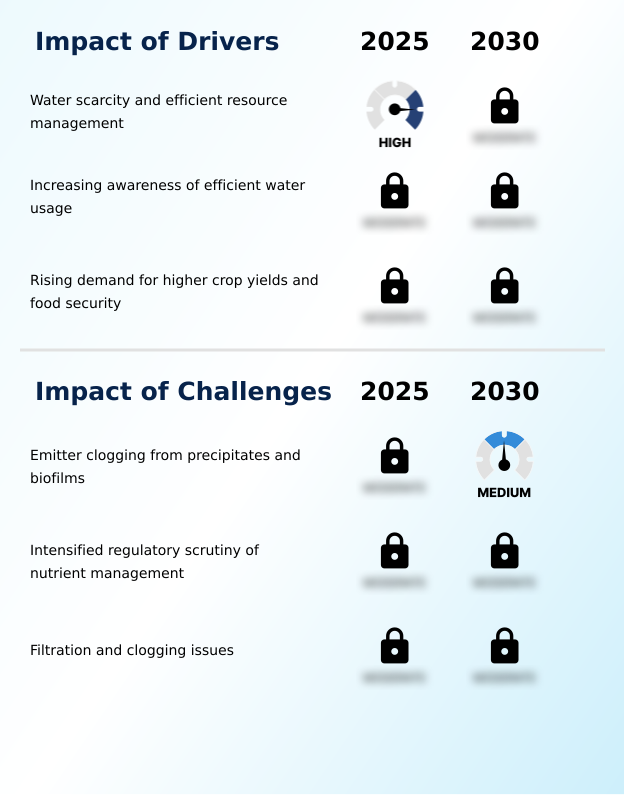
Our researchers analyzed the data with 2025 as the base year, along with the key drivers, trends, and challenges. A holistic analysis of drivers will help companies refine their marketing strategies to gain a competitive advantage.
- The global fertigation and chemigation market continues to evolve as agricultural producers seek more efficient and sustainable methods for crop management. Key considerations include drip system maintenance for clogging and the chemigation impact on soil health, which are critical for long-term productivity. The fertigation for high-value crops is a major driver, as precision is paramount for profitability.
- Concurrently, there is a focus on optimizing fertilizer use in sprinklers to broaden application. The IoT integration in fertigation systems is transforming the industry, enabling automated nutrient dosing for greenhouses and advanced variable rate chemigation technology. However, challenges persist, such as water-soluble fertilizer compatibility issues and preventing emitter biofouling in irrigation, which demand sophisticated solutions.
- The use of chemigation systems for pest control and managing water quality for fertigation are integral components of modern integrated pest management strategies. Acid injection for pH control is a common practice to mitigate the impact of salinity on fertigation and enhance nutrient uptake via drip.
- Economic assessments often analyze the cost-benefit of automated fertigation, with fertigation scheduling for fruit orchards serving as a prime example of optimizing inputs. Ultimately, the goal is improving crop resilience with chemigation and successfully integrating sensors with irrigation controllers.
- Farms adopting these systems have documented water savings that are multiple times greater than those using traditional flood irrigation, directly improving their operational bottom line.
What are the key market drivers leading to the rise in the adoption of Fertigation And Chemigation Industry?
- Escalating water scarcity and the corresponding imperative for efficient resource management are primary drivers advancing the market.
- The market is primarily driven by the critical need for water conservation and resource efficiency in modern agriculture.
- With increasing water scarcity worldwide, fertigation and chemigation systems offer a compelling solution, achieving up to 90% water use efficiency compared to traditional flood irrigation.
- This efficiency not only conserves a vital resource but also translates into tangible economic benefits, with payback periods for system installations often under two years.
- The ability of drip irrigation systems to deliver water-soluble fertilizers and liquid fertilizer formulations directly to the root zone enhances nutrient uptake, supporting both yield and soil health improvement.
- These resource-efficient farming methods are essential for sustainable agriculture, enabling growers to maximize output while minimizing environmental impact and adhering to regulatory standards for nutrient leaching prevention.
What are the market trends shaping the Fertigation And Chemigation Industry?
- The integration of precision technologies and the Internet of Things in fertigation systems is a significant market trend, enhancing resource efficiency and promoting sustainable agricultural practices.
- A primary trend shaping the market is the integration of advanced digital technologies to enhance precision and efficiency. The adoption of IoT-enabled dosing systems and automated controllers allows for real-time monitoring and data-driven adjustments, improving water use efficiency to levels above 90%.
- This shift toward smart agriculture platforms facilitates predictive analytics for irrigation, enabling variable rate application that optimizes resource use and boosts crop yields by up to 20%. The use of wireless sensor networks is becoming standard for collecting critical data on soil and plant health.
- These advancements in precision nutrient management and remote irrigation management support sustainable intensification and help growers meet increasingly stringent environmental regulations while achieving significant operational cost reduction and improved crop quality enhancement.
What challenges does the Fertigation And Chemigation Industry face during its growth?
- Emitter clogging, which arises from the accumulation of chemical precipitates and biofilms, presents a key technical challenge that affects system efficiency and industry growth.
- A significant technical challenge confronting the market is emitter clogging caused by chemical precipitates and biofilms, which can reduce emission uniformity to below 90% and compromise system effectiveness. Maintenance protocols, such as acid washing, show varied success; studies indicate a 24% reduction in clogging is possible under optimal pH conditions, but this adds to operational burdens.
- This issue necessitates investments in advanced solutions like self-cleaning filtration systems and anti-clog emitter geometries featuring wider labyrinth path emitters. Issues with biofilm mitigation protocols and chemical precipitate management are particularly pronounced when using low-quality water sources.
- Consequently, innovation in material science and pre-treatment technologies like UV disinfection and disc filters is critical to ensure system reliability, protect investments, and maintain the performance of both micro-irrigation solutions and large-scale center-pivot irrigation networks.
Exclusive Technavio Analysis on Customer Landscape
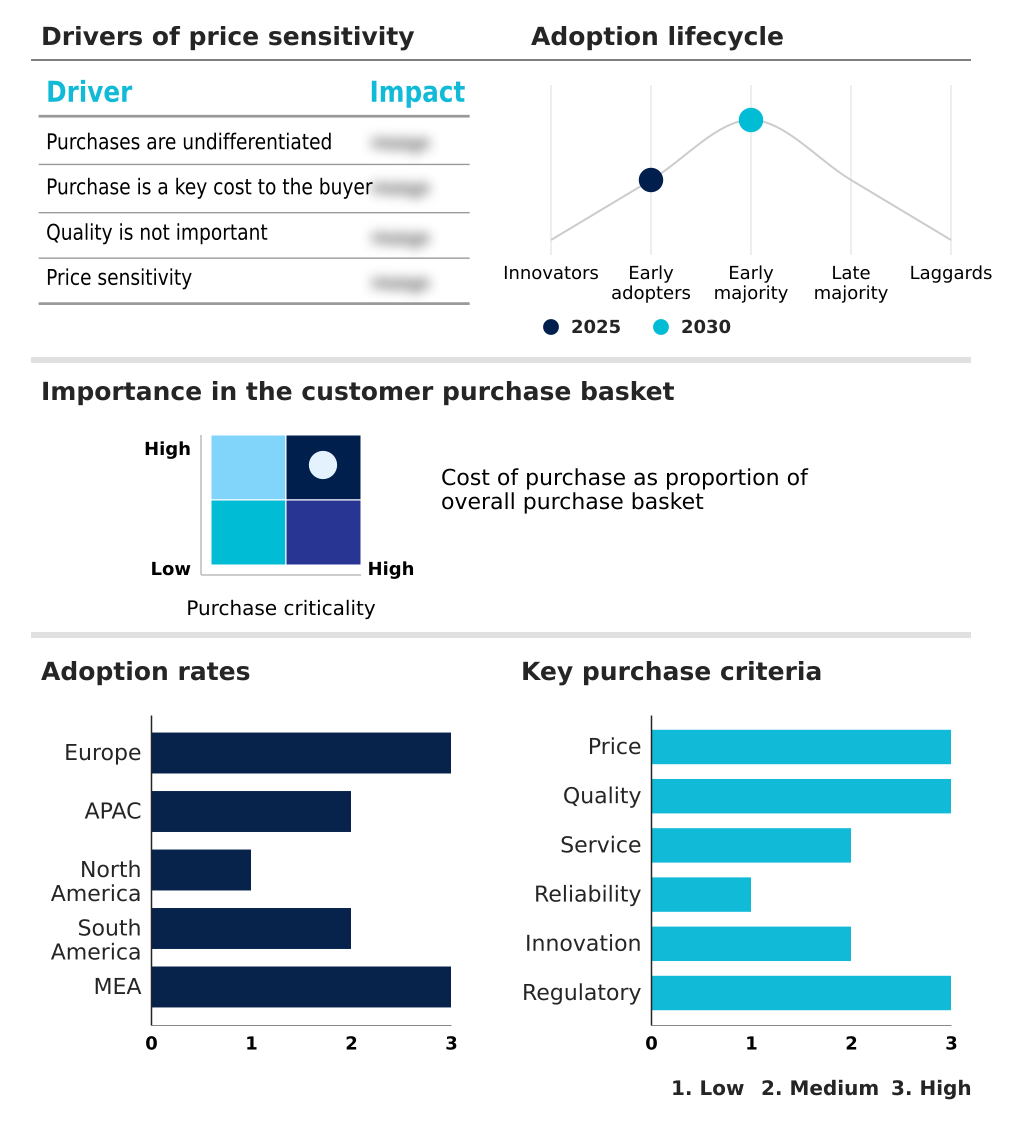
The fertigation and chemigation market forecasting report includes the adoption lifecycle of the market, covering from the innovator’s stage to the laggard’s stage. It focuses on adoption rates in different regions based on penetration. Furthermore, the fertigation and chemigation market report also includes key purchase criteria and drivers of price sensitivity to help companies evaluate and develop their market growth analysis strategies.
Customer Landscape of Fertigation And Chemigation Industry
Competitive Landscape
Companies are implementing various strategies, such as strategic alliances, fertigation and chemigation market forecast, partnerships, mergers and acquisitions, geographical expansion, and product/service launches, to enhance their presence in the industry.
AGnVET Services - Providers offer advanced fertigation controllers and automated nutrient-dosing systems, enabling precise management for hydroponics and enhancing irrigation water applications.
The industry research and growth report includes detailed analyses of the competitive landscape of the market and information about key companies, including:
- AGnVET Services
- Agri-Inject Inc.
- Bluelab Corp. Ltd.
- Finolex Plasson Pvt. Ltd.
- Galcon Bakarim Society Ltd.
- Greentech India
- Haifa Negev technologies Ltd.
- Hunter Industries
- Inject-O-Meter
- Jain Irrigation Systems Ltd.
- Lindsay Corp.
- Nelson Irrigation Corp.
- Netafim Ltd.
- Rain Bird Corp.
- Rivulis Irrigation Ltd.
- T.L. Irrigation Co.
- The Toro Co.
- Valmont Industries Inc.
Qualitative and quantitative analysis of companies has been conducted to help clients understand the wider business environment as well as the strengths and weaknesses of key industry players. Data is qualitatively analyzed to categorize companies as pure play, category-focused, industry-focused, and diversified; it is quantitatively analyzed to categorize companies as dominant, leading, strong, tentative, and weak.
Recent Development and News in Fertigation and chemigation market
- In October 2024, Irritec SPA introduced SFIDA, an Internet of Things-enabled intelligent fertigation system designed to optimize resource allocation and fertilizer efficacy through advanced irrigation protocols.
- In November 2024, Netafim Italia finalized its acquisition of Tecnir S.r.l., a strategic move to broaden its precision irrigation service capabilities and strengthen its market presence in Europe.
- In February 2025, The Toro Company launched Intelli360, a web-based digital toolkit developed to streamline equipment and irrigation management for turf professionals, enhancing operational efficiency.
- In April 2025, Orbia Netafim announced a collaboration with Treetoscope, integrating its real-time plant-sensing technology into the GrowSphere platform to provide data-driven irrigation and fertigation recommendations for orchards.
Dive into Technavio’s robust research methodology, blending expert interviews, extensive data synthesis, and validated models for unparalleled Fertigation And Chemigation Market insights. See full methodology.
| Market Scope | |
|---|---|
| Page number | 290 |
| Base year | 2025 |
| Historic period | 2020-2024 |
| Forecast period | 2026-2030 |
| Growth momentum & CAGR | Accelerate at a CAGR of 8.3% |
| Market growth 2026-2030 | USD 24216.3 thousand |
| Market structure | Fragmented |
| YoY growth 2025-2026(%) | 7.6% |
| Key countries | Germany, UK, France, Italy, Spain, The Netherlands, China, India, Japan, South Korea, Australia, Indonesia, US, Canada, Mexico, Brazil, Argentina, Chile, Saudi Arabia, South Africa, UAE, Israel and Turkey |
| Competitive landscape | Leading Companies, Market Positioning of Companies, Competitive Strategies, and Industry Risks |
Research Analyst Overview
- The fertigation and chemigation market is fundamentally reshaping agricultural practices through the integration of advanced hardware and digital oversight. The deployment of drip irrigation systems and sprinkler irrigation systems, enhanced with automated controllers and soil moisture sensors, is becoming standard for achieving crop yield optimization.
- This shift is driven by the need for superior nutrient use efficiency (NUE) and water use efficiency, which together can boost yields by up to 20%. Key boardroom decisions now center on capital expenditures for micro-irrigation solutions and IoT-enabled dosing systems that support variable rate application and direct root zone delivery.
- Strategic investments in center-pivot irrigation and advanced filtration units are crucial for large-scale operations. Success in this market depends on addressing technical hurdles like chemical precipitate management and biofilm mitigation protocols, often requiring technologies like disc filters, UV disinfection, or specialized acid injection protocols.
- The evolution toward smart agriculture platforms, which leverage digital farming technologies for climate adaptation strategies, is compelling producers to adopt more sophisticated, organic-compatible formulations and biostimulant-enhanced fertilizers to remain competitive in a resource-constrained world.
What are the Key Data Covered in this Fertigation And Chemigation Market Research and Growth Report?
-
What is the expected growth of the Fertigation And Chemigation Market between 2026 and 2030?
-
USD 24.22 million, at a CAGR of 8.3%
-
-
What segmentation does the market report cover?
-
The report is segmented by Type (Drip, and Sprinkler), Product Type (Fertilizers, Insecticides, Fungicides, Herbicides, and Others), Application (Agriculture irrigation, Landscape irrigation, Greenhouse irrigation, and Others) and Geography (Europe, APAC, North America, South America, Middle East and Africa)
-
-
Which regions are analyzed in the report?
-
Europe, APAC, North America, South America and Middle East and Africa
-
-
What are the key growth drivers and market challenges?
-
Water scarcity and efficient resource management, Emitter clogging from precipitates and biofilms
-
-
Who are the major players in the Fertigation And Chemigation Market?
-
AGnVET Services, Agri-Inject Inc., Bluelab Corp. Ltd., Finolex Plasson Pvt. Ltd., Galcon Bakarim Society Ltd., Greentech India, Haifa Negev technologies Ltd., Hunter Industries, Inject-O-Meter, Jain Irrigation Systems Ltd., Lindsay Corp., Nelson Irrigation Corp., Netafim Ltd., Rain Bird Corp., Rivulis Irrigation Ltd., T.L. Irrigation Co., The Toro Co. and Valmont Industries Inc.
-
Market Research Insights
- The fertigation and chemigation market is defined by a push toward greater operational efficiency and sustainability, with adoption delivering measurable business outcomes. Advanced systems demonstrate up to 90% water use efficiency compared to conventional methods, a critical advantage in water-stressed agricultural regions.
- This efficiency gain, coupled with reduced labor needs, contributes to payback periods of under two years for many installations. Furthermore, precision nutrient management through these systems helps growers align with stringent regulatory compliance reporting for environmental protection. The integration of data-driven agronomy and remote irrigation management allows for precise control over inputs, enhancing resource-efficient farming.
- As a result, enterprises can achieve significant operational cost reduction while also improving soil health, showcasing a clear return on investment beyond simple yield increases.
We can help! Our analysts can customize this fertigation and chemigation market research report to meet your requirements.