


Latin America Flexible Packaging Market Size and Trends
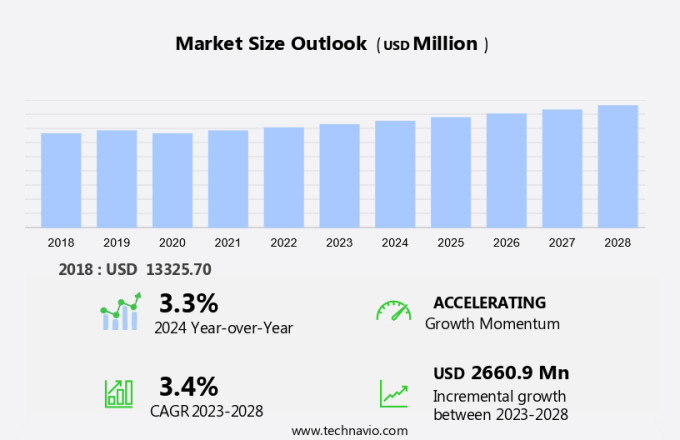
The Latin America flexible packaging market size is forecast to increase by USD 2.66 billion at a CAGR of 3.4% between 2023 and 2028. The market is experiencing significant growth due to several key drivers. One major factor is the increasing emphasis on extending product shelf life, as consumers demand longer-lasting packaged goods. Another trend is the shift towards more sustainable packaging solutions, with recyclable flexible plastic packaging gaining popularity. Additionally, the growing number of working women and the need for convenient, user-friendly packaging options are driving demand for flexible packaging. Advanced technologies, such as QR codes and near-field communication (NFC), are also being integrated into flexible packaging to enhance traceability and convenience for consumers.
The focus on waste reduction and environmental sustainability is also influencing the market, as companies seek to reduce their use of plastic packaging and increase the use of eco-friendly materials. These packaging formats offer convenience and portability, making them popular choices for various industries, including electronics, cosmetics, and personal care. Overall, the market is poised for continued growth as it addresses these evolving consumer needs and preferences.
What will be the Latin America Flexible Packaging Market Size During the Forecast Period?
The market is witnessing significant growth due to the numerous advantages offered by this packaging format. Flexible packaging is increasingly being adopted across various industries, including consumer goods and non-food products, due to its ability to extend product shelf life and reduce food wastage. Plastic, paper, metals, and other materials, such as polypropylene are commonly used in the production of flexible packaging. The use of recycled materials in the manufacturing process is a growing trend, as sustainability becomes a priority for consumers and businesses alike. Bioplastics, derived from renewable resources, are also gaining popularity due to their eco-friendly nature. The food industry is a major consumer of flexible packaging, with applications ranging from pouches and bags to films and wraps. The use of flexible packaging in the food sector helps maintain product freshness and extend shelf life, thereby reducing food wastage. Aluminum foil is another popular material used in the food industry for its excellent barrier properties. In the consumer goods sector, flexible packaging is used for various applications such as stand-up pouches, bag-in-box, and cartons. Smart packaging is an emerging trend in the market. This technology integrates various functionalities such as temperature monitoring, freshness indicators, and RFID tags to provide real-time information about the product. This technology is particularly useful in the food industry, where it helps ensure food safety and quality. The use of flexible packaging is not limited to food and consumer goods industries. It is also being adopted in various other industries such as electronics, pharmaceuticals, and industrial packaging.
Market Segmentation
The market research report provides comprehensive data (region-wise segment analysis), with forecasts and estimates in "USD billion" for the period 2024-2028, as well as historical data from 2018 - 2022 for the following segments.
- End-user
- Food and beverage
- Healthcare
- Others
- Product
- Pouches
- Bags
- Films and wraps
- Others
- Geography
- Latin America
By End-user Insights
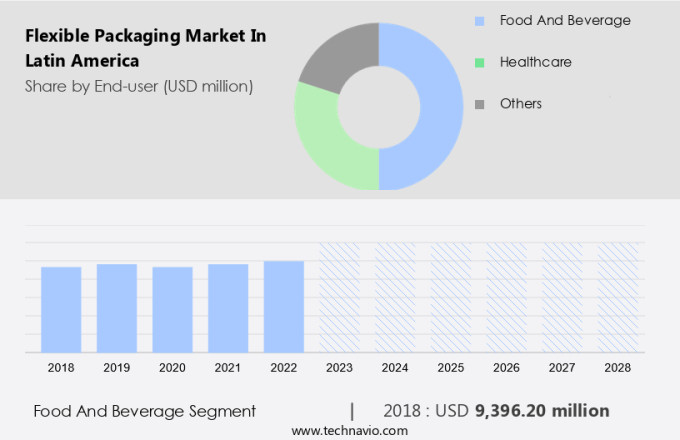
The food and beverage segment is estimated to witness significant growth during the forecast period. The food and beverage sector is projected to dominate the market in the upcoming years. The expansion of the packaged food industry in Latin America, driven by rising sales and agricultural production, is fueling the demand for flexible packaging solutions.
Get a glance at the market share of various segments Download the PDF Sample
The food and beverage segment was the largest segment and was valued at USD 9.40 billion in 2018. According to the Population Reference Bureau, approximately 79% of Latin America's population resides in urban areas, leading to a heightened focus on convenience and sustainability in packaging. Additionally, eco-friendly alternatives like stand-up pouches and paper-based packaging are gaining popularity due to their sustainability benefits. Overall, the market in Latin America is poised for growth, driven by the food and beverage sector's expansion and the region's urbanization trend. Hence, such factors are fuelling the growth of this segment during the forecast period.
Our researchers analyzed the data with 2023 as the base year, along with the key drivers, trends, and challenges. A holistic analysis of drivers will help companies refine their marketing strategies to gain a competitive advantage.
Latin America Flexible Packaging Market Driver
Rising focus on improving shelf life of products is notably driving market growth. Flexible packaging plays a significant role in enhancing the shelf life of various products, including food, beverages, pharmaceuticals, and others. By using materials such as biodegradable films, cartons, Tetra packs, and boxes, manufacturers can extend the life of their offerings, thereby reducing waste and increasing profitability.
Environmentally friendly packaging solutions, like recyclable products, are gaining popularity due to their sustainability benefits. Flexible packaging, in particular, offers advantages such as protection from oxygen, moisture, and light, preserving the quality of the contents. For example, bananas packaged in flexible films ripen more slowly, while coffee is kept fresh in pouches. These innovations contribute to the growth of the market in the region. Thus, such factors are driving the growth of the market during the forecast period.
Latin America Flexible Packaging Market Trends
Emergence of recyclable flexible plastic packaging is the key trend in the market. The demand for eco-friendly and sustainable packaging solutions has increased, leading to a significant increase in the usage of recyclable flexible packaging.
End-users have been actively implementing initiatives to reduce their reliance on traditional rigid packaging and embrace more sustainable alternatives. These developments underscore the industry's commitment to sustainability and the growing importance of flexible packaging in the market. Thus, such trends will shape the growth of the market during the forecast period.
Latin America Flexible Packaging Market Challenge
Increasing environmental focus on reducing use of plastic packaging is the major challenge that affects the growth of the market. Flexible packaging, a popular choice for various industries due to its user-friendly features and extended shelf life, is predominantly made from plastics such as PS, PE, and PP. However, the environmental impact of discarded flexible plastic packaging is a significant concern.
These plastics are non-biodegradable and contribute to a substantial amount of waste, particularly in landfills. The environmental harm caused by plastic packaging waste is a pressing issue in the market, especially in Latin America. Plastics take centuries to decompose, and when they do, they break down into harmful by-products like styrene monomer, styrene dimer, and styrene trimer, which are carcinogenic. Hence, the above factors will impede the growth of the market during the forecast period.
Exclusive Customer Landscape
The market forecasting report includes the adoption lifecycle of the market, covering from the innovator's stage to the laggard's stage. It focuses on adoption rates in different regions based on penetration. Furthermore, the report also includes key purchase criteria and drivers of price sensitivity to help companies evaluate and develop their market growth analysis strategies.

Customer Landscape
Key Companies & Market Insights
Companies are implementing various strategies, such as strategic alliances, partnerships, mergers and acquisitions, geographical expansion, and product/service launches, to enhance their presence in the market.
Amcor Plc: The company offers flexible packaging for food, beverage, and pharmaceuticals.
The market research and growth report also includes detailed analyses of the competitive landscape of the market and information about key companies, including:
- American Packaging Corp.
- Berry Global Inc.
- Cascades Inc.
- Clifton Packaging Group Ltd.
- Coveris Management GmbH
- FlexPak Services LLC
- Inteplast Group
- Mondi Plc
- Novolex
- Oben Holding Group
- PO Empaques Flexibles SA de CV
- Printpack Inc.
- ProAmpac Holdings Inc.
- Sealed Air Corp.
- Sonoco Products Co.
- Tetra Pak International SA
- Toray Plastics America Inc.
- Transcontinental Inc.
- Wipf AG
Qualitative and quantitative analysis of companies has been conducted to help clients understand the wider business environment as well as the strengths and weaknesses of key market players. Data is qualitatively analyzed to categorize companies as pure play, category-focused, industry-focused, and diversified; it is quantitatively analyzed to categorize companies as dominant, leading, strong, tentative, and weak.
The market is witnessing significant growth due to its increasing adoption in various industries, particularly in personal care, food, and consumer goods. Flexible packaging solutions offer numerous benefits such as extended product shelf life, reduced food wastage, and improved inventory management. These packages come in various forms, including stand-up pouches, bulk coffee packaging, and paper-based packaging. Materials used in flexible packaging include plastic, paper, and metals. Polypropylene is a popular plastic material due to its excellent barrier properties and resistance to moisture and oxygen. Recycling is a crucial aspect of the flexible packaging industry, with bioplastics and biodegradable films gaining popularity due to their environmentally friendly nature. Smart packaging technologies such as QR codes and near-field communication (NFC) are increasingly being used to enhance user experience and improve sales tracking and product tracking. Flexographic printing is a common technique used to print designs and logos on these packages. Flexible packaging is not limited to food products but is also used extensively in non-food industries such as electronics, cosmetics, medical supplies, household care, and more. The market is expected to grow further due to the increasing demand for lightweight, convenient, and cost-effective packaging solutions. Flexible packaging manufacturers are focusing on producing recyclable products and reducing waste to meet the growing demand for environmentally friendly packaging solutions. The use of materials like paperboard, bags, films, and wraps, as well as bioplastics, is increasing to meet the sustainability goals of various industries. The market for flexible packaging is vast and diverse, with applications ranging from food and beverages to electronics and cosmetics. The market is expected to continue growing due to its numerous benefits, including extended shelf life, improved user-friendly features, and reduced environmental impact.
|
Latin America Flexible Packaging Market Scope |
|
|
Report Coverage |
Details |
|
Page number |
162 |
|
Base year |
2023 |
|
Historic period |
2018 - 2022 |
|
Forecast period |
2024-2028 |
|
Growth momentum & CAGR |
Accelerate at a CAGR of 3.4% |
|
Market growth 2024-2028 |
USD 2.66 billion |
|
Market structure |
Fragmented |
|
YoY growth 2023-2024(%) |
3.3 |
|
Competitive landscape |
Leading Companies, Market Positioning of Companies, Competitive Strategies, and Industry Risks |
|
Key companies profiled |
Amcor Plc, American Packaging Corp., Berry Global Inc., Cascades Inc., Clifton Packaging Group Ltd., Coveris Management GmbH, FlexPak Services LLC, Inteplast Group, Mondi Plc, Novolex, Oben Holding Group, PO Empaques Flexibles SA de CV, Printpack Inc., ProAmpac Holdings Inc., Sealed Air Corp., Sonoco Products Co., Tetra Pak International SA, Toray Plastics America Inc., Transcontinental Inc., and Wipf AG |
|
Market dynamics |
Parent market analysis, market report , market forecast, Market growth inducers and obstacles, Fast-growing and slow-growing segment analysis, COVID-19 impact and recovery analysis and future consumer dynamics, Market condition analysis for forecast period |
|
Customization purview |
If our report has not included the data that you are looking for, you can reach out to our analysts and get segments customized. |
What are the Key Data Covered in this Market Research Report?
- CAGR of the market during the forecast period
- Detailed information on factors that will drive the market growth and forecasting between 2024 and 2028
- Precise estimation of the size of the market and its contribution of the market in focus to the parent market
- Accurate predictions about upcoming market growth and trends and changes in consumer behaviour
- Growth of the market across Latin America
- Thorough analysis of the market's competitive landscape and detailed information about companies
- Comprehensive analysis of factors that will challenge the growth of market companies
We can help! Our analysts can customize this market research report to meet your requirements. Get in touch