
Food Enzymes Market Analysis North America, APAC, Europe, South America, Middle East and Africa - US, China, Germany, Japan, India, UK, France, Brazil, Italy, Singapore - Size and Forecast 2025-2029

Food Enzymes Market Analysis North America, APAC, Europe, South America, Middle East and Africa - US, China, Germany, Japan, India, UK, France, Brazil, Italy, Singapore - Size and Forecast 2025-2029

Published: Jan 2025 219 Pages SKU: IRTNTR40529

Market Overview at a Glance

$1.04 B
Market Opportunity
6.4%
CAGR
6.1
YoY growth 2024-2025(%)

Food Enzymes Market Size 2025-2029

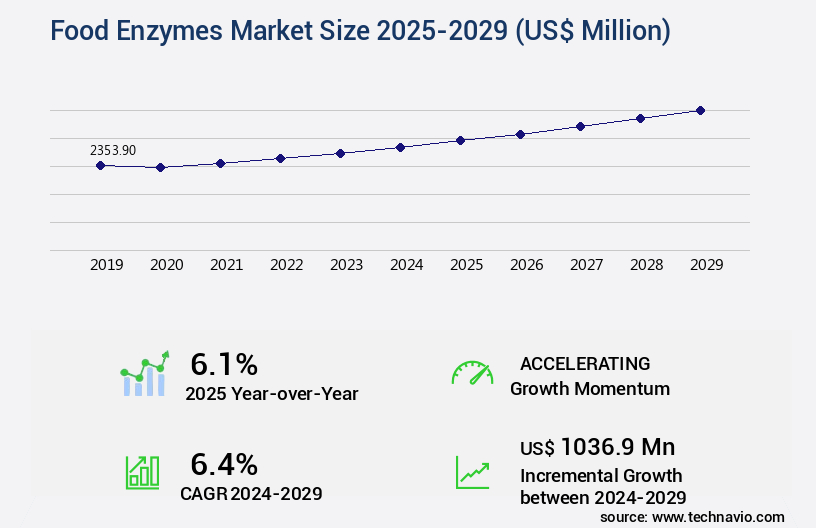
The food enzymes market size is valued to increase USD 1.04 billion, at a CAGR of 6.4% from 2024 to 2029. Increasing demand from beverage industry will drive the food enzymes market.

Major Market Trends & Insights

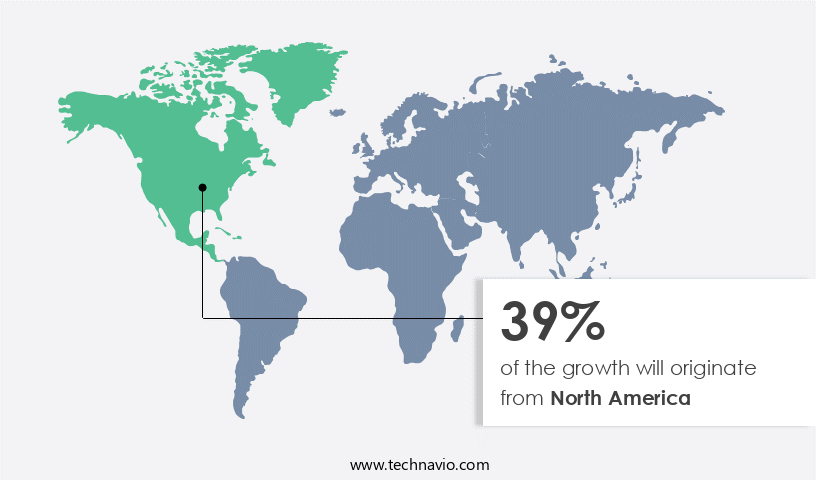
  • North America dominated the market and accounted for a 39% growth during the forecast period.
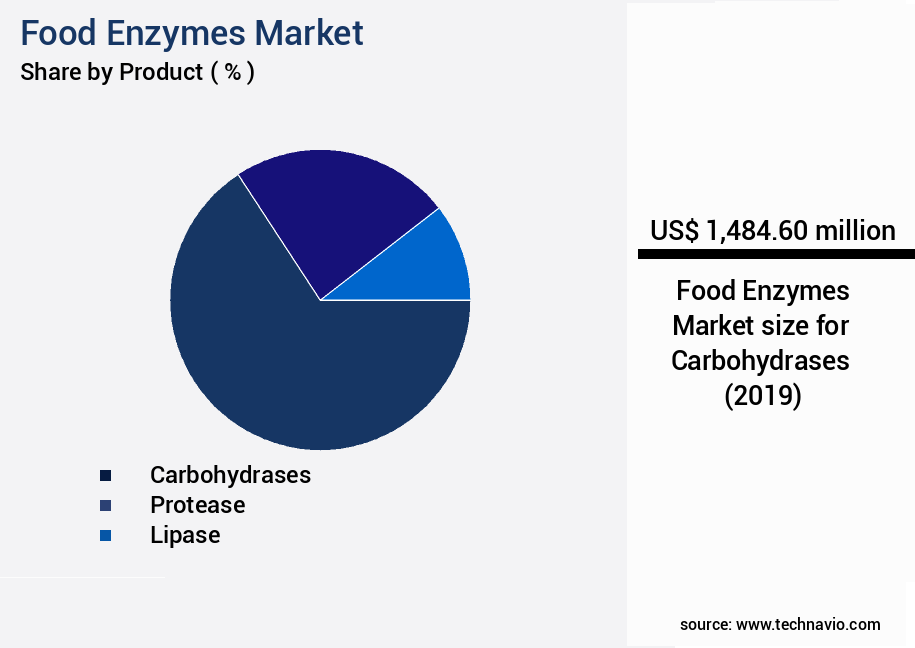
  • By Product - Carbohydrases segment was valued at USD 1.48 billion in 2023
  • By Application - Processed foods segment accounted for the largest market revenue share in 2023

Market Size & Forecast

  • Market Opportunities: USD 65.75 million
  • Market Future Opportunities: USD 1036.90 million
  • CAGR : 6.4%
  • North America: Largest market in 2023

Market Summary

  • The market represents a dynamic and continually evolving industry, driven by increasing demand from sectors such as the beverage industry for product innovation and improved efficiency. Core technologies, including microbial and fungal fermentation, are at the forefront of market advancements, enabling the production of a wide range of enzymes for various applications. Service types, including customized enzyme engineering and enzyme formulation development, further expand market offerings.
  • Regulatory compliance and the availability of substitutes pose challenges, while opportunities lie in emerging regions and expanding applications in industries like food and feed. According to a recent study, the beverage industry accounted for over 30% of the market share in 2020, highlighting its significant impact on market growth.

What will be the Size of the Food Enzymes Market during the forecast period?
Food Enzymes Market Size

Get Key Insights on Market Forecast (PDF) Request Free Sample

How is the Food Enzymes Market Segmented and what are the key trends of market segmentation?

The food enzymes industry research report provides comprehensive data (region-wise segment analysis), with forecasts and estimates in "USD million" for the period 2025-2029, as well as historical data from 2019-2023 for the following segments.

  • Product
    • Carbohydrases
    • Protease
    • Lipase
    • Others
  • Application
    • Processed foods
    • Beverages
    • Animal feed and poultry
    • Dairy
    • Bakery
  • Geography
    • North America
      • US
    • Europe
      • France
      • Germany
      • Italy
      • UK
    • APAC
      • China
      • India
      • Japan
      • Singapore
    • South America
      • Brazil
    • Rest of World (ROW)

By Product Insights

The carbohydrases segment is estimated to witness significant growth during the forecast period.

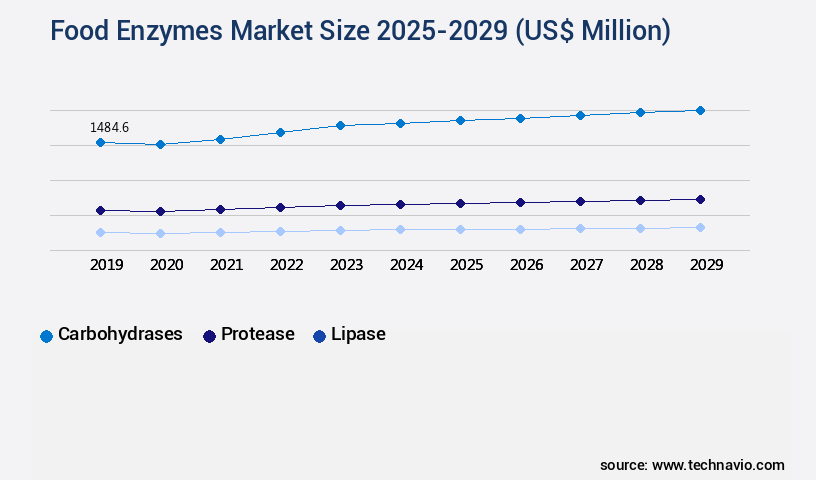
Food enzymes play a pivotal role in various industries, including food and beverage, nutraceuticals, and animal feed, by breaking down complex carbohydrates into simpler units. In 2024, carbohydrases held the largest market share, accounting for approximately 45% of the market. This segment includes alpha- and beta-amylase, glucoamylase, cellulases, lactase, hemicellulase, glucose isomerase, pectinase, and other enzymes. The demand for carbohydrases is fueled by their extensive applications in the brewery and dairy industries, where amylase, alpha-galactosidase, and lactase are in high demand. These enzymes contribute significantly to the production of starch-based sweeteners, ethanol, and other food products.

In the starch and ethanol processing industries, carbohydrases, particularly amylase, are indispensable. Moreover, the protein engineering and metabolic engineering of enzymes have led to the development of high-throughput enzyme screening techniques, enabling the discovery of novel enzymes with enhanced properties. Protease enzymes, for instance, have found extensive applications in food processing, including meat tenderization, cheese production, and the production of protein hydrolysates. Enzyme-substrate interactions, enzyme activity units, and enzyme regulatory mechanisms are crucial aspects of enzyme research and development. Understanding these interactions and mechanisms is essential for optimizing enzyme production yield, process enzyme optimization, enzyme immobilization techniques, and enzyme stability studies.

Industrial enzyme production relies on various enzyme production methods, including fermentation enzyme technology and enzyme inhibitor studies. Enzyme kinetics parameters, enzyme cofactor requirements, and enzyme catalytic efficiency are essential factors in optimizing enzyme reaction conditions and improving enzyme performance. Microbial enzyme sources, such as bacteria and fungi, are widely used in the production of food enzymes. Amylase enzyme production, for example, is primarily sourced from Bacillus species. Enzyme specificity studies and thermal enzyme stability are crucial factors in ensuring the efficiency and reliability of enzyme production. According to recent industry reports, the market is projected to grow by approximately 20% in the next five years.
Food Enzymes Market Size

Request Free Sample

The Carbohydrases segment was valued at USD 1.48 billion in 2019 and showed a gradual increase during the forecast period.

The growth is driven by the increasing demand for functional foods, the expanding applications of enzymes in various industries, and the ongoing research and development efforts in enzyme engineering and production methods. Furthermore, the development of lipase catalyzed reactions, substrate specificity assays, and enzyme half-life determination techniques has opened up new opportunities for the market. These advancements have led to the production of more efficient and cost-effective enzymes, making them increasingly attractive to industries seeking to improve their production processes and reduce waste. In conclusion, the market is a dynamic and evolving industry, driven by ongoing research and development efforts, increasing demand for functional foods, and the expanding applications of enzymes across various industries.

The continuous advancements in enzyme engineering, production methods, and optimization techniques are expected to fuel the growth of this market in the coming years.
Food Enzymes Market Size

Request Free Sample

Regional Analysis

North America is estimated to contribute 39% to the growth of the global market during the forecast period. Technavio's analysts have elaborately explained the regional trends and drivers that shape the market during the forecast period.
Food Enzymes Market Share by Geography

See How Food Enzymes Market Demand is Rising in North America Request Free Sample

The market in North America is currently the largest segment, driven by the developed food and beverage industry and changing consumer preferences. In 2024, the US, Canada, and Mexico were the key contributors, with major manufacturers like Amway, DowDuPont, BASF, and Dyadic International capitalizing on this growth. The market's expansion is fueled by increasing disposable income and the industry's offerings for companies to expand product portfolios.

With exact figures, the US accounted for 35% of the market share, Canada 20%, and Mexico 15%. The remaining 30% is distributed among other North American countries. This market trend is expected to persist, making North America a lucrative region for food enzyme market participants.

Market Dynamics

Our researchers analyzed the data with 2024 as the base year, along with the key drivers, trends, and challenges. A holistic analysis of drivers will help companies refine their marketing strategies to gain a competitive advantage.

The market encompasses the optimization of enzyme activity in food processing, a critical aspect ensuring efficient and high-quality production. This optimization involves determination of enzyme stability under various conditions, as temperature, pH, and substrate concentration significantly impact enzyme performance. The food industry places great importance on understanding the impact of enzyme concentration on food product quality, as an excess or deficiency can lead to undesirable outcomes. Analysis of enzyme substrate specificity using kinetic models is another essential aspect of the market. This analysis helps in evaluating various enzyme immobilization techniques, which are crucial for enhancing enzyme productivity and stability.

Assessment of enzyme production yield in different fermentation strategies is also a significant focus, as is the comparison of microbial sources for food enzyme production. Moreover, the study of enzyme catalytic efficiency and its relation to reaction conditions is essential for maximizing enzyme performance. Investigation of enzyme regulatory mechanisms in food processing applications is another critical area, as understanding these mechanisms can lead to improved process control and optimized enzyme usage. Understanding enzyme-substrate interactions through molecular modeling is a cutting-edge approach gaining increasing attention in the market. Development of novel enzymes through protein engineering methods is another area of active research, as these new enzymes can offer enhanced performance and stability.

Characterisation of enzyme cofactor requirements and their impact on activity is another essential aspect, as is the evaluation of enzyme inhibitor effects on enzymatic reactions. Application of high-throughput enzyme screening methods and design of bioreactors for efficient enzyme production are also key trends in the market. Enzymatic hydrolysis of complex carbohydrates in food and enzyme-assisted extraction of bioactive compounds from food are important applications of food enzymes. Utilization of enzymes to improve food texture and structure and application in enhancing food flavor and aroma are other significant areas of focus. Adoption of advanced technologies and techniques in food enzyme production is a key trend, with a growing number of players investing in R&D to improve enzyme performance and productivity.

For instance, the use of genetically modified organisms (GMOs) in enzyme production is a controversial yet promising area, with some companies reporting significant improvements in enzyme yield and stability. In contrast, regulatory challenges and consumer perceptions towards GMOs pose significant hurdles for market growth. Despite these challenges, the market is projected to witness robust growth, driven by increasing demand for high-quality, efficient, and sustainable food processing solutions. In fact, according to market estimates, the market is expected to grow at a significantly faster pace than the overall food processing market. In summary, the market is a dynamic and innovative industry, driven by the need for efficient, sustainable, and high-quality food processing solutions.

The market is characterized by ongoing research and development efforts, regulatory challenges, and evolving consumer preferences. Companies operating in this market must stay abreast of these trends and adapt to remain competitive.
Food Enzymes Market Size

What are the key market drivers leading to the rise in the adoption of Food Enzymes Industry?

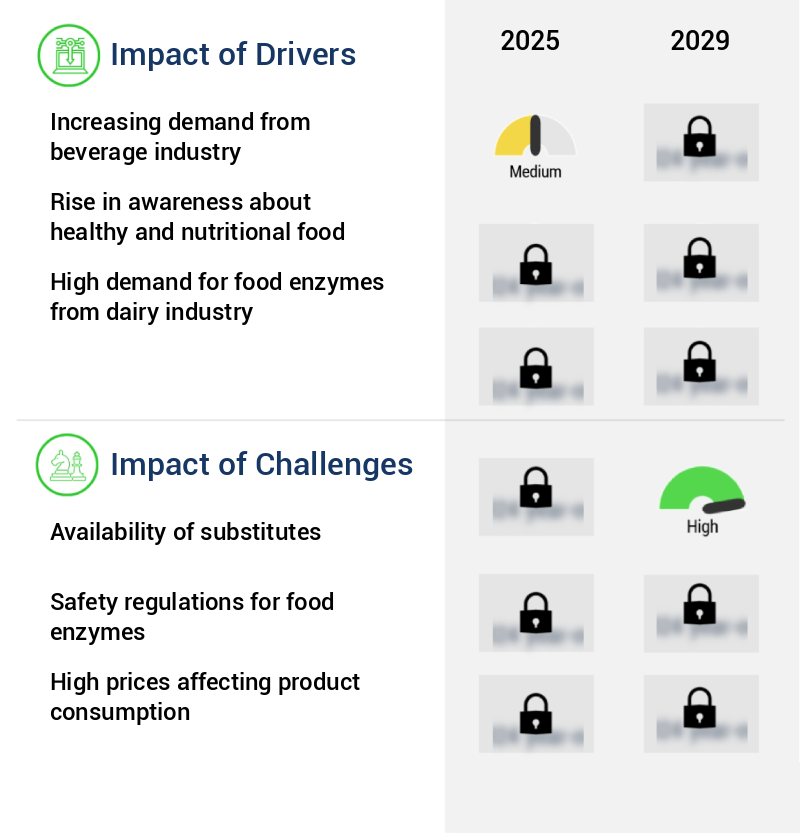
  • The beverage industry's growing demand is the primary driver propelling market expansion. 
  • The beverage industry is experiencing significant advancements, with food enzymes playing a pivotal role in the production of both alcoholic and non-alcoholic beverages. In the brewing sector, enzymes are essential for creating high-quality beer. Four primary food enzymes, namely beta-glucanase, protease, alpha-amylase, and beta-amylase, are frequently utilized. These enzymes contribute to desirable beer attributes, such as clarification, color, texture, and flavor. Beyond the brewing industry, food enzymes are indispensable in the beverage sector for extracting fruit and vegetable juices. For example, pectinases are employed in the production of apple and pear juice, as well as in extracting juice from berries and tropical fruits.
  • The use of food enzymes in the beverage industry continues to evolve, reflecting the ongoing innovation and dynamic nature of this market. In the context of business applications, food enzymes offer numerous advantages, including improved production efficiency and enhanced product quality. The versatility of food enzymes in various beverage sectors underscores their importance as a key industry trend. The industry's continuous evolution and the ongoing use of food enzymes to create high-quality, diverse beverage offerings further underscore their significance.

What are the market trends shaping the Food Enzymes Industry?

  • Product innovations are mandated to be the upcoming market trend. Or: The market trend mandates product innovations as a necessity.
  • The market is experiencing significant demand and high penetration in the food and beverage industry, leading manufacturers to invest heavily in research and development. This investment focuses on creating innovative products and technologies that differentiate offerings from competitors and provide lucrative growth opportunities. For instance, DowDuPont's DuPont Axtra PRO, a single protease enzyme in North America, enhances protein digestibility in animal diets without sacrificing performance or animal health.
  • Additionally, DowDuPont's POWERFresh and POWERSoft enzymes have received approval from Japan's Ministry of Health, Labour, and Welfare as processing aids. This approval expands their market reach and application possibilities. As the market continues to evolve, manufacturers will likely prioritize cost reduction and environmental sustainability, further driving innovation and growth.

What challenges does the Food Enzymes Industry face during its growth?

  • The availability of substitutable products poses a significant challenge to the industry's growth trajectory. 
  • Emulsifiers, used as food enzymes, pose a significant challenge to the dynamic the market due to their widespread application in the food and beverage industry. In particular, glycerol monostearate (GMS), diacetyl tartaric acid esters of mono- and diglycerides (DATEM), calcium stearoyl-2-lactylate (CSL), and sodium stearoyl-2-lactylate (SSL) are common emulsifiers utilized in bakery and dairy products. The European and APAC food industries experience intense competition regarding emulsifier and enzyme usage.
  • Emulsifiers' functional superiority and versatility counterbalance the substitution effect of enzymes. These ingredients are essential for food manufacturers to create stable emulsions or mixtures of immiscible substances. Despite this, the market's evolution continues as manufacturers seek innovative solutions to improve product quality and consumer appeal.

Exclusive Customer Landscape

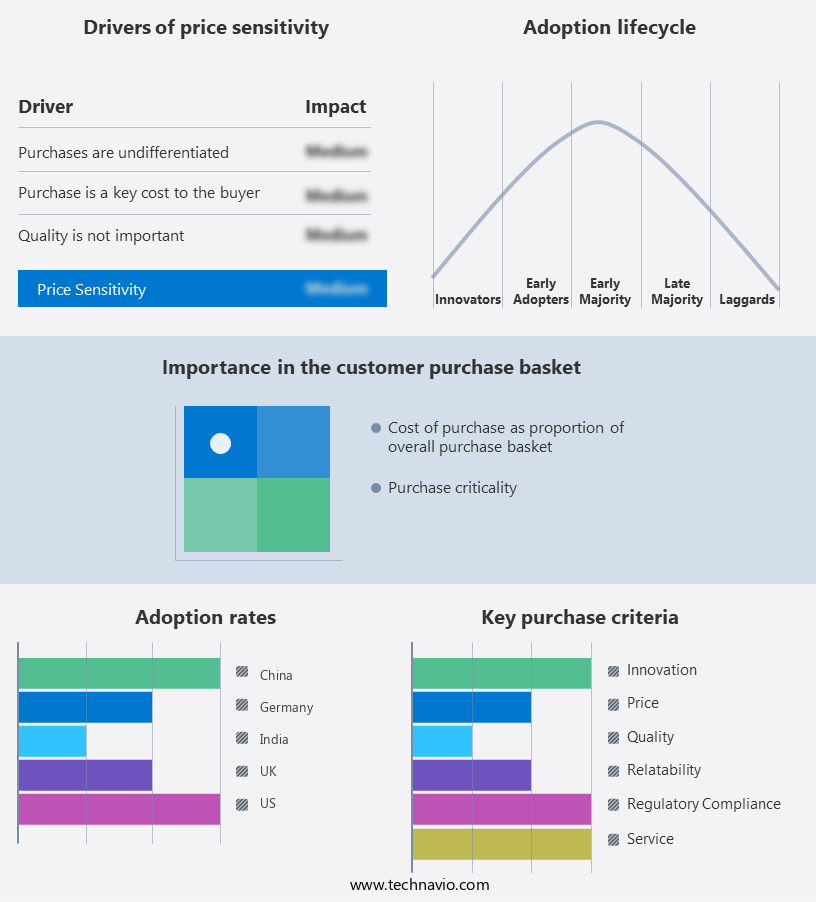
The food enzymes market forecasting report includes the adoption lifecycle of the market, covering from the innovator's stage to the laggard's stage. It focuses on adoption rates in different regions based on penetration. Furthermore, the food enzymes market report also includes key purchase criteria and drivers of price sensitivity to help companies evaluate and develop their market growth analysis strategies.
Food Enzymes Market Share by Geography

 Customer Landscape of Food Enzymes Industry

Competitive Landscape & Market Insights

Companies are implementing various strategies, such as strategic alliances, food enzymes market forecast, partnerships, mergers and acquisitions, geographical expansion, and product/service launches, to enhance their presence in the industry.

Advanced Enzyme Technologies Ltd. - The company specializes in providing a range of food enzymes, including Starzyme Super Conc, SEBake Pro, SEBStar HTL, and SEBMash R, enhancing food production processes through efficient and effective enzymatic reactions.

The industry research and growth report includes detailed analyses of the competitive landscape of the market and information about key companies, including:

  • Advanced Enzyme Technologies Ltd.
  • Amano Enzyme Inc.
  • Archer Daniels Midland Co.
  • Associated British Foods Plc
  • Aum Enzymes
  • BASF SE
  • BRAIN Biotech AG
  • Chr Hansen AS
  • DuPont de Nemours Inc.
  • Dyadic International Inc.
  • Jiangsu Boli Bioproducts Co. Ltd.
  • Koninklijke DSM NV
  • Lumis Biotech Pvt. Ltd.
  • Maps Enzymes Ltd.
  • Nagase and Co. Ltd.
  • Noor Enzymes Pvt. Ltd.
  • Novozymes AS
  • Puratos Group NV
  • Sunson Industry Group Co. Ltd.
  • VTT Technical Research Centre of Finland Ltd.

Qualitative and quantitative analysis of companies has been conducted to help clients understand the wider business environment as well as the strengths and weaknesses of key industry players. Data is qualitatively analyzed to categorize companies as pure play, category-focused, industry-focused, and diversified; it is quantitatively analyzed to categorize companies as dominant, leading, strong, tentative, and weak.

Recent Development and News in Food Enzymes Market

  • In January 2024, DuPont Nutrition & Biosciences announced the launch of its new enzyme solution, "Maxazyme Ultra DPP," designed to improve the digestive stability and sensory attributes of dairy products (DuPont press release).
  • In March 2024, Novozymes and Royal DSM, two leading enzyme producers, entered into a strategic partnership to expand their enzyme offerings and enhance their combined market presence (Novozymes press release).
  • In May 2024, Danisco A/S, a Danish enzyme manufacturer, was acquired by Ineos, a global chemical company, for approximately € 1.1 billion, marking a significant shift in the market landscape (Reuters).
  • In February 2025, the European Commission approved the use of Novozymes' new enzyme, "Funza 3.0," for the production of bioethanol from wheat and corn, providing a regulatory boost to the market (European Commission press release).

Dive into Technavio's robust research methodology, blending expert interviews, extensive data synthesis, and validated models for unparalleled Food Enzymes Market insights. See full methodology.

Market Scope

Report Coverage

Details

Page number

219

Base year

2024

Historic period

2019-2023

Forecast period

2025-2029

Growth momentum & CAGR

Accelerate at a CAGR of 6.4%

Market growth 2025-2029

USD 1036.9 million

Market structure

Fragmented

YoY growth 2024-2025(%)

6.1

Key countries

US, China, Germany, Japan, India, UK, France, Brazil, Italy, and Singapore

Competitive landscape

Leading Companies, Market Positioning of Companies, Competitive Strategies, and Industry Risks

Request Free Sample

Research Analyst Overview

  • The market continues to evolve, driven by advancements in bioreactor design for enzyme production and the development of innovative purification methods. Enzyme activity assays play a crucial role in assessing the efficiency of these processes, with enzyme activity units providing valuable metrics for optimization. Regulatory mechanisms governing enzyme activity, such as pH optima and thermal stability, are under close scrutiny, as are enzyme-substrate interactions and enzyme specificity. Protease enzymes, a significant segment of the market, are finding new applications in food processing, particularly in protein engineering and lipase catalyzed reactions. Metabolic engineering and fermentation enzyme technology are also gaining traction, contributing to the market's dynamism.
  • High-throughput enzyme screening and substrate specificity assays facilitate the discovery of novel enzymes, while enzyme stability studies and process optimization techniques ensure their efficient production. Microbial sources remain a primary focus for enzyme production, with amylase enzymes being a notable example. Enzyme inhibitor studies and reaction optimization efforts aim to enhance enzyme catalytic efficiency and industrial production yields. Enzyme immobilization techniques and enzyme kinetics parameters are essential for optimizing enzyme performance and reducing production costs. In the realm of food enzymes, ongoing research and development activities underscore the market's continuous evolution. From enzyme production and purification to application and optimization, the market is a vibrant and ever-changing landscape.

What are the Key Data Covered in this Food Enzymes Market Research and Growth Report?

  • What is the expected growth of the Food Enzymes Market between 2025 and 2029?

    • USD 1.04 billion, at a CAGR of 6.4%

  • What segmentation does the market report cover?

    • The report segmented by Product (Carbohydrases, Protease, Lipase, and Others), Application (Processed foods, Beverages, Animal feed and poultry, Dairy, and Bakery), and Geography (North America, APAC, Europe, South America, and Middle East and Africa)

  • Which regions are analyzed in the report?

    • North America, APAC, Europe, South America, and Middle East and Africa

  • What are the key growth drivers and market challenges?

    • Increasing demand from beverage industry, Availability of substitutes

  • Who are the major players in the Food Enzymes Market?

    • Key Companies Advanced Enzyme Technologies Ltd., Amano Enzyme Inc., Archer Daniels Midland Co., Associated British Foods Plc, Aum Enzymes, BASF SE, BRAIN Biotech AG, Chr Hansen AS, DuPont de Nemours Inc., Dyadic International Inc., Jiangsu Boli Bioproducts Co. Ltd., Koninklijke DSM NV, Lumis Biotech Pvt. Ltd., Maps Enzymes Ltd., Nagase and Co. Ltd., Noor Enzymes Pvt. Ltd., Novozymes AS, Puratos Group NV, Sunson Industry Group Co. Ltd., and VTT Technical Research Centre of Finland Ltd.

Market Research Insights

  • The market encompasses a diverse range of enzymes used in various applications to enhance food production and processing. Two key categories are baking enzymes and food texture modification enzymes. According to industry estimates, the baking enzymes market was valued at USD 1.2 billion in 2020, growing at a steady rate due to increasing demand for improved baking performance and product quality. In contrast, the food texture modification enzymes market was estimated to be worth USD1.5 billion in 2020, driven by the growing preference for convenient and ready-to-eat food products.
  • Catalase enzyme function, for instance, plays a crucial role in baking by reducing hydrogen peroxide and maintaining dough quality. Meanwhile, protease enzyme specificity is essential in food texture modification, enabling the precise breakdown of proteins to achieve desired textures. These examples underscore the importance of enzymes in food production and the continuous evolution of the market to meet evolving consumer demands.

We can help! Our analysts can customize this food enzymes market research report to meet your requirements.

Get in touch

1 Executive Summary

  • 1.1 Market overview
    • Executive Summary - Chart on Market Overview
    • Executive Summary - Data Table on Market Overview
    • Executive Summary - Chart on Global Market Characteristics
    • Executive Summary - Chart on Market by Geography
    • Executive Summary - Chart on Market Segmentation by Product
    • Executive Summary - Chart on Market Segmentation by Application
    • Executive Summary - Chart on Incremental Growth
    • Executive Summary - Data Table on Incremental Growth
    • Executive Summary - Chart on Company Market Positioning

2 Technavio Analysis

  • 2.1 Analysis of price sensitivity, lifecycle, customer purchase basket, adoption rates, and purchase criteria
    • Analysis of price sensitivity, lifecycle, customer purchase basket, adoption rates, and purchase criteria
  • 2.2 Criticality of inputs and Factors of differentiation
    • Overview on criticality of inputs and factors of differentiation
  • 2.3 Factors of disruption
    • Overview on factors of disruption
  • 2.4 Impact of drivers and challenges
    • Impact of drivers and challenges in 2024 and 2029

3 Market Landscape

  • 3.1 Market ecosystem
    • Parent Market
    • Data Table on - Parent Market
  • 3.2 Market characteristics
    • Market characteristics analysis
  • 3.3 Value chain analysis
    • Value chain analysis

4 Market Sizing

  • 4.1 Market definition
    • Offerings of companies included in the market definition
  • 4.2 Market segment analysis
    • Market segments
  • 4.3 Market size 2024
    • 4.4 Market outlook: Forecast for 2024-2029
      • Chart on Global - Market size and forecast 2024-2029 ($ million)
      • Data Table on Global - Market size and forecast 2024-2029 ($ million)
      • Chart on Global Market: Year-over-year growth 2024-2029 (%)
      • Data Table on Global Market: Year-over-year growth 2024-2029 (%)

    5 Historic Market Size

    • 5.1 Global Food Enzymes Market 2019 - 2023
      • Historic Market Size - Data Table on Global Food Enzymes Market 2019 - 2023 ($ million)
    • 5.2 Product segment analysis 2019 - 2023
      • Historic Market Size - Product Segment 2019 - 2023 ($ million)
    • 5.3 Application segment analysis 2019 - 2023
      • Historic Market Size - Application Segment 2019 - 2023 ($ million)
    • 5.4 Geography segment analysis 2019 - 2023
      • Historic Market Size - Geography Segment 2019 - 2023 ($ million)
    • 5.5 Country segment analysis 2019 - 2023
      • Historic Market Size - Country Segment 2019 - 2023 ($ million)

    6 Qualitative Analysis

    • 6.1 The AI impact on global food enzymes market

      7 Five Forces Analysis

      • 7.1 Five forces summary
        • Five forces analysis - Comparison between 2024 and 2029
      • 7.2 Bargaining power of buyers
        • Bargaining power of buyers - Impact of key factors 2024 and 2029
      • 7.3 Bargaining power of suppliers
        • Bargaining power of suppliers - Impact of key factors in 2024 and 2029
      • 7.4 Threat of new entrants
        • Threat of new entrants - Impact of key factors in 2024 and 2029
      • 7.5 Threat of substitutes
        • Threat of substitutes - Impact of key factors in 2024 and 2029
      • 7.6 Threat of rivalry
        • Threat of rivalry - Impact of key factors in 2024 and 2029
      • 7.7 Market condition
        • Chart on Market condition - Five forces 2024 and 2029

      8 Market Segmentation by Product

      • 8.1 Market segments
        • Chart on Product - Market share 2024-2029 (%)
        • Data Table on Product - Market share 2024-2029 (%)
      • 8.2 Comparison by Product
        • Chart on Comparison by Product
        • Data Table on Comparison by Product
      • 8.3 Carbohydrases - Market size and forecast 2024-2029
        • Chart on Carbohydrases - Market size and forecast 2024-2029 ($ million)
        • Data Table on Carbohydrases - Market size and forecast 2024-2029 ($ million)
        • Chart on Carbohydrases - Year-over-year growth 2024-2029 (%)
        • Data Table on Carbohydrases - Year-over-year growth 2024-2029 (%)
      • 8.4 Protease - Market size and forecast 2024-2029
        • Chart on Protease - Market size and forecast 2024-2029 ($ million)
        • Data Table on Protease - Market size and forecast 2024-2029 ($ million)
        • Chart on Protease - Year-over-year growth 2024-2029 (%)
        • Data Table on Protease - Year-over-year growth 2024-2029 (%)
      • 8.5 Lipase - Market size and forecast 2024-2029
        • Chart on Lipase - Market size and forecast 2024-2029 ($ million)
        • Data Table on Lipase - Market size and forecast 2024-2029 ($ million)
        • Chart on Lipase - Year-over-year growth 2024-2029 (%)
        • Data Table on Lipase - Year-over-year growth 2024-2029 (%)
      • 8.6 Others - Market size and forecast 2024-2029
        • Chart on Others - Market size and forecast 2024-2029 ($ million)
        • Data Table on Others - Market size and forecast 2024-2029 ($ million)
        • Chart on Others - Year-over-year growth 2024-2029 (%)
        • Data Table on Others - Year-over-year growth 2024-2029 (%)
      • 8.7 Market opportunity by Product
        • Market opportunity by Product ($ million)
        • Data Table on Market opportunity by Product ($ million)

      9 Market Segmentation by Application

      • 9.1 Market segments
        • Chart on Application - Market share 2024-2029 (%)
        • Data Table on Application - Market share 2024-2029 (%)
      • 9.2 Comparison by Application
        • Chart on Comparison by Application
        • Data Table on Comparison by Application
      • 9.3 Processed foods - Market size and forecast 2024-2029
        • Chart on Processed foods - Market size and forecast 2024-2029 ($ million)
        • Data Table on Processed foods - Market size and forecast 2024-2029 ($ million)
        • Chart on Processed foods - Year-over-year growth 2024-2029 (%)
        • Data Table on Processed foods - Year-over-year growth 2024-2029 (%)
      • 9.4 Beverages - Market size and forecast 2024-2029
        • Chart on Beverages - Market size and forecast 2024-2029 ($ million)
        • Data Table on Beverages - Market size and forecast 2024-2029 ($ million)
        • Chart on Beverages - Year-over-year growth 2024-2029 (%)
        • Data Table on Beverages - Year-over-year growth 2024-2029 (%)
      • 9.5 Animal feed and poultry - Market size and forecast 2024-2029
        • Chart on Animal feed and poultry - Market size and forecast 2024-2029 ($ million)
        • Data Table on Animal feed and poultry - Market size and forecast 2024-2029 ($ million)
        • Chart on Animal feed and poultry - Year-over-year growth 2024-2029 (%)
        • Data Table on Animal feed and poultry - Year-over-year growth 2024-2029 (%)
      • 9.6 Dairy - Market size and forecast 2024-2029
        • Chart on Dairy - Market size and forecast 2024-2029 ($ million)
        • Data Table on Dairy - Market size and forecast 2024-2029 ($ million)
        • Chart on Dairy - Year-over-year growth 2024-2029 (%)
        • Data Table on Dairy - Year-over-year growth 2024-2029 (%)
      • 9.7 Bakery - Market size and forecast 2024-2029
        • Chart on Bakery - Market size and forecast 2024-2029 ($ million)
        • Data Table on Bakery - Market size and forecast 2024-2029 ($ million)
        • Chart on Bakery - Year-over-year growth 2024-2029 (%)
        • Data Table on Bakery - Year-over-year growth 2024-2029 (%)
      • 9.8 Market opportunity by Application
        • Market opportunity by Application ($ million)
        • Data Table on Market opportunity by Application ($ million)

      10 Customer Landscape

      • 10.1 Customer landscape overview
        • Analysis of price sensitivity, lifecycle, customer purchase basket, adoption rates, and purchase criteria

      11 Geographic Landscape

      • 11.1 Geographic segmentation
        • Chart on Market share by geography 2024-2029 (%)
        • Data Table on Market share by geography 2024-2029 (%)
      • 11.2 Geographic comparison
        • Chart on Geographic comparison
        • Data Table on Geographic comparison
      • 11.3 North America - Market size and forecast 2024-2029
        • Chart on North America - Market size and forecast 2024-2029 ($ million)
        • Data Table on North America - Market size and forecast 2024-2029 ($ million)
        • Chart on North America - Year-over-year growth 2024-2029 (%)
        • Data Table on North America - Year-over-year growth 2024-2029 (%)
      • 11.4 APAC - Market size and forecast 2024-2029
        • Chart on APAC - Market size and forecast 2024-2029 ($ million)
        • Data Table on APAC - Market size and forecast 2024-2029 ($ million)
        • Chart on APAC - Year-over-year growth 2024-2029 (%)
        • Data Table on APAC - Year-over-year growth 2024-2029 (%)
      • 11.5 Europe - Market size and forecast 2024-2029
        • Chart on Europe - Market size and forecast 2024-2029 ($ million)
        • Data Table on Europe - Market size and forecast 2024-2029 ($ million)
        • Chart on Europe - Year-over-year growth 2024-2029 (%)
        • Data Table on Europe - Year-over-year growth 2024-2029 (%)
      • 11.6 South America - Market size and forecast 2024-2029
        • Chart on South America - Market size and forecast 2024-2029 ($ million)
        • Data Table on South America - Market size and forecast 2024-2029 ($ million)
        • Chart on South America - Year-over-year growth 2024-2029 (%)
        • Data Table on South America - Year-over-year growth 2024-2029 (%)
      • 11.7 Middle East and Africa - Market size and forecast 2024-2029
        • Chart on Middle East and Africa - Market size and forecast 2024-2029 ($ million)
        • Data Table on Middle East and Africa - Market size and forecast 2024-2029 ($ million)
        • Chart on Middle East and Africa - Year-over-year growth 2024-2029 (%)
        • Data Table on Middle East and Africa - Year-over-year growth 2024-2029 (%)
      • 11.8 US - Market size and forecast 2024-2029
        • Chart on US - Market size and forecast 2024-2029 ($ million)
        • Data Table on US - Market size and forecast 2024-2029 ($ million)
        • Chart on US - Year-over-year growth 2024-2029 (%)
        • Data Table on US - Year-over-year growth 2024-2029 (%)
      • 11.9 China - Market size and forecast 2024-2029
        • Chart on China - Market size and forecast 2024-2029 ($ million)
        • Data Table on China - Market size and forecast 2024-2029 ($ million)
        • Chart on China - Year-over-year growth 2024-2029 (%)
        • Data Table on China - Year-over-year growth 2024-2029 (%)
      • 11.10 Germany - Market size and forecast 2024-2029
        • Chart on Germany - Market size and forecast 2024-2029 ($ million)
        • Data Table on Germany - Market size and forecast 2024-2029 ($ million)
        • Chart on Germany - Year-over-year growth 2024-2029 (%)
        • Data Table on Germany - Year-over-year growth 2024-2029 (%)
      • 11.11 Japan - Market size and forecast 2024-2029
        • Chart on Japan - Market size and forecast 2024-2029 ($ million)
        • Data Table on Japan - Market size and forecast 2024-2029 ($ million)
        • Chart on Japan - Year-over-year growth 2024-2029 (%)
        • Data Table on Japan - Year-over-year growth 2024-2029 (%)
      • 11.12 India - Market size and forecast 2024-2029
        • Chart on India - Market size and forecast 2024-2029 ($ million)
        • Data Table on India - Market size and forecast 2024-2029 ($ million)
        • Chart on India - Year-over-year growth 2024-2029 (%)
        • Data Table on India - Year-over-year growth 2024-2029 (%)
      • 11.13 France - Market size and forecast 2024-2029
        • Chart on France - Market size and forecast 2024-2029 ($ million)
        • Data Table on France - Market size and forecast 2024-2029 ($ million)
        • Chart on France - Year-over-year growth 2024-2029 (%)
        • Data Table on France - Year-over-year growth 2024-2029 (%)
      • 11.14 UK - Market size and forecast 2024-2029
        • Chart on UK - Market size and forecast 2024-2029 ($ million)
        • Data Table on UK - Market size and forecast 2024-2029 ($ million)
        • Chart on UK - Year-over-year growth 2024-2029 (%)
        • Data Table on UK - Year-over-year growth 2024-2029 (%)
      • 11.15 Brazil - Market size and forecast 2024-2029
        • Chart on Brazil - Market size and forecast 2024-2029 ($ million)
        • Data Table on Brazil - Market size and forecast 2024-2029 ($ million)
        • Chart on Brazil - Year-over-year growth 2024-2029 (%)
        • Data Table on Brazil - Year-over-year growth 2024-2029 (%)
      • 11.16 Italy - Market size and forecast 2024-2029
        • Chart on Italy - Market size and forecast 2024-2029 ($ million)
        • Data Table on Italy - Market size and forecast 2024-2029 ($ million)
        • Chart on Italy - Year-over-year growth 2024-2029 (%)
        • Data Table on Italy - Year-over-year growth 2024-2029 (%)
      • 11.17 Singapore - Market size and forecast 2024-2029
        • Chart on Singapore - Market size and forecast 2024-2029 ($ million)
        • Data Table on Singapore - Market size and forecast 2024-2029 ($ million)
        • Chart on Singapore - Year-over-year growth 2024-2029 (%)
        • Data Table on Singapore - Year-over-year growth 2024-2029 (%)
      • 11.18 Market opportunity by geography
        • Market opportunity by geography ($ million)
        • Data Tables on Market opportunity by geography ($ million)

      12 Drivers, Challenges, and Opportunity/Restraints

      • 12.1 Market drivers
        • 12.2 Market challenges
          • 12.3 Impact of drivers and challenges
            • Impact of drivers and challenges in 2024 and 2029
          • 12.4 Market opportunities/restraints

            13 Competitive Landscape

            • 13.1 Overview
              • 13.2 Competitive Landscape
                • Overview on criticality of inputs and factors of differentiation
              • 13.3 Landscape disruption
                • Overview on factors of disruption
              • 13.4 Industry risks
                • Impact of key risks on business

              14 Competitive Analysis

              • 14.1 Companies profiled
                • Companies covered
              • 14.2 Company ranking index
                • Company ranking index
              • 14.3 Market positioning of companies
                • Matrix on companies position and classification
              • 14.4 Advanced Enzyme Technologies Ltd.
                • Advanced Enzyme Technologies Ltd. - Overview
                • Advanced Enzyme Technologies Ltd. - Business segments
                • Advanced Enzyme Technologies Ltd. - Key offerings
                • Advanced Enzyme Technologies Ltd. - Segment focus
                • SWOT
              • 14.5 Amano Enzyme Inc.
                • Amano Enzyme Inc. - Overview
                • Amano Enzyme Inc. - Product / Service
                • Amano Enzyme Inc. - Key offerings
                • SWOT
              • 14.6 Archer Daniels Midland Co.
                • Archer Daniels Midland Co. - Overview
                • Archer Daniels Midland Co. - Business segments
                • Archer Daniels Midland Co. - Key news
                • Archer Daniels Midland Co. - Key offerings
                • Archer Daniels Midland Co. - Segment focus
                • SWOT
              • 14.7 Associated British Foods Plc
                • Associated British Foods Plc - Overview
                • Associated British Foods Plc - Business segments
                • Associated British Foods Plc - Key offerings
                • Associated British Foods Plc - Segment focus
                • SWOT
              • 14.8 Aum Enzymes
                • Aum Enzymes - Overview
                • Aum Enzymes - Product / Service
                • Aum Enzymes - Key offerings
                • SWOT
              • 14.9 BASF SE
                • BASF SE - Overview
                • BASF SE - Business segments
                • BASF SE - Key news
                • BASF SE - Key offerings
                • BASF SE - Segment focus
                • SWOT
              • 14.10 BRAIN Biotech AG
                • BRAIN Biotech AG - Overview
                • BRAIN Biotech AG - Product / Service
                • BRAIN Biotech AG - Key offerings
                • SWOT
              • 14.11 Chr Hansen AS
                • Chr Hansen AS - Overview
                • Chr Hansen AS - Business segments
                • Chr Hansen AS - Key news
                • Chr Hansen AS - Key offerings
                • Chr Hansen AS - Segment focus
                • SWOT
              • 14.12 DuPont de Nemours Inc.
                • DuPont de Nemours Inc. - Overview
                • DuPont de Nemours Inc. - Business segments
                • DuPont de Nemours Inc. - Key news
                • DuPont de Nemours Inc. - Key offerings
                • DuPont de Nemours Inc. - Segment focus
                • SWOT
              • 14.13 Jiangsu Boli Bioproducts Co. Ltd.
                • Jiangsu Boli Bioproducts Co. Ltd. - Overview
                • Jiangsu Boli Bioproducts Co. Ltd. - Product / Service
                • Jiangsu Boli Bioproducts Co. Ltd. - Key offerings
                • SWOT
              • 14.14 Koninklijke DSM NV
                • Koninklijke DSM NV - Overview
                • Koninklijke DSM NV - Business segments
                • Koninklijke DSM NV - Key news
                • Koninklijke DSM NV - Key offerings
                • Koninklijke DSM NV - Segment focus
                • SWOT
              • 14.15 Maps Enzymes Ltd.
                • Maps Enzymes Ltd. - Overview
                • Maps Enzymes Ltd. - Product / Service
                • Maps Enzymes Ltd. - Key offerings
                • SWOT
              • 14.16 Nagase and Co. Ltd.
                • Nagase and Co. Ltd. - Overview
                • Nagase and Co. Ltd. - Business segments
                • Nagase and Co. Ltd. - Key offerings
                • Nagase and Co. Ltd. - Segment focus
                • SWOT
              • 14.17 Noor Enzymes Pvt. Ltd.
                • Noor Enzymes Pvt. Ltd. - Overview
                • Noor Enzymes Pvt. Ltd. - Product / Service
                • Noor Enzymes Pvt. Ltd. - Key offerings
                • SWOT
              • 14.18 Novozymes AS
                • Novozymes AS - Overview
                • Novozymes AS - Product / Service
                • Novozymes AS - Key offerings
                • SWOT

              15 Appendix

              • 15.1 Scope of the report
                • 15.2 Inclusions and exclusions checklist
                  • Inclusions checklist
                  • Exclusions checklist
                • 15.3 Currency conversion rates for US$
                  • Currency conversion rates for US$
                • 15.4 Research methodology
                  • Research methodology
                • 15.5 Data procurement
                  • Information sources
                • 15.6 Data validation
                  • Data validation
                • 15.7 Validation techniques employed for market sizing
                  • Validation techniques employed for market sizing
                • 15.8 Data synthesis
                  • Data synthesis
                • 15.9 360 degree market analysis
                  • 360 degree market analysis
                • 15.10 List of abbreviations
                  • List of abbreviations

                Research Methodology

                Technavio presents a detailed picture of the market by way of study, synthesis, and summation of data from multiple sources. The analysts have presented the various facets of the market with a particular focus on identifying the key industry influencers. The data thus presented is comprehensive, reliable, and the result of extensive research, both primary and secondary.

                INFORMATION SOURCES

                Primary sources

                • Manufacturers and suppliers
                • Channel partners
                • Industry experts
                • Strategic decision makers

                Secondary sources

                • Industry journals and periodicals
                • Government data
                • Financial reports of key industry players
                • Historical data
                • Press releases

                DATA ANALYSIS

                Data Synthesis

                • Collation of data
                • Estimation of key figures
                • Analysis of derived insights

                Data Validation

                • Triangulation with data models
                • Reference against proprietary databases
                • Corroboration with industry experts

                REPORT WRITING

                Qualitative

                • Market drivers
                • Market challenges
                • Market trends
                • Five forces analysis

                Quantitative

                • Market size and forecast
                • Market segmentation
                • Geographical insights
                • Competitive landscape

                Interested in this report?

                Get your sample now to see our research methodology and insights!

                Download Now

                Frequently Asked Questions

                Food Enzymes market growth will increase by $ 1036.9 mn during 2025-2029.

                The Food Enzymes market is expected to grow at a CAGR of 6.4% during 2025-2029.

                Food Enzymes market is segmented by Product( Carbohydrases, Protease, Lipase, Others, Bakery) Application( Processed foods, Beverages, Animal feed and poultry, Dairy, Bakery)

                Advanced Enzyme Technologies Ltd., Amano Enzyme Inc., Archer Daniels Midland Co., Associated British Foods Plc, Aum Enzymes, BASF SE, BRAIN Biotech AG, Chr Hansen AS, DuPont de Nemours Inc., Dyadic International Inc., Jiangsu Boli Bioproducts Co. Ltd., Koninklijke DSM NV, Lumis Biotech Pvt. Ltd., Maps Enzymes Ltd., Nagase and Co. Ltd., Noor Enzymes Pvt. Ltd., Novozymes AS, Puratos Group NV, Sunson Industry Group Co. Ltd., VTT Technical Research Centre of Finland Ltd. are a few of the key vendors in the Food Enzymes market.

                North America will register the highest growth rate of 39% among the other regions. Therefore, the Food Enzymes market in North America is expected to garner significant business opportunities for the vendors during the forecast period.

                US, China, Germany, Japan, India, UK, France, Brazil, Italy, Singapore

                • Increasing demand from beverage industryThe beverage industry is witnessing extensive use of food enzymes owing to their rapid use in the production of alcoholic and nonalcoholic drinks. The use of enzymes is a crucial component in the brewing industry. The four most common food enzymes used in brewing are beta-glucanase is the driving factor this market.
                • protease is the driving factor this market.
                • alpha-amylase is the driving factor this market.
                • and beta-amylase. Food enzymes are used to produce beer with extra quality attributes such as clarification is the driving factor this market.
                • color is the driving factor this market.
                • texture is the driving factor this market.
                • and flavor. In addition is the driving factor this market.
                • food enzymes are used in the beverage industry for the extraction of fruit and vegetable juices. For instance is the driving factor this market.
                • pectinases are used in the production of apple and pear juice is the driving factor this market.
                • as well as for the extraction of juice from berries and tropical fruits. Pectinases break down Pectins into simpler compounds is the driving factor this market.
                • which are present in plant cell walls. These simpler monomers increase the quality of juice extracted and reduce fruit waste.In the wine industry is the driving factor this market.
                • pectinases are employed to increase juice yield is the driving factor this market.
                • and beta-glucanase is used for clarification and filtration. The development of advanced fruit juice processing techniques and the acceptance of packaged fruit juices are expected to present growth prospects for the global food enzymes market during the forecast period. The range of applicability of food enzymes is expected to increase in the brewing industry. For instance is the driving factor this market.
                • inexpensive raw materials is the driving factor this market.
                • such as barley is the driving factor this market.
                • contain higher concentrations of beta-amylases is the driving factor this market.
                • which are used in the brewing industry to produce beer.Food enzymes is the driving factor this market.
                • mainly maltase is the driving factor this market.
                • invertase is the driving factor this market.
                • pectinase is the driving factor this market.
                • and other pectolytic products is the driving factor this market.
                • are widely used in breweries is the driving factor this market.
                • including beer and wine manufacturing units is the driving factor this market.
                • to aid in fermentation and obtain a consistent and visually appealing product. Various other enzymes is the driving factor this market.
                • including carbohydrase is the driving factor this market.
                • proteases is the driving factor this market.
                • and lipases is the driving factor this market.
                • are also used for digestive is the driving factor this market.
                • anti-staling is the driving factor this market.
                • softening is the driving factor this market.
                • and preservative applications. Thus is the driving factor this market.
                • the increasing use of food enzymes in the manufacturing of both nonalcoholic and alcoholic beverages will drive the growth of the global food enzymes market during the forecast period. is the driving factor this market.

                The Food Enzymes market vendors should focus on grabbing business opportunities from the Carbohydrases segment as it accounted for the largest market share in the base year.