


India Foundry Market Size 2026-2030
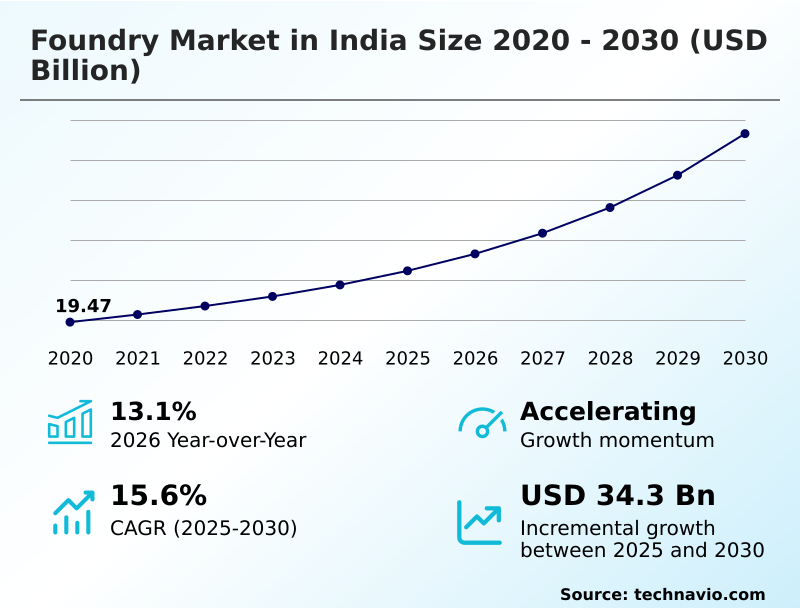
The india foundry market size is valued to increase by USD 34.30 billion, at a CAGR of 15.6% from 2025 to 2030. Proliferation of automotive sector and electric vehicle localization will drive the india foundry market.
Major Market Trends & Insights
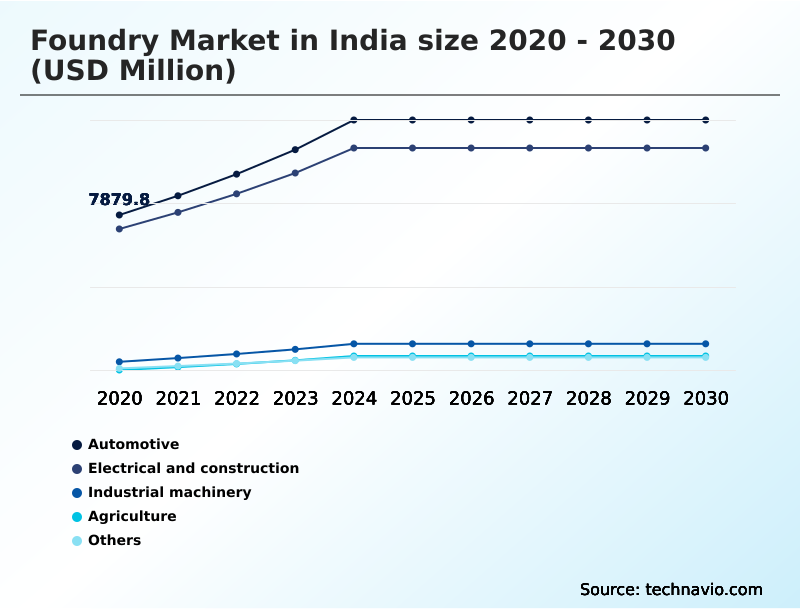
- By End-user - Automotive segment was valued at USD 11.92 billion in 2024
- By Type - Gray iron casting segment accounted for the largest market revenue share in 2024
Market Size & Forecast
- Market Opportunities: USD 47.12 billion
- Market Future Opportunities: USD 34.30 billion
- CAGR from 2025 to 2030 : 15.6%
Market Summary
- The foundry market in India is undergoing a significant transformation, moving beyond traditional manufacturing to become a hub for advanced industrial production. This evolution is defined by the integration of Industry 4.0 technologies and a strategic focus on high-value manufacturing across sectors like automotive, aerospace, and renewable energy.
- A key business scenario involves foundries leveraging AI-driven simulations to predict and mitigate defects in complex metal castings before production begins, a critical capability for meeting the zero-defect mandates of global automotive OEMs. This shift toward smart manufacturing is essential for enhancing global export competitiveness.
- Concurrently, the sector grapples with challenges such as a persistent shortage of skilled metallurgical engineers and volatility in raw material procurement. The drive for sustainability is also reshaping operations, with a notable transition from coke-fired cupolas to cleaner induction furnaces.
- As the nation aims for greater self-reliance in critical components, the foundry market in India is pivotal, balancing technological modernization with the need to address deep-rooted operational and workforce challenges. This dynamic environment fosters innovation in both ferrous and non-ferrous casting, solidifying the industry's role in the broader manufacturing ecosystem.
What will be the Size of the India Foundry Market during the forecast period?
Get Key Insights on Market Forecast (PDF) Get Free Sample
How is the India Foundry Market Segmented?
The india foundry industry research report provides comprehensive data (region-wise segment analysis), with forecasts and estimates in "USD million" for the period 2026-2030, as well as historical data from 2020-2024 for the following segments.
- End-user
- Automotive
- Electrical and construction
- Industrial machinery
- Agriculture
- Others
- Type
- Gray iron casting
- Non-ferrous casting
- Ductile iron casting
- Steel casting
- Malleable casting
- Material
- Ferrous
- Non-ferrous
- Geography
- APAC
- India
- APAC
By End-user Insights
The automotive segment is estimated to witness significant growth during the forecast period.
The automotive sector is a primary consumer in the foundry market in India, with demand for high-performance material adoption being crucial. This segment supplies essential components such as engine blocks and transmission housings.
The transition to electric vehicles necessitates a shift toward lightweight non-ferrous casting, particularly for battery and motor enclosures. This evolution in automotive casting components is driving investment in advanced die casting and automated molding lines to meet stringent quality standards.
Firms are optimizing operations for zero-defect manufacturing, with some achieving a reduction in melting costs by up to 18% through enhanced raw material utilization.
The focus on localized component manufacturing strengthens the domestic supply chain, aligning with global demands for efficiency and precision industrial casting in an era of connected vehicle technologies.
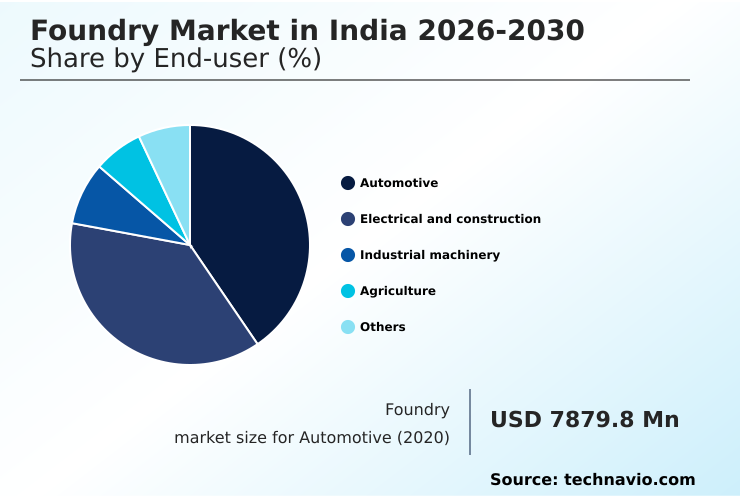
The Automotive segment was valued at USD 11.92 billion in 2024 and showed a gradual increase during the forecast period.
Market Dynamics
Our researchers analyzed the data with 2025 as the base year, along with the key drivers, trends, and challenges. A holistic analysis of drivers will help companies refine their marketing strategies to gain a competitive advantage.
- The foundry market in India is advancing through targeted technological adoption to address complex manufacturing challenges. Firms leveraging additive manufacturing for rapid tooling are witnessing project lead times shorten by more than half compared to conventional methods, a critical advantage in competitive sectors.
- The use of a digital twin for casting line simulation enables precise control over production variables, directly addressing the need for developing high-strength low-weight components for automotive and aerospace applications. Similarly, AI-driven mold-fill defect prediction is becoming essential for meeting the zero-defect mandates for automotive OEMs.
- The impact of CBAM on metal casting exports is compelling foundries to accelerate the modernization of legacy foundry operations, with a focus on induction furnace energy efficiency metrics to reduce carbon footprints. Concurrently, the industry is tackling the persistent skill gap in metallurgical engineering roles through partnerships with academic institutions.
- Sustainable binders in sand casting and the expansion of the circular economy in metal recycling are central to green foundry initiatives. These efforts are complemented by the use of advanced analytics for quality control, which helps manage raw material price volatility.
- The growth of investment casting for aerospace parts and precision casting for medical devices further underscores the industry's shift toward high-value, specialized production.
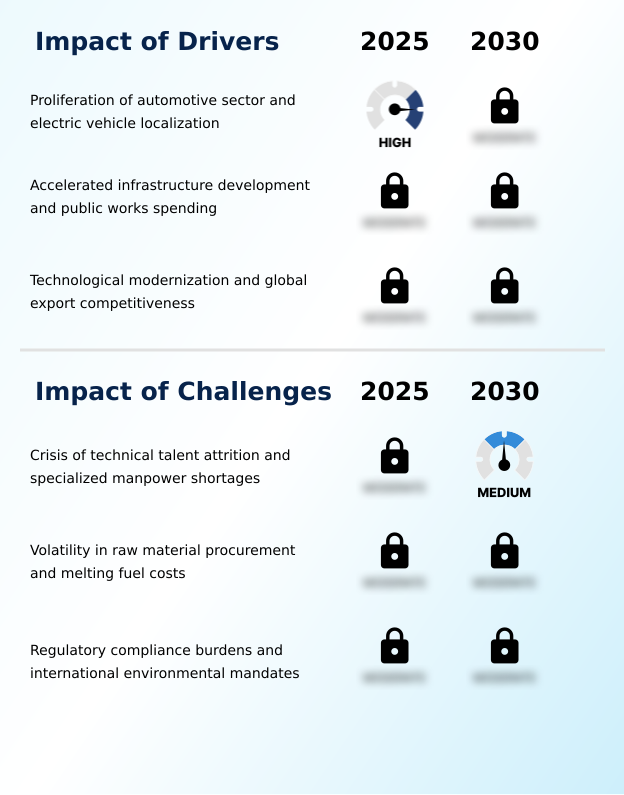
What are the key market drivers leading to the rise in the adoption of India Foundry Industry?
- The proliferation of the automotive sector, coupled with the localization of electric vehicle production, serves as a key driver for market growth.
- The growth of the foundry market in India is significantly propelled by the expansion of the automotive and infrastructure sectors.
- The domestic push for electric vehicle localization is creating substantial demand for advanced lightweight castings, particularly for motor and battery enclosures. This has accelerated industry 4.0 adoption, with facilities integrating AI-driven process optimization to enhance output quality and efficiency.
- Government-led infrastructure development components are fueling demand for robust ferrous metals and non-ferrous metals.
- The emphasis on global export competitiveness has led to a strategic shift toward high-value manufacturing, with firms leveraging their capabilities in cupola furnace operations and coking coal management to secure international contracts for industrial machinery castings and renewable energy castings.
- The implementation of advanced predictive maintenance algorithms has improved operational uptime by over 20% in leading plants.
What are the market trends shaping the India Foundry Industry?
- The integration of digital twin technology and AI-driven process optimization emerges as a key trend. This development enhances operational predictability and manufacturing efficiency.
- Key trends in the foundry market in India are centered on technological modernization and sustainability. The adoption of additive manufacturing solutions is transforming production, enabling the creation of complex near-net-shape castings and facilitating rapid prototyping services. This shift allows manufacturers to reduce material waste by up to 30%.
- Concurrently, the integration of digital twin technology provides virtual replicas of the entire casting line, optimizing thermal dynamics simulation and improving energy efficiency by 15%. A strong focus on the circular economy model is driving investment in advanced material reclamation systems and the use of secondary alloys.
- These green manufacturing practices, combined with advanced driver assistance systems in the automotive sector, are pushing the boundaries of what is possible with malleable casting and pig iron.
What challenges does the India Foundry Industry face during its growth?
- A critical challenge affecting industry growth is the crisis of technical talent attrition and a shortage of specialized manpower.
- The foundry market in India confronts significant operational and structural challenges. Persistent technical talent attrition and a shortage of skilled metallurgical engineers hinder the effective deployment of advanced technologies. Volatility in raw material procurement, particularly for essential inputs like ferro-alloys and silica sand, creates severe margin pressure, with price fluctuations impacting production costs by as much as 15% quarterly.
- Furthermore, increasingly stringent regulatory compliance burdens, including international environmental mandates, demand substantial capital investment in cleaner technologies. Foundries must navigate these pressures while meeting the demand for sophisticated aerospace and defense castings and other high-specification components. Managing these hurdles is critical for maintaining competitiveness and ensuring the sustainable growth of pump casings and machine beds production.
Exclusive Technavio Analysis on Customer Landscape
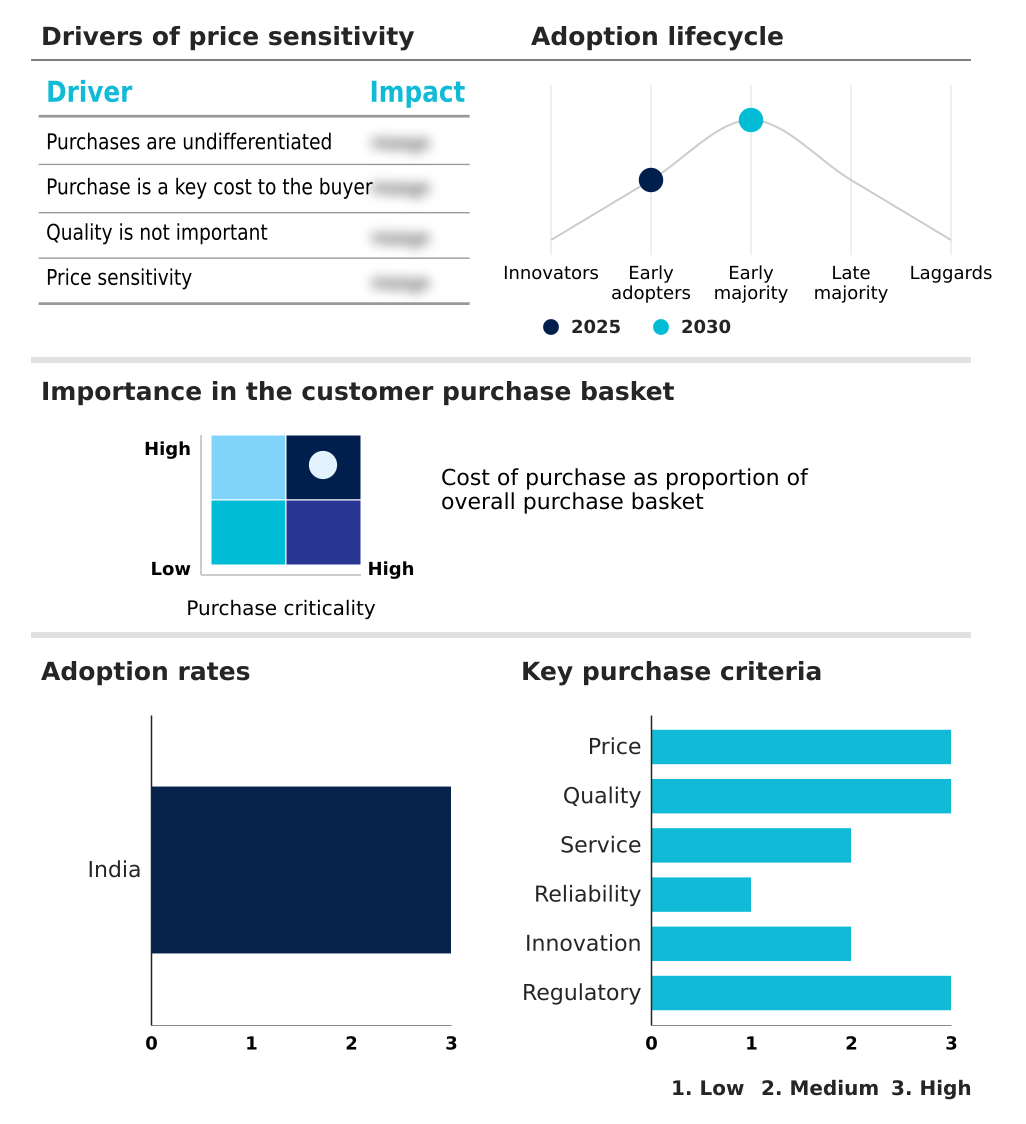
The india foundry market forecasting report includes the adoption lifecycle of the market, covering from the innovator’s stage to the laggard’s stage. It focuses on adoption rates in different regions based on penetration. Furthermore, the india foundry market report also includes key purchase criteria and drivers of price sensitivity to help companies evaluate and develop their market growth analysis strategies.
Customer Landscape of India Foundry Industry
Competitive Landscape
Companies are implementing various strategies, such as strategic alliances, india foundry market forecast, partnerships, mergers and acquisitions, geographical expansion, and product/service launches, to enhance their presence in the industry.
A Cast Foundry - The company provides a comprehensive range of braking solutions and iron castings, catering to both automotive and non-automotive sectors with precision-engineered components.
The industry research and growth report includes detailed analyses of the competitive landscape of the market and information about key companies, including:
- A Cast Foundry
- Brakes India Pvt. Ltd.
- CALMET
- Cooper Corp.
- Crescent Foundry Co. Pvt. Ltd.
- DCM Ltd.
- Electrosteel Castings Ltd.
- Fortune Foundries Pvt. Ltd.
- Gujarat Metal Cast Industries
- Hindalco Industries
- Jayaswal Neco Industries Ltd.
- JSW Holdings Ltd.
- Kalyani Forge Ltd.
- Kirloskar Ferrous Industries
- Larsen and Toubro Ltd.
- Menon and Menod Ltd.
- Nelcast Ltd.
- Tata Steel Ltd.
- The Sanmar Group
- VULKAN Group
Qualitative and quantitative analysis of companies has been conducted to help clients understand the wider business environment as well as the strengths and weaknesses of key industry players. Data is qualitatively analyzed to categorize companies as pure play, category-focused, industry-focused, and diversified; it is quantitatively analyzed to categorize companies as dominant, leading, strong, tentative, and weak.
Recent Development and News in India foundry market
- In November 2024, Brakes India Pvt. Ltd. completed a significant capital expenditure program to expand the capacity of its foundry division and strengthen its financial foundation.
- In January 2025, Tata Steel Ltd. approved the design and engineering for an advanced thin slab casting and rolling facility at its Meramandali plant to increase its long rolled product capacity.
- In April 2025, Tata Electronics signed a Memorandum of Understanding with Bosch to collaborate on semiconductor manufacturing and packaging for its upcoming facilities.
- In May 2025, Kirloskar Ferrous Industries accelerated the operational ramp-up of its new foundry facilities in Solapur to increase casting offtake for the commercial vehicle and tractor sectors.
Dive into Technavio’s robust research methodology, blending expert interviews, extensive data synthesis, and validated models for unparalleled India Foundry Market insights. See full methodology.
| Market Scope | |
|---|---|
| Page number | 195 |
| Base year | 2025 |
| Historic period | 2020-2024 |
| Forecast period | 2026-2030 |
| Growth momentum & CAGR | Accelerate at a CAGR of 15.6% |
| Market growth 2026-2030 | USD 34304.1 million |
| Market structure | Fragmented |
| YoY growth 2025-2026(%) | 13.1% |
| Key countries | India |
| Competitive landscape | Leading Companies, Market Positioning of Companies, Competitive Strategies, and Industry Risks |
Research Analyst Overview
- The foundry market in India is advancing through the systematic modernization of its production capabilities, driven by the need for enhanced metallurgical precision and sustainability. The integration of mold-fill simulations and robotic fettling systems has become standard practice, reducing defect rates by over 20% in automated facilities.
- This technological adoption addresses the industry's transition toward high-pressure die casting and investment casting for complex applications. A crucial boardroom-level consideration is the strategic capital expenditure required to replace traditional coke-fired cupolas with cleaner induction furnace technology, a move essential for compliance with emerging international regulations like the carbon border adjustment mechanism.
- The market's focus extends across various materials, including ductile iron casting, gray iron casting, and steel casting, as well as specialized alloy steel castings. As facilities adopt advanced methods like vacuum induction melting and sand reclamation, the sector is improving its capacity to produce precision industrial casting components, thereby strengthening its position in the global manufacturing landscape.
What are the Key Data Covered in this India Foundry Market Research and Growth Report?
-
What is the expected growth of the India Foundry Market between 2026 and 2030?
-
USD 34.30 billion, at a CAGR of 15.6%
-
-
What segmentation does the market report cover?
-
The report is segmented by End-user (Automotive, Electrical and construction, Industrial machinery, Agriculture, and Others), Type (Gray iron casting, Non-ferrous casting, Ductile iron casting, Steel casting, and Malleable casting), Material (Ferrous, and Non-ferrous) and Geography (APAC)
-
-
Which regions are analyzed in the report?
-
APAC
-
-
What are the key growth drivers and market challenges?
-
Proliferation of automotive sector and electric vehicle localization, Crisis of technical talent attrition and specialized manpower shortages
-
-
Who are the major players in the India Foundry Market?
-
A Cast Foundry, Brakes India Pvt. Ltd., CALMET, Cooper Corp., Crescent Foundry Co. Pvt. Ltd., DCM Ltd., Electrosteel Castings Ltd., Fortune Foundries Pvt. Ltd., Gujarat Metal Cast Industries, Hindalco Industries, Jayaswal Neco Industries Ltd., JSW Holdings Ltd., Kalyani Forge Ltd., Kirloskar Ferrous Industries, Larsen and Toubro Ltd., Menon and Menod Ltd., Nelcast Ltd., Tata Steel Ltd., The Sanmar Group and VULKAN Group
-
Market Research Insights
- The foundry market in India is shaped by a confluence of technological advancements and shifting industrial demands. Key dynamics include the rapid adoption of smart foundry solutions and predictive maintenance algorithms, which have collectively reduced equipment downtime by over 25% in modernized facilities.
- The push for a circular economy model is also prominent, with advanced material reclamation systems enabling the reuse of up to 95% of foundry sand, significantly lowering operational costs. High-value manufacturing is being driven by the need for near-net-shape castings in the aerospace and defense sectors, while on-demand manufacturing services are gaining traction for industrial machinery.
- These advancements in green manufacturing practices and digital twin technology are critical for maintaining global export competitiveness, especially as firms align with international standards and mitigate the impacts of raw material price volatility.
We can help! Our analysts can customize this india foundry market research report to meet your requirements.
 RIA -
RIA - 
