

What is the Geotechnical Engineering Market Size?
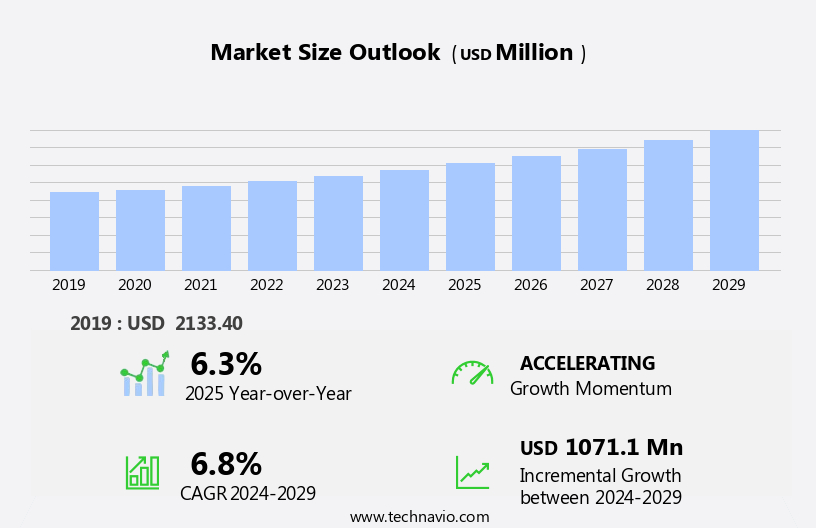
The geotechnical engineering market size is estimated to grow by USD 1.07 billion at a CAGR of 6.8% between 2024 and 2029. The market is experiencing significant growth due to the expansion of various sectors, particularly renewable energy. The integration of artificial intelligence (AI) in geotechnical engineering services is another key trend, enabling more accurate and efficient analysis of geological data. However, the high cost of advanced technologies remains a challenge for smaller players in the market. The renewable energy sector's growth is driving the demand for engineering services, as the installation of wind turbines and solar panels requires a thorough understanding of soil conditions. AI is revolutionizing the industry by providing real-time analysis of geological data, reducing the need for manual labor and increasing efficiency. Despite these opportunities, the high cost of advanced technologies, such as AI and geophysical sensors, is limiting the market growth for smaller companies. Overall, the geotechnical engineering market is poised for growth, with renewable energy and technological advancements presenting significant opportunities.
What will be the size of Market during the forecast period?
Request Free Geotechnical Engineering Market Sample
Market Segmentation
The market research report provides comprehensive data (region-wise segment analysis), with forecasts and estimates in "USD billion" for the period 2025-2029, as well as historical data from 2019 - 2023 for the following segments.
- Application
- Real estate
- Infrastructure
- Industrial
- Type
- Underground city space engineering
- Slope excavation engineering
- Ground foundation engineering
- Geography
- APAC
- China
- India
- Japan
- South Korea
- North America
- US
- Europe
- Germany
- UK
- France
- Spain
- Middle East and Africa
- South America
- Brazil
- APAC
Which is the largest segment driving market growth?
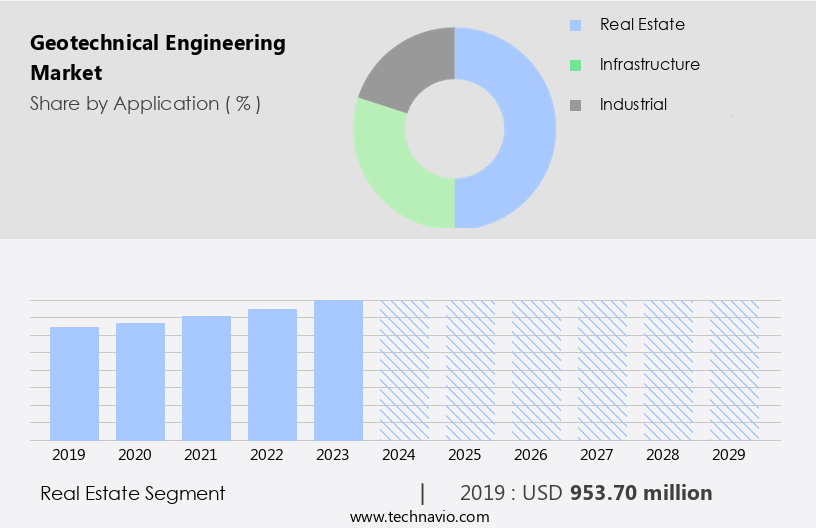
The real estate segment is estimated to witness significant growth during the forecast period. Geotechnical engineering plays a crucial role in the real estate sector due to the increasing demand for safe and stable structures for residential, commercial, and industrial projects. The residential development segment is experiencing significant growth as a result of the pressing need for housing in urban areas.
Get a glance at the market share of various regions. Download the PDF Sample
The real estate segment was valued at USD 953.70 million in 2019. Governments and private developers are investing heavily to address housing shortages, with initiatives such as the Canadian government's plan to transform six federal properties into 2,800 new homes announced in November 2023. Offshore projects, including oil and gas platforms and wind farms, also contribute to the market's growth. The use of geotechnical engineering in offshore projects ensures the stability of structures in challenging marine environments. Slope failures and landslides are common geotechnical issues that pose risks to infrastructure, particularly in hilly and mountainous regions. Geotechnical engineering solutions, such as those based on rock mechanics and artificial intelligence, help mitigate these risks. Recycled materials are increasingly being used in geotechnical engineering applications due to their environmental benefits and cost-effectiveness. Building information modeling (BIM) is another technology that is gaining popularity in the industry, as it enables the creation of digital models of structures, improving design and construction processes. These trends are expected to drive the growth of the market.
Which region is leading the market?
For more insights on the market share of various regions, Request Free Sample
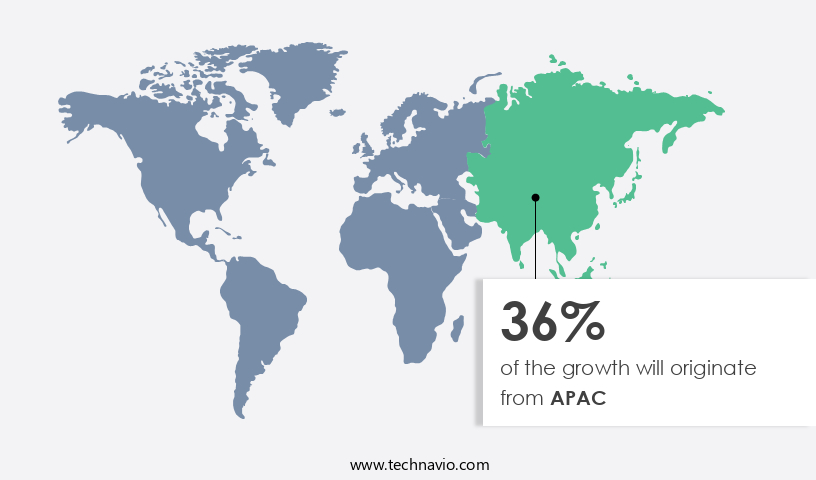
APAC is estimated to contribute 36% to the growth of the global market during the forecast period. Technavio's analysts have elaborately explained the regional market trends and drivers that shape the market during the forecast period. The Asia Pacific region is experiencing substantial growth in the market due to extensive infrastructure development and urbanization. Urbanization and the increasing adoption of renewable energy projects further fuel the demand for geotechnical engineering technology in the Asia Pacific region. For instance, the development of substations and cabling infrastructure for renewable energy sources necessitates the expertise of geotechnical engineers to ensure the structural integrity of these installations on building sites and the seabed.
How do company ranking index and market positioning come to your aid?
Companies are implementing various strategies, such as strategic alliances, partnerships, mergers and acquisitions, geographical expansion, and product/service launches, to enhance their presence in the market.
AECOM - The company offers geotechnical engineering services such as subsurface investigations, foundation design, earthworks, and ground treatment design.
Technavio provides the ranking index for the top 20 companies along with insights on the market positioning of:
- AtkinsRealis Group Inc
- Bechtel Corp.
- Black and Veatch Holding Co.
- Fluor Corp.
- Global Geotechnical Consultants LLC
- Haley and Aldrich
- HDR Inc.
- Jacobs Solutions Inc.
- Kiewit Corp.
- Laing O Rourke
- Stantec Inc.
- Terracon Consultants Inc.
- Tetra Tech Inc.
- WSP Global Inc.
Explore our company rankings and market positioning. Request Free Sample
How can Technavio assist you in making critical decisions?
What is the market structure and year-over-year growth of the Geotechnical Engineering Market?
|
Market structure |
Fragmented |
|
YoY growth 2024-2025 |
6.3 |
Market Dynamics
Our researchers analyzed the data with 2024 as the base year and the key drivers, trends, and challenges. A holistic analysis of drivers will help companies refine their marketing strategies to gain a competitive advantage.
What are the primary factors driving the market growth?
Expansion of the renewable energy sector is the key driver of the market. The market is experiencing significant growth, driven by the expansion of various infrastructure sectors, particularly in the areas of renewable energy and urbanization. Geotechnical engineering technology plays a crucial role in ensuring the stability and safety of building sites, roads, substations, and other infrastructure projects. For instance, the utility sectors, including wind energy, utility pipelines, and power generation, require extensive geotechnical engineering to address challenges such as ground conditions, slope excavation engineering, and rock mechanics.
One of the most notable areas of growth is in the renewable energy sector, where the demand for sustainable energy solutions and the push towards reducing carbon emissions is driving the need for advanced geotechnical engineering. For example, the construction of wind farms requires extensive geotechnical engineering to address challenges such as seabed conditions, foundation design, and environmental impact. Moreover, urbanization is another key driver for the geotechnical engineering market. The development of municipal engineering projects, such as slope failures, landslides, and land reclamation, requires advanced geotechnical engineering solutions. Thus, such factors are driving the growth of the market during the forecast period.
What are the significant trends being witnessed in the market?
Integration of AI in geotechnical engineering services is the upcoming trend in the market. Geotechnical engineering technology plays a vital role in the development of cabling infrastructure, urbanization, and various infrastructure projects, including building sites, roads, substations, and utility sectors. The integration of artificial intelligence (AI) in geotechnical engineering services is revolutionizing the industry, providing insights into complex earth materials and optimizing design decisions for safer construction practices. AI's capabilities are particularly impactful in automating data extraction from geotechnical reports using optical character recognition (OCR) and natural language processing (NLP), transforming unstructured data into structured formats like Excel. This streamlines workflows and reduces human error, ensuring timely site condition analysis.
Furthermore, AI enhances real-time monitoring of geotechnical parameters through its integration with Internet of Things (IoT) devices, providing critical information for managing slope failures, landslides, and other geotechnical risks. In addition, AI's applications extend to wind energy, utility pipelines, dams, and other infrastructure projects, as well as mining engineering, municipal engineering, slope excavation engineering, and tunnel building. The integration of AI in geotechnical engineering services also supports power generation, renewable energy, and sustainable urban expansion, reducing energy consumption and environmental footprint. Thus, such trends will shape the growth of the market during the forecast period.
What are the major market challenges?
The high cost of advanced technologies is a key challenge affecting market growth. The high cost of these technologies poses a challenge for organizations, particularly smaller firms and those in developing regions. For instance, ground-penetrating radar (GPR) systems, which are essential for accurate subsurface investigations, range from USD 50,000 to USD 200,000. Electrical resistivity tomography (ERT) systems, used for mapping subsurface resistivity variations, cost between USD 20,000 and USD 100,000. These costs can limit accessibility and widespread adoption, especially for smaller projects or firms with limited budgets. Urbanization and infrastructure development in sectors such as government buildings, roads, substations, and renewable energy projects require extensive geotechnical assessments.
Geotechnical engineering technology is also crucial for slope excavation engineering, dam construction, and natural disaster mitigation. In the energy sector, geotechnical engineering plays a vital role in wind power projects, land reclamation, and offshore substructure projects. The use of advanced technologies, such as machine learning, building information modeling, and real-time monitoring systems, is becoming increasingly common in geotechnical engineering. These technologies enable more efficient and accurate assessments, reducing the risk of slope failures, landslides, and other geotechnical hazards. Hence, the above factors will impede the growth of the market during the forecast period.
Exclusive Customer Landscape
The market forecasting report includes the adoption lifecycle of the market research and growth, covering from the innovator's stage to the laggard's stage. It focuses on adoption rates in different regions based on penetration. Furthermore, the report also includes key purchase criteria and drivers of price sensitivity to help companies evaluate and develop their market growth analysis strategies.
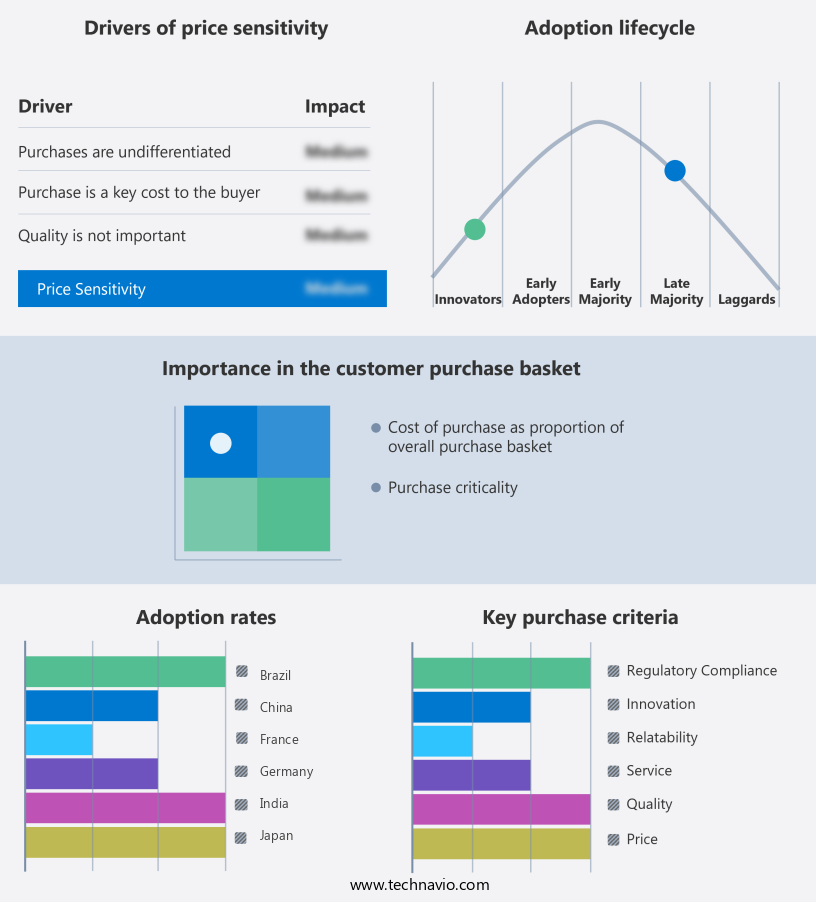
Customer Landscape
Market Analyst Overview
Geotechnical engineering plays a pivotal role in the development of various infrastructure projects, including cabling infrastructure, roads, bridges, and utility sectors. The market is driven by ongoing urbanization and the need for sustainable and resilient constructions. Geohazard mitigation is becoming increasingly important in the development of smart cities, where construction management software and data-driven engineering play a vital role in ensuring safety and sustainability. In coastal engineering projects, geotechnical investigation and soil stabilization techniques are crucial for building resilient infrastructure, while the integration of smart infrastructure supports the efficient use of resources. Additionally, offshore wind energy projects benefit from advanced engineering practices to harness renewable energy while mitigating environmental risks. The shift towards renewable energy sources, such as wind energy and solar power, has led to an increase in the number of wind farms and utility pipelines.
Furthermore, geotechnical engineering is crucial in the design and construction of these projects, particularly in the assessment of soil conditions and the selection of appropriate foundation systems. In the context of infrastructure development, geotechnical engineering also plays a critical role in the construction of substructures for power generation, such as dams and substations. The circular economy plays a crucial role in disaster preparedness and urban planning by promoting the use of green building materials and renewable energy development. Through tools like remote sensing, life cycle analysis, and environmental impact assessment, cities can better understand their carbon footprint reduction and optimize resources. Digital twins offer innovative ways to model sustainable urban environments, enabling smarter decisions to reduce environmental impact and enhance resilience to future challenges. The use of geotechnical engineering technology is also becoming increasingly important in the context of sustainable urban expansion.
|
Market Scope |
|
|
Report Coverage |
Details |
|
Page number |
202 |
|
Base year |
2024 |
|
Historic period |
2019 - 2023 |
|
Forecast period |
2025-2029 |
|
Growth momentum & CAGR |
Accelerate at a CAGR of 6.8% |
|
Market Growth 2025-2029 |
USD 1.07 billion |
|
Regional analysis |
APAC, North America, Europe, Middle East and Africa, and South America |
|
Performing market contribution |
APAC at 36% |
|
Key countries |
US, China, Germany, UK, France, Spain, Japan, South Korea, India, and Brazil |
|
Competitive landscape |
Leading Companies, Market Positioning of Companies, Competitive Strategies, and Industry Risks |
|
Key companies profiled |
AECOM, AtkinsRealis Group Inc, Bechtel Corp., Black and Veatch Holding Co., Fluor Corp., Global Geotechnical Consultants LLC, Haley and Aldrich, HDR Inc., Jacobs Solutions Inc., Kiewit Corp., Laing O Rourke, Stantec Inc., Terracon Consultants Inc., Tetra Tech Inc., and WSP Global Inc. |
|
Market Segmentation |
Application (Real estate, Infrastructure, and Industrial), Type (Underground city space engineering, Slope excavation engineering, and Ground foundation engineering), and Geography (APAC, North America, Europe, Middle East and Africa, and South America) |
|
Customization purview |
If our report has not included the data that you are looking for, you can reach out to our analysts and get segments customized. |
What are the Key Data Covered in this Market Report?
- CAGR of the market during the market forecast period
- Detailed information on factors that will drive the market growth and forecasting between 2025 and 2029
- Precise estimation of the size of the market and its contribution of the market in focus to the parent market
- Accurate predictions about upcoming market growth and trends and changes in consumer behavior
- Growth of the market across APAC, North America, Europe, Middle East and Africa, and South America
- Thorough analysis of the market's competitive landscape and detailed information about companies
- Comprehensive analysis of factors that will challenge the growth of market companies
 RIA -
RIA -