


Gige Camera Market Size 2024-2028
The gige camera market size is forecast to increase by USD 1.89 billion at a CAGR of 18.55% between 2023 and 2028.
- The market is experiencing significant growth due to increasing demand for high-definition surveillance systems in various sectors, particularly in security and surveillance. Additionally, the healthcare industry is witnessing a surge In the adoption of GigE cameras for medical imaging applications. However, the high cost of research and development poses a challenge to market growth. These trends and factors are shaping the future of the market. The report provides a comprehensive analysis of these trends and their impact on market growth. GigE cameras offer superior image quality and high-speed data transfer, making them an ideal choice for applications requiring real-time image processing.
- The market is expected to witness steady growth In the coming years, driven by these key trends.
What will be the Size of the Gige Camera Market During the Forecast Period?

- The market represents a significant segment of the machine vision industry, focusing on computer systems integrated with machine vision hardware utilizing Gigabit Ethernet technology. These cameras offer high-speed data transfer capabilities, enabling real-time processing of raw images from industrial applications, lab automation, and various machine vision systems. Frame grabbers, an essential component of GigE cameras, facilitate the transfer of data between the camera and the computer system. Key players In the market include manufacturers of industrial cameras, such as General Motors and Teledyne Marine, as well as those specializing in machine vision cameras, like Sony's PREGIO series and Teledyne Dalsa.
- The adoption of GigE cameras is driven by their ability to provide high frame rates, onboard memory, and advanced firmware updates. The integration of these cameras with Ethernet networks and advanced processors enhances their functionality and flexibility in various industries. The market is expected to grow due to the increasing demand for high-resolution, high-speed image sources in machine vision applications and industrial automation.
How is this Gige Camera Industry segmented and which is the largest segment?
The gige camera industry research report provides comprehensive data (region-wise segment analysis), with forecasts and estimates in "USD million" for the period 2024-2028, as well as historical data from 2018-2022 for the following segments.
- Type
- Area scan camera
- Line scan camera
- Geography
- North America
- Canada
- US
- APAC
- India
- Japan
- Europe
- Germany
- South America
- Middle East and Africa
- North America
By Type Insights
- The area scan camera segment is estimated to witness significant growth during the forecast period.
The market experienced significant growth In the area scan camera segment in 2021. Area scan GigE cameras offer high-resolution and high-performance features, resulting in superior image quality and various sensor options. These cameras are popular in industries such as automotive, military and defense, food packaging, pharmaceutical, security and surveillance, and medical devices. Area scan GigE cameras are ideal for machine vision applications in industrial settings, where objects are uniform in size in both two-dimensions and three-dimensions. Their rectangular or square sensors capture images in a single frame, providing efficiency and accuracy. Gigabit ethernet technology, onboard memory, firmware, and power supply are essential components of these cameras.
Area scan GigE cameras are integral to various applications, including inspection, robotics, medical imaging, surveillance, scientific research, and traffic monitoring. Industry-specific standards, device miniaturization trends, and environmental protection features further enhance their utility.
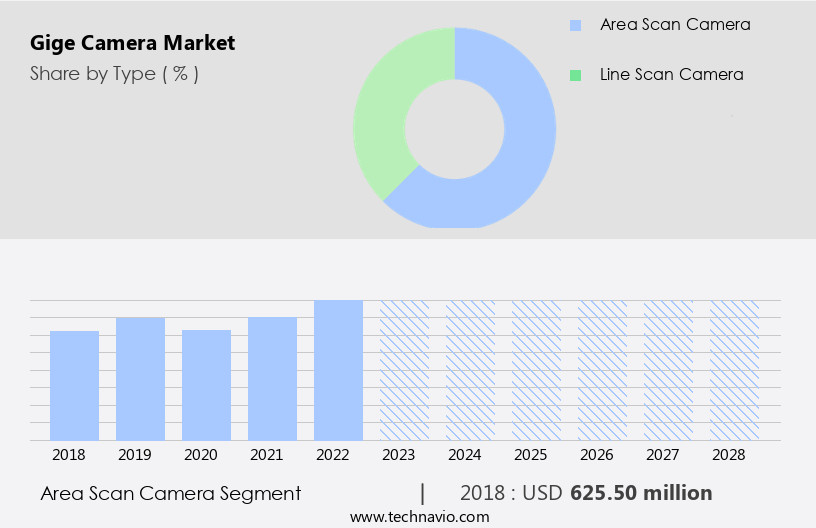
Get a glance at the Gige Camera Industry report of share of various segments Request Free Sample
The Area scan camera segment was valued at USD 625.50 billion in 2018 and showed a gradual increase during the forecast period.
Regional Analysis
- North America is estimated to contribute 38% to the growth of the global market during the forecast period.
Technavio's analysts have elaborately explained the regional trends and drivers that shape the market during the forecast period.

For more insights on the market share of various regions, Request Free Sample
The market in North America holds a significant share due to the region's early adoption of technology and the presence of various industries, including defense, automotive, medical, food and beverage, oil and gas, and pharmaceutical. These industries require advanced machine vision solutions, driving the demand for high-performance GigE cameras. The defense sector, in particular, utilizes GigE cameras for aerial imaging and surveillance applications. Furthermore, the increasing investment in machine vision technologies, such as 3D vision and depth mapping, fuels market growth. Gigabit ethernet technology's ability to deliver high-quality RAW images, high frame rates, and onboard memory makes it an ideal choice for various industries, including industrial automation, inspection, robotics, and scientific research.
Key applications include yield estimation, process monitoring, and anomaly detection. The market is expected to grow further due to emerging trends like industry-specific standards, device miniaturization, and the increasing use of GigE cameras in UAVs and portable inspection systems.
Market Dynamics
Our researchers analyzed the data with 2023 as the base year, along with the key drivers, trends, and challenges. A holistic analysis of drivers will help companies refine their marketing strategies to gain a competitive advantage.
What are the key market drivers leading to the rise In the adoption of Gige Camera Industry?
Increasing demand for GigE cameras in security and surveillance is the key driver of the market.
- The market has experienced significant growth due to the increasing demand for machine vision hardware in various industries, including machine vision industry, industrial automation, and computer systems. GigE cameras, which utilize Gigabit ethernet technology, offer numerous advantages over traditional cameras. These advantages include high-quality RAW images, faster frame rates, onboard memory, and firmware updates. Industrial applications of GigE cameras span across sectors such as manufacturing, food processing, and laboratory automation. For instance, General Motors uses GigE cameras for inspection and quality control In their manufacturing processes. In the medical field, GigE cameras are employed in surgical imaging systems, endoscopic procedures, and robotic-assisted surgeries.
- Additionally, GigE cameras are utilized in scientific research, traffic monitoring, and surveillance. Moreover, the advancements in GigE interface technology have led to the development of multi-sensor GigE cameras, 3D vision, depth mapping, object recognition, image classification, and anomaly detection. These features are essential in applications such as target tracking, missile guidance, autonomous vehicles, and driver monitoring systems. Environmental protection features, robust housings, and sealed connectors are crucial considerations In the design of GigE cameras. Furthermore, industry-specific standards and device miniaturization trends have led to the production of lightweight and compact GigE cameras. These cameras are increasingly being used in UAVs (drones) and portable inspection systems.
- In conclusion, the market is driven by the increasing demand for high-quality video footage and advanced image processing capabilities in various industries. The flexibility and versatility of GigE cameras, coupled with their ability to offer real-time data transfer, make them an ideal choice for applications requiring high-resolution images and fast frame rates.
What are the market trends shaping the Gige Camera Industry?
Growing use of GigE cameras in healthcare applications is the upcoming market trend.
- The market encompasses the supply and demand for machine vision hardware, including industrial cameras and frame grabbers, that utilize Gigabit ethernet technology for data transmission. This market caters to various industries, including machine vision, industrial automation, inspection, robotics, medical imaging, surveillance, scientific research, traffic monitoring, food processing, sports activities, and factory automation. GigE cameras offer high-quality RAW images, onboard memory, firmware updates, and power supply via ethernet networks, enabling frame rates up to 1000 fps. Key players in this market include companies such as Teledyne Marine, Sony Pregius 3, Teledyne Dalsa, and Image Source. The market's growth is driven by the increasing demand for high-resolution cameras in industries like medical imaging, where precision is crucial.
- The need for advanced 3D vision, depth mapping, object recognition, image classification, and anomaly detection is also fueling market growth. Environmental protection features, robust housings, and sealed connectors are essential industry-specific standards for GigE cameras. Device miniaturization trends have led to the development of lightweight and compact GigE cameras, making them suitable for applications in UAVs (drones), portable inspection systems, and other industries where size and weight are critical factors. GigE cameras are used in various applications, including quality control, product inspection, defect detection, measurement, process monitoring, plant monitoring, crop inspection, yield estimation, high-quality video footage, aerial surveillance, target tracking, missile guidance, autonomous vehicles, driver monitoring systems, surgical imaging systems, endoscopic procedures, robotic-assisted surgeries, microscopy, pathology applications, and research laboratories.
- Clinical diagnostics, telemedicine, and telehealth applications are also significant markets for GigE cameras. In summary, the market is experiencing significant growth due to the increasing demand for high-resolution cameras in various industries, including medical imaging, industrial automation, and machine vision. The market's growth is driven by technological advances, the need for advanced imaging capabilities, and industry-specific standards. The development of lightweight and compact GigE cameras has expanded their applications in various industries, making them an essential component of modern technology.
What challenges does the Gige Camera Industry face during its growth?
High cost of R and D is a key challenge affecting the industry growth.
- The market encompasses the production and sale of machine vision hardware, including industrial cameras and frame grabbers, equipped with the Gigabit Ethernet technology interface. This market caters to various industries such as machine vision, industrial automation, inspection, robotics, medical imaging, surveillance, scientific research, traffic monitoring, food processing, sports activities, factory automation, quality control, product inspection, defect detection, measurement, process monitoring, plant monitoring, crop inspection, yield estimation, high-quality video footage, aerial surveillance, target tracking, missile guidance, autonomous vehicles, driver monitoring systems, surgical imaging systems, endoscopic procedures, robotic-assisted surgeries, microscopy, pathology applications, and research laboratories. The increasing demand for high-performance imaging solutions in sectors like military and defense, automotive, medical, food and beverage, oil and gas, and agriculture is driving the growth of the market.
- In the military sector, GigE cameras are utilized for aerial imaging applications, offering real-time intelligence on battlefield conditions, vehicle and troop movements, and weapon locations, despite poor light or adverse weather. companies must invest heavily in research and development to enhance surveillance and security capabilities to meet the escalating demand in this sector. The food and beverage industry faces challenges in ensuring product quality and safety, necessitating the adoption of advanced imaging technologies like GigE cameras for inspection purposes. Similarly, the medical industry relies on GigE cameras for applications such as surgical imaging systems, endoscopic procedures, and robotic-assisted surgeries.
- In the oil and gas industry, GigE cameras are used for process monitoring and pipeline inspections, while in agriculture, they are employed for crop inspection and yield estimation. The growing trend towards miniaturization and the development of multi-sensor GigE cameras, as well as 3D vision, depth mapping, object recognition, image classification, and anomaly detection, are further expanding the scope of the market. Additionally, environmental protection features, robust housings, and sealed connectors cater to the industry-specific requirements of various applications. The market is witnessing significant advancements, with the development of compact and lightweight cameras for use in portable inspection systems, UAVs (drones), and other applications where size and weight are critical factors.
- These cameras offer high frame rates, onboard memory, firmware upgrades, and power supply flexibility, making them suitable for a wide range of applications. In conclusion, the market is experiencing substantial growth due to its applications in various industries, including military and defense, food and beverage, medical, oil and gas, and agriculture. The demand for high-performance imaging solutions and the continuous development of advanced features are driving the market's expansion. companies must invest in research and development to meet the evolving needs of their customers and stay competitive in this dynamic market.
Exclusive Customer Landscape
The gige camera market forecasting report includes the adoption lifecycle of the market, covering from the innovator's stage to the laggard's stage. It focuses on adoption rates in different regions based on penetration. Furthermore, the gige camera market report also includes key purchase criteria and drivers of price sensitivity to help companies evaluate and develop their market growth analysis strategies.

Customer Landscape
Key Companies & Market Insights
Companies are implementing various strategies, such as strategic alliances, gige camera market forecast, partnerships, mergers and acquisitions, geographical expansion, and product/service launches, to enhance their presence In the industry.
Allied Vision Technologies GmbH - The Mako GigE camera device from the company caters to applications requiring Precision Time Protocol (PTP), Trigger over Ethernet (ToE), and Power over Ethernet (PoE) functionalities. This camera device adheres to industry standards, offering reliable synchronization, remote triggering, and power delivery via Ethernet connection. With its advanced features, the Mako camera device is an ideal solution for various industrial imaging applications.
The industry research and growth report includes detailed analyses of the competitive landscape of the market and information about key companies, including:
- Allied Vision Technologies GmbH
- Basler AG
- Baumer Holding AG
- Emergent Vision Technologies Inc.
- GEViCAM Inc.
- Hangzhou Ai Ke Electronics Co. Ltd.
- Hangzhou Hikvision Digital Technology Co. Ltd.
- IDS Imaging Development Systems GmbH
- Imperx Inc.
- INET Electronics and Trade ltd.
- JAI AS
- LUCID Vision Labs Inc.
- Matrox Electronic Systems Ltd.
- OMRON Corp.
- Photonfocus AG
- Pleora Technologies Inc.
- Sony Group Corp.
- Teledyne Technologies Inc.
- TKH Technology Poland
- Toshiba Corp.
Qualitative and quantitative analysis of companies has been conducted to help clients understand the wider business environment as well as the strengths and weaknesses of key industry players. Data is qualitatively analyzed to categorize companies as pure play, category-focused, industry-focused, and diversified; it is quantitatively analyzed to categorize companies as dominant, leading, strong, tentative, and weak.
Research Analyst Overview
The market encompasses a range of machine vision hardware designed for capturing and transferring raw images from industrial cameras to computer systems. These cameras employ Gigabit Ethernet technology, which facilitates high-speed data transfer, making them suitable for various industries and applications. Machine vision cameras are integral components of computer systems used in numerous sectors, including industrial automation, inspection, robotics, medical imaging, surveillance, scientific research, and more. The raw images produced by these cameras are processed and analyzed to extract valuable insights and information. Frame grabbers serve as intermediaries between the camera and the computer system, ensuring seamless communication and data transfer.
GigE cameras are increasingly replacing traditional frame grabbers due to their advanced capabilities and ease of integration with Ethernet networks. Industrial cameras are available in various formats and configurations, catering to diverse application requirements. They come with onboard memory, firmware, and power supply systems that enable them to function independently. The cameras' processors and image sensors are optimized for high-speed data processing and image quality. GigE cameras are utilized in various industries, including manufacturing, lab automation, traffic monitoring, food processing, sports activities, and more. They are employed for tasks such as quality control, product inspection, defect detection, measurement, process monitoring, plant monitoring, crop inspection, yield estimation, and more.
High-quality video footage is another application area for GigE cameras. They are used in aerial surveillance, target tracking, missile guidance, autonomous vehicles, driver monitoring systems, surgical imaging systems, endoscopic procedures, and robotic-assisted surgeries. The machine vision industry is witnessing several trends, including the miniaturization of devices, the adoption of industry-specific standards, and the development of multi-sensor GigE cameras. Lightweight and compact GigE cameras are increasingly popular in applications where size and weight are critical factors. UAVs (drones) and portable inspection systems are prime examples of such applications. Environmental protection features, robust housings, and sealed connectors are essential considerations for GigE cameras used in harsh environments.
The cameras must be able to withstand extreme temperatures, humidity, and other challenging conditions. GigE cameras are also being developed to cater to specific application needs. For instance, 3D vision, depth mapping, object recognition, image classification, anomaly detection, and other advanced features are being integrated into these cameras to enhance their capabilities. In conclusion, the market is a dynamic and evolving landscape, driven by the growing demand for high-speed data transfer and advanced image processing capabilities. These cameras are transforming various industries by enabling real-time data analysis and decision-making, ultimately leading to increased efficiency and productivity.
|
Market Scope |
|
|
Report Coverage |
Details |
|
Page number |
137 |
|
Base year |
2023 |
|
Historic period |
2018-2022 |
|
Forecast period |
2024-2028 |
|
Growth momentum & CAGR |
Accelerate at a CAGR of 18.55% |
|
Market growth 2024-2028 |
USD 1885.9 million |
|
Market structure |
Fragmented |
|
YoY growth 2023-2024(%) |
15.19 |
|
Key countries |
US, Germany, Japan, Canada, and India |
|
Competitive landscape |
Leading Companies, Market Positioning of Companies, Competitive Strategies, and Industry Risks |
What are the Key Data Covered in this Gige Camera Market Research and Growth Report?
- CAGR of the Gige Camera industry during the forecast period
- Detailed information on factors that will drive the growth and forecasting between 2024 and 2028
- Precise estimation of the size of the market and its contribution of the industry in focus to the parent market
- Accurate predictions about upcoming growth and trends and changes in consumer behaviour
- Growth of the market across North America, APAC, Europe, South America, and Middle East and Africa
- Thorough analysis of the market's competitive landscape and detailed information about companies
- Comprehensive analysis of factors that will challenge the gige camera market growth of industry companies
We can help! Our analysts can customize this gige camera market research report to meet your requirements.