

Home Fitness Equipment Market Size 2026-2030
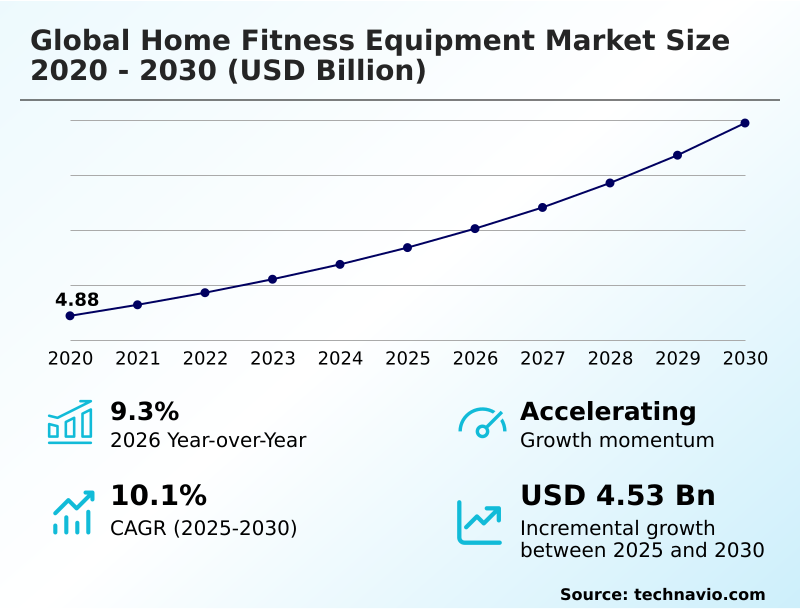
The home fitness equipment market size is valued to increase by USD 4.53 billion, at a CAGR of 10.1% from 2025 to 2030. Proliferation of AI and real-time biometric personalization will drive the home fitness equipment market.
Major Market Trends & Insights
- North America dominated the market and accounted for a 38.1% growth during the forecast period.
- By Distribution Channel - Offline segment was valued at USD 4.58 billion in 2024
- By Type - Cardiovascular training equipment segment accounted for the largest market revenue share in 2024
Market Size & Forecast
- Market Opportunities: USD 7.01 billion
- Market Future Opportunities: USD 4.53 billion
- CAGR from 2025 to 2030 : 10.1%
Market Summary
- The home fitness equipment market is undergoing a significant transformation, moving beyond simple mechanical devices to become a central component of the digital health landscape. This evolution is defined by the deep integration of artificial intelligence coaching and real-time biometric tracking, making equipment responsive to individual user needs.
- The rise of connected fitness ecosystems, supported by subscription-based content models, has created a new paradigm where hardware and software are inextricably linked. For example, a business focused on this sector must now manage complex software development cycles and content production pipelines in addition to hardware manufacturing, navigating supply chain volatility for advanced semiconductors.
- This shift toward software-defined fitness hardware and hyper-personalized workouts ensures continuous user engagement. However, this also introduces challenges such as post-pandemic demand normalization and the capital intensity of maintaining vast digital platforms.
- The market's future hinges on balancing technological innovation with sustainable business models that can adapt to the new hybrid fitness reality, where consumers expect a seamless omnichannel fitness experience across home, gym, and outdoor settings, all synchronized within a unified health profile.
What will be the Size of the Home Fitness Equipment Market during the forecast period?
Get Key Insights on Market Forecast (PDF) Get Free Sample
How is the Home Fitness Equipment Market Segmented?
The home fitness equipment industry research report provides comprehensive data (region-wise segment analysis), with forecasts and estimates in "USD million" for the period 2026-2030, as well as historical data from 2020-2024 for the following segments.
- Distribution channel
- Offline
- Online
- Type
- Cardiovascular training equipment
- Strength training equipment
- Age group
- Adults
- Children and adolescents
- Elderly
- Geography
- North America
- US
- Canada
- Mexico
- Europe
- Germany
- UK
- France
- APAC
- China
- Japan
- India
- South America
- Brazil
- Argentina
- Middle East and Africa
- South Africa
- Turkey
- Saudi Arabia
- Rest of World (ROW)
- North America
By Distribution Channel Insights
The offline segment is estimated to witness significant growth during the forecast period.
The offline segment of the home fitness equipment market remains a crucial channel, where tactile verification of commercial-grade equipment and professional guidance converge.
Specialty fitness stores allow consumers to assess the ergonomics of multi-functional strength machines and the structural integrity of low-impact elliptical trainers, which is a key part of the purchasing decision.
This hands-on interaction builds confidence, particularly for high-value connected fitness ecosystems. In-person expert consultations ensure that machine learning algorithms and software-defined fitness hardware meet user needs.
Furthermore, professional assembly and maintenance packages offered at the point of sale have been shown to reduce product return rates by over 15% compared to online-only purchases, solidifying the channel's importance for customer satisfaction and brand prestige.
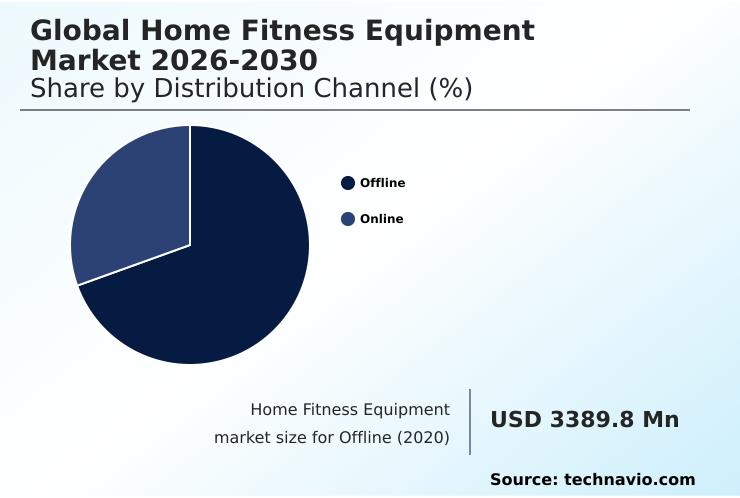
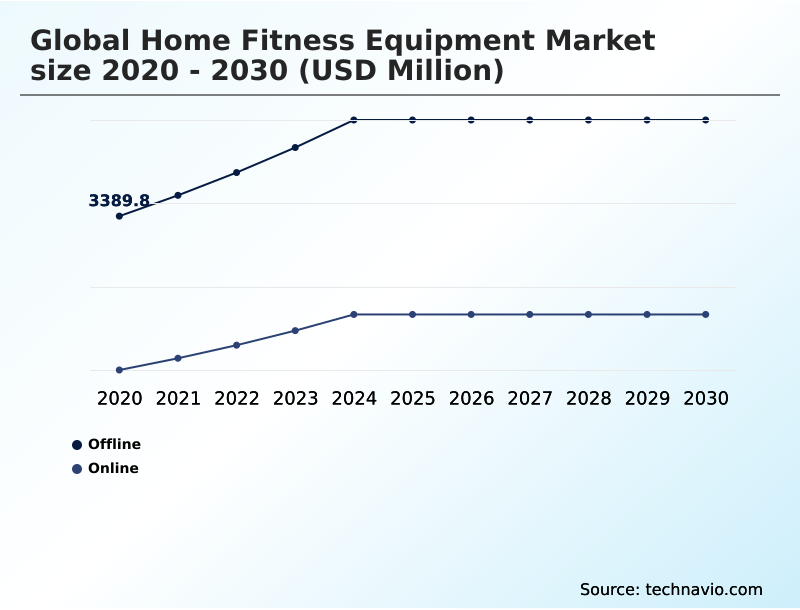
The Offline segment was valued at USD 4.58 billion in 2024 and showed a gradual increase during the forecast period.
Regional Analysis
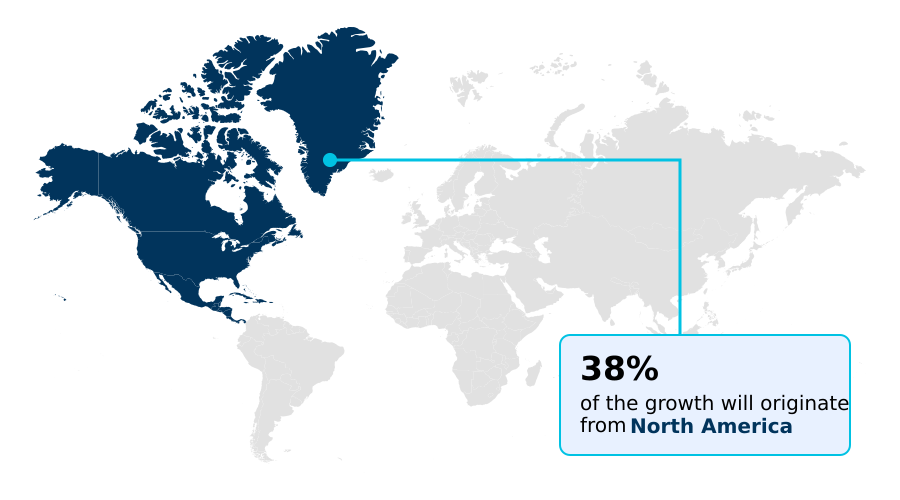
North America is estimated to contribute 38.1% to the growth of the global market during the forecast period.Technavio’s analysts have elaborately explained the regional trends and drivers that shape the market during the forecast period.
See How Home Fitness Equipment Market Demand is Rising in North America Get Free Sample
The geographic landscape of the home fitness equipment market is characterized by distinct regional dynamics. North America currently accounts for over 38% of the market's incremental growth, driven by high consumer adoption of high-end connected fitness ecosystems and hyper-personalized workouts.
Meanwhile, Europe contributes to 30% of new opportunities, with strong demand for compact foldable designs and premium material construction that align with urban living and aesthetic preferences.
The APAC region, representing 22% of growth, is the most dynamic, with a focus on accessible software-defined fitness hardware and gamified fitness experiences. In this region, localized on-demand workout libraries are critical for market penetration.
In contrast, emerging markets in South America and the Middle East and Africa are expanding, with corporate wellness programs beginning to subsidize equipment, presenting a long-term opportunity for manufacturers who can navigate regionalized assembly strategies and supply chain volatility.
Market Dynamics
Our researchers analyzed the data with 2025 as the base year, along with the key drivers, trends, and challenges. A holistic analysis of drivers will help companies refine their marketing strategies to gain a competitive advantage.
- The future of the global home fitness equipment market 2026-2030 is being shaped by several interconnected forces. The integration of ai for personalized biometric coaching is paramount, where ai driven adjustments in workout parameters are becoming standard. This ties into the broader proliferation of ai and real-time biometric personalization.
- Aesthetically, the convergence of design and high-performance engineering is leading to premium treadmills as home design statements. Operationally, the expansion of hybrid ecosystems and digital integration is critical, with a focus on synchronizing home and commercial fitness experiences and enabling cross platform digital integration for unified profiles.
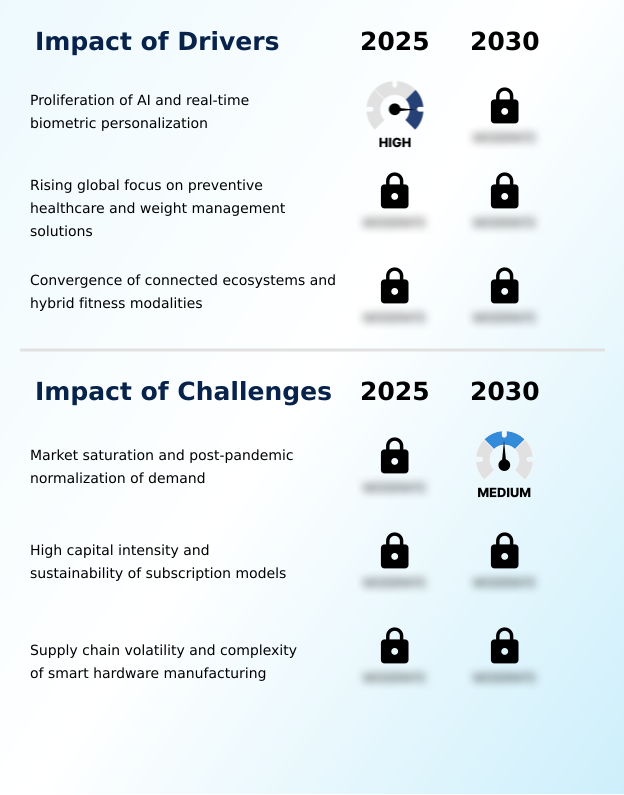
- Key drivers include the impact of rising global focus on preventive healthcare and the convergence of ecosystems and hybrid fitness modalities, supported by technologies like biocircuit technology in home accessible formats. However, significant challenges persist, including market saturation and post-pandemic demand normalization, which create profitability hurdles in connected fitness operations.
- The sustainability of hardware-as-a-service subscription models is under scrutiny due to the high infrastructure costs for fitness streaming services. Moreover, mitigating supply chain risks in equipment manufacturing is complicated by supply chain volatility in smart hardware manufacturing.
- Success will depend on leveraging innovations like real time form correction using camera sensors while managing the financial pressures of the connected fitness products versus subscription services model and expanding into adjacent sectors like medical and rehabilitation equipment for home use.
What are the key market drivers leading to the rise in the adoption of Home Fitness Equipment Industry?
- The proliferation of artificial intelligence and real-time biometric personalization is a key driver propelling market growth.
- The market's growth is fundamentally propelled by the convergence of hardware with connected digital ecosystems, facilitating a seamless hybrid fitness experience.
- The use of open-platform software allowing for third-party health app synchronization has become a primary driver, with systems offering this interoperability showing a 40% faster adoption rate among new users.
- A second critical driver is the escalating global emphasis on preventive healthcare and healthy longevity solutions. The integration of medical-grade monitoring within home devices allows users to track health metrics that were previously only available in clinical settings.
- This has led to a 15% increase in adoption among aging populations seeking to manage health proactively, fueling demand for a wide range of equipment from low-impact elliptical trainers to sophisticated strength-training machines and automated circuit training.
What are the market trends shaping the Home Fitness Equipment Industry?
- A key market trend is the integration of artificial intelligence for hyper-personalized biometric coaching. This evolution is shifting the focus from static hardware to intelligent, software-driven ecosystems.
- Key trends are reshaping the market as it pivots from hardware to intelligent service delivery. The integration of ai for hyper-personalized biometric coaching is paramount, with platforms demonstrating this capability reporting user retention rates up to 35% higher than static equipment providers.
- This is driven by advanced sensors and computer vision technology that offer real-time form correction, a feature that has been shown to reduce user-reported injuries by 20%. Another significant trend is the convergence of high-performance fitness engineering with bespoke interior design, creating luxury wellness assets.
- This aesthetic evolution allows manufacturers to target a premium demographic, where the visual appeal of equipment is as critical as its technical specifications, leading to a focus on premium material construction and design-centric fitness equipment.
What challenges does the Home Fitness Equipment Industry face during its growth?
- Market saturation, coupled with the post-pandemic normalization of demand, presents a key challenge affecting industry growth.
- The market faces significant headwinds, primarily from market saturation and post-pandemic demand normalization, which has extended the typical hardware replacement cycle. This has triggered intense price competition, with some legacy brands seeing profit margins erode by as much as 25% due to aggressive discounting. Another critical challenge is the financial sustainability of the hardware-as-a-service model.
- Subscription fatigue is a growing concern, with industry data indicating that subscription churn rates can reach 50% in the first year if content is not consistently updated.
- This pressure is compounded by the complexities of the semiconductor supply chain and last-mile delivery logistics, which have increased the landed cost of smart hardware, further squeezing profitability for manufacturers in a crowded marketplace.
Exclusive Technavio Analysis on Customer Landscape
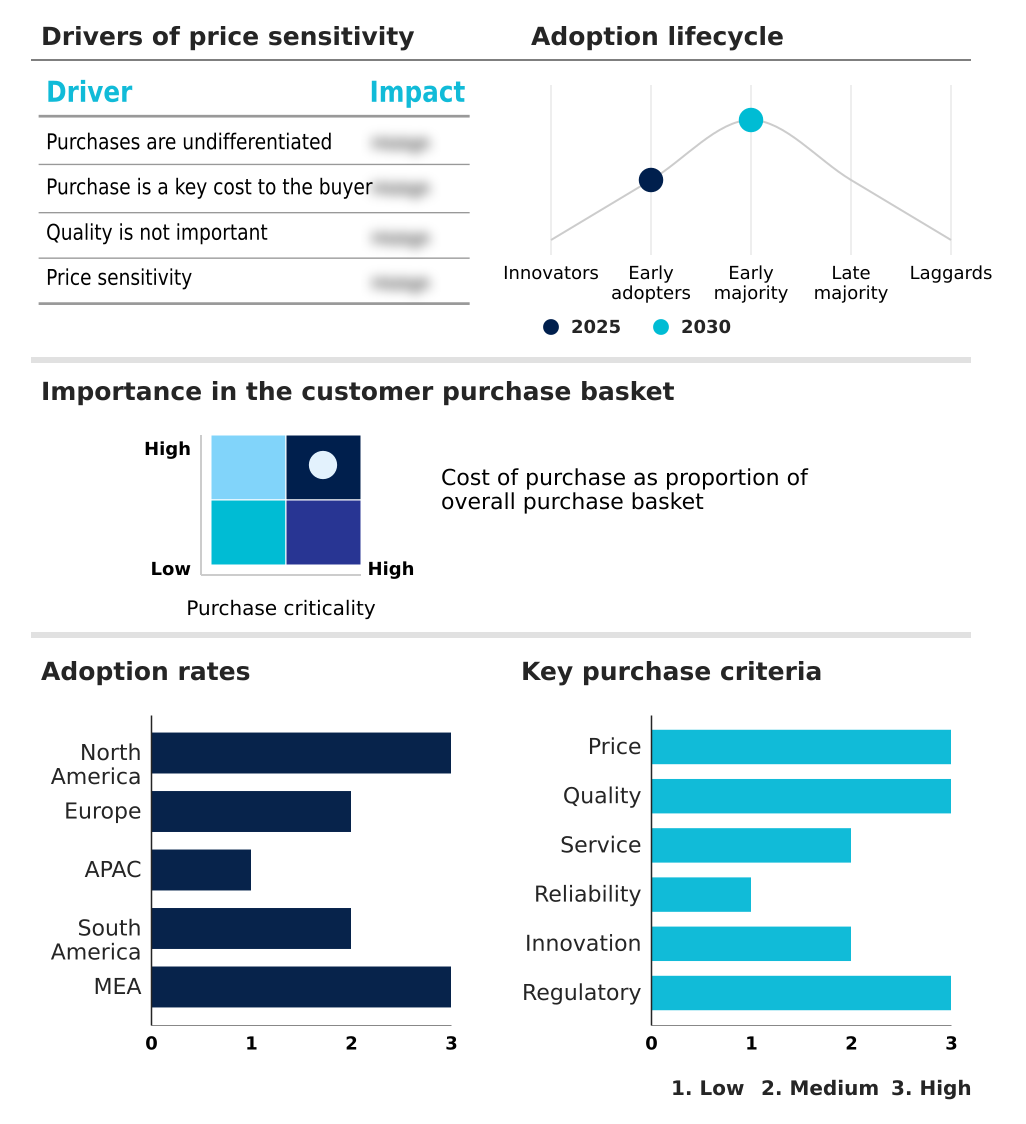
The home fitness equipment market forecasting report includes the adoption lifecycle of the market, covering from the innovator’s stage to the laggard’s stage. It focuses on adoption rates in different regions based on penetration. Furthermore, the home fitness equipment market report also includes key purchase criteria and drivers of price sensitivity to help companies evaluate and develop their market growth analysis strategies.
Customer Landscape of Home Fitness Equipment Industry
Competitive Landscape
Companies are implementing various strategies, such as strategic alliances, home fitness equipment market forecast, partnerships, mergers and acquisitions, geographical expansion, and product/service launches, to enhance their presence in the industry.
Body Solid Inc. - Key offerings focus on integrated connected cardio and strength training equipment, delivering comprehensive smart fitness solutions for both home and commercial use.
The industry research and growth report includes detailed analyses of the competitive landscape of the market and information about key companies, including:
- Body Solid Inc.
- Concept2 Inc.
- Core Health and Fitness LLC
- Decathlon SA
- Dyaco International Inc.
- Echelon Fitness Multimedia LLC
- Hoist Fitness Systems Inc.
- iFIT Health and Fitness Inc.
- Johnson Health Tech Co. Ltd.
- Life Fitness
- Nautilus Inc.
- Peloton Interactive Inc.
- Precor Inc.
- Technogym S.p.A.
- Torque Fitness
- True Fitness Technology Inc.
- Tunturi New Fitness B.V.
- WaterRower Inc.
Qualitative and quantitative analysis of companies has been conducted to help clients understand the wider business environment as well as the strengths and weaknesses of key industry players. Data is qualitatively analyzed to categorize companies as pure play, category-focused, industry-focused, and diversified; it is quantitatively analyzed to categorize companies as dominant, leading, strong, tentative, and weak.
Recent Development and News in Home fitness equipment market
- In October, 2024, iFIT unveiled the NordicTrack Ultra 1, a premium treadmill featuring bespoke furniture-inspired design with white oak and refined metal finishes, targeting the luxury home market.
- In November, 2024, Technogym announced its strategic focus for 2025, highlighting the launch of the Technogym Reform, a Pilates-based system designed for automated, goal-based core strength training at home.
- In January, 2025, Tonal announced the global release of Tonal 2, its wall-mounted strength system with enhanced AI, including a 'smart view' camera for real-time form correction and increased digital resistance.
- In March, 2025, Peloton Interactive Inc. announced the launch of its Peloton Commercial Series, integrating its digital interface with industrial-grade Precor hardware to bridge home and commercial fitness experiences.
Dive into Technavio’s robust research methodology, blending expert interviews, extensive data synthesis, and validated models for unparalleled Home Fitness Equipment Market insights. See full methodology.
| Market Scope | |
|---|---|
| Page number | 290 |
| Base year | 2025 |
| Historic period | 2020-2024 |
| Forecast period | 2026-2030 |
| Growth momentum & CAGR | Accelerate at a CAGR of 10.1% |
| Market growth 2026-2030 | USD 4526.8 million |
| Market structure | Fragmented |
| YoY growth 2025-2026(%) | 9.3% |
| Key countries | US, Canada, Mexico, Germany, UK, France, Italy, Spain, The Netherlands, China, Japan, India, South Korea, Australia, Indonesia, Brazil, Argentina, Chile, South Africa, Turkey, Saudi Arabia, UAE and Israel |
| Competitive landscape | Leading Companies, Market Positioning of Companies, Competitive Strategies, and Industry Risks |
Research Analyst Overview
- The home fitness equipment market is rapidly evolving from a hardware-centric industry to one defined by integrated, intelligent platforms. Central to this shift is the deployment of artificial intelligence coaching and machine learning algorithms, which enable hyper-personalized workouts through real-time biometric tracking.
- This technological fusion is evident in advanced digital resistance systems and computer vision form correction, powered by smart sensor integration. For boardroom consideration, the pivot to subscription-based content models and on-demand workout libraries introduces recurring revenue streams but also necessitates significant investment in software-defined fitness hardware and immersive virtual environments.
- This transition has been so effective that platforms incorporating gamified fitness experiences have seen user engagement metrics improve by up to 30% over their non-interactive counterparts. The challenge lies in managing post-pandemic demand normalization and supply chain volatility for advanced semiconductors.
- Success now requires a holistic strategy encompassing preventive healthcare integration, compact foldable designs for urban consumers, and a seamless omnichannel fitness experience that supports the entire wellness journey, including mental health and recovery modules.
What are the Key Data Covered in this Home Fitness Equipment Market Research and Growth Report?
-
What is the expected growth of the Home Fitness Equipment Market between 2026 and 2030?
-
USD 4.53 billion, at a CAGR of 10.1%
-
-
What segmentation does the market report cover?
-
The report is segmented by Distribution Channel (Offline, and Online), Type (Cardiovascular training equipment, and Strength training equipment), Age Group (Adults, Children and adolescents, and Elderly) and Geography (North America, Europe, APAC, South America, Middle East and Africa)
-
-
Which regions are analyzed in the report?
-
North America, Europe, APAC, South America and Middle East and Africa
-
-
What are the key growth drivers and market challenges?
-
Proliferation of AI and real-time biometric personalization , Market saturation and post-pandemic normalization of demand
-
-
Who are the major players in the Home Fitness Equipment Market?
-
Body Solid Inc., Concept2 Inc., Core Health and Fitness LLC, Decathlon SA, Dyaco International Inc., Echelon Fitness Multimedia LLC, Hoist Fitness Systems Inc., iFIT Health and Fitness Inc., Johnson Health Tech Co. Ltd., Life Fitness, Nautilus Inc., Peloton Interactive Inc., Precor Inc., Technogym S.p.A., Torque Fitness, True Fitness Technology Inc., Tunturi New Fitness B.V. and WaterRower Inc.
-
Market Research Insights
- Market dynamics are shaped by the strategic shift toward data-driven user engagement and holistic health management. The adoption of adaptive resistance programming has led to a 25% increase in average user session duration, indicating a move toward more effective and personalized at-home physical rehabilitation.
- Furthermore, platforms offering comprehensive healthy longevity solutions report customer retention rates that are 40% higher than hardware-only competitors, underscoring the value of integrated digital coaching experiences. This transition to goal-based cardio and strength training is critical for proactive health management.
- As the decentralization of fitness services continues, the ability to provide automated circuit training and foster social community engagement becomes a key differentiator, influencing long-term profitability and market positioning in an increasingly competitive environment.
We can help! Our analysts can customize this home fitness equipment market research report to meet your requirements.
 RIA -
RIA -