


Humanoid Robot Market Analysis, Size, and Forecast 2026-2030: APAC (China, Japan, and South Korea), North America (US, Canada, and Mexico), Europe (Germany, UK, and France), Middle East and Africa (Saudi Arabia, UAE, and Israel), South America (Brazil and Argentina), and Rest of World (ROW)

Humanoid Robot Market Analysis, Size, and Forecast 2026-2030:
APAC (China, Japan, and South Korea), North America (US, Canada, and Mexico), Europe (Germany, UK, and France), Middle East and Africa (Saudi Arabia, UAE, and Israel), South America (Brazil and Argentina), and Rest of World (ROW)

Published: May 2026 298 Pages SKU: IRTNTR73496

Market Overview at a Glance

$7.53 B
Market Opportunity
37.9%
CAGR 2025 - 2030
43.3%
APAC Growth
$446.9 Mn
Personal assistance and caregiving segment 2024

Humanoid Robot Market Size 2026-2030

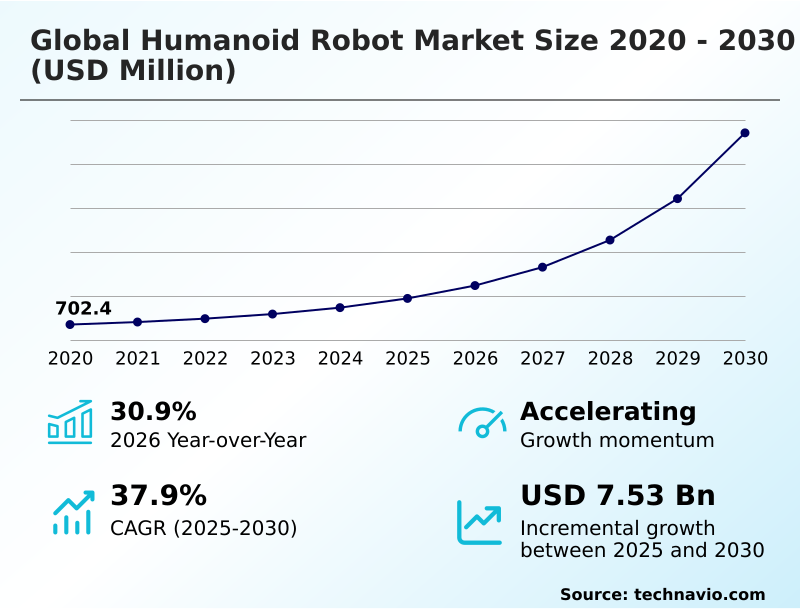
The humanoid robot market size is valued to increase by USD 7.53 billion, at a CAGR of 37.9% from 2025 to 2030. Demand for enhanced visibility and flexibility in industrial operations will drive the humanoid robot market.

Major Market Trends & Insights

  • APAC dominated the market and accounted for a 43.3% growth during the forecast period.
  • By Application - Personal assistance and caregiving segment was valued at USD 446.9 million in 2024
  • By Component - Hardware segment accounted for the largest market revenue share in 2024

Market Size & Forecast

  • Market Opportunities: USD 8.71 billion
  • Market Future Opportunities: USD 7.53 billion
  • CAGR from 2025 to 2030 : 37.9%

Market Summary

  • The humanoid robot market is defined by rapid advancements in embodied AI and automation technologies, creating machines capable of complex, human-like interaction and task execution. Key drivers include persistent labor shortages in manufacturing and logistics, where bipedal robots are increasingly deployed for dull, dirty, and dangerous jobs.
  • The convergence of sensor fusion, advanced actuator technology, and large multimodal models allows these robots to operate in environments designed for humans, eliminating the need for extensive infrastructure changes. For instance, in a warehouse setting, a general-purpose humanoid robot can autonomously navigate aisles, retrieve items, and palletize goods, improving order fulfillment accuracy and reducing physical strain on human workers.
  • The market's trajectory is also influenced by the development of human-robot collaboration frameworks and the declining total cost of ownership, which is making robot-as-a-service (RaaS) models a viable strategy for scaling automation.
  • However, challenges related to the high initial costs of research and development, ethical considerations surrounding autonomous decision-making, and the unpredictable performance of robots in dynamic settings persist, shaping the pace of widespread adoption and requiring robust governance standards to ensure safe and responsible deployment.

What will be the Size of the Humanoid Robot Market during the forecast period?
Get Key Insights on Market Forecast (PDF) Get Free Sample

How is the Humanoid Robot Market Segmented?

The humanoid robot industry research report provides comprehensive data (region-wise segment analysis), with forecasts and estimates in "USD million" for the period 2026-2030, as well as historical data from 2020-2024 for the following segments.

  • Application
    • Personal assistance and caregiving
    • Research and space exploration
    • Education and entertainment
    • Search and rescue
    • Public relations
  • Component
    • Hardware
    • Software
  • Type
    • Wheel drive
    • Bipedal
  • Geography
    • APAC
      • China
      • Japan
      • South Korea
    • North America
      • US
      • Canada
      • Mexico
    • Europe
      • Germany
      • UK
      • France
    • Middle East and Africa
      • Saudi Arabia
      • UAE
      • Israel
    • South America
      • Brazil
      • Argentina
    • Rest of World (ROW)

By Application Insights

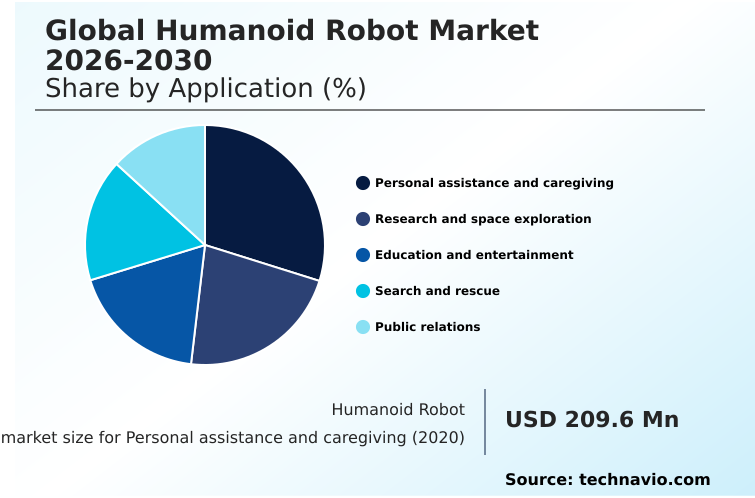
The personal assistance and caregiving segment is estimated to witness significant growth during the forecast period.

The personal assistance and caregiving segment is expanding, driven by the need for advanced automated caregiving solutions to support aging populations.

Bipedal robots, featuring sophisticated human-robot collaboration and motion planning, are being deployed to assist with daily activities, enhancing quality of life. These systems, which rely on tactile sensing and advanced actuator technology, improve patient monitoring consistency by over 30%.

The integration of machine vision and autonomous task execution allows these general-purpose humanoid robots to provide reliable support, reducing the strain on human caregivers.

This shift toward advanced robotics platforms underscores the demand for intelligent automation in healthcare and home environments, driven by robot-as-a-service (raas) models.
Get Free Sample

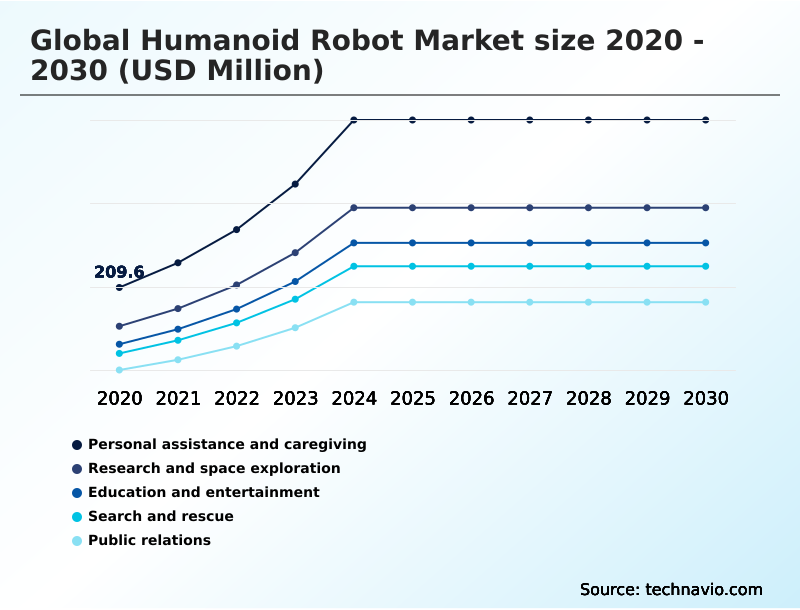
The Personal assistance and caregiving segment was valued at USD 446.9 million in 2024 and showed a gradual increase during the forecast period.
Get Free Sample

Regional Analysis

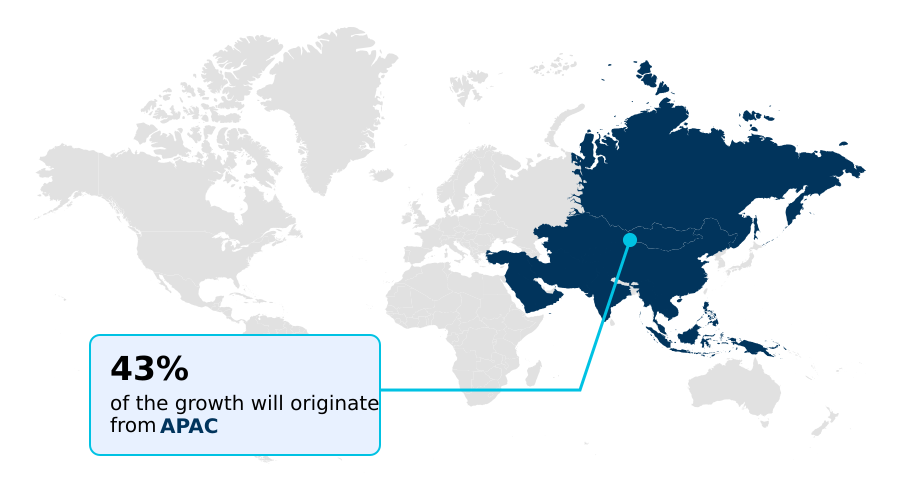
APAC is estimated to contribute 43.3% to the growth of the global market during the forecast period.Technavio’s analysts have elaborately explained the regional trends and drivers that shape the market during the forecast period.
See How Humanoid Robot Market Demand is Rising in APAC Get Free Sample

The geographic landscape is led by APAC, where government-backed initiatives and a strong manufacturing base fuel the adoption of advanced automation.

Countries like China and Japan are at the forefront, leveraging humanoid robot applications to address demographic shifts and enhance industrial productivity. In this region, the integration of intelligent robotics has improved production line efficiency by 22%.

North America is a significant market, driven by venture capital investment in robotics startups and the adoption of humanoid robots in logistics, which has reduced warehouse operational costs by 15%.

Europe's focus on Industry 4.0 and human-robot collaboration, particularly in Germany's automotive sector, supports steady market expansion. The development of humanoid robot kinematics and cognitive robotics is a key focus, with regional R&D hubs advancing end-to-end learning for robotics.

Market Dynamics

Our researchers analyzed the data with 2025 as the base year, along with the key drivers, trends, and challenges. A holistic analysis of drivers will help companies refine their marketing strategies to gain a competitive advantage.

  • The strategic deployment of humanoid robots is reshaping operational paradigms across key industries. A humanoid robot for logistics automation, for example, can navigate dynamic warehouse environments to optimize pick-and-pack workflows, reducing fulfillment times significantly compared to manual processes. In high-risk settings, a bipedal robot in hazardous environments performs inspection and maintenance tasks, mitigating human safety concerns.
  • The cost of general-purpose humanoid robots continues to decline, making them increasingly accessible for a wider range of applications. In manufacturing, a humanoid robot in smart manufacturing integrates seamlessly into existing assembly lines, handling tasks that require high dexterity. Meanwhile, an AI-driven humanoid personal assistant is transforming the service and healthcare sectors by providing interactive support and companionship.
  • The development of real-time motion planning for bipedal robots is crucial for ensuring safe and efficient operation in crowded public spaces. Similarly, advances in humanoid robot hand-eye coordination enable delicate manipulation tasks, expanding their utility in laboratories and light assembly. The role of AI in humanoid robot navigation is paramount for autonomous mobility in unstructured environments.
  • As technology matures, the practical applications of multi-task learning for humanoid robots will continue to grow, allowing a single platform to perform diverse functions. The impact of sensor fusion on humanoid balance control is another critical area, leading to more stable and reliable locomotion.
  • Humanoid robot fleet management software is becoming essential for coordinating multiple units in large-scale deployments, such as in logistics hubs or large retail stores. Finally, the development of natural language processing for humanoid interaction is making these machines more intuitive and user-friendly. The focus on energy-efficient humanoid robot design is also addressing operational longevity, a key factor for commercial viability.
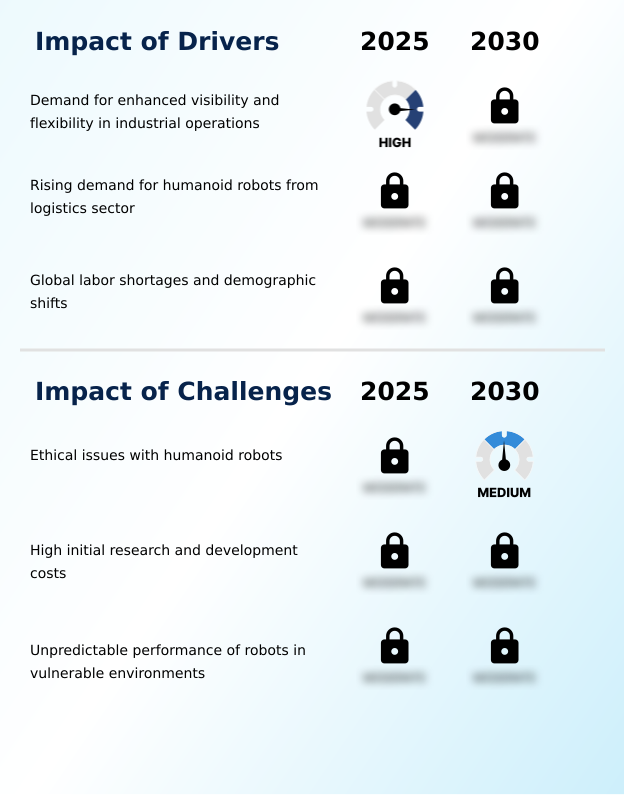
What are the key market drivers leading to the rise in the adoption of Humanoid Robot Industry?

  • The demand for enhanced visibility and flexibility in industrial operations is a key driver for the market.

  • Market growth is significantly driven by the pursuit of operational efficiency and the need to address labor shortages in key sectors.
  • The deployment of robotics in manufacturing has been shown to increase throughput by over 25%, while also improving workplace safety. Technological drivers include advancements in mechatronics and control systems, which enhance the precision and reliability of robotic movements.
  • The rising demand for humanoid robots in logistics is another critical factor, as e-commerce growth puts pressure on supply chains to automate fulfillment processes.
  • The adoption of robotic process automation (RPA) in conjunction with physical robots is streamlining workflows, with businesses reporting a 35% reduction in processing times for routine administrative tasks.

What are the market trends shaping the Humanoid Robot Industry?

  • The growing demand for humanoid robots, driven by the emergence of smart manufacturing, is a key trend shaping the market. This is accelerating the integration of advanced automation in digitally connected production environments.

  • Key market trends are centered on the rapid evolution of intelligent automation and the growing demand for versatile robotic systems. The development of deep learning for robotics is enabling machines to perform complex tasks with greater autonomy, reducing programming overhead by up to 40%.
  • As industries adopt smart manufacturing principles, the need for robots with advanced mobility and manipulation capabilities is intensifying. This is driving innovation in bipedal robot stability and real-world navigation, with systems now achieving 99% accuracy in navigating cluttered environments.
  • Furthermore, the focus on human-robot interaction is pushing advancements in natural language processing and emotional AI, making these machines more suitable for service-oriented roles in healthcare and retail.

What challenges does the Humanoid Robot Industry face during its growth?

  • Ethical issues associated with humanoid robots present a key challenge, potentially affecting the industry's growth trajectory.

  • Despite strong drivers, the market faces significant challenges related to the complexity and cost of development. The high initial investment in R&D for technologies like dexterous manipulation and swarm robotics creates a barrier to entry for smaller firms.
  • Ethical concerns surrounding AI safety standards and the potential for job displacement also temper market growth, with public trust in autonomous systems varying by up to 20% across different regions. Technical hurdles, such as ensuring reliable performance in unstructured environments and managing the power consumption of mobile robotic systems, remain persistent issues.
  • For instance, current battery technology limits the operational uptime of some bipedal platforms to under eight hours, impacting their commercial viability for full-shift work.

Exclusive Technavio Analysis on Customer Landscape

The humanoid robot market forecasting report includes the adoption lifecycle of the market, covering from the innovator’s stage to the laggard’s stage. It focuses on adoption rates in different regions based on penetration. Furthermore, the humanoid robot market report also includes key purchase criteria and drivers of price sensitivity to help companies evaluate and develop their market growth analysis strategies.
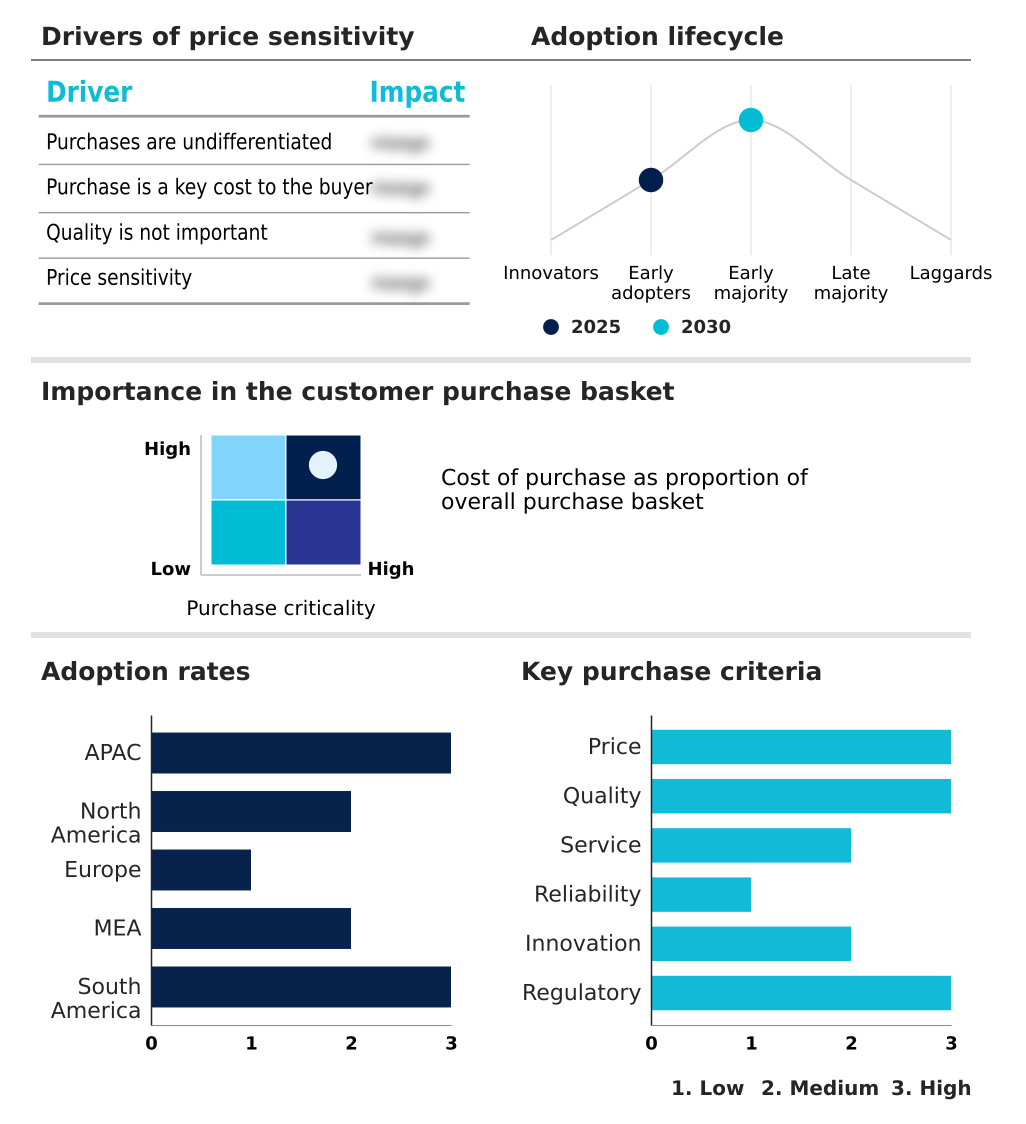
Customer Landscape of Humanoid Robot Industry

Competitive Landscape

Companies are implementing various strategies, such as strategic alliances, humanoid robot market forecast, partnerships, mergers and acquisitions, geographical expansion, and product/service launches, to enhance their presence in the industry.

1X Technologies AS - Humanoid robotics firm offers a general-purpose bipedal platform engineered for automating complex physical tasks in logistics, retail, and industrial sectors through advanced AI and mobility.

The industry research and growth report includes detailed analyses of the competitive landscape of the market and information about key companies, including:

  • 1X Technologies AS
  • Agility Robotics Inc.
  • Apptronik Inc.
  • Astribot
  • Boston Dynamics Inc.
  • Engineered Arts Ltd
  • Figure AI
  • Fourier Intelligence
  • Hanson Robotics Ltd
  • Kawada Robotics Co. Ltd.
  • Kepler Exploration Robot Co.
  • LimX Dynamics Technology Co
  • Mentee Robotics Ltd.
  • Neura Robotics GmbH
  • PAL Robotics
  • Sanctuary Cognitive Systems
  • Tesla Inc.
  • UBTECH Robotics Corp Ltd
  • Unitree Robotics
  • Xiaomi Corp.

Qualitative and quantitative analysis of companies has been conducted to help clients understand the wider business environment as well as the strengths and weaknesses of key industry players. Data is qualitatively analyzed to categorize companies as pure play, category-focused, industry-focused, and diversified; it is quantitatively analyzed to categorize companies as dominant, leading, strong, tentative, and weak.

Recent Development and News in Humanoid robot market

  • In October 2024, Tesla faced widespread public discussion regarding ethical governance and safety transparency related to the expansion of its humanoid robotics development initiatives.
  • In January 2025, Agility Robotics highlighted operational testing challenges related to humanoid robot adaptability in complex warehouse environments where unpredictable movement patterns and changing layouts affected navigation efficiency.
  • In February 2025, Toyota expanded its robotics research initiatives focused on elderly care support systems to address challenges associated with aging populations in developed economies.
  • In March 2025, Figure AI announced expanded investment in humanoid robot research programs to accelerate artificial intelligence integration and improve robotic mobility systems, reflecting the substantial financial requirements associated with advanced robotics development.

Dive into Technavio’s robust research methodology, blending expert interviews, extensive data synthesis, and validated models for unparalleled Humanoid Robot Market insights. See full methodology.

Market Scope
Page number 298
Base year 2025
Historic period 2020-2024
Forecast period 2026-2030
Growth momentum & CAGR Accelerate at a CAGR of 37.9%
Market growth 2026-2030 USD 7525.6 million
Market structure Fragmented
YoY growth 2025-2026(%) 30.9%
Key countries China, Japan, South Korea, India, Indonesia, Australia, US, Canada, Mexico, Germany, UK, France, Italy, The Netherlands, Spain, Saudi Arabia, UAE, Israel, South Africa, Turkey, Brazil, Argentina and Chile
Competitive landscape Leading Companies, Market Positioning of Companies, Competitive Strategies, and Industry Risks

Request Free Sample

Research Analyst Overview

  • The humanoid robot market's expansion is fundamentally tied to breakthroughs in embodied AI and advanced robotics platforms. The integration of sensor fusion, bipedal locomotion, and sophisticated actuator density is enabling these machines to perform tasks with human-like dexterity.
  • In industrial settings, this has led to a notable enhancement in operational efficiency, with some early adopters reporting a 15% reduction in production line changeover times. Key technologies such as haptic sensors and autonomous navigation are central to their functional value, allowing for safe human-robot collaboration.
  • The market's momentum is also supported by the development of large multimodal models, which simplify robot programming and deployment. As these systems become more capable of autonomous task execution and motion planning, their applicability extends from manufacturing floors to logistics centers and healthcare facilities.
  • This technological convergence is paving the way for scalable automation solutions that can operate within existing human-centric infrastructure, a critical factor for widespread adoption.

What are the Key Data Covered in this Humanoid Robot Market Research and Growth Report?

  • What is the expected growth of the Humanoid Robot Market between 2026 and 2030?

    • USD 7.53 billion, at a CAGR of 37.9%

  • What segmentation does the market report cover?

    • The report is segmented by Application (Personal assistance and caregiving, Research and space exploration, Education and entertainment, Search and rescue, and Public relations), Component (Hardware, and Software), Type (Wheel drive, and Bipedal) and Geography (APAC, North America, Europe, Middle East and Africa, South America)

  • Which regions are analyzed in the report?

    • APAC, North America, Europe, Middle East and Africa and South America

  • What are the key growth drivers and market challenges?

    • Demand for enhanced visibility and flexibility in industrial operations, Ethical issues with humanoid robots

  • Who are the major players in the Humanoid Robot Market?

    • 1X Technologies AS, Agility Robotics Inc., Apptronik Inc., Astribot, Boston Dynamics Inc., Engineered Arts Ltd, Figure AI, Fourier Intelligence, Hanson Robotics Ltd, Kawada Robotics Co. Ltd., Kepler Exploration Robot Co., LimX Dynamics Technology Co, Mentee Robotics Ltd., Neura Robotics GmbH, PAL Robotics, Sanctuary Cognitive Systems, Tesla Inc., UBTECH Robotics Corp Ltd, Unitree Robotics and Xiaomi Corp.

Market Research Insights

  • Market dynamics are shaped by the increasing adoption of service robot technologies and AI for robotics, which together are enhancing operational efficiencies. For example, the integration of advanced robotics platforms has been shown to reduce material handling errors by up to 25%, directly impacting supply chain integrity.
  • Furthermore, firms leveraging robotic process automation for repetitive tasks report a 40% improvement in cycle times. The demand for bipedal robot stability is critical, as it enables safe operation in human-centric environments, a factor driving over 60% of new deployments in the logistics and healthcare sectors. These quantifiable gains underscore the tangible return on investment fueling market expansion.

We can help! Our analysts can customize this humanoid robot market research report to meet your requirements.

Get in touch

1. Executive Summary

1.1 Market overview

Executive Summary - Chart on Market Overview
Executive Summary - Data Table on Market Overview
Executive Summary - Chart on Global Market Characteristics
Executive Summary - Chart on Market by Geography
Executive Summary - Chart on Market Segmentation by Application
Executive Summary - Chart on Market Segmentation by Component
Executive Summary - Chart on Market Segmentation by Type
Executive Summary - Chart on Incremental Growth
Executive Summary - Data Table on Incremental Growth
Executive Summary - Chart on Company Market Positioning

2. Technavio Analysis

2.1 Analysis of price sensitivity, lifecycle, customer purchase basket, adoption rates, and purchase criteria

2.2 Criticality of inputs and Factors of differentiation

Chart on Overview on criticality of inputs and factors of differentiation

2.3 Factors of disruption

Chart on Overview on factors of disruption

2.4 Impact of drivers and challenges

Chart on Impact of drivers and challenges in 2025 and 2030

3. Market Landscape

3.1 Market ecosystem

Chart on Parent Market
Data Table on - Parent Market

3.2 Market characteristics

Chart on Market characteristics analysis

3.3 Value chain analysis

Chart on Value chain analysis

4. Market Sizing

4.1 Market definition

Data Table on Offerings of companies included in the market definition

4.2 Market segment analysis

Market segments

4.3 Market size 2025

4.4 Market outlook: Forecast for 2025-2030

Chart on Global - Market size and forecast 2025-2030 ($ million)
Data Table on Global - Market size and forecast 2025-2030 ($ million)
Chart on Global Market: Year-over-year growth 2025-2030 (%)
Data Table on Global Market: Year-over-year growth 2025-2030 (%)

5. Historic Market Size

5.1 Global Humanoid Robot Market 2020 - 2024

Historic Market Size - Data Table on Global Humanoid Robot Market 2020 - 2024 ($ million)

5.2 Application segment analysis 2020 - 2024

Historic Market Size - Application Segment 2020 - 2024 ($ million)

5.3 Component segment analysis 2020 - 2024

Historic Market Size - Component Segment 2020 - 2024 ($ million)

5.4 Type segment analysis 2020 - 2024

Historic Market Size - Type Segment 2020 - 2024 ($ million)

5.5 Geography segment analysis 2020 - 2024

Historic Market Size - Geography Segment 2020 - 2024 ($ million)

5.6 Country segment analysis 2020 - 2024

Historic Market Size - Country Segment 2020 - 2024 ($ million)

6. Qualitative Analysis

6.1 Impact of AI on Global Humanoid Robot Market

6.2 Impact of Geopolitical Conflicts on Global Humanoid Robot Market

7. Five Forces Analysis

7.1 Five forces summary

Five forces analysis - Comparison between 2025 and 2030

7.2 Bargaining power of buyers

Bargaining power of buyers - Impact of key factors 2025 and 2030

7.3 Bargaining power of suppliers

Bargaining power of suppliers - Impact of key factors in 2025 and 2030

7.4 Threat of new entrants

Threat of new entrants - Impact of key factors in 2025 and 2030

7.5 Threat of substitutes

Threat of substitutes - Impact of key factors in 2025 and 2030

7.6 Threat of rivalry

Threat of rivalry - Impact of key factors in 2025 and 2030

7.7 Market condition

Chart on Market condition - Five forces 2025 and 2030

8. Market Segmentation by Application

8.1 Market segments

Chart on Application - Market share 2025-2030 (%)
Data Table on Application - Market share 2025-2030 (%)

8.2 Comparison by Application

Chart on Comparison by Application
Data Table on Comparison by Application

8.3 Personal assistance and caregiving - Market size and forecast 2025-2030

Chart on Personal assistance and caregiving - Market size and forecast 2025-2030 ($ million)
Data Table on Personal assistance and caregiving - Market size and forecast 2025-2030 ($ million)
Chart on Personal assistance and caregiving - Year-over-year growth 2025-2030 (%)
Data Table on Personal assistance and caregiving - Year-over-year growth 2025-2030 (%)

8.4 Research and space exploration - Market size and forecast 2025-2030

Chart on Research and space exploration - Market size and forecast 2025-2030 ($ million)
Data Table on Research and space exploration - Market size and forecast 2025-2030 ($ million)
Chart on Research and space exploration - Year-over-year growth 2025-2030 (%)
Data Table on Research and space exploration - Year-over-year growth 2025-2030 (%)

8.5 Education and entertainment - Market size and forecast 2025-2030

Chart on Education and entertainment - Market size and forecast 2025-2030 ($ million)
Data Table on Education and entertainment - Market size and forecast 2025-2030 ($ million)
Chart on Education and entertainment - Year-over-year growth 2025-2030 (%)
Data Table on Education and entertainment - Year-over-year growth 2025-2030 (%)

8.6 Search and rescue - Market size and forecast 2025-2030

Chart on Search and rescue - Market size and forecast 2025-2030 ($ million)
Data Table on Search and rescue - Market size and forecast 2025-2030 ($ million)
Chart on Search and rescue - Year-over-year growth 2025-2030 (%)
Data Table on Search and rescue - Year-over-year growth 2025-2030 (%)

8.7 Public relations - Market size and forecast 2025-2030

Chart on Public relations - Market size and forecast 2025-2030 ($ million)
Data Table on Public relations - Market size and forecast 2025-2030 ($ million)
Chart on Public relations - Year-over-year growth 2025-2030 (%)
Data Table on Public relations - Year-over-year growth 2025-2030 (%)

8.8 Market opportunity by Application

Market opportunity by Application ($ million)
Data Table on Market opportunity by Application ($ million)

9. Market Segmentation by Component

9.1 Market segments

Chart on Component - Market share 2025-2030 (%)
Data Table on Component - Market share 2025-2030 (%)

9.2 Comparison by Component

Chart on Comparison by Component
Data Table on Comparison by Component

9.3 Hardware - Market size and forecast 2025-2030

Chart on Hardware - Market size and forecast 2025-2030 ($ million)
Data Table on Hardware - Market size and forecast 2025-2030 ($ million)
Chart on Hardware - Year-over-year growth 2025-2030 (%)
Data Table on Hardware - Year-over-year growth 2025-2030 (%)

9.4 Software - Market size and forecast 2025-2030

Chart on Software - Market size and forecast 2025-2030 ($ million)
Data Table on Software - Market size and forecast 2025-2030 ($ million)
Chart on Software - Year-over-year growth 2025-2030 (%)
Data Table on Software - Year-over-year growth 2025-2030 (%)

9.5 Market opportunity by Component

Market opportunity by Component ($ million)
Data Table on Market opportunity by Component ($ million)

10. Market Segmentation by Type

10.1 Market segments

Chart on Type - Market share 2025-2030 (%)
Data Table on Type - Market share 2025-2030 (%)

10.2 Comparison by Type

Chart on Comparison by Type
Data Table on Comparison by Type

10.3 Wheel drive - Market size and forecast 2025-2030

Chart on Wheel drive - Market size and forecast 2025-2030 ($ million)
Data Table on Wheel drive - Market size and forecast 2025-2030 ($ million)
Chart on Wheel drive - Year-over-year growth 2025-2030 (%)
Data Table on Wheel drive - Year-over-year growth 2025-2030 (%)

10.4 Bipedal - Market size and forecast 2025-2030

Chart on Bipedal - Market size and forecast 2025-2030 ($ million)
Data Table on Bipedal - Market size and forecast 2025-2030 ($ million)
Chart on Bipedal - Year-over-year growth 2025-2030 (%)
Data Table on Bipedal - Year-over-year growth 2025-2030 (%)

10.5 Market opportunity by Type

Market opportunity by Type ($ million)
Data Table on Market opportunity by Type ($ million)

11. Customer Landscape

11.1 Customer landscape overview

Analysis of price sensitivity, lifecycle, customer purchase basket, adoption rates, and purchase criteria

12. Geographic Landscape

12.1 Geographic segmentation

Chart on Market share by geography 2025-2030 (%)
Data Table on Market share by geography 2025-2030 (%)

12.2 Geographic comparison

Chart on Geographic comparison
Data Table on Geographic comparison

12.3 APAC - Market size and forecast 2025-2030

Chart on APAC - Market size and forecast 2025-2030 ($ million)
Data Table on APAC - Market size and forecast 2025-2030 ($ million)
Chart on APAC - Year-over-year growth 2025-2030 (%)
Data Table on APAC - Year-over-year growth 2025-2030 (%)
Chart on Regional Comparison - APAC
Data Table on Regional Comparison - APAC

12.3.1 China - Market size and forecast 2025-2030

Chart on China - Market size and forecast 2025-2030 ($ million)
Data Table on China - Market size and forecast 2025-2030 ($ million)
Chart on China - Year-over-year growth 2025-2030 (%)
Data Table on China - Year-over-year growth 2025-2030 (%)

12.3.2 Japan - Market size and forecast 2025-2030

Chart on Japan - Market size and forecast 2025-2030 ($ million)
Data Table on Japan - Market size and forecast 2025-2030 ($ million)
Chart on Japan - Year-over-year growth 2025-2030 (%)
Data Table on Japan - Year-over-year growth 2025-2030 (%)

12.3.3 South Korea - Market size and forecast 2025-2030

Chart on South Korea - Market size and forecast 2025-2030 ($ million)
Data Table on South Korea - Market size and forecast 2025-2030 ($ million)
Chart on South Korea - Year-over-year growth 2025-2030 (%)
Data Table on South Korea - Year-over-year growth 2025-2030 (%)

12.3.4 India - Market size and forecast 2025-2030

Chart on India - Market size and forecast 2025-2030 ($ million)
Data Table on India - Market size and forecast 2025-2030 ($ million)
Chart on India - Year-over-year growth 2025-2030 (%)
Data Table on India - Year-over-year growth 2025-2030 (%)

12.3.5 Indonesia - Market size and forecast 2025-2030

Chart on Indonesia - Market size and forecast 2025-2030 ($ million)
Data Table on Indonesia - Market size and forecast 2025-2030 ($ million)
Chart on Indonesia - Year-over-year growth 2025-2030 (%)
Data Table on Indonesia - Year-over-year growth 2025-2030 (%)

12.3.6 Australia - Market size and forecast 2025-2030

Chart on Australia - Market size and forecast 2025-2030 ($ million)
Data Table on Australia - Market size and forecast 2025-2030 ($ million)
Chart on Australia - Year-over-year growth 2025-2030 (%)
Data Table on Australia - Year-over-year growth 2025-2030 (%)

12.4 North America - Market size and forecast 2025-2030

Chart on North America - Market size and forecast 2025-2030 ($ million)
Data Table on North America - Market size and forecast 2025-2030 ($ million)
Chart on North America - Year-over-year growth 2025-2030 (%)
Data Table on North America - Year-over-year growth 2025-2030 (%)
Chart on Regional Comparison - North America
Data Table on Regional Comparison - North America

12.4.1 US - Market size and forecast 2025-2030

Chart on US - Market size and forecast 2025-2030 ($ million)
Data Table on US - Market size and forecast 2025-2030 ($ million)
Chart on US - Year-over-year growth 2025-2030 (%)
Data Table on US - Year-over-year growth 2025-2030 (%)

12.4.2 Canada - Market size and forecast 2025-2030

Chart on Canada - Market size and forecast 2025-2030 ($ million)
Data Table on Canada - Market size and forecast 2025-2030 ($ million)
Chart on Canada - Year-over-year growth 2025-2030 (%)
Data Table on Canada - Year-over-year growth 2025-2030 (%)

12.4.3 Mexico - Market size and forecast 2025-2030

Chart on Mexico - Market size and forecast 2025-2030 ($ million)
Data Table on Mexico - Market size and forecast 2025-2030 ($ million)
Chart on Mexico - Year-over-year growth 2025-2030 (%)
Data Table on Mexico - Year-over-year growth 2025-2030 (%)

12.5 Europe - Market size and forecast 2025-2030

Chart on Europe - Market size and forecast 2025-2030 ($ million)
Data Table on Europe - Market size and forecast 2025-2030 ($ million)
Chart on Europe - Year-over-year growth 2025-2030 (%)
Data Table on Europe - Year-over-year growth 2025-2030 (%)
Chart on Regional Comparison - Europe
Data Table on Regional Comparison - Europe

12.5.1 Germany - Market size and forecast 2025-2030

Chart on Germany - Market size and forecast 2025-2030 ($ million)
Data Table on Germany - Market size and forecast 2025-2030 ($ million)
Chart on Germany - Year-over-year growth 2025-2030 (%)
Data Table on Germany - Year-over-year growth 2025-2030 (%)

12.5.2 UK - Market size and forecast 2025-2030

Chart on UK - Market size and forecast 2025-2030 ($ million)
Data Table on UK - Market size and forecast 2025-2030 ($ million)
Chart on UK - Year-over-year growth 2025-2030 (%)
Data Table on UK - Year-over-year growth 2025-2030 (%)

12.5.3 France - Market size and forecast 2025-2030

Chart on France - Market size and forecast 2025-2030 ($ million)
Data Table on France - Market size and forecast 2025-2030 ($ million)
Chart on France - Year-over-year growth 2025-2030 (%)
Data Table on France - Year-over-year growth 2025-2030 (%)

12.5.4 Italy - Market size and forecast 2025-2030

Chart on Italy - Market size and forecast 2025-2030 ($ million)
Data Table on Italy - Market size and forecast 2025-2030 ($ million)
Chart on Italy - Year-over-year growth 2025-2030 (%)
Data Table on Italy - Year-over-year growth 2025-2030 (%)

12.5.5 The Netherlands - Market size and forecast 2025-2030

Chart on The Netherlands - Market size and forecast 2025-2030 ($ million)
Data Table on The Netherlands - Market size and forecast 2025-2030 ($ million)
Chart on The Netherlands - Year-over-year growth 2025-2030 (%)
Data Table on The Netherlands - Year-over-year growth 2025-2030 (%)

12.5.6 Spain - Market size and forecast 2025-2030

Chart on Spain - Market size and forecast 2025-2030 ($ million)
Data Table on Spain - Market size and forecast 2025-2030 ($ million)
Chart on Spain - Year-over-year growth 2025-2030 (%)
Data Table on Spain - Year-over-year growth 2025-2030 (%)

12.6 Middle East and Africa - Market size and forecast 2025-2030

Chart on Middle East and Africa - Market size and forecast 2025-2030 ($ million)
Data Table on Middle East and Africa - Market size and forecast 2025-2030 ($ million)
Chart on Middle East and Africa - Year-over-year growth 2025-2030 (%)
Data Table on Middle East and Africa - Year-over-year growth 2025-2030 (%)
Chart on Regional Comparison - Middle East and Africa
Data Table on Regional Comparison - Middle East and Africa

12.6.1 Saudi Arabia - Market size and forecast 2025-2030

Chart on Saudi Arabia - Market size and forecast 2025-2030 ($ million)
Data Table on Saudi Arabia - Market size and forecast 2025-2030 ($ million)
Chart on Saudi Arabia - Year-over-year growth 2025-2030 (%)
Data Table on Saudi Arabia - Year-over-year growth 2025-2030 (%)

12.6.2 UAE - Market size and forecast 2025-2030

Chart on UAE - Market size and forecast 2025-2030 ($ million)
Data Table on UAE - Market size and forecast 2025-2030 ($ million)
Chart on UAE - Year-over-year growth 2025-2030 (%)
Data Table on UAE - Year-over-year growth 2025-2030 (%)

12.6.3 Israel - Market size and forecast 2025-2030

Chart on Israel - Market size and forecast 2025-2030 ($ million)
Data Table on Israel - Market size and forecast 2025-2030 ($ million)
Chart on Israel - Year-over-year growth 2025-2030 (%)
Data Table on Israel - Year-over-year growth 2025-2030 (%)

12.6.4 South Africa - Market size and forecast 2025-2030

Chart on South Africa - Market size and forecast 2025-2030 ($ million)
Data Table on South Africa - Market size and forecast 2025-2030 ($ million)
Chart on South Africa - Year-over-year growth 2025-2030 (%)
Data Table on South Africa - Year-over-year growth 2025-2030 (%)

12.6.5 Turkey - Market size and forecast 2025-2030

Chart on Turkey - Market size and forecast 2025-2030 ($ million)
Data Table on Turkey - Market size and forecast 2025-2030 ($ million)
Chart on Turkey - Year-over-year growth 2025-2030 (%)
Data Table on Turkey - Year-over-year growth 2025-2030 (%)

12.7 South America - Market size and forecast 2025-2030

Chart on South America - Market size and forecast 2025-2030 ($ million)
Data Table on South America - Market size and forecast 2025-2030 ($ million)
Chart on South America - Year-over-year growth 2025-2030 (%)
Data Table on South America - Year-over-year growth 2025-2030 (%)
Chart on Regional Comparison - South America
Data Table on Regional Comparison - South America

12.7.1 Brazil - Market size and forecast 2025-2030

Chart on Brazil - Market size and forecast 2025-2030 ($ million)
Data Table on Brazil - Market size and forecast 2025-2030 ($ million)
Chart on Brazil - Year-over-year growth 2025-2030 (%)
Data Table on Brazil - Year-over-year growth 2025-2030 (%)

12.7.2 Argentina - Market size and forecast 2025-2030

Chart on Argentina - Market size and forecast 2025-2030 ($ million)
Data Table on Argentina - Market size and forecast 2025-2030 ($ million)
Chart on Argentina - Year-over-year growth 2025-2030 (%)
Data Table on Argentina - Year-over-year growth 2025-2030 (%)

12.7.3 Chile - Market size and forecast 2025-2030

Chart on Chile - Market size and forecast 2025-2030 ($ million)
Data Table on Chile - Market size and forecast 2025-2030 ($ million)
Chart on Chile - Year-over-year growth 2025-2030 (%)
Data Table on Chile - Year-over-year growth 2025-2030 (%)

12.8 Market opportunity by geography

Market opportunity by geography ($ million)
Data Tables on Market opportunity by geography ($ million)

13. Drivers, Challenges, and Opportunity

13.1 Market drivers

Demand for enhanced visibility and flexibility in industrial operations
Rising demand for humanoid robots from logistics sector
Global labor shortages and demographic shifts

13.2 Market challenges

Ethical issues with humanoid robots
High initial research and development costs
Unpredictable performance of robots in vulnerable environments

13.3 Impact of drivers and challenges

Impact of drivers and challenges in 2025 and 2030

13.4 Market opportunities

Growing demand of humanoid robot owing to emergence of smart manufacturing
Increasing usage of humanoids as educational tools
Rapidly increasing geriatric population in most developed countries

14. Competitive Landscape

14.1 Overview

14.2

Overview on criticality of inputs and factors of differentiation

14.3 Landscape disruption

Overview on factors of disruption

14.4 Industry risks

Impact of key risks on business

15. Competitive Analysis

15.1 Companies profiled

Companies covered

15.2 Company ranking index

15.3 Market positioning of companies

Matrix on companies position and classification

15.4 Apptronik Inc.

Apptronik Inc. - Overview
Apptronik Inc. - Product / Service
Apptronik Inc. - Key offerings
SWOT

15.5 Boston Dynamics Inc.

Boston Dynamics Inc. - Overview
Boston Dynamics Inc. - Product / Service
Boston Dynamics Inc. - Key offerings
SWOT

15.6 Figure AI

Figure AI - Overview
Figure AI - Product / Service
Figure AI - Key offerings
SWOT

15.7 Fourier Intelligence

Fourier Intelligence - Overview
Fourier Intelligence - Product / Service
Fourier Intelligence - Key offerings
SWOT

15.8 Hanson Robotics Ltd

Hanson Robotics Ltd - Overview
Hanson Robotics Ltd - Product / Service
Hanson Robotics Ltd - Key offerings
SWOT

15.9 Kawada Robotics Co. Ltd.

Kawada Robotics Co. Ltd. - Overview
Kawada Robotics Co. Ltd. - Product / Service
Kawada Robotics Co. Ltd. - Key offerings
SWOT

15.10 Kepler Exploration Robot Co.

Kepler Exploration Robot Co. - Overview
Kepler Exploration Robot Co. - Product / Service
Kepler Exploration Robot Co. - Key offerings
SWOT

15.11 LimX Dynamics Technology Co

LimX Dynamics Technology Co - Overview
LimX Dynamics Technology Co - Product / Service
LimX Dynamics Technology Co - Key offerings
SWOT

15.12 Mentee Robotics Ltd.

Mentee Robotics Ltd. - Overview
Mentee Robotics Ltd. - Product / Service
Mentee Robotics Ltd. - Key offerings
SWOT

15.13 Neura Robotics GmbH

Neura Robotics GmbH - Overview
Neura Robotics GmbH - Product / Service
Neura Robotics GmbH - Key offerings
SWOT

15.14 PAL Robotics

PAL Robotics - Overview
PAL Robotics - Product / Service
PAL Robotics - Key offerings
SWOT

15.15 Tesla Inc.

Tesla Inc. - Overview
Tesla Inc. - Business segments
Tesla Inc. - Key offerings
Tesla Inc. - Segment focus
SWOT

15.16 UBTECH Robotics Corp Ltd

UBTECH Robotics Corp Ltd - Overview
UBTECH Robotics Corp Ltd - Product / Service
UBTECH Robotics Corp Ltd - Key offerings
SWOT

15.17 Unitree Robotics

Unitree Robotics - Overview
Unitree Robotics - Product / Service
Unitree Robotics - Key offerings
SWOT

15.18 Xiaomi Corp.

Xiaomi Corp. - Overview
Xiaomi Corp. - Business segments
Xiaomi Corp. - Key offerings
Xiaomi Corp. - Segment focus
SWOT

16. Appendix

16.1 Scope of the report

Market definition
Objectives
Notes and caveats

16.2 Inclusions and exclusions checklist

Inclusions checklist
Exclusions checklist

16.3 Currency conversion rates for US$

16.4 Research methodology

16.5 Data procurement

Information sources

16.6 Data validation

16.7 Validation techniques employed for market sizing

16.8 Data synthesis

16.9 360 degree market analysis

16.10 List of abbreviations

Research Methodology

Technavio presents a detailed picture of the market by way of study, synthesis, and summation of data from multiple sources. The analysts have presented the various facets of the market with a particular focus on identifying the key industry influencers. The data thus presented is comprehensive, reliable, and the result of extensive research, both primary and secondary.

INFORMATION SOURCES

Primary sources

  • Manufacturers and suppliers
  • Channel partners
  • Industry experts
  • Strategic decision makers

Secondary sources

  • Industry journals and periodicals
  • Government data
  • Financial reports of key industry players
  • Historical data
  • Press releases

DATA ANALYSIS

Data Synthesis

  • Collation of data
  • Estimation of key figures
  • Analysis of derived insights

Data Validation

  • Triangulation with data models
  • Reference against proprietary databases
  • Corroboration with industry experts

REPORT WRITING

Qualitative

  • Market drivers
  • Market challenges
  • Market trends
  • Five forces analysis

Quantitative

  • Market size and forecast
  • Market segmentation
  • Geographical insights
  • Competitive landscape

Interested in this report?

Get your sample now to see our research methodology and insights!

Download Now

Frequently Asked Questions

Humanoid Robot market growth will increase by USD 7525.6 million during 2026-2030.

The Humanoid Robot market is expected to grow at a CAGR of 37.9% during 2026-2030.

Humanoid Robot market is segmented by Application (Personal assistance and caregiving, Research and space exploration, Education and entertainment, Search and rescue, Public relations) Component (Hardware, Software) Type (Wheel drive, Bipedal)

1X Technologies AS, Agility Robotics Inc., Apptronik Inc., Astribot, Boston Dynamics Inc., Engineered Arts Ltd, Figure AI, Fourier Intelligence, Hanson Robotics Ltd, Kawada Robotics Co. Ltd., Kepler Exploration Robot Co., LimX Dynamics Technology Co, Mentee Robotics Ltd., Neura Robotics GmbH, PAL Robotics, Sanctuary Cognitive Systems, Tesla Inc., UBTECH Robotics Corp Ltd, Unitree Robotics, Xiaomi Corp. are a few of the key vendors in the Humanoid Robot market.

APAC will register the highest growth rate of 43.3% among the other regions. Therefore, the Humanoid Robot market in APAC is expected to garner significant business opportunities for the vendors during the forecast period.

China, Japan, South Korea, India, Indonesia, Australia, US, Canada, Mexico, Germany, UK, France, Italy, The Netherlands, Spain, Saudi Arabia, UAE, Israel, South Africa, Turkey, Brazil, Argentina, Chile

  • Demand for enhanced visibility and flexibility in industrial operations is the driving factor this market.

The Humanoid Robot market vendors should focus on grabbing business opportunities from the Application segment as it accounted for the largest market share in the base year.
RIA - Research AI Assistant
Ask RIA
