

HVAC System Market Analysis APAC, Europe, North America, Middle East and Africa, South America - China, US, Japan, Germany, UK - Size and Forecast 2024-2028

HVAC System Market Analysis APAC, Europe, North America, Middle East and Africa, South America - China, US, Japan, Germany, UK - Size and Forecast 2024-2028

Published: Aug 2024 170 Pages SKU: IRTNTR75866

Market Overview at a Glance

$56.3 B
Market Opportunity
6.78%
CAGR
6.2
YoY growth 2023-2024(%)

HVAC System Market Size 2024-2028

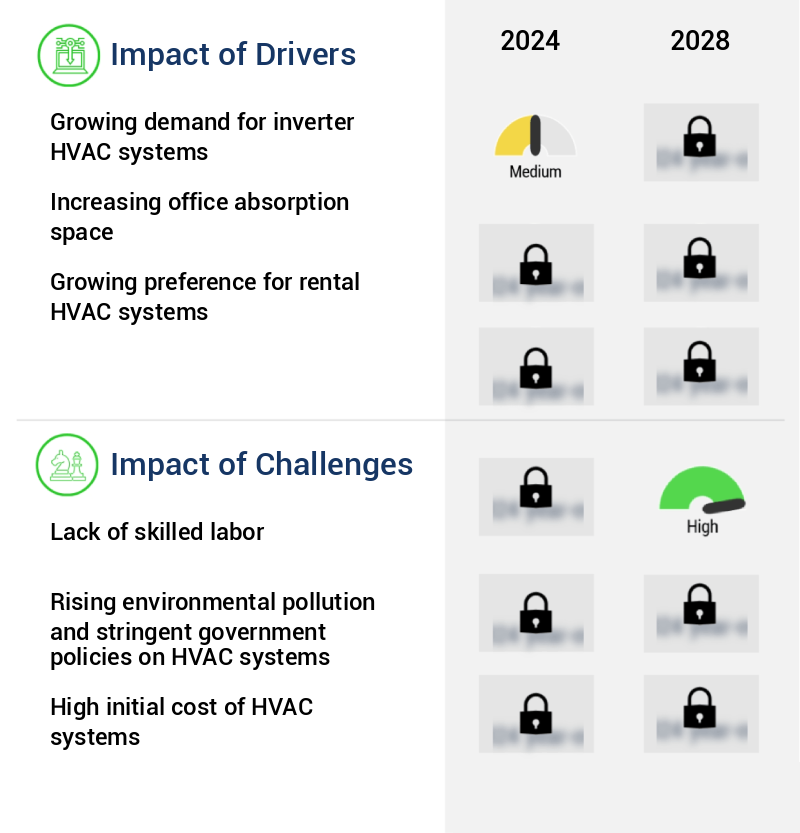
The hvac system market size is valued to increase USD 56.3 billion, at a CAGR of 6.78% from 2023 to 2028. Growing demand for inverter HVAC systems will drive the hvac system market.

Major Market Trends & Insights

  • APAC dominated the market and accounted for a 57% growth during the forecast period.
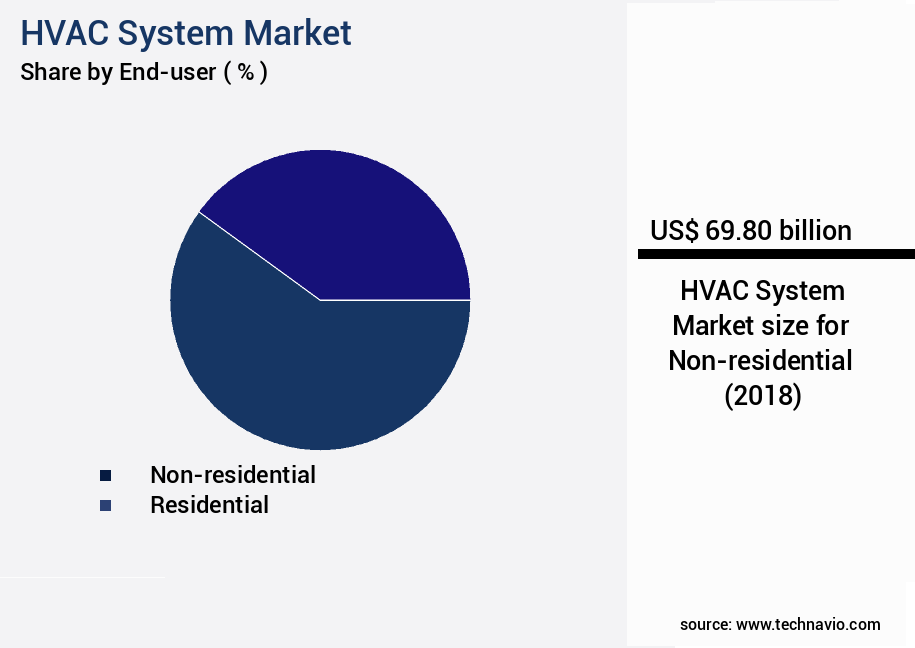
  • By End-user - Non-residential segment was valued at USD 69.80 billion in 2022
  • By Type - Split system segment accounted for the largest market revenue share in 2022

Market Size & Forecast

  • Market Opportunities: USD 79.02 billion
  • Market Future Opportunities: USD 56.30 billion
  • CAGR : 6.78%
  • APAC: Largest market in 2022

Market Summary

  • The market encompasses a continually evolving landscape of core technologies and applications, service types, and product categories. One of the most significant trends driving market growth is the increasing adoption of inverter HVAC systems, which accounted for over 30% of global sales in 2020. These energy-efficient systems offer improved temperature control and energy savings, making them a popular choice for both residential and commercial applications. Another emerging trend is the growing popularity of smart HVAC systems, which allow users to remotely monitor and control their heating and cooling systems via mobile apps or voice assistants.
  • However, the market faces challenges such as the lack of skilled labor, which can hinder installation and maintenance. Regulations, such as energy efficiency standards, also play a crucial role in shaping the market's direction. Stay tuned for further insights into the evolving the market.

What will be the Size of the HVAC System Market during the forecast period?
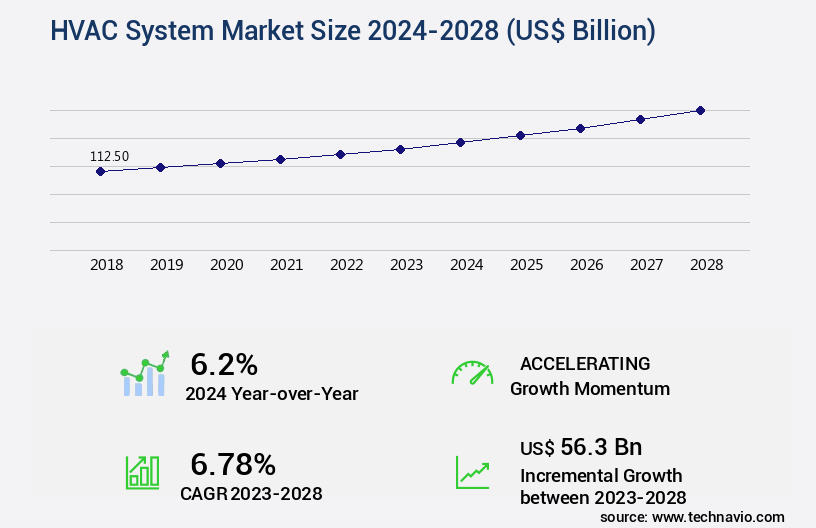
HVAC System Market Size

Get Key Insights on Market Forecast (PDF) Request Free Sample

How is the HVAC System Market Segmented and what are the key trends of market segmentation?

The hvac system industry research report provides comprehensive data (region-wise segment analysis), with forecasts and estimates in "USD billion" for the period 2024-2028, as well as historical data from 2018-2022 for the following segments.

  • End-user
    • Non-residential
    • Residential
  • Type
    • Split system
    • Ductless system
    • Packaged system
  • Heating Equipment
    • Heat pumps
    • Furnaces
    • Unitary heaters
    • Boilers
    • Heat pumps
    • Furnaces
    • Unitary heaters
    • Boilers
  • Ventilation Equipment
    • Air-handling units
    • Air filters
    • Dehumidifiers
    • Ventilation fans
    • Humidifiers
    • Air purifiers
  • Cooling Equipment
    • Unitary air conditioners
    • VRF systems
    • Chillers
    • Room air conditioners
    • Coolers
    • Cooling towers
  • Geography
    • North America
      • US
    • Europe
      • Germany
      • UK
    • APAC
      • China
      • Japan
    • Rest of World (ROW)

By End-user Insights

The non-residential segment is estimated to witness significant growth during the forecast period.

The non-residential segment of the market encompasses commercial and industrial applications. This sector holds significant market share and is projected to experience continuous expansion during the forecast period. The construction industry's growth and increasing infrastructure investments fuel the demand for HVAC systems in the non-residential sector. Rapid urbanization and favorable policies supporting commercial real estate development contribute to the increasing demand for office spaces. Consequently, the need for advanced HVAC systems to maintain thermal comfort and ensure energy efficiency becomes essential. Additionally, the emergence of start-ups and the availability of co-working spaces have further boosted the demand for HVAC systems.

Variable refrigerant flow (VRF) systems and integrated building systems are gaining popularity due to their energy efficiency and ability to provide zoned temperature control. Building energy modeling and HVAC control systems enable the optimization of energy consumption and improve overall system performance. Refrigerant management and heat exchanger design are crucial aspects of HVAC systems, with smart HVAC controllers and refrigerant leak detection systems ensuring efficient and reliable operations. Heat pump technology, air conditioning systems, and HVAC diagnostics tools are essential components of modern HVAC systems. Thermal energy storage and system performance analysis enable better energy management and cost savings.

Building automation systems, demand-controlled ventilation, and thermal comfort modeling contribute to enhanced indoor air quality and occupant comfort. HVAC maintenance schedules and air quality monitoring are critical for ensuring system longevity and optimal performance. Energy recovery ventilation and air filtration technologies improve indoor air quality and contribute to overall system efficiency. HVAC efficiency metrics and system optimization techniques help businesses reduce energy consumption and costs. Cooling tower operation and humidity control systems are vital for industrial applications, while ductwork design criteria ensure efficient air distribution. Energy efficiency upgrades and the HVAC commissioning process ensure that systems operate at their maximum potential.

Heating system design and integration with other building systems are essential for comprehensive building solutions. The HVAC market's future growth is driven by the increasing focus on energy efficiency, advanced technologies, and the growing demand for comfortable and energy-efficient indoor environments. The market is expected to witness significant growth, with a projected increase in demand for HVAC systems in various industries, including healthcare, education, and hospitality. In conclusion, the non-residential the market is expected to experience steady growth due to the increasing demand for energy-efficient and advanced HVAC systems in various industries. The market's continuous evolution is driven by technological advancements, energy efficiency concerns, and the growing need for comfortable indoor environments.
HVAC System Market Size

Request Free Sample

The Non-residential segment was valued at USD 69.80 billion in 2018 and showed a gradual increase during the forecast period.
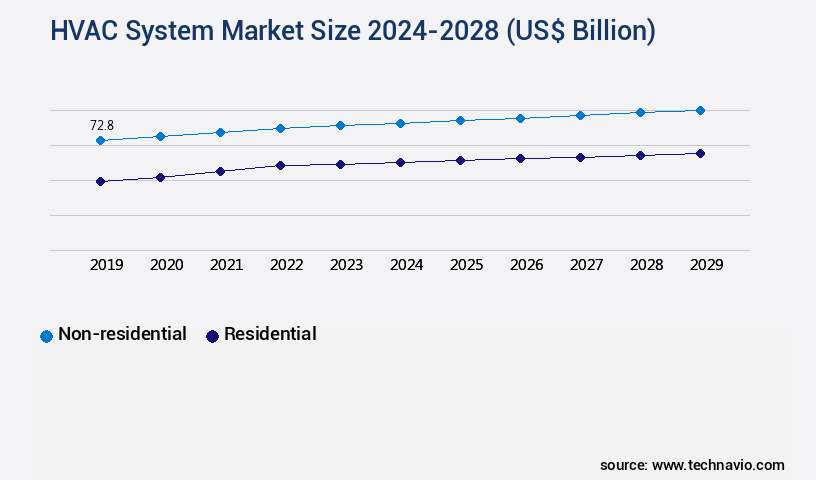
HVAC System Market Size

Request Free Sample

Regional Analysis

APAC is estimated to contribute 57% to the growth of the global market during the forecast period.Technavio's analysts have elaborately explained the regional trends and drivers that shape the market during the forecast period.
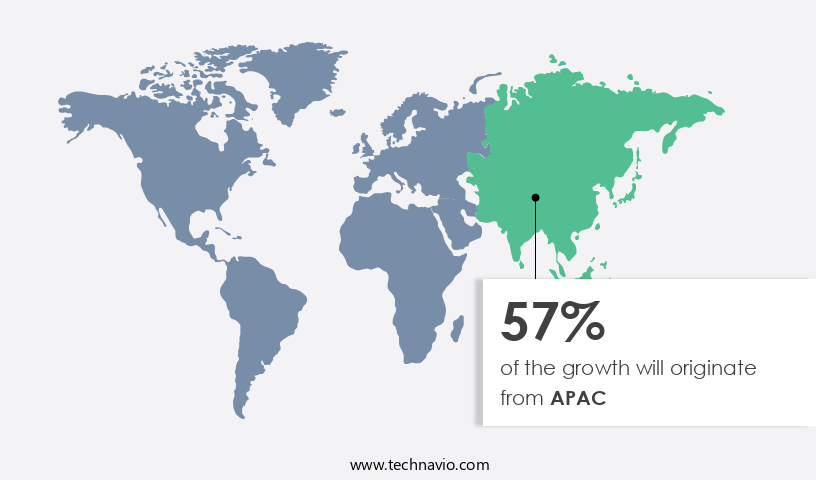
HVAC System Market Share by Geography

See How HVAC System Market Demand is Rising in APAC Request Free Sample

In the Asia Pacific (APAC) region, the market is experiencing significant growth due to several factors. The expanding population in countries like China and India, with a combined population of over 2.83 billion in 2023, is a major driving force. Climatic conditions and increasing urbanization are also contributing factors. Moreover, demographic changes and the growing commercial construction sector are further boosting market growth.

Regulations and efficiency norms in countries such as India and China will continue to shape the market during the forecast period. For instance, India's Bureau of Energy Efficiency (BEE) Star Rating System and China's Energy Conservation Law are key initiatives promoting energy-efficient HVAC systems.

Market Dynamics

Our researchers analyzed the data with 2023 as the base year, along with the key drivers, trends, and challenges. A holistic analysis of drivers will help companies refine their marketing strategies to gain a competitive advantage.

The market encompasses a wide range of technologies and applications, including variable refrigerant flow systems, energy recovery ventilation systems, air handling unit filter replacement schedules, building automation system integrations, chiller plant efficiency optimization strategies, demand controlled ventilation system commissioning, heat pump system performance evaluations, HVAC system diagnostics and troubleshooting techniques, refrigerant leak detection and repair procedures, thermal energy storage system design considerations, smart HVAC controller programming and configuration, air filtration technology selection criteria, cooling tower water treatment and maintenance, building energy modeling and simulation software, HVAC system maintenance and preventative measures, high-efficiency air conditioning system selection, energy efficient HVAC retrofit project planning, ductwork design and insulation best practices, air quality monitoring and indoor environmental control, and building code compliance for HVAC system installations.

One notable trend in the market is the increasing focus on energy efficiency and cost savings. For instance, more than 70% of new HVAC system installations prioritize energy-efficient solutions, with high-efficiency air conditioning systems accounting for a significantly larger share than traditional systems. In comparison, less than 15% of existing systems have been retrofitted with energy-efficient technologies, indicating a vast opportunity for growth in this area. Furthermore, advanced technologies such as smart HVAC controllers, demand-controlled ventilation systems, and variable refrigerant flow systems are gaining traction due to their ability to optimize energy consumption and enhance indoor environmental quality.

Building automation system integrations and air filtration technology selection criteria are also crucial factors influencing the market's growth trajectory. In terms of regional dynamics, the Asia Pacific market is expected to dominate the HVAC system landscape due to its large and rapidly growing construction sector and increasing focus on energy efficiency. Europe and North America follow closely behind, with a strong emphasis on building energy modeling and simulation software, HVAC system maintenance and preventative measures, and cooling tower water treatment and maintenance. Overall, the market is poised for robust growth, driven by a combination of factors, including technological advancements, increasing energy awareness, and regulatory compliance requirements.
HVAC System Market Size

What are the key market drivers leading to the rise in the adoption of HVAC System Industry?

  • The increasing demand for energy-efficient and cost-effective HVAC solutions is primarily driven by the growing preference for inverter-based systems in the market. 
  • The market for inverter HVAC systems is experiencing significant growth due to various factors. Increasing disposable income and enhancing living standards among consumers are key drivers, as more people invest in comfort solutions for their homes and businesses. Extreme weather conditions also contribute to the demand for HVAC systems, as seen in the fifth hottest year recorded in India in 2022, with an average temperature rise of 0.51 degrees Celsius. Furthermore, government investments in infrastructure development, such as the USD2 billion allocation in India's interim budget in 2022, fuel the demand for HVAC systems in this sector.
  • This trend is a continuous one, as consumers and businesses increasingly prioritize temperature control and energy efficiency. Inverter HVAC systems offer these benefits, making them a popular choice in various industries and applications.

What are the market trends shaping the HVAC System Industry?

  • The rising preference for smart HVAC systems represents a notable market trend. Smart HVAC systems are experiencing growing popularity within the industry.
  • The market is experiencing significant advancements, with the adoption of smart and connected HVAC systems on the rise. This shift is driven by technological innovations in portable devices and monitoring systems, enabling end-users to manage their HVAC systems more efficiently and conveniently. The demand for Internet of Things (IoT)-enabled devices is surging, particularly for data collection and analysis in addressing intricate residential and commercial HVAC maintenance tasks.
  • IoT devices, such as wireless acoustic transmitters and steam trap monitors, play a crucial role in monitoring HVAC system operations. Predictive maintenance is gaining traction as it minimizes downtime and enhances operational efficiency. This trend underscores the market's continuous evolution and its applications across various sectors.

What challenges does the HVAC System Industry face during its growth?

  • The scarcity of skilled labor poses a significant challenge to the expansion and growth of the industry. 
  • HVAC manufacturing involves producing advanced systems and offering aftermarket services, which are crucial for market success. Technical expertise is essential in installing and managing these systems. However, the industry faces a significant challenge: a persistent shortage of skilled labor. This issue is expected to persist, impacting contractors' profitability due to the importance of aftermarket services. The root cause is the preference of new graduates for careers in fields like computer programming, design, and finance over HVAC.
  • This trend continues to widen the gap in the workforce, posing a significant challenge for the industry's growth. The labor shortage's consequences extend beyond contractors, affecting manufacturers' ability to meet demand and maintain profitability.

Exclusive Customer Landscape

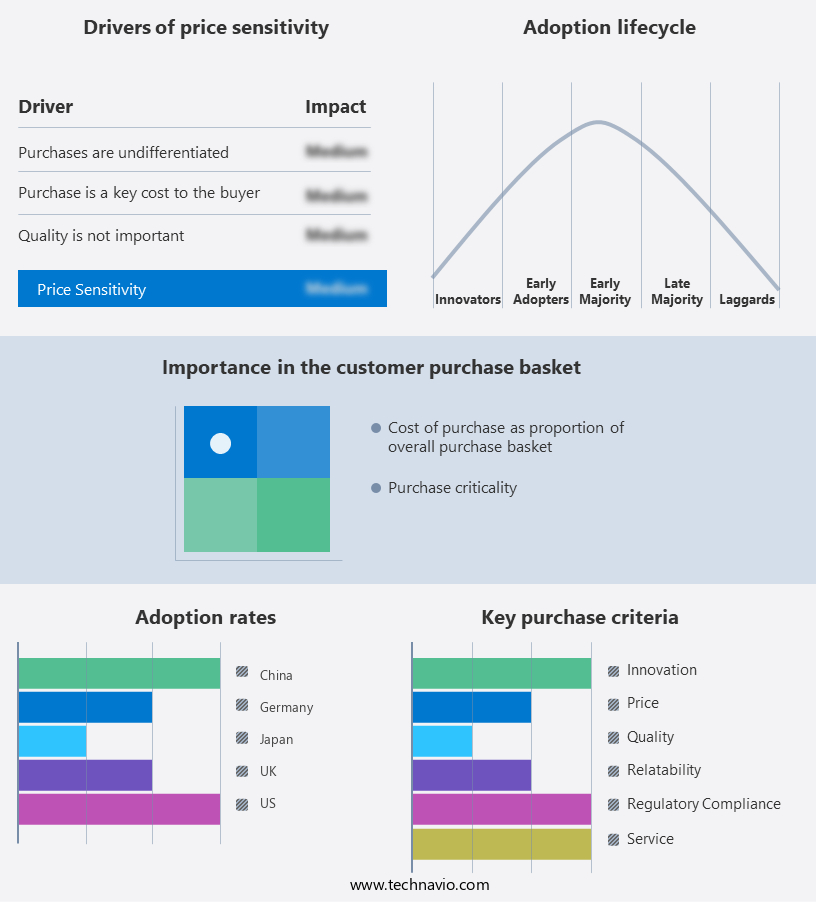
The hvac system market forecasting report includes the adoption lifecycle of the market, covering from the innovator's stage to the laggard's stage. It focuses on adoption rates in different regions based on penetration. Furthermore, the hvac system market report also includes key purchase criteria and drivers of price sensitivity to help companies evaluate and develop their market growth analysis strategies.
HVAC System Market Share by Geography

 Customer Landscape of HVAC System Industry

Competitive Landscape & Market Insights

Companies are implementing various strategies, such as strategic alliances, hvac system market forecast, partnerships, mergers and acquisitions, geographical expansion, and product/service launches, to enhance their presence in the industry.

Carrier Global Corp. - The company specializes in HVAC systems, including Carrier Infinity, delivering advanced temperature control and energy efficiency solutions to various industries and residential markets. Their innovative technology enhances indoor comfort and sustainability, setting industry benchmarks for performance and reliability.

The industry research and growth report includes detailed analyses of the competitive landscape of the market and information about key companies, including:

  • Carrier Global Corp.
  • Daikin Industries Ltd.
  • Danfoss AS
  • Emerson Electric Co.
  • Furukawa Electric Co. Ltd.
  • GREE Comfort
  • Haier Smart Home Co. Ltd.
  • Hitachi Ltd.
  • Honeywell International Inc.
  • Ingersoll Rand Inc.
  • Johnson Controls International Plc.
  • Lennox International Inc.
  • LG Corp.
  • Midea Group Co. Ltd.
  • Mitsubishi Electric Corp.
  • Nortek
  • Panasonic Holdings Corp.
  • Samsung Electronics Co. Ltd.
  • Trane Technologies Plc
  • Whirlpool Corp.

Qualitative and quantitative analysis of companies has been conducted to help clients understand the wider business environment as well as the strengths and weaknesses of key industry players. Data is qualitatively analyzed to categorize companies as pure play, category-focused, industry-focused, and diversified; it is quantitatively analyzed to categorize companies as dominant, leading, strong, tentative, and weak.

Recent Development and News in HVAC System Market

  • In January 2024, Carrier Global Corporation, a leading HVAC market player, announced the launch of its new AquaEdge 19DV centrifugal chiller, featuring a digital intelligence platform that optimizes energy efficiency by up to 20% (Carrier Global Corporation Press Release).
  • In March 2024, Johnson Controls and Google entered into a strategic partnership to integrate Johnson Controls' OpenBlue digital platform with Google's Building IoT platform, enabling seamless data exchange and advanced analytics for energy management in commercial buildings (Johnson Controls Press Release).
  • In May 2024, United Technologies Corporation completed the acquisition of Carrier Global Corporation, creating a leading provider of HVAC and fire safety solutions with a combined revenue of USD23 billion in 2023 (United Technologies Corporation SEC Filing).
  • In April 2025, the European Commission approved the Danfoss and Eaton merger, creating a leading player in the HVAC market with a combined market share of 16% (European Commission Press Release).

Dive into Technavio's robust research methodology, blending expert interviews, extensive data synthesis, and validated models for unparalleled HVAC System Market insights. See full methodology.

Market Scope

Report Coverage

Details

Page number

170

Base year

2023

Historic period

2018-2022

Forecast period

2024-2028

Growth momentum & CAGR

Accelerate at a CAGR of 6.78%

Market growth 2024-2028

USD 56.3 billion

Market structure

Fragmented

YoY growth 2023-2024(%)

6.2

Key countries

China, US, Japan, Germany, and UK

Competitive landscape

Leading Companies, Market Positioning of Companies, Competitive Strategies, and Industry Risks

Request Free Sample

Research Analyst Overview

  • In the dynamic and evolving world of HVAC systems, several key trends are shaping the market landscape. Chiller plant operations continue to advance, with a focus on energy efficiency and optimized performance. HVAC load calculations are increasingly sophisticated, enabling precise temperature control and reduced energy consumption. Variable refrigerant flow (VRF) systems are gaining popularity due to their adaptability and energy savings. Ventilation system types are diversifying, with integrated building systems offering improved indoor air quality and energy efficiency. Building energy modeling and HVAC control systems are essential tools for optimizing energy usage and reducing operational costs. Refrigerant management and heat exchanger design are critical aspects of HVAC systems, with smart HVAC controllers facilitating efficient operation and refrigerant leak detection.
  • Heat pump technology is another area of innovation, providing both heating and cooling solutions with minimal environmental impact. Air conditioning systems are becoming more intelligent, with HVAC diagnostics tools and system performance analysis enabling proactive maintenance and repairs. Thermal energy storage and building automation systems are enhancing energy efficiency and occupant comfort. Demand-controlled ventilation and thermal comfort modeling are essential for maintaining optimal indoor air quality. HVAC maintenance schedules and air quality monitoring are crucial components of any effective building management strategy. Energy recovery ventilation and air filtration technologies are improving indoor air quality while reducing energy consumption.
  • HVAC efficiency metrics and system optimization are essential for minimizing operational costs and maximizing performance. Cooling tower operation and zoned HVAC systems are addressing the unique challenges of large commercial and industrial facilities. Humidity control systems and ductwork design criteria are ensuring optimal thermal comfort and energy efficiency. Energy efficiency upgrades and the HVAC commissioning process are essential for maintaining and improving the performance of existing systems. Overall, the HVAC market is characterized by continuous innovation and a focus on energy efficiency, indoor air quality, and optimized performance.

What are the Key Data Covered in this HVAC System Market Research and Growth Report?

  • What is the expected growth of the HVAC System Market between 2024 and 2028?

    • USD 56.3 billion, at a CAGR of 6.78%

  • What segmentation does the market report cover?

    • The report segmented by End-user (Non-residential and Residential), Type (Split system, Ductless system, and Packaged system), Geography (APAC, Europe, North America, Middle East and Africa, and South America), Heating Equipment (Heat pumps, Furnaces, Unitary heaters, Boilers, Heat pumps, Furnaces, Unitary heaters, and Boilers), Ventilation Equipment (Air-handling units, Air filters, Dehumidifiers, Ventilation fans, Humidifiers, Air purifiers, Air-handling units, Air filters, Dehumidifiers, Ventilation fans, Humidifiers, and Air purifiers), and Cooling Equipment (Unitary air conditioners, VRF systems, Chillers, Room air conditioners, Coolers, Cooling towers, Unitary air conditioners, VRF systems, Chillers, Room air conditioners, Coolers, and Cooling towers)

  • Which regions are analyzed in the report?

    • APAC, Europe, North America, Middle East and Africa, and South America

  • What are the key growth drivers and market challenges?

    • Growing demand for inverter HVAC systems, Lack of skilled labor

  • Who are the major players in the HVAC System Market?

    • Key Companies Carrier Global Corp., Daikin Industries Ltd., Danfoss AS, Emerson Electric Co., Furukawa Electric Co. Ltd., GREE Comfort, Haier Smart Home Co. Ltd., Hitachi Ltd., Honeywell International Inc., Ingersoll Rand Inc., Johnson Controls International Plc., Lennox International Inc., LG Corp., Midea Group Co. Ltd., Mitsubishi Electric Corp., Nortek, Panasonic Holdings Corp., Samsung Electronics Co. Ltd., Trane Technologies Plc, and Whirlpool Corp.

Market Research Insights

  • The market encompasses a diverse range of technologies and services, including fan system performance, system control strategies, and capacity planning. HVAC design software and energy auditing services play crucial roles in optimizing system efficiency and reducing energy consumption. In contrast, HVAC retrofit projects accounted for approximately 25% of the market share in 2020, reflecting the growing importance of upgrading existing systems to meet building code compliance and improve ventilation effectiveness.
  • Energy consumption data and thermal imaging analysis are essential tools for identifying areas of improvement in HVAC systems. Furthermore, system integration with building management systems, renewable energy sources, and data center cooling solutions are key trends driving market growth. Pressure drop calculations and hvac sensor technologies are essential for maintaining optimal airflow distribution patterns and ensuring thermal comfort standards.

We can help! Our analysts can customize this hvac system market research report to meet your requirements.

Get in touch

1 Executive Summary

  • 1.1 Market overview
    • Executive Summary - Chart on Market Overview
    • Executive Summary - Data Table on Market Overview
    • Executive Summary - Chart on Global Market Characteristics
    • Executive Summary - Chart on Market by Geography
    • Executive Summary - Chart on Market Segmentation by End-user
    • Executive Summary - Chart on Market Segmentation by Type
    • Executive Summary - Chart on Incremental Growth
    • Executive Summary - Data Table on Incremental Growth
    • Executive Summary - Chart on Company Market Positioning

2 Market Landscape

  • 2.1 Market ecosystem
    • Parent Market
    • Data Table on - Parent Market
  • 2.2 Market characteristics
    • Market characteristics analysis
  • 2.3 Value chain analysis
    • Value Chain Analysis

3 Market Sizing

  • 3.1 Market definition
    • Offerings of companies included in the market definition
  • 3.2 Market segment analysis
    • Market segments
  • 3.3 Market size 2023
    • 3.4 Market outlook: Forecast for 2023-2028
      • Chart on Global - Market size and forecast 2023-2028 ($ billion)
      • Data Table on Global - Market size and forecast 2023-2028 ($ billion)
      • Chart on Global Market: Year-over-year growth 2023-2028 (%)
      • Data Table on Global Market: Year-over-year growth 2023-2028 (%)

    4 Historic Market Size

    • 4.1 Global HVAC System Market 2018 - 2022
      • Historic Market Size - Data Table on Global HVAC System Market 2018 - 2022 ($ billion)
    • 4.2 End-user segment analysis 2018 - 2022
      • Historic Market Size - End-user Segment 2018 - 2022 ($ billion)
    • 4.3 Type segment analysis 2018 - 2022
      • Historic Market Size - Type Segment 2018 - 2022 ($ billion)
    • 4.4 Geography segment analysis 2018 - 2022
      • Historic Market Size - Geography Segment 2018 - 2022 ($ billion)
    • 4.5 Country segment analysis 2018 - 2022
      • Historic Market Size - Country Segment 2018 - 2022 ($ billion)

    5 Five Forces Analysis

    • 5.1 Five forces summary
      • Five forces analysis - Comparison between 2023 and 2028
    • 5.2 Bargaining power of buyers
      • Bargaining power of buyers - Impact of key factors 2023 and 2028
    • 5.3 Bargaining power of suppliers
      • Bargaining power of suppliers - Impact of key factors in 2023 and 2028
    • 5.4 Threat of new entrants
      • Threat of new entrants - Impact of key factors in 2023 and 2028
    • 5.5 Threat of substitutes
      • Threat of substitutes - Impact of key factors in 2023 and 2028
    • 5.6 Threat of rivalry
      • Threat of rivalry - Impact of key factors in 2023 and 2028
    • 5.7 Market condition
      • Chart on Market condition - Five forces 2023 and 2028

    6 Market Segmentation by End-user

    • 6.1 Market segments
      • Chart on End-user - Market share 2023-2028 (%)
      • Data Table on End-user - Market share 2023-2028 (%)
    • 6.2 Comparison by End-user
      • Chart on Comparison by End-user
      • Data Table on Comparison by End-user
    • 6.3 Non-residential - Market size and forecast 2023-2028
      • Chart on Non-residential - Market size and forecast 2023-2028 ($ billion)
      • Data Table on Non-residential - Market size and forecast 2023-2028 ($ billion)
      • Chart on Non-residential - Year-over-year growth 2023-2028 (%)
      • Data Table on Non-residential - Year-over-year growth 2023-2028 (%)
    • 6.4 Residential - Market size and forecast 2023-2028
      • Chart on Residential - Market size and forecast 2023-2028 ($ billion)
      • Data Table on Residential - Market size and forecast 2023-2028 ($ billion)
      • Chart on Residential - Year-over-year growth 2023-2028 (%)
      • Data Table on Residential - Year-over-year growth 2023-2028 (%)
    • 6.5 Market opportunity by End-user
      • Market opportunity by End-user ($ billion)
      • Data Table on Market opportunity by End-user ($ billion)

    7 Market Segmentation by Type

    • 7.1 Market segments
      • Chart on Type - Market share 2023-2028 (%)
      • Data Table on Type - Market share 2023-2028 (%)
    • 7.2 Comparison by Type
      • Chart on Comparison by Type
      • Data Table on Comparison by Type
    • 7.3 Split system - Market size and forecast 2023-2028
      • Chart on Split system - Market size and forecast 2023-2028 ($ billion)
      • Data Table on Split system - Market size and forecast 2023-2028 ($ billion)
      • Chart on Split system - Year-over-year growth 2023-2028 (%)
      • Data Table on Split system - Year-over-year growth 2023-2028 (%)
    • 7.4 Ductless system - Market size and forecast 2023-2028
      • Chart on Ductless system - Market size and forecast 2023-2028 ($ billion)
      • Data Table on Ductless system - Market size and forecast 2023-2028 ($ billion)
      • Chart on Ductless system - Year-over-year growth 2023-2028 (%)
      • Data Table on Ductless system - Year-over-year growth 2023-2028 (%)
    • 7.5 Packaged system - Market size and forecast 2023-2028
      • Chart on Packaged system - Market size and forecast 2023-2028 ($ billion)
      • Data Table on Packaged system - Market size and forecast 2023-2028 ($ billion)
      • Chart on Packaged system - Year-over-year growth 2023-2028 (%)
      • Data Table on Packaged system - Year-over-year growth 2023-2028 (%)
    • 7.6 Market opportunity by Type
      • Market opportunity by Type ($ billion)
      • Data Table on Market opportunity by Type ($ billion)

    8 Market Segmentation by Heating Equipment

    • 8.1 Market segments
      • Chart on Heating Equipment - Market share (2023-2028) (%)
      • Data Table on Heating Equipment - Market share (2023-2028) (%)
    • 8.2 Comparison by Heating Equipment
      • Chart on Comparison by Heating Equipment
      • Data Table on Comparison by Heating Equipment
    • 8.3 Heat pumps - Market size and forecast (2023-2028)
      • Chart on Heat pumps - Market size and forecast (2023-2028) ($ million)
      • Data Table on Heat pumps - Market size and forecast (2023-2028) ($ million)
      • Chart on Heat pumps - Year-over-year growth (2023-2028) (%)
      • Data Table on Heat pumps - Year-over-year growth (2023-2028) (%)
    • 8.4 Furnaces - Market size and forecast (2023-2028)
      • Chart on Furnaces - Market size and forecast (2023-2028) ($ million)
      • Data Table on Furnaces - Market size and forecast (2023-2028) ($ million)
      • Chart on Furnaces - Year-over-year growth (2023-2028) (%)
      • Data Table on Furnaces - Year-over-year growth (2023-2028) (%)
    • 8.5 Unitary heaters - Market size and forecast (2023-2028)
      • Chart on Unitary heaters - Market size and forecast (2023-2028) ($ million)
      • Data Table on Unitary heaters - Market size and forecast (2023-2028) ($ million)
      • Chart on Unitary heaters - Year-over-year growth (2023-2028) (%)
      • Data Table on Unitary heaters - Year-over-year growth (2023-2028) (%)
    • 8.6 Boilers - Market size and forecast (2023-2028)
      • Chart on Boilers - Market size and forecast (2023-2028) ($ million)
      • Data Table on Boilers - Market size and forecast (2023-2028) ($ million)
      • Chart on Boilers - Year-over-year growth (2023-2028) (%)
      • Data Table on Boilers - Year-over-year growth (2023-2028) (%)
    • 8.7 Market opportunity by Heating Equipment
      • Market opportunity by $segment_name ($ million)
      • Data Table on Market opportunity by $segment_name ($ million)

    9 Market Segmentation by Ventilation Equipment

    • 9.1 Market segments
      • Chart on Ventilation Equipment - Market share (2023-2028) (%)
      • Data Table on Ventilation Equipment - Market share (2023-2028) (%)
    • 9.2 Comparison by Ventilation Equipment
      • Chart on Comparison by Ventilation Equipment
      • Data Table on Comparison by Ventilation Equipment
    • 9.3 Air-handling units - Market size and forecast (2023-2028)
      • Chart on Air-handling units - Market size and forecast (2023-2028) ($ million)
      • Data Table on Air-handling units - Market size and forecast (2023-2028) ($ million)
      • Chart on Air-handling units - Year-over-year growth (2023-2028) (%)
      • Data Table on Air-handling units - Year-over-year growth (2023-2028) (%)
    • 9.4 Air filters - Market size and forecast (2023-2028)
      • Chart on Air filters - Market size and forecast (2023-2028) ($ million)
      • Data Table on Air filters - Market size and forecast (2023-2028) ($ million)
      • Chart on Air filters - Year-over-year growth (2023-2028) (%)
      • Data Table on Air filters - Year-over-year growth (2023-2028) (%)
    • 9.5 Dehumidifiers - Market size and forecast (2023-2028)
      • Chart on Dehumidifiers - Market size and forecast (2023-2028) ($ million)
      • Data Table on Dehumidifiers - Market size and forecast (2023-2028) ($ million)
      • Chart on Dehumidifiers - Year-over-year growth (2023-2028) (%)
      • Data Table on Dehumidifiers - Year-over-year growth (2023-2028) (%)
    • 9.6 Ventilation fans - Market size and forecast (2023-2028)
      • Chart on Ventilation fans - Market size and forecast (2023-2028) ($ million)
      • Data Table on Ventilation fans - Market size and forecast (2023-2028) ($ million)
      • Chart on Ventilation fans - Year-over-year growth (2023-2028) (%)
      • Data Table on Ventilation fans - Year-over-year growth (2023-2028) (%)
    • 9.7 Humidifiers - Market size and forecast (2023-2028)
      • Chart on Humidifiers - Market size and forecast (2023-2028) ($ million)
      • Data Table on Humidifiers - Market size and forecast (2023-2028) ($ million)
      • Chart on Humidifiers - Year-over-year growth (2023-2028) (%)
      • Data Table on Humidifiers - Year-over-year growth (2023-2028) (%)
    • 9.8 Air purifiers - Market size and forecast (2023-2028)
      • Chart on Air purifiers - Market size and forecast (2023-2028) ($ million)
      • Data Table on Air purifiers - Market size and forecast (2023-2028) ($ million)
      • Chart on Air purifiers - Year-over-year growth (2023-2028) (%)
      • Data Table on Air purifiers - Year-over-year growth (2023-2028) (%)
    • 9.9 Market opportunity by Ventilation Equipment
      • Market opportunity by $segment_name ($ million)
      • Data Table on Market opportunity by $segment_name ($ million)

    10 Market Segmentation by Cooling Equipment

    • 10.1 Market segments
      • Chart on Cooling Equipment - Market share (2023-2028) (%)
      • Data Table on Cooling Equipment - Market share (2023-2028) (%)
    • 10.2 Comparison by Cooling Equipment
      • Chart on Comparison by Cooling Equipment
      • Data Table on Comparison by Cooling Equipment
    • 10.3 Unitary air conditioners - Market size and forecast (2023-2028)
      • Chart on Unitary air conditioners - Market size and forecast (2023-2028) ($ million)
      • Data Table on Unitary air conditioners - Market size and forecast (2023-2028) ($ million)
      • Chart on Unitary air conditioners - Year-over-year growth (2023-2028) (%)
      • Data Table on Unitary air conditioners - Year-over-year growth (2023-2028) (%)
    • 10.4 VRF systems - Market size and forecast (2023-2028)
      • Chart on VRF systems - Market size and forecast (2023-2028) ($ million)
      • Data Table on VRF systems - Market size and forecast (2023-2028) ($ million)
      • Chart on VRF systems - Year-over-year growth (2023-2028) (%)
      • Data Table on VRF systems - Year-over-year growth (2023-2028) (%)
    • 10.5 Chillers - Market size and forecast (2023-2028)
      • Chart on Chillers - Market size and forecast (2023-2028) ($ million)
      • Data Table on Chillers - Market size and forecast (2023-2028) ($ million)
      • Chart on Chillers - Year-over-year growth (2023-2028) (%)
      • Data Table on Chillers - Year-over-year growth (2023-2028) (%)
    • 10.6 Room air conditioners - Market size and forecast (2023-2028)
      • Chart on Room air conditioners - Market size and forecast (2023-2028) ($ million)
      • Data Table on Room air conditioners - Market size and forecast (2023-2028) ($ million)
      • Chart on Room air conditioners - Year-over-year growth (2023-2028) (%)
      • Data Table on Room air conditioners - Year-over-year growth (2023-2028) (%)
    • 10.7 Coolers - Market size and forecast (2023-2028)
      • Chart on Coolers - Market size and forecast (2023-2028) ($ million)
      • Data Table on Coolers - Market size and forecast (2023-2028) ($ million)
      • Chart on Coolers - Year-over-year growth (2023-2028) (%)
      • Data Table on Coolers - Year-over-year growth (2023-2028) (%)
    • 10.8 Cooling towers - Market size and forecast (2023-2028)
      • Chart on Cooling towers - Market size and forecast (2023-2028) ($ million)
      • Data Table on Cooling towers - Market size and forecast (2023-2028) ($ million)
      • Chart on Cooling towers - Year-over-year growth (2023-2028) (%)
      • Data Table on Cooling towers - Year-over-year growth (2023-2028) (%)
    • 10.9 Market opportunity by Cooling Equipment
      • Market opportunity by $segment_name ($ million)
      • Data Table on Market opportunity by $segment_name ($ million)

    11 Customer Landscape

    • 11.1 Customer landscape overview
      • Analysis of price sensitivity, lifecycle, customer purchase basket, adoption rates, and purchase criteria

    12 Geographic Landscape

    • 12.1 Geographic segmentation
      • Chart on Market share by geography 2023-2028 (%)
      • Data Table on Market share by geography 2023-2028 (%)
    • 12.2 Geographic comparison
      • Chart on Geographic comparison
      • Data Table on Geographic comparison
    • 12.3 APAC - Market size and forecast 2023-2028
      • Chart on APAC - Market size and forecast 2023-2028 ($ billion)
      • Data Table on APAC - Market size and forecast 2023-2028 ($ billion)
      • Chart on APAC - Year-over-year growth 2023-2028 (%)
      • Data Table on APAC - Year-over-year growth 2023-2028 (%)
    • 12.4 Europe - Market size and forecast 2023-2028
      • Chart on Europe - Market size and forecast 2023-2028 ($ billion)
      • Data Table on Europe - Market size and forecast 2023-2028 ($ billion)
      • Chart on Europe - Year-over-year growth 2023-2028 (%)
      • Data Table on Europe - Year-over-year growth 2023-2028 (%)
    • 12.5 North America - Market size and forecast 2023-2028
      • Chart on North America - Market size and forecast 2023-2028 ($ billion)
      • Data Table on North America - Market size and forecast 2023-2028 ($ billion)
      • Chart on North America - Year-over-year growth 2023-2028 (%)
      • Data Table on North America - Year-over-year growth 2023-2028 (%)
    • 12.6 Middle East and Africa - Market size and forecast 2023-2028
      • Chart on Middle East and Africa - Market size and forecast 2023-2028 ($ billion)
      • Data Table on Middle East and Africa - Market size and forecast 2023-2028 ($ billion)
      • Chart on Middle East and Africa - Year-over-year growth 2023-2028 (%)
      • Data Table on Middle East and Africa - Year-over-year growth 2023-2028 (%)
    • 12.7 South America - Market size and forecast 2023-2028
      • Chart on South America - Market size and forecast 2023-2028 ($ billion)
      • Data Table on South America - Market size and forecast 2023-2028 ($ billion)
      • Chart on South America - Year-over-year growth 2023-2028 (%)
      • Data Table on South America - Year-over-year growth 2023-2028 (%)
    • 12.8 China - Market size and forecast 2023-2028
      • Chart on China - Market size and forecast 2023-2028 ($ billion)
      • Data Table on China - Market size and forecast 2023-2028 ($ billion)
      • Chart on China - Year-over-year growth 2023-2028 (%)
      • Data Table on China - Year-over-year growth 2023-2028 (%)
    • 12.9 US - Market size and forecast 2023-2028
      • Chart on US - Market size and forecast 2023-2028 ($ billion)
      • Data Table on US - Market size and forecast 2023-2028 ($ billion)
      • Chart on US - Year-over-year growth 2023-2028 (%)
      • Data Table on US - Year-over-year growth 2023-2028 (%)
    • 12.10 Japan - Market size and forecast 2023-2028
      • Chart on Japan - Market size and forecast 2023-2028 ($ billion)
      • Data Table on Japan - Market size and forecast 2023-2028 ($ billion)
      • Chart on Japan - Year-over-year growth 2023-2028 (%)
      • Data Table on Japan - Year-over-year growth 2023-2028 (%)
    • 12.11 Germany - Market size and forecast 2023-2028
      • Chart on Germany - Market size and forecast 2023-2028 ($ billion)
      • Data Table on Germany - Market size and forecast 2023-2028 ($ billion)
      • Chart on Germany - Year-over-year growth 2023-2028 (%)
      • Data Table on Germany - Year-over-year growth 2023-2028 (%)
    • 12.12 UK - Market size and forecast 2023-2028
      • Chart on UK - Market size and forecast 2023-2028 ($ billion)
      • Data Table on UK - Market size and forecast 2023-2028 ($ billion)
      • Chart on UK - Year-over-year growth 2023-2028 (%)
      • Data Table on UK - Year-over-year growth 2023-2028 (%)
    • 12.13 Market opportunity by geography
      • Market opportunity by geography ($ billion)
      • Data Tables on Market opportunity by geography ($ billion)

    13 Drivers, Challenges, and Opportunity/Restraints

    • 13.1 Market drivers
      • 13.2 Market challenges
        • 13.3 Impact of drivers and challenges
          • Impact of drivers and challenges in 2023 and 2028
        • 13.4 Market opportunities/restraints

          14 Competitive Landscape

          • 14.1 Overview
            • 14.2 Competitive Landscape
              • Overview on criticality of inputs and factors of differentiation
            • 14.3 Landscape disruption
              • Overview on factors of disruption
            • 14.4 Industry risks
              • Impact of key risks on business

            15 Competitive Analysis

            • 15.1 Companies profiled
              • Companies covered
            • 15.2 Market positioning of companies
              • Matrix on companies position and classification
            • 15.3 Carrier Global Corp.
              • Carrier Global Corp. - Overview
              • Carrier Global Corp. - Business segments
              • Carrier Global Corp. - Key news
              • Carrier Global Corp. - Key offerings
              • Carrier Global Corp. - Segment focus
            • 15.4 Daikin Industries Ltd.
              • Daikin Industries Ltd. - Overview
              • Daikin Industries Ltd. - Business segments
              • Daikin Industries Ltd. - Key news
              • Daikin Industries Ltd. - Key offerings
              • Daikin Industries Ltd. - Segment focus
            • 15.5 Emerson Electric Co.
              • Emerson Electric Co. - Overview
              • Emerson Electric Co. - Business segments
              • Emerson Electric Co. - Key news
              • Emerson Electric Co. - Key offerings
              • Emerson Electric Co. - Segment focus
            • 15.6 GREE Comfort
              • GREE Comfort - Overview
              • GREE Comfort - Product / Service
              • GREE Comfort - Key offerings
            • 15.7 Hitachi Ltd.
              • Hitachi Ltd. - Overview
              • Hitachi Ltd. - Business segments
              • Hitachi Ltd. - Key news
              • Hitachi Ltd. - Key offerings
              • Hitachi Ltd. - Segment focus
            • 15.8 Honeywell International Inc.
              • Honeywell International Inc. - Overview
              • Honeywell International Inc. - Business segments
              • Honeywell International Inc. - Key news
              • Honeywell International Inc. - Key offerings
              • Honeywell International Inc. - Segment focus
            • 15.9 Johnson Controls International Plc.
              • Johnson Controls International Plc. - Overview
              • Johnson Controls International Plc. - Business segments
              • Johnson Controls International Plc. - Key news
              • Johnson Controls International Plc. - Key offerings
              • Johnson Controls International Plc. - Segment focus
            • 15.10 Lennox International Inc.
              • Lennox International Inc. - Overview
              • Lennox International Inc. - Business segments
              • Lennox International Inc. - Key news
              • Lennox International Inc. - Key offerings
              • Lennox International Inc. - Segment focus
            • 15.11 LG Corp.
              • LG Corp. - Overview
              • LG Corp. - Business segments
              • LG Corp. - Key news
              • LG Corp. - Key offerings
              • LG Corp. - Segment focus
            • 15.12 Mitsubishi Electric Corp.
              • Mitsubishi Electric Corp. - Overview
              • Mitsubishi Electric Corp. - Business segments
              • Mitsubishi Electric Corp. - Key news
              • Mitsubishi Electric Corp. - Key offerings
              • Mitsubishi Electric Corp. - Segment focus
            • 15.13 Nortek
              • Nortek - Overview
              • Nortek - Product / Service
              • Nortek - Key offerings
            • 15.14 Panasonic Holdings Corp.
              • Panasonic Holdings Corp. - Overview
              • Panasonic Holdings Corp. - Product / Service
              • Panasonic Holdings Corp. - Key news
              • Panasonic Holdings Corp. - Key offerings
            • 15.15 Samsung Electronics Co. Ltd.
              • Samsung Electronics Co. Ltd. - Overview
              • Samsung Electronics Co. Ltd. - Business segments
              • Samsung Electronics Co. Ltd. - Key news
              • Samsung Electronics Co. Ltd. - Key offerings
              • Samsung Electronics Co. Ltd. - Segment focus
            • 15.16 Trane Technologies Plc
              • Trane Technologies Plc - Overview
              • Trane Technologies Plc - Business segments
              • Trane Technologies Plc - Key news
              • Trane Technologies Plc - Key offerings
              • Trane Technologies Plc - Segment focus
            • 15.17 Whirlpool Corp.
              • Whirlpool Corp. - Overview
              • Whirlpool Corp. - Business segments
              • Whirlpool Corp. - Key news
              • Whirlpool Corp. - Key offerings
              • Whirlpool Corp. - Segment focus

            16 Appendix

            • 16.1 Scope of the report
              • 16.2 Inclusions and exclusions checklist
                • Inclusions checklist
                • Exclusions checklist
              • 16.3 Currency conversion rates for US$
                • Currency conversion rates for US$
              • 16.4 Research methodology
                • Research methodology
              • 16.5 Data procurement
                • Information sources
              • 16.6 Data validation
                • Data validation
              • 16.7 Validation techniques employed for market sizing
                • Validation techniques employed for market sizing
              • 16.8 Data synthesis
                • Data synthesis
              • 16.9 360 degree market analysis
                • 360 degree market analysis
              • 16.10 List of abbreviations
                • List of abbreviations

              Research Methodology

              Technavio presents a detailed picture of the market by way of study, synthesis, and summation of data from multiple sources. The analysts have presented the various facets of the market with a particular focus on identifying the key industry influencers. The data thus presented is comprehensive, reliable, and the result of extensive research, both primary and secondary.

              INFORMATION SOURCES

              Primary sources

              • Manufacturers and suppliers
              • Channel partners
              • Industry experts
              • Strategic decision makers

              Secondary sources

              • Industry journals and periodicals
              • Government data
              • Financial reports of key industry players
              • Historical data
              • Press releases

              DATA ANALYSIS

              Data Synthesis

              • Collation of data
              • Estimation of key figures
              • Analysis of derived insights

              Data Validation

              • Triangulation with data models
              • Reference against proprietary databases
              • Corroboration with industry experts

              REPORT WRITING

              Qualitative

              • Market drivers
              • Market challenges
              • Market trends
              • Five forces analysis

              Quantitative

              • Market size and forecast
              • Market segmentation
              • Geographical insights
              • Competitive landscape

              Interested in this report?

              Get your sample now to see our research methodology and insights!

              Download Now

              Frequently Asked Questions

              Hvac System market growth will increase by $ 56.3 bn during 2024-2028 .

              The Hvac System market is expected to grow at a CAGR of 6.78% during 2024-2028 .

              Hvac System market is segmented by End-user( Non-residential, Residential) Type( Split system, Ductless system, Packaged system)

              Carrier Global Corp., Daikin Industries Ltd., Danfoss AS, Emerson Electric Co., Furukawa Electric Co. Ltd., GREE Comfort, Haier Smart Home Co. Ltd., Hitachi Ltd., Honeywell International Inc., Ingersoll Rand Inc., Johnson Controls International Plc., Lennox International Inc., LG Corp., Midea Group Co. Ltd., Mitsubishi Electric Corp., Nortek, Panasonic Holdings Corp., Samsung Electronics Co. Ltd., Trane Technologies Plc, Whirlpool Corp. are a few of the key vendors in the Hvac System market.

              APAC will register the highest growth rate of 57% among the other regions. Therefore, the Hvac System market in APAC is expected to garner significant business opportunities for the vendors during the forecast period.

              China, US, Japan, Germany, UK

              • Growing demand for inverter HVAC systemsThe demand for inverter HVAC systems is growing rapidly owing to increasing disposable income and the improving standard of living of consumers. The presence of extreme weather conditions is also a crucial factor driving the demand for HVAC systems. For instance is the driving factor this market.
              • in January 2023 is the driving factor this market.
              • the India Meteorological Department (IMD) claimed that 2022 was the fifth hottest year in India since 1901. The average temperature across the nation increased by 0.51 degree Celsius in 2022. In addition is the driving factor this market.
              • the increase in investments by the Indian government in infrastructure development is driving the demand for HVAC systems in India. For instance is the driving factor this market.
              • in 2022 is the driving factor this market.
              • the interim budget in India allocated about $2.41 billion for the expansion of the metro network in Noida is the driving factor this market.
              • Lucknow is the driving factor this market.
              • Mumbai is the driving factor this market.
              • Bangalore is the driving factor this market.
              • Kochi is the driving factor this market.
              • and Hyderabad. Such investments in the expansion and construction of metro stations and airports are expected to drive the demand for the HVAC system in India during the forecast period.In addition is the driving factor this market.
              • the residential segment is witnessing higher adoption of split ACs compared to window ACs. Based on the type of compressors is the driving factor this market.
              • split ACs can be categorized into two is the driving factor this market.
              • namely is the driving factor this market.
              • fixed-speed split ACs and inverter split ACs. In fixed-speed split ACs is the driving factor this market.
              • the compressor runs at a constant speed and stops and starts automatically based on the set temperature. Inverter split ACs run continuously at variable speeds to maintain the set temperature and consume less energy than fixed-speed split ACs. However is the driving factor this market.
              • inverter-type split ACs cost more than fixed-speed split ACs is the driving factor this market.
              • which has resulted in their lower adoption in the highly price-sensitive customer base. However is the driving factor this market.
              • increasing awareness of the need to reduce energy consumption and the growing focus of HVAC system manufacturers to provide energy-efficient products are increasing the adoption of inverter-type split ACs. Several well-established players is the driving factor this market.
              • such as LG Electronics is the driving factor this market.
              • Samsung Electronics is the driving factor this market.
              • Panasonic is the driving factor this market.
              • and ETA General is the driving factor this market.
              • offer a wide range of inverter split ACs. The increasing adoption of inverter split ACs is the driving factor this market.
              • despite their high cost is the driving factor this market.
              • is expected to have a positive impact on the global HVAC system market in terms of revenue during the forecast period. is the driving factor this market.

              The Hvac System market vendors should focus on grabbing business opportunities from the Non-residential segment as it accounted for the largest market share in the base year.