


India Rainwater Harvesting Market Size and Growth Forecast 2026-2030
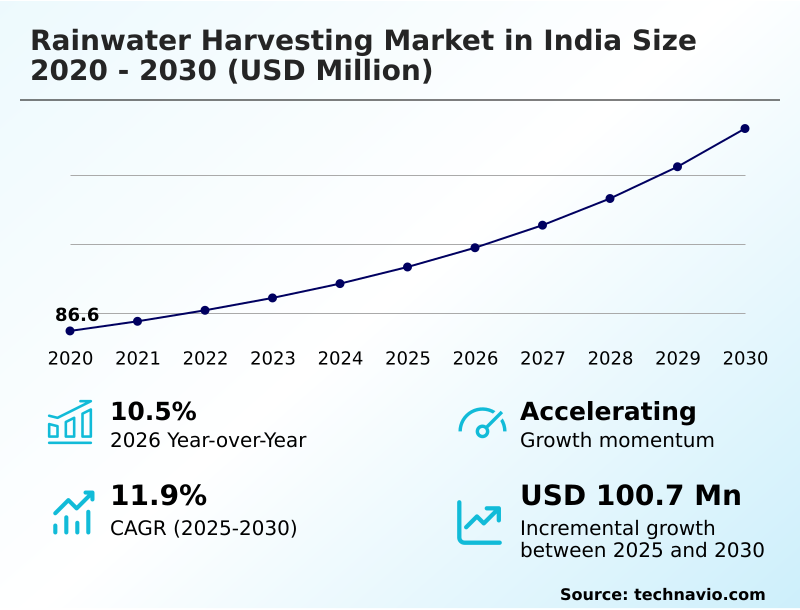
The India Rainwater Harvesting Market size was valued at USD 133.1 million in 2025 growing at a CAGR of 11.9% during the forecast period 2026-2030.
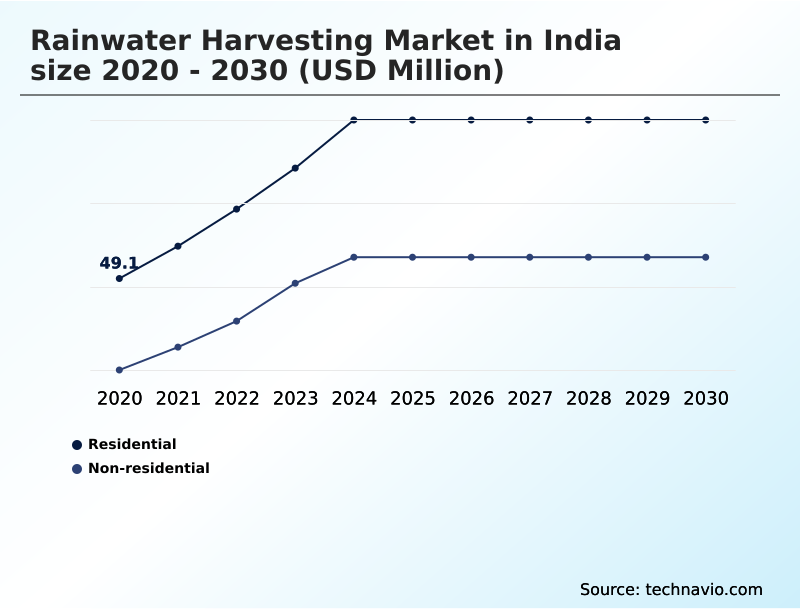
The Residential segment by End-user was valued at USD 69.2 million in 2024, while the Surface-based segment holds the largest revenue share by Application.
The market is projected to grow by USD 147.2 million from 2020 to 2030, with USD 100.7 million of the growth expected during the forecast period of 2025 to 2030.
Get Key Insights on Market Forecast (PDF) Request Free Sample
India Rainwater Harvesting Market Overview
The rainwater harvesting market in India is expanding, with a year-over-year growth of 10.5%, driven by acute water stress and regulatory pressures. This expansion is not just about installing tanks; it involves a sophisticated approach to decentralized water management, where surface runoff management is as critical as rooftop collection. Key applications now include non-potable water reuse for industrial processes and supplementing municipal supplies in large commercial complexes. For instance, a new commercial building in a Tier-1 city integrates a system combining permeable pavement systems with subsurface aquifer storage. This design captures stormwater, filters it through gravity-based filtration units, and uses it for HVAC cooling and landscaping, reducing reliance on municipal water. This trend is supported by the deployment of water quality monitoring sensors and real-time data tracking, which provides auditable proof of water savings and compliance with environmental standards, enhancing the overall climate resilience infrastructure.
Drivers, Trends, and Challenges in the India Rainwater Harvesting Market
The rainwater harvesting market in India is set for substantial expansion, with an incremental growth of USD 100.7 million. This growth is underpinned by a pressing need to address water security, moving beyond theory to practical application.
For instance, a cost-benefit analysis of rainwater harvesting installation for large residential complexes often reveals a payback period significantly shorter than initially perceived, especially when factoring in the rising costs of tanker water. In the industrial sector, the use of rainwater harvesting systems for industrial cooling is becoming a standard practice for achieving water neutrality.
An operational scenario in a textile processing unit shows that integrating rooftop capture with a closed-loop cooling system can reduce freshwater intake by over 40%. The effectiveness of green roofs for stormwater management is also being proven in urban centers, mitigating localized flooding.
The integration of rainwater harvesting with smart city infrastructure is a key focus, with automated monitoring of rainwater storage and quality becoming essential for efficient urban water management. Government actions, such as the mandate in Hyderabad for rainwater harvesting compliance for new constructions, are accelerating adoption.
Decision-makers are now evaluating everything from the technical specifications for ferrocement storage tanks to financing and subsidy options for rainwater harvesting to ensure sustainable and economically viable solutions.
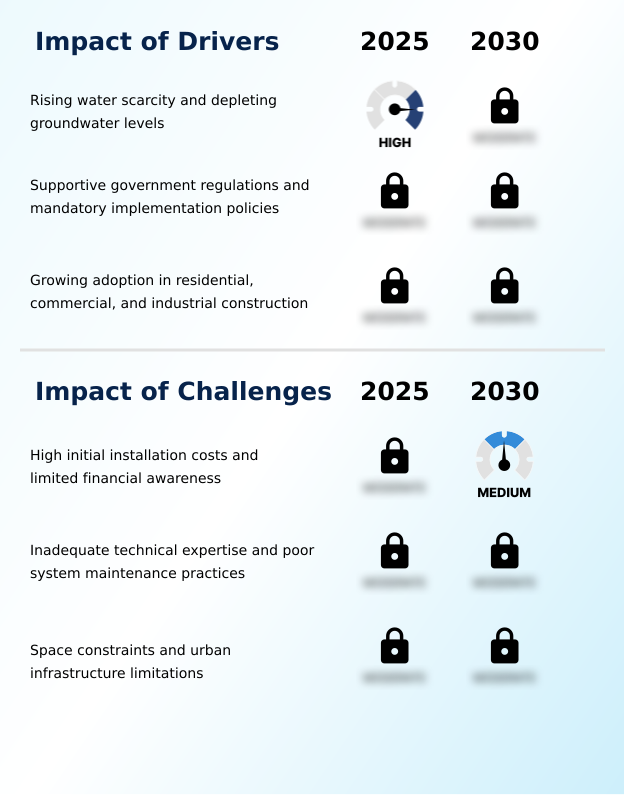
Primary Growth Driver: Intensifying water scarcity and the depletion of groundwater levels serve as the primary drivers for the adoption of rainwater harvesting systems across India.
The primary driver for the rainwater harvesting market in India, which accounts for 100% of the incremental growth in APAC, is the escalating pressure on water resources from rapid urbanization and severe groundwater table depletion.
This has created a critical dependency on decentralized water management to ensure long-term water security. Industrial and commercial sectors are adopting these systems to meet internal water neutrality targets and comply with tightening environmental compliance standards.
The unreliability and rising cost of municipal water supply dependency are forcing property owners and businesses to invest in on-site water capture as a risk mitigation strategy.
This shift reflects a broader recognition of water resource sustainability as a core operational necessity rather than an optional green initiative.
Emerging Market Trend: The integration of rainwater harvesting with smart water management technologies is an emerging trend. This involves incorporating digital monitoring tools to optimize water collection, storage, and usage.
A defining trend is the integration of smart water management with harvesting systems, transitioning from passive collection to active resource optimization. This involves the deployment of water quality monitoring sensors and automated water level controllers that provide real-time data tracking on storage levels, usage patterns, and system efficiency.
As a result, commercial and industrial users are increasingly seeking turnkey system implementation that includes these digital overlays. This technological shift enables predictive maintenance and ensures that water directed toward non-potable water reuse meets required standards.
The adoption of self-cleaning filter mechanisms and other automated components reduces operational burdens, making sophisticated systems more accessible and reliable for a wider range of applications, from residential complexes to large industrial facilities.
Key Industry Challenge: High initial installation costs, coupled with limited financial awareness and a lack of accessible financing options, present a significant challenge to widespread market adoption.
A significant challenge restraining market growth is the high initial installation costs, which are a major deterrent for many potential residential and small commercial adopters. This is compounded by a high degree of price sensitivity among buyers and a general lack of awareness regarding available financing and subsidy options for rainwater harvesting.
The technical expertise required for proper system design and installation is often scarce, leading to suboptimal performance and a negative perception of the technology's effectiveness. Furthermore, ongoing system maintenance requirements are frequently underestimated in the initial cost-benefit analysis of rainwater harvesting installation.
In densely populated urban areas, physical space constraints for citing storage tanks and recharge structures add another layer of complexity, hindering widespread implementation.
Explore Full Market Dynamics Analysis Request Free Sample
India Rainwater Harvesting Market Segmentation
The india rainwater harvesting industry research report provides comprehensive data including region-wise segment analysis, with forecasts and analysis for the period 2026-2030, as well as historical data from 2020-2024 for the following segments.
End-user Segment Analysis
The residential segment is estimated to witness significant growth during the forecast period.
The residential segment is foundational to the rainwater harvesting market in India, accounting for over 57% of demand. Adoption is driven by households in dense urban areas seeking domestic water self-sufficiency to counter unreliable municipal supplies.
Homeowners and housing societies are implementing integrated solutions, from basic first-flush diverter systems to more advanced setups featuring modular rainwater storage tanks for non-potable use.
This push toward decentralized water management is reinforced by local mandates requiring new constructions to include systems for rooftop catchment.
As a result, procurement decisions increasingly favor systems that not only provide a buffer water supply but also contribute to local aquifer recharge wells, aligning with broader water conservation goals and enhancing property value through improved sustainability credentials.
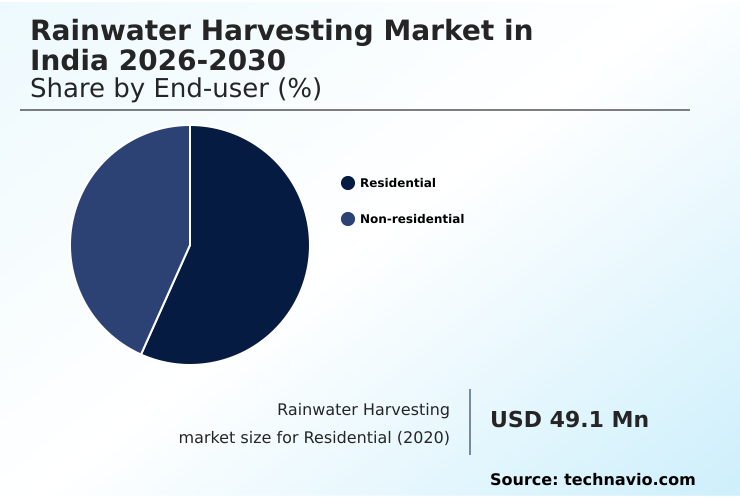
The Residential segment was valued at USD 69.2 million in 2024 and showed a gradual increase during the forecast period.
Customer Landscape Analysis for the India Rainwater Harvesting Market
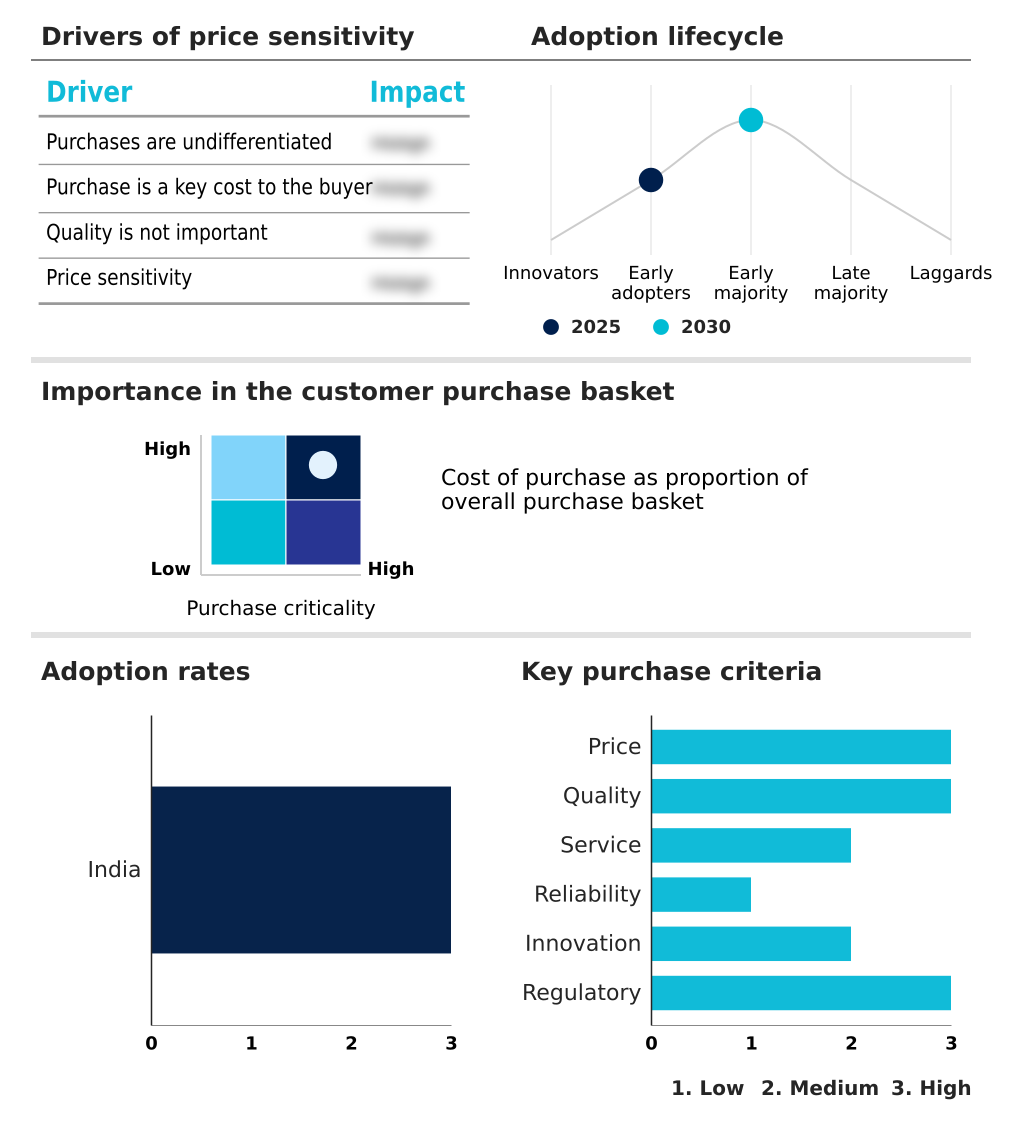
The india rainwater harvesting market forecasting report includes the adoption lifecycle of the market, covering from the innovator’s stage to the laggard’s stage. It focuses on adoption rates in different regions based on penetration. Furthermore, the india rainwater harvesting market report also includes key purchase criteria and drivers of price sensitivity to help companies evaluate and develop their market growth analysis strategies.
Competitive Landscape of the India Rainwater Harvesting Market
Companies are implementing various strategies, such as strategic alliances, partnerships, mergers and acquisitions, geographical expansion, and product/service launches, to enhance their presence in the india rainwater harvesting market industry.
Ashwath Infratech - Analyst View: The firm focuses on advanced filtration, leveraging proprietary cross-wave technology to optimize water capture, reuse, and groundwater recharge for diverse applications.
The industry research and growth report includes detailed analyses of the competitive landscape of the market and information about key companies, including:
- Ashwath Infratech
- D and D Ecotech Services
- Era Hydrobiotech Energy Ltd.
- Farmons Techno Pvt. Ltd.
- FRHS
- Hydrostatics Watertech LLP
- JAD Ferrocements
- Jaldhara Water Solutions
- KRG India Research Centre
- Osmosis Autopump Pvt. Ltd.
- Shree Saideep Multiservices
- Sunlight Consultancy Pvt. Ltd.
- The Supreme Industries Ltd.
- Vardhman Envirotech
- Vikas Industries
- Water Field Technologies Ltd.
Qualitative and quantitative analysis of companies has been conducted to help clients understand the wider business environment as well as the strengths and weaknesses of key industry players. Data is qualitatively analyzed to categorize companies as pure play, category-focused, industry-focused, and diversified; it is quantitatively analyzed to categorize companies as dominant, leading, strong, tentative, and weak.
Recent Developments in the India Rainwater Harvesting Market
- In September 2024, the Greater Hyderabad Municipal Corporation announced a mandate requiring rainwater harvesting systems for all properties with a construction area exceeding 300 square meters to promote sustainable water use and improve groundwater levels.
- In March 2025, the Ministry of Jal Shakti launched the 'Jal Shakti Abhiyan: Catch the Rain 2025' campaign, a nationwide initiative focused on water conservation and rainwater harvesting through enhanced community participation and the development of innovative water management strategies.
- In March 2025, the Karnataka government amended its urban development and water quality regulations for Bengaluru, mandating the installation of in-situ sewage treatment plants (STPs) for all residential complexes with more than 120 apartments to manage wastewater on-site.
- In May 2025, Vardhman Envirotech released a technical brief detailing the principles of natural groundwater recharge, emphasizing the critical role of artificial recharge technologies in mitigating the effects of declining water tables in water-stressed regions.
Research Analyst Overview: India Rainwater Harvesting Market
The rainwater harvesting market in India is defined by a critical need for localized water solutions, with the residential segment constituting the majority of market share. Boardroom decisions on capital expenditure now frequently weigh the upfront cost of advanced systems against the long-term operational risk of water unavailability.
The implementation of government programs like the Jal Shakti Abhiyan has accelerated the deployment of groundwater recharge pits and v-wire screen filtration. A key technical trend is the shift from basic collection to integrated systems using automated water level controllers and self-cleaning filter mechanisms, which reduce maintenance overhead.
For instance, a commercial real estate developer must now assess the total cost of ownership of installing in-situ sewage treatment plants alongside modular rainwater storage tanks, a decision directly impacting project viability.
This involves complex hydrological feasibility studies to optimize systems that manage both surface runoff and rooftop catchment, ensuring facilities meet water neutrality targets while utilizing technologies like cross-wave technology filters for efficient non-potable water reuse.
Dive into Technavio’s robust research methodology, blending expert interviews, extensive data synthesis, and validated models for unparalleled India Rainwater Harvesting Market insights. See full methodology.
| Market Scope | |
|---|---|
| Page number | 177 |
| Base year | 2025 |
| Historic period | 2020-2024 |
| Forecast period | 2026-2030 |
| Growth momentum & CAGR | Accelerate at a CAGR of 11.9% |
| Market growth 2026-2030 | USD 100.7 million |
| Market structure | Fragmented |
| YoY growth 2025-2026(%) | 10.5% |
| Key countries | India |
| Competitive landscape | Leading Companies, Market Positioning of Companies, Competitive Strategies, and Industry Risks |
India Rainwater Harvesting Market: Key Questions Answered in This Report
-
What is the expected growth of the India Rainwater Harvesting Market between 2026 and 2030?
-
The India Rainwater Harvesting Market is expected to grow by USD 100.7 million during 2026-2030, registering a CAGR of 11.9%. Year-over-year growth in 2026 is estimated at 10.5%%. This acceleration is shaped by rising water scarcity and depleting groundwater levels, which is intensifying demand across multiple end-use verticals covered in the report.
-
-
What segmentation does the market report cover?
-
The report is segmented by End-user (Residential, and Non-residential), Application (Surface-based, and Rooftop-based), Type (Wet system, Rain barrel system, Dry system, and Green roof system) and Geography (APAC). Among these, the Residential segment is estimated to witness significant growth during the forecast period, driven by rising adoption across key application areas. Each segment includes detailed qualitative and quantitative analysis, along with historical data from 2020-2024 and forecasts through 2030 with year-over-year growth rates.
-
-
Which regions are analyzed in the report?
-
The report covers APAC. Country-level analysis includes India, with dedicated market size tables and year-over-year growth for each.
-
-
What are the key growth drivers and market challenges?
-
The primary driver is rising water scarcity and depleting groundwater levels, which is accelerating investment and industry demand. The main challenge is high initial installation costs and limited financial awareness, creating operational barriers for key market participants. The report quantifies the impact of each driver and challenge across 2026 and 2030 with comparative analysis.
-
-
Who are the major players in the India Rainwater Harvesting Market?
-
Key vendors include Ashwath Infratech, D and D Ecotech Services, Era Hydrobiotech Energy Ltd., Farmons Techno Pvt. Ltd., FRHS, Hydrostatics Watertech LLP, JAD Ferrocements, Jaldhara Water Solutions, KRG India Research Centre, Osmosis Autopump Pvt. Ltd., Shree Saideep Multiservices, Sunlight Consultancy Pvt. Ltd., The Supreme Industries Ltd., Vardhman Envirotech, Vikas Industries and Water Field Technologies Ltd.. The report provides qualitative and quantitative analysis categorizing companies as dominant, leading, strong, tentative, and weak based on their market positioning. Company profiles include business segment analysis, SWOT assessment, key offerings, and recent strategic developments.
-
India Rainwater Harvesting Market Research Insights
Market dynamics are shaped by regulatory actions like the BBMP Amendment Bill-2025, which empowers municipal bodies to enforce stricter water management standards. This legislative push compels commercial and residential developers to move beyond basic compliance toward implementing comprehensive water conservation solutions. The emphasis on sustainable water resource management creates demand for advanced rainwater harvesting consultancy to navigate complex local bylaws.
As groundwater table depletion accelerates, decision-makers are prioritizing long-term water security, influencing procurement to favor systems that support both immediate needs and aquifer health. This shift is evident as industrial water conservation efforts increasingly incorporate rainwater harvesting to meet internal sustainability goals and reduce operational risks associated with water scarcity, reflecting a move toward greater accountability in water use.
We can help! Our analysts can customize this india rainwater harvesting market research report to meet your requirements.
 RIA -
RIA - 
