

Industrial Chillers Market Analysis APAC, North America, Europe, Middle East and Africa, South America - US, China, Japan, Germany, UK - Size and Forecast 2024-2028

Industrial Chillers Market Analysis APAC, North America, Europe, Middle East and Africa, South America - US, China, Japan, Germany, UK - Size and Forecast 2024-2028

Published: Jul 2024 166 Pages SKU: IRTNTR75082

Market Overview at a Glance

$1.28 B
Market Opportunity
4.36%
CAGR
4.11
YoY growth 2023-2024(%)

Industrial Chillers Market Size 2024-2028

The industrial chillers market size is forecast to increase by USD 1.28 billion at a CAGR of 4.36% between 2023 and 2028.

  • The market is experiencing significant growth due to the increasing adoption of district heating and cooling infrastructure. This trend is driven by the need to reduce energy consumption and improve overall efficiency in industrial processes. Another key factor fueling market growth is the advent of smart connected chillers, which offer enhanced control and monitoring capabilities. However, high capital and maintenance costs remain challenges for market growth. Industrial chillers are essential for various industries to maintain optimal operating temperatures, particularly in sectors such as food and beverage, pharmaceuticals, and chemical manufacturing. As energy efficiency becomes a top priority for businesses, the market for industrial chillers is expected to continue expanding.
  • What will be the Size of the Industrial Chillers Market During the Forecast Period?
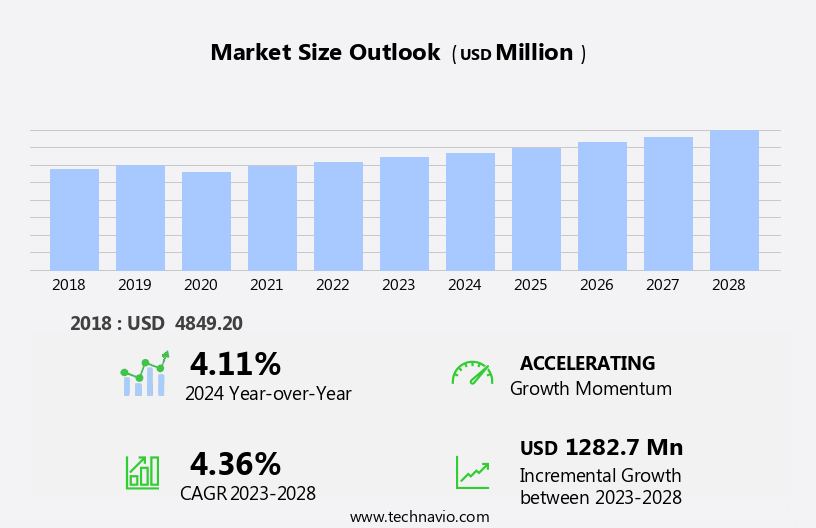
    Industrial Chillers Market Size

     Request Free Sample

  • The market caters to various industries, including food and beverage, pharmaceuticals, and data centers, among others. Driven by factors such as increasing standards of living and the demand for air conditioners, refrigerators, and frozen food, the market is experiencing significant growth. Industrial chillers play a crucial role in process cooling applications, such as food baking, pasteurization processes, and temperature regulation for laser treatment tools and cat scanners. With the rise of busy lifestyles and the need for energy efficiency, advanced technologies and smart controls are becoming increasingly popular. Energy efficiency is a major concern for homeowners and businesses alike, making industrial chillers with high energy efficiency ratings a preferred choice.
  • The commercial sector, including data centers and critical processes, is also adopting sustainable building practices and energy efficiency standards, further fueling market growth. Additionally, sensors and predictive maintenance features are enhancing equipment reliability and reducing environmental impact.
  • How is this Industrial Chillers Industry segmented and which is the largest segment?

    The industrial chillers industry research report provides comprehensive data (region-wise segment analysis), with forecasts and estimates in "USD million" for the period 2024-2028, as well as historical data from 2018-2022 for the following segments.

    • End-user
      • Chemical and petrochemical
      • Plastics
      • Food and beverage
      • Pharmaceuticals and biotechnology
      • Others
    • Type
      • Water chillers
      • Air chillers
    • Geography
      • APAC
        • China
        • Japan
      • North America
        • US
      • Europe
        • Germany
        • UK
      • Middle East and Africa
        • South America

        By End-user Insights

        • The chemical and petrochemical segment is estimated to witness significant growth during the forecast period.

        Industrial chillers play a crucial role In the industrial sector by maintaining the temperature of process equipment and refrigeration of temperature-sensitive materials. Major consumers of industrial chillers include the chemical and petrochemical industries, which require low-temperature conditions for their processes. These chillers can be integrated directly with industrial processes, utilizing waste heat generated by equipment such as flue gases, wastewater, reflux condensers, compressor interstages, and expander plants. This integration not only reduces fuel consumption but also minimizes the environmental impact by decreasing the amount of heat rejected to the environment. Advanced technologies like smart controls, temperature regulation, and energy efficiency standards enhance the performance and sustainability of industrial chillers.

        The commercial sector, including data centers and food industries, also benefits from industrial chillers for occupant comfort, equipment reliability, and critical processes. Sustainable building practices and low environmental impact naturally are essential considerations In the selection of industrial chillers, with options including water-cooled chillers, air-cooled chillers, and cooling towers. Water scarcity is a concern, leading to the adoption of low GWP refrigerants, HFOs, natural refrigerants like CO2, and expandability, compact design, wireless technology, and remote monitoring features.
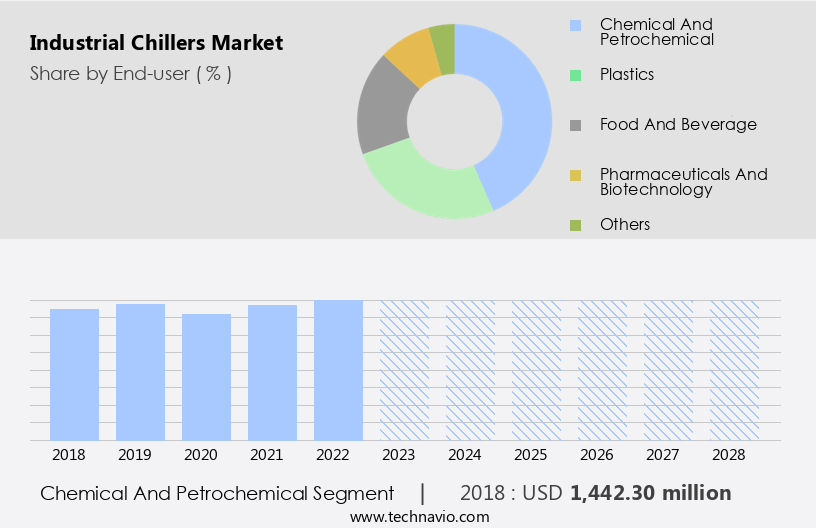
        Industrial Chillers Market Size

        Get a glance at the  Industrial Chillers Industry report of share of various segments Request Free Sample

        The Chemical and petrochemical segment was valued at USD 1.44 billion in 2018 and showed a gradual increase during the forecast period.

        Regional Analysis

        • APAC is estimated to contribute 45% to the growth of the global market during the forecast period.

        Technavio’s analysts have elaborately explained the regional trends and drivers that shape the market during the forecast period.
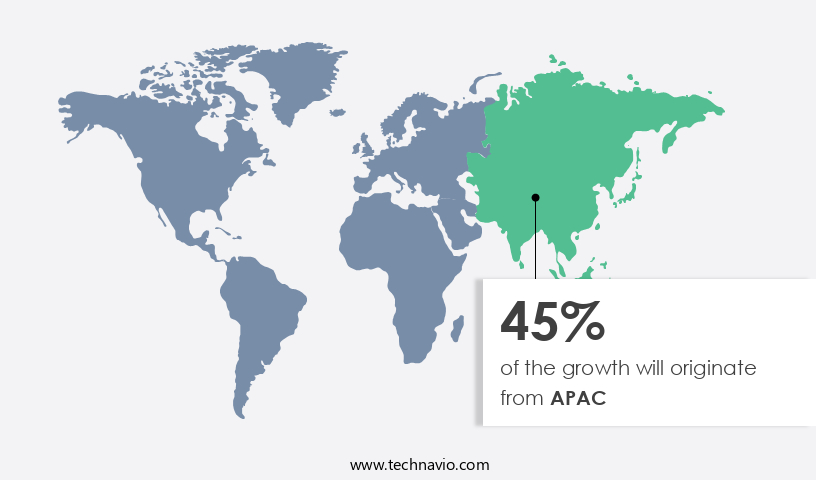
        Industrial Chillers Market Share by Geography

        For more insights on the market share of various regions, Request Free Sample

        The industrial chiller market in Asia Pacific (APAC) experiences significant growth due to increasing industrialization, urbanization, and population expansion in countries like China, Japan, India, and Southeast Asia. The surge in commercial and residential construction projects necessitates the use of medium to large-scale heating, ventilation, air conditioning, and refrigeration (HVAC and R) systems, thereby fueling the demand for industrial chillers. Additionally, the implementation of green building initiatives in countries such as China and India is another factor contributing to the market's growth. Industrial chillers are essential components in various industries, including food and beverage, pharmaceuticals, and data centers, where temperature regulation is crucial for process cooling, food baking, pasteurization, heat treatment, and critical processes.

        The adoption of advanced technologies, such as smart controls, sensors, predictive maintenance features, and remote monitoring, enhances equipment reliability and energy efficiency. Moreover, the use of low GWP refrigerants, such as HFOs and natural refrigerants like CO2, contributes to the market's growth while minimizing environmental impact. The commercial sector, including data centers, demands energy-efficient industrial chillers to ensure occupant comfort and critical process continuity. The market is expected to grow further due to sustainable building practices and energy efficiency standards.

        Market Dynamics

        Our  researchers analyzed the data with 2023 as the base year, along with the key drivers, trends, and challenges. A holistic analysis of drivers will help companies refine their marketing strategies to gain a competitive advantage.

        What are the key market drivers leading to the rise In the adoption of Industrial Chillers Industry?

        Growing adoption of district heating and cooling infrastructure is the key driver of the market.

      • Industrial chillers play a crucial role in district cooling systems, which provide centralized heating and cooling solutions to large areas. These systems, which utilize chilled or heated water transported through insulated pipelines, offer several advantages over traditional air-cooling methods. They boast increased energy efficiency, reduced environmental impact, and lower maintenance requirements. Industrial chillers, capable of processing and cooling vast quantities of water, are integral to district cooling plants. By opting for district cooling, businesses and homeowners In the commercial sector can prioritize occupant comfort and equipment reliability while managing critical processes. Advanced technologies, such as smart controls and sensors, enable predictive maintenance features and remote monitoring.
      • Moreover, the adoption of low GWP refrigerants, including HFOs and natural refrigerants like CO2, contributes to the sustainability of these systems. Compact designs, expandability, and wireless technology further enhance their appeal. Despite water scarcity concerns, district cooling systems with water-cooled and air-cooled chillers, as well as cooling towers, continue to gain traction due to their low environmental impact.
      • What are the market trends shaping the Industrial Chillers Industry?

        Advent of smart connected chillers is the upcoming market trend.

      • The market is witnessing significant growth due to the increasing demand for temperature regulation in various sectors, including food processing, data centers, and the metal and plastics industries. Advanced technologies such as smart controls, sensors, and predictive maintenance features are being integrated into chillers to enhance equipment reliability and optimize energy efficiency. These innovations enable operators to monitor chiller performance in real-time, reducing downtime and maintenance costs. Moreover, the adoption of low GWP refrigerants, such as HFOs and natural refrigerants like CO2, is a critical trend In the market. These refrigerants have a lower environmental impact compared to traditional refrigerants, making them an attractive option for industries striving for sustainable building practices and energy efficiency standards.
      • Smart connected chillers are revolutionizing the market, offering remote monitoring, wireless technology, and expandability. These chillers allow for temperature regulation in busy lifestyles, ensuring occupant comfort In the commercial sector, and maintaining critical processes in data centers. With the integration of sensors and predictive maintenance features, operators can minimize downtime and optimize energy consumption, ultimately leading to cost savings. Water scarcity is a concern for many industries, leading to the adoption of water-cooled and air-cooled chillers, as well as cooling towers. These solutions help reduce water usage and minimize the environmental impact of cooling systems. Overall, the market is expected to continue growing, driven by the need for energy efficiency, temperature regulation, and sustainable practices.
      • What challenges does the Industrial Chillers Industry face during its growth?

        High capital and maintenance costs is a key challenge affecting the industry growth.

      • The market is witnessing significant growth due to the increasing focus on energy efficiency in various industries. Air conditioners and refrigerators in both residential and commercial sectors, as well as process cooling applications in industries like food baking, pasteurization processes, and laser treatment tools in manufacturing, are driving the demand for industrial chillers. The data center industry is another major consumer of industrial chillers, requiring advanced temperature regulation systems for critical processes. However, the high initial and maintenance costs of industrial chillers may hinder market growth. Energy-efficient industrial chillers, such as water-cooled and air-cooled chillers, are more expensive than conventional models but offer long-term energy savings.
      • The market is also witnessing the adoption of low GWP refrigerants, including HFOs and natural refrigerants like CO2, to reduce environmental impact. Moreover, the commercial sector is increasingly adopting sustainable building practices and energy efficiency standards, leading to the demand for industrial chillers with expandability, compact designs, and wireless technology for remote monitoring and predictive maintenance features. The market is also witnessing the integration of sensors and smart controls for temperature regulation and equipment reliability. Despite these opportunities, water scarcity and the need for low environmental impact are emerging challenges for the market. The market is expected to grow significantly In the forecast period, with key applications including the metal and plastics industries.
      • Industrial chillers play a crucial role in maintaining occupant comfort and ensuring the reliability of critical processes.
      • Exclusive Customer Landscape

        The industrial chillers market forecasting report includes the adoption lifecycle of the market, covering from the innovator’s stage to the laggard’s stage. It focuses on adoption rates in different regions based on penetration. Furthermore, the industrial chillers market report also includes key purchase criteria and drivers of price sensitivity to help companies evaluate and develop their market growth analysis strategies.
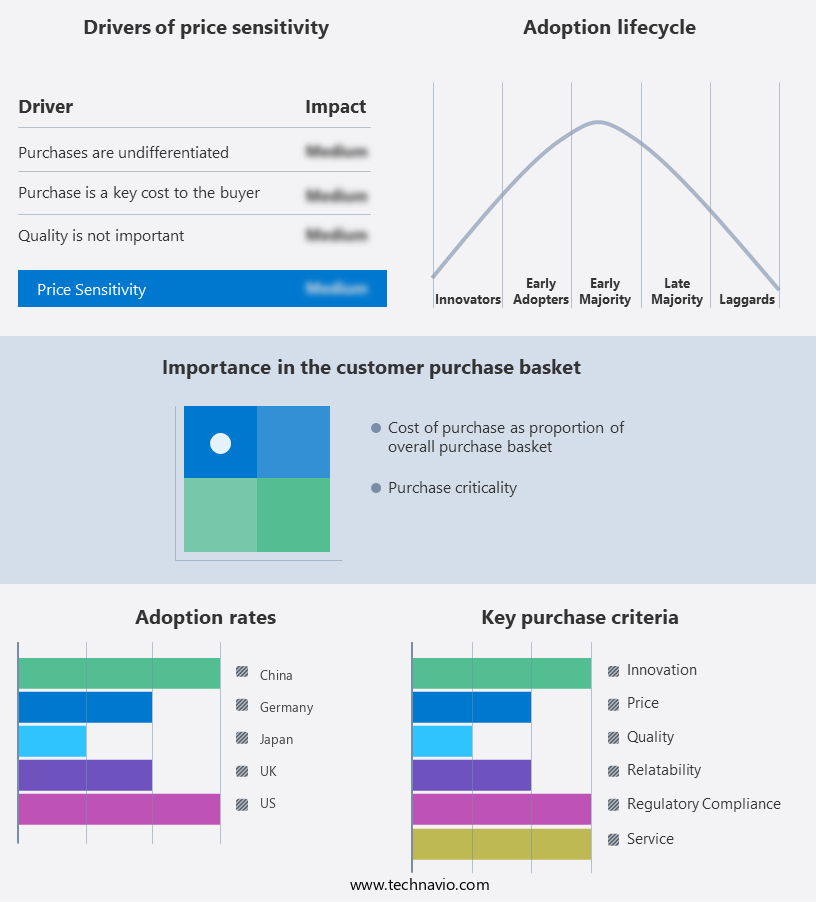
        Industrial Chillers Market Share by Geography

         Customer Landscape

        Key Companies & Market Insights

        Companies are implementing various strategies, such as strategic alliances, industrial chillers market forecast, partnerships, mergers and acquisitions, geographical expansion, and product/service launches, to enhance their presence In the industry.

        ait deutschland GmbH - Industrial chillers, offered by the company, are designed for maximum efficiency, enabling businesses to minimize operating costs. These chillers optimize energy usage, reducing overall energy consumption and expenses. By implementing advanced technologies and engineering solutions, the industrial chillers ensure reliable and consistent cooling performance, making them an essential investment for energy-conscious businesses.

        The industry research and growth report includes detailed analyses of the competitive landscape of the market and information about key companies, including:

        • ait deutschland GmbH
        • Carrier Global Corp.
        • Daikin Industries Ltd.
        • Drake Refrigeration Inc.
        • FRIGEL FIRENZE S.p.A.
        • Friulair S.r.l.
        • General Air Products
        • HYDAC Technology Corp.
        • Johnson Controls International Plc.
        • LG Corp.
        • Mitsubishi Electric Corp.
        • MTA S.p.A.
        • Paul Mueller Co. Inc.
        • PolyScience
        • RTX Corp.
        • Reynold India Pvt. Ltd.
        • Senho Machinery Shenzhen Co. Ltd.
        • Sentry Equipment Corp.
        • Smardt Chiller Group Inc.
        • Trane Technologies Plc

        Qualitative and quantitative analysis of companies has been conducted to help clients understand the wider business environment as well as the strengths and weaknesses of key industry players. Data is qualitatively analyzed to categorize companies as pure play, category-focused, industry-focused, and diversified; it is quantitatively analyzed to categorize companies as dominant, leading, strong, tentative, and weak.

        Research Analyst Overview

        The industrial chiller market encompasses a broad range of applications, primarily focused on process cooling for various industries. These systems play a crucial role in maintaining optimal temperatures for various manufacturing processes, ensuring product quality and efficiency. Process cooling is a fundamental requirement in numerous industries, including but not limited to food and beverage, pharmaceuticals, and chemical manufacturing. In food processing, chilled water is utilized in baking, pasteurization, and other temperature-sensitive processes to enhance product quality and prolong shelf life. In the pharmaceutical sector, precise temperature control is essential for maintaining the stability of active ingredients during manufacturing. Industrial chillers are also indispensable In the manufacturing sector, particularly In the metal and plastics industries.

        The metal industry relies on chillers for various applications, such as quenching, forming, and heat treatment processes. In the plastics industry, chillers are used to cool down molten plastic during the injection molding process, ensuring the production of high-quality end products. The data center industry is another significant consumer of industrial chillers. These facilities require large amounts of cooling to maintain optimal operating temperatures for their servers and other IT equipment. Chillers play a vital role in ensuring energy efficiency and reliability in data centers, which is crucial for their continuous operation. Advanced technologies, such as smart controls and sensors, have become increasingly prevalent in industrial chillers.

        These features enable predictive maintenance, remote monitoring, and energy efficiency, making them a popular choice for businesses seeking to optimize their operations and reduce costs. Energy efficiency is a critical consideration In the industrial chiller market. With increasing awareness of environmental impact and energy costs, there is a growing demand for chillers that consume less energy and have a lower carbon footprint. Low Global Warming Potential (GWP) refrigerants and natural refrigerants, such as CO2, are gaining popularity due to their environmental benefits. The commercial sector, including offices and retail spaces, also utilizes industrial chillers for temperature regulation and occupant comfort.

        Sustainable building practices and energy efficiency standards have become increasingly important in this sector, making chillers with expandability, compact design, and wireless technology attractive options. Water scarcity is another factor driving innovation In the industrial chiller market. Cooling towers, a common component of traditional chillers, consume large amounts of water. However, new technologies, such as air-cooled chillers and water-cooled chillers with closed-loop systems, offer more water-efficient alternatives. In conclusion, the industrial chiller market is a dynamic and evolving sector that plays a crucial role in various industries, from food and beverage to data centers. With a focus on energy efficiency, sustainability, and advanced technologies, industrial chillers continue to adapt to the changing needs of businesses and consumers.

        Market Scope

        Report Coverage

        Details

        Page number

        166

        Base year

        2023

        Historic period

        2018-2022

        Forecast period

        2024-2028

        Growth momentum & CAGR

        Accelerate at a CAGR of 4.36%

        Market growth 2024-2028

        USD 1282.7 million

        Market structure

        Fragmented

        YoY growth 2023-2024(%)

        4.11

        Key countries

        US, China, Japan, Germany, and UK

        Competitive landscape

        Leading Companies, Market Positioning of Companies, Competitive Strategies, and Industry Risks

        Request Free Sample

        What are the Key Data Covered in this Industrial Chillers Market Research and Growth Report?

        • CAGR of the Industrial Chillers industry during the forecast period
        • Detailed information on factors that will drive the growth and forecasting between 2024 and 2028
        • Precise estimation of the size of the market and its contribution of the industry in focus to the parent market
        • Accurate predictions about upcoming growth and trends and changes in consumer behaviour
        • Growth of the market across APAC, North America, Europe, Middle East and Africa, and South America
        • Thorough analysis of the market’s competitive landscape and detailed information about companies
        • Comprehensive analysis of factors that will challenge the industrial chillers market growth of industry companies

        We can help! Our analysts can customize this industrial chillers market research report to meet your requirements.

        Get in touch


        1 Executive Summary

        • 1.1 Market overview
          • Executive Summary - Chart on Market Overview
          • Executive Summary - Data Table on Market Overview
          • Executive Summary - Chart on Global Market Characteristics
          • Executive Summary - Chart on Market by Geography
          • Executive Summary - Chart on Market Segmentation by End-user
          • Executive Summary - Chart on Market Segmentation by Type
          • Executive Summary - Chart on Incremental Growth
          • Executive Summary - Data Table on Incremental Growth
          • Executive Summary - Chart on Company Market Positioning

        2 Market Landscape

        • 2.1 Market ecosystem
          • Parent Market
          • Data Table on - Parent Market
        • 2.2 Market characteristics
          • Market characteristics analysis
        • 2.3 Value chain analysis
          • Value Chain Analysis

        3 Market Sizing

        • 3.1 Market definition
          • Offerings of companies included in the market definition
        • 3.2 Market segment analysis
          • Market segments
        • 3.3 Market size 2023
          • 3.4 Market outlook: Forecast for 2023-2028
            • Chart on Global - Market size and forecast 2023-2028 ($ million)
            • Data Table on Global - Market size and forecast 2023-2028 ($ million)
            • Chart on Global Market: Year-over-year growth 2023-2028 (%)
            • Data Table on Global Market: Year-over-year growth 2023-2028 (%)

          4 Historic Market Size

          • 4.1 Global Industrial Chillers Market 2018 - 2022
            • Historic Market Size - Data Table on Global Industrial Chillers Market 2018 - 2022 ($ million)
          • 4.2 End-user segment analysis 2018 - 2022
            • Historic Market Size - End-user Segment 2018 - 2022 ($ million)
          • 4.3 Type segment analysis 2018 - 2022
            • Historic Market Size - Type Segment 2018 - 2022 ($ million)
          • 4.4 Geography segment analysis 2018 - 2022
            • Historic Market Size - Geography Segment 2018 - 2022 ($ million)
          • 4.5 Country segment analysis 2018 - 2022
            • Historic Market Size - Country Segment 2018 - 2022 ($ million)

          5 Five Forces Analysis

          • 5.1 Five forces summary
            • Five forces analysis - Comparison between 2023 and 2028
          • 5.2 Bargaining power of buyers
            • Bargaining power of buyers - Impact of key factors 2023 and 2028
          • 5.3 Bargaining power of suppliers
            • Bargaining power of suppliers - Impact of key factors in 2023 and 2028
          • 5.4 Threat of new entrants
            • Threat of new entrants - Impact of key factors in 2023 and 2028
          • 5.5 Threat of substitutes
            • Threat of substitutes - Impact of key factors in 2023 and 2028
          • 5.6 Threat of rivalry
            • Threat of rivalry - Impact of key factors in 2023 and 2028
          • 5.7 Market condition
            • Chart on Market condition - Five forces 2023 and 2028

          6 Market Segmentation by End-user

          • 6.1 Market segments
            • Chart on End-user - Market share 2023-2028 (%)
            • Data Table on End-user - Market share 2023-2028 (%)
          • 6.2 Comparison by End-user
            • Chart on Comparison by End-user
            • Data Table on Comparison by End-user
          • 6.3 Chemical and petrochemical - Market size and forecast 2023-2028
            • Chart on Chemical and petrochemical - Market size and forecast 2023-2028 ($ million)
            • Data Table on Chemical and petrochemical - Market size and forecast 2023-2028 ($ million)
            • Chart on Chemical and petrochemical - Year-over-year growth 2023-2028 (%)
            • Data Table on Chemical and petrochemical - Year-over-year growth 2023-2028 (%)
          • 6.4 Plastics - Market size and forecast 2023-2028
            • Chart on Plastics - Market size and forecast 2023-2028 ($ million)
            • Data Table on Plastics - Market size and forecast 2023-2028 ($ million)
            • Chart on Plastics - Year-over-year growth 2023-2028 (%)
            • Data Table on Plastics - Year-over-year growth 2023-2028 (%)
          • 6.5 Food and beverage - Market size and forecast 2023-2028
            • Chart on Food and beverage - Market size and forecast 2023-2028 ($ million)
            • Data Table on Food and beverage - Market size and forecast 2023-2028 ($ million)
            • Chart on Food and beverage - Year-over-year growth 2023-2028 (%)
            • Data Table on Food and beverage - Year-over-year growth 2023-2028 (%)
          • 6.6 Pharmaceuticals and biotechnology - Market size and forecast 2023-2028
            • Chart on Pharmaceuticals and biotechnology - Market size and forecast 2023-2028 ($ million)
            • Data Table on Pharmaceuticals and biotechnology - Market size and forecast 2023-2028 ($ million)
            • Chart on Pharmaceuticals and biotechnology - Year-over-year growth 2023-2028 (%)
            • Data Table on Pharmaceuticals and biotechnology - Year-over-year growth 2023-2028 (%)
          • 6.7 Others - Market size and forecast 2023-2028
            • Chart on Others - Market size and forecast 2023-2028 ($ million)
            • Data Table on Others - Market size and forecast 2023-2028 ($ million)
            • Chart on Others - Year-over-year growth 2023-2028 (%)
            • Data Table on Others - Year-over-year growth 2023-2028 (%)
          • 6.8 Market opportunity by End-user
            • Market opportunity by End-user ($ million)
            • Data Table on Market opportunity by End-user ($ million)

          7 Market Segmentation by Type

          • 7.1 Market segments
            • Chart on Type - Market share 2023-2028 (%)
            • Data Table on Type - Market share 2023-2028 (%)
          • 7.2 Comparison by Type
            • Chart on Comparison by Type
            • Data Table on Comparison by Type
          • 7.3 Water chillers - Market size and forecast 2023-2028
            • Chart on Water chillers - Market size and forecast 2023-2028 ($ million)
            • Data Table on Water chillers - Market size and forecast 2023-2028 ($ million)
            • Chart on Water chillers - Year-over-year growth 2023-2028 (%)
            • Data Table on Water chillers - Year-over-year growth 2023-2028 (%)
          • 7.4 Air chillers - Market size and forecast 2023-2028
            • Chart on Air chillers - Market size and forecast 2023-2028 ($ million)
            • Data Table on Air chillers - Market size and forecast 2023-2028 ($ million)
            • Chart on Air chillers - Year-over-year growth 2023-2028 (%)
            • Data Table on Air chillers - Year-over-year growth 2023-2028 (%)
          • 7.5 Market opportunity by Type
            • Market opportunity by Type ($ million)
            • Data Table on Market opportunity by Type ($ million)

          8 Customer Landscape

          • 8.1 Customer landscape overview
            • Analysis of price sensitivity, lifecycle, customer purchase basket, adoption rates, and purchase criteria

          9 Geographic Landscape

          • 9.1 Geographic segmentation
            • Chart on Market share by geography 2023-2028 (%)
            • Data Table on Market share by geography 2023-2028 (%)
          • 9.2 Geographic comparison
            • Chart on Geographic comparison
            • Data Table on Geographic comparison
          • 9.3 APAC - Market size and forecast 2023-2028
            • Chart on APAC - Market size and forecast 2023-2028 ($ million)
            • Data Table on APAC - Market size and forecast 2023-2028 ($ million)
            • Chart on APAC - Year-over-year growth 2023-2028 (%)
            • Data Table on APAC - Year-over-year growth 2023-2028 (%)
          • 9.4 North America - Market size and forecast 2023-2028
            • Chart on North America - Market size and forecast 2023-2028 ($ million)
            • Data Table on North America - Market size and forecast 2023-2028 ($ million)
            • Chart on North America - Year-over-year growth 2023-2028 (%)
            • Data Table on North America - Year-over-year growth 2023-2028 (%)
          • 9.5 Europe - Market size and forecast 2023-2028
            • Chart on Europe - Market size and forecast 2023-2028 ($ million)
            • Data Table on Europe - Market size and forecast 2023-2028 ($ million)
            • Chart on Europe - Year-over-year growth 2023-2028 (%)
            • Data Table on Europe - Year-over-year growth 2023-2028 (%)
          • 9.6 Middle East and Africa - Market size and forecast 2023-2028
            • Chart on Middle East and Africa - Market size and forecast 2023-2028 ($ million)
            • Data Table on Middle East and Africa - Market size and forecast 2023-2028 ($ million)
            • Chart on Middle East and Africa - Year-over-year growth 2023-2028 (%)
            • Data Table on Middle East and Africa - Year-over-year growth 2023-2028 (%)
          • 9.7 South America - Market size and forecast 2023-2028
            • Chart on South America - Market size and forecast 2023-2028 ($ million)
            • Data Table on South America - Market size and forecast 2023-2028 ($ million)
            • Chart on South America - Year-over-year growth 2023-2028 (%)
            • Data Table on South America - Year-over-year growth 2023-2028 (%)
          • 9.8 US - Market size and forecast 2023-2028
            • Chart on US - Market size and forecast 2023-2028 ($ million)
            • Data Table on US - Market size and forecast 2023-2028 ($ million)
            • Chart on US - Year-over-year growth 2023-2028 (%)
            • Data Table on US - Year-over-year growth 2023-2028 (%)
          • 9.9 China - Market size and forecast 2023-2028
            • Chart on China - Market size and forecast 2023-2028 ($ million)
            • Data Table on China - Market size and forecast 2023-2028 ($ million)
            • Chart on China - Year-over-year growth 2023-2028 (%)
            • Data Table on China - Year-over-year growth 2023-2028 (%)
          • 9.10 Japan - Market size and forecast 2023-2028
            • Chart on Japan - Market size and forecast 2023-2028 ($ million)
            • Data Table on Japan - Market size and forecast 2023-2028 ($ million)
            • Chart on Japan - Year-over-year growth 2023-2028 (%)
            • Data Table on Japan - Year-over-year growth 2023-2028 (%)
          • 9.11 Germany - Market size and forecast 2023-2028
            • Chart on Germany - Market size and forecast 2023-2028 ($ million)
            • Data Table on Germany - Market size and forecast 2023-2028 ($ million)
            • Chart on Germany - Year-over-year growth 2023-2028 (%)
            • Data Table on Germany - Year-over-year growth 2023-2028 (%)
          • 9.12 UK - Market size and forecast 2023-2028
            • Chart on UK - Market size and forecast 2023-2028 ($ million)
            • Data Table on UK - Market size and forecast 2023-2028 ($ million)
            • Chart on UK - Year-over-year growth 2023-2028 (%)
            • Data Table on UK - Year-over-year growth 2023-2028 (%)
          • 9.13 Market opportunity by geography
            • Market opportunity by geography ($ million)
            • Data Tables on Market opportunity by geography ($ million)

          10 Drivers, Challenges, and Opportunity/Restraints

          • 10.1 Market drivers
            • 10.2 Market challenges
              • 10.3 Impact of drivers and challenges
                • Impact of drivers and challenges in 2023 and 2028
              • 10.4 Market opportunities/restraints

                11 Competitive Landscape

                • 11.1 Overview
                  • 11.2 Competitive Landscape
                    • Overview on criticality of inputs and factors of differentiation
                  • 11.3 Landscape disruption
                    • Overview on factors of disruption
                  • 11.4 Industry risks
                    • Impact of key risks on business

                  12 Competitive Analysis

                  • 12.1 Companies profiled
                    • Companies covered
                  • 12.2 Market positioning of companies
                    • Matrix on companies position and classification
                  • 12.3 ait deutschland GmbH
                    • ait deutschland GmbH - Overview
                    • ait deutschland GmbH - Product / Service
                    • ait deutschland GmbH - Key offerings
                  • 12.4 Carrier Global Corp.
                    • Carrier Global Corp. - Overview
                    • Carrier Global Corp. - Business segments
                    • Carrier Global Corp. - Key news
                    • Carrier Global Corp. - Key offerings
                    • Carrier Global Corp. - Segment focus
                  • 12.5 Daikin Industries Ltd.
                    • Daikin Industries Ltd. - Overview
                    • Daikin Industries Ltd. - Business segments
                    • Daikin Industries Ltd. - Key news
                    • Daikin Industries Ltd. - Key offerings
                    • Daikin Industries Ltd. - Segment focus
                  • 12.6 Drake Refrigeration Inc.
                    • Drake Refrigeration Inc. - Overview
                    • Drake Refrigeration Inc. - Product / Service
                    • Drake Refrigeration Inc. - Key offerings
                  • 12.7 HYDAC Technology Corp.
                    • HYDAC Technology Corp. - Overview
                    • HYDAC Technology Corp. - Product / Service
                    • HYDAC Technology Corp. - Key offerings
                  • 12.8 Johnson Controls International Plc.
                    • Johnson Controls International Plc. - Overview
                    • Johnson Controls International Plc. - Business segments
                    • Johnson Controls International Plc. - Key news
                    • Johnson Controls International Plc. - Key offerings
                    • Johnson Controls International Plc. - Segment focus
                  • 12.9 LG Corp.
                    • LG Corp. - Overview
                    • LG Corp. - Business segments
                    • LG Corp. - Key news
                    • LG Corp. - Key offerings
                    • LG Corp. - Segment focus
                  • 12.10 Mitsubishi Electric Corp.
                    • Mitsubishi Electric Corp. - Overview
                    • Mitsubishi Electric Corp. - Business segments
                    • Mitsubishi Electric Corp. - Key news
                    • Mitsubishi Electric Corp. - Key offerings
                    • Mitsubishi Electric Corp. - Segment focus
                  • 12.11 MTA S.p.A.
                    • MTA S.p.A. - Overview
                    • MTA S.p.A. - Product / Service
                    • MTA S.p.A. - Key offerings
                  • 12.12 Paul Mueller Co. Inc.
                    • Paul Mueller Co. Inc. - Overview
                    • Paul Mueller Co. Inc. - Business segments
                    • Paul Mueller Co. Inc. - Key offerings
                    • Paul Mueller Co. Inc. - Segment focus
                  • 12.13 RTX Corp.
                    • RTX Corp. - Overview
                    • RTX Corp. - Business segments
                    • RTX Corp. - Key news
                    • RTX Corp. - Key offerings
                    • RTX Corp. - Segment focus
                  • 12.14 Reynold India Pvt. Ltd.
                    • Reynold India Pvt. Ltd. - Overview
                    • Reynold India Pvt. Ltd. - Product / Service
                    • Reynold India Pvt. Ltd. - Key offerings
                  • 12.15 Senho Machinery Shenzhen Co. Ltd.
                    • Senho Machinery Shenzhen Co. Ltd. - Overview
                    • Senho Machinery Shenzhen Co. Ltd. - Product / Service
                    • Senho Machinery Shenzhen Co. Ltd. - Key offerings
                  • 12.16 Smardt Chiller Group Inc.
                    • Smardt Chiller Group Inc. - Overview
                    • Smardt Chiller Group Inc. - Product / Service
                    • Smardt Chiller Group Inc. - Key offerings
                  • 12.17 Trane Technologies Plc
                    • Trane Technologies Plc - Overview
                    • Trane Technologies Plc - Business segments
                    • Trane Technologies Plc - Key news
                    • Trane Technologies Plc - Key offerings
                    • Trane Technologies Plc - Segment focus

                  13 Appendix

                  • 13.1 Scope of the report
                    • 13.2 Inclusions and exclusions checklist
                      • Inclusions checklist
                      • Exclusions checklist
                    • 13.3 Currency conversion rates for US$
                      • Currency conversion rates for US$
                    • 13.4 Research methodology
                      • Research methodology
                    • 13.5 Data procurement
                      • Information sources
                    • 13.6 Data validation
                      • Data validation
                    • 13.7 Validation techniques employed for market sizing
                      • Validation techniques employed for market sizing
                    • 13.8 Data synthesis
                      • Data synthesis
                    • 13.9 360 degree market analysis
                      • 360 degree market analysis
                    • 13.10 List of abbreviations
                      • List of abbreviations

                    Research Methodology

                    Technavio presents a detailed picture of the market by way of study, synthesis, and summation of data from multiple sources. The analysts have presented the various facets of the market with a particular focus on identifying the key industry influencers. The data thus presented is comprehensive, reliable, and the result of extensive research, both primary and secondary.

                    INFORMATION SOURCES

                    Primary sources

                    • Manufacturers and suppliers
                    • Channel partners
                    • Industry experts
                    • Strategic decision makers

                    Secondary sources

                    • Industry journals and periodicals
                    • Government data
                    • Financial reports of key industry players
                    • Historical data
                    • Press releases

                    DATA ANALYSIS

                    Data Synthesis

                    • Collation of data
                    • Estimation of key figures
                    • Analysis of derived insights

                    Data Validation

                    • Triangulation with data models
                    • Reference against proprietary databases
                    • Corroboration with industry experts

                    REPORT WRITING

                    Qualitative

                    • Market drivers
                    • Market challenges
                    • Market trends
                    • Five forces analysis

                    Quantitative

                    • Market size and forecast
                    • Market segmentation
                    • Geographical insights
                    • Competitive landscape

                    Interested in this report?

                    Get your sample now to see our research methodology and insights!

                    Download Now

                    Frequently Asked Questions

                    Industrial Chillers market growth will increase by $ 1282.7 mn during 2024-2028 .

                    The Industrial Chillers market is expected to grow at a CAGR of 4.36% during 2024-2028 .

                    Industrial Chillers market is segmented by End-user( Chemical and petrochemical, Plastics, Food and beverage, Pharmaceuticals and biotechnology, Others) Type( Water chillers, Air chillers)

                    ait deutschland GmbH, Carrier Global Corp., Daikin Industries Ltd., Drake Refrigeration Inc., FRIGEL FIRENZE S.p.A., Friulair S.r.l., General Air Products, HYDAC Technology Corp., Johnson Controls International Plc., LG Corp., Mitsubishi Electric Corp., MTA S.p.A., Paul Mueller Co. Inc., PolyScience, RTX Corp., Reynold India Pvt. Ltd., Senho Machinery Shenzhen Co. Ltd., Sentry Equipment Corp., Smardt Chiller Group Inc., Trane Technologies Plc are a few of the key vendors in the Industrial Chillers market.

                    APAC will register the highest growth rate of 45% among the other regions. Therefore, the Industrial Chillers market in APAC is expected to garner significant business opportunities for the vendors during the forecast period.

                    US, China, Japan, Germany, UK

                    • Growing adoption of district heating and cooling infrastructureDistrict cooling systems are centralized air conditioning/chilling systems that cater to the heating/cooling demand in a large geographical area. The chilled/heated water from the central system is carried to all buildings is the driving factor this market.
                    • apartments is the driving factor this market.
                    • and facilities using a common insulated pipeline network. It is an economical option compared to the running compressor for cooling is the driving factor this market.
                    • which requires more energy. The system requires a central chiller plant is the driving factor this market.
                    • a pumping station is the driving factor this market.
                    • and a pipeline network. District cooling is replacing the traditional air-cooling methods is the driving factor this market.
                    • owing to its numerous advantages such as energy-saving is the driving factor this market.
                    • low environmental damage is the driving factor this market.
                    • and reduced maintenance needs. Industrial chillers are commonly used in district cooling plants is the driving factor this market.
                    • which can process and cool massive amount of water. Running these large-scale plants results in substantial electricity savings. The district cooling systems that use industrial chillers have a distinct advantage. They can directly utilize seawater or water from reservoirs to produce chilled water if the heating requirement is not too high. Many district cooling systems use this principle to cool the water during winter is the driving factor this market.
                    • thereby saving a substantial amount of fuel energy. Other advantages of district cooling systems are mentioned below: Low lifetime investment and operations and maintenance cost High energy efficiency Low environmental impact Space savings and reliability District cooling systems have witnessed a high adoption rate in many developed countries is the driving factor this market.
                    • such as the US is the driving factor this market.
                    • Canada is the driving factor this market.
                    • Japan is the driving factor this market.
                    • and European countries is the driving factor this market.
                    • to reduce electricity consumption and the environmental impact of large is the driving factor this market.
                    • high-density cities and industries. Some countries in the Middle East is the driving factor this market.
                    • such as the UAE is the driving factor this market.
                    • Qatar is the driving factor this market.
                    • and Kuwait is the driving factor this market.
                    • which have hot climatic conditions is the driving factor this market.
                    • use this technology is the driving factor this market.
                    • as the energy consumption of cooling requirements is substantially high. In developing countries is the driving factor this market.
                    • district cooling systems are relatively new is the driving factor this market.
                    • as these systems are primarily implemented in industrial complexes. The development of smart cities and the growth of the urban population in these regions may lead to higher adoption of these systems. For instance is the driving factor this market.
                    • in India is the driving factor this market.
                    • district cooling systems have been selected for installation in GIFT City is the driving factor this market.
                    • which is being constructed in the state of Gujarat. With the growing adoption of district cooling/heating infrastructure is the driving factor this market.
                    • the global industrial chillers market is expected to witness growth during the forecast period. is the driving factor this market.

                    The Industrial Chillers market vendors should focus on grabbing business opportunities from the Chemical and petrochemical segment as it accounted for the largest market share in the base year.