
Industrial Enzymes Market Analysis, Size, and Forecast 2024-2028: North America (US, Canada), Europe (Germany, UK, Italy, France), APAC (China, India, Japan), South America (Brazil), Middle East & Africa

Industrial Enzymes Market Analysis, Size, and Forecast 2024-2028:
North America (US, Canada), Europe (Germany, UK, Italy, France), APAC (China, India, Japan), South America (Brazil), Middle East & Africa

Published: Sep 2024 188 Pages SKU: IRTNTR44390

Market Overview at a Glance

$2.26 B
Market Opportunity
6.1%
CAGR
5.7
YoY growth 2023-2024(%)

Industrial Enzymes Market Size 2024-2028

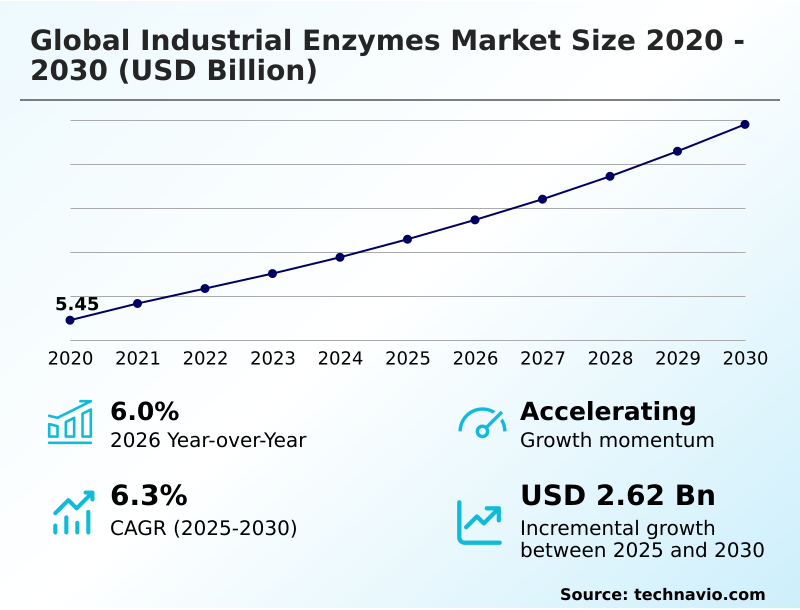
The industrial enzymes market size is forecast to increase by USD 2.26 billion, at a CAGR of 6.1% between 2023 and 2028.

Major Market Trends & Insights

  • APAC dominated the market and accounted for a 37% growth during the forecast period.
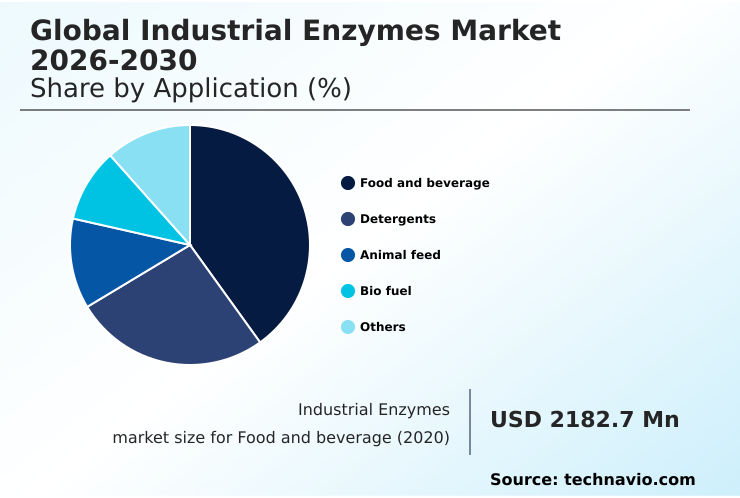
  • By the Application - Food and beverage segment was valued at USD 2.15 billion in 2022
  • By the Source - Microorganism segment accounted for the largest market revenue share in 2022

Market Size & Forecast

  • Market Opportunities: USD 61.73 million
  • Market Future Opportunities: USD 2255.10 million
  • CAGR : 6.1%
  • APAC: Largest market in 2022

Market Summary

  • The market has witnessed significant growth in recent years, with a focus on sectors such as food and beverages, textiles, and biofuels. According to industry reports, the global market for industrial enzymes is projected to reach a value of around USD7.5 billion by 2026, growing at a steady pace. This expansion can be attributed to the increasing demand for enzymes in various applications, including the production of bioethanol, detergents, and Food Additives. Advancements in enzyme technology have led to improvements in their efficiency and specificity, making them indispensable in numerous industries. For instance, in the food sector, enzymes are used for various purposes, such as improving food quality, increasing nutritional value, and enhancing taste and texture.
  • In the textile industry, enzymes are utilized for finishing processes, reducing the need for harsh chemicals and water. Despite these promising developments, the production process for industrial enzymes remains complex, involving the extraction and purification of enzymes from various sources, such as microorganisms and plants. This intricate process necessitates a high level of expertise and investment, making it a challenging yet rewarding area for businesses. In conclusion, the market continues to evolve, driven by increasing demand across various sectors and advancements in technology. The market's potential for growth is substantial, making it an attractive proposition for businesses looking to innovate and expand their offerings.

What will be the Size of the Industrial Enzymes Market during the forecast period?
Industrial Enzymes Market Size

Explore market size, adoption trends, and growth potential for industrial enzymes market Request Free Sample

  • The market encompasses a diverse range of applications, from enzyme delivery systems to enzyme byproduct utilization. According to industry estimates, the global market for industrial enzymes was valued at USD6.5 billion in 2020, with a projected compound annual growth rate (CAGR) of 7.2% from 2021 to 2026. This growth is driven by the increasing demand for efficient enzyme catalysis, enzyme waste reduction, and enzyme reaction mechanisms in various industries, including food and beverage, textiles, and biofuels. Enzyme substrate specificity and enzyme intellectual property are key areas of focus for market participants. For instance, advances in enzyme formulation development and enhancing enzyme stability have led to significant improvements in enzyme catalytic efficiency and enzyme quality control.
  • Concurrently, there is a growing emphasis on sustainable enzyme production and reducing the environmental impact of enzyme processes. These trends are expected to shape the market in the coming years, with potential opportunities in bioprocess development enzymes and enzyme regulatory affairs. The market for enzyme inhibitor studies is another emerging area, with potential applications in optimizing enzyme process control and scale-up enzyme production. According to estimates, the enzyme inhibitor market is projected to reach USD1.2 billion by 2026, growing at a CAGR of 8.5% from 2021 to 2026. This growth is attributed to the increasing demand for efficient enzyme catalysis and waste reduction in various industries.
  • Despite the promising growth prospects, challenges remain, including the need for efficient enzyme delivery systems and enzyme byproduct utilization, as well as the complex enzyme reaction mechanisms and enzyme regulatory affairs. Addressing these challenges will require ongoing research and innovation in the field of industrial enzymes.

How is this Industrial Enzymes Industry segmented?

The industrial enzymes industry research report provides comprehensive data (region-wise segment analysis), with forecasts and estimates in "USD million" for the period 2024-2028, as well as historical data from 2018-2022 for the following segments.

  • Application
    • Food and beverage
    • Detergents
    • Animal feed
    • Bio fuel
    • Others
  • Source
    • Microorganism
    • Animals
    • Plants
  • Geography
    • North America
      • US
      • Canada
    • Europe
      • France
      • Germany
      • Italy
      • UK
    • Middle East and Africa
      • Egypt
      • KSA
      • Oman
      • UAE
    • APAC
      • China
      • India
      • Japan
    • South America
      • Argentina
      • Brazil
    • Rest of World (ROW)

By Application Insights

The food and beverage segment is estimated to witness significant growth during the forecast period.

Industrial enzymes have been instrumental in enhancing production efficiency and quality in various sectors, particularly in food processing. These enzymes, including carbohydrases, have found extensive applications in animal feed, food and beverages, textiles, and pharmaceuticals. The market is experiencing significant growth, with carbohydrases being a major contributor. This expansion can be attributed to the increasing use of enzymes in producing eco-friendly products, reducing resource consumption, and minimizing waste. In the food industry, the adoption of enzymes has led to the production of high-quality goods, such as baked products, beverages, and dairy items. The food and beverage sector's shift towards natural and organic products has further fueled the demand for enzymes.

In the animal feed industry, enzymes are used to improve feed efficiency and nutritional value. In the textile sector, enzymes are employed for various applications, including denim finishing, cotton bleaching, and wool scouring. In the pharmaceutical sector, enzymes are used for the production of intermediates, Active Pharmaceutical Ingredients, and enzyme-therapeutics. The market for industrial enzymes is expected to continue growing, with the food and beverage sector accounting for the largest market share. The increasing use of artificial sweeteners, prebiotic products, and juices is further driving the demand for enzyme-based products. The textile industry is also expected to witness significant growth due to the rising demand for sustainable and eco-friendly textile production methods.

Additionally, advancements in enzyme technology, such as immobilized enzyme technology, metabolic engineering, and Protein Engineering, have led to the development of more efficient and cost-effective enzyme production methods. These advancements have also resulted in the production of enzymes with improved stability, activity, and specificity. Enzyme production optimization, enzyme characterization techniques, and enzyme modification techniques have also gained significant attention in the market. These techniques enable the production of enzymes with enhanced properties, such as improved thermal stability, pH stability, and enzyme activity modeling. Furthermore, the use of enzymes in downstream processing, such as enzyme-catalyzed synthesis and biocatalytic reaction engineering, has led to the development of more efficient and sustainable manufacturing processes.

The market for industrial enzymes is expected to grow at a steady pace, with the food and beverage sector continuing to dominate the market. The increasing demand for eco-friendly and sustainable manufacturing processes is expected to further fuel the growth of the market. According to recent studies, the market is expected to grow by 12% in the next five years. This growth can be attributed to the increasing demand for enzymes in various sectors, particularly in the food and beverage industry. Additionally, the development of more efficient and cost-effective enzyme production methods is expected to further drive the growth of the market.

In conclusion, the market is experiencing significant growth due to the increasing demand for eco-friendly and sustainable manufacturing processes. Carbohydrases, a significant component of the market, are expected to continue driving the growth of the market due to their extensive use in various sectors. The development of more efficient and cost-effective enzyme production methods, as well as advancements in enzyme technology, is expected to further fuel the growth of the market.

Industrial Enzymes Market Size

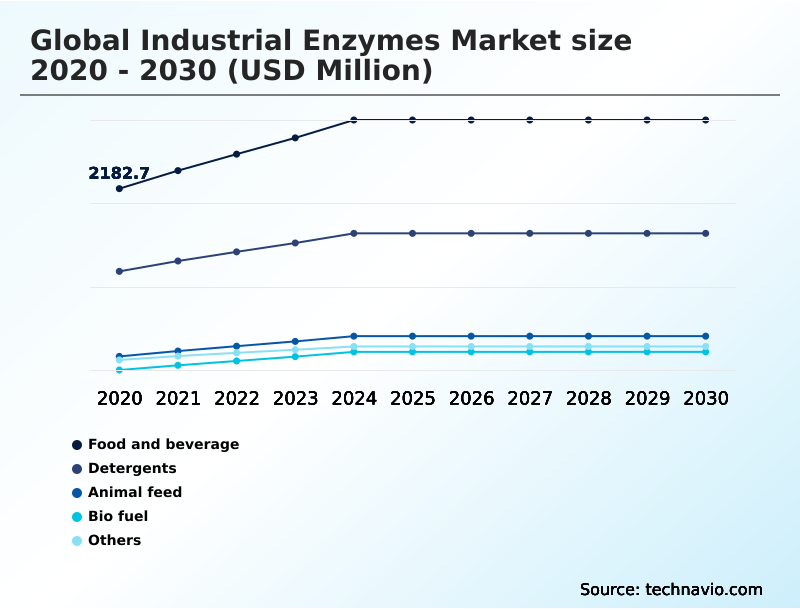
The Food and beverage segment was valued at USD 2.15 billion in 2018 and showed a gradual increase during the forecast period.
Industrial Enzymes Market Size

Request Free Sample

Regional Analysis

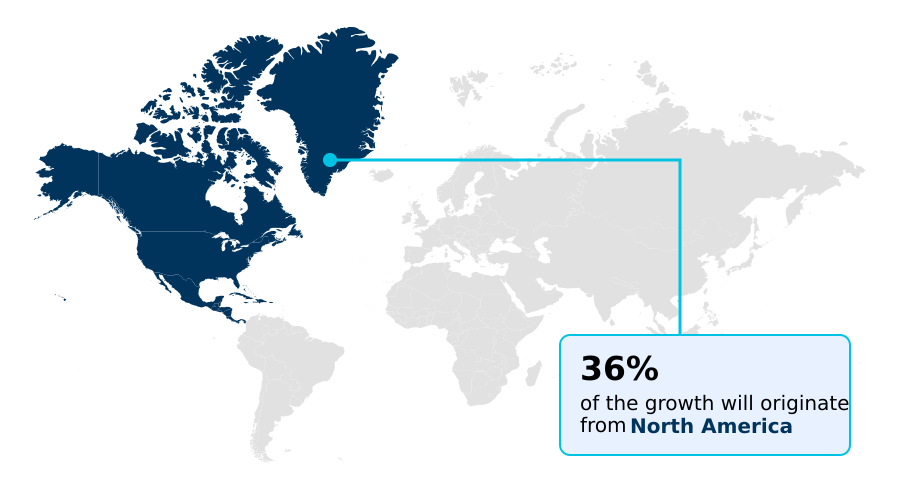
APAC is estimated to contribute 37% to the growth of the global market during the forecast period.Technavio's analysts have elaborately explained the regional trends and drivers that shape the market during the forecast period.
Industrial Enzymes Market Share by Geography

See How Industrial Enzymes Market Demand is Rising in APAC Request Free Sample

The market in North America experienced significant growth in 2023, with feed enzymes being a major contributor to this expansion. This segment's revenue increase can be attributed to the rising utilization of phytase in high doses and increased investment in superior enzymes to optimize feed enzymes' potential. Feed enzymes play a crucial role in animal feed production, as the absence of essential enzymes results in the loss of valuable nutrients and increased feed costs. The North American market's dominance is driven by the region's strong agricultural sector and growing demand for efficient and cost-effective animal feed solutions.

Furthermore, the increasing focus on sustainable animal farming practices and the adoption of enzymes to improve feed conversion rates and animal health contribute to the market's continued growth. According to recent studies, the feed enzymes segment is projected to account for over 40% of the total the market share in North America by 2027. Another significant trend in the market is the increasing demand for enzymes in various industries, including food and beverage, textiles, and biofuels. This diversification of applications is expected to drive the market's growth and create new opportunities for market participants. The market in North America is expected to grow at a steady pace, with a revenue increase of around 5% annually over the next five years.

This growth is fueled by the increasing demand for enzymes in various industries and the ongoing research and development efforts to create more efficient and cost-effective enzyme solutions. The market's competitive landscape is characterized by the presence of several key players, including major chemical and biotech companies, who are investing in research and development to expand their product offerings and maintain their market position. This competition drives innovation and ensures that the market remains dynamic and responsive to changing industry trends and customer demands.

Market Dynamics

Our researchers analyzed the data with 2023 as the base year, along with the key drivers, trends, and challenges. A holistic analysis of drivers will help companies refine their marketing strategies to gain a competitive advantage.

Innovations and Performance Improvements in the US the market  is witnessing significant advancements, driven by the quest for optimizing enzyme activity in various applications. Researchers and industry professionals are developing novel immobilization strategies to enhance thermal stability and catalytic efficiency of industrial enzymes. For instance, improving the thermal stability of enzymes for biofuel production can increase process efficiency by 10-12%. In the textile industry, enzymes are increasingly being used to replace harsh chemicals, reducing water usage and improving compliance with environmental regulations. Analyzing enzyme kinetics in biocatalytic reactions can lead to significant efficiency gains and improved product quality.

The pharmaceutical industry is also exploring the use of enzymes to develop new drugs and improve production processes. Designing high-throughput screening assays for enzyme discovery and developing innovative enzyme formulations for specific applications are key areas of focus. Sustainability is a critical factor in industrial enzyme production, with researchers evaluating economic feasibility and developing sustainable methods. Enzyme production yield in submerged fermentation can be improved through efficient purification methods and assessing the environmental impact of industrial enzyme production. Regulatory compliance and safety are essential considerations in the market. Developing robust enzyme reactors for industrial processes and understanding enzyme reaction mechanisms for improved process control are crucial to ensure safety and compliance. Improving enzyme shelf life and developing new enzyme-based technologies for industrial applications are ongoing areas of research and innovation. These advancements are driving growth and improving the competitiveness of the US the market.

Industrial Enzymes Market Size

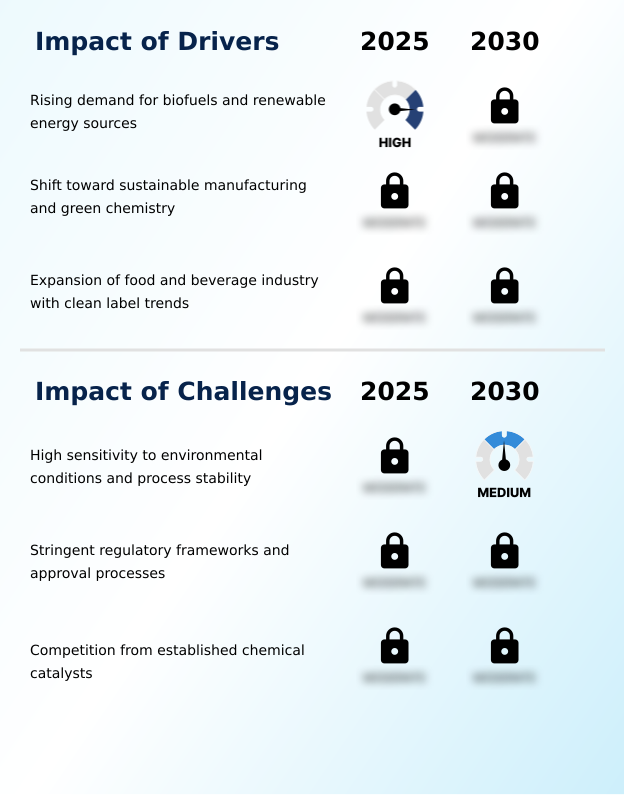
What are the key market drivers leading to the rise in the adoption of Industrial Enzymes Industry?

  • The market for food enzymes is propelled primarily by the escalating demand for these essential additives in various food industries. 
  • Industrial enzymes play a pivotal role in enhancing the properties of various products across multiple industries. Extracted from microorganisms using advanced technologies, these enzymes impart desirable characteristics, such as anti-stale, digestive, and softening properties, to food products, thereby increasing their shelf-life. Enzymes like protease, lipase, and carbohydrase are extensively utilized in meat products, bakery, dairy, and Frozen Food products, oils, and fats, confectioneries, and other sectors. Their application is driven by the growing demand for processed and packaged food products, which prioritize food security and safety. The food enzymes market is undergoing continuous evolution, with new applications and technologies emerging to cater to the evolving consumer preferences and industry demands.
  • For instance, the increasing awareness of consumers regarding the health and nutritional benefits of food enzymes is driving the market's growth. According to industry reports, the global food enzymes market was valued at over USD6 billion in 2020 and is projected to reach over USD8 billion by 2026, registering a steady expansion. This growth can be attributed to the expanding food processing industries, particularly in developing regions, and the increasing adoption of enzymes in various applications, such as biodiesel production and animal feed. Moreover, the market is witnessing significant advancements in enzyme production technologies, such as solid-state fermentation and metagenomics, which are expected to further fuel the market's growth.
  • These innovations will enable the production of enzymes with enhanced efficiency, specificity, and stability, thereby catering to the evolving industry demands and consumer preferences. In conclusion, the food enzymes market is a dynamic and evolving landscape, driven by the growing demand for processed and packaged food products, increasing consumer awareness, and technological advancements. Its continuous expansion is poised to bring about significant opportunities and challenges for industry players, making it an exciting space to watch.

What are the market trends shaping the Industrial Enzymes Industry?

  • Recent advances in enzyme technology are currently shaping market trends. (Alternatively) The latest developments in enzyme technology are spearheading market trends at present.
  • The market continues to evolve, driven by advancements in genetics and process technology. Genetic engineering plays a crucial role in enhancing the production of industrial enzymes, ensuring improved stability, specificity, and productivity. This approach enables the transfer of enzyme genes to safe host organisms, avoiding uncertainties related to toxin-producing or pathogenic organisms. Genetic engineering significantly contributes to the market by enabling the production of naturally occurring enzymes in other organisms through fermentation. This method offers cost-effective and high-quality enzyme solutions for various industries, including food and beverage, pharmaceuticals, and textiles. Comparatively, traditional methods of enzyme production, such as extraction from natural sources, can be less consistent and less cost-effective.
  • Genetic engineering addresses these challenges by providing a more controlled and efficient production process. Furthermore, it allows for the creation of enzymes with tailored properties, meeting the evolving demands of diverse industries. The market's ongoing growth can be attributed to the continuous advancements in genetic engineering and process technology. These innovations contribute to the development of more efficient, cost-effective, and sustainable enzyme solutions for a wide range of applications.

What challenges does the Industrial Enzymes Industry face during its growth?

  • The intricate production process poses a significant challenge to the industry's growth trajectory. 
  • The market encompasses the production of biologically active substances derived from various sources, including animals, plants, microorganisms, and fungi. These enzymes undergo extraction processes to yield valuable proteins used in diverse applications. Fungi and yeast serve as the primary sources for a significant portion of enzymes, with over one-third of the total production attributable to bacterial enzymes. The remaining portion is sourced from animals and plants. The continuous advancements in biotechnology and genetic engineering have expanded the scope of enzyme production, enabling the industry to cater to a broad spectrum of sectors. The increasing demand for enzymes stems from their extensive use in various industries, such as food and beverages, pharmaceuticals, textiles, and detergents.
  • The production process of enzymes involves several intricate steps, including the selection of the enzyme source, fermentation, purification, and formulation. The selection of the enzyme source plays a crucial role in the production process. Microbial and fungal sources are commonly used due to their high productivity and ease of manipulation. The fermentation process involves the growth of the microorganisms under controlled conditions, which results in the production of the desired enzyme. The purification process ensures the removal of impurities and the isolation of the enzyme, while formulation involves the addition of stabilizers and other additives to enhance the enzyme's stability and shelf life.
  • The market is characterized by its dynamic nature, with ongoing research and development efforts aimed at improving enzyme production processes and expanding their applications. This continuous evolution reflects the market's potential for growth and its significance in various industries.

Exclusive Customer Landscape

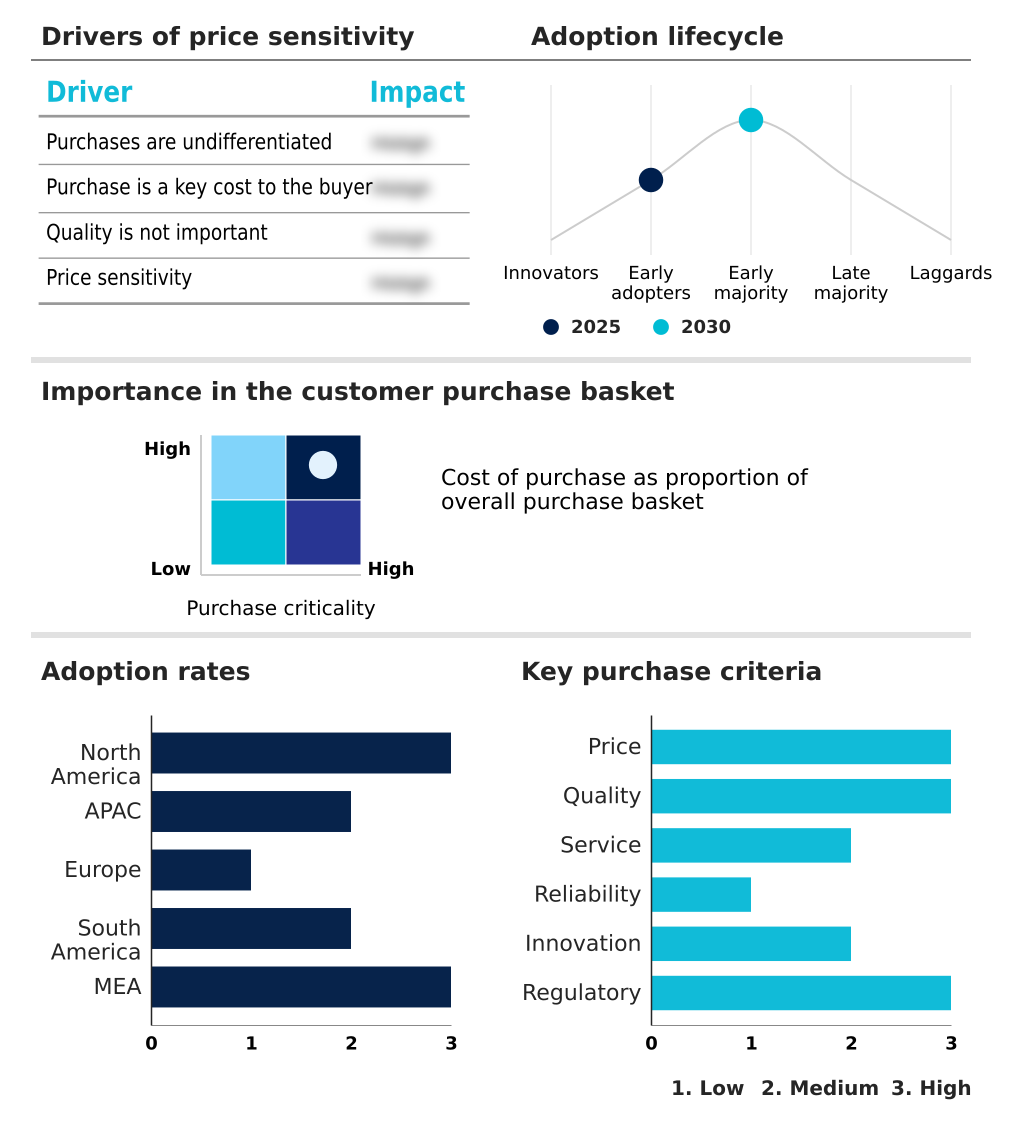
The industrial enzymes market forecasting report includes the adoption lifecycle of the market, covering from the innovator's stage to the laggard's stage. It focuses on adoption rates in different regions based on penetration. Furthermore, the industrial enzymes market report also includes key purchase criteria and drivers of price sensitivity to help companies evaluate and develop their market growth analysis strategies.
Industrial Enzymes Market Share by Geography

 Customer Landscape of Industrial Enzymes Industry

Key Companies & Market Insights

Companies are implementing various strategies, such as strategic alliances, industrial enzymes market forecast, partnerships, mergers and acquisitions, geographical expansion, and product/service launches, to enhance their presence in the industry.

Advanced Enzyme Technologies Ltd. - The company specializes in providing a range of industrial enzymes for various applications, including textile processing, leather processing, paper and pulp processing, biofuels, biomass processing, and biocatalysis. These enzymes enhance efficiency, reduce costs, and promote sustainability in diverse industries.

The industry research and growth report includes detailed analyses of the competitive landscape of the market and information about key companies, including:

  • Advanced Enzyme Technologies Ltd.
  • Amano Enzyme Inc.
  • Associated British Foods Plc
  • Aumgene Biosciences
  • BASF SE
  • Chr Hansen Holding AS
  • Codexis Inc
  • DuPont de Nemours Inc.
  • Enzymatic Deinking Technologies LLC
  • F. Hoffmann La Roche Ltd.
  • Jiangsu Boli Bioproducts Co. Ltd.
  • Kerry Group Plc
  • Koninklijke DSM NV
  • Merck KGaA
  • Nature BioScience Pvt. Ltd.
  • Neogen Corp.
  • Novozymes AS
  • Novus International Inc.
  • The Soufflet Group
  • Thermo Fisher Scientific Inc.

Qualitative and quantitative analysis of companies has been conducted to help clients understand the wider business environment as well as the strengths and weaknesses of key industry players. Data is qualitatively analyzed to categorize companies as pure play, category-focused, industry-focused, and diversified; it is quantitatively analyzed to categorize companies as dominant, leading, strong, tentative, and weak.

Recent Development and News in Industrial Enzymes Market

  • In January 2024, DuPont Nutrition & Biosciences, a leading industrial enzymes provider, announced the launch of its new enzyme solution, Danisco Danafloc 300, designed to improve the taste and texture of plant-based meat alternatives (DuPont press release). This innovative product expansion catered to the growing demand for sustainable and meatless food options.
  • In March 2024, Novozymes, a global leader in biological solutions, entered into a strategic partnership with Archer Daniels Midland Company (ADM) to expand their industrial enzymes business in North America. This collaboration aimed to strengthen their market position and offer enhanced solutions to customers (Novozymes press release).
  • In May 2024, BASF SE, a major chemical producer, acquired Biosev SA, a Brazilian producer of industrial enzymes and bio-based chemicals, for €1.1 billion. This acquisition expanded BASF's global presence and enhanced its portfolio in the market (BASF press release).
  • In February 2025, the European Commission approved the use of Novozymes' enzyme, Maxazyme, for the production of bioethanol from wheat and barley. This approval marked a significant regulatory milestone, enabling Novozymes to expand its market reach in the biofuels sector (European Commission press release).

Research Analyst Overview

  • The market continues to evolve, driven by advancements in enzyme production methods, thermal stability, and activity modeling. One significant trend is the shift towards plant-based enzyme production, which offers sustainability advantages and reduces reliance on animal-derived enzymes. For instance, microbial enzyme production through submerged fermentation and solid-state fermentation has gained traction due to its cost-effectiveness and scalability. Immobilized enzyme technology, which involves attaching enzymes to a solid support, has emerged as a promising solution for improving enzyme stability and productivity. Enzyme stability studies, including thermal stability assessments, play a crucial role in optimizing enzyme performance in industrial applications.
  • Directed evolution enzymes, engineered through genetic manipulation, offer enhanced stability, activity, and specificity. Metabolic engineering and protein engineering techniques are employed to produce such enzymes, which find extensive applications in various sectors, such as food and beverage, textiles, and biofuels. Enzyme production optimization is a critical focus area, with researchers exploring methods like recombinant enzyme technology, biocatalytic reaction engineering, and high-throughput enzyme screening to enhance yield and reduce production costs. Enzyme characterization techniques and modification methods are also essential for understanding enzyme properties and improving their performance. According to recent market research, the market is projected to grow at a steady rate of 6% annually, driven by increasing demand for sustainable and cost-effective production methods.
  • This growth underscores the dynamic nature of the market and the continuous unfolding of innovative solutions.

Dive into Technavio's robust research methodology, blending expert interviews, extensive data synthesis, and validated models for unparalleled Industrial Enzymes Market insights. See full methodology.

Market Scope

Report Coverage

Details

Page number

188

Base year

2023

Historic period

2018-2022

Forecast period

2024-2028

Growth momentum & CAGR

Accelerate at a CAGR of 6.1%

Market growth 2024-2028

USD 2255.1 million

Market structure

Fragmented

YoY growth 2023-2024(%)

5.7

Key countries

US, Canada, Germany, UK, Italy, France, China, India, Japan, Brazil, Egypt, UAE, Oman, Argentina, and KSA

Competitive landscape

Leading Companies, Market Positioning of Companies, Competitive Strategies, and Industry Risks

Request Free Sample

What are the Key Data Covered in this Industrial Enzymes Market Research and Growth Report?

  • CAGR of the Industrial Enzymes industry during the forecast period
  • Detailed information on factors that will drive the growth and forecasting between 2024 and 2028
  • Precise estimation of the size of the market and its contribution of the industry in focus to the parent market
  • Accurate predictions about upcoming growth and trends and changes in consumer behaviour
  • Growth of the market across North America, APAC, Europe, South America, and Middle East and Africa
  • Thorough analysis of the market's competitive landscape and detailed information about companies
  • Comprehensive analysis of factors that will challenge the industrial enzymes market growth of industry companies

We can help! Our analysts can customize this industrial enzymes market research report to meet your requirements.

Get in touch

1 Executive Summary

  • 1.1 Market overview
    • Executive Summary - Chart on Market Overview
    • Executive Summary - Data Table on Market Overview
    • Executive Summary - Chart on Global Market Characteristics
    • Executive Summary - Chart on Market by Geography
    • Executive Summary - Chart on Market Segmentation by Application
    • Executive Summary - Chart on Market Segmentation by Source
    • Executive Summary - Chart on Incremental Growth
    • Executive Summary - Data Table on Incremental Growth
    • Executive Summary - Chart on Company Market Positioning

2 Market Landscape

  • 2.1 Market ecosystem
    • Parent Market
    • Data Table on - Parent Market
  • 2.2 Market characteristics
    • Market characteristics analysis
  • 2.3 Value chain analysis
    • Value Chain Analysis

3 Market Sizing

  • 3.1 Market definition
    • Offerings of companies included in the market definition
  • 3.2 Market segment analysis
    • Market segments
  • 3.3 Market size 2023
    • 3.4 Market outlook: Forecast for 2023-2028
      • Chart on Global - Market size and forecast 2023-2028 ($ million)
      • Data Table on Global - Market size and forecast 2023-2028 ($ million)
      • Chart on Global Market: Year-over-year growth 2023-2028 (%)
      • Data Table on Global Market: Year-over-year growth 2023-2028 (%)

    4 Historic Market Size

    • 4.1 Global Industrial Enzymes Market 2018 - 2022
      • Historic Market Size - Data Table on Global Industrial Enzymes Market 2018 - 2022 ($ million)
    • 4.2 Application segment analysis 2018 - 2022
      • Historic Market Size - Application Segment 2018 - 2022 ($ million)
    • 4.3 Source segment analysis 2018 - 2022
      • Historic Market Size - Source Segment 2018 - 2022 ($ million)
    • 4.4 Geography segment analysis 2018 - 2022
      • Historic Market Size - Geography Segment 2018 - 2022 ($ million)
    • 4.5 Country segment analysis 2018 - 2022
      • Historic Market Size - Country Segment 2018 - 2022 ($ million)

    5 Five Forces Analysis

    • 5.1 Five forces summary
      • Five forces analysis - Comparison between 2023 and 2028
    • 5.2 Bargaining power of buyers
      • Bargaining power of buyers - Impact of key factors 2023 and 2028
    • 5.3 Bargaining power of suppliers
      • Bargaining power of suppliers - Impact of key factors in 2023 and 2028
    • 5.4 Threat of new entrants
      • Threat of new entrants - Impact of key factors in 2023 and 2028
    • 5.5 Threat of substitutes
      • Threat of substitutes - Impact of key factors in 2023 and 2028
    • 5.6 Threat of rivalry
      • Threat of rivalry - Impact of key factors in 2023 and 2028
    • 5.7 Market condition
      • Chart on Market condition - Five forces 2023 and 2028

    6 Market Segmentation by Application

    • 6.1 Market segments
      • Chart on Application - Market share (2023-2028) (%)
      • Data Table on Application - Market share (2023-2028) (%)
    • 6.2 Comparison by Application
      • Chart on Comparison by Application
      • Data Table on Comparison by Application
    • 6.3 Food and beverage - Market size and forecast (2023-2028)
      • Chart on Food and beverage - Market size and forecast (2023-2028) ($ million)
      • Data Table on Food and beverage - Market size and forecast (2023-2028) ($ million)
      • Chart on Food and beverage - Year-over-year growth (2023-2028) (%)
      • Data Table on Food and beverage - Year-over-year growth (2023-2028) (%)
    • 6.4 Detergents - Market size and forecast (2023-2028)
      • Chart on Detergents - Market size and forecast (2023-2028) ($ million)
      • Data Table on Detergents - Market size and forecast (2023-2028) ($ million)
      • Chart on Detergents - Year-over-year growth (2023-2028) (%)
      • Data Table on Detergents - Year-over-year growth (2023-2028) (%)
    • 6.5 Animal feed - Market size and forecast (2023-2028)
      • Chart on Animal feed - Market size and forecast (2023-2028) ($ million)
      • Data Table on Animal feed - Market size and forecast (2023-2028) ($ million)
      • Chart on Animal feed - Year-over-year growth (2023-2028) (%)
      • Data Table on Animal feed - Year-over-year growth (2023-2028) (%)
    • 6.6 Bio fuel - Market size and forecast (2023-2028)
      • Chart on Bio fuel - Market size and forecast (2023-2028) ($ million)
      • Data Table on Bio fuel - Market size and forecast (2023-2028) ($ million)
      • Chart on Bio fuel - Year-over-year growth (2023-2028) (%)
      • Data Table on Bio fuel - Year-over-year growth (2023-2028) (%)
    • 6.7 Others - Market size and forecast (2023-2028)
      • Chart on Others - Market size and forecast (2023-2028) ($ million)
      • Data Table on Others - Market size and forecast (2023-2028) ($ million)
      • Chart on Others - Year-over-year growth (2023-2028) (%)
      • Data Table on Others - Year-over-year growth (2023-2028) (%)
    • 6.8 Market opportunity by Application
      • Market opportunity by Application ($ million)
      • Data Table on Market opportunity by Application ($ million)

    7 Market Segmentation by Source

    • 7.1 Market segments
      • Chart on Source - Market share (2023-2028) (%)
      • Data Table on Source - Market share (2023-2028) (%)
    • 7.2 Comparison by Source
      • Chart on Comparison by Source
      • Data Table on Comparison by Source
    • 7.3 Microorganism - Market size and forecast (2023-2028)
      • Chart on Microorganism - Market size and forecast (2023-2028) ($ million)
      • Data Table on Microorganism - Market size and forecast (2023-2028) ($ million)
      • Chart on Microorganism - Year-over-year growth (2023-2028) (%)
      • Data Table on Microorganism - Year-over-year growth (2023-2028) (%)
    • 7.4 Animals - Market size and forecast (2023-2028)
      • Chart on Animals - Market size and forecast (2023-2028) ($ million)
      • Data Table on Animals - Market size and forecast (2023-2028) ($ million)
      • Chart on Animals - Year-over-year growth (2023-2028) (%)
      • Data Table on Animals - Year-over-year growth (2023-2028) (%)
    • 7.5 Plants - Market size and forecast (2023-2028)
      • Chart on Plants - Market size and forecast (2023-2028) ($ million)
      • Data Table on Plants - Market size and forecast (2023-2028) ($ million)
      • Chart on Plants - Year-over-year growth (2023-2028) (%)
      • Data Table on Plants - Year-over-year growth (2023-2028) (%)
    • 7.6 Market opportunity by Source
      • Market opportunity by Source ($ million)
      • Data Table on Market opportunity by Source ($ million)

    8 Customer Landscape

    • 8.1 Customer landscape overview
      • Analysis of price sensitivity, lifecycle, customer purchase basket, adoption rates, and purchase criteria

    9 Geographic Landscape

    • 9.1 Geographic segmentation
      • Chart on Market share by geography 2023-2028 (%)
      • Data Table on Market share by geography 2023-2028 (%)
    • 9.2 Geographic comparison
      • Chart on Geographic comparison
      • Data Table on Geographic comparison
    • 9.3 North America - Market size and forecast 2023-2028
      • Chart on North America - Market size and forecast 2023-2028 ($ million)
      • Data Table on North America - Market size and forecast 2023-2028 ($ million)
      • Chart on North America - Year-over-year growth 2023-2028 (%)
      • Data Table on North America - Year-over-year growth 2023-2028 (%)
    • 9.4 APAC - Market size and forecast 2023-2028
      • Chart on APAC - Market size and forecast 2023-2028 ($ million)
      • Data Table on APAC - Market size and forecast 2023-2028 ($ million)
      • Chart on APAC - Year-over-year growth 2023-2028 (%)
      • Data Table on APAC - Year-over-year growth 2023-2028 (%)
    • 9.5 Europe - Market size and forecast 2023-2028
      • Chart on Europe - Market size and forecast 2023-2028 ($ million)
      • Data Table on Europe - Market size and forecast 2023-2028 ($ million)
      • Chart on Europe - Year-over-year growth 2023-2028 (%)
      • Data Table on Europe - Year-over-year growth 2023-2028 (%)
    • 9.6 South America - Market size and forecast 2023-2028
      • Chart on South America - Market size and forecast 2023-2028 ($ million)
      • Data Table on South America - Market size and forecast 2023-2028 ($ million)
      • Chart on South America - Year-over-year growth 2023-2028 (%)
      • Data Table on South America - Year-over-year growth 2023-2028 (%)
    • 9.7 Middle East and Africa - Market size and forecast 2023-2028
      • Chart on Middle East and Africa - Market size and forecast 2023-2028 ($ million)
      • Data Table on Middle East and Africa - Market size and forecast 2023-2028 ($ million)
      • Chart on Middle East and Africa - Year-over-year growth 2023-2028 (%)
      • Data Table on Middle East and Africa - Year-over-year growth 2023-2028 (%)
    • 9.8 US - Market size and forecast 2023-2028
      • Chart on US - Market size and forecast 2023-2028 ($ million)
      • Data Table on US - Market size and forecast 2023-2028 ($ million)
      • Chart on US - Year-over-year growth 2023-2028 (%)
      • Data Table on US - Year-over-year growth 2023-2028 (%)
    • 9.9 China - Market size and forecast 2023-2028
      • Chart on China - Market size and forecast 2023-2028 ($ million)
      • Data Table on China - Market size and forecast 2023-2028 ($ million)
      • Chart on China - Year-over-year growth 2023-2028 (%)
      • Data Table on China - Year-over-year growth 2023-2028 (%)
    • 9.10 Germany - Market size and forecast 2023-2028
      • Chart on Germany - Market size and forecast 2023-2028 ($ million)
      • Data Table on Germany - Market size and forecast 2023-2028 ($ million)
      • Chart on Germany - Year-over-year growth 2023-2028 (%)
      • Data Table on Germany - Year-over-year growth 2023-2028 (%)
    • 9.11 France - Market size and forecast 2023-2028
      • Chart on France - Market size and forecast 2023-2028 ($ million)
      • Data Table on France - Market size and forecast 2023-2028 ($ million)
      • Chart on France - Year-over-year growth 2023-2028 (%)
      • Data Table on France - Year-over-year growth 2023-2028 (%)
    • 9.12 India - Market size and forecast 2023-2028
      • Chart on India - Market size and forecast 2023-2028 ($ million)
      • Data Table on India - Market size and forecast 2023-2028 ($ million)
      • Chart on India - Year-over-year growth 2023-2028 (%)
      • Data Table on India - Year-over-year growth 2023-2028 (%)
    • 9.13 Market opportunity by geography
      • Market opportunity by geography ($ million)
      • Data Tables on Market opportunity by geography ($ million)
    • 9.14 Canada - Market size and forecast (2023-2028)
      • Chart on Canada - Market size and forecast (2023-2028) ($ million)
      • Data Table on Canada - Market size and forecast (2023-2028) ($ million)
      • Chart on Canada - Year-over-year growth (2023-2028) (%)
      • Data Table on Canada - Year-over-year growth (2023-2028) (%)
    • 9.15 UK - Market size and forecast (2023-2028)
      • Chart on UK - Market size and forecast (2023-2028) ($ million)
      • Data Table on UK - Market size and forecast (2023-2028) ($ million)
      • Chart on UK - Year-over-year growth (2023-2028) (%)
      • Data Table on UK - Year-over-year growth (2023-2028) (%)
    • 9.16 Italy - Market size and forecast (2023-2028)
      • Chart on Italy - Market size and forecast (2023-2028) ($ million)
      • Data Table on Italy - Market size and forecast (2023-2028) ($ million)
      • Chart on Italy - Year-over-year growth (2023-2028) (%)
      • Data Table on Italy - Year-over-year growth (2023-2028) (%)
    • 9.17 Japan - Market size and forecast (2023-2028)
      • Chart on Japan - Market size and forecast (2023-2028) ($ million)
      • Data Table on Japan - Market size and forecast (2023-2028) ($ million)
      • Chart on Japan - Year-over-year growth (2023-2028) (%)
      • Data Table on Japan - Year-over-year growth (2023-2028) (%)
    • 9.18 Brazil - Market size and forecast (2023-2028)
      • Chart on Brazil - Market size and forecast (2023-2028) ($ million)
      • Data Table on Brazil - Market size and forecast (2023-2028) ($ million)
      • Chart on Brazil - Year-over-year growth (2023-2028) (%)
      • Data Table on Brazil - Year-over-year growth (2023-2028) (%)
    • 9.19 Egypt - Market size and forecast (2023-2028)
      • Chart on Egypt - Market size and forecast (2023-2028) ($ million)
      • Data Table on Egypt - Market size and forecast (2023-2028) ($ million)
      • Chart on Egypt - Year-over-year growth (2023-2028) (%)
      • Data Table on Egypt - Year-over-year growth (2023-2028) (%)
    • 9.20 UAE - Market size and forecast (2023-2028)
      • Chart on UAE - Market size and forecast (2023-2028) ($ million)
      • Data Table on UAE - Market size and forecast (2023-2028) ($ million)
      • Chart on UAE - Year-over-year growth (2023-2028) (%)
      • Data Table on UAE - Year-over-year growth (2023-2028) (%)
    • 9.21 Oman - Market size and forecast (2023-2028)
      • Chart on Oman - Market size and forecast (2023-2028) ($ million)
      • Data Table on Oman - Market size and forecast (2023-2028) ($ million)
      • Chart on Oman - Year-over-year growth (2023-2028) (%)
      • Data Table on Oman - Year-over-year growth (2023-2028) (%)
    • 9.22 Argentina - Market size and forecast (2023-2028)
      • Chart on Argentina - Market size and forecast (2023-2028) ($ million)
      • Data Table on Argentina - Market size and forecast (2023-2028) ($ million)
      • Chart on Argentina - Year-over-year growth (2023-2028) (%)
      • Data Table on Argentina - Year-over-year growth (2023-2028) (%)
    • 9.23 KSA - Market size and forecast (2023-2028)
      • Chart on KSA - Market size and forecast (2023-2028) ($ million)
      • Data Table on KSA - Market size and forecast (2023-2028) ($ million)
      • Chart on KSA - Year-over-year growth (2023-2028) (%)
      • Data Table on KSA - Year-over-year growth (2023-2028) (%)
    • 9.24 Rest of World (ROW) - Market size and forecast (2023-2028)
      • Chart on Rest of World (ROW) - Market size and forecast (2023-2028) ($ million)
      • Data Table on Rest of World (ROW) - Market size and forecast (2023-2028) ($ million)
      • Chart on Rest of World (ROW) - Year-over-year growth (2023-2028) (%)
      • Data Table on Rest of World (ROW) - Year-over-year growth (2023-2028) (%)

    10 Drivers, Challenges, and Opportunity/Restraints

    • 10.1 Market drivers
      • 10.2 Market challenges
        • 10.3 Impact of drivers and challenges
          • Impact of drivers and challenges in 2023 and 2028
        • 10.4 Market opportunities/restraints

          11 Competitive Landscape

          • 11.1 Overview
            • 11.2 Competitive Landscape
              • Overview on criticality of inputs and factors of differentiation
            • 11.3 Landscape disruption
              • Overview on factors of disruption
            • 11.4 Industry risks
              • Impact of key risks on business

            12 Competitive Analysis

            • 12.1 Companies profiled
              • Companies covered
            • 12.2 Market positioning of companies
              • Matrix on companies position and classification
            • 12.3 Advanced Enzyme Technologies Ltd.
              • Advanced Enzyme Technologies Ltd. - Overview
              • Advanced Enzyme Technologies Ltd. - Business segments
              • Advanced Enzyme Technologies Ltd. - Key offerings
              • Advanced Enzyme Technologies Ltd. - Segment focus
            • 12.4 Amano Enzyme Inc.
              • Amano Enzyme Inc. - Overview
              • Amano Enzyme Inc. - Product / Service
              • Amano Enzyme Inc. - Key offerings
            • 12.5 Associated British Foods Plc
              • Associated British Foods Plc - Overview
              • Associated British Foods Plc - Business segments
              • Associated British Foods Plc - Key offerings
              • Associated British Foods Plc - Segment focus
            • 12.6 Aumgene Biosciences
              • Aumgene Biosciences - Overview
              • Aumgene Biosciences - Product / Service
              • Aumgene Biosciences - Key offerings
            • 12.7 BASF SE
              • BASF SE - Overview
              • BASF SE - Business segments
              • BASF SE - Key news
              • BASF SE - Key offerings
              • BASF SE - Segment focus
            • 12.8 Chr Hansen Holding AS
              • Chr Hansen Holding AS - Overview
              • Chr Hansen Holding AS - Business segments
              • Chr Hansen Holding AS - Key news
              • Chr Hansen Holding AS - Key offerings
              • Chr Hansen Holding AS - Segment focus
            • 12.9 Codexis Inc
              • Codexis Inc - Overview
              • Codexis Inc - Business segments
              • Codexis Inc - Key offerings
              • Codexis Inc - Segment focus
            • 12.10 DuPont de Nemours Inc.
              • DuPont de Nemours Inc. - Overview
              • DuPont de Nemours Inc. - Business segments
              • DuPont de Nemours Inc. - Key news
              • DuPont de Nemours Inc. - Key offerings
              • DuPont de Nemours Inc. - Segment focus
            • 12.11 Enzymatic Deinking Technologies LLC
              • Enzymatic Deinking Technologies LLC - Overview
              • Enzymatic Deinking Technologies LLC - Product / Service
              • Enzymatic Deinking Technologies LLC - Key offerings
            • 12.12 F. Hoffmann La Roche Ltd.
              • F. Hoffmann La Roche Ltd. - Overview
              • F. Hoffmann La Roche Ltd. - Business segments
              • F. Hoffmann La Roche Ltd. - Key news
              • F. Hoffmann La Roche Ltd. - Key offerings
              • F. Hoffmann La Roche Ltd. - Segment focus
            • 12.13 Jiangsu Boli Bioproducts Co. Ltd.
              • Jiangsu Boli Bioproducts Co. Ltd. - Overview
              • Jiangsu Boli Bioproducts Co. Ltd. - Product / Service
              • Jiangsu Boli Bioproducts Co. Ltd. - Key offerings
            • 12.14 Kerry Group Plc
              • Kerry Group Plc - Overview
              • Kerry Group Plc - Business segments
              • Kerry Group Plc - Key news
              • Kerry Group Plc - Key offerings
              • Kerry Group Plc - Segment focus
            • 12.15 Koninklijke DSM NV
              • Koninklijke DSM NV - Overview
              • Koninklijke DSM NV - Business segments
              • Koninklijke DSM NV - Key news
              • Koninklijke DSM NV - Key offerings
              • Koninklijke DSM NV - Segment focus
            • 12.16 Novozymes AS
              • Novozymes AS - Overview
              • Novozymes AS - Product / Service
              • Novozymes AS - Key offerings
            • 12.17 Thermo Fisher Scientific Inc.
              • Thermo Fisher Scientific Inc. - Overview
              • Thermo Fisher Scientific Inc. - Business segments
              • Thermo Fisher Scientific Inc. - Key news
              • Thermo Fisher Scientific Inc. - Key offerings
              • Thermo Fisher Scientific Inc. - Segment focus

            13 Appendix

            • 13.1 Scope of the report
              • 13.2 Inclusions and exclusions checklist
                • Inclusions checklist
                • Exclusions checklist
              • 13.3 Currency conversion rates for US$
                • Currency conversion rates for US$
              • 13.4 Research methodology
                • Research methodology
              • 13.5 Data procurement
                • Information sources
              • 13.6 Data validation
                • Data validation
              • 13.7 Validation techniques employed for market sizing
                • Validation techniques employed for market sizing
              • 13.8 Data synthesis
                • Data synthesis
              • 13.9 360 degree market analysis
                • 360 degree market analysis
              • 13.10 List of abbreviations
                • List of abbreviations

              Research Methodology

              Technavio presents a detailed picture of the market by way of study, synthesis, and summation of data from multiple sources. The analysts have presented the various facets of the market with a particular focus on identifying the key industry influencers. The data thus presented is comprehensive, reliable, and the result of extensive research, both primary and secondary.

              INFORMATION SOURCES

              Primary sources

              • Manufacturers and suppliers
              • Channel partners
              • Industry experts
              • Strategic decision makers

              Secondary sources

              • Industry journals and periodicals
              • Government data
              • Financial reports of key industry players
              • Historical data
              • Press releases

              DATA ANALYSIS

              Data Synthesis

              • Collation of data
              • Estimation of key figures
              • Analysis of derived insights

              Data Validation

              • Triangulation with data models
              • Reference against proprietary databases
              • Corroboration with industry experts

              REPORT WRITING

              Qualitative

              • Market drivers
              • Market challenges
              • Market trends
              • Five forces analysis

              Quantitative

              • Market size and forecast
              • Market segmentation
              • Geographical insights
              • Competitive landscape

              Interested in this report?

              Get your sample now to see our research methodology and insights!

              Download Now

              Frequently Asked Questions

              Industrial Enzymes market growth will increase by $ 2255.1 mn during 2024-2028 .

              The Industrial Enzymes market is expected to grow at a CAGR of 6.1% during 2024-2028 .

              Industrial Enzymes market is segmented by Application( Food and beverage, Detergents, Animal feed, Bio fuel, Others) Source( Microorganism, Animals, Plants, South America, MEA)

              Advanced Enzyme Technologies Ltd., Amano Enzyme Inc., Associated British Foods Plc, Aumgene Biosciences, BASF SE, Chr Hansen Holding AS, Codexis Inc, DuPont de Nemours Inc., Enzymatic Deinking Technologies LLC, F. Hoffmann La Roche Ltd., Jiangsu Boli Bioproducts Co. Ltd., Kerry Group Plc, Koninklijke DSM NV, Merck KGaA, Nature BioScience Pvt. Ltd., Neogen Corp., Novozymes AS, Novus International Inc., The Soufflet Group, Thermo Fisher Scientific Inc. are a few of the key vendors in the Industrial Enzymes market.

              APAC will register the highest growth rate of 37% among the other regions. Therefore, the Industrial Enzymes market in APAC is expected to garner significant business opportunities for the vendors during the forecast period.

              US, Canada, Germany, UK, Italy, France, China, India, Japan, Brazil, Egypt, UAE, Oman, Argentina, KSA

              • Increasing demand for food enzymesFood enzymes are extracted from microorganisms using advanced technologies and impart anti-stale is the driving factor this market.
              • digestive is the driving factor this market.
              • and softening properties to food products is the driving factor this market.
              • thereby increasing their shelf-life. Enzymes such as protease is the driving factor this market.
              • lipase is the driving factor this market.
              • and carbohydrase are commonly used in meat products; bakery is the driving factor this market.
              • dairy is the driving factor this market.
              • and frozen food products is the driving factor this market.
              • oils is the driving factor this market.
              • and fats; confectioneries; and others to keep the nutritional content intact due to the complexities in the global food supply chain.The demand for processed and packaged food products has been increasing with the necessity to provide food security and safety. The food enzymes market is witnessing growth due to the increasing awareness of consumers regarding the health and nutritional benefits of food enzymes. This has resulted in the increased adoption of food enzymes across numerous food applications is the driving factor this market.
              • including frozen food manufacturing industries and packaged food units. In food manufacturing units is the driving factor this market.
              • the use of food enzymes facilitates an eco-friendly process by reducing the wastage of raw materials and emissions of greenhouse gases.Along with these reasons is the driving factor this market.
              • the increasing penetration of organized retail in urban and rural areas globally drives the demand for industrial enzymes from the food industry. The enzymes enhance metabolism and support digestion by breaking down the complex fats and carbohydrates present in food into simpler molecules. Enzymes are used in various applications in the food industry as biocatalysts to improve product quality and increase the rate of production. The production of alcoholic and non-alcoholic beverages requires enzymes used in the food industry as they decompose pectin present in the plant cell walls is the driving factor this market.
              • consequently increasing the quality of the extracted juice. This factor is expected to drive the growth of the market in focus during the forecast period.  is the driving factor this market.

              The Industrial Enzymes market vendors should focus on grabbing business opportunities from the Food and beverage segment as it accounted for the largest market share in the base year.