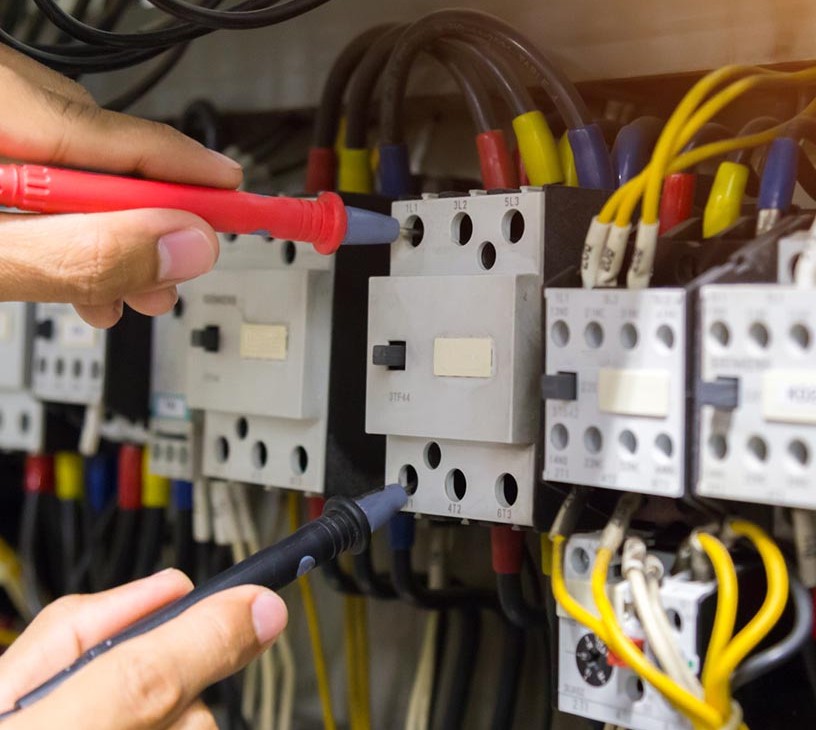


Industrial Relays Market Size 2026-2030
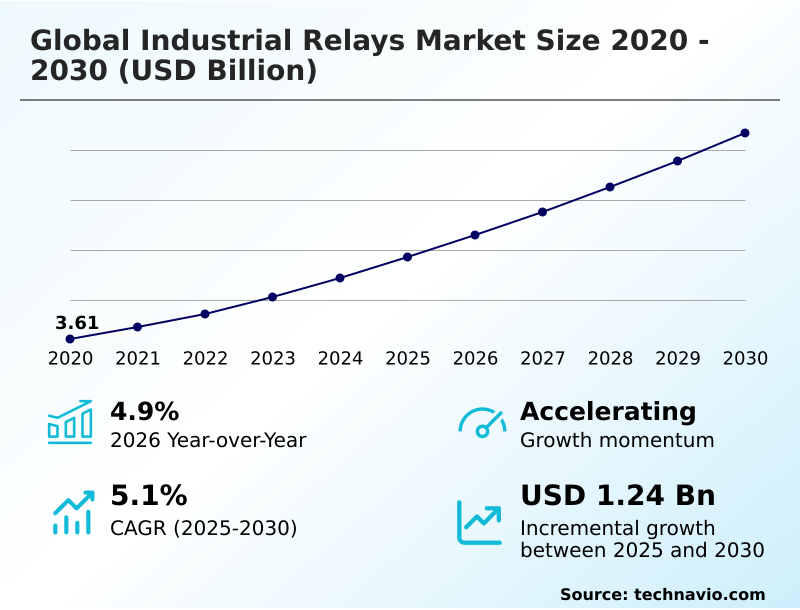
The industrial relays market size is valued to increase by USD 1.24 billion, at a CAGR of 5.1% from 2025 to 2030. Proliferation of industrial automation and smart manufacturing will drive the industrial relays market.
Major Market Trends & Insights
- APAC dominated the market and accounted for a 41.4% growth during the forecast period.
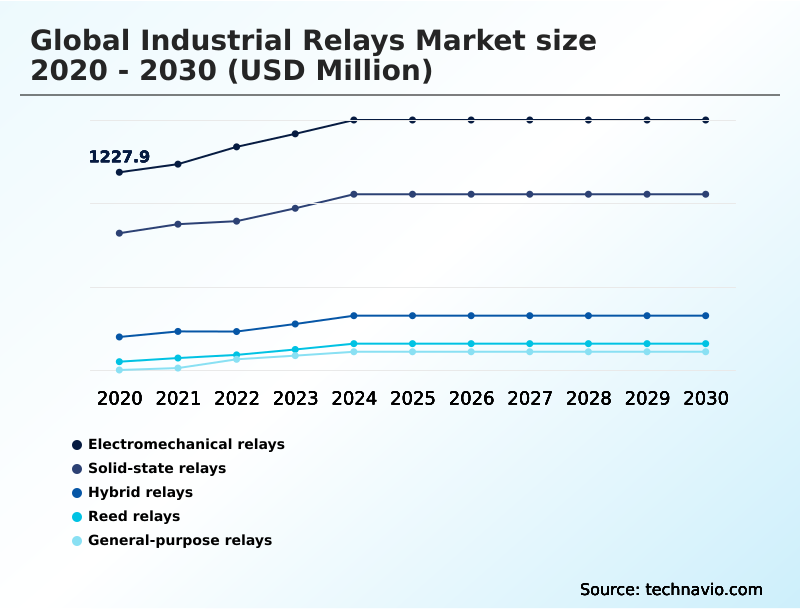
- By Product - Electromechanical relays segment was valued at USD 1.44 billion in 2024
- By End-user - Process industries segment accounted for the largest market revenue share in 2024
Market Size & Forecast
- Market Opportunities: USD 2.06 billion
- Market Future Opportunities: USD 1.24 billion
- CAGR from 2025 to 2030 : 5.1%
Market Summary
- The industrial relays market is integral to modern electrical control and automation systems. These devices, ranging from electromechanical relays to advanced solid-state relays, are fundamental for ensuring operational safety and efficiency in high-power environments.
- Key drivers include the global push for industrial automation and the modernization of energy grids, which demand more sophisticated components like intelligent monitoring relays and safety relay modules for protective relaying. A primary trend is the integration of communication protocols like IO-Link, enabling predictive maintenance and reducing downtime.
- For instance, a manufacturing facility can leverage smart relays to monitor motor health, predicting failures and scheduling maintenance to avoid disruptions that could halt production for hours. However, the market faces challenges from volatile raw material costs and the technical complexities of integrating with legacy systems.
- The continuous innovation in materials and digital capabilities ensures relays remain critical for bridging low-power control signals with high-power industrial machinery.
What will be the Size of the Industrial Relays Market during the forecast period?
Get Key Insights on Market Forecast (PDF) Get Free Sample
How is the Industrial Relays Market Segmented?
The industrial relays industry research report provides comprehensive data (region-wise segment analysis), with forecasts and estimates in "USD million" for the period 2026-2030, as well as historical data from 2020-2024 for the following segments.
- Product
- Electromechanical relays
- Solid-state relays
- Hybrid relays
- Reed relays
- General-purpose relays
- End-user
- Process industries
- Discrete industries
- Power output
- Low voltage relays
- Medium voltage relays
- High voltage relays
- Application
- Industrial automation
- Electronics
- Military
- Others
- Geography
- APAC
- China
- Japan
- India
- North America
- US
- Canada
- Mexico
- Europe
- Germany
- UK
- France
- Middle East and Africa
- Saudi Arabia
- UAE
- South Africa
- South America
- Brazil
- Argentina
- Rest of World (ROW)
- APAC
By Product Insights
The electromechanical relays segment is estimated to witness significant growth during the forecast period.
The industrial relays market is defined by several key product categories, each designed for specific operational demands. Electromechanical relays provide essential physical isolation, making them invaluable for high-voltage applications and ensuring robust performance.
These devices are critical for managing bidirectional power flows and handling fault conditions, which is crucial for maintaining system integrity. In contrast, applications requiring agentic automation and advanced frequency regulation benefit from the precision of AI controllers.
The market also includes solutions designed for effective load balancing and the management of DC voltages. In advanced industrial settings, the integration of these components within lights-out factories is driven by the need for enhanced functional safety.
The use of smart sensing relays supports AI model training, creating virtual replicas to optimize processes and mitigate the risks associated with supply chain fragility.
This segmentation underscores the industry’s shift toward specialized, high-performance solutions where component selection can improve operational uptime by over 15%.
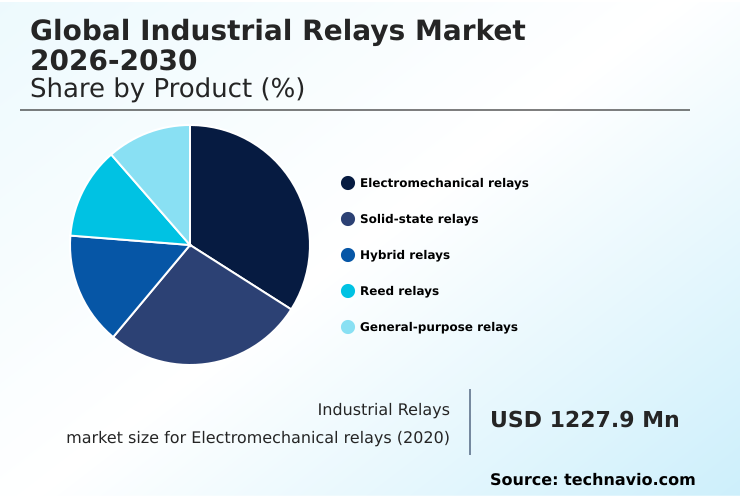
The Electromechanical relays segment was valued at USD 1.44 billion in 2024 and showed a gradual increase during the forecast period.
Regional Analysis
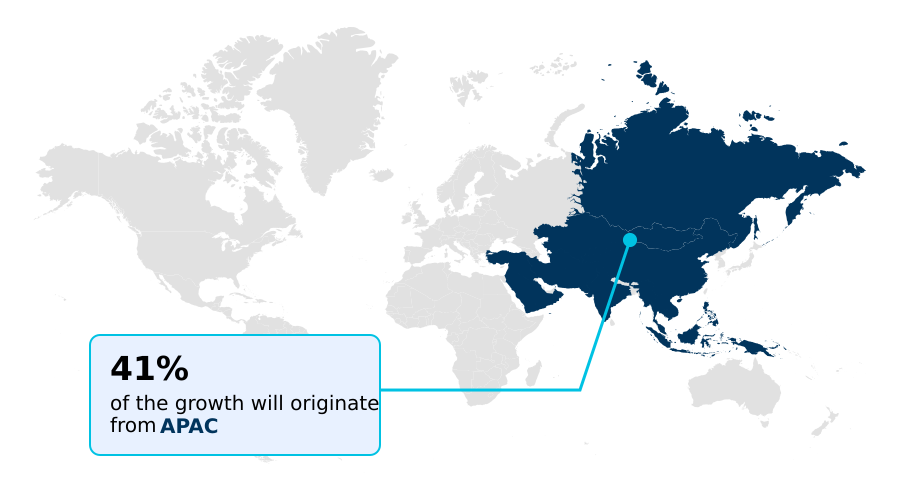
APAC is estimated to contribute 41.4% to the growth of the global market during the forecast period.Technavio’s analysts have elaborately explained the regional trends and drivers that shape the market during the forecast period.
See How Industrial Relays Market Demand is Rising in APAC Get Free Sample
The geographic landscape is increasingly influenced by the need for robust circuit protection and overcurrent protection in high-density digital infrastructures.
The development of next-generation systems is focused on managing high inrush currents and minimizing contact resistance to improve efficiency, with some achieving a 15% reduction in energy loss.
In advanced economies, the emphasis is on monitoring contact health and switching cycles through a communication-enabled architecture, allowing for proactive maintenance.
The rise of human-robot collaboration in manufacturing has intensified the need for reliable components that can handle voltage fluctuations without failure.
This is particularly relevant as facilities integrate supervisory control and data acquisition systems with large language models for process optimization.
Furthermore, the deployment of edge computing solutions in industrial settings has led to a 20% increase in the adoption of specialized components that ensure uninterrupted power and data integrity in distributed networks.
Market Dynamics
Our researchers analyzed the data with 2025 as the base year, along with the key drivers, trends, and challenges. A holistic analysis of drivers will help companies refine their marketing strategies to gain a competitive advantage.
- Strategic decision-making in the industrial relays market increasingly revolves around specific, high-value applications. The selection of industrial relays for motor control is a primary consideration in factory automation, where reliability directly impacts production uptime. In parallel, the demand for solid-state relays for high-frequency switching is growing in electronics manufacturing and automated test equipment, where speed and precision are paramount.
- As energy infrastructure modernizes, protective relays for grid stability and high voltage relays in transmission lines are critical for maintaining power quality. The integration of safety relays in human-robot collaboration is now a standard requirement for functional safety. Smart relays with IO-Link communication and other relays with integrated communication protocols are central to intelligent predictive maintenance strategies.
- The market for hybrid relays for high-inrush current is expanding in heavy-duty applications. In building automation, low voltage relays in building automation are standard, while medium voltage relays for power distribution are key in industrial parks. Specialized components such as reed relays in automated test equipment and relays for hazardous environment applications fill important niches.
- The growth of the digital economy fuels the need for industrial relays for data center power, while sustainability targets drive demand for relays in renewable energy storage and relays with low power consumption. This shift toward specialized applications has resulted in a market where niche segments grow at rates 5% higher than the general-purpose sector.
- Finally, the rise of electric mobility creates a strong market for industrial relays for EV charging infrastructure, and the expansion of connected devices boosts the need for relays for industrial internet of things.
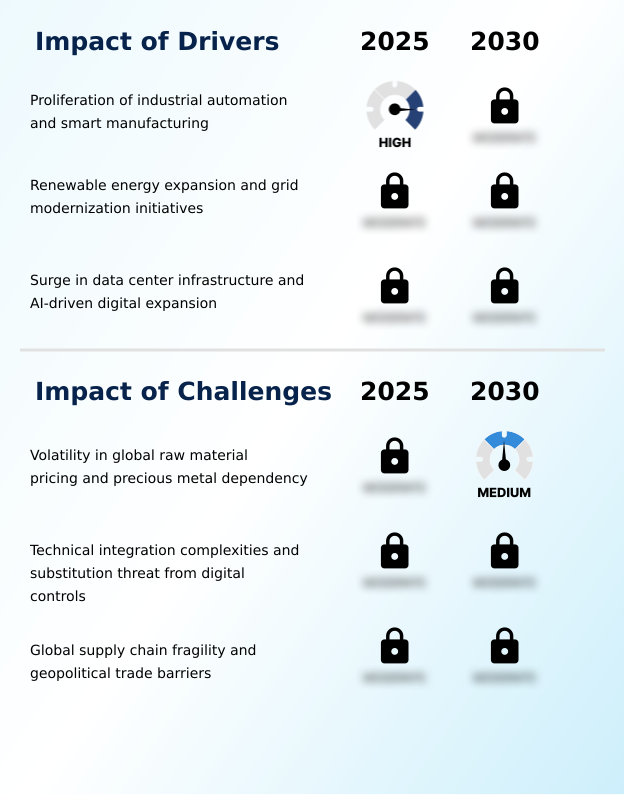
What are the key market drivers leading to the rise in the adoption of Industrial Relays Industry?
- The proliferation of industrial automation and smart manufacturing frameworks is the key driver for the market.
- The market is primarily driven by the expansion of industrial automation and critical infrastructure upgrades. The push for resilient operations has accelerated the adoption of smart relays and components supporting IO-Link communication, which are essential for modern manufacturing.
- In the energy sector, grid modernization and renewable energy expansion are fueling demand for high voltage relays and advanced protective relaying for substation automation.
- The integration of battery energy storage systems to support utility-scale solar projects and wind turbine control systems is a significant factor, with these projects improving grid stability by up to 30%.
- Furthermore, these initiatives align with global decarbonization targets, creating a sustained need for reliable components. The adoption of these technologies has shown to decrease grid-related outages by 20% in certain modernized regions.
What are the market trends shaping the Industrial Relays Industry?
- The evolution toward intelligent and communication-enabled relay architectures represents a key market trend. This shift is redefining the role of relays from simple switches to data-providing components in modern industrial systems.
- Key trends are reshaping the market, with a clear shift toward intelligent components within the Industry 4.0 framework. The adoption of the industrial internet of things is driving demand for relays that offer more than basic switching.
- Technologies such as electromechanical relays and solid-state relays are being enhanced with communication capabilities to support predictive maintenance, with some systems demonstrating a 25% reduction in unexpected failures. The use of hybrid relays, reed relays, and general-purpose relays is also evolving, particularly in low voltage and medium voltage applications.
- This evolution supports smart manufacturing environments, where components in automated conveyor systems and collaborative robotics must provide real-time data. This integration has been shown to improve production line efficiency by over 15%, highlighting the tangible benefits of connected architectures.
What challenges does the Industrial Relays Industry face during its growth?
- Volatility in global raw material pricing and dependency on precious metals present a key challenge affecting the industry's growth.
- The market faces significant challenges related to component design and system integration in increasingly complex environments. The demand for advanced signal processing and reliable circuit interruption is pushing the limits of current technology. Ensuring robust motor protection and complete electrical isolation in compact formats is a primary concern, addressed by innovations like the solid-state latching relay and intelligent monitoring relays.
- The integration into smart grids and the management of power conversion units require sophisticated solutions. For example, digital twin technology is being used to model and mitigate risks, improving system reliability by 18%.
- The growth of hyperscale data centers and the electrification of transport are also creating new demands, while the development of AI-driven load management systems necessitates a new generation of safety relay modules.
Exclusive Technavio Analysis on Customer Landscape
The industrial relays market forecasting report includes the adoption lifecycle of the market, covering from the innovator’s stage to the laggard’s stage. It focuses on adoption rates in different regions based on penetration. Furthermore, the industrial relays market report also includes key purchase criteria and drivers of price sensitivity to help companies evaluate and develop their market growth analysis strategies.
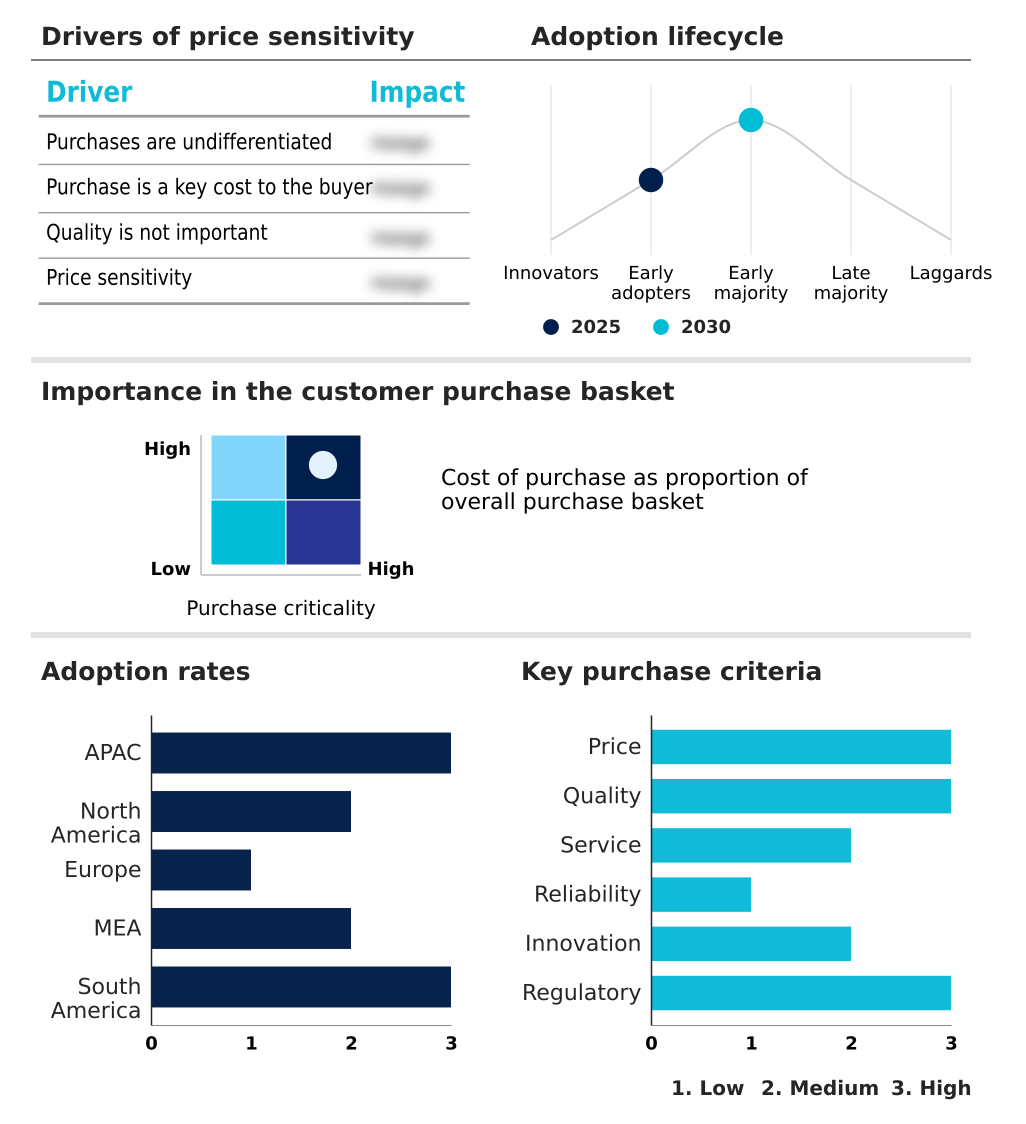
Customer Landscape of Industrial Relays Industry
Competitive Landscape
Companies are implementing various strategies, such as strategic alliances, industrial relays market forecast, partnerships, mergers and acquisitions, geographical expansion, and product/service launches, to enhance their presence in the industry.
ABB Ltd. - Analysis indicates a portfolio of industrial relays, including interface, control, and specialized solid-state variants, designed for diverse automation and power management applications.
The industry research and growth report includes detailed analyses of the competitive landscape of the market and information about key companies, including:
- ABB Ltd.
- Carlo Gavazzi Holding AG
- Crouzet
- Eaton Corp. Plc
- FINDER SpA
- Fuji Electric Co. Ltd.
- Honeywell International Inc.
- IDEC Corp.
- Littelfuse Inc.
- Murrelektronik GmbH
- OMRON Corp.
- Panasonic Holdings Corp.
- Phoenix Contact GmbH and Co
- Rockwell Automation Inc.
- Schneider Electric SE
- Sensata Technologies Inc.
- Siemens AG
- TE Connectivity plc
- WAGO GmbH and Co. KG
- Weidmuller GmbH and Co. KG
Qualitative and quantitative analysis of companies has been conducted to help clients understand the wider business environment as well as the strengths and weaknesses of key industry players. Data is qualitatively analyzed to categorize companies as pure play, category-focused, industry-focused, and diversified; it is quantitatively analyzed to categorize companies as dominant, leading, strong, tentative, and weak.
Recent Development and News in Industrial relays market
- In February 2025, Phoenix Contact announced the launch of a new safety relay module, the PSR-MM25, engineered for reliable monitoring and shutdown functions in hazardous areas, meeting strict international safety and explosion-protection standards for industries such as oil and gas, chemicals, and mining.
- In February 2025, Phoenix Contact introduced a new network-capable PLC-INTERFACE Ethernet gateway, designed for the remote monitoring and control of relay systems. This gateway enables centralized diagnostics and predictive maintenance by allowing users to manage relay modules over Ethernet networks.
- In May 2025, Littelfuse expanded its industrial solid-state relay portfolio with new single-pole AC and DC models. The SRP1-CC, SRP1-CE, and SRP1-ME series were developed to offer cost-effective switching for resistive and inductive loads, targeting applications in industrial, HVAC, and food equipment.
- In November 2025, Littelfuse Inc. introduced a new solid-state latching relay designed for zero-power operation in compact packages, emphasizing the industry-wide move toward energy-efficient and durable switching solutions for applications where space and reliability are critical.
Dive into Technavio’s robust research methodology, blending expert interviews, extensive data synthesis, and validated models for unparalleled Industrial Relays Market insights. See full methodology.
| Market Scope | |
|---|---|
| Page number | 332 |
| Base year | 2025 |
| Historic period | 2020-2024 |
| Forecast period | 2026-2030 |
| Growth momentum & CAGR | Accelerate at a CAGR of 5.1% |
| Market growth 2026-2030 | USD 1242.1 million |
| Market structure | Fragmented |
| YoY growth 2025-2026(%) | 4.9% |
| Key countries | China, Japan, India, South Korea, Australia, Indonesia, US, Canada, Mexico, Germany, UK, France, Italy, Spain, The Netherlands, Saudi Arabia, UAE, South Africa, Israel, Turkey, Brazil, Argentina and Chile |
| Competitive landscape | Leading Companies, Market Positioning of Companies, Competitive Strategies, and Industry Risks |
Research Analyst Overview
- The industrial relays market is undergoing a significant transformation driven by the dual imperatives of industrial automation and energy infrastructure modernization. The core of this market is segmented into key technologies such as electromechanical relays, solid-state relays, hybrid relays, reed relays, and general-purpose relays, each serving distinct application needs from low voltage to high voltage systems.
- In boardroom decisions, the focus is shifting toward lifecycle cost over initial price, with an emphasis on components that support predictive maintenance strategies. The integration of smart relays with IO-Link communication allows for real-time monitoring of contact health and switching cycles, which can reduce unplanned downtime by up to 30%.
- Key applications such as motor protection and circuit interruption are enhanced by intelligent monitoring relays and specialized safety relay modules. The expansion into substation automation and battery energy storage systems requires advanced protective relaying to manage bidirectional power flows and fault conditions.
- These systems must handle high inrush currents, DC voltages, and ensure electrical isolation, all while contributing to load balancing and frequency regulation in smart grids. This evolution is driven by the need for reliable signal processing and overcurrent protection in an increasingly connected and automated industrial landscape.
What are the Key Data Covered in this Industrial Relays Market Research and Growth Report?
-
What is the expected growth of the Industrial Relays Market between 2026 and 2030?
-
USD 1.24 billion, at a CAGR of 5.1%
-
-
What segmentation does the market report cover?
-
The report is segmented by Product (Electromechanical relays, Solid-state relays, Hybrid relays, Reed relays, and General-purpose relays), End-user (Process industries, and Discrete industries), Power Output (Low voltage relays, Medium voltage relays, and High voltage relays), Application (Industrial automation, Electronics, Military, and Others) and Geography (APAC, North America, Europe, Middle East and Africa, South America)
-
-
Which regions are analyzed in the report?
-
APAC, North America, Europe, Middle East and Africa and South America
-
-
What are the key growth drivers and market challenges?
-
Proliferation of industrial automation and smart manufacturing, Volatility in global raw material pricing and precious metal dependency
-
-
Who are the major players in the Industrial Relays Market?
-
ABB Ltd., Carlo Gavazzi Holding AG, Crouzet, Eaton Corp. Plc, FINDER SpA, Fuji Electric Co. Ltd., Honeywell International Inc., IDEC Corp., Littelfuse Inc., Murrelektronik GmbH, OMRON Corp., Panasonic Holdings Corp., Phoenix Contact GmbH and Co, Rockwell Automation Inc., Schneider Electric SE, Sensata Technologies Inc., Siemens AG, TE Connectivity plc, WAGO GmbH and Co. KG and Weidmuller GmbH and Co. KG
-
Market Research Insights
- Market dynamics are shaped by a strategic focus on resilient operations and the expansion of smart grids, which collectively improve system stability by over 25%. The adoption of a communication-enabled architecture is central to the Industry 4.0 framework, where predictive maintenance strategies reduce equipment failure rates by up to 40%.
- The ongoing grid modernization, driven by decarbonization targets, and the electrification of transport are creating new demand verticals. Concurrently, the growth of hyperscale data centers to support large language models and edge computing is accelerating. These facilities demand highly reliable power management solutions, favoring green data centers that align with sustainability goals.
- The use of digital twin technology allows for the creation of virtual replicas, enhancing system design and performance before deployment.
We can help! Our analysts can customize this industrial relays market research report to meet your requirements.
 RIA -
RIA -