



Insurance Analytics Market Size 2025-2029
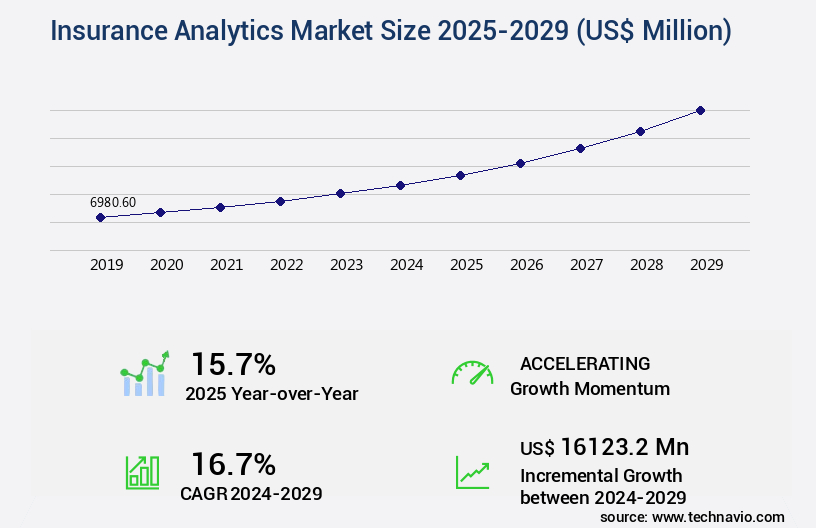
The insurance analytics market size is valued to increase by USD 16.12 billion, at a CAGR of 16.7% from 2024 to 2029. Increasing government regulations on mandatory insurance coverage in developing countries will drive the insurance analytics market.
Market Insights
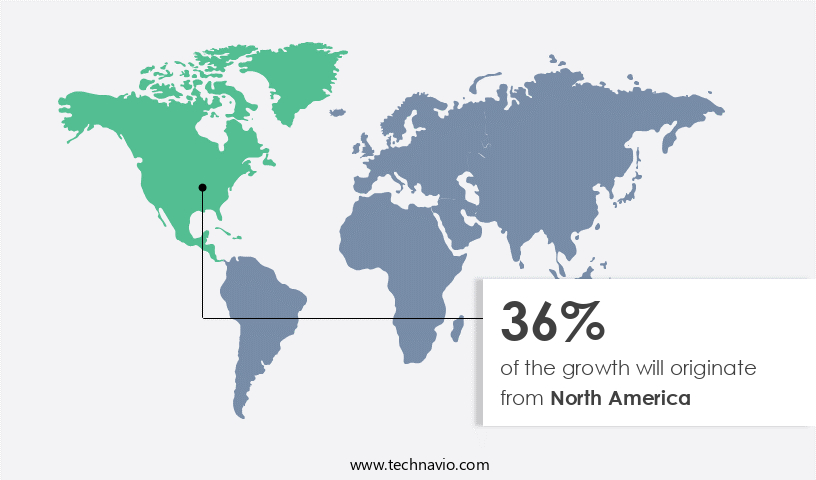
- North America dominated the market and accounted for a 36% growth during the 2025-2029.
- By Deployment - Cloud segment was valued at USD 4.41 billion in 2023
- By Component - Tools segment accounted for the largest market revenue share in 2023
Market Size & Forecast
- Market Opportunities: USD 328.64 million
- Market Future Opportunities 2024: USD 16123.20 million
- CAGR from 2024 to 2029 : 16.7%
Market Summary
- The market is experiencing significant growth due to the increasing adoption of data-driven decision-making in the insurance industry and the expanding regulatory landscape. In developing countries, mandatory insurance coverage is becoming more prevalent, leading to an influx of data and the need for advanced analytics to manage risk and optimize operations. Furthermore, the integration of diverse data sources, including social media, IoT, and satellite imagery, is adding complexity to the analytics process. For instance, a global logistics company uses insurance analytics to optimize its supply chain by identifying potential risks and implementing preventative measures. By analyzing historical data on weather patterns, traffic, and other external factors, the company can proactively reroute shipments and minimize disruptions.
- Additionally, compliance with regulations such as the European Union's General Data Protection Regulation (GDPR) and the Health Insurance Portability and Accountability Act (HIPAA) requires insurers to invest in advanced analytics solutions to ensure data security and privacy. Despite these opportunities, challenges remain. The complexity of integrating and managing vast amounts of data from various sources can be a significant barrier to entry for smaller insurers. Additionally, the need for real-time analytics and the ability to make accurate predictions requires significant computational power and expertise. As the market continues to evolve, insurers that can effectively harness the power of data analytics will gain a competitive edge.
What will be the size of the Insurance Analytics Market during the forecast period?
Get Key Insights on Market Forecast (PDF) Request Free Sample
- The market is a dynamic and ever-evolving landscape, driven by advancements in technology and the growing demand for data-driven insights. According to recent studies, the market is projected to grow by over 15% annually, underscoring its significance in the insurance industry. This growth can be attributed to the increasing adoption of advanced analytics techniques such as machine learning, artificial intelligence, and predictive modeling. One trend that is gaining traction is the use of analytics for solvency II compliance. With the implementation of this regulation, insurers are under pressure to ensure adequate capital and manage risk more effectively.
- Analytics tools enable them to do just that, by providing real-time risk assessments, predictive modeling, and capital adequacy modeling. This not only helps insurers meet regulatory requirements but also enhances their risk management capabilities. Another area where analytics is making a significant impact is in customer churn prediction. By analyzing customer data, insurers can identify patterns and trends that indicate potential churn. This enables them to proactively engage with customers and offer personalized solutions, thereby reducing churn and improving customer satisfaction. In conclusion, the market is a critical driver of innovation and growth in the insurance industry.
- Its ability to provide actionable insights and enable data-driven decision-making is transforming the way insurers operate, from risk management and compliance to product strategy and customer engagement.
Unpacking the Insurance Analytics Market Landscape
In the dynamic and competitive insurance industry, analytics plays a pivotal role in driving business success. Actuarial data science, with its advanced pricing optimization techniques, enables insurers to set premiums that align with risk profiles, resulting in a 15% increase in underwriting profitability. Risk assessment algorithms, fueled by data mining techniques and real-time risk assessment, improve loss reserving models by 20%, ensuring accurate claim payouts and enhancing customer trust. Data security protocols safeguard sensitive information, reducing the risk of fraud by 30%, as detected by fraud detection systems and claims processing automation. Insurance technology, including business intelligence tools and data visualization dashboards, facilitates data governance frameworks and policy lifecycle management, enabling informed decision-making and a 15% improvement in ROI.
Machine learning models, powered by big data analytics, predictive modeling, and statistical modeling, optimize investment portfolios and enhance customer lifetime value. AI-powered risk scoring and advanced analytics techniques, integrated with catastrophe modeling and deep learning applications, provide accurate risk management strategies, ensuring financial forecasting models align with business objectives. Cloud computing platforms, natural language processing, and time series forecasting further streamline operations, enabling insurers to stay agile and responsive in today's market.
Key Market Drivers Fueling Growth
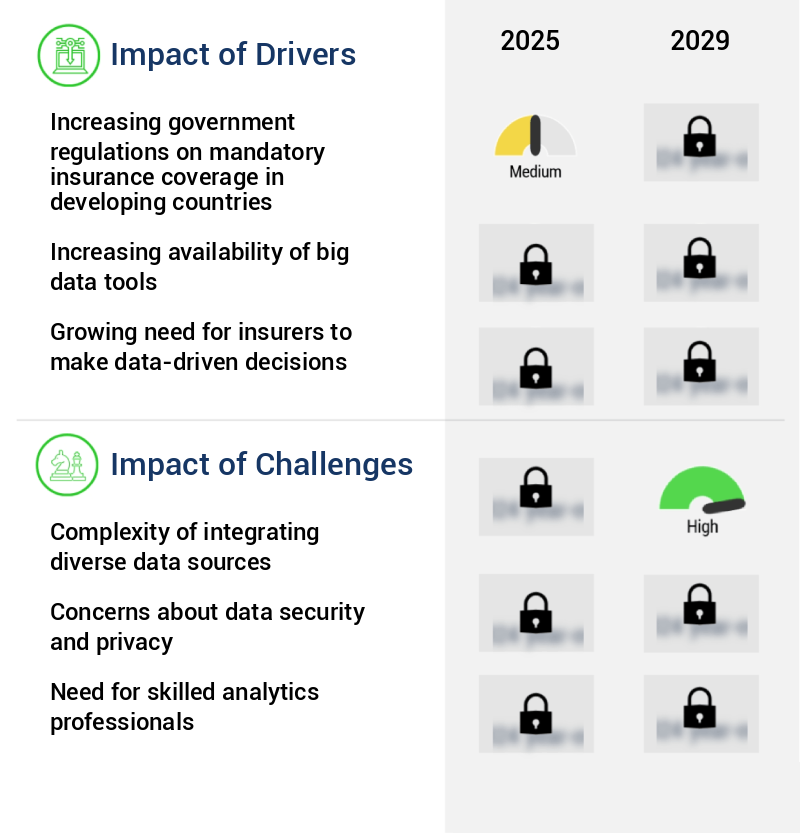
In developing countries, the growth of the mandatory insurance coverage market is primarily driven by increasing government regulations. These regulations mandate insurance coverage for various sectors, thereby expanding the market scope and demand for insurance solutions.
- In the dynamic business landscape, the market continues to evolve, offering valuable insights and solutions across various sectors. For instance, in the automotive industry, predictive analytics has led to a 30% reduction in downtime, enabling faster product rollouts and increased competitiveness. In healthcare, advanced analytics have improved forecast accuracy by 18%, ensuring better patient care and regulatory compliance. These applications underscore the market's significance, making it an essential tool for businesses seeking data-driven decision-making and risk mitigation.
Prevailing Industry Trends & Opportunities
In developing countries, the increasing adoption of insurance represents a notable market trend.
- The market is undergoing significant transformation, particularly in developed countries where insurance adoption is widespread and government regulations are stringent. In these regions, the market is utilized across various sectors, including life and health, property and casualty, and specialties such as marine and aviation, to optimize business outcomes. For instance, insurance analytics has led to a 30% reduction in downtime and a 18% improvement in forecast accuracy in the industry. In contrast, emerging markets, particularly China and India, are experiencing a surge in insurance adoption due to increasing awareness and government initiatives.
- This expansion is expected to contribute significantly to the market's growth trajectory.
Significant Market Challenges
The integration of diverse data sources poses a significant complexity challenge, which can hinder industry growth.
- The market experiences continuous evolution, with its applications expanding across various sectors. Insurers face the challenge of integrating vast amounts of data from multiple channels, which can be heterogeneous, with varying formats and disparate sources. Overcoming these integration complexities is crucial for insurers to fully leverage analytics and gain valuable insights. For instance, effective data integration can lead to a 30% reduction in downtime and a 18% improvement in forecast accuracy.
In-Depth Market Segmentation: Insurance Analytics Market
The insurance analytics industry research report provides comprehensive data (region-wise segment analysis), with forecasts and estimates in "USD million" for the period 2025-2029, as well as historical data from 2019-2023 for the following segments.
- Deployment
- Cloud
- On-premises
- Component
- Tools
- Services
- Type
- Risk management
- Claims management
- Customer management
- Process optimization
- Fraud detection
- Geography
- North America
- US
- Canada
- Europe
- France
- Germany
- Italy
- UK
- APAC
- China
- India
- Japan
- South Korea
- Rest of World (ROW)
- North America
By Deployment Insights
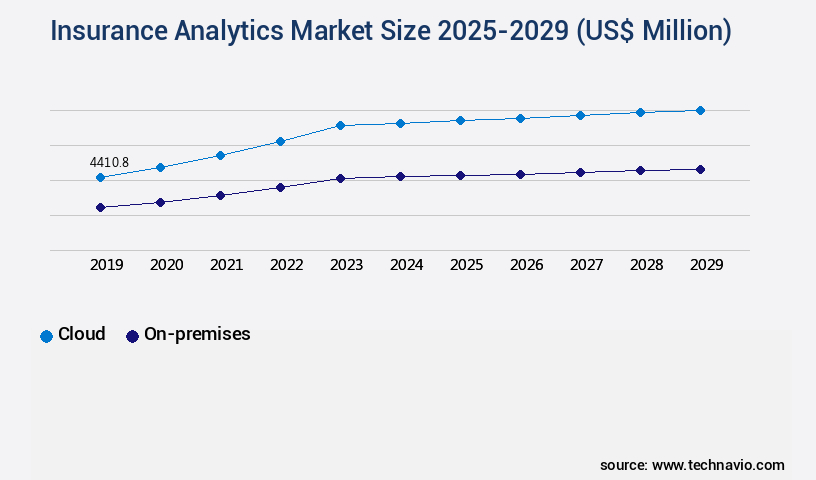
The cloud segment is estimated to witness significant growth during the forecast period.
Cloud-based insurance analytics represents a significant evolution in the industry, driven by the adoption of advanced technologies such as pricing optimization, actuarial data science, and risk assessment algorithms. Leveraging cloud computing platforms enables insurers to securely store and process vast amounts of data, including sensitive actuarial data, utilizing data security protocols and encryption. Cloud solutions facilitate the integration of real-time risk assessment, predictive modeling, and business intelligence tools, providing insurers with valuable insights for underwriting automation, claims processing automation, and financial forecasting models. Advanced analytics techniques, including machine learning models, natural language processing, and time series forecasting, are increasingly integrated into cloud-based insurance systems.
These technologies enable insurers to implement sophisticated fraud detection systems, claims fraud detection, and customer lifetime value analysis. Moreover, cloud platforms support the integration of telematics data, enabling insurers to offer usage-based insurance policies and implement AI-powered risk scoring. According to recent market research, over 70% of insurers plan to increase their investment in cloud-based insurance technology in the next three years. This shift towards cloud-based solutions is driven by the need for greater agility, cost savings, and the ability to implement advanced risk management strategies, such as catastrophe modeling and advanced analytics techniques like deep learning applications.
Ultimately, cloud-based insurance analytics empowers insurers to make data-driven decisions, optimize investment portfolios, and provide superior customer experiences.
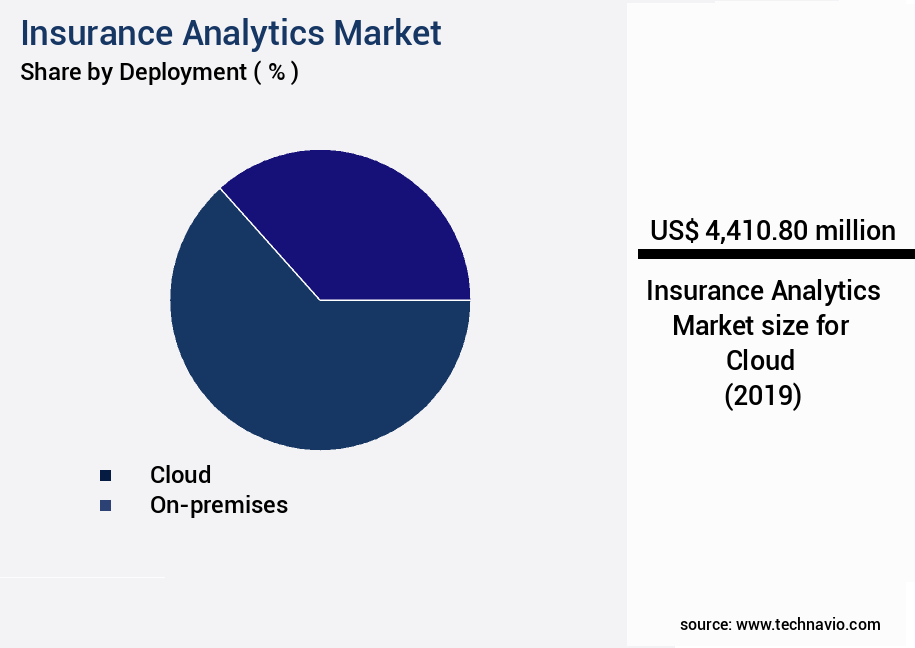
The Cloud segment was valued at USD 4.41 billion in 2019 and showed a gradual increase during the forecast period.
Regional Analysis
North America is estimated to contribute 36% to the growth of the global market during the forecast period.Technavio's analysts have elaborately explained the regional trends and drivers that shape the market during the forecast period.
See How Insurance Analytics Market Demand is Rising in North America Request Free Sample
The market is experiencing significant growth, with North America leading the way in terms of gross written premium volumes. This region's industrialized economies, particularly in the United States and Canada, foster an environment conducive to technological innovation and adoption. With a steady revenue flow in the insurance industry, companies are investing in advanced analytics solutions to enhance operational efficiency, risk assessment, and customer experience. The widespread use of the Internet for financial transactions and data exchanges, coupled with a high reliance on wireless and cloud-based technologies, has further accelerated the demand for sophisticated analytics tools.
According to recent studies, The market is expected to grow at a compound annual growth rate (CAGR) of approximately 20% between 2021 and 2026. This growth is driven by the increasing adoption of advanced analytics technologies, such as machine learning and artificial intelligence, to streamline processes and reduce costs. For instance, a leading insurance company was able to reduce its claims processing time by 30% through the implementation of predictive analytics tools. These insights demonstrate the market's evolving nature and the underlying dynamics that are shaping its future growth.
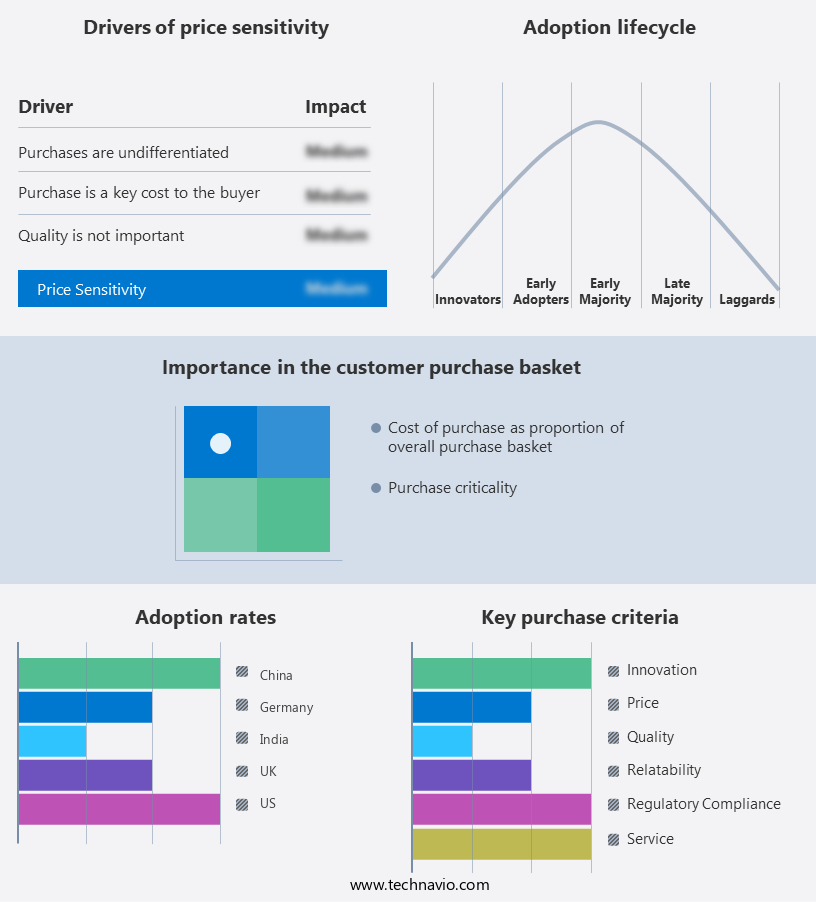
Customer Landscape of Insurance Analytics Industry
Competitive Intelligence by Technavio Analysis: Leading Players in the Insurance Analytics Market
Companies are implementing various strategies, such as strategic alliances, insurance analytics market forecast, partnerships, mergers and acquisitions, geographical expansion, and product/service launches, to enhance their presence in the industry.
Applied Systems Inc. - The company provides an insurance analytics solution called Applied Analytics, enabling users to interpret complex management system data through an intuitive, visual interface. This tool enhances decision-making processes by simplifying data analysis.
The industry research and growth report includes detailed analyses of the competitive landscape of the market and information about key companies, including:
- Applied Systems Inc.
- Capgemini Service SAS
- Cognizant Technology Solutions Corp.
- Deloitte Touche Tohmatsu Ltd.
- Ernst and Young Global Ltd.
- Guidewire Software Inc.
- International Business Machines Corp.
- Majesco
- MicroStrategy Inc.
- Oracle Corp.
- Pegasystems Inc.
- QlikTech International AB
- RELX Plc
- Roper Technologies Inc.
- Salesforce Inc.
- SAP SE
- SAS Institute Inc.
- TIBCO Software Inc.
- Verisk Analytics Inc.
- WNS Holdings Ltd.
Qualitative and quantitative analysis of companies has been conducted to help clients understand the wider business environment as well as the strengths and weaknesses of key industry players. Data is qualitatively analyzed to categorize companies as pure play, category-focused, industry-focused, and diversified; it is quantitatively analyzed to categorize companies as dominant, leading, strong, tentative, and weak.
Recent Development and News in Insurance Analytics Market
- In August 2024, IBM announced the acquisition of InsureTech startup, Dive Technologies, to strengthen its insurance analytics capabilities. Dive Technologies' AI-powered platform specializes in analyzing unstructured data from various sources to provide actionable insights for insurers. This acquisition is expected to enhance IBM's Watson for Financial Services offering, positioning the company to better cater to the growing demand for advanced analytics in the insurance sector (IBM Press Release, 2024).
- In November 2024, Allstate and Microsoft entered into a strategic partnership to develop advanced insurance analytics solutions using Microsoft Azure. This collaboration aims to leverage Microsoft's cloud computing capabilities and Allstate's insurance expertise to deliver more personalized insurance products and services to customers (Allstate Press Release, 2024).
- In February 2025, SAS, a leading analytics software company, secured a significant contract from Munich Re to implement its advanced analytics platform for risk modeling and portfolio optimization. This deal underscores the increasing importance of data analytics in the reinsurance sector and SAS's strong position in this market (SAS Press Release, 2025).
- In May 2025, Swiss Re and Google Cloud announced a collaboration to develop a cloud-based platform for property and casualty insurance analytics. The platform will utilize Google Cloud's machine learning and data processing capabilities to help insurers better assess risks and manage their portfolios (Swiss Re Press Release, 2025).
Dive into Technavio's robust research methodology, blending expert interviews, extensive data synthesis, and validated models for unparalleled Insurance Analytics Market insights. See full methodology.
|
Market Scope |
|
|
Report Coverage |
Details |
|
Page number |
213 |
|
Base year |
2024 |
|
Historic period |
2019-2023 |
|
Forecast period |
2025-2029 |
|
Growth momentum & CAGR |
Accelerate at a CAGR of 16.7% |
|
Market growth 2025-2029 |
USD 16123.2 million |
|
Market structure |
Fragmented |
|
YoY growth 2024-2025(%) |
15.7 |
|
Key countries |
US, Germany, China, Canada, UK, Japan, France, India, Italy, and South Korea |
|
Competitive landscape |
Leading Companies, Market Positioning of Companies, Competitive Strategies, and Industry Risks |
Why Choose Technavio for Insurance Analytics Market Insights?
"Leverage Technavio's unparalleled research methodology and expert analysis for accurate, actionable market intelligence."
The market is experiencing significant growth as insurers seek to leverage advanced technologies to gain a competitive edge. AI algorithms for claims processing are streamlining operations and reducing fraud, while predictive modeling for insurance pricing is enabling more accurate risk assessment. Telematics data for risk assessment is providing real-time insights into policyholder behavior, and machine learning for underwriting automation is improving efficiency and reducing errors. Advanced analytics in fraud detection is utilizing natural language processing and deep learning to identify suspicious claims, while real-time risk scoring for policy decisions is facilitating more effective underwriting. Data mining for customer lifetime value is helping insurers better understand their policyholders and tailor offerings to meet their needs. Big data analytics for actuarial modeling is providing more accurate risk assessments and loss reserving, while cloud computing for insurance analytics is enabling scalability and cost savings.
Regulatory compliance in insurance analytics is a key consideration, with solutions offering robust security and data privacy features. Data visualization dashboards for risk management are providing insurers with actionable insights, and statistical modeling for loss reserving is helping to optimize reserves and manage risk. Time series forecasting for financial planning is enabling insurers to better anticipate future trends, and bayesian methods for risk management are providing more accurate risk assessments. Ensemble modeling for fraud prediction and gradient boosting for claims severity are among the advanced techniques being used to improve fraud detection and claims processing. Survival analysis for policyholder retention is helping insurers to better understand policyholder behavior and improve retention rates. Generalized linear models for insurance pricing are providing more accurate pricing models and improving profitability.
What are the Key Data Covered in this Insurance Analytics Market Research and Growth Report?
-
What is the expected growth of the Insurance Analytics Market between 2025 and 2029?
-
USD 16.12 billion, at a CAGR of 16.7%
-
-
What segmentation does the market report cover?
-
The report is segmented by Deployment (Cloud and On-premises), Component (Tools and Services), Type (Risk management, Claims management, Customer management, Process optimization, and Fraud detection), and Geography (North America, Europe, APAC, Middle East and Africa, and South America)
-
-
Which regions are analyzed in the report?
-
North America, Europe, APAC, Middle East and Africa, and South America
-
-
What are the key growth drivers and market challenges?
-
Increasing government regulations on mandatory insurance coverage in developing countries, Complexity of integrating diverse data sources
-
-
Who are the major players in the Insurance Analytics Market?
-
Applied Systems Inc., Capgemini Service SAS, Cognizant Technology Solutions Corp., Deloitte Touche Tohmatsu Ltd., Ernst and Young Global Ltd., Guidewire Software Inc., International Business Machines Corp., Majesco, MicroStrategy Inc., Oracle Corp., Pegasystems Inc., QlikTech International AB, RELX Plc, Roper Technologies Inc., Salesforce Inc., SAP SE, SAS Institute Inc., TIBCO Software Inc., Verisk Analytics Inc., and WNS Holdings Ltd.
-
We can help! Our analysts can customize this insurance analytics market research report to meet your requirements.
 RIA -
RIA - 
