


Inverter Duty Motor Market Size 2026-2030
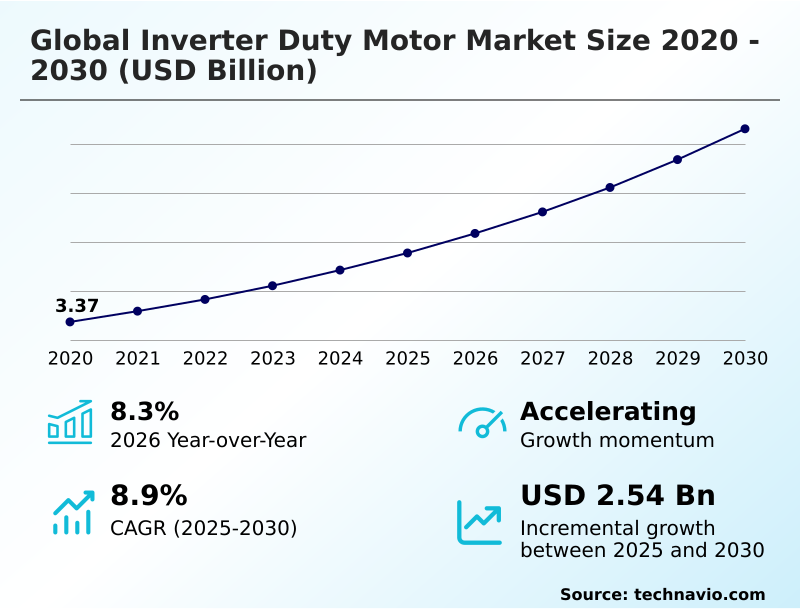
The inverter duty motor market size is valued to increase by USD 2.54 billion, at a CAGR of 8.9% from 2025 to 2030. Rising focus on energy efficiency regulations will drive the inverter duty motor market.
Major Market Trends & Insights
- North America dominated the market and accounted for a 35.8% growth during the forecast period.
- By Application - Pumps segment was valued at USD 1.74 billion in 2024
- By End-user - Oil and gas segment accounted for the largest market revenue share in 2024
Market Size & Forecast
- Market Opportunities: USD 3.95 billion
- Market Future Opportunities: USD 2.54 billion
- CAGR from 2025 to 2030 : 8.9%
Market Summary
- The Inverter Duty Motor Market is defined by a deep integration with the industrial motion control system and a relentless pursuit of energy efficiency. These specialized motors are engineered for variable frequency drive compatibility, featuring an enhanced motor insulation system to handle stresses from a non-sinusoidal voltage waveform, making them essential for applications requiring constant torque at low speed.
- A key driver is the global regulatory push for premium efficiency motor standards, compelling industries to upgrade. Consequently, designs incorporate advanced motor thermal management and an inter-laminar insulation coating to prevent premature failure.
- For example, a food processing motor application in a large-scale plant can achieve operational gains by retrofitting its lines with these motors, which feature predictive motor maintenance capabilities. This reduces energy consumption and minimizes downtime from issues like bearing current damage prevention.
- While initial investment for an integrated motor-drive package is higher, the long-term motor lifecycle cost is lower, making it a sound decision for any process industry motor.
What will be the Size of the Inverter Duty Motor Market during the forecast period?
Get Key Insights on Market Forecast (PDF) Request Free Sample
How is the Inverter Duty Motor Market Segmented?
The inverter duty motor industry research report provides comprehensive data (region-wise segment analysis), with forecasts and estimates in "USD million" for the period 2026-2030, as well as historical data from 2020-2024 for the following segments.
- Application
- Pumps
- Fans
- Conveyors
- Others
- End-user
- Oil and gas
- Chemicals
- Metal and mining
- Food and beverages
- Others
- Material type
- Laminated steel
- Cast iron
- Aluminum
- Geography
- North America
- US
- Canada
- Mexico
- APAC
- China
- India
- Japan
- Europe
- Germany
- France
- UK
- South America
- Brazil
- Argentina
- Middle East and Africa
- Saudi Arabia
- UAE
- Turkey
- Rest of World (ROW)
- North America
By Application Insights
The pumps segment is estimated to witness significant growth during the forecast period.
The pumps segment is central to the inverter duty motor market, driven by a global push for efficiency in fluid handling.
In industrial processes, operators achieve significant energy savings by using these motors with variable frequency drives to match pump speed to flow demand. For instance, a 20% reduction in pump speed can cut energy use by nearly 50%.
This capability is critical in water management and industrial applications. Modern solutions often feature an integrated motor-drive package and leverage electrical signature analysis for predictive motor maintenance.
This focus on an industrial motion control system with integrated motor diagnostics ensures reliable motor operation and supports demand for custom engineered motor designs with high power density motor configurations, optimizing lifecycle performance over initial cost.
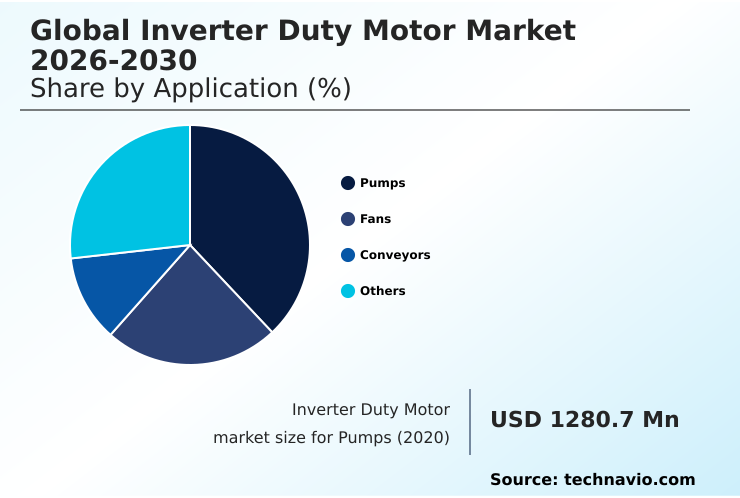
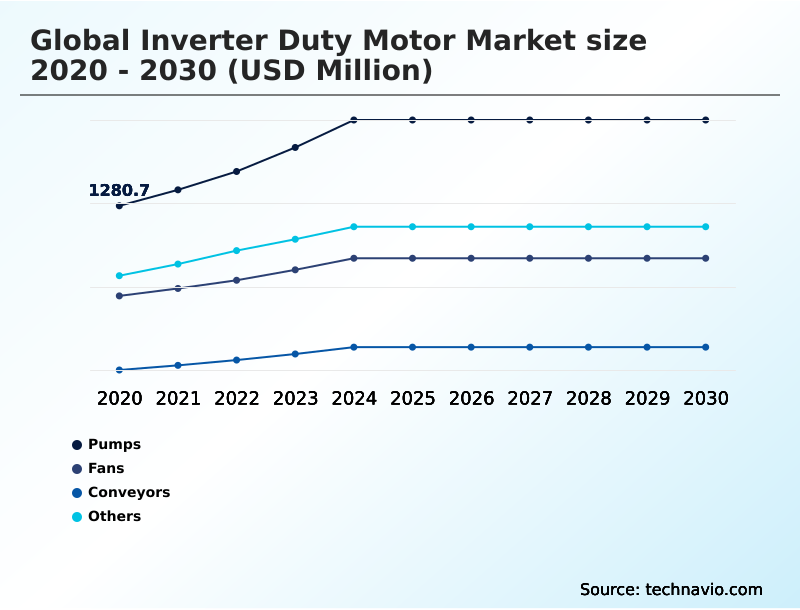
The Pumps segment was valued at USD 1.74 billion in 2024 and showed a gradual increase during the forecast period.
Regional Analysis
North America is estimated to contribute 35.8% to the growth of the global market during the forecast period.Technavio’s analysts have elaborately explained the regional trends and drivers that shape the market during the forecast period.

See How Inverter Duty Motor Market Demand is Rising in North America Request Free Sample
North America is projected to be a significant contributor to market growth, accounting for approximately 35.8% of the incremental expansion. This is driven by stringent energy regulations and the modernization of industrial infrastructure.
In sectors like oil and gas, the use of an oil and gas pump motor with an explosion-proof motor design is critical. The push towards higher efficiency in wastewater treatment motor applications and food processing motor systems also fuels demand.
Manufacturers are using high-grade electrical steel and advanced inter-laminar insulation coating on high dV/dt motor winding to meet flame-proof motor standards.
The region's focus on adopting high-performance motor winding technology in every process industry motor reinforces its leading position, with facilities reporting up to a 25% improvement in operational uptime after upgrading their motor systems.
Market Dynamics
Our researchers analyzed the data with 2025 as the base year, along with the key drivers, trends, and challenges. A holistic analysis of drivers will help companies refine their marketing strategies to gain a competitive advantage.
- Navigating the specifics of the Global Inverter Duty Motor Market 2026-2030 requires a deep dive into application-specific requirements. For example, selecting an inverter duty motor for high ambient temperature conditions demands different specifications than one for washdown environments.
- A frequent point of evaluation involves understanding the benefits of inverter duty motor vs standard motor, where the former offers superior performance under variable loads, reducing instances of troubleshooting inverter duty motor overheating. A critical specification is the inverter duty motor insulation class requirements, which dictate resilience against voltage spikes.
- For reliability, an inverter duty motor shaft grounding selection guide is essential to prevent premature inverter duty motor bearing failure analysis issues, often caused by the impact of long motor leads on inverter duty motors. In practical terms, these motors are fundamental to achieving precise control in constant pressure pump systems and material handling conveyor systems.
- Their use in HVAC air handler units and for variable torque applications showcases their versatility. The decision on how to select an inverter duty motor for extruders depends on torque needs, while comparing cast iron vs aluminum inverter duty motors involves a trade-off between durability and weight.
- The inverter duty motor total cost of ownership calculator often reveals that retrofitting standard motor with inverter duty motor yields a positive ROI, with some systems with an inverter duty motor with integrated encoder feedback achieving double the precision.
- NEMA premium inverter duty motor specifications and ensuring inverter duty motor compliance with energy regulations are non-negotiable for modern industrial facilities, especially those with a hazardous area classification.
What are the key market drivers leading to the rise in the adoption of Inverter Duty Motor Industry?
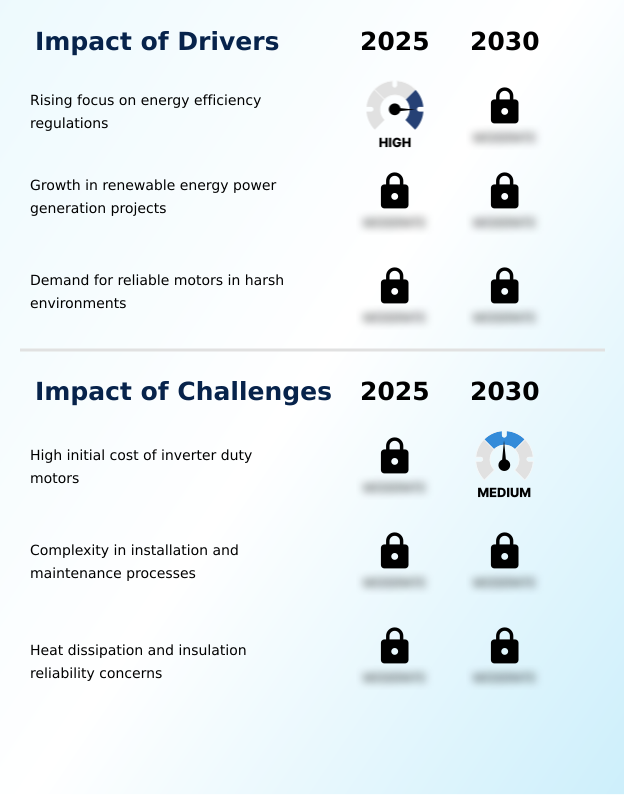
- A rising focus on stringent energy efficiency regulations worldwide is a key driver compelling industries to adopt advanced inverter duty motor technologies.
- The market is primarily driven by regulations mandating premium efficiency motor standards and the pursuit of lower operational expenditures.
- Analyzing motor lifecycle cost reveals that energy expenses constitute the vast majority of a motor's total cost of ownership motor, making efficiency a key investment criterion.
- The use of an industrial pump motor or conveyor system motor with variable speed control can reduce energy consumption by up to 50%.
- The underlying technology, including advanced rotor and stator core material and effective motor thermal management, mitigates the negative pulse width modulation effects.
- The adoption of shaft grounding ring technology has become crucial for reliability, decreasing drive-related bearing failures by more than 60% in applications like the HVAC fan motor, directly impacting maintenance budgets and uptime.
What are the market trends shaping the Inverter Duty Motor Industry?
- The rising adoption of inverter duty motors in industrial automation systems is emerging as a significant market trend. This is driven by the need for enhanced productivity, precision, and efficiency in modern manufacturing.
- The primary trend is the deepening integration of the industrial automation motor into smart manufacturing ecosystems. This evolution is driven by the need for a VFD-rated electric motor that offers not just an energy-efficient motor solution but also superior control and data generation.
- Modern motors feature an enhanced motor insulation system for high voltage spike resistance, ensuring reliability in a harsh environment motor application. This variable frequency drive compatibility allows for constant torque at low speed, a critical requirement in robotics and precision conveying, improving process consistency by over 15%.
- Furthermore, this advanced variable speed motor application reduces mechanical stress on equipment, extending asset life by up to 25% compared to fixed-speed alternatives.
What challenges does the Inverter Duty Motor Industry face during its growth?
- The high initial cost of inverter duty motors remains a key challenge, potentially slowing adoption for companies prioritizing short-term affordability over long-term operational savings.
- Despite clear benefits, the market faces challenges related to complexity and cost. A primary hurdle is the higher upfront investment for motors compliant with IE4 and IE5 efficiency classes, which can be a barrier for some operators. These motors are designed to handle a non-sinusoidal voltage waveform, which necessitates advanced engineering and materials.
- For a motor for hazardous location or a heavy industry electric motor, the design must also ensure bearing current damage prevention from phenomena like electrical discharge machining damage. Implementing a smart factory motor with intelligent motor control requires specialized skills, adding to initial setup costs.
- In some severe-duty motor application scenarios, retrofitting legacy systems presents integration complexities that can delay projects and inflate budgets by up to 20%.
Exclusive Technavio Analysis on Customer Landscape
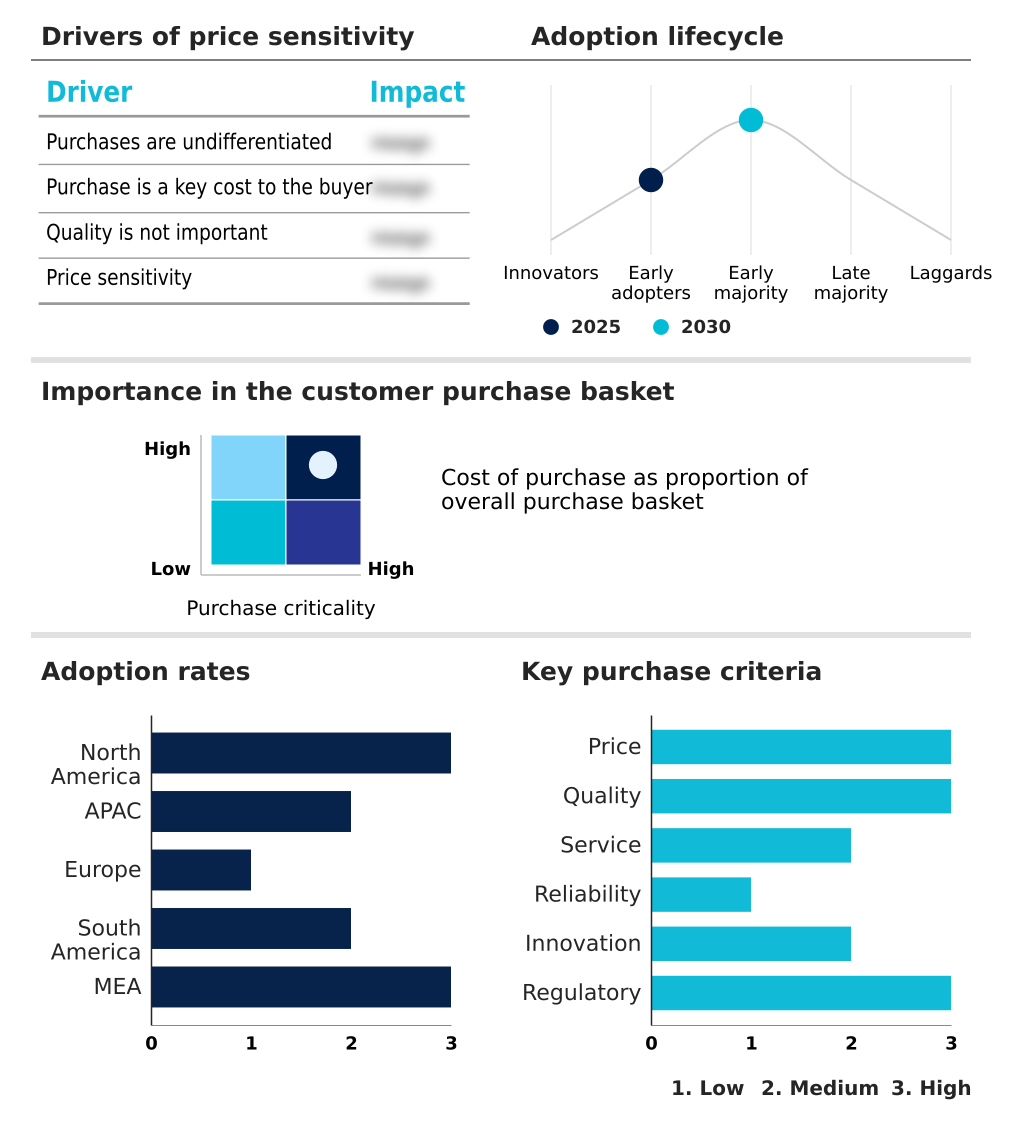
The inverter duty motor market forecasting report includes the adoption lifecycle of the market, covering from the innovator’s stage to the laggard’s stage. It focuses on adoption rates in different regions based on penetration. Furthermore, the inverter duty motor market report also includes key purchase criteria and drivers of price sensitivity to help companies evaluate and develop their market growth analysis strategies.
Customer Landscape of Inverter Duty Motor Industry
Competitive Landscape
Companies are implementing various strategies, such as strategic alliances, inverter duty motor market forecast, partnerships, mergers and acquisitions, geographical expansion, and product/service launches, to enhance their presence in the industry.
ABB Ltd. - Key offerings include AC inverter, vector duty, and RPM AC motors engineered for superior performance and reliability in demanding variable speed applications.
The industry research and growth report includes detailed analyses of the competitive landscape of the market and information about key companies, including:
- ABB Ltd.
- Adlee Powertronic Co. Ltd.
- Bison Gear And Engineering Co
- Bodine Electric Company
- Havells India Ltd.
- Megha Roto Tech Pvt. Ltd.
- Nidec Corp.
- Nord Gear Corp.
- Regal Rexnord Corp.
- Rockwell Automation Inc.
- SEW EURODRIVE
- Synchronics Electronics
- TECO-Westinghouse
- Toshiba Corp.
- WEG S.A
- Yaskawa Electric Corp.
Qualitative and quantitative analysis of companies has been conducted to help clients understand the wider business environment as well as the strengths and weaknesses of key industry players. Data is qualitatively analyzed to categorize companies as pure play, category-focused, industry-focused, and diversified; it is quantitatively analyzed to categorize companies as dominant, leading, strong, tentative, and weak.
Recent Development and News in Inverter duty motor market
- In September, 2024, WEG S.A. announced the acquisition of Volt Electric Motors in Turkey to enhance its market presence in Eastern Europe and the Middle East.
- In November, 2024, Nidec Corp. inaugurated a new manufacturing facility in Sri City, India, to address the growing regional demand for industrial motors.
- In January, 2025, ABB launched its Baldor-Reliance Food Safe SP5+ motor, an ultra-premium efficient model designed with advanced rotor technology for the food processing industry.
- In April, 2025, WEG S.A. disclosed significant investments to increase its low-voltage motor production capacity in Lissone, Italy, aiming to strengthen its European service levels.
Dive into Technavio’s robust research methodology, blending expert interviews, extensive data synthesis, and validated models for unparalleled Inverter Duty Motor Market insights. See full methodology.
| Market Scope | |
|---|---|
| Page number | 296 |
| Base year | 2025 |
| Historic period | 2020-2024 |
| Forecast period | 2026-2030 |
| Growth momentum & CAGR | Accelerate at a CAGR of 8.9% |
| Market growth 2026-2030 | USD 2542.2 million |
| Market structure | Fragmented |
| YoY growth 2025-2026(%) | 8.3% |
| Key countries | US, Canada, Mexico, China, India, Japan, South Korea, Australia, Indonesia, Germany, France, UK, Italy, Spain, The Netherlands, Brazil, Argentina, Chile, Saudi Arabia, UAE, Turkey, South Africa and Egypt |
| Competitive landscape | Leading Companies, Market Positioning of Companies, Competitive Strategies, and Industry Risks |
Research Analyst Overview
- The landscape for inverter duty motors is shaped by the convergence of automation and energy mandates. A core competency is variable frequency drive compatibility, which necessitates an enhanced motor insulation system capable of withstanding significant voltage spike resistance. The challenge of harmonic distortion mitigation is addressed through superior rotor and stator core material and advanced motor thermal management.
- Technologies like the shaft grounding ring technology are now standard for bearing current damage prevention, a common failure point stemming from electrical discharge machining damage. Adherence to premium efficiency motor standards, including NEMA premium efficiency levels and the stringent IE4 and IE5 efficiency classes, is no longer optional.
- These motors are designed to operate on a non-sinusoidal voltage waveform without degradation, a result of robust high dV/dt motor winding and the use of high-grade electrical steel with a resilient inter-laminar insulation coating. The market offers explosion-proof motor design and models meeting flame-proof motor standards, often delivered as an integrated motor-drive package.
- As part of an industrial motion control system, these motors leverage electrical signature analysis for predictive motor maintenance, with some industrial operators reporting a 30% reduction in unplanned downtime.
What are the Key Data Covered in this Inverter Duty Motor Market Research and Growth Report?
-
What is the expected growth of the Inverter Duty Motor Market between 2026 and 2030?
-
USD 2.54 billion, at a CAGR of 8.9%
-
-
What segmentation does the market report cover?
-
The report is segmented by Application (Pumps, Fans, Conveyors, and Others), End-user (Oil and gas, Chemicals, Metal and mining, Food and beverages, and Others), Material Type (Laminated steel, Cast iron, and Aluminum) and Geography (North America, APAC, Europe, South America, Middle East and Africa)
-
-
Which regions are analyzed in the report?
-
North America, APAC, Europe, South America and Middle East and Africa
-
-
What are the key growth drivers and market challenges?
-
Rising focus on energy efficiency regulations, High initial cost of inverter duty motors
-
-
Who are the major players in the Inverter Duty Motor Market?
-
ABB Ltd., Adlee Powertronic Co. Ltd., Bison Gear And Engineering Co, Bodine Electric Company, Havells India Ltd., Megha Roto Tech Pvt. Ltd., Nidec Corp., Nord Gear Corp., Regal Rexnord Corp., Rockwell Automation Inc., SEW EURODRIVE, Synchronics Electronics, TECO-Westinghouse, Toshiba Corp., WEG S.A and Yaskawa Electric Corp.
-
Market Research Insights
- The market's momentum is fueled by a strategic shift toward intelligent manufacturing, where operational efficiency is paramount. The adoption of an energy-efficient motor solution can reduce energy consumption by up to 50% in variable torque applications, directly improving a firm's bottom line.
- Furthermore, the integration of a VFD-rated electric motor in production lines enhances process control, with some systems reporting a 15% increase in output consistency. The focus on total cost of ownership motor analysis over initial purchase price is becoming standard practice.
- For a harsh environment motor application, reliable motor operation is critical, and these specialized motors deliver superior performance, with failure rates nearly 40% lower than standard motors under similar variable speed conditions. This shift underscores the value of investing in specialized technology for long-term industrial resilience.
We can help! Our analysts can customize this inverter duty motor market research report to meet your requirements.